

Imagine your most sensitive data wrapped in an unbreakable shield—ISO 27001 lays out the blueprint for that protection. Small businesses across Australia are adopting this framework to lock down their information and satisfy ever-toughening regulations. In this long-form guide, we dive deep into every aspect of the 27001 certification journey, from initial planning to leveraging certification for growth.
Getting Started With 27001 Certification
Think of an ISMS as a security routine you repeat daily. It’s more than a policy manual—it’s a living system of checks and balances. As cyber threats mutate and compliance bars rise, ISO 27001 certification isn’t optional. It’s a statement of commitment to data safety and risk management excellence.
Key drivers for going through the certification process include:
- Building a risk-driven framework that guards customer and financial records
- Showing due diligence to partners, regulators and insurers
- Meeting legal obligations, like the Australian Privacy Principles
- Embedding continuous improvement through regular audits
In Australia, ISO 27001 has morphed into a benchmark for any organisation serious about data safety. The 2013 version gave way to the 2022 framework, and you’ve got until 31 October 2025 to make the switch. Discover more on ISO 27001’s local impact in 2025 over at IQC Global.
Embedding ISO 27001 into daily operations turns security into a team habit, not a one-time project.
The screenshot below shows the ISO/IEC 27001 standard layout on Wikipedia.
This image highlights how the standard organises clauses for systematic ISMS implementation.
Key Elements of 27001 Certification
Below is a quick snapshot of what matters most when you’re planning your certification journey.
| Element | Detail |
|---|---|
| Definition | International standard for ISMS requirements |
| Objectives | Protect data, manage risk and ensure ongoing improvement |
| Industries | Government, ICT, data centre hosting and other sectors |
| Deadline | Transition to ISO 27001:2022 required by 31 October 2025 |
With these core elements mapped out, you’ll know exactly what to prioritise as you move forward. Check out our guide on how to get ISO 27001 certified for step-by-step instructions.
How To Begin
Treat your ISMS like a safety net under a high-wire act: you plan, test and adjust. Start with these steps:
- Assemble Your Team: Identify key stakeholders—executive sponsor, IT lead, compliance officer.
- Define Scope: Pinpoint the assets, processes and locations your ISMS will cover.
- Allocate Resources: Secure budget for consultancy, tools and training.
- Conduct a Gap Analysis: Compare current practices against ISO 27001 clauses.
- Draft Policies: Develop high-level information security policy and specific procedures.
- Engage Certification Body: Select an accredited auditor early to clarify requirements.
Once you’ve ticked off these basics, your team can dive into detailed policy writing, control setup and internal audit planning. Below, we explore the PDCA cycle to keep improvements rolling.
Understanding ISO 27001 Key Concepts

Imagine tuning a high-performance engine. You wouldn’t overhaul every part at once—you’d adjust, test and refine step by step. That’s exactly how the Plan-Do-Check-Act cycle powers an ISMS. It keeps everything moving smoothly, pinpoints weak spots and drives continuous improvement.
Plan-Do-Check-Act Cycle
- Plan:
- Define scope, objectives and risk criteria.
- Identify stakeholders and allocate roles/responsibilities.
- Gather data on existing processes, assets and threat landscape.
- Do:
- Implement risk treatment plan: deploy controls, conduct training and document procedures.
- Launch awareness campaigns to embed security culture.
- Record implementation evidence—checklists, screenshots, logs.
- Check:
- Monitor key performance indicators (KPIs) via dashboards and reports.
- Conduct internal audits and management reviews.
- Compare actual performance against planned objectives.
- Act:
- Analyse audit findings and incident reports.
- Refine policies and update risk assessments.
- Plan enhancements for the next cycle.
“A well-tuned ISMS resembles a finely tuned race car; every component works in harmony to prevent undesired failures.”
Risk Assessment And Annex A Controls
At its core, risk assessment under ISO 27001 spots threats and vulnerabilities demanding attention. It’s a three-step process:
- Asset Identification: Catalogue critical assets—data, servers, networks.
- Threat Analysis: Pinpoint potential threats from ransomware to insider error.
- Impact Estimation: Gauge potential costs, reputational damage and operational disruption.
Use a risk matrix to score each risk by likelihood and impact. Once risks are mapped, Annex A controls help you choose safeguards.
| Control Category | Real-World Analogy | Example Controls |
|---|---|---|
| Access Control | Smart key entry system | MFA, role-based permissions, session time-outs |
| Cryptography | Engine immobiliser | AES encryption, key management policies |
| Physical Security | Crash-resistant chassis | CCTV, badge access, locked cabinets |
| Communications | Secure radio channels | VPNs, TLS email encryption |
Linking controls to analogies makes them easier to understand—and far more memorable.
Applying PDCA In Practice
Consider a small marketing agency embedding PDCA into their weekly rhythm:
- Quarterly Plan: Update risk register and redefine priorities based on market shifts.
- Monthly Do: Roll out new controls—two-factor authentication, secure remote access.
- Weekly Check: Spot audits on access logs and document changes.
- Annual Act: Leadership review to adjust policies, resource allocation and training focus.
This structured cadence weaves security into everyday operations, no matter your industry or team size.
ISMS Core Components
An effective ISMS relies on interlocking elements that cover people, processes and technology:
- Policies and Procedures:
- Information security policy, access control procedures, incident response plan.
- Revision cycle and document control.
- Leadership Commitment:
- Executive sponsorship, steering committee, charter for ISMS.
- Training and Awareness:
- Tailored programs—phishing simulations, secure coding workshops.
- Monitoring and Metrics:
- SIEM dashboards, vulnerability scanning reports, KPI scorecards.
- Incident Management:
- Incident classification, communication protocols, forensics and root-cause analysis.
- Continuous Improvement:
- Corrective/preventive actions, management reviews, feedback loops.
Together, these building blocks form a robust framework that protects your organisation’s most vital information.
Why 27001 Certification Matters For Small Businesses
Small teams can feel that high security standards are reserved for big players. Yet, earning ISO 27001 certification delivers real advantages, no matter your size. It shrinks the risk of data breaches and strengthens your reputation in the marketplace.
In Australia, we’ve seen over 94 000 cybercrime reports in the past year—an increase of 23%. This sharp rise is driving more small firms to explore tailored ISO 27001 programmes. Learn more in the Australian Cyber Security Centre report. Clearly, a solid ISMS is no longer optional—it’s vital for keeping pace with evolving threats.
Building Trust With Customers
Certification sends a powerful signal: you take data protection seriously. That reassurance not only builds confidence, it often turns into longer contracts and better renewal rates.
- Risk Reduction: Consistent safeguards help avoid fines and minimise downtime.
- Procurement Eligibility: Meeting supplier security criteria unlocks more tender opportunities.
- Competitive Edge: ISO 27001 becomes a clear differentiator in bids.
“Small businesses with ISO 27001 often win bids over larger rivals thanks to proven security practices.”
Use your certificate in proposals, website badges and email signatures to amplify trust.
Level Playing Field For Small Teams
Without dedicated security staff, small operations can feel overwhelmed. Think of ISO 27001 as a scaffold: it guides you through each stage of your security journey.
- Define Scope: Map critical data and draw clear ISMS boundaries.
- Conduct Risk Assessment: Pinpoint threats and gauge their impact.
- Select Controls: Pick Annex A safeguards that align with your risks.
- Document Processes: Keep procedures simple so your team can follow them every day.
Following this roadmap, even lean teams deliver strong security without hiring extra hands.
Turning Certification Into Growth
ISO 27001 isn't just a shield—it can unlock new business too. Some Australian firms report contract wins up to 70% higher after certification.
“Certificate status gave us credibility in competitive tenders and boosted revenue by 25%.”
To harness this potential:
- Secure Leadership Buy-In: Get top-level support for budget and awareness.
- Automate Controls: Deploy user-friendly tools for logging and monitoring.
- Review Regularly: Schedule internal audits and use feedback to refine processes.
By weaving continuous improvement into your ISMS, each milestone paves the way for growth.
Partnering With Experts
Bringing in experienced consultants can accelerate your journey. Anitech provides hands-on support from initial documentation to audit readiness.
- Policy Development: Craft clear policies aligned with ISO 27001 clauses.
- Training Workshops: Build your team’s ISMS know-how.
- Internal Audits: Run dry-runs of certification audits to spot gaps early.
- Certification Guidance: Navigate the maze of auditors and applications.
With expert help, you stay focused on your core business while ticking every certification box.
Next Steps For Certification
Start by running a simple gap analysis to see where you stand. Then, assemble a team or engage a consultant to draft policies and apply controls. Inviting an external auditor early helps you fine-tune before the official audit.
- Prepare Evidence: Keep records of policies, risk assessments and training logs.
- Engage Staff: Define ISMS roles so everyone knows their responsibility.
- Review Outcomes: Use auditor feedback to evolve your ISMS continuously.
Adopting this proactive stance ensures your ISMS adapts to emerging threats and opportunities.
Investing in ISO 27001 today secures your digital future and boosts business resilience.
Contact Anitech to begin your ISO 27001 journey and level up your security credentials.
Visit Anitech for guidance and real-world support.
Start your certification today.
Implementing Required Controls And Risk Management
Zeroing in on your biggest vulnerabilities starts with a solid risk assessment. For small businesses, this phase uncovers weak spots in systems, processes and data assets before you choose any safeguards.
Think of your network as a home: firewalls become sturdy locks, intrusion detection systems act like alarms, and encryption works as ever-watchful cameras.
Risk Assessment Process
To keep things manageable, divide your audit into three clear steps:
- Asset Inventory: Catalogue every piece of hardware, software and data store.
- Threat Identification: Pinpoint internal slip-ups or external attacks that could cause harm.
- Risk Analysis: Score each risk by likelihood and potential impact to set priorities.
Use risk assessment tools or spreadsheets to record findings, risk owners, deadlines and mitigation plans.
“A clear risk register turns unknowns into action items that teams can tackle systematically.”
Once you have a risk register, you’ll avoid feeling swamped. Next, map each finding to the relevant Annex A controls.
Mapping Controls To Vulnerabilities
Matching risks to controls is like installing the right security measures around a house. If a window—say, remote access—is vulnerable, add multi-factor authentication. If the server room door looks flimsy, fit it with CCTV or a locked cabinet.
Below, you’ll find a concise guide to some key Annex A domains alongside practical examples.
| Control Category | Example Controls |
|---|---|
| Access Control | Multi-factor authentication for remote connections |
| Cryptography | AES encryption for data at rest |
| Physical And Environmental Security | Locked server cabinets and CCTV in data centre |
| Communications Security | Secure VPN tunnels and email encryption |
By linking each domain to tangible controls, you turn theory into a straightforward action plan.
This snapshot from ISO illustrates how clauses interlock to form a robust Information Security Management System (ISMS). Seeing the architecture laid out helps you decide which tasks to tackle first.
Implementing And Documenting Controls
Once the mapping is clear, cement your approach with well-written policies and procedures. Follow these 4 steps:
- Assign Responsibilities: Specify control owners and decision authorities.
- Draft Policies: Access rules, encryption standards, user permissions—versioned and approved.
- Record Procedures: Store step-by-step guides in an ISMS manual or secure digital workspace.
- Train Staff: Conduct workshops and tests so everyone knows their part and can spot gaps early.
This level of documentation not only guides your team but also serves as vital audit evidence. Plus, automated logs give you 24/7 visibility into how controls perform in real time.
As part of your risk management, it’s crucial to assess cybersecurity considerations for emerging technologies like AI tools. This step ensures fresh tech doesn’t introduce blind spots into your ISMS.
Ready to dive in? Grab our detailed template for a head start on your risk assessment and documentation.
Continuous Monitoring And Improvement
An ISMS is never truly “set and forget.” Schedule periodic reviews to keep controls sharp. Automated monitoring platforms—such as SIEM systems—act like motion sensors, flagging odd behaviour the moment it happens.
- Regular Penetration Tests: Conduct every six months to confirm controls remain effective.
- Ongoing Audits: Rotate internal audits quarterly to catch emerging gaps.
- Management Reviews: Present concise risk and performance reports to leadership at least once a year.
By weaving these activities into daily routines, you build a living security culture. As your business evolves and threats shift, you’ll stay resilient, audit-ready and confident that every “window” is locked.
Measuring Business Impact Of 27001 Certification
ISO 27001 isn’t just about ticking boxes. For a small business, it can become the engine that drives operational efficiency, trims costs and bolsters your reputation.
Globally, the ISO 27001 certification market sits at USD 18.59 billion in 2025. By 2035, it’s forecast to hit USD 74.56 billion, growing at a 15.2% CAGR. Down under, many Aussie SMBs report a 70% uplift in partnership opportunities once they demonstrate robust data protection. Discover more insights about the ISO 27001 market forecast.
Key Metrics To Track
- Operational Resilience: Downtime reduction, mean time to recover (MTTR).
- Cost Savings: Breach remediation costs, insurance premiums.
- Partnership Wins: New contracts, procurement success rates.
- Reputation Score: Customer feedback, Net Promoter Score (NPS).
- Contract Value Growth: Average deal size before vs. after certification.
Think of resilience like a car’s shock absorbers—it smooths out the bumps so you keep moving forward.
Setting Measurable Goals
- Define Baseline Metrics: Note your current incident frequency and response times.
- Align With Business Objectives: Link security wins to revenue targets or cost-cutting goals.
- Establish Targets: Aim for realistic improvements—say, a 20% cut in response time.
- Review Periodically: Schedule quarterly check-ins to track progress.
- Adjust Strategy: Tweak controls based on collected data.
Quantifying intangible gains—like client confidence or smoother audits—adds real depth to your financial story.
“ISO 27001 certification boosted our credibility and led to partnerships three times faster than before.”
– CFO, Adelaide Startup
Comparing Pre And Post Metrics
| Metric | Pre-Certification | Post-Certification |
|---|---|---|
| Downtime per month | 4 hours | 1.5 hours |
| Breach costs per year | $60 000 | $15 000 |
| New contracts per quarter | 2 | 4 |
This snapshot shows how a simple before-and-after can reveal powerful improvements—and justify further investment.
Analysing Cost Savings Over Time
Tracking your savings year on year uncovers the true return on certification.
- Insurance Premiums: Drop from $12 000 to $9 000 in year two.
- Incident Remediation: Average cost per incident falls by 60%.
- Audit Preparation: Staff hours saved through templated evidence.
- Vendor Negotiations: Better supplier terms realized.
- Staff Productivity: Fewer security disruptions on the calendar.
These figures often hide in plain sight until you begin measuring.
Integrating Insights Into Strategy
- Report Findings: Share clear metrics with your board and investors.
- Budget Adjustments: Funnel resources into high-impact controls.
- Refresh Goals: Set new benchmarks after each review cycle.
By weaving measurement into your ISMS, you create a compelling story for ongoing security investment and continuous improvement.
Success Story Spotlight
A Perth-based retailer adopted ISO 27001 in 2023 to protect customer data and streamline workflows. In just six months:
- Incident resolution time fell from 72 to 24 hours.
- Procurement approvals jumped by 50%.
These wins show how focused measurement and transparent reporting can turn ISO 27001 from a cost centre into a genuine revenue driver. Learn more about the ROI of cyber security in our article on investing in protection benefits your bottom line: Investing in Protection Benefits Your Bottom Line
Navigating The 27001 Certification Journey
Embarking on ISO 27001 certification can feel like venturing into uncharted waters. You know there’s a destination, but the path seems murky. With clear milestones, those vast oceans become a series of manageable legs.
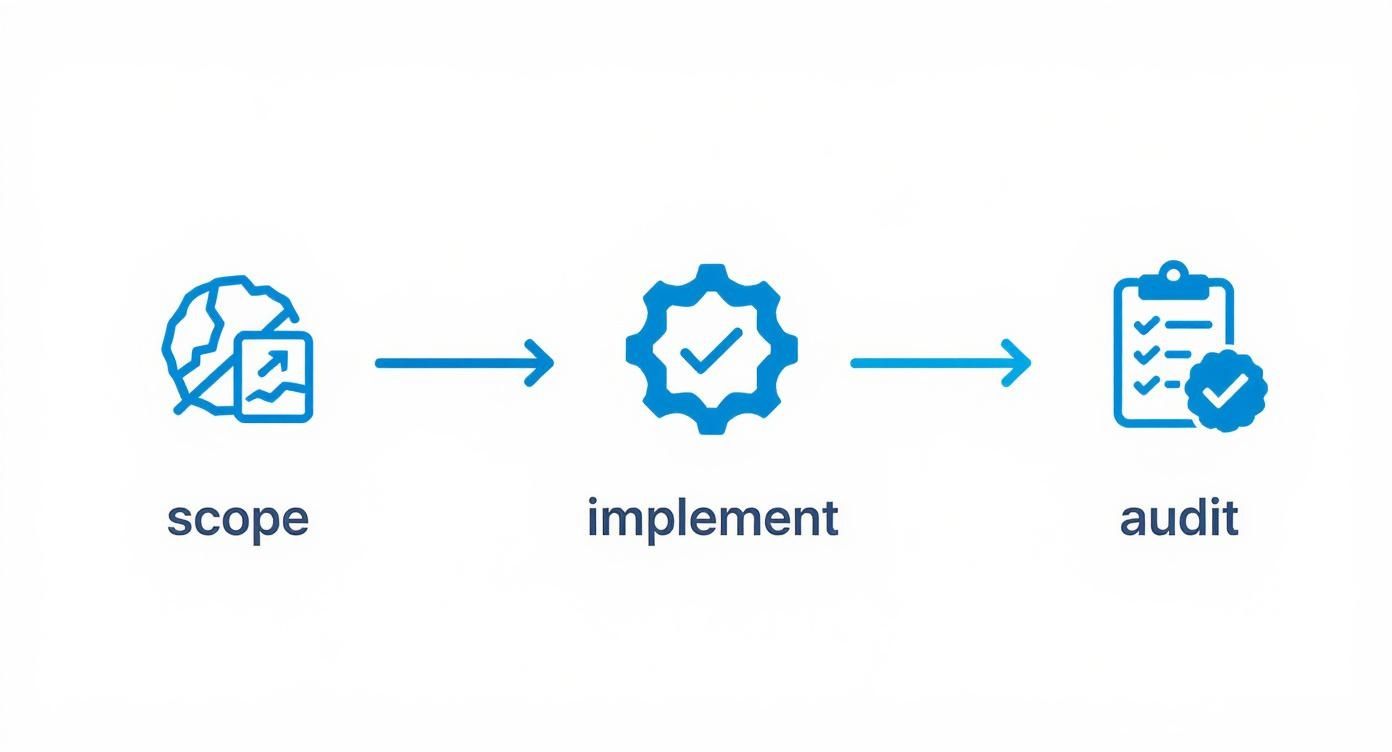
Our guide walks lean teams through three critical stages: scoping, gap analysis, then controls and audits. Each phase builds momentum, ensuring you hit every mark without getting lost.
- ISMS Scope is your ship’s hull, protecting core data from external threats.
- Gap Analysis serves as a navigational chart, highlighting weak spots.
- Controls and Audits function like routine crew drills, guaranteeing readiness.
Preparing Your ISMS Scope
Draft a concise scope statement that outlines what’s in and what sits outside your ISMS boundary. Note every location, device and information flow to create a precise roadmap. Treat this as a living document that informs all future steps in your certification journey.
- Include: Physical sites, cloud services, third-party processors.
- Exclude: Out-of-scope functions—e.g., personal email systems.
- Review: Update scope when entering new markets or launching services.
Conducting Gap Analysis And Policy Drafting
Once you have your ISMS scope, it’s time for a gap analysis followed by policy drafting. Picture it like scanning the horizon for hidden obstacles then crafting protocols to keep your crew safe.
- List All ISO 27001 Clauses and map them to your existing processes.
- Rate Gap Severity by potential impact on your security posture.
- Prioritise High-Risk Actions so you tackle the most critical gaps first.
- Draft Policies: Use plain language, include roles/responsibilities, reference Annex A controls.
- Workshop Reviews: Gather feedback from IT, HR, legal and operations.
To see the entire process at a glance, take a look at the infographic below. It visualises core stages of the certification path in a simple left-to-right flow.
Implementing Controls And Running Internal Audits
Think of installing controls as strapping on safety gear for a dive. Assign clear ownership for each control so nothing slips through the cracks. Then, treat internal audits like crew inspections: your chance to spot and fix issues before an external assessor arrives.
“Continuous internal audits keep your ISMS shipshape and ready for external assessment.”
- Schedule Quarterly Audits: Use checklists mapped to ISO 27001 clauses.
- Log Findings: Assign actions, due dates and status updates in a tracking tool.
- Follow Up: Verify corrective actions are implemented and effective.
- Automate Where Possible: GRC platforms, audit management software, Power BI dashboards.
To successfully complete your journey, a detailed understanding of the ISO 27001 certification process is essential.
Preparing For External Audit
With internal checks in place, prepare for the external audit. Your goal is to make it seamless for the assessor to see your work.
- Compile Evidence Package: Policies, risk register, training records—clearly labelled with versions and dates.
- Schedule Auditor Interviews: Let staff know their roles and rehearse answers.
- Conduct Mock Audits: Engage a third party or use internal resources to simulate the audit.
- Verify Scope Alignment: Ensure physical and digital assets match the declared scope.
- Prepare Meeting Agenda: Outline key milestones, recent improvements and continuous improvement plans.
On audit day, stay transparent and treat any nonconformities as opportunities to refine your ISMS. Promptly implement corrective actions and update your documents.
Achieving ISO 27001 certification marks a milestone, not an endpoint. It’s the launchpad for continual refinement.
After certification, embed the PDCA cycle to keep your ISMS evolving:
- Annual Scope Review: Adjust for business growth or market changes.
- Ongoing Training: Update sessions when policies change or new threats emerge.
- Surveillance Audits: Prepare quarterly status reports for certification bodies.
By charting this step-by-step journey, even small, focused teams can secure and sustain ISO 27001 certification. Stay proactive and your ISMS will serve as a lasting strategic asset.
Frequently Asked Questions
Tackling ISO 27001 often sparks a few key questions for small business leaders. Below are clear, pragmatic answers to help you navigate with confidence.
What Is The Typical Timeframe For Certification?
The journey usually spans 6 to 12 months:
- Microteams with existing governance: ~6 months.
- Larger scopes or complex operations: up to 18 months.
Set clear milestones from day one and review progress weekly.
How Much Will It Cost?
Costs vary by team size and scope. Expect initial consultancy fees of AUD 10 000–15 000 for a small setup. Key cost drivers include:
- Gap analysis and scope definition
- Policy development
- Internal and external audit fees
- Training programmes
- Technology tools (GRC, SIEM)
“Budget realistically for 15–20% of your annual IT budget to cover all phases.”
Integration With Other Frameworks
Many organisations map ISO 27001 to NIST, ISO 22301 (BCMS), ISO 9001 (QMS) or GDPR. Benefits include:
- Streamlined Audits: Shared controls and documentation.
- Holistic Risk Management: Single risk register for multiple standards.
- Cost Efficiency: Leverage existing processes and tools.
Use a cross-reference matrix to link clauses between standards.
How Do I Manage Cloud Services And Remote Work?
- Cloud Provider Assessment: Review SLA, ISO 27017/27018 certifications.
- Remote Access Controls: Enforce VPN, MFA and endpoint protection.
- Policy Updates: Amend BYOD, home working and data transfer procedures.
- Awareness Campaigns: Train staff on secure video conferencing and phishing risks.
Strategies For Maintaining Certification
After passing the audit, embed ISO 27001 into everyday operations:
- Internal Audits: Quarterly to detect emerging gaps.
- Management Reviews: Biannual reassessments of risk and resource needs.
- Policy Revisions: Triggered by major incidents or business changes.
- Monitoring Tools: Automated alerts for unusual activity.
Consistent reviews turn compliance into habit, not a one-off push.
Ready to secure your data with expert guidance? Contact Anitech today and take the next step in your 27001 certification journey.
Recent Comments