

When you hear about cybersecurity, what's the first thing that comes to mind? For many, it's a complex, ever-changing world of threats and vulnerabilities that seems almost impossible to manage. That’s precisely where the ACSC Essential Eight comes in. It’s a set of no-nonsense, prioritised security strategies straight from the Australian Cyber Security Centre (ACSC), the nation's leading authority on cyber threats. Think of it as a baseline defence blueprint, a foundational guide designed to help Australian businesses protect themselves against the most common and damaging cyber attacks by focusing on eight critical, evidence-based controls. It cuts through the noise and gives organisations a clear, actionable path to dramatically improve their resilience.
Your Digital Fortress: The Essential Eight Explained

In today's deeply connected world, your data, intellectual property, and digital assets are every bit as valuable as your physical ones, if not more so. You wouldn’t dream of leaving your office unlocked overnight with the keys in the door, so why would you leave your digital front door swinging wide open for any opportunistic cybercriminal? The ACSC Essential Eight is a battle-tested, expertly crafted blueprint for building a formidable cyber fortress around your entire business operation.
It's crucial to understand that this isn't about installing one single, magical piece of software or a powerful firewall. It’s a complete, multi-layered security system—a strategic combination of reinforced digital doors, vigilant security cameras, a blaring alarm system, and strict, enforced access protocols, all working together in a cohesive strategy. Developed by the experts at the Australian Cyber Security Centre (ACSC), this framework isn't just about ticking boxes for compliance audits. It’s laser-focused on implementing the most effective, high-impact strategies to shield you from the real-world attacks that businesses face every single day.
This kind of proactive, structured thinking is no longer an optional extra for the tech-savvy; it's a fundamental cost of doing business in the modern economy. The threat of a cyber incident isn't a distant 'what if' scenario; it's a daily, persistent reality for businesses of all sizes, all over the country.
A Wake-Up Call for Australian Businesses
The urgent need for robust, standardised frameworks like the Essential Eight became frighteningly clear in late 2022. Australia was rocked by a dramatic and alarming wave of high-profile data breaches, exposing just how vulnerable many organisations were and how serious the national cybersecurity crisis had become. This series of incidents served as a massive, unavoidable wake-up call that pushed many businesses to finally abandon their ad-hoc security measures and adopt more robust, structured security frameworks.
During the last quarter of 2022, the number of individuals affected by data breaches in Australia shot up by an incredible 489 percent compared to previous periods. On top of that, the Australian Information Commissioner's report on Notifiable Data Breaches revealed that 40 large-scale breaches occurred in just the second half of the year—a staggering 26 percent increase from the first six months. These weren't minor incidents; they were significant compromises of personal and sensitive information, affecting millions of Australians.
This explosion in malicious activity proved one thing beyond a shadow of a doubt: a basic firewall and off-the-shelf antivirus software just don't cut it anymore. Businesses of all sizes need a structured, layered, and proven defence strategy to survive and thrive in today's hostile digital environment.
From Baseline to Hardened: The Maturity Levels
One of the most valuable and practical aspects of the Essential Eight is its structured approach to implementation through Maturity Levels. This model acknowledges the reality that you can't build an impenetrable digital fortress overnight. Instead, it provides a clear, logical, and step-by-step pathway to progressively strengthen your security posture over time, allowing for a manageable and resource-aware implementation.
The ACSC defines these levels to help businesses accurately assess where they currently stand and what realistic goals they should aim for next.
-
Maturity Level One (ML1): This is your foundational layer. It's specifically designed to protect against adversaries who are just using common, widely available tools and techniques. These are often opportunistic attackers looking for low-hanging fruit. Hitting ML1 provides a huge boost in resilience against these opportunistic, low-level threats and significantly raises the bar for any would-be attacker.
-
Maturity Level Two (ML2): At this level, your defences become significantly tougher and more resilient. ML2 is about protecting your organisation against more skilled and determined adversaries—those who are willing to put in more time, effort, and resources to bypass your initial security controls. They are more targeted, more persistent, and more adept at identifying and exploiting weaknesses.
-
Maturity Level Three (ML3): This represents the top tier of protection within the framework, offering a robust defence against highly sophisticated and determined adversaries. These attackers are often well-resourced, potentially state-sponsored, and use advanced, bespoke tools and methods to achieve their objectives. ML3 is typically the target for government agencies, organisations that manage critical national infrastructure, or those handling highly sensitive and valuable data.
The key takeaway isn't to aim blindly for Maturity Level Three from day one. The framework is built around a risk-based approach. You should choose a target maturity level that actually makes sense for your specific risk profile, the type and value of the data you are protecting, and what your team can realistically implement and manage.
For the vast majority of small to medium-sized businesses, even achieving a solid, well-maintained Maturity Level One is a massive security victory that places them far ahead of their peers. As your business grows, evolves, and your risk landscape changes, you can then map out a strategic journey toward the higher maturity levels. Understanding the wider cybersecurity industry provides valuable context for this journey, which involves a holistic combination of technology, processes, and people. For more detail, you can check out our guide on strengthening information security practices for Australian businesses. By starting with the Essential Eight, you're laying the critical groundwork for a secure, resilient, and prosperous future.
Breaking Down Each Essential Eight Mitigation Strategy

Okay, let's move from the high-level theory to the frontline of your digital defence. To truly appreciate the power and elegance of the ACSC Essential Eight, we need to dig deep and understand what each of these eight mitigation strategies actually does. Think of them as individual layers of armour plating on a battleship. While they are undoubtedly strongest when used together as a complete system, each control has a very specific and critical job, designed to shut down the common attack vectors and methods that cybercriminals exploit every single day.
It's time to unpack these eight core strategies in detail. We'll look at how they function as indispensable pieces of your business's cyber defence shield and, more importantly, the exact threats they are specifically designed to stop. This is your practical, hands-on guide to building a truly resilient and defensible security posture from the ground up.
To give you a quick overview, here's how the eight strategies fit together, what they aim to achieve, and the common threats they are proven to shut down.
The ACSC Essential Eight Mitigation Strategies at a Glance
| Mitigation Strategy | Primary Goal | Common Threats Prevented |
|---|---|---|
| 1. Application Control | Prevent unauthorised and malicious software from running on your systems. | Ransomware, malware execution, malicious scripts, unauthorised tools. |
| 2. Patch Applications | Close known security holes in software like browsers, Office, and other applications. | Exploitation of known software vulnerabilities, drive-by-downloads. |
| 3. Configure Microsoft Office Macro Settings | Block a historically common and highly effective malware delivery method. | Phishing attacks, macro-based malware, malicious document droppers. |
| 4. User Application Hardening | Reduce the potential attack surface by disabling risky or unnecessary features. | Malvertising, browser-based exploits, zero-day attacks, file-based attacks. |
| 5. Restrict Administrative Privileges | Limit the potential damage an attacker can do if they gain initial access. | Lateral movement, data exfiltration, system-wide compromise, privilege escalation. |
| 6. Patch Operating Systems | Secure the foundational software of your computers, servers, and network devices. | Exploitation of OS vulnerabilities, worm-like attacks, remote code execution. |
| 7. Multi-Factor Authentication | Protect user accounts and sensitive data even if passwords are stolen or compromised. | Account takeover, phishing, credential stuffing, password spray attacks. |
| 8. Regular Backups | Ensure you can recover your data and systems from a major incident like ransomware. | Data loss from ransomware, hardware failure, accidental deletion, insider threats. |
Each one of these strategies represents a crucial defensive layer that addresses a specific stage of a typical cyber attack. Now, let's explore exactly what’s involved in putting each one into practice effectively.
1. Application Control
Think of application control as a strict but fair bouncer standing at the door of your company's digital office. It operates on one simple, powerful rule: if a program isn't on the pre-approved guest list, it doesn't get in. Period. This is, without a doubt, one of the single most effective security controls for stopping malware dead in its tracks before it can even execute.
Most ransomware, spyware, and other nasty programs—like malicious .exe files, PowerShell scripts, and dodgy installers downloaded from the internet—are, by their very nature, unauthorised. By implementing a ‘default-deny’ security posture where only approved and vetted applications are allowed to run, you block them automatically before they can do any damage whatsoever.
This fundamentally shifts your security from being reactive (detecting and cleaning up a mess after the fact) to being proactive (preventing the mess from ever happening in the first place). For any organisation, this is a genuine game-changer that drastically shrinks the playground available for attackers to operate in.
2. Patch Applications
Leaving your business software unpatched is the digital equivalent of knowing your front door has a broken lock and just hoping for the best. It's an open invitation for trouble. Hackers and automated scanning tools are constantly on the lookout for these known vulnerabilities in everyday programs—web browsers, PDF readers, office productivity software, and collaboration tools are all prime targets.
Patching on time closes these security gaps before criminals can discover and squeeze through them. The ACSC is very clear and prescriptive on this point: vulnerabilities that are rated as ‘extreme risk’ must be patched within 48 hours of the patch being released. This isn't an arbitrary number; it's a direct response to how quickly attackers move to weaponise and exploit newly discovered flaws.
And this goes beyond just applying security updates. It’s also about having a robust asset management process to ensure you’re always using the latest, vendor-supported versions of your software so you continue to receive critical protection. To really get a handle on this, you can learn more about the cybersecurity importance of regular software updates in our detailed guide.
3. Configure Microsoft Office Macro Settings
Microsoft Office macros—those small scripts that automate repetitive tasks in documents like Word and Excel—have a dark and notorious history. For years, they've been a favourite delivery method for all kinds of malware. An employee receives a seemingly harmless-looking document via email, clicks 'Enable Content' when prompted, and in that single click, unknowingly unleashes malicious code that can compromise their machine and spread across your network.
The Essential Eight provides a straightforward and highly effective solution: block all macros that originate from the internet by default. For those rare situations where you genuinely need macros for critical business functions, they must only be allowed to run from highly secure and designated 'trusted locations' within your network or be digitally signed by a trusted and verifiable source.
By disabling or tightly controlling the execution of macros, you effectively cut off a major superhighway for attackers. It’s a simple configuration change that can stop a huge range of common phishing and malware attacks in their tracks.
For the vast majority of businesses, the massive security win that comes from blocking untrusted macros far outweighs any minor operational inconvenience.
4. User Application Hardening
Beyond just timely patching, user application hardening is about proactively fine-tuning your software to be as secure as possible right out of the box. The core idea is to systematically switch off any features, protocols, or functions that you don't absolutely need, effectively making the target smaller and more difficult for attackers to hit.
Imagine every feature in a program is a potential window or door into your network. Hardening is simply the process of boarding up all the windows and locking all the doors you aren't actively using.
A few key application hardening actions include:
- Tuning Web Browsers: Blocking or completely uninstalling risky plugins and legacy technologies like Adobe Flash and Java.
- Disabling Unneeded Features: Turning off functions in Microsoft Office or PDF readers that aren't essential for day-to-day work, such as embedded scripting capabilities.
- Blocking Malicious Ads: Using tools and browser extensions to stop web ads from loading, as they are a common vector for delivering malware (a sneaky technique called ‘malvertising’).
Every feature you disable is one less tool an attacker can potentially exploit and use against you.
5. Restrict Administrative Privileges
Administrator accounts are the ‘master keys’ to your entire IT kingdom. If an attacker manages to get their hands on one of these accounts, it's effectively game over. They can access your most sensitive data, install any software they want (including backdoors), disable your security controls, and cover their tracks.
This is where the principle of least privilege comes into play. It’s a foundational concept in cybersecurity that dictates that people should only have the bare minimum level of access and permissions they need to perform their job role—and absolutely no more.
Here's what that looks like in practice:
- Limit the Number of Admins: Very, very few people in your organisation should have permanent administrative rights.
- Use Just-in-Time Access: Grant administrative rights on a temporary basis, only when they are needed for a specific, authorised task, and then revoke them automatically.
- Separate Accounts: Ensure that nobody uses a powerful administrator account for high-risk activities like browsing the web or checking emails. Daily tasks should be done with a standard user account.
- Regularly Review Access: Periodically audit and review who has administrator rights and remove them if they are no longer required for that person's role.
By keeping these powerful accounts under strict lock and key, you contain the potential blast radius of a breach. Even if a regular user account gets compromised, the attacker will be trapped in a low-privilege environment, unable to move laterally across the network and cause serious, systemic damage.
6. Patch Operating Systems
Just like your applications, your core operating systems (OS)—Windows, macOS, Linux—need consistent, disciplined, and timely patching. The OS is the very foundation of your computers and servers, which makes it an incredibly valuable and high-impact target for cybercriminals.
The advice here is exactly the same as it is for applications: if an ‘extreme risk’ vulnerability is discovered and a patch is released, you have a 48-hour window to apply it. This applies to everything from employee workstations and company servers to network infrastructure gear like routers, switches, and firewalls.
What's more, using an operating system that the vendor no longer supports is a massive, unjustifiable gamble. These 'end-of-life' systems do not receive security updates, leaving any new flaws that are discovered wide open for exploitation forever. Having a documented plan to replace unsupported systems isn't just good advice; it's a non-negotiable security imperative.
7. Multi-Factor Authentication
These days, a password alone just doesn't cut it. It's an outdated security mechanism that is no longer sufficient on its own. Passwords can be stolen in data breaches, guessed, phished, or cracked with brute force attacks. Multi-factor authentication (MFA) adds a vital second layer of security, making it incredibly difficult for the wrong person to get into your critical accounts and systems.
MFA works by requiring two or more different pieces of evidence to prove your identity before granting access. Usually, it's a combination of something you know (your password) and something you have (a code from an authenticator app on your phone, an SMS message, or a physical security key).
The ACSC Essential Eight requires MFA to be implemented in several key places:
- For anyone accessing your network remotely, such as through a VPN connection when working from home.
- Whenever a user with privileged access performs an administrative task or accesses sensitive company data.
- For all users accessing important company data that is stored in cloud services like Microsoft 365 or Google Workspace.
With MFA enabled, even if a crook manages to steal a user's password, they are stopped cold at the login prompt because they don't have that crucial second factor. It is one of the most powerful and effective defences against account takeovers.
8. Regular Backups
Finally, we have your ultimate safety net. Because no matter how good and layered your defences are, you have to be prepared for the worst-case scenario. Regular, reliable, and tested backups are your ticket to a swift and complete recovery after a disaster.
This is about much more than just having copies of your important files. It's about having a tested, proven, and well-documented process to get your business back online and operational as quickly as possible. A solid backup strategy includes:
- Frequency: Backing up important data, software, and system configurations at least once a day, if not more frequently for critical systems.
- Separation: Storing your backups offline or on a completely separate, isolated network, so that ransomware cannot find and encrypt them.
- Retention: Keeping backups for a defined period, such as at least three months, to protect against slow-burning threats.
- Testing: Regularly and rigorously testing that you can actually restore your systems and data from your backups. You have to know it works before you need it to.
A well-oiled backup and recovery plan can turn a potentially business-ending catastrophe like a ransomware attack into a manageable, albeit stressful, inconvenience. It means that when a server dies or an attack hits, you can get back to work without paying a ransom or losing years of irreplaceable company data.
Why a Unified Defence Is Your Strongest Asset
It's tempting to look at the ACSC Essential Eight as a buffet of individual security options that you can pick and choose from based on convenience or budget. However, its real strength—the kind that makes a tangible, measurable difference to your business's resilience—comes from implementing it as a single, unified, and holistic strategy. Cherry-picking a few of the easier controls is like building a fortress with impenetrable stone walls but leaving the front gate unlocked, unguarded, and wide open.
Cybercriminals are wired for efficiency. They are fundamentally lazy. They don't waste time and resources trying to break down your strongest defences; they actively hunt for the one weak link, the single unlocked door, that they can exploit with minimal effort. This is precisely why a piecemeal, fragmented security approach is almost guaranteed to fail in the long run. The Essential Eight was specifically designed as an interlocking framework where every single control supports and reinforces the others, creating a defence-in-depth posture.
Adopting the whole package is what elevates your business from having basic, disjointed protection to achieving true, sustainable cyber resilience. It’s about weaving a defensive net so tight and comprehensive that it closes off the overwhelming majority of common attack routes used by criminals today.
The Power of Synergy in Cybersecurity
Picture your cyber defences as a highly trained, specialist team. Application Control is the vigilant bouncer at the front door, Patch Management is the diligent maintenance crew sealing up any cracks as soon as they appear, and Multi-Factor Authentication is the detail-oriented security guard demanding multiple forms of verified ID from everyone who enters. If any one of them is missing or not doing their job properly, the entire team is compromised and the whole security system is weakened.
For instance, restricting who has powerful administrative privileges is a fantastic and essential security measure. But if you’re not also diligently patching your operating systems, an attacker can simply exploit a known vulnerability to gain those exact same administrative privileges, completely sidestepping and nullifying your access controls. The strategies simply do not work in isolation; they work in concert to create a force-multiplying effect.
This synergy is the secret sauce of the Essential Eight. Each control is designed to lock a different door that attackers commonly try to force open. When all eight of those doors are bolted shut and monitored, the effort, cost, and complexity required to break in skyrockets, convincing most attackers to give up and look for an easier, less-defended target.
A unified defence leaves no easy way in. It forces attackers to overcome multiple, layered, and diverse obstacles, which massively increases the cost and complexity of an attack while drastically reducing their overall chance of success.
This idea of layered security isn't just a buzzword; it's a foundational, time-tested principle of modern cybersecurity. The Essential Eight gives you a clear, proven, and practical roadmap for putting that principle into effective practice.
Evidence-Based Effectiveness
The case for a unified, comprehensive defence isn't just theoretical—it's backed by cold, hard data and real-world experience. The framework has been shown to be incredibly effective at stopping and mitigating real-world cyber incidents, but only when all of its components are implemented and working together as intended.
According to the Australian Cyber Security Centre's own reporting and analysis, a staggering 62 percent of breaches that were reported in Australia could have been prevented entirely if the victims had fully implemented the Essential Eight framework. That one powerful statistic says everything you need to know about the critical importance of adopting all eight pillars instead of just a select few.
This is exactly why the Australian Government now mandates the Essential Eight for all non-corporate federal entities (NCCEs). They know from experience that a complete, unified defence is the only reliable and effective way to protect Australia’s most critical government systems and sensitive national data.
Meeting Modern Business Expectations
In today's interconnected and interdependent business world, your security posture isn't just your problem. It directly impacts your clients, your partners, and your entire supply chain. A weak link in your own defence can easily become the open door for a devastating attack on everyone you do business with.
As a result, there's a rapidly growing expectation for businesses of all sizes to demonstrate a mature, robust, and well-managed security posture. Full adoption of the ACSC Essential Eight is quickly becoming the de facto benchmark for good security practice in the Australian market.
Just think about these common business scenarios:
- Winning New Business: When you're bidding for new contracts, especially with government bodies or large corporations, you will almost certainly be asked to provide evidence of your security credentials. Being able to show that you’re aligned with the Essential Eight can give you a massive and decisive competitive edge.
- Maintaining Client Trust: Your customers hand over their sensitive personal and financial data, trusting you to protect it diligently. A comprehensive security framework like the Essential Eight proves that you take that responsibility seriously, helping you build the long-term trust and loyalty that underpins sustainable business success.
- Securing Cyber Insurance: Insurers are getting much tougher and more selective. To get decent terms and premiums—or even to get a policy at all—you often need to prove that you have foundational security controls like the Essential Eight in place and properly maintained.
Failing to implement a unified defence doesn't just leave you technically exposed to attack; it can also leave you commercially stranded in the marketplace.
A Competitive Necessity, Not a Choice
Ultimately, adopting the entire Essential Eight framework is a strategic business decision, not just a technical IT one. It signals to the market that your organisation is trustworthy, reliable, and resilient. It tells your clients, partners, and stakeholders that you are a safe pair of hands to do business with in an increasingly risky world.
A fragmented, ad-hoc approach to security sends the opposite message. It can look like you aren’t serious about your security obligations, which can damage your brand reputation and put valuable business relationships on the line. To get a wider view on how different regions handle cybersecurity and contribute to a unified defence, you might want to explore other top Governance, Risk, and Compliance (GRC) frameworks.
The business case for a comprehensive and diligent implementation is undeniable. It's about much more than just stopping cyber attacks; it's about protecting your reputation, strengthening your position in the market, and ensuring your business can thrive safely and sustainably for years to come. The question is no longer if you should adopt a unified defence, but how quickly you can get it done.
Your Roadmap to Implementing the Essential Eight
Looking at the ACSC Essential Eight for the first time can feel like staring up at a tall, imposing mountain. It’s a big goal, but like any big goal, it’s entirely achievable when you break it down into a series of manageable, logical steps. This isn't about flipping a switch overnight; it's about building a solid, phased implementation plan that prioritises what matters most and uses your available resources wisely and effectively.
The journey doesn't start with going out and buying fancy new security software. It starts with a good, honest look in the mirror. You have to know your exact starting point before you can accurately map out your destination. This means taking a detailed stock of your current security maturity, figuring out where you stand against the framework's requirements, and shining a bright spotlight on your biggest and most pressing risks.
Think of it as a strategic evolution from a series of scattered, weak links into a single, strong, and interconnected shield.
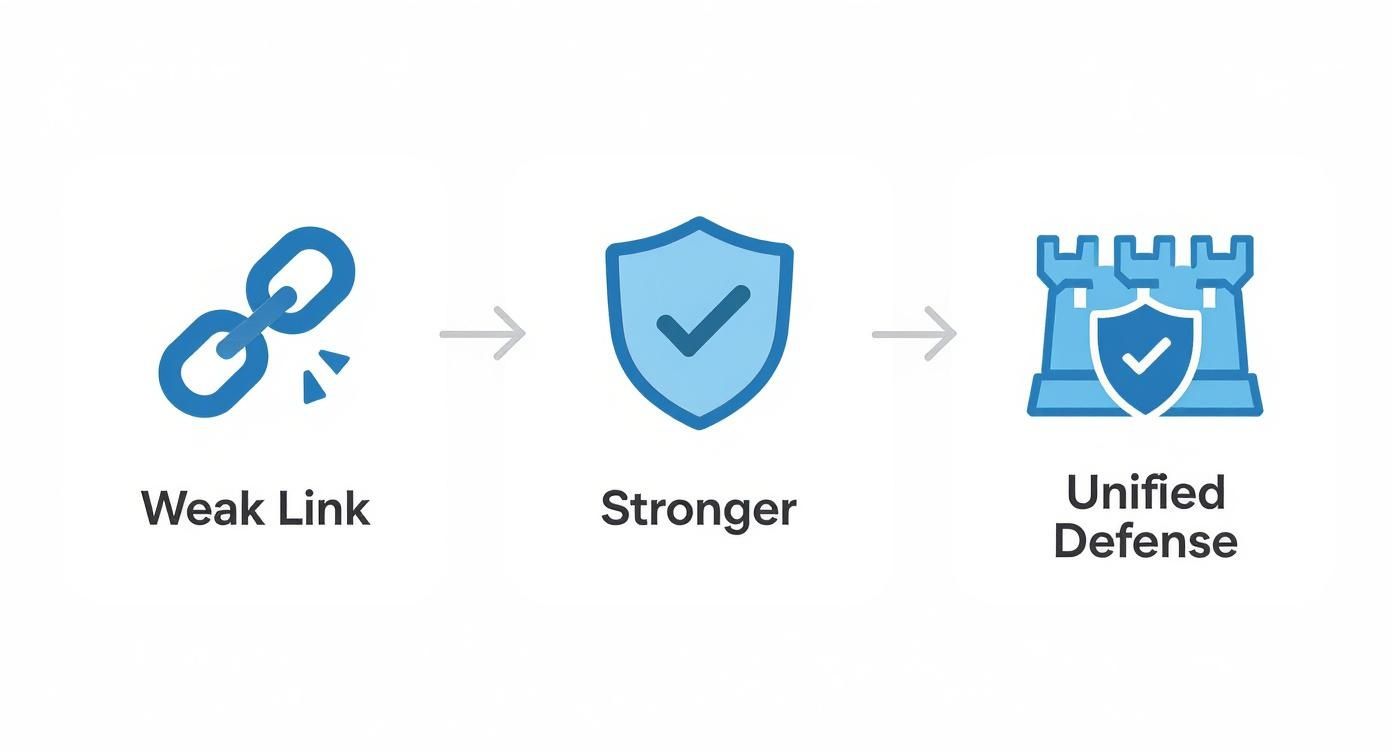
As the image clearly illustrates, scattered and weak security measures are easily identified and broken by an adversary. An integrated, complete framework, on the other hand, creates a truly formidable and layered defence.
Start with a Self-Assessment
Before you can build anything new, you need to survey the land. A self-assessment or a formal gap analysis is the absolute first and most critical step on your Essential Eight journey. The whole point of this exercise is to get a clear, unbiased, and evidence-based picture of where you are right now versus where the requirements for Maturity Level One say you need to be.
It's like conducting a pre-flight checklist for your entire cybersecurity program. You need to systematically walk through each of the eight controls and ask some tough, honest questions:
- Do we even have this specific control in place in any form?
- If we do have it, is it configured correctly and is it actually working effectively?
- Where are the specific gaps between our current setup and the detailed requirements for Maturity Level One?
This doesn't have to be some overly complex, drawn-out, and expensive process. It can be as simple as using a detailed checklist and having some frank, open conversations with your IT team or external provider. The goal is to establish an honest and accurate baseline that will guide every decision you make from here on out.
Prioritise Based on Risk
Once you've identified your weaknesses and gaps, the natural instinct for many is to try and fix everything all at once. That's a classic mistake, and it's a fast track to team burnout, budget overruns, and a series of half-baked projects that don't deliver real value. A much smarter and more effective approach is to prioritise your efforts based on risk and impact.
Not all controls will deliver the same value or risk reduction to every business. You're looking for the "quick wins"—those specific controls or actions that give you the biggest security bang for your buck in the shortest amount of time.
Focus your initial efforts on the controls that directly address the most probable and high-impact threats to your specific business. This ensures you are closing your biggest and most dangerous security holes first, delivering tangible improvements to your resilience from day one.
For most small and medium-sized businesses, a great starting point often includes:
- Patching Applications and Operating Systems: This is usually a low-cost, high-impact action that slams the door on a huge number of common, automated cyber attacks that exploit known vulnerabilities.
- Multi-Factor Authentication (MFA): Turning on MFA across your critical services is one of the single most powerful things you can do to stop attackers from taking over user accounts, which is the starting point for so many major breaches.
- Regular Backups: A working, tested, and offline backup system is your ultimate get-out-of-jail-free card if you're ever hit with a catastrophic incident like a ransomware attack.
This risk-based approach ensures your limited time, budget, and resources are always spent where they'll do the most good. It makes the entire implementation process more efficient, more manageable, and a lot more effective. To see how this aligns with broader international compliance goals, explore our comprehensive guide to ISO 27001 implementation, which also champions a risk-first methodology.
Overcoming Common Implementation Hurdles
Knowing the plan is one thing; putting it into action is another challenge entirely. Most businesses, regardless of their size, run into a few common roadblocks along the way. Getting ahead of these challenges and having a plan to address them is the first step to beating them.
And these challenges are very real. A recent government report found a staggering 71 percent of Commonwealth entities stated that legacy technology was holding back their Essential Eight implementation efforts. On top of that, the ACSC's own cybersecurity hotline received over 42,500 calls in a single year—a 16 percent jump from the previous year—which shows just how many organisations are actively looking for help and guidance. You can read more about the challenges organisations face in the official ACSC report.
Let's break down the three biggest hurdles that businesses typically face and how you can proactively clear them.
Budget Limitations
Many business owners mistakenly believe that proper, robust cybersecurity costs a fortune. While some high-end, enterprise-grade tools are certainly pricey, you’d be surprised how many of the Essential Eight controls can be implemented effectively using features you already pay for as part of your existing technology stack.
- Action Plan: Before you spend a single cent on new products, conduct a thorough audit of the security features that are already built into your existing systems. Modern operating systems and cloud platforms like Microsoft 365 have powerful, built-in tools for application control, device hardening, and MFA that are often included in the subscription price. Squeeze every drop of value out of those investments first.
Skills Gaps
It’s completely normal and understandable if your in-house IT team doesn't have the niche, specialised expertise to configure every single one of these controls perfectly. This is especially true for smaller businesses that don't have a dedicated, full-time security specialist on the payroll.
- Action Plan: Don't be afraid to ask for help. Bringing in a qualified cybersecurity consultant or a managed service provider (MSP) with proven experience in the Essential Eight can be a really cost-effective way to fill those critical skills gaps. They can handle the tricky initial setup and configuration, and then train your team to manage the day-to-day operations, giving your progress a massive and immediate boost.
Organisational Resistance
Let’s face it, people don’t always like change, especially when it affects their daily routines. New security rules and procedures can feel inconvenient or disruptive to employees. Things like restricting admin rights or blocking macros in documents can throw a wrench in long-established workflows, and you might get some pushback from your team.
- Action Plan: This is all about clear, consistent, and transparent communication. You have to clearly explain why these changes are so important for protecting the business, the customers, and ultimately, everyone's jobs. Frame security not as a hurdle or a punishment, but as a shared responsibility that benefits everyone. Offer training, documentation, and ongoing support to help your team adjust, and you can turn that initial resistance into active participation and advocacy.
By following this practical roadmap—starting with an honest assessment, prioritising by risk, and tackling the common hurdles head-on—you can turn the ACSC Essential Eight from a daunting technical document into a practical, achievable, and value-adding plan for a much safer and more resilient future.
Maintaining Vigilance Through Continuous Monitoring
Getting your business to your target maturity level for the ACSC Essential Eight is a huge win and a significant accomplishment. Seriously, pop the champagne and celebrate the milestone. But in the world of cybersecurity, there is no finish line you can cross and then just coast. The threat landscape is constantly shifting and evolving as attackers get more creative, more sophisticated, and more determined, which means our defences have to be just as nimble and adaptive.
Achieving compliance with the framework isn't a one-time project you can tick off a list and then forget about. It's really the starting pistol for a long-term, ongoing commitment to vigilance and continuous improvement. The very controls you've so carefully put in place today could become ineffective or obsolete tomorrow if they aren't actively monitored, maintained, and improved over time. Your security posture has to be a living, breathing system that adapts to whatever comes next.
This is where the real work of building sustainable cyber resilience begins—turning that static implementation checklist into a dynamic, active, and ever-improving defence.
From Implementation to Active Defence
The move from simply implementing controls to actively and continuously monitoring them is a massive and critical pivot in your overall security strategy. It's a bit like owning a high-performance car. You wouldn't drop a fortune on a brand-new Ferrari and then never change the oil, check the tyre pressure, or take it for a service, right? Your security controls need that same consistent, hands-on attention to perform at their peak and protect you when you need them most.
Continuous monitoring is all about getting into a disciplined rhythm of regular checks, audits, and tests to make sure your defences are not just in place, but are actually working as intended. It’s about creating a robust feedback loop where you’re proactively hunting for gaps, misconfigurations, and weaknesses before an attacker gets the chance to find and exploit them.
Cybersecurity isn't a destination; it's a perpetual state of readiness. The ultimate goal of continuous monitoring is to ensure your Essential Eight controls remain a hardened, effective shield, not just a document gathering dust on a shelf.
This active, ongoing approach is what turns a one-off compliance exercise into a powerful, real-time defence mechanism that can stand up to modern, sophisticated threats.
Key Performance Indicators for Your Essential Eight Controls
To monitor your security posture effectively, you need to know what you're measuring. You can't just rely on a vague, subjective feeling of being "secure." You need hard, quantifiable data. Tracking specific Key Performance Indicators (KPIs) for each of the eight strategies gives you concrete numbers and trends on how well your defences are actually performing over time.
Here are some practical KPIs you can start tracking for each control:
-
Application Control:
- Number of unauthorised application execution attempts blocked per week/month.
- Average time taken to review and add new, legitimate software to the approved list.
-
Patching Applications & Operating Systems:
- Average time-to-patch for critical and high-risk vulnerabilities (your target should be under 48 hours for criticals).
- Percentage of all systems in your environment that are fully patched and compliant with policy at any given time.
-
Microsoft Office Macro Settings:
- Number of macro-enabled documents originating from the internet that were blocked by your controls.
- Count of approved, digitally signed macros in active use versus the total number of macro-enabled documents encountered.
-
User Application Hardening:
- Percentage of web browsers across the organisation that are fully compliant with your hardening policies (e.g., Flash, Java, or other risky plugins are disabled).
- Number of unnecessary or high-risk software features that have been disabled across all standard workstations.
-
Restrict Administrative Privileges:
- Total number of active, permanent administrator accounts (the goal is always to have as few as possible).
- Frequency of privileged access reviews being conducted and the number of old or unnecessary privileged accounts that have been decommissioned as a result.
-
Multi-Factor Authentication (MFA):
- Percentage of users with MFA successfully enabled on every single required internal and external service.
- Number of failed or suspicious login attempts that were ultimately stopped by an MFA prompt, proving its effectiveness.
-
Regular Backups:
- Overall backup success rate (this needs to be 100%, or very close to it, every single day).
- Time taken to successfully restore a random sample of critical data during a scheduled, quarterly test drill.
Tracking these metrics provides a real-time health check on your security posture. It allows you to spot worrying trends, identify controls that are not performing as expected, and fix small issues before they snowball into critical failures.
Establishing a Rhythm of Security Assessments
Beyond the day-to-day metrics, you need a structured and disciplined schedule of deeper security assessments to uncover those hidden weaknesses that automated dashboards and routine checks might miss. Think of it as a comprehensive workout routine for your security program—it keeps your team sharp, your processes tuned, and validates your defences against real-world attack techniques.
This validation process should include a healthy mix of both internal and external assessments to give you the most complete and unbiased picture of your security posture.
Internal Audits and Reviews
Your own internal audits are the first line of proactive defence and assurance. These should be conducted at least quarterly to check that your Essential Eight controls are still configured correctly according to your policies and that your team is actually following the established security procedures. It’s a crucial opportunity to catch any configuration "drift" that can inevitably happen over time as systems are changed and updated.
Vulnerability Assessments
These are automated scans that crawl your network, servers, and workstations looking for known security holes and misconfigurations. Running these scans frequently—at least monthly, if not more often—gives you an up-to-date inventory of your technical exposures. This allows your team to intelligently prioritise their patching and remediation efforts based on how severe the discovered risks are.
Penetration Testing
A penetration test, or "pen test," goes a giant step further than an automated scan. This is where you bring in the professionals—independent, certified ethical hackers who will actively try to break into your systems using the same tactics, tools, and procedures that a real attacker would. An annual penetration test is an invaluable stress test for your defences, often finding clever, business-logic flaws and complex chain-of-exploit weaknesses that automated tools simply can't.
Integrating with Your Incident Response Plan
All of this monitoring, testing, and assessment has one ultimate purpose: to make your organisation stronger and more prepared for when—not if—a security incident happens. The insights you gather from your KPIs, audits, and penetration tests should directly feed back into your documented incident response (IR) plan, making it sharper, more relevant, and more effective.
Your IR plan is your detailed playbook for when things go wrong. It details the exact steps your team will take to detect, contain, eradicate, and recover from a cyber attack in a calm and coordinated manner.
Your Essential Eight monitoring supercharges this plan in a few key ways:
- Faster Detection: Actively monitoring logs from your application control or MFA systems can give you the critical early warning signs you need to spot an attack in its earliest stages, long before significant damage is done.
- Effective Containment: Knowing exactly who has admin privileges and where they're being used means you can quickly lock down compromised accounts and stop an attacker from moving laterally across your network.
- Confident Recovery: Because you've been rigorously and regularly testing your backups, you know you can restore your critical data and get systems back online quickly. This turns a potential business-ending disaster into a managed, albeit stressful, recovery process.
By tightly linking your continuous monitoring program to your incident response strategy, you create a truly resilient organisation. You're no longer just hoping an attack won't happen; you’re building a tested, prepared, and battle-ready system that knows exactly what to do when it does.
Your Questions About the ACSC Essential Eight, Answered
Jumping into a new cybersecurity framework for the first time always brings up a few important questions. Let's cut through the technical jargon and get straight to the practical, straightforward answers you need about implementing the ACSC Essential Eight.
Is the Essential Eight Mandatory for My Business?
Right now, the direct, legal mandate to implement the Essential Eight applies mainly to Australian federal government agencies (specifically, non-corporate Commonwealth entities). But that’s only half the story, and it's the less important half for private businesses.
For everyone else, the Essential Eight has quickly and decisively become the gold-standard benchmark for what good, responsible security looks like in Australia. Adopting it isn't just about ticking a compliance box; it's about seriously and demonstrably reducing your real-world risk of a damaging data breach. Plus, it builds enormous trust with clients and is often a non-negotiable requirement for winning contracts with government and large corporate entities who need to ensure their supply chain is secure.
What’s the Real Cost of Implementing the Essential Eight?
This is the big question on every business owner's mind, and the honest answer is: it depends. The final cost comes down to a number of factors, including the technology you already have in place, the size and complexity of your business, and the specific maturity level you’re aiming for.
But here’s the good news—it’s almost always more affordable than you might think. Many of the controls, especially at Maturity Level One, can be put in place using the software and licences you’re already paying for (like Microsoft 365 or Google Workspace). A bit of expert configuration and policy development is often all that’s needed to make huge progress.
When you get down to it, the question isn't whether you can afford to implement the Essential Eight. It's whether you can afford not to. The average cost of a single data breach can easily run into hundreds of thousands of dollars for a small business, completely dwarfing any proactive, upfront security investment.
I’m Ready to Start. Where Do I Begin?
Don't try to boil the ocean or do everything at once. The best and most successful approach is a measured, phased, and risk-based one. Start with a comprehensive gap analysis to get a clear picture of where you stand today compared to the baseline requirements of Maturity Level One.
From there, it’s all about smart prioritisation. Focus your initial efforts on the controls that give you the biggest bang for your buck in closing your most significant and likely security gaps. For most businesses, things like patching critical vulnerabilities, enabling MFA everywhere, and getting solid, tested application controls in place are usually the best places to start your journey.
If you don't have a dedicated, experienced security expert on your team, bringing in a trusted cybersecurity partner can make all the difference. They'll help you get the implementation done faster, more efficiently, and more importantly, get it done right the first time.
Making sense of the Essential Eight and building a robust, sustainable security posture takes specialist knowledge and experience. Anitech offers expert ISO 27001 consulting to guide your business through every stage of the process, from initial assessment to ongoing monitoring and improvement. We don't just help you meet the standards; we help you build genuine, long-term resilience. Let our 100% success rate speak for itself. Find out more at https://iso-27001.com.au.
Recent Comments