

In the world of information security, the terms audit and compliance get thrown around a lot. They sound similar, and they are definitely related, but they play two very different roles.
Think of it like this: compliance is the "what." It's the set of rules you have to follow—the laws, industry standards, and internal policies that dictate how you must protect your data. An audit, on the other hand, is the "how well." It’s the independent check-up that verifies you’re actually doing what you say you’re doing.
Why Audit and Compliance Are Your Business Superpowers

It’s easy to see these activities as a hassle—a grudge purchase just to keep the regulators happy. But that’s a narrow view that misses the whole point. When you treat them seriously, audit and compliance become your secret weapons for building a stronger, more trusted business.
Let’s use an analogy. Imagine you’re building a commercial skyscraper. The building codes and architectural blueprints are your compliance framework. They’re not just suggestions; they’re strict rules designed to make sure the building is safe and won’t fall down. You have to follow them.
The audit is the independent building inspector who comes in at key stages. They don’t write the rules, but they meticulously examine the foundation, the steel beams, and the wiring to ensure everything is built exactly to spec. Their sign-off is the proof that your building is safe to occupy.
The Real-World Impact
Operating without a compliance framework is like building with no plans—it’s pure chaos and incredibly risky. But without an audit, you have no objective proof that your work is any good. In the business world, this applies directly to how you handle information. A solid audit and compliance program does more than just help you avoid fines; it builds a rock-solid foundation of trust with everyone you do business with.
This is more important than ever for Australian businesses. Customers are savvy about data privacy, and being able to prove your commitment to security is a massive competitive advantage. Getting a formal certification like ISO 27001 is like that inspector's final seal of approval on your skyscraper—it’s an internationally recognised signal that your security has been independently verified against a gold standard.
“Compliance tells you the rules of the game. An audit checks to see if you’re actually playing by them. You can't have one without the other if you want a truly resilient security posture.”
More Than Just a Certificate
Looking past the analogy, the benefits are very real. A structured approach to audit and compliance makes you take a hard, honest look at your own processes. You’ll find weaknesses you never knew you had and put practical controls in place to protect your most critical asset—your data. For most businesses, diving into the essentials of ISO compliance is the first step on that journey.
A good audit isn't about finding fault; it's about finding opportunities. It uncovers inefficiencies and gives you a clear roadmap for improvement. The whole process forces you to get organised, shifting your security culture from constantly putting out fires to proactively managing risk.
Ultimately, getting audit and compliance right turns a business requirement into a genuine strategic edge. It’s about creating a secure environment that protects your reputation, wins over customers, and sets you up for long-term growth. This guide is here to walk you through that process, from the basic concepts to getting it done.
The Three Security Audits Every Business Should Know
When you hear the word “audit,” it’s easy to picture a single, stressful event. But in the world of information security, that’s not quite the full story. Not all audits are created equal; they serve different purposes, involve different people, and deliver very different outcomes. Getting your head around these distinctions is the first step to building a rock-solid audit and compliance strategy.
Think of it like getting your car serviced. There’s the regular oil change you do yourself (an internal check), the mandatory annual roadworthy inspection (a formal certification), and checking the service history before you buy a used car (a supplier review). Each is a type of inspection, but they all have a completely different goal.
For your business, knowing which audit to use and when is a game-changer. Let's break down the three essential security audits you’ll almost certainly encounter on your compliance journey.
Internal Audits: The Essential Self-Checkup
An internal audit is your first line of defence. It’s a proactive, self-initiated look at your own Information Security Management System (ISMS) to see how it stacks up against your policies and, of course, the requirements of a standard like ISO 27001.
This isn't about passing a test; it’s about honest self-assessment. The real aim is to find weaknesses, gaps, and nonconformities before an external auditor does. You’re essentially playing the role of the inspector to catch problems early, when they are much easier and cheaper to fix.
This can be carried out by your own trained staff or by a consultant you hire for a fresh pair of eyes. They’ll review your documentation, chat with employees, and check that security controls are actually working as intended. This process gives you a clear, internal benchmark of your audit and compliance readiness.
An internal audit is like a dress rehearsal for the main performance. It’s your chance to find and fix any forgotten lines or misplaced props before the critics arrive, ensuring a smooth and successful opening night.
For example, an internal auditor might discover that while your policy requires quarterly password updates, several key server accounts haven't been changed in six months. Finding this yourself lets you correct the issue and retrain the team, turning a potential failure into a valuable learning opportunity. It’s a crucial part of the continuous improvement cycle that sits at the very heart of ISO 27001.
Certification Audits: The Formal Inspection
This is the main event. A certification audit is the formal, independent assessment that determines whether you earn your ISO 27001 certificate. Unlike an internal audit, this is conducted by an accredited third-party organisation known as a Certification Body (CB).
These auditors are completely impartial. Their job isn’t to help you fix problems, but to objectively verify that your ISMS meets every single requirement of the ISO 27001 standard. A successful certification audit results in a formal certificate that’s valid for three years—a powerful signal to clients and partners that you take security seriously.
The audit is typically broken into two stages:
- Stage 1 Audit: This is mostly a documentation review. The auditor checks that you have all the necessary policies, procedures, and frameworks in place to form a compliant ISMS. They’re making sure your theoretical "blueprint" is correct.
- Stage 2 Audit: Here, the auditor looks for hard evidence that your ISMS is fully up and running. They’ll conduct interviews, observe processes, and review records to confirm that you’re actually "walking the walk."
Successfully getting through a certification audit is a massive milestone, proving your commitment to robust audit and compliance practices.
Supplier Audits: Protecting Your Supply Chain
Your organisation's security is only as strong as its weakest link, and these days, that vulnerability often lies outside your own four walls. Supplier audits, also known as third-party or vendor audits, are all about assessing the security of the partners and suppliers who have access to your data.
Think about it—you likely rely on dozens of third parties, from cloud providers like AWS to your marketing platform or even the company that handles your payroll. If just one of them suffers a data breach, your data could be exposed, and your business could be held responsible.
A supplier audit means reviewing a vendor's security policies, procedures, and controls to make sure they meet your standards. This can be done in a few ways:
- Questionnaires: Sending detailed security questionnaires for vendors to self-report on their practices.
- Documentation Review: Asking for evidence of their own certifications, like their ISO 27001 certificate or a SOC 2 report.
- On-site Audits: For critical suppliers, you might even conduct a direct audit of their facilities and processes.
By performing this due diligence, you extend your audit and compliance efforts beyond your own business. This not only protects your data but also shows auditors and customers that you take a holistic approach to security. To better understand how these different assessments fit together, many find it helpful to learn more about the different types of audits and their specific goals.
Your Step-by-Step ISO 27001 Compliance Journey
An ISO 27001 audit isn't something you can cram for the night before. Far from it. It’s a methodical journey with distinct stages, each one building on the last. When you start seeing it this way, the whole process transforms from a daunting monster into a manageable project, giving you a clear roadmap to certification and a genuinely stronger security posture.
Thinking about your audit and compliance obligations as a structured lifecycle helps you prepare properly, put resources where they’re needed, and move forward with confidence. Instead of reacting to an auditor's questions on the back foot, you'll be proactively demonstrating complete control over your information security.
Let's walk through this journey in four clear stages. This structure helps make sense of the different audit types and shows how they all fit into a continuous cycle of improvement.
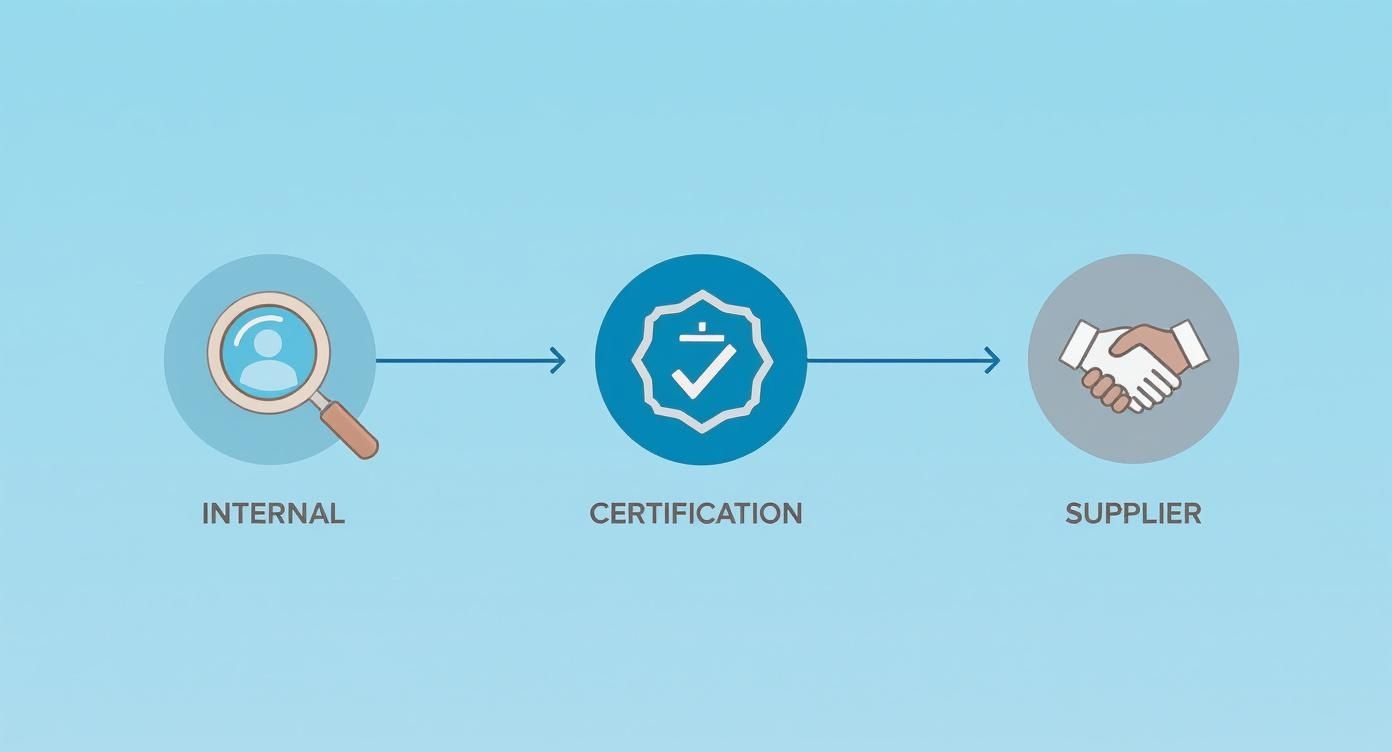
This visual really captures how internal self-checks, formal certification, and supplier reviews create a reinforcing loop. By getting each stage right, you build a robust system where every audit makes the next one stronger, driving real, ongoing improvement.
Breaking down the audit into these four distinct stages makes the entire process far less intimidating. The following table outlines what to expect at each phase, from the initial planning to the final report and follow-up actions.
| The Four Stages of an ISO 27001 Audit |
| :— | :— | :— | :— |
| Audit Stage | Key Objective | Typical Activities | Critical Documentation |
| Stage 1: Strategic Planning | Define the audit’s scope and establish the framework for your ISMS. | Scope definition, risk assessment, selecting controls, securing management support. | Scope Statement, Risk Assessment Register, Statement of Applicability. |
| Stage 2: Fieldwork & Evidence | Verify that the ISMS is implemented and operating as designed. | Staff interviews, system observation, reviewing logs and records. | Policy documents, training records, incident reports, system logs. |
| Stage 3: Analysis & Reporting | Assess the collected evidence against ISO 27001 requirements. | Analysing findings, categorising nonconformities (major/minor). | Formal Audit Report, List of Nonconformities. |
| Stage 4: Remediation & Follow-up | Address all identified nonconformities and drive continuous improvement. | Creating and executing a corrective action plan, verifying fixes. | Corrective Action Plan, Updated procedures, Evidence of remediation. |
With this lifecycle in mind, you can approach each step methodically, ensuring you have the right documentation and team members ready for whatever the auditor throws your way.
Stage 1: Strategic Planning and Preparation
This is where you lay the entire foundation for the audit. Think of it as drawing up the blueprints and gathering all your materials before you even think about breaking ground. Rushing this stage is a one-way ticket to problems later on; a thoughtful, thorough approach here makes everything that follows run smoother.
Your first big task is to define the scope of your Information Security Management System (ISMS). What parts of the business need to be covered? Is it the whole company, or just a specific department, product line, or office? This decision has huge knock-on effects for the resources and effort you'll need.
From there, you’ll dive into a comprehensive risk assessment to pinpoint potential threats to your information. This isn't just a box-ticking exercise; it's the absolute heart of your ISMS. You need to identify, analyse, and evaluate risks, then decide how to treat them—often by implementing specific security controls from ISO 27001's Annex A.
Key Takeaway: Preparation isn’t just about paperwork. It’s about making smart, strategic decisions that define your scope, identify real-world risks, and establish the security controls that will become the backbone of your entire compliance effort.
This is also when you get your team together, assign clear responsibilities, and get genuine buy-in from leadership. Without visible support from the top, your audit and compliance project can quickly run out of steam.
Stage 2: Evidence Gathering and Fieldwork
Once your ISMS is designed and up and running, the audit fieldwork begins. This is where the auditor—whether they're from your own team or an external body—digs in to check that your system actually works in practice, not just on paper. It's the "show, don't just tell" part of the process.
The auditor will spend time with your team, conducting interviews to get a feel for how security processes are handled day-to-day. They’ll observe operations to see controls in action and, most importantly, they will ask to see evidence. This evidence is the hard proof that your ISMS is doing what you say it does.
Auditors will be looking for things like:
- Policy and Procedure Documents: The official rulebooks for your ISMS.
- System Logs and Records: Technical data showing that controls like access restrictions or activity monitoring are switched on and working.
- Employee Training Records: Proof that your team has been properly trained on security policies.
- Incident Reports: Documentation showing how you’ve handled security events in the past.
- Management Review Minutes: Evidence that leadership is actively involved in overseeing the ISMS.
This phase can feel a bit intense, but if you’ve done your prep work, it’s really just a matter of presenting the organised documents you’ve already created. As you go through this, it’s vital to grasp the importance of specific controls and understand why email security matters for ISO 27001 as part of your overall strategy.
Stage 3: Analysing Findings and Reporting
After the fieldwork is done, the auditor steps back to analyse everything they've found. They meticulously compare the evidence they gathered against the strict requirements of the ISO 27001 standard. The aim is to see if your ISMS conforms to the standard or if there are any gaps, which are called nonconformities.
Any issues are sorted by how serious they are. A minor nonconformity might be a one-off mistake or a small slip-up in a process. A major nonconformity, on the other hand, points to a systemic failure or a complete lack of a required control—the kind of thing that could put your whole security system at risk.
The auditor then wraps all of this up into a formal audit report. This document is the key output of the audit and compliance process. It gives you a detailed rundown of the audit’s scope, what was checked, and a clear, prioritised list of any nonconformities they found. It’s not a report card; it’s a diagnostic tool that gives you a precise, objective health check of your ISMS and a clear action plan.
Stage 4: Remediation and Continuous Improvement
The final audit report isn't the end of the line—it’s the start of the next cycle. This stage is all about acting on the auditor’s findings. You need to develop and roll out a corrective action plan to fix every single nonconformity that was identified.
For minor issues, the fix might be as simple as updating a procedure or running a quick training session. For major ones, you might be looking at a much bigger effort, like redesigning a core process or bringing in new technology.
This constant drive for improvement is what ISO 27001 is all about. The standard is designed to be a living, breathing system, not a plaque you hang on the wall and forget about. The audit process provides the essential feedback loop that fuels this improvement, making sure your security keeps up with new threats and business changes.
This ongoing cycle is what keeps your certification valuable and your organisation safe. Committing to this is particularly critical in the complex Australian business environment. Interestingly, PwC’s 2025 Global Compliance Survey found that no Australian organisations saw themselves as leaders in compliance. While 73% of local executives recognise AI’s potential to help, 58% are not yet planning to use it for regulatory tasks, showing a cautious approach to new tools for such vital functions.
By fully embracing all four stages, you turn audit and compliance from a stressful chore into a strategic advantage that builds resilience and trust. An expert partner can be a huge help at each step, making sure your journey to ISO 27001 certification is not only successful but also adds lasting value to your business.
Where ISO 27001 Audits Go Wrong (and How to Get Yours Right)
Getting through an ISO 27001 audit feels like a massive achievement, but what about the businesses that don't make it? It’s almost never one big, dramatic mistake. Audit failures usually come down to a handful of common, and entirely preventable, slip-ups that auditors see over and over again.
Let's move past the theory. Honestly, one of the best ways to prepare is to learn from the mistakes of others. By knowing where companies typically trip up, you can focus your audit and compliance efforts where they matter most, saving yourself from the headache and cost of fixing things later.
Inadequate Risk Assessment and Treatment
Think of your risk assessment as the absolute foundation of your entire Information Security Management System (ISMS). If it’s weak, the whole structure is shaky. A shallow or incomplete risk assessment is one of the quickest tickets to a major nonconformity.
Too many businesses treat this as a checkbox exercise. They download a template and fail to identify the risks that are unique to their own operations—the specific software they use, the third-party suppliers they rely on, or even the physical security of their office. What they end up with is a generic risk register that doesn’t actually reflect their reality.
Just as bad is a weak risk treatment plan. It's not enough to just list the risks; you have to show a clear, logical plan for what you’re doing about each one. Will you mitigate it, accept it, avoid it, or transfer it? An auditor needs to see that thought process.
How to avoid this: Don't rush your risk assessment. Pull people in from different parts of the business—IT, HR, operations, management—to get a 360-degree view of potential threats. Make sure every single risk you identify has a clear treatment decision next to it, along with the name of the person responsible for seeing it through.
Poor or Missing Access Controls
"Who can access what?" It’s one of the most fundamental questions in information security, and auditors find problems with access controls all the time. This is an area you absolutely have to nail.
The usual culprits are:
- Excessive Privileges: People have access to data and systems they simply don’t need for their jobs. This is classic "privilege creep"—someone changes roles, and their old permissions just linger forever.
- Shared User Accounts: Multiple staff using the same login. This is a huge red flag for auditors because it makes it impossible to trace actions back to a specific person.
- Weak Password Policies: No enforcement of complex passwords, regular updates, or minimum length.
These aren't just theoretical gaps; they're real vulnerabilities. With data breach incidents on the rise in Australia, this is under intense scrutiny. The Office of the Australian Information Commissioner (OAIC) has reported a significant jump in breaches, underscoring just how critical this is. You can get more insights from the OAIC’s report on rising data breaches in Australia.
How to avoid this: Live by the principle of least privilege. Users should only have the bare minimum access they need to do their jobs, and nothing more. Set up regular access reviews—at least quarterly—to catch and remove permissions that are no longer needed. And of course, enforce a strong password policy and ban shared accounts, no exceptions.
Insufficient Employee Security Training
Your team can either be your strongest line of defence or your biggest vulnerability. You can bet that an auditor will want to chat with a few of your staff to see what they know about your security policies.
What auditors often find is a disconnect. The policies might exist in a folder somewhere, but employees have no idea they exist. They can't spot a phishing email, don't know the first thing about reporting a security incident, and are fuzzy on their responsibilities for protecting company data.
This tells an auditor that security isn't truly part of your company culture. A policy that nobody knows about is worthless.
How to avoid this: Ditch the one-off induction training. You need an ongoing security awareness program. Mix it up with different methods like short online modules, realistic phishing simulations, and quick security reminders in team meetings. Most importantly, keep detailed records of who has completed what training and when. That's the proof an auditor will ask for.
Incomplete or Outdated Documentation
A successful audit and compliance program runs on proof. One of the most common and frustrating reasons for a nonconformity is simply not having the right documentation in order.
This shows up in a few different ways:
- Missing Policies: Key documents required by ISO 27001 are just… not there.
- Outdated Procedures: The policy says you do one thing, but in reality, the business now operates completely differently.
- No Version Control: Multiple, conflicting versions of a document are floating around, and no one is sure which one is the official, current version.
- No Management Review Records: There are no meeting minutes to prove that senior leadership is actually involved in overseeing the ISMS.
Without this paper trail, you can’t prove to an auditor that your ISMS is alive and working. It doesn’t matter how secure you think you are in practice if you can't show the evidence.
How to avoid this: Set up a central place for all your documents that has clear version control. Assign an owner for every single policy and procedure, and make it their job to review and update it at least once a year (or whenever something changes). Be meticulous about documenting your management review meetings—who was there, what was discussed, what decisions were made, and what the action items are. This creates the solid evidence trail that auditors love to see.
Building an Auditor-Ready Evidence Toolkit
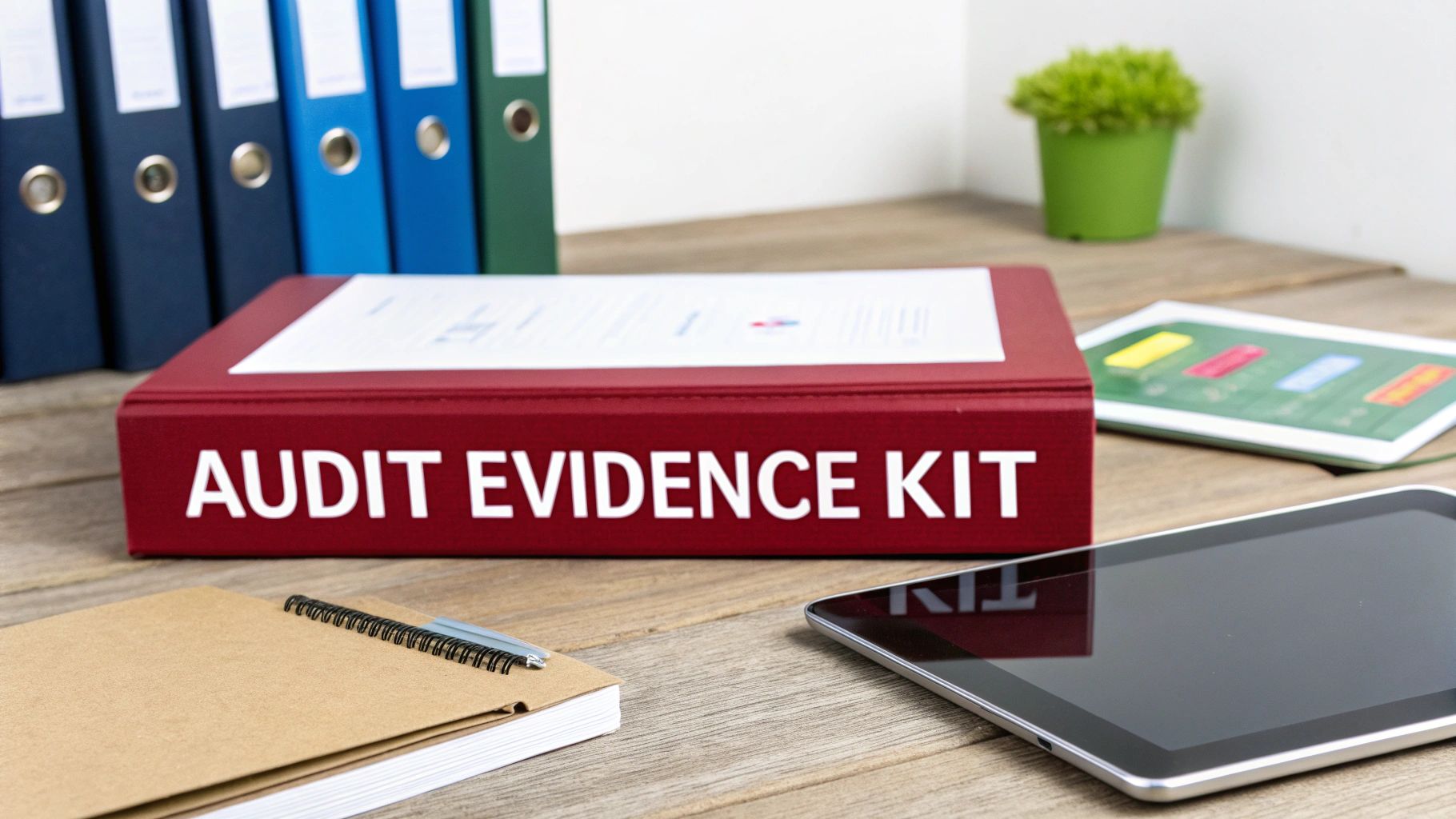
A successful audit isn’t won with good intentions; it's proven with solid evidence. Think of an auditor like a detective arriving at a scene. They aren't just going to take your word for it that everything is secure—they need to see tangible proof. This is where your evidence toolkit comes into play.
Too many businesses fall into the trap of thinking that evidence is just a stack of written policies. While policies are essential, they're only the very first step. Real evidence shows that your policies are living, breathing parts of your day-to-day operations. It's the proof that you don't just say you’re secure, you actively are secure.
Moving From Policies to Proof
An auditor's main job is to verify that your Information Security Management System (ISMS) actually works as designed. To do this, they’ll sample evidence that connects your documented procedures to your real-world actions.
For instance, having a policy that mandates employee security training is a good start. But the evidence is the signed attendance sheets, the completed quiz results, and the training slides themselves. This is what shows the policy is being actively implemented, not just sitting on a shelf.
“Evidence is the bridge between your security policies and your operational reality. Without it, your compliance framework is just a collection of theoretical documents with no verifiable impact.”
Building a robust evidence toolkit means you’re not scrambling for documents when the auditor arrives. Instead, you're confidently presenting a well-organised collection of proof that showcases a mature and effective security program.
Core Components of Your Evidence Toolkit
Your evidence collection should be a curated library of documents and records that directly map back to ISO 27001 requirements. Think of each piece of evidence as a crucial exhibit in your case for compliance. Here are the must-have items for your toolkit.
- Policy and Procedure Documents: This is your foundation. It includes your core Information Security Policy, your Risk Assessment methodology, and your Statement of Applicability.
- Operational Logs and Records: These are the technical fingerprints of your security controls in action. This includes things like server access logs, firewall activity reports, and records from your antivirus software.
- Employee Training Records: As mentioned, this is the hard proof of your security awareness program. It includes training schedules, content outlines, and completion certificates for each team member.
- Incident Response Reports: This shows you have a tested process for handling security events. You should include reports from past incidents (even minor ones), detailing how they were identified, contained, and resolved.
- Management Review Minutes: These are absolutely non-negotiable. Detailed minutes from leadership meetings prove that your ISMS has executive oversight and is part of the business's strategic direction.
Having these items organised and ready to go demonstrates a high level of preparedness and control, which always makes a strong impression on any auditor.
Pro Tips for Managing Your Evidence
Simply having the evidence isn't enough; how you manage it is just as important. Disorganised, outdated, or inaccessible evidence can lead to nonconformities just as easily as not having any at all.
This level of scrutiny on documentation is becoming more common across all regulatory bodies. In the 12 months leading to 30 June 2025, for example, the Australian Securities and Investments Commission (ASIC) conducted extensive reviews of company financial reports and audit files. This detailed oversight led to 18 entities agreeing to take corrective action, showing that regulators demand clear, verifiable evidence. You can discover more about ASIC's audit quality findings to see how this trend applies broadly.
Here are two critical practices for keeping your toolkit auditor-ready:
- Implement Strict Version Control: An auditor needs to see the current, approved version of every document. Use a clear naming convention (e.g.,
Policy_Name_v1.2_2025-10-26) and keep an archive of older versions. This avoids confusion and shows you have a systematic approach. - Use a Secure Central Repository: Don't let evidence live on individual laptops or get scattered across different network drives. Set up a single, secure location, like a dedicated SharePoint site or a document management system, where all audit evidence is stored. This ensures everyone knows where to find the official documents.
An organised toolkit not only makes the audit process smoother but also serves as a valuable internal resource. For more guidance, you can explore the minimum documented information needed for ISO 27001 certification in our detailed guide.
By thoughtfully putting together and managing your evidence, you transform the audit and compliance process from a stressful test into a confident demonstration of your commitment to information security. An expert partner can help you identify and organise the specific evidence required, ensuring you walk into your audit fully prepared.
Don't Go It Alone: Why a Compliance Partner is Your Secret Weapon
Let's be honest, staring down the barrel of an ISO 27001 audit can feel overwhelming. From getting your head around the audit lifecycle to pulling together a mountain of evidence, the road to certification looks steep and full of potential wrong turns. But what if you viewed this not as a roadblock, but as a chance to build a smarter, stronger business?
That's where an expert partner comes in. They completely change the game. What feels like a costly, time-sucking chore can become a powerful way to make your business more secure, resilient, and trusted by your customers. The right guide turns compliance from a box-ticking headache into a genuine competitive edge.
Turning a Burden into a Business Advantage
A good consultant is your navigator. They take the dense, jargon-filled requirements of the standard and translate them into simple, actionable steps that don't bring your daily operations to a grinding halt. They’ve been through this process countless times, seen all the common tripwires, and know exactly what auditors are looking for.
Instead of your team sinking hundreds of hours into deciphering the standard, a partner points you exactly where you need to go. This doesn't just get you certified faster; it ensures you end up with a robust Information Security Management System (ISMS) that actually works for your business.
A strategic partnership does more than just get you a certificate for the wall. It weaves a culture of security into the very fabric of your organisation, strengthening your defences and building unshakable trust with clients who care deeply about how their data is handled.
This proactive approach is especially crucial if you're looking to grow. For any leader with an eye on scaling, leaning on dedicated IT Compliance Services can transform the complex job of managing risk and earning customer trust into a straightforward, strategic investment.
How an Expert Makes Every Step Easier
An experienced partner provides practical, hands-on support through the entire audit and compliance journey. Their job is to take the risk and stress out of the process, freeing you up to run your business.
Here’s a snapshot of what that looks like:
- Strategic Planning: Right from the start, they help you define the scope of your ISMS and conduct a proper risk assessment that actually makes sense for your business goals. A solid foundation is everything.
- Evidence Gathering: They provide proven templates and clear instructions to help you build your evidence toolkit, making sure every document is present, correct, and easy for an auditor to find.
- Internal Audits: They act as a 'friendly' auditor first, running a tough internal audit to find and fix any gaps before the real one. This single step massively boosts your chances of passing without a hitch.
- Remediation: If issues do pop up, they help you create practical corrective action plans that don’t just tick a box for the auditor but genuinely make your security stronger.
This kind of support means you can keep your focus where it should be—on your customers and your core business—while the compliance project steams ahead. It’s a known fact that businesses with expert guidance are far more likely to get certified on their first try, dodging the expensive delays that major nonconformities can cause. A classic example is messy documentation; a consultant ensures your records are flawless.
Start Your Compliance Journey with Confidence
At the end of the day, achieving ISO 27001 certification is a huge win. It unlocks new business, polishes your brand reputation, and cements the loyalty of your customers. The journey takes work, but you absolutely don't have to do it alone.
Partnering with an expert takes the guesswork and anxiety out of the audit and compliance process. With a 100% success rate in guiding Australian businesses to certification, we have the know-how and practical experience to make your compliance goals a reality. Let us help you build a security framework that not only meets a global standard but becomes one of your most valuable assets.
Your ISO 27001 Audit Questions, Answered
Stepping into the world of ISO 27001 for the first time can feel a bit daunting, and it's natural to have questions. We hear a lot of the same queries from businesses just starting out, so we've put together clear, straightforward answers to help you plan your audit and compliance journey with confidence.
How Long Does a Typical ISO 27001 Audit Take?
There's no single answer here, as the timeline really depends on the size of your business and how complex your operations are. The scope of your Information Security Management System (ISMS) is the biggest factor.
For most small to medium-sized businesses, the audit is broken into two key parts. Stage 1 (the documentation review) and Stage 2 (the implementation audit) usually take a few days each. They're often spaced a few weeks apart to give you time to prepare between stages.
Naturally, larger organisations with more intricate systems will need a longer, more in-depth assessment. The best way to keep the process moving efficiently, regardless of your size, is thorough preparation.
What Is the Difference Between a Major and a Minor Nonconformity?
Auditors classify their findings based on how serious they are, and it’s crucial to understand the distinction.
- A minor nonconformity is a single slip-up or an isolated case where a requirement wasn't met. It doesn't put your whole system at risk. Think of it like a small crack that needs a quick patch.
- A major nonconformity is a much bigger deal. This could be the total absence of a required process or a systemic failure that exposes your information to significant risk. It points to a foundational problem that needs immediate attention.
A major nonconformity will stop your certification in its tracks. You have to fix it completely before you can be certified. For minor issues, you can usually proceed with a documented plan to correct them.
What Happens After We Achieve ISO 27001 Certification?
Getting your ISO 27001 certificate is a huge milestone, but it's the start of your commitment, not the finish line. To keep your certification active, your business will need to go through annual surveillance audits.
These yearly check-ins are designed to confirm your ISMS is still running effectively and that you're continuously making improvements. They ensure your security measures stay sharp and adapt to new threats as they pop up.
Then, every three years, you'll have a full recertification audit to formally renew your certificate. This demonstrates your long-term dedication to keeping your information secure.
Can We Fail an ISO 27001 Audit?
It’s not really a pass-or-fail exam. A better way to think about it is as an opportunity to find and fix weak spots. If an auditor finds any nonconformities, you will always get the chance to address them with a proper corrective action plan.
Certification is granted once you show the auditor solid proof that you've resolved any major issues they found.
This is where working with an experienced consultant makes all the difference. We can help you spot and fix potential problems well before the official auditor even walks through the door, which makes the whole process smoother and far less stressful.
The journey to ISO 27001 certification is a serious undertaking, but it’s one of the best investments you can make in your business’s security, resilience, and reputation. At Anitech, we specialise in guiding Australian businesses through every single step.
Secure your certification with an expert partner—discover our ISO 27001 services at iso-27001.com.au
Recent Comments