

When you hear the terms ‘audit’ and ‘compliance’, it’s easy to feel a bit overwhelmed. But they’re not as complicated as they sound. They're really just two sides of the same coin, both essential for building a business that people trust.
Let’s try a simple analogy. Think of compliance as your commitment to a healthy lifestyle—eating well and exercising every day. An audit, on the other hand, is your annual health check-up with the doctor. It’s the official verdict that proves all your daily efforts are actually paying off.
The Two Sides of Business Trust
Too many businesses see audits and compliance as separate chores to tick off a list. The real secret is understanding they work together to make your organisation stronger and more resilient. One is the ongoing practice, the other is the periodic proof.
Compliance is the "how." It’s all the day-to-day things you do—the policies you write, the procedures you follow, the training you provide—to meet the rules set by laws, industry standards, or frameworks like ISO 27001. It's about building good habits into the very fabric of your operations.
An audit is the "proof." It's a formal, independent review to check if your compliance activities are not just happening, but are actually working effectively. An auditor provides an objective, third-party look to confirm you’re genuinely doing what you claim to be doing.
Understanding the Core Concepts
Let's go with a different analogy. Imagine you're training for a marathon.
Your compliance is the training plan. It’s the daily runs, the stretching routines, the nutrition plan, and getting enough sleep. These are the consistent, everyday actions you take to prepare for the big day.
The marathon itself? That’s the audit. It's the one-off event that puts your training plan (your compliance) to the test. Finishing the race proves your preparation was solid. Hitting a wall at the 20-kilometre mark, however, shows there were probably some gaps in your process.
This highlights the real relationship here: you can't succeed at one without the other. A strong compliance program makes audit day far less stressful. And the findings from an audit give you invaluable feedback to make your compliance efforts even stronger.
When you master both, you’re no longer just trying to avoid fines. You’re building a foundation for operational excellence that earns customer trust and gives you a serious competitive edge.
To put it in perspective, let's break down the key differences in a simple table.
Audit vs Compliance at a Glance
This quick comparison table highlights the core functions and objectives of each activity.
| Aspect | Compliance | Audit |
|---|---|---|
| What it is | The continuous act of adhering to rules, laws, and standards. | A point-in-time, independent verification of that adherence. |
| Timing | Ongoing, a daily part of business operations. | Periodic, conducted at specific intervals (e.g., annually). |
| Objective | To maintain standards and prevent issues from occurring. | To provide assurance that standards are being met effectively. |
| Who does it? | Internal teams (everyone in the company has a role). | Independent, objective third-party auditors (or an internal audit team). |
| Output | Operational procedures, policies, training records, and daily process evidence. | A formal audit report with findings, observations, and recommendations. |
As you can see, while they have different functions, their goals are ultimately aligned: to ensure your business is operating correctly and securely.
Why It Matters for Small Businesses
For small and medium-sized businesses (SMEs), this synergy is absolutely critical, especially when it comes to information security. In an era where a single data breach can sink a company, simply saying you’re secure isn't enough. You have to be able to prove it.
This is where a globally respected standard like ISO 27001 comes in. It gives you a world-class framework for building an Information Security Management System (ISMS).
Getting certified for ISO 27001 involves both sides of the coin:
- Implementing Controls: This is your compliance work. You put the required technical and organisational safeguards in place to protect your information.
- Undergoing Audits: This is where you prove it. An external certification body comes in to verify your controls are designed and operating as intended.
Achieving this certification is so much more than a piece of paper for the wall. It’s a powerful statement to your clients, partners, and regulators that you are serious about security. For an SME, that certificate can be the very thing that helps you win a major contract, build unshakable customer loyalty, and cement your reputation as a trustworthy partner.
Navigating audits and compliance isn't just an obligation—it's one of the smartest strategic investments you can make in your company's future.
Why Australian Compliance Is More Complex Than Ever
Let's be honest, the days of treating compliance like a simple box-ticking exercise are well and truly over. For Australian businesses today, staying on the right side of regulations feels less like a straight road and more like a maze that keeps changing shape.
This isn't just a hunch. Between tightening regulations, smarter cyber threats, and more pressure from governing bodies, the entire field has been turned on its head. A solid strategy for audits and compliance isn't just a "nice-to-have" anymore—it's essential for survival and growth. What used to be an annual, static task is now a living, breathing part of the business that needs constant attention.
The Rising Tide of Regulatory Demands
Australian regulators are sharpening their pencils, and the consequences for getting it wrong are getting steeper. Laws covering data privacy, cybersecurity, and financial reporting aren't just getting stricter; they're becoming more tangled, creating a web of obligations that can feel impossible to unravel.
This is a huge challenge for small and medium-sized businesses (SMEs). Without the luxury of a large, dedicated compliance department, you're left trying to keep up with legislative changes while also running the day-to-day operations. The pressure is on to prove you’re not just following the rules, but that you have a genuine culture of compliance built into your business.
It's a very real strain. A recent PwC Global Compliance Survey found that 56% of Australian executives said this growing complexity was directly hurting their ability to grow. You can dig into their Australian compliance insights to see the full picture.
Evolving Cyber Threats Are Pouring Fuel on the Fire
It’s not just the rulebook that’s getting thicker. The threats themselves are evolving at an alarming pace. Businesses are now fighting off dangers that didn't even exist a decade ago. A data breach today isn't just an IT headache; it's a major compliance failure with very real, and very expensive, consequences.
Regulators now expect you to be on the front foot with your security. Frameworks from bodies like the Australian Cyber Security Centre are no longer suggestions—they're the baseline.
- Ransomware Attacks: These can completely paralyse your business and trigger multiple, painful breach notification obligations.
- Phishing and Social Engineering: Clever tactics that turn your own team into a potential weak spot if they aren't properly trained.
- Supply Chain Vulnerabilities: A security gap in one of your vendors can quickly become your compliance nightmare, making third-party risk management a must.
Tackling these risks head-on is a core part of modern compliance. Any audit you face will dive deep into your cybersecurity posture, scrutinising everything from your access controls to how you'd respond in a crisis. For a great primer on these foundational security measures, take a look at our guide on the ACSC Essential Eight framework.
Shifting from a Reactive Mess to a Proactive Mindset
Trying to survive in this environment by just fixing problems as they pop up is a recipe for disaster. It’s expensive, stressful, and puts your business at constant risk. The only way forward is to be proactive, strategic, and continuous in your approach to audits and compliance.
Instead of seeing compliance as a cost, smart businesses now view it as a competitive edge. A strong compliance posture doesn't just help you avoid fines; it builds incredible trust with your customers, helps you attract top talent, and opens doors to bigger clients who won't work with anyone who can't prove their security credentials.
The real goal is to shift from a culture of "box-ticking" to one of genuine risk management. It's about understanding the ‘why’ behind the rules and building processes that are strong by design, not just compliant on a piece of paper.
This proactive approach is about creating a sustainable system that not only protects your business but allows it to grow with confidence. It comes down to a few key actions:
- Continuous Monitoring: Regularly checking your controls and systems to spot weaknesses before an auditor—or an attacker—does.
- Leadership Buy-In: Getting senior management to truly understand and champion compliance across the entire organisation. It has to come from the top.
- Employee Training: Building a security-aware culture where every single person knows their role in protecting company and customer data.
- Integrated Systems: Using technology to automate compliance tasks and give you a clear, real-time picture of where you stand.
By embracing this forward-thinking approach, you can turn compliance from a source of anxiety into a powerful tool for building a more resilient and trustworthy business. The pressures might be greater than ever, but so is the opportunity to stand out.
A Look Inside an ISO 27001 Audit
The word ‘audit’ can make even the most seasoned professional’s blood run a little cold. It often conjures up images of a tense interrogation. But when it comes to ISO 27001, it’s far more productive to think of an audit as a collaborative process—a final verification that all your hard work is paying off.
It’s the moment where you prove your security measures aren't just policies gathering dust on a shelf, but are genuinely woven into the fabric of your daily operations.
The whole landscape of compliance and security has shifted dramatically. What was once a simple box-ticking exercise has become a complex response to ever-evolving threats and mounting regulatory pressure.
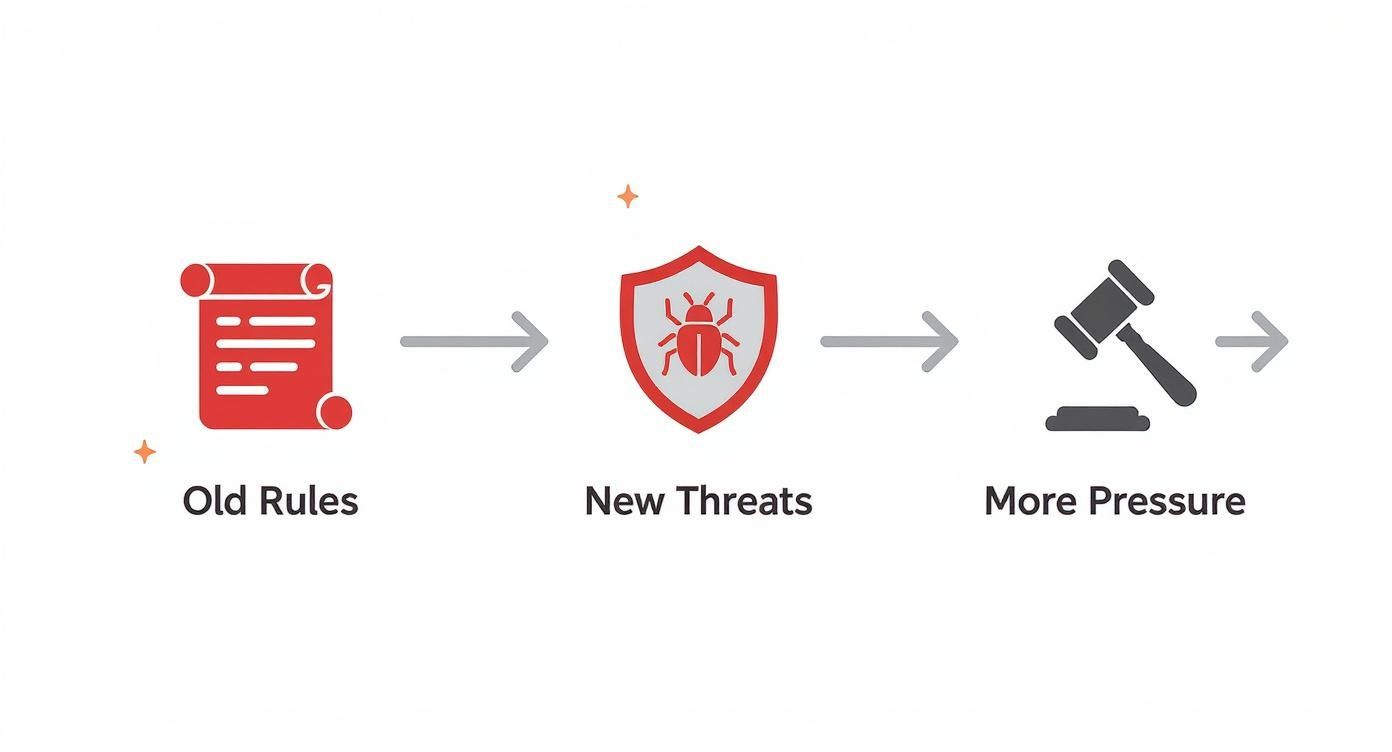
This new reality is precisely why modern audits are so comprehensive. They have to be.
Different Audits for Different Goals
Not all audits are the same. On the path to ISO 27001 certification, you'll run into three distinct types, each serving a very different purpose. Getting your head around these helps turn the process into a series of helpful checkpoints rather than one massive, do-or-die exam.
-
First-Party Audits (Internal Audits): Think of this as your dress rehearsal. You can run these yourself or bring in a consultant to play the role of the auditor. It’s your golden opportunity to kick the tyres, find any weak spots, and fix them long before the official auditors show up. You’re essentially marking your own homework against the ISO 27001 standard.
-
Second-Party Audits: These are usually driven by your customers or partners. For instance, a major corporate client might want to audit your security before they trust you with their data. It’s a way for them to do their due diligence, and it's becoming incredibly common as everyone gets smarter about supply chain risk.
-
Third-Party Audits (Certification Audits): This is the main event. An independent, accredited auditor comes in to formally assess whether your Information Security Management System (ISMS) meets every requirement of the ISO 27001 standard. Pass this, and you earn your certification.
The Two Stages of ISO 27001 Certification
The formal certification audit isn’t a single event; it's split into two clear phases. This approach is designed to eliminate surprises and make sure everyone is on the same page before the deep dive begins.
Stage 1: The Documentation Review
Think of Stage 1 as a readiness check. The auditor isn’t there to watch you work or interview your team just yet. Their entire focus is on your paperwork. They need to see that you’ve designed a complete, logical Information Security Management System (ISMS) on paper before they check how it works in practice.
During this phase, they'll pour over key documents like:
- The defined scope of your ISMS.
- Your high-level information security policy.
- Your risk assessment methodology and the resulting risk treatment plan.
- The Statement of Applicability (SoA), which is your list of chosen ISO 27001 controls and your justification for them.
The real goal of Stage 1 is to catch any showstoppers early. If there are big gaps in your documentation, the auditor will point them out so you can fix them before investing time and money in the much more intensive Stage 2.
Stage 2: The Onsite Verification
Once you've passed Stage 1, it's time for the main audit. This is where the auditor comes to see your ISMS in action (either on-site or remotely). They are looking for hard, objective evidence that you actually "do what you say you do."
This means they’ll be talking to your staff, watching processes unfold, and digging through your records. They are methodically working through your security controls, looking for tangible proof that they are fully implemented and effective.
What Kind of Evidence Do Auditors Actually Look For?
A well-written policy is nice, but it’s meaningless to an auditor without proof. They need to see evidence that your controls are alive and working every day. The exact evidence they ask for will depend on the controls you’ve implemented, but it’s always about tangible proof.
Here are a few real-world examples of what an auditor might ask to see:
| Control Area | Sample Evidence an Auditor Might Request |
|---|---|
| Access Control | A live demonstration of user access rights, followed by a review of system logs to show only authorised staff accessed a sensitive database. |
| Human Resources | Onboarding checklists and signed confidentiality agreements for the last five new hires. |
| Security Awareness | Copies of your training materials, attendance records from the last phishing simulation, and quiz results. |
| Incident Management | The complete incident log for the past 12 months, including tickets, post-mortem reports, and evidence of corrective actions taken. |
| Asset Management | Your up-to-date asset register, along with examples of how data is labelled and handled according to its classification. |
When you have this kind of evidence ready to go, the audit transforms from a stressful interrogation into a straightforward "show and tell." You’re simply walking the auditor through the great work you’ve already done.
For an even deeper dive into what to expect, our detailed guide on the ISO 27001 audit breaks it down further. At the end of the day, the audit is your chance to validate your commitment to security and earn the certification that proves it to the world.
Your Playbook for a Flawless Audit
Let's get one thing straight: confidence in an audit comes from preparation, not perfection. The goal isn't to be flawless from day one. It's about having a structured, logical game plan that proves your commitment to keeping information secure. This playbook is your clear, actionable roadmap to get your business ready for an ISO 27001 audit, turning a potentially chaotic process into a project you can actually manage and win.

But this journey doesn’t start with technology or paperwork. It starts with people. Without genuine support from the top, even the best-laid plans will hit a wall.
Step 1: Secure Genuine Leadership Buy-In
Before you write a single policy, the most critical first move is getting your leadership team on board. This is about more than just securing a budget; it's about making security a core business value. An audit can be disruptive, and you’ll need that executive backing to push through new policies and get the resources you need.
Frame the conversation around business benefits, not tech-speak. Talk about how ISO 27001 certification can unlock bigger contracts, build rock-solid customer trust, and slash the financial risk of a data breach. When leaders see audits and compliance as a strategic advantage, the whole process gets a lot easier.
Step 2: Define Your Scope Correctly
One of the most common early blunders is trying to certify the entire organisation at once. For most small businesses, this is a recipe for disaster. The "scope" of your Information Security Management System (ISMS) simply defines which specific parts of your business will be audited and certified.
Think carefully about what you really need to protect. Does the certification need to cover the whole company, or just a specific product, service, or location that handles sensitive client data? A tightly defined scope makes the audit process far more focused and achievable.
For example, a software company might decide to only scope its ISMS to include the development team, the production servers, and the customer support platform. This leaves departments like finance or marketing out of the initial certification, simplifying the effort immensely.
Step 3: Conduct a Meaningful Risk Assessment
The real heart of ISO 27001 is risk management. An audit isn't about getting rid of every single risk—that’s impossible. It's about showing you have a smart, structured way of identifying, analysing, and treating them.
This process breaks down into a few key actions:
- Identify Assets: What information is gold to your business? Think customer databases, source code, or employee records.
- Identify Threats: What could go wrong? This could be a ransomware attack, an employee clicking a dodgy link, or a server failing.
- Identify Vulnerabilities: What are your weak spots? This might be unpatched software, a lack of staff training, or weak password policies.
Once you have this list, you can figure out the likelihood and potential impact of each risk to prioritise what you fix first. This assessment directly tells you which security controls you actually need. For a deeper dive, check out this excellent IT Compliance Assessment Complete Guide.
Step 4: Implement Annex A Controls
Annex A of the ISO 27001 standard gives you a menu of 93 potential security controls, sorted into four themes: organisational, people, physical, and technological. The risk assessment you just did will tell you which of these controls are relevant to your business.
The key here is that you don't have to implement every single one. What you do have to do is justify your decisions. You’ll record why you’ve included or excluded each control in a crucial document called the Statement of Applicability (SoA), which is one of the first things an auditor will ask for.
Key Takeaway: The goal isn't to build an impenetrable fortress. It's to build a sensible, risk-based defence that fits your business, and to have the paperwork to prove you’ve thought it through.
Step 5: Create Lean and Effective Documentation
Paperwork is a non-negotiable part of any audit, but it doesn't have to be a bureaucratic nightmare. Auditors are looking for clarity and consistency, not thousand-page manuals that no one reads.
Focus on creating lean, practical documents that your team will actually use. Your core documentation will usually include:
- The Information Security Policy
- The Scope of the ISMS
- The Risk Assessment and Treatment Plan
- The Statement of Applicability (SoA)
- Procedures for key processes (like access control and incident response)
Keep it simple. The best documentation is a living resource that guides day-to-day work, not a dusty binder that only comes out for the audit.
Step 6: Run Impactful Staff Training
At the end of the day, your people are your most important security control. An auditor will want to see proof that your team understands their security responsibilities. A one-off email won’t cut it; you need a proper awareness program.
Run training sessions on key topics like your security policy, how to handle data correctly, and how to spot phishing attacks. Keep records of who attended. Even better, test their understanding with quizzes or simulated phishing campaigns to prove the training is actually sticking.
Step 7: Perform a Rigorous Internal Audit
Before you call in the external auditors, you have to audit yourself. An internal audit is a mandatory part of ISO 27001, and for good reason—it’s your best chance to find and fix problems on your own terms. Think of it as a dress rehearsal.
This friendly audit allows you to test your controls, check your documents, and talk to staff to see if the ISMS is working as intended. You can get a better handle on this by learning what an ISO internal audit really involves. Any issues you find—called "nonconformities"—can be sorted out long before the certification auditors arrive.
To make this playbook even more practical, here’s a step-by-step checklist to guide your preparation from start to finish.
ISO 27001 Audit Preparation Checklist
| Phase | Key Action | Primary Outcome |
|---|---|---|
| Phase 1: Foundation | Secure leadership buy-in and define the ISMS scope. | A clear mandate, budget, and defined boundaries for the project. |
| Phase 2: Risk Management | Conduct a thorough risk assessment and create a risk treatment plan. | A prioritized list of information security risks and a plan to address them. |
| Phase 3: Control Implementation | Select and implement relevant Annex A controls and complete the Statement of Applicability (SoA). | A functional set of security controls and a formal record of your control choices. |
| Phase 4: Documentation | Develop and approve all required policies, procedures, and records. | A complete, lean, and usable set of ISMS documentation. |
| Phase 5: Engagement | Conduct staff awareness training and communication campaigns. | An informed team that understands and can follow security procedures. |
| Phase 6: Verification | Perform a full internal audit and a management review meeting. | Identification of nonconformities and formal management oversight of the ISMS. |
| Phase 7: Remediation | Address all findings from the internal audit and management review. | An improved ISMS that is ready for external scrutiny. |
Following these seven steps and using this checklist will provide a solid foundation, transforming the audit from a dreaded exam into a final, validating checkpoint on your journey to certification.
Avoiding the Common Pitfalls in Compliance
Embarking on any compliance journey, especially one for a standard as thorough as ISO 27001, is a serious commitment. While the path to certification is clear, it's also littered with common, preventable hurdles. Knowing what these are ahead of time isn't about being negative; it's about being smart. A little foresight can save you a world of headaches, wasted money, and frustration down the track.
This section shines a light on the most frequent mistakes businesses make during their audits and compliance initiatives. More importantly, it gives you a practical playbook for building a program that’s not just effective, but built to withstand scrutiny from day one.
Pitfall 1: Your Scope is a Mess
One of the earliest and most damaging mistakes you can make is getting the scope of your Information Security Management System (ISMS) wrong. If it's too broad, you’re trying to boil the ocean. Your resources will be stretched thin, and the audit will become a tangled, complex nightmare.
But if your scope is too narrow, you might miss the very systems and data your clients are worried about, which defeats the entire purpose of getting certified in the first place.
Imagine a software company that decides to include its marketing and finance departments in its initial ISO 27001 scope. While their heart is in the right place, it needlessly complicates things. Auditors will now have to check security controls on systems that have little to do with the core product, blowing out the time and effort required.
The Fix: Get Laser-Focused
The trick is to start small and smart. Begin with your most critical assets and processes. Ask yourself: "What exactly do our customers need us to protect?" Then work backwards from that answer. A well-defined scope statement should clearly map out the boundaries, including specific locations, departments, tech, and services. This focused approach makes your initial audit manageable and delivers real value where it counts.
Pitfall 2: Treating It as a One-Time Project
So many organisations treat getting certified as the finish line. They throw a massive amount of effort into passing the audit, only to let their carefully crafted policies and procedures collect digital dust a month later. This "set and forget" mentality is a guaranteed recipe for failure.
Compliance isn't a project with an end date; it’s a constant process of getting better. An audit is just a snapshot in time. The real work is in maintaining and improving your security posture every single day. If you neglect this, your next surveillance audit will turn into a last-minute, high-stress scramble.
The most successful compliance programs are woven into the daily rhythm of the business. They are living, breathing systems that adapt to new threats and business changes, not static documents stored on a server.
Pitfall 3: Failing to Get Real Leadership Buy-In
Let's be blunt: without genuine commitment from the top, any compliance initiative is doomed. If the leadership team sees audits and compliance as just another expensive box-ticking exercise, you'll constantly be fighting for the budget, resources, and authority you need to make meaningful changes.
This lack of commitment always trickles down. When employees see that management isn't taking security seriously, why would they? This leads to poor adoption of new policies and a culture that actively works around security controls, creating massive vulnerabilities.
The Fix: Talk Business Value, Not Jargon
To get your executives on board, you need to speak their language. Ditch the technical talk about security controls. Instead, frame the entire discussion around risk, return on investment, and competitive advantage.
- Slash Your Risk: Explain how ISO 27001 certification directly lowers the financial and reputational risk of a data breach.
- Unlock New Doors: Show them how certification can open up new revenue streams by letting you work with bigger, security-conscious clients who demand it.
- Work Smarter: Highlight how a well-structured ISMS actually improves business processes and cuts down on security-related disruptions.
When leaders understand that compliance is a strategic enabler, not just a cost, they'll become its biggest champions.
Pitfall 4: Forgetting That Culture is Everything
Regulators are looking beyond the paperwork these days. They want to see proof of a deeply embedded security culture where protecting information is everyone's job. This is a huge point of focus for Australian regulators like the Australian Securities and Investments Commission (ASIC). They’ve even taken action against auditors for failing to uphold standards, pointing directly to poor compliance cultures that led to major issues being ignored. You can read more about ASIC's recent audit and reporting findings to see how seriously they take this.
A checklist can't create culture. You can have the best policies in the world, but if your team doesn't understand them or, worse, doesn't care, they’re useless. A good auditor can spot a weak culture a mile away, just by talking to your people and observing their daily habits.
The Fix: Invest in Constant Awareness and Training
Building a strong security culture takes a dedicated, ongoing effort.
- Make Training Engaging: Ditch the boring, once-a-year PowerPoint presentations. Use interactive modules, real-world examples, and even simulated phishing attacks to make the lessons stick.
- Communicate the "Why": Don't just tell people the rules; regularly explain why the security policies exist. Help your team see how their actions directly protect the company and its customers.
- Lead from the Front: When leaders visibly follow security protocols themselves, it sends a powerful message that the rules apply to everyone, no exceptions.
By sidestepping these common pitfalls, you shift your approach from reactive firefighting to proactive, strategic management. This doesn't just smooth your path to certification—it builds a more resilient, trustworthy, and competitive business for the long haul.
Building a Future-Proof Compliance Strategy
Meeting today’s standards is one thing, but being ready for what’s around the corner is a different game entirely. A truly solid strategy for audits and compliance isn't just about ticking boxes to pass the next review. It’s about building a sustainable, forward-looking program that actually thrives on change, turning compliance from a defensive chore into a real business advantage.
The end goal is simple: move from a reactive stance to a proactive one. Instead of scrambling when new rules drop, a future-proof strategy sees them coming. It’s all about creating an organisation that’s resilient, agile, and fundamentally trustworthy—one that’s set up for long-term success, no matter how the regulatory winds shift.
Cultivating a Powerful Compliance Culture
The strongest compliance programs are built on a surprisingly simple foundation: a culture where everyone feels they have skin in the game. When security and compliance become everyone's responsibility—not just a job for the IT or legal teams—the whole organisation gets stronger. It stops being a siloed task and becomes a shared value.
This kind of cultural shift has to start at the top. When leadership consistently talks about the importance of compliance and models the right behaviour, that message filters down through every team. The aim is to create an environment where doing the right thing is simply the easiest and most natural path for every single employee.
Strategic audits and compliance are about more than just following rules; they are about building a resilient, agile, and trustworthy organisation poised for long-term success.
This is especially true in Australia, where the regulatory landscape is evolving at a breakneck pace. We’ve recently seen major reforms hitting everything from new Wage Theft laws and Climate Financial Disclosures to the Cyber Security Act and tough new scam prevention rules. This crackdown comes with eye-watering fines and greater personal accountability for directors, forcing companies to sharpen their internal controls. Having audit-ready logs is no longer a 'nice-to-have'; it's a key line of defence. To get a handle on the full scope of these changes, you can find more insights on compliance risks in Australia.
Leveraging Technology and Automation
Trying to manage modern compliance with spreadsheets and manual checklists is like trying to navigate Sydney traffic with a street directory from the 90s. It’s slow, you’re bound to make a mistake, and you’ll probably miss your exit. Technology and automation aren’t a luxury anymore; they’re essential tools for building a compliance program that actually works.
Modern Governance, Risk, and Compliance (GRC) platforms can take so much of the grunt work out of managing audits and compliance.
- Continuous Monitoring: Imagine tools that constantly scan your systems for weak spots or misconfigurations, flagging issues in real-time—not weeks later when an auditor finds them.
- Streamlined Evidence Collection: Instead of manually pulling together screenshots and logs for an audit, the software can collect and organise the proof for you. This can save hundreds of hours.
- Centralised Reporting: A good GRC platform gives you a single source of truth. You get clear dashboards that show your compliance posture at a glance and highlight any high-risk areas needing attention.
By handing off these repetitive tasks to technology, you free up your team to focus on the stuff that really matters—like risk analysis, improving processes, and training people. It's not just about minimising human error; it's about getting powerful insights that would be impossible to spot manually.
Unifying a Converging Compliance Landscape
Not so long ago, cybersecurity, data privacy, and financial compliance were treated like separate worlds. They were often managed by different teams with completely different goals. Today, these worlds are colliding. A cybersecurity slip-up is now a data privacy breach, which can quickly become a financial reporting nightmare.
A future-proof strategy sees this convergence and builds a single, unified framework to handle it. Instead of tackling each regulation in its own silo, this approach maps your controls across multiple frameworks.
Think about it: a single access control policy can help you meet requirements for ISO 27001, the Privacy Act, and PCI DSS all at once. This "implement once, comply many" approach pays off in big ways:
- Reduces Redundancy: You stop wasting time and money implementing and auditing the same control over and over for different regulations.
- Improves Consistency: A unified framework ensures your security and compliance efforts are applied the same way across the entire organisation.
- Provides a Holistic View: You get a complete picture of your risk, not a fragmented view from different departmental silos.
This integrated approach is the secret to managing the ever-growing complexity of the regulatory world without your workload exploding. By building a unified compliance framework, you create a system that’s not only more efficient but also far more resilient. It puts your business in a position to adapt quickly and confidently, turning compliance into a genuine strategic asset.
Got Questions About Audits and Compliance? We've Got Answers.
Stepping into the world of audits and compliance for the first time? It’s completely normal to have a heap of questions. Let’s tackle some of the most common ones we hear from businesses just starting their ISO 27001 journey.
How Long Will It Take to Get Ready for an ISO 27001 Audit?
This is the classic "how long is a piece of string?" question, but I can give you a realistic idea. The timeline really hinges on your company's size, how complex your operations are, and where your security posture is right now.
For a small or medium-sized business starting from scratch, you should probably budget for 6 to 12 months. That gives you enough breathing room to do everything properly—from figuring out your scope and doing a proper risk assessment, to putting controls in place and running a full internal audit cycle.
Of course, if you’ve already got some solid security processes in place, you might be able to get it done much faster, maybe in as little as 3 to 6 months.
What’s the Real Difference Between an Internal and External Audit?
This is a great question, and the distinction is crucial. While both are essential for genuine audits and compliance, they have completely different jobs.
-
Think of an internal audit as your dress rehearsal. It’s carried out by your own people (or a consultant you bring in) to see how your systems stack up against your own policies and the ISO 27001 standard. The whole point is to find and fix any gaps before the official auditors show up.
-
The external audit is the main event. This is performed by an independent, accredited certification body. Their job is to give an unbiased, objective verdict on whether you truly meet the ISO 27001 standard. Pass this, and you get your official certification.
Can We Really Manage All This Without Specialised Software?
Look, it’s technically possible. A small business can try to manage its compliance using a patchwork of spreadsheets, Word documents, and calendar reminders. But let's be honest, that approach gets messy fast and is incredibly prone to human error, especially as your business or the regulations get more complex.
Trying to manage compliance manually is like doing your company accounts with a shoebox full of receipts. It might work when you’re tiny, but it’s a recipe for disaster as you start to grow.
This is why investing in dedicated Governance, Risk, and Compliance (GRC) software is a smart move. It takes care of the tedious stuff like monitoring controls, gathering evidence, and pulling together reports. You get a single, clear dashboard to see what's going on, which makes preparing for an audit a whole lot less stressful and keeps everything consistent. It’s the right choice for any business that’s serious about getting compliance right for the long haul.
Ready to take the complexity out of your ISO 27001 certification journey? The experts at Anitech have a 100% success rate in guiding Australian businesses through every stage of the process, from documentation to certification. Get in touch with our team today to build a compliance strategy that protects your business and powers your growth.
Recent Comments