

Quick Summary: ISO 27001 is more than a compliance certificate; it's a strategic framework for building genuine business resilience. By moving beyond a simple checkbox mentality, organisations can leverage ISO 27001 to align security with business goals, ensure operational continuity, and create a proactive culture that withstands modern cyber threats.
Let's be honest: many see ISO 27001 as just another certificate to hang on the wall, a box-ticking exercise to satisfy clients or regulators. But thinking that way misses the entire point. This guide explores going beyond compliance: building business resilience via ISO 27001 is not just about passing audits; it's about embedding a framework for operational continuity and long-term stability into your organisation's DNA.
When you properly embed a risk-based Information Security Management System (ISMS) into your core operations, something fundamental shifts. You move from a reactive, constantly-on-the-back-foot security posture to one of proactive readiness. This is how you safeguard your organisation, ensure operational continuity, earn unwavering trust, and build a truly resilient business that can weather any storm.
Achieving ISO 27001 certification isn't the finish line. It’s the starting block for creating a durable, adaptive organisation. It elevates information security from an IT problem to a core business function, giving you the structure to withstand, adapt to, and recover from whatever comes your way.
Why Mere Compliance Fails to Build Business Resilience
In an environment where cyber threats are relentless and sophisticated, simply checking boxes on a compliance list is a recipe for disaster. A compliance-only mindset breeds a static, rigid security posture that’s almost immediately out of date and completely ineffective against modern attack vectors. This approach fails to build true business resilience because it focuses on meeting minimum standards rather than preparing for real-world disruptive events.

This approach creates a dangerous false sense of security. You might sail through an audit today, but what about tomorrow when a zero-day exploit or a cleverly disguised phishing email lands in an inbox? True business resilience demands a dynamic, risk-based approach that anticipates threats to ensure operational continuity, rather than just cleaning up the mess after the damage is done.
The Escalating Threat to Operational Continuity
The modern threat landscape is unforgiving, and Australia is right in the thick of it. We've seen a staggering 47 million individual data breaches reported. The nation now ranks fourth globally for attacks, and a deeply concerning 11% of these hit our critical infrastructure.
These aren't just abstract numbers; they're a wake-up call. They show exactly why a robust framework like ISO 27001 is about so much more than meeting regulatory requirements. And this isn't just a "big company" problem. Small and medium-sized businesses are often seen as easier targets, making a solid security framework a matter of survival and a key component of ensuring operational continuity.
Business resilience is the ability to not just survive a disruptive event but to emerge stronger. It’s about maintaining operational integrity, preserving customer trust, and adapting to new challenges without missing a beat. ISO 27001 provides the blueprint for this capability.
From a Compliance Mindset to a Resilience Culture
Moving from a compliance checklist to a culture of resilience is about changing your entire perspective. This table breaks down the fundamental differences in thinking and action.
| Aspect | Compliance-Only Approach | ISO 27001 Resilience Approach |
|---|---|---|
| Goal | Pass audits and avoid penalties. | Protect the business, maintain operational continuity, and adapt to threats. |
| Mindset | Reactive and static. "What's the minimum we have to do?" | Proactive and dynamic. "What could go wrong and how do we prepare?" |
| Focus | Meeting specific control requirements. | Managing information security risks to ensure business resilience. |
| Ownership | An IT or compliance department task. | A shared responsibility across the entire organisation. |
| Outcome | A certificate and a false sense of security. | A stronger, more adaptive organisation with a competitive advantage. |
The distinction is clear. One is a defensive crouch, driven by fear of penalties. The other is an agile, forward-looking stance, driven by a commitment to long-term success and business resilience.
This shift is crucial. Organisations that embrace ISO 27001 as a framework for genuine resilience gain real, tangible advantages:
- Proactive Risk Management: You stop waiting for incidents to happen. Instead, you actively identify, assess, and treat risks before they can hurt your operations.
- Sharper Decision-Making: With a clear view of your information security risks, your leadership team can make smarter, more informed decisions about where to invest resources and what to prioritise.
- Unshakeable Stakeholder Trust: When you can prove your commitment to resilience, you build incredible confidence with customers, partners, and regulators. That's a powerful competitive edge.
Ultimately, building business resilience with ISO 27001 is about weaving security into the very fabric of your organisation. It’s a journey, and a foundational first step is truly understanding the key differences between security risks and compliance obligations.
Aligning Risk Management with Your Business Goals
The real genius of ISO 27001 isn't just about ticking security boxes; it's about weaving information security directly into the fabric of your business strategy. It stops security from being a siloed IT problem and turns it into a powerful tool for ensuring operational continuity and long-term success. This alignment is what makes the standard so effective—it ensures your efforts are aimed squarely at protecting what actually drives your business forward, not just passing an audit.
Instead of slapping a generic security template on your organisation, ISO 27001 forces you to get real about your specific operational priorities through a detailed risk assessment. It’s this context-driven approach that lays the foundation for genuine business resilience.
From Abstract Risk to Concrete Business Impact
Let's be honest, every business has a unique set of worries. The risks that give a government contractor sleepless nights are a world away from what keeps an e-commerce founder up at night. ISO 27001 gets this.
For instance, a defence contractor's world revolves around the confidentiality of sensitive project data. A single leak could mean catastrophic contract penalties, losing their security clearance, and a reputational nosedive they may never recover from. Their risk assessment has to reflect that reality.
On the other hand, an online retailer is obsessed with the availability of their website and payment gateway. Even a couple of hours of downtime during a major sale could mean a massive hit to revenue and send frustrated customers straight to a competitor. For them, a solid risk management process is fundamental to operational continuity and a massive competitive advantage.
A Practical Approach to Risk Assessment
A truly effective risk assessment is much more than a long list of potential threats. It’s a structured way of thinking that helps you identify, analyse, and evaluate risks so you can make smart, informed decisions about how to handle them.
Here’s how you can put that theory into practice:
- Know your assets: First, what information is absolutely critical to your business? Think client data, intellectual property, financial records, and core system configurations.
- Identify the threats: What could actually go wrong? This isn't just about hackers. You need to consider everything from disgruntled insiders and system failures to fires and floods.
- Analyse the fallout: If a risk becomes a reality, what’s the real-world damage? Try to put a number on it—think financial loss, reputational harm, legal fines, and operational chaos.
- Prioritise what matters: You can't fix everything at once. Use a simple risk matrix to score each risk based on its likelihood and potential impact. This helps you focus your time, money, and people where they'll make the biggest difference.
When you systematically weigh up risks against your core business priorities, you create a clear line of sight from a specific security control right through to the operational stability it provides. Your Information Security Management System (ISMS) suddenly transforms from a dusty binder on a shelf into a living, breathing tool for strategic decisions.
Mapping Controls to Business Goals
Once your risks are prioritised, the next move is to choose the right controls to manage them. This is where the ISO 27001 Annex A controls really shine. The key is to create an undeniable link between the control you implement and the business goal it’s there to protect.
Let’s look at a few real-world scenarios:
| Business Goal | Identified Risk | Relevant Annex A Control | Resilience Outcome |
|---|---|---|---|
| Protect Client Revenue | Unauthorised access to financial systems leads to fraudulent transactions. | A.9.4.1 (Secure log-on procedures) Implementing multi-factor authentication (MFA). | Prevents direct financial loss and maintains the trust clients have in your payment systems. |
| Maintain Operational Continuity | Ransomware attack encrypts critical servers, grinding operations to a halt. | A.12.3.1 (Information backup) Regular, tested backups of all critical systems. | Allows you to recover services quickly, dramatically reducing downtime and protecting long-term stability. |
| Safeguard Intellectual Property | An exiting employee steals proprietary software code on their way out the door. | A.8.1.3 (Acceptable use of information) Clear policies and technical controls that prevent data being copied to USBs or personal cloud accounts. | Protects your competitive edge and the long-term health of your business. |
Following this methodical process makes security investments a much easier conversation to have. You're no longer just "implementing MFA"; you're actively "protecting client revenue." This simple shift in framing is vital for getting the leadership team on board and building a security-first culture. A well-defined risk management strategy is ultimately the cornerstone for moving beyond mere compliance and building sustainable business resilience with ISO 27001.
Your Incident Response Plan: From Chaos to Control
Let’s be realistic: you can't stop every single security incident. It's just not possible. True business resilience isn't about building an impenetrable fortress; it's about having a calm, well-rehearsed plan for when the walls are inevitably breached. This is where ISO 27001 shines, helping you turn the chaos of an incident into a structured, effective response that ensures operational continuity.
Without a solid plan, a minor issue can quickly spiral into a full-blown catastrophe. An ISO 27001-aligned incident response plan gives your team clarity when stress levels are high, ensuring everyone knows exactly what to do. This isn't just about ticking a compliance box—it's about building genuine resilience and long-term stability from the ground up.
Defining Roles and Responsibilities
When an incident hits, confusion is your worst enemy. The most critical first step is defining who does what before you ever need it. Who has the authority to declare an incident? Who’s cleared to talk to the media?
If these roles aren't crystal clear, decision-making stalls. Picture a ransomware attack unfolding. Your IT Manager knows they need to take critical systems offline right now to stop the spread. But if they have to wait hours for the CEO to approve it, the damage could be catastrophic. Your plan must spell out the chain of command and the specific duties of every person on the response team.
Establishing Clear Communication Protocols
Panic is contagious, and a poorly handled announcement can damage your reputation more than the breach itself. A key part of building a resilient data breach response plan is getting your communications strategy right.
Your ISO 27001-guided plan should map out:
- Internal Updates: Who inside the company needs to know what’s happening, and when? Think executives, legal, and any staff whose work is impacted.
- External Messaging: Get pre-approved templates ready for clients, partners, and regulators. This keeps your story consistent, transparent, and calm.
- Media Point Person: Designate one trained spokesperson to handle all media questions. This prevents conflicting messages and misinformation from getting out.
The aim is to control the narrative and maintain trust. A well-oiled communication strategy is the backbone of any strong incident response plan.
Real-World Scenario: Ransomware Attack
Let's walk through a common nightmare: an employee clicks a dodgy link, and ransomware starts locking up your file servers. With a tested, ISO 27001-aligned plan, the response is immediate and organised.
The IT team spots the strange activity and confirms it’s ransomware, alerting the Incident Response Lead. Following protocol, they instantly isolate the infected servers from the network, containing the threat.
Next, the team hunts down the source of the breach and wipes the malicious software from the systems. With the threat gone, they begin restoring data from clean, tested backups—a crucial control in Annex A—and carefully bring services back online. Finally, a post-incident review digs into how it happened and what can be done to stop it from happening again.
This flow is all about a proactive cycle of identifying, analysing, and controlling risks, which is fundamental to stopping these incidents before they start.
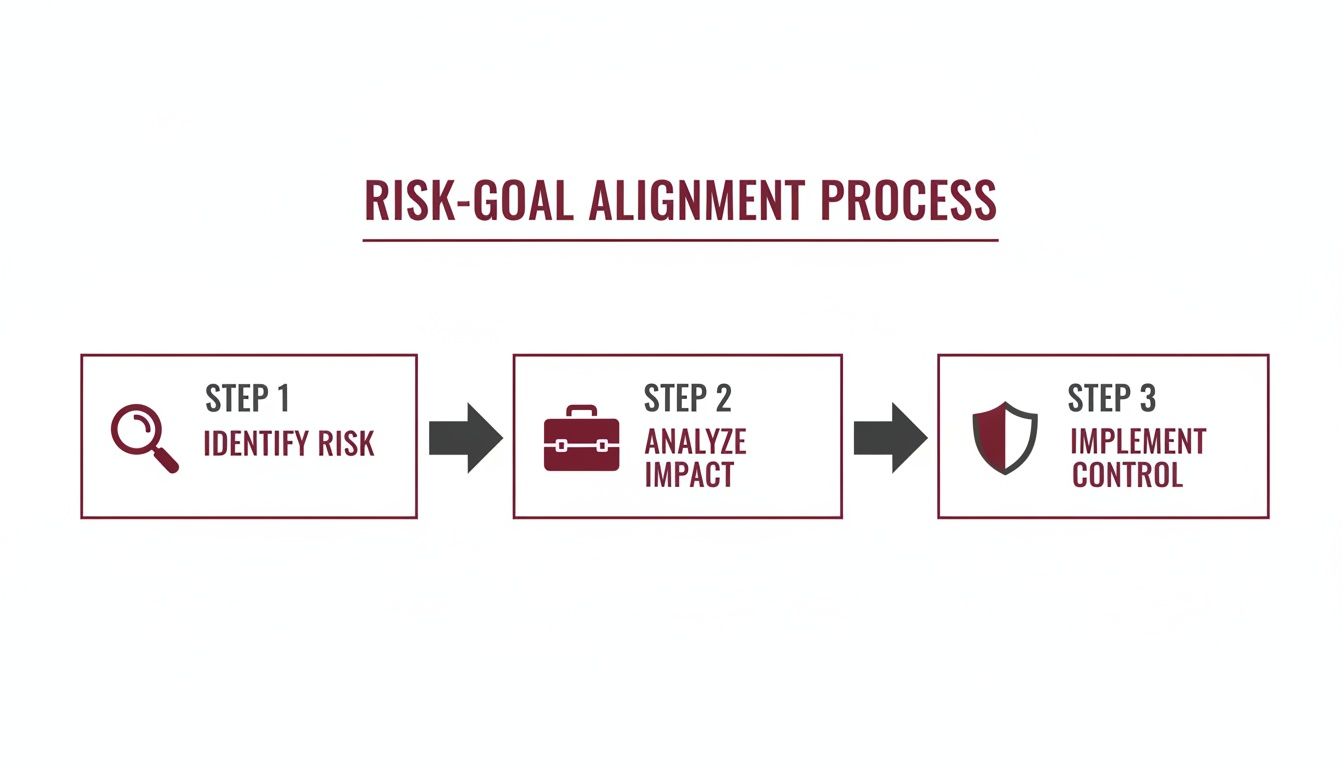
As you can see, a proactive risk management culture, driven by ISO 27001, directly strengthens your ability to respond by shrinking your attack surface in the first place.
The Power of Regular Testing and Drills
An incident response plan gathering dust on a shelf is completely useless. The whole point of ISO 27001's focus on continual improvement is to regularly test your procedures. These simulations, from simple tabletop exercises to full-scale drills, are where you discover the cracks in your plan before a real crisis does.
This is what truly separates a compliant business from a resilient one. And it’s not an optional extra. Australia recently saw an alarming 1,113 data breaches reported to the OAIC, a 25% spike from the previous year and the highest figure since the Notifiable Data Breaches scheme was introduced. This surge shows precisely why having a battle-tested plan is non-negotiable.
A well-rehearsed plan can be the difference between a few hours of manageable downtime and weeks of crippling chaos. Regular drills build muscle memory, ensuring your team acts decisively and effectively under pressure.
Extending Resilience Across Your Supply Chain
Let's be blunt: your organisation's security is only as strong as its weakest link. In today's interconnected world, that weak link is very often a third-party supplier, vendor, or partner. Building genuine business resilience with ISO 27001 means you have to look beyond your own four walls and get serious about managing the risks that come with your supply chain.
This isn't just theory. Data breaches that start with a third party have doubled in recent years, and now make up a staggering 30% of all incidents. Thankfully, ISO 27001 gives us a clear framework to work with, especially in Annex A.15 (Supplier Relationships), to make sure your partners don’t become your biggest liability.
Vetting Vendors Before They Get the Keys
The best way to handle supplier risk is to tackle it head-on, long before a contract is ever signed. Due diligence isn't just a box to tick; it's non-negotiable. It's time to move beyond simple cost comparisons and start treating a potential supplier's security posture as a critical factor in your decision.
You need to ask pointed, specific questions that show you what they’re really made of. Don't let them get away with vague promises.
- Security Certifications: Are they ISO 27001 certified themselves? If not, what other recognised frameworks (like the NIST CSF or SOC 2) can they prove they follow?
- Incident Response: Can you see a copy of their incident response plan? Ask them straight up: "How would you notify us if a breach affects our data?"
- Access Controls: How do they manage who gets access to sensitive systems? What happens when an employee leaves? You need to know that access is cut off immediately.
The quality of their answers—or the lack of them—will tell you everything you need to know about how seriously they take security. A vendor who is open and organised during this process is one you can probably trust.
Embedding Security into Your Contracts
A handshake and a promise simply won't cut it. Your supplier contracts must have explicit, legally binding security clauses to protect your organisation. These clauses are your first line of defence when—not if—something goes wrong.
To properly extend resilience beyond your own business and manage these interconnected risks, it's essential to put in place robust Third-Party Risk Management (TPRM) programs. These contractual safeguards are a fundamental part of that.
Think of your legal agreements as an extension of your own security policy. Clearly spell out your security expectations, the penalties for not meeting them, and the exact steps for handling a security incident. This level of clarity stops the finger-pointing when you're in the middle of a crisis.
Here are a few key clauses you should insist on:
- Data Breach Notification: Specify a strict timeframe for them to tell you about a breach (e.g., within 24 or 48 hours of discovery), not just when it suits them.
- Right to Audit: Include a clause that gives you the right to audit their security controls or demand third-party audit reports.
- Security Requirements: Mandate specific controls that match your own ISO 27001 policies, such as requiring data encryption both in transit and at rest.
A Practical Scenario: A Small Business and Its IT Provider
Imagine a small accounting firm. They outsource all their IT management—cloud hosting, network security, everything—to a third-party provider. The firm's ability to operate and its operational continuity are completely tied to the security practices of this single partner.
Using the ISO 27001 framework, the firm’s compliance officer runs an annual security assessment on their supplier. They check the IT provider’s access logs, confirm that software patches are being applied on time, and make sure that data backups are being tested properly.
During one of these reviews, they find a critical flaw: a former employee of the IT provider still had active login details for their systems. By enforcing the principles of ISO 27001, the firm spotted this dangerous gap and got it fixed immediately, preventing a potential disaster.
This kind of proactive oversight is what building resilience is all about. It transforms supplier relationships from a source of unknown risk into a verified, secure extension of your own operations.
Driving Lasting Resilience with Continual Improvement
So, you’ve achieved ISO 27001 certification. That's a massive accomplishment, but it's crucial to understand that this isn't the finish line. Far from it. This is the starting pistol for a new, more resilient way of operating your business.
Think of your certification not as a static trophy to sit on a shelf, but as a living, breathing system. It’s designed to adapt to new threats, shifting business goals, and the relentless pace of technological change. This is where the real work—and the real value—of building business resilience via ISO 27001 truly begins.
The engine that powers this entire process is continual improvement. You’re essentially creating a feedback loop that ensures your Information Security Management System (ISMS) gets smarter and stronger over time. Without this commitment, even the most brilliantly designed security program will eventually fall behind.
The PDCA Cycle in Action
At the heart of ISO 27001's improvement model is the Plan-Do-Check-Act (PDCA) cycle. It’s a beautifully simple yet incredibly powerful framework that keeps your security efforts methodical, measurable, and always moving in the right direction. It’s what transforms your ISMS from a static rulebook into a dynamic, self-correcting system.
Let's unpack what this looks like in the real world:
- Plan: This is your strategy session. Based on your risk assessment, you set clear objectives. For instance, you might plan to cut the number of successful phishing attempts by 50% over the next three months.
- Do: Now it's time for action. You roll out the controls and processes needed to hit that target. This could mean implementing new email security software and running targeted training for your team.
- Check: This phase is all about measurement. You monitor how your new controls are performing. Are phishing clicks actually going down? Are people reporting suspicious emails more often? You need hard data here.
- Act: Based on what you learned, you make adjustments. If the training was a huge success but the new software is underperforming, you might "act" by fine-tuning the software's configuration or even looking for a better solution.
This isn't a one-and-done exercise. It's a continuous loop that, over time, embeds a proactive security culture deep within the DNA of your organisation.
Measuring What Truly Matters
You can't improve what you don't measure. A critical part of the "Check" phase is tracking Key Performance Indicators (KPIs) that tell you if your security controls are actually working. The trap many organisations fall into, however, is getting lost in technical metrics that mean absolutely nothing to the board.
To build genuine business resilience, you need to connect security performance directly to business outcomes. A CEO might not care about firewall block rates, but they will absolutely sit up and pay attention to metrics that show reduced risk and improved operational stability.
The trick is to translate technical security data into the language of business risk. When you can draw a straight line from your ISMS activities to a reduction in potential financial or reputational damage, you’ve won the battle for ongoing investment and executive buy-in.
To make this tangible, you need to be tracking KPIs that tell a clear story. Here’s a look at some metrics that effectively bridge that gap between the server room and the boardroom.
Key Metrics for Measuring Your ISMS Resilience
| Resilience Area | Example KPI | What It Measures |
|---|---|---|
| Incident Response | Mean Time to Detect (MTTD) & Mean Time to Respond (MTTR) | The speed and efficiency of your team in identifying and containing threats, which directly impacts the potential damage of an incident. |
| Security Awareness | Phishing Simulation Click-Through Rate | The effectiveness of your training programs in creating a vigilant, security-conscious workforce—your human firewall. |
| Vulnerability Management | Average Time to Patch Critical Vulnerabilities | Your organisation's agility in closing known security gaps before attackers can exploit them. |
Tracking these types of metrics is about more than just compliance; it allows you to demonstrate the tangible return on your ISO 27001 investment, proving it's a core driver of business resilience, not just an IT cost centre.
The Role of Audits and Reviews
Two other pieces of the puzzle fuel this continual improvement engine: internal audits and management reviews.
Think of internal audits as a regular health check for your ISMS. They provide an objective, no-nonsense look at whether your controls are working as intended and, crucially, help you spot areas of non-conformity before an external auditor does.
Management reviews are where leadership gets hands-on. In these formal meetings, you present your KPIs, audit findings, and risk assessment updates. This keeps senior management plugged in, ensures they understand the current threat landscape, and helps them provide the resources needed to keep the ISMS effective. It's this top-down engagement that truly cements a culture of resilience.
ISO 27001 for Resilience: Your Questions Answered
Making the leap from a simple compliance checkbox to a genuine, resilience-focused strategy often brings up a lot of practical questions. I hear them all the time from business owners, IT managers, and compliance officers who want to understand what this shift really means for them and what it takes to get there.
Let's cut through the noise. Here are some straightforward answers to the most common questions we get about using ISO 27001 to build a truly resilient business.
How Does ISO 27001 Differ from a Simple Security Audit?
This is a really important distinction, and one that gets to the heart of the matter. A typical security audit is just a snapshot in time. It’s designed to check if you meet a specific list of requirements on a particular day. It tells you if certain controls are in place, but that's about it.
ISO 27001 is something else entirely. It's about building a living, breathing Information Security Management System (ISMS). It’s a continuous cycle of planning, doing, checking, and acting. Rather than a one-off check, the standard forces you to constantly assess your business risks and refine your security to match. Your defences have to evolve because the threats certainly are.
What Are the Biggest Benefits Beyond Just Getting Certified?
Look, certification is fantastic for winning new business and showing clients you're serious about security. But the real gold is what happens inside your organisation. When companies truly get on board with the standard, the operational benefits are huge.
- Smarter Spending: You stop throwing money at security gadgets you don't actually need. By focusing on your biggest risks first, you put your resources where they’ll make a genuine difference.
- Less Damage During an Incident: An incident response plan isn't optional with ISO 27001; you have to have one, and you have to test it. This means when something does go wrong, the financial fallout and reputational hit are massively reduced.
- A Stronger Security Culture: The standard gets everyone involved, making security a shared responsibility instead of just "the IT guy's problem." This creates a much more vigilant team—and your people are always your best line of defence.
The most powerful shift is moving from a reactive, "firefighting" mode to a proactive, strategic one. You start controlling your security environment instead of letting it control you. That's the core of building business resilience via ISO 27001.
How Can I Get Executive Buy-In for a Resilience-Focused Approach?
To get the leadership team on board, you have to speak their language. That means talking about business risk, not technical jargon. Forget talking about Annex A controls; talk about protecting revenue, ensuring operational continuity, and safeguarding the company's hard-won reputation.
Build a solid business case that directly links security investment to business outcomes. Use metrics they understand, like "Mean Time to Recover" or a "reduction in successful phishing attempts," to demonstrate real progress. Frame ISO 27001 not as another cost, but as a strategic investment in the long-term stability and trustworthiness of the business.
How Much Time and Resources Does This Really Take?
There's no magic number here—it really depends on your company's size, complexity, and how mature your security is right now. A smaller business that already has decent processes might get certified in 6-9 months. For a larger, more complex organisation, it could easily take over a year.
The most critical resource isn't just money; it's the time and commitment from your management and staff. You'll need a dedicated person to lead the project and input from people across different departments. But remember, the effort you put in upfront pays for itself many times over through smoother operations and less risk down the track. Many businesses find that bringing in an expert can seriously speed things up and help them avoid common pitfalls.
How Does ISO 27001 Integrate with Other Business Continuity Standards?
ISO 27001 plays incredibly well with other standards, especially ISO 22301, which is the international standard for Business Continuity Management Systems (BCMS).
Think of them as two sides of the same coin:
- ISO 27001 is all about protecting your information from security threats—keeping it confidential, available, and untampered with.
- ISO 22301 is focused on making sure your critical business functions can keep running during and after a major disruption, whether that’s a cyber-attack, a flood, or a power outage.
When you use them together, you get a powerful, unified strategy for total organisational resilience. The risk assessment you do for ISO 27001 is a perfect input for your business continuity plan, ensuring you’re ready for whatever comes your way.
At Anitech, we specialise in guiding Australian businesses through every step of the ISO 27001 journey, transforming it from a complex compliance challenge into a strategic advantage. With a 100% success rate, we provide the expert support you need to not only achieve certification but build true, lasting resilience. Visit us at https://iso-27001.com.au to learn how we can help protect and grow your business.
Recent Comments