

Quick Summary: This guide provides a comprehensive business continuity management template to help your organization prepare for, respond to, and recover from disruptions. Learn how to conduct a Business Impact Analysis, identify risks, create recovery strategies, and align your BCM plan with standards like ISO 27001 for enhanced resilience.
Think of a business continuity management (BCM) template as your organisation's emergency blueprint. It’s the practical framework that helps you navigate disruptions, ensuring your most critical operations can weather any storm. This guide will walk you through building a solid BCM plan, from pinpointing risks to crafting recovery strategies that align with standards like ISO 27001.
A business continuity management template isn't just another document to file away. It's a living, breathing playbook designed to turn chaos into a controlled, organised response when the stakes are highest.
Why You Need a BCM Template Before Disaster Strikes
In a world full of uncertainty, from supply chain meltdowns to crippling cyber attacks, figuring out your response in the middle of a crisis is a recipe for failure. Relying on improvisation when disaster strikes is a gamble you can't afford to take. The only sensible path is a proactive one.
This is where a well-structured BCM template becomes your most valuable asset. It helps you shift from a reactive, high-stress scramble to a proactive, prepared stance, ready for whatever comes your way.
The Stark Reality of Business Disruptions
The threat of a major disruption isn't a vague possibility; it's a statistical reality. Here in Australia, a staggering 50% of businesses are hit by at least one significant disruption every single year. Yet, worryingly, only about 30% have a genuinely robust business continuity plan in place.
That's a massive gap, especially when you look at the sharp rise in threats like data breaches, which jumped 25% in just one year according to recent OAIC reports. Having a BCM template isn't just about ticking a box; it's proven to slash recovery times, maintain customer trust, and ensure you stay compliant with regulations like the Privacy Act 1988.
A BCM template forces you to ask the hard questions before a crisis hits: What are our most critical operations? How long can we survive without them? Who is in charge when our primary leaders are unavailable?
Moving from Chaos to Control
When a crisis hits without a plan, confusion is the first thing to set in. Decisions are rushed under immense pressure, communication channels collapse, and precious time is wasted. A template gives you the framework to sidestep this disaster.
It establishes:
- Clear Roles and Responsibilities: Everyone knows who’s in charge and what their job is during an incident. No guesswork, no confusion.
- Structured Communication Plans: You'll have a clear plan for keeping employees, customers, suppliers, and other stakeholders in the loop, which is crucial for protecting your reputation.
- Actionable Recovery Steps: It acts as a step-by-step checklist to bring your most critical functions back online in the right order.
This structured approach is what separates a minor hiccup from a catastrophic shutdown. For a deeper dive into the specific IT components, this practical guide to building a business continuity plan for IT systems is an excellent resource. You can also get back to basics by reading our article on what is business continuity planning.
Mapping Your Critical Functions and Biggest Threats
Before you can build a resilient organisation, you have to get brutally honest about what you’re protecting and what you’re protecting it from. This is the foundational stage where we separate the "nice-to-haves" from the "can't-live-withouts." It’s here that your business continuity management template starts to become a genuinely practical tool, not just a theoretical document.
Everything kicks off with a Business Impact Analysis (BIA). Think of it as a diagnostic scan of your entire operation. Its sole purpose is to pinpoint the critical processes that keep the lights on—the ones that generate revenue, serve your customers, or satisfy your compliance obligations. Without that clarity, your recovery efforts will be scattered, wasting precious time and money on the wrong things during a crisis.
This process isn't just a reaction; it's a strategic journey that starts with a deep understanding of what could go wrong.

As you can see, a solid plan is built on a foundation of risk awareness, which then informs your strategy and, ultimately, your response.
Defining Your Recovery Timelines
Once you know which functions are essential, you need to figure out just how time-sensitive they are. This comes down to two crucial metrics that every continuity professional lives by:
- Recovery Time Objective (RTO): This is your deadline. It’s the absolute maximum amount of time a process can be down before the business suffers serious, maybe even irreversible, harm. Your customer-facing e-commerce site might have an RTO of one hour, but your internal HR reporting system could probably wait 24 hours.
- Recovery Point Objective (RPO): This metric is all about data. It defines the maximum amount of data you can afford to lose. An RPO of 15 minutes for your sales database means you need backups running at least every quarter-hour. This is what dictates your backup frequency.
Assigning realistic RTOs and RPOs creates a clear pecking order for your recovery plan. It tells your team exactly what to fix first when disaster strikes, ensuring the most vital parts of your operation are back online as quickly as possible.
Don't set your RTOs and RPOs in a vacuum. I’ve seen it happen, and it never ends well. You have to involve the department heads and process owners. They're the ones on the ground who truly understand the downstream impact of an outage and can give you the realistic context you need to set meaningful targets.
Uncovering and Scoring Your Biggest Risks
With a clear view of what’s most important, you can now shift your focus to the threats that could bring it all crashing down. A structured risk assessment isn’t about cooking up every possible doomsday scenario. It’s about identifying and prioritising the most likely and most impactful threats that are specific to your business, your industry, and your location.
For Australian businesses, the cyber threat environment is particularly harsh. In just one year, the country saw a staggering 47 million data breaches and 1,113 notifiable incidents. That's a 25% increase and the highest it’s been since 2018. Yet, shockingly, only 30% of Australian businesses have robust continuity plans in place. A well-thought-out BCM template helps close this dangerous gap by mapping these risks and preventing the 20-30% revenue loss an unmitigated breach can cause. You can discover more insights about Australia's cyber threat landscape on securityquotient.io.
A practical risk assessment boils down to identifying potential threats and then scoring them.
Threat Identification and Scoring Framework
To stop this from becoming an overwhelming list, it helps to categorise potential threats and score them methodically. Here’s a simple framework I often use.
| Threat Category | Example Scenario | Likelihood Score (1-5) | Impact Score (1-5) |
|---|---|---|---|
| Cybersecurity | Ransomware attack encrypts all company data | 4 | 5 |
| Supplier Failure | Critical single-source supplier goes out of business | 2 | 5 |
| Human Error | Accidental deletion of a critical database | 3 | 4 |
| Natural Disasters | Major flooding impacts office and data centre access | 2 | 5 |
| Utility Outage | Extended power or internet failure | 4 | 3 |
Scoring Key:
- Likelihood: 1 (Very Unlikely) to 5 (Very Likely)
- Impact: 1 (Minimal Disruption) to 5 (Catastrophic Business Impact)
By multiplying the Likelihood and Impact scores, you get a simple Risk Score. This calculation instantly helps you visualise your threat landscape, allowing you to focus your energy on the highest-scoring risks. It's this data-driven approach that ensures your business continuity plan is targeted, efficient, and actually tackles the threats that matter most.
Crafting Your Incident Response and Recovery Playbook
Alright, you've done the heavy lifting. You know which parts of your business are absolutely critical and you've pinpointed the biggest threats that could bring them down. The analytical part is over. Now, we switch gears from thinking to doing. It’s time to build the playbook your team will lean on when things go sideways.
This is the point where your business continuity management template stops being a document and starts becoming a practical, life-saving guide. We're talking about creating real, tangible recovery strategies and a detailed Incident Response Plan (IRP).
Think of the IRP as the script your team follows the second an incident hits. It’s all about getting rid of the guesswork, stopping panic in its tracks, and making sure everyone can launch a swift, coordinated response to minimise the damage.

When everyone knows their role, you get a much more organised—and far more effective—recovery.
Developing Practical Recovery Strategies
Your recovery strategies are the "how" of your continuity plan. They’re the specific, pre-approved actions you’ll take to get critical functions back online within their target recovery times (RTOs). These aren’t just vague ideas; they are concrete plans with people and resources assigned to them.
For instance, let’s say your risk assessment flagged a major vulnerability because you rely on a single supplier for a key component. A solid recovery strategy isn't just knowing that's a risk; it's actively onboarding and maintaining a relationship with at least one backup supplier. Suddenly, you've moved from a position of weakness to one of strength.
Here are some real-world recovery strategies I often see put into practice:
- Data and IT System Recovery: This could mean anything from replicating your critical servers to a second data centre, using cloud backups for fast restoration, or having pre-configured virtual machines ready to spin up at a moment's notice. If you're on Microsoft 365, this also means backing up your crucial configurations in Azure AD and SharePoint, not just the data.
- Workplace Recovery: What happens if a flood or fire makes your office unusable? A good strategy might be an agreement with a shared workspace provider. Or, more commonly these days, ensuring you have a rock-solid and secure remote work setup that lets all essential staff work from home without a hitch.
- Supply Chain Diversification: Don't get caught out by putting all your eggs in one basket. A proactive strategy involves identifying and vetting alternative suppliers in different geographic regions. This can save you from localised disruptions that would otherwise shut you down.
- Human Resources Contingencies: Key people can be a single point of failure. Your plan should address this by cross-training employees on vital tasks and meticulously documenting procedures so someone else can step in if needed.
Building Your Incident Response Plan
Once your high-level strategies are set, the Incident Response Plan (IRP) zooms in on the immediate actions taken right when a crisis begins. This is the most time-sensitive part of your whole plan, where every single minute counts. A well-designed IRP cuts through the chaos by providing clear, step-by-step instructions.
An Incident Response Plan is no place for ambiguity. During a high-stress event, people don't need paragraphs of theory; they need a checklist. The goal is to make it so clear that even under immense pressure, no critical step gets missed.
To make your IRP truly effective, it has to nail a few key elements.
Defining Roles and Establishing Command
When a crisis hits, the first thing to disappear is often clear leadership. Your IRP must establish an iron-clad chain of command. This isn't your everyday org chart; this is a specific "crisis mode" structure.
- Incident Commander: This person has the final say on decisions during the incident. It’s not always the CEO. It’s the person best equipped to manage the chaos.
- Response Teams: Build dedicated teams with pre-assigned members and crystal-clear duties (e.g., IT Recovery Team, Communications Team, Facilities Team).
Everyone on these teams needs to know exactly who they report to in the incident structure and what they’re responsible for. This is how you prevent conflicting orders and keep the response unified. If you're looking for a solid starting point, our detailed incident response plan template gives you an excellent framework to build from.
Creating Airtight Communication Protocols
How you communicate during a crisis can either save your business or destroy your reputation. Your IRP must spell out the exact protocols for talking to people both inside and outside the company.
Internal Communications: How will you let employees know the BCM plan is active? Define your primary and backup channels—things like a mass text messaging service, a dedicated status webpage, or even old-school phone trees.
External Communications: Who is allowed to talk to the media, your customers, and your suppliers? Prepare pre-written statement templates for different scenarios. This ensures your message is consistent, accurate, and empathetic, which goes a long way in stopping misinformation and maintaining trust when it matters most.
Making Your BCM Work for ISO 27001 and 22301
If your organisation handles sensitive data or simply wants to be seen as a leader in security, compliance isn’t just a nice-to-have; it's a necessity. This is where your business continuity management template becomes more than just an internal document—it transforms into a powerful asset for achieving world-class standards.
Aligning your BCM with ISO 27001 and ISO 22301 isn't about piling on more work. It’s about being smart and making the work you’re already doing pull double duty. This alignment shifts compliance from a box-ticking exercise to a genuine strategic advantage, demonstrating your organisation's resilience to clients, regulators, and partners. It dramatically strengthens your overall security posture.
Mapping BCM Activities to ISO 27001 Controls
Here’s the good news: a well-crafted BCM template already contains the DNA of ISO 27001 compliance. Much of the foundational work, like your Business Impact Analysis (BIA) and risk assessment, maps directly to specific controls in the standard’s Annex A. ISO 27001 is all about information security, and a huge part of that is ensuring that security holds up when things go wrong.
Your BCM plan is the tangible proof auditors are looking for. When they ask how you maintain information security continuity, you won’t just hand them a policy; you'll show them a detailed, living, and breathing plan.
Think about it: the BIA you performed pinpoints your most vital information assets and their maximum tolerable downtime. That's precisely what control A.17.1.1 – Planning information security continuity demands. Your risk assessment and recovery strategies? They directly satisfy control A.17.1.2 – Implementing information security continuity.
An ISO auditor once told me, "A policy without a plan is just a wish." Your BCM template is the plan that gives your information security policies teeth, demonstrating a genuine commitment to resilience that goes far beyond a simple checkbox.
For a deeper dive into how this integration builds a stronger organisation, have a look at our guide on building business resilience via ISO 27001.
Connecting the dots between your BCM efforts and ISO 27001 controls makes the audit process much smoother. It shows you've embedded security continuity into your operational fabric, not just bolted it on as an afterthought. Here’s a quick look at how your BCM sections line up with key Annex A controls.
ISO 27001 Annex A Controls vs BCM Template Sections
| BCM Template Section | Relevant ISO 27001 Control | Compliance Objective |
|---|---|---|
| BIA & Risk Assessment | A.17.1.1: Planning information security continuity | To define requirements for info-sec continuity based on business impact. |
| Recovery Strategies | A.17.1.2: Implementing info-sec continuity | To establish, implement, and maintain processes to recover information systems. |
| Incident Response Plan | A.17.1.2: Implementing info-sec continuity | To ensure a structured and effective response to security incidents. |
| Testing & Review | A.17.1.3: Verify, review, and evaluate | To ensure continuity plans are current, effective, and regularly tested. |
| Communications Plan | A.17.1.2 & A.18.1.4: Privacy and PII | To manage communications during an incident, protecting stakeholder trust. |
This table clearly illustrates that your BCM isn’t a separate stream of work; it's a core component of your Information Security Management System (ISMS).
Aligning with ISO 22301: The Gold Standard
While ISO 27001 touches on business continuity from an information security angle, ISO 22301 is the gold standard for it. This standard outlines a complete framework for a Business Continuity Management System (BCMS). The great thing is, your BCM template is already structured to meet most of its core demands.
By organising your template smartly, you can satisfy both standards simultaneously—a massive win for efficiency. For instance, the leadership and governance section in your template can tick the box for the equivalent clauses in both standards.
Here’s how your BCM template sections align with key clauses in ISO 22301:
- BIA and Risk Assessment: Directly satisfies Clause 8.2.
- Recovery Strategies: Fulfills the requirements of Clause 8.3.
- Incident Response Plan: Directly addresses Clause 8.4.
- Testing and Exercises: Meets the validation requirements of Clause 8.5.
This synergy means you aren’t building two separate systems. You're creating a single, powerful framework for resilience that happens to meet the requirements of two major international standards, strengthening your ISMS and BCMS in one go.
The Strategic Value of an Integrated Approach
Achieving these certifications isn't just a defensive move; it's a powerful business enabler. For companies bidding on government contracts, it's often a deal-breaker. In competitive markets, it’s a huge differentiator, building incredible trust with customers who need to know their data and services are in safe hands.
Using a single, comprehensive business continuity management template as your foundation creates a system that's far easier to manage, audit, and improve. You’ll avoid the dreaded "silo effect," where your info-sec and business continuity teams work from different playbooks. This integrated approach ensures that when a crisis hits, your response is unified, efficient, and ultimately, effective.
Bringing Your Continuity Plan to Life Through Testing
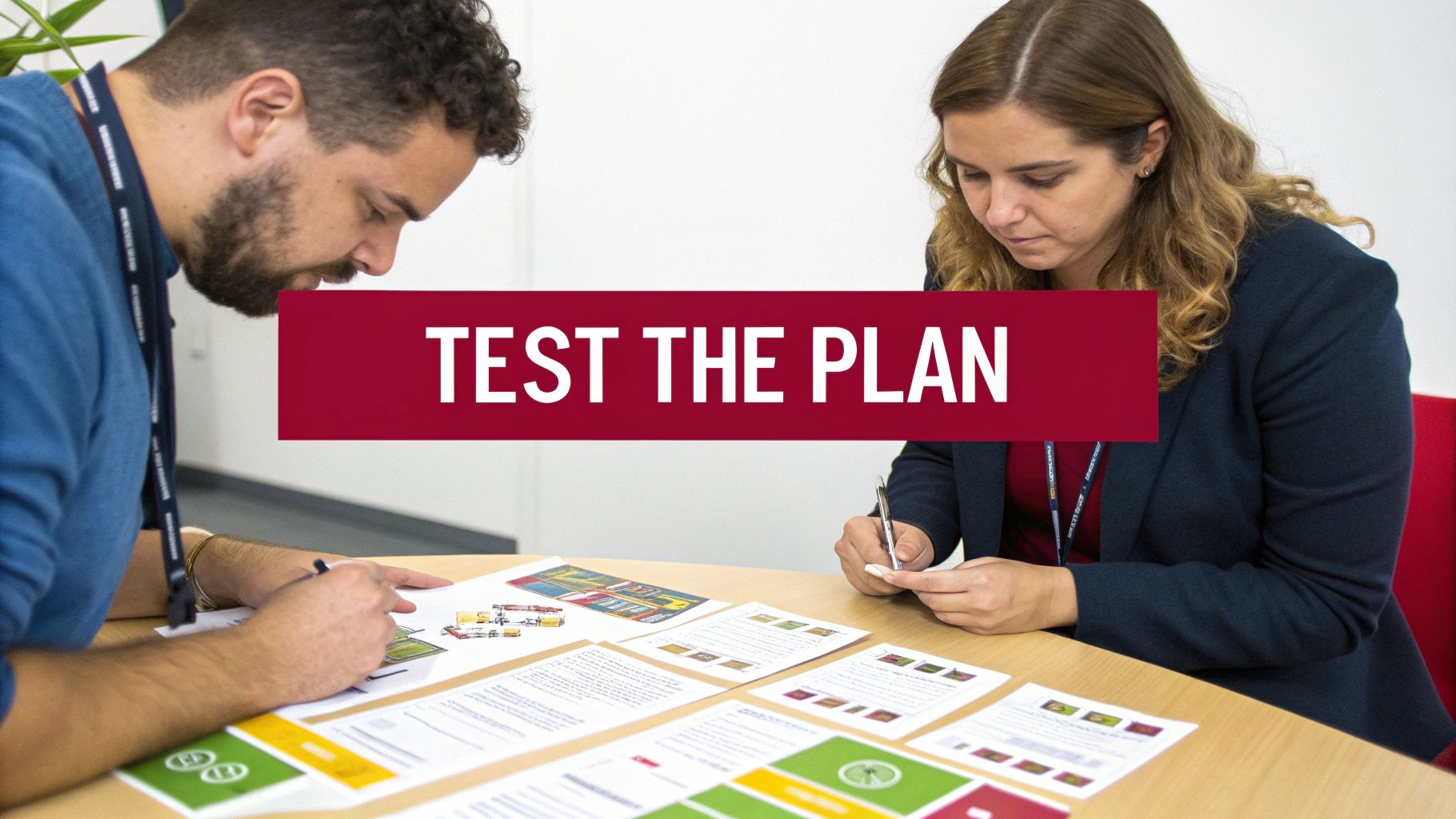
Let's be honest. A business continuity management template that’s just filled out and filed away is nothing more than a document. It’s a box-ticking exercise that might satisfy an auditor, but it won’t do you a lick of good when things actually go sideways. This is where testing comes in—it’s the process that transforms your plan from a static theory into a living, breathing asset that genuinely protects your business.
A plan that hasn't been put through its paces is a plan you simply can't trust. Testing is the only way to uncover the hidden gaps, flawed assumptions, and process bottlenecks that will inevitably pop up during a real crisis. Think of it not as a test to find fault, but as a drill to build confidence.
Choosing the Right Testing Method
Not all tests are created equal, and you definitely don't need to simulate a full-blown catastrophe every quarter. The real key is to use a variety of testing methods that match your organisation's maturity and what you’re trying to achieve. Each type serves a different purpose, building your resilience one layer at a time.
- Plan Review: This is your starting point. It's a simple, low-effort exercise where key team members gather to read through the plan. They're looking for outdated contact details, inaccurate information, or obvious gaps in logic. It’s a high-reward first step.
- Tabletop Exercise: Now we’re getting more interactive. This is a discussion-based session where you throw a specific crisis scenario at your response team. For example, you might present a ransomware attack and have the team talk through every step of their response, explaining their actions. It's brilliant for exposing communication breakdowns and confusion over roles.
- Walk-through Simulation: This one is more hands-on. Team members actually get up and perform their recovery tasks, like trying to restore data from a backup or setting up an alternate communication channel. This is where you test if the procedures you've documented are actually practical.
Of course, there are more advanced tests, like a full-interruption simulation where you actually failover a critical system. These require a heap of planning but provide the ultimate proof that your plan works. Starting with the simpler tests first builds the muscle memory you'll need for those more complex drills.
Executing and Analysing Your BCM Tests
Running the drill is only half the battle. A successful test is really defined by what you learn from it. That's why proper execution and analysis are so critical for improving your business continuity management template and your overall resilience.
To get the most value, go in with a structured approach. Define clear goals beforehand. What are you actually trying to validate? Is it the RTO for your primary database, or the effectiveness of your crisis comms plan?
The single most valuable part of any BCM test is the debrief session held immediately afterwards. Don't wait. While the experience is still fresh in everyone’s mind, get the team in a room to discuss what went well, what was a complete mess, and what threw you a curveball. This is where the real learning happens.
After every single test, you need to create a formal after-action report. This document isn’t about pointing fingers; it’s a constructive analysis designed for improvement.
Key elements of an after-action report:
- Test Overview: A quick summary of the scenario, your objectives, and who participated.
- Observations: A factual rundown of what happened during the test—both the good and the bad.
- Analysis: An evaluation of why things happened the way they did, getting to the root causes of any failures.
- Recommendations: Specific, actionable steps to fix the gaps you found. Crucially, assign each action item to an owner with a clear deadline.
This cycle of testing, analysing, and refining is what keeps your plan relevant and effective.
Creating a Culture of Resilience
At the end of the day, a business continuity plan is only as strong as the people who have to execute it. A truly resilient culture is one where everyone, from the executive suite right down to the front line, understands their role in keeping the business running.
This all starts with solid communication and training. Don't just email the plan out and hope people read it. Run engaging training sessions that use real-world scenarios your people can relate to. Make absolutely sure every employee knows how to find the plan and who to call in an emergency.
Better yet, involve different departments in your testing exercises. When the marketing team participates in a cyber-attack simulation, they suddenly gain a much deeper appreciation for IT's challenges and their own crucial role in customer communication. This kind of cross-functional involvement breaks down silos and builds a powerful, collective sense of ownership over the organisation's resilience.
Got Questions About Your BCM Template? We’ve Got Answers.
As you start filling in the blanks of your business continuity management template, you’re bound to hit a few roadblocks or have questions pop up. That’s a good sign—it means you’re thinking critically about what your business truly needs.
Let’s tackle some of the most common questions our team hears from managers and compliance officers.
What’s the Real Difference Between a BCM Plan and a Disaster Recovery Plan?
This one comes up all the time, and it’s a vital distinction to get right. The simplest way to think about it is that a Disaster Recovery (DR) plan is one important piece of the much larger Business Continuity Management (BCM) puzzle. DR is tactical and IT-focused; BCM is strategic and business-wide.
Disaster Recovery (DR): This is all about the tech. A DR plan is your playbook for restoring IT systems, applications, and data after a major incident. Think server crashes, data corruption, or a crippling cyber-attack. The goal is purely to get the technology working again.
Business Continuity Management (BCM): This is the master plan for the entire organisation. It covers everything needed to keep the business running through a disruption—not just IT, but your people, processes, physical sites, and key suppliers.
So, while your DR plan details how to restore a critical database from backups, your overarching BCM plan dictates which database gets restored first because your Business Impact Analysis has proven it’s the most critical. The BCM plan also outlines how your sales team will continue to take orders and communicate with customers while IT is busy with the recovery.
How Often Should We Be Testing Our Business Continuity Plan?
A plan you don’t test is just a document collecting dust. In reality, it’s probably full of holes you won’t discover until it’s too late.
Best practice is to test your plan in some capacity at least once a year. But honestly, a more layered approach works much better. You don't always need a full-blown, business-halting drill.
Try mixing up your testing schedule to keep everyone sharp:
Quarterly: Run a tabletop exercise. These are just structured, discussion-based sessions. Get your crisis team in a room and talk them through a specific scenario, like "Our main supplier just went into administration. What do we do, right now?"
Annually: Go for a more hands-on simulation. This might involve actually failing over a non-critical IT system to its backup or getting a skeleton crew to work from the alternate site for a day.
The golden rule here is to immediately review and update your plan after any significant business change. This isn't just a calendar-based task. New core software, a change in key leadership, or a new office location are all triggers. An out-of-date plan can give you a false sense of security, which is often more dangerous than having no plan at all.
Does My Small Business Genuinely Need a Full BCM Template?
Yes, without a doubt. In fact, small businesses often have more to lose from a major disruption. Large corporations usually have deep pockets and a lot more fat to trim to survive a crisis. For a small business, a few weeks of downtime isn't just an inconvenience—it can be a nail in the coffin.
The trick is to make the plan fit your business, not the other way around. You don’t need a mammoth 200-page document designed for a multinational bank.
A lean business continuity management template for a smaller organisation should be ruthlessly focused on the essentials: its most critical functions, key people, and the technology that underpins it all.
Even a simple, focused plan that clearly identifies your top three business-critical activities and spells out the recovery steps is a massive advantage. It brings order to chaos, giving your team a clear path forward when stress levels are at their highest.
Ready to build a resilient organisation that stands up to scrutiny? Anitech specialises in guiding Australian businesses through the complexities of ISO 27001 certification, ensuring your BCM plan aligns with international standards. Learn how our expert consultants can help you achieve compliance and strengthen your security posture.
Recent Comments