

Imagine a thriving online retail business during its busiest sales period. Suddenly, a total website crash brings everything to a grinding halt. Panic? Not if they have a solid Business Continuity Plan (BCP). Their plan kicks into gear instantly: a cloud-based backup is activated, restoring the site within their pre-defined one-hour Recovery Time Objective (RTO). With a Recovery Point Objective (RPO) of just 15 minutes, they've lost minimal transaction data. This isn't just a hypothetical scenario; it's the tangible result of effective planning.
This is the core purpose of a BCP: to provide clear, practical, and pre-rehearsed steps that keep your business operational when faced with unexpected disruptions. It's the difference between a minor hiccup and a catastrophic failure. In an increasingly volatile world, a well-structured BCP is no longer a luxury for large corporations; it's an essential survival tool for businesses of all sizes, ensuring they can withstand shocks, protect their reputation, and maintain the trust of their customers.
Why Your Business Needs a Continuity Plan Today
Let's be blunt: disruptions are no longer a matter of 'if' but a stark reality of 'when'. We operate in an economic and technological landscape where a single unexpected event—a cyber attack, a critical supplier failure, a natural disaster, or even a localized power outage—can halt operations, cripple sales, irrevocably tarnish a hard-won reputation, and send customers flocking to more resilient competitors. In this high-stakes environment, being unprepared isn't merely a risk; it's a strategic gamble that very few businesses can afford to take, and even fewer will win.
Consider a Business Continuity Plan (BCP) as your organization's strategic playbook for chaos. While your unprepared competitors are caught in a reactive tailspin, scrambling to make sense of a crisis, a robust BCP provides your team with a clear, pre-agreed-upon roadmap. It's the mechanism that transforms the raw energy of panic and confusion into a calm, measured, and effective response. This proactive stance doesn't just help you survive; it gives you a powerful competitive advantage when it matters most, allowing you to recover faster, communicate with confidence, and potentially even capture market share from those who falter.
From Theory to Reality
A BCP is the fundamental framework that shifts your business's entire mindset from being reactive to proactive. It’s not just a document; it's a comprehensive process built upon three foundational pillars that collectively map out a clear, strategic path from vulnerability to resilience.
- Risk Assessment: This is the initial, critical phase where you conduct a thorough and honest evaluation of the specific threats your business faces. This goes far beyond generic risks. It means identifying plausible scenarios, from a sophisticated ransomware attack that encrypts your entire network, to the sudden bankruptcy of a sole-source supplier for a critical component, or a regional flood that makes your primary office inaccessible for weeks.
- Business Impact Analysis (BIA): Following the risk assessment, the BIA is where you meticulously determine which parts of your operation are absolutely essential for survival. It's a deep dive into your processes to answer the critical question: "What would the real, quantifiable financial and operational cost be if this function were knocked offline?" This analysis prioritizes recovery efforts based on tangible impact, not just gut feeling.
- Recovery Strategies: This is the "how" of business continuity—the actionable heart of the plan. Based on the insights from your BIA and risk assessment, you will develop clear, step-by-step procedures to get those critical functions back up and running within a pre-determined, acceptable timeframe that the business has agreed upon.
By focusing intently on these three areas, you construct a resilience plan that is not only practical and actionable but is also intrinsically tied to the core functions that keep your business solvent and operational. This structured, analytical approach is the essence of effective what is business continuity planning, and it’s absolutely crucial to grasp the full scope of what's involved to build a plan that holds up under real-world pressure.
A well-crafted BCP is your business’s insurance policy against chaos. It doesn’t prevent disasters, but it ensures they don’t become catastrophes by giving your team a clear roadmap to follow under pressure.
The Real Cost of Unpreparedness
We've seen firsthand in Australia just how critical robust continuity planning has become. The last decade has presented a relentless and punishing cycle of disruptions. We've weathered devastating bushfires that redrew landscapes, widespread floods that submerged entire communities, and a global pandemic that reshaped how we work, all while simultaneously dealing with a massive and ever-escalating surge in sophisticated cyber threats targeting businesses of all sizes.
Take the 2024 Optus outage as a stark, recent case in point. The nationwide disruption hammered millions of individuals and businesses, but it was the small to medium enterprises (SMEs) that felt the pain most acutely. Those who relied solely on Optus for their connectivity and payment processing found themselves completely paralyzed, unable to trade, communicate, or operate. In the immediate aftermath, countless Australian businesses scrambled to revise and bolster their BCPs, urgently adding in secondary internet connections from different carriers, diversifying their payment gateway options, and implementing more robust remote work protocols to ensure they'd never again be crippled by a single point of failure.
These are not isolated, black-swan incidents; they represent the new normal of operational risk. A seemingly minor IT glitch can rapidly snowball into a full-blown system outage. A key supplier, one you've relied on for years, can vanish overnight due to their own unmanaged crisis. A local power outage, initially a minor inconvenience, can drag on for days, rendering your office useless. Without a pre-defined plan, every one of these events forces you and your team to improvise under extreme stress—a scenario that almost invariably leads to poor decisions, costly mistakes, and long-term reputational damage.
Building a Resilient Organisation
The process of putting together a BCP is your first tangible, strategic step toward building a business that can bend without breaking—an organization that is truly resilient. The very act of creating the plan forces you to look at your entire operation with a critical, analytical eye. It compels you to question assumptions, map out dependencies, and shine a light into the darker corners of your processes. This often exposes hidden weaknesses and single points of failure you never even knew you had. That process of discovery, in and of itself, makes your organization stronger, more efficient, and more aware.
Ultimately, this entire endeavor is about safeguarding the three pillars of your business: your people, your assets, and your reputation. To get started on the crucial journey of preparing for the inevitable, leveraging a comprehensive disaster recovery planning checklist can provide a fantastic framework and invaluable guidance. This isn't just about satisfying a compliance requirement or ticking a box for an auditor. It's a fundamental investment in securing the future of your business and ensuring that you have the institutional strength, foresight, and capability to weather any storm that comes your way.
An Actionable Business Continuity Plan Example
Theory is essential for understanding concepts, but seeing a real-world plan in action is what truly makes it all click. So, let's move from the abstract to the practical and break down a detailed, annotated business continuity plan example. This is not some generic, downloadable template you fill in and forget; it's a living, breathing blueprint designed for a modern Australian SME—imagine a rapidly growing e-commerce company, a busy digital marketing agency, or a professional consulting firm.
We will carefully dissect each critical section of the plan, explaining not just the 'what' but, more importantly, the 'why' behind each component. You’ll see exactly how to frame your overarching strategy, how to assign crystal-clear roles and responsibilities to your team, and how to set realistic recovery objectives that will actually hold up under the immense pressure of a real crisis.
At its core, the process of building a robust and effective plan follows a logical, intuitive flow: you first assess the potential risks to your business, then you analyze the potential impact of those risks on your critical operations, and finally, you develop a clear, actionable path to recovery.
This structured process is designed to move your organization from a state of simply understanding what could go wrong to a state of knowing precisely and confidently how you will get back on your feet, minimize damage, and resume operations as quickly as possible.
Core Components of a Modern BCP
A BCP that actually works in the real world isn't just a single, monolithic document; it's a well-organized collection of interconnected parts, each serving a specific purpose. Think of it as your master playbook for emergencies, with specific sections and protocols designed for different scenarios. Each piece of this puzzle is vital for creating a comprehensive plan that won’t fall apart or cause confusion when you need it the most.
The golden rule throughout the entire document is to prioritize clarity, conciseness, and accessibility. During a real incident, when stress levels are high and time is of the essence, the last thing your team needs is to be frantically searching through a dense, 100-page document for a critical phone number, a password, or a specific recovery procedure. Simplicity and usability are paramount.
The Introductory Statement and Policy
This is page one of your BCP, and its importance cannot be overstated. It sets the entire tone for the document and, by extension, for your organization's commitment to resilience. It is a high-level declaration of intent, a formal policy statement that must be reviewed, endorsed, and signed off by the highest level of senior leadership. This executive endorsement gives the plan its institutional authority and signals to the entire organization that business continuity is a top priority.
Here’s what this introductory section absolutely needs to include:
- Purpose: A concise, powerful statement explaining why the BCP exists. For example: "This Business Continuity Plan is designed to protect our people, maintain critical business operations, and preserve customer trust in the face of significant disruptions."
- Scope: You need to be explicit and specific about what the plan covers. Does it apply to all departments and all locations? Is it focused on a single critical office? Does it cover just your IT infrastructure, or does it extend to your entire supply chain? Clarity at this stage prevents confusion and jurisdictional disputes during a real event.
- Objectives: List 3-4 key, measurable goals for the plan. These could include objectives like "Minimize operational downtime for mission-critical services," "Ensure the safety and well-being of all personnel during an incident," or "Maintain transparent communication with all stakeholders throughout a crisis."
Expert Tip: Ensure that your CEO, Managing Director, or business owner personally signs this introductory statement. That single signature transforms the plan from a theoretical document into a mandated policy. It provides the top-down authority required for the plan to be taken seriously and implemented effectively across the entire business.
Assembling the Business Continuity Team
A plan is nothing more than ink on paper (or pixels on a screen) without a dedicated team of people empowered to bring it to life. This section of your BCP is where you formally identify the key players who will be responsible for activating, managing, and executing the plan during a crisis. It is absolutely crucial to define these roles by their function and responsibilities, not just by a person's name. People take vacations, get sick, or leave the company. A functional role ensures that someone is always assigned to that responsibility.
Here's a simple, effective team structure that works well for most small to medium-sized businesses:
- Crisis Manager (e.g., CEO or COO): This individual has the ultimate authority to declare a disaster and officially activate the BCP. They are the final decision-maker, responsible for the overall strategic direction of the response.
- IT Recovery Lead (e.g., IT Manager or Senior Engineer): This person is tasked with the entire technical recovery effort. Their responsibilities include restoring critical technology systems, recovering data from backups, re-establishing network connections, and managing cybersecurity during the incident.
- Operations Lead (e.g., Office Manager or Head of Operations): This role manages the physical and human side of the response. This includes tasks like coordinating a move to an alternate work site, ensuring staff have the necessary equipment for a sudden shift to remote work, and liaising with facility management.
- Communications Lead (e.g., Marketing Manager or PR Head): This individual is the single source of truth for all information. They are responsible for managing every message going in or out of the organization—providing regular updates to staff, reassuring clients and stakeholders, and keeping suppliers and partners informed.
Make sure the contact details for every primary team member (and their designated backups or deputies!) are listed clearly and accessibly. This must include multiple contact methods, such as mobile numbers and personal email addresses, in case corporate systems are unavailable.
The Business Impact Analysis Summary
Your full Business Impact Analysis (BIA) is a detailed, comprehensive, and often lengthy document. However, the BCP itself only needs the high-level, actionable summary. This is the section where you translate abstract risks and operational dependencies into cold, hard business impacts. It is a critical tool that forces you to prioritize which business functions and systems get recovered first by defining two crucial metrics for each critical process.
- Recovery Time Objective (RTO): This is the maximum acceptable period of time that a business function can be down before the disruption causes unacceptable damage to the business. For instance, your e-commerce checkout page, which directly generates revenue, might have a very aggressive RTO of just 1 hour.
- Recovery Point Objective (RPO): This defines the maximum amount of data you can afford to lose, measured in time from the point of the disaster. An RPO of 15 minutes for your customer order database means that in a worst-case scenario, you cannot afford to lose more than the last 15 minutes of transactions before the system failed.
This summary acts as the crucial 'at-a-glance' guide that the Crisis Manager and the rest of the team will use to direct the recovery effort when every second is critical and decisions must be made quickly and decisively.
Sample RTO and RPO for a Small E-commerce Business
Let's make this tangible and practical. A simple, clear table is often the most effective way to translate your detailed BIA into an actionable recovery guide for your response team. This format tells the team exactly what to focus on first when a crisis hits, removing ambiguity and ensuring efforts are directed where they will have the most impact.
| Business Function | Criticality Level | Recovery Time Objective (RTO) | Recovery Point Objective (RPO) |
|---|---|---|---|
| Website & E-commerce Platform | Mission-Critical | 1 Hour | 15 Minutes |
| Customer Support System (CRM) | High | 4 Hours | 1 Hour |
| Order Fulfilment & Logistics | High | 8 Hours | 4 Hours |
| Internal Accounting Software | Medium | 24 Hours | 24 Hours |
| Marketing & Social Media | Low | 48 Hours | N/A |
This table immediately makes the recovery priorities crystal clear for everyone involved: the website is the absolute top priority and is non-negotiable, while marketing activities can wait until core operations are stabilized. For a deeper look at structuring these critical elements and ensuring they align with best practices, obtaining a professional business continuity strategy template can provide an excellent, robust foundation upon which you can build your customized plan.
Incident Response Protocols
This section is the operational heart of your BCP—it contains the specific, step-by-step procedures that your team will follow for the disruptive events you are most likely to face. You don't need a detailed plan for a zombie apocalypse or an alien invasion, but you absolutely need one for the plausible and high-impact scenarios that you identified during your risk assessment phase.
For a typical Australian SME, these essential protocols might include:
- Cyber Attack (Ransomware): What are the immediate first three steps? The protocol should be a clear checklist: 1. Isolate affected machines from the network to prevent spread. 2. Contact your retained cybersecurity partner immediately. 3. Begin the process of data recovery from offline, immutable backups. 4. Draft and issue an initial communication to clients and stakeholders.
- Major Power Outage: How do you safely switch over to the backup generator? What is its fuel capacity and how long will it run? What is the established protocol for shifting the entire workforce to remote work if the utility provider confirms the outage will last for more than a day?
- Key Supplier Failure: Who is your pre-vetted backup supplier? What is the process and how fast can they be activated? What is the pre-approved script for communicating with customers about potential product delays or substitutions?
- Office Inaccessibility (e.g., Flood, Fire, Gas Leak): Where is the designated alternate work site or rally point? How are all staff notified immediately and simultaneously? What is the procedure for distributing essential equipment like laptops and peripherals to enable effective remote work?
Each protocol should be designed as a dead-simple checklist. Avoid jargon, long paragraphs, and complex technical language wherever possible. The ultimate goal is for anyone on the response team, even under extreme stress, to be able to pick up the plan and know exactly what to do next without hesitation.
Communication Plan and Templates
In a crisis, silence is not golden; it breeds chaos, speculation, and fear. A lack of clear, consistent, and authoritative communication causes staff to panic, customers to lose trust, and the media to create their own narrative. That’s precisely why your BCP must contain a dedicated, detailed communication plan.
Key elements of a robust communication plan include:
- Stakeholder Lists: Pre-compiled and regularly updated contact lists for all key stakeholder groups: employees (with out-of-band contact info), key clients, critical suppliers, board members, and even local media contacts.
- Designated Spokesperson: The Communications Lead is the single, authoritative source of truth for the organization during the crisis. All information, both internal and external, must flow through them to ensure the message remains consistent, accurate, and controlled.
- Communication Channels: How will you reach people if your corporate email system is down or the office phone lines are dead? You must define primary and backup channels. Think about using a mass SMS notification service, a private WhatsApp or Signal group for the response team, or even a simple, low-tech phone tree.
- Pre-Written Templates: Having draft messages, statements, and updates ready to go is an absolute game-changer. It saves precious time, reduces the risk of errors under pressure, and ensures you don't say the wrong thing in the heat of the moment.
Example Template – Internal Staff Update (SMS):
URGENT BCP ALERT: Our main server is currently down. The IT team is actively working on the issue now. All staff are to follow established remote work procedures until further notice. The next update will be provided in 1 hour via this channel. [Crisis Manager Name]
Example Template – Customer-Facing Update (Website Banner/Social Media):
We are currently experiencing a system outage that is affecting our main platform. Our technical teams are working diligently to restore service as quickly as possible. We sincerely apologize for this disruption and will post another update by [Time]. We appreciate your patience and understanding.
These simple, pre-approved messages ensure that your public and internal response is fast, professional, and reassuring—even if it's chaotic behind the scenes. Building a BCP isn't just about disaster recovery; it’s about embedding a culture of resilience deep into your company’s DNA, preparing you to manage any crisis with confidence and control.
Conducting a Practical Risk and Impact Analysis
A solid, defensible business continuity plan is built on one simple, powerful idea: you must intimately know what could go wrong and have a crystal-clear understanding of what it would really cost your business. Without this foundational knowledge, your BCP is just guesswork—a collection of assumptions that will likely crumble under the first sign of real-world pressure. This crucial phase is where we get brutally honest, moving your plan from a theoretical document to a practical, evidence-based survival guide through two key, intertwined processes: the Business Impact Analysis (BIA) and the Risk Assessment.
Here’s an easy way to differentiate the two and understand how they work together. The BIA tells you what your most precious, irreplaceable assets are—the specific business functions, processes, and systems that represent the lifeblood of your organization. The Risk Assessment then acts like a spotlight, shining a bright light on the specific dangers and threats lurking just around the corner, ready to take a swing at those very assets. Together, they provide you with the strategic clarity needed to protect what truly matters most.

This structured framework is what ensures that your BCP is shaped by your unique, specific vulnerabilities, not just by generic threats pulled from a dusty, one-size-fits-all template.
Pinpointing Your Critical Operations with a BIA
The Business Impact Analysis is the stage where you must be brutally honest with yourself and your team. The central, driving question you are trying to answer is, "If this specific business function stopped right now, how much would it hurt, and for how long could we realistically survive without it?" This analysis must go far beyond just the immediate financial bottom line. We’re talking about quantifying impacts across multiple domains: your brand reputation, your customers' trust, contractual obligations, and the internal operational chaos that inevitably follows a major disruption.
To do this effectively, get the key leaders from each department in a room—sales, operations, IT, finance, HR, and customer service—and start methodically walking through your core business processes one by one, from lead generation right through to product delivery and invoicing.
For each distinct business function, you need to ask a series of probing questions:
- What is the immediate and escalating financial hit from an outage (e.g., lost online sales per hour, penalties for breaching service level agreements)?
- What is the operational fallout (e.g., work backlogs that will take weeks to clear, delayed project milestones, supply chain bottlenecks)?
- How would a failure of this function damage our brand reputation and our customers’ confidence in our ability to deliver?
- Are there any legal, regulatory, or compliance headaches we would face if this process fails (e.g., data breach reporting requirements, safety regulations)?
The primary aim here is to quantify the pain in terms of both time and money. This exercise will very quickly and clearly reveal your operational crown jewels—that handful of functions that, if they were to fail, would bring your entire business to a grinding, catastrophic halt.
Identifying Realistic Threats Through a Risk Assessment
Once you know with certainty what you need to protect, the next logical question is what you need to protect it from. A formal Risk Assessment is all about identifying, analyzing, and prioritizing the specific threats that are genuinely relevant to your business, your industry, and your geographical location. Forget about asteroid strikes and zombie apocalypses for now; let's focus on the probable and the plausible threats that keep you up at night.
This process is about looking at your vulnerabilities with a clear, objective, and unemotional eye. Where are the weak points and single points of failure in your systems, your processes, your people, or even your supply chain?
Think about organizing potential threats into these common categories:
- Technical Failures: This is a broad category that covers everything from a critical server crash or a major software bug in your core application to a complete internet outage caused by a fiber cut in your local area.
- Human-Centric Risks: This encompasses a wide range of issues, such as the sudden departure of a key team member with unique institutional knowledge, a simple human error causing catastrophic data loss, or even malicious insider activity.
- External Events: This is another broad category covering events outside your direct control, such as natural disasters like floods, cyclones, or bushfires, widespread power grid failures, pandemics, and major disruptions to your critical supply chain partners.
- Cyber Attacks: In today's landscape, this is a non-negotiable category. It includes ransomware attacks that hold your data hostage, sophisticated phishing scams that lead to major data breaches, and denial-of-service (DoS) attacks designed to knock your website offline.
This thorough analysis provides the essential context for your recovery strategies. If you want to dive deeper into a more structured, internationally recognized approach for this process, exploring formal frameworks for ISO 31000 risk management is an excellent and highly recommended next step.
Marrying Impact and Likelihood
The real strategic magic happens when you bring the outputs of your BIA and your Risk Assessment together. By mapping the specific threats you've identified against your most critical business functions, you create a powerful, data-driven, and prioritized action list. I find that a simple risk matrix is the most effective way to visualize this. This tool plots the likelihood of a specific event happening against the potential impact it would have if it did.
A low-likelihood, low-impact event (like a coffee spill on a single keyboard) doesn't need a formal, documented response protocol in your BCP. But a high-likelihood, high-impact event (like a sophisticated ransomware attack on your entire customer database)? That needs to be at the absolute top of your priority list for planning, mitigation, and response.
This simple yet powerful approach ensures that you focus your limited time, budget, and resources on building bulletproof, well-rehearsed recovery plans for the scenarios that pose a genuine existential threat to the future of your business.
Why Australian Businesses Cannot Afford to Skip This Step
The need for this level of detailed, analytical rigor has never been more urgent. Despite the growing frequency and severity of disruptions, the state of Australia's business continuity preparedness reveals some significant and worrying gaps. Data from 2025 indicates that approximately 50% of all Australian businesses face some form of significant operational disruption each year, ranging from severe weather events to crippling cyber-attacks. The truly worrying statistic? Only about 30% of these businesses have a robust, well-documented, and regularly tested business continuity plan in place.
That enormous gap between risk and readiness highlights a massive, systemic vulnerability across the economy. Without a proper risk and impact analysis to ground it in reality, any business continuity plan example you follow is just a document—a piece of corporate theater, not a functional and life-saving tool for survival.
Turning Analysis into Actionable Insights
The outcome of all this diligent work isn't just a list of scary what-if scenarios designed to frighten the board. It's a set of clear, actionable, and data-driven insights that will directly shape and inform every subsequent section of your BCP.
Your completed analysis should provide you with:
- A Prioritized List of Critical Functions: You will know, without a shadow of a doubt, which parts of your business must be brought back online first, second, and third.
- Defined Recovery Objectives (RTO/RPO): For each of those critical functions, you will have a clear, business-justified target for how quickly it must be restored (RTO) and how much data you can stomach losing in a worst-case scenario (RPO).
- A Shortlist of Plausible High-Risk Threats: You now have a focused and manageable list of threats to build specific, practical, and checklist-based response plans around.
This structured analysis transforms your continuity planning from a reactive, fear-based exercise into a strategic, proactive defense of your business's future. It arms you with the knowledge and foresight to create a BCP that doesn't just sit on a shelf but actively and effectively protects your business from the unique challenges it is most likely to face.
Building Your Incident Response and Communication Plan
When a genuine crisis hits, all the beautifully written theory and strategic analysis in the world goes out the window. A brilliant, comprehensive plan is just a useless document if your team doesn't know precisely what to do, who to call, or what to say in those critical first few minutes and hours. This is the moment where your incident response and communication plan proves its immense worth, acting as the bridge that turns potential chaos into a coordinated, calm, and effective response.
A well-oiled plan means that the very moment an incident is officially declared, everyone from the CEO down to the customer support team knows their role, their responsibilities, and their immediate priorities. It’s about building institutional muscle memory through training and testing, so that the right actions happen swiftly and automatically, even when the pressure is immense and the situation is fluid.
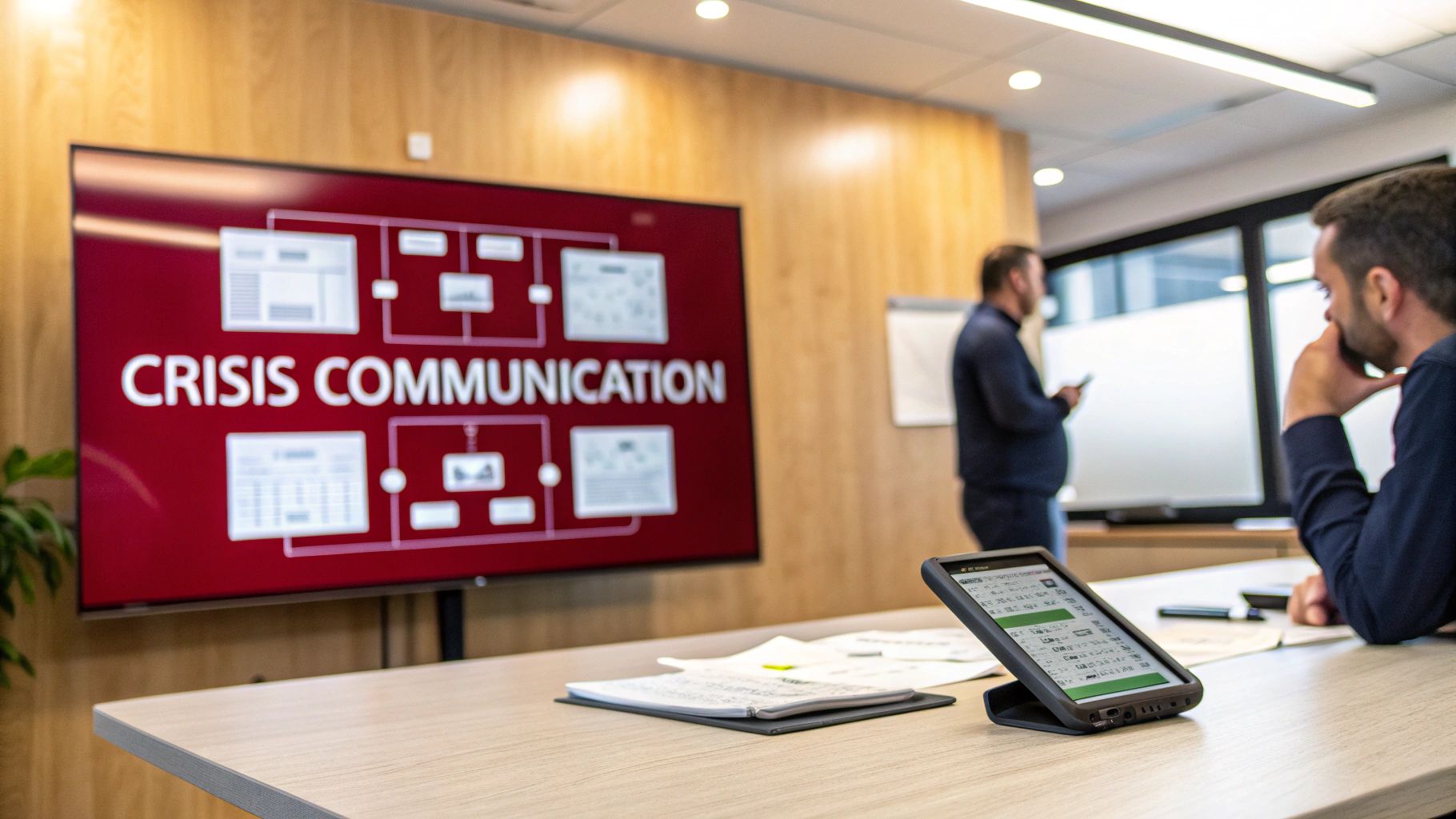
Let's dive into the practical steps of turning your high-level strategy into synchronized, real-world action, giving you the essential structure needed to manage any disruption with confidence, clarity, and control.
Assembling Your Incident Response Team
First things first: you need to build a nimble, decisive, and empowered incident response team. This isn’t about just handing out tasks during a crisis; it's about formally defining roles based on function and skill set, making sure you have the right expertise ready to deploy at a moment's notice. For a small or medium-sized business, this team doesn't need to be huge, but it absolutely must be decisive and have the authority to act.
Here’s a simple, proven structure that works for most organizations:
- Crisis Manager (e.g., CEO/Owner): The ultimate decision-maker and leader of the response. This person has the sole authority to officially declare an incident and activate the full BCP. They provide strategic oversight and make the tough calls.
- Technical Lead (e.g., IT Manager or Head of Technology): Your go-to expert for all things technical. They are responsible for diagnosing the root cause of the problem, executing the technical recovery plan, restoring systems from backups, and getting the digital side of the business back up and running.
- Operations Lead (e.g., Office Manager or COO): This individual manages the physical and human response. Think of them as the logistics commander, responsible for coordinating a move to an alternate site, ensuring staff have the necessary equipment to work from home effectively, and managing facility-related issues.
- Communications Lead (e.g., Marketing Manager or Head of Comms): The single, authoritative source of truth for all messaging. They are responsible for crafting and disseminating every update to staff, clients, suppliers, the media, and any other stakeholder who needs to know what’s happening.
A crucial tip from years of experience: for every single role, you must name a primary contact and at least one secondary or backup contact. This simple but vital step prevents your entire response from grinding to a screeching halt if one key person happens to be on a long-haul flight, in a hospital, or otherwise unreachable when the crisis breaks.
Defining Clear Activation Triggers
So, how do you know when it’s the right time to actually pull the trigger and formally activate the plan? That’s what "activation triggers" are for. They are pre-defined, unambiguous conditions that, once met, automatically set your formal response in motion. This critical step removes the dangerous guesswork, debate, and hesitation that can waste precious time when every second counts.
Your triggers need to be specific, measurable, and easily understood. For a deeper look at the nuances of handling disruptions effectively, you’ll find some great insights in these best practices for incident management.
Here are some real-world examples of clear activation triggers:
| Incident Type | Activation Trigger |
|---|---|
| Cyber Attack | Confirmed ransomware encryption on a critical server or confirmed exfiltration of sensitive data. |
| Power Outage | The local utility provider confirms that the outage is widespread and will last longer than four hours. |
| System Failure | The core e-commerce platform or primary business application remains offline for more than one hour despite initial troubleshooting. |
| Supplier Loss | A mission-critical, sole-source supplier confirms they are unable to fulfil orders for the foreseeable future. |
Having these documented clearly in your business continuity plan example empowers your team to act swiftly and decisively, rather than waiting for permission from a chain of command while a critical situation deteriorates further.
Crafting a Multi-Channel Communication Strategy
During a major crisis, your usual, day-to-day communication channels might be the first casualties. What happens if your email server is encrypted by ransomware, or the office phone system is completely offline due to a power outage? A solid, resilient communication plan always has a backup, and a backup for the backup.
You need to establish and document both primary and backup communication channels for your different stakeholder groups.
Internal Communications (Staff):
- Primary: Company-wide email distribution lists and a corporate messaging platform like Slack or Microsoft Teams.
- Backup: A mass SMS notification service (like Twilio or Whispir) or a dedicated, out-of-band WhatsApp or Signal group for the incident response team and all staff members.
External Communications (Clients, Partners & Public):
- Primary: A prominent banner on your company website, frequent updates on your main social media channels (like LinkedIn and Twitter), and direct, proactive emails to your key accounts and partners.
- Backup: A pre-configured, independent status page hosted on a separate service (like Statuspage.io or Atlassian Statuspage). This ensures you can provide reliable updates to the outside world even if your main website is completely down.
Remember, the primary goal of crisis communication is to be clear, consistent, empathetic, and frequent. Even if the update is simply, "We are still investigating the issue and will provide more information in 30 minutes," regular contact builds trust, demonstrates control, and stops people from filling the information vacuum with their own, usually much worse, assumptions and rumors.
Developing Ready-To-Use Communication Templates
Under intense pressure, it’s far too easy to mis-speak, use the wrong tone, or convey inaccurate information. Having a suite of pre-written and pre-approved communication templates is an absolute lifesaver for your Communications Lead. They allow your team to get accurate, consistent, and well-crafted information out the door incredibly fast. Keep them simple, empathetic, direct, and free of jargon.
Here are a few essential templates you can adapt for your own plan.
Template 1: Initial Internal Staff Alert (SMS)
- URGENT BCP ALERT: We are experiencing a major IT outage affecting [System Name]. The incident response team has been activated. All staff are to switch to established remote work protocols immediately. The next update will be sent via this channel in 30 minutes. – [Crisis Manager Name]
Template 2: Initial Customer-Facing Website Banner / Social Media Post
- We are currently investigating a service disruption affecting our main platform. Our team is working around the clock to restore full functionality as quickly as possible. We sincerely apologise for this interruption and the impact it may have on your business. Our next formal update will be posted here by [Time/Date].
Template 3: Initial Key Supplier Notification (Email)
- Hi [Supplier Contact Name], this is a formal notification that we have activated our business continuity plan due to [Brief, Factual Incident Description]. We anticipate a potential impact on [e.g., our ability to process new orders]. We are committed to keeping you informed as the situation develops. Please confirm you have received this message.
Make sure you store these templates in a secure, cloud-based location that the entire incident response team can access from any device (e.g., Google Drive, SharePoint). This ensures that no matter who is tasked with sending the message, the tone, content, and accuracy remain consistent, projecting an image of calm, competence, and control when it matters most.
Turning Your Plan into Action: Testing and Training
A business continuity plan that sits collecting dust on a shelf (or in a forgotten network folder) is worse than having no plan at all. It provides a dangerous, false sense of security that will be brutally shattered the moment a real crisis hits. The only way to know with any certainty if your plan actually works—if it's practical, realistic, and understood—is to practice it. Regular testing and training are what transform that static document into a living, breathing tool that your team can wield effectively under immense pressure.
Let’s be real. A high-stress, fast-moving crisis is the worst possible time for your team to be reading a complex manual for the very first time. The ultimate goal here is to build institutional muscle memory. When an actual incident is declared, you want your team’s response to be swift, confident, and almost automatic—a series of actions driven by practice and familiarity, not by panic and improvisation.
This commitment to practice is what separates the businesses that just scrape by during a disruption from those that emerge from the other side even stronger and more trusted. It makes your plan a genuine operational advantage, not just a compliance checkbox.
From Theory to Practice: How to Test Your BCP
Testing your BCP doesn't mean you have to shut down the entire business for a day and simulate a catastrophe. That's impractical and often counterproductive. The trick is to start small and incrementally build up the complexity and realism of your tests over time. The objective is to find the cracks, gaps, and flawed assumptions in your plan within a controlled, safe-to-fail setting, not when your revenue and reputation are on the line.
Here are a few practical, proven methods to test your plan without causing a major headache for your day-to-day operations.
- Plan Walk-Through (or Desk Check): This is your essential starting point. Get the entire incident response team together in a meeting room, project the plan onto a screen, and verbally walk through a simple scenario, step-by-step. For example, "Our main office building has been closed due to a gas leak. What is the first step in the plan? Who makes the call? What do we do next?" It’s a low-stress, low-cost way to spot obvious gaps, confusing instructions, or outdated information.
- Tabletop Exercise: It's time to make it more interactive and dynamic. A facilitator presents a developing scenario to the team—"A phishing email was opened, and a ransomware attack has just encrypted our main file server and is spreading. What do you do right now?"—and the team must talk through their specific roles, actions, decisions, and communications in real-time. These exercises are fantastic for pressure-testing your decision-making processes and inter-team coordination.
- Functional Drill: This is where the rubber truly meets the road. A functional drill is a hands-on, live test of a single, specific function or capability within your plan. For instance, you might get the IT team to actually restore a critical database from a backup onto a separate, isolated test server. Or you might test your mass notification system by sending a test alert to all staff. It’s all about proving that a specific technical or logistical recovery strategy really works as designed.
The focus on building resilience isn't just a passing trend; it's a fundamental market reality. The global business continuity management market hit USD 754 million in 2024 and is projected to grow significantly, driven by an increasing frequency of disruptive events. Here in Australia, this growth is all about businesses making strategic investments to slash potential downtime and financial loss, often pushed by stricter regulatory compliance needs and customer expectations. You can get a deeper look at the market dynamics in this detailed business continuity management market report.
Building a Realistic Testing Schedule
Consistency is the absolute key to an effective BCP program. A one-off test is a good start, but a regular, predictable testing rhythm is what keeps your BCP sharp, relevant, and at the forefront of your team's minds as your business inevitably changes. The worst thing you can do is create an impossibly ambitious schedule that you'll never stick to. Start with something practical that you can actually achieve and build from there.
For a small to medium-sized business, a practical and manageable annual schedule might look like this:
| Frequency | Activity | Purpose |
|---|---|---|
| Quarterly | Contact List Verification | A simple but critical task. Verify that all emergency contact details for staff, the response team, key suppliers, and major clients are 100% up-to-date. An old phone number can completely derail your response. |
| Bi-Annually | Tabletop Exercise | Run a 90-minute simulation with a new and different scenario each time (e.g., a major power outage in Q2, a critical supplier failure in Q4). This keeps the team's thinking fresh and exposes them to a variety of challenges. |
| Annually | Functional Drill | Pick one mission-critical technical process to test live, such as a full data restore of your primary application or a failover to your backup internet connection. This provides tangible proof of capability. |
| Annually | Full BCP Review & Update | Sit down with key stakeholders and formally review the entire plan, from the risk assessment and the BIA through to the response protocols, to ensure it accurately reflects any changes in your business, technology, or personnel over the last year. |
This structured, cyclical approach makes BCP maintenance a manageable and integrated part of your routine business operations, not a dreaded, monolithic annual project that everyone tries to avoid.
The Power of People: Effective Team Training
Testing finds the gaps and flaws in your plan; training closes the gaps in the knowledge and skills of your people. A technically brilliant plan is utterly useless if your team members don't know what their specific role is, how to execute their assigned tasks, or how to communicate effectively with the rest of the team with confidence.
It's vital to tailor your training to the specific audience.
- General Staff Awareness: Everyone in the business needs to know the basics. This training should cover what a BCP is, why it's important, how to report an incident, and what to expect during a disruption (e.g., how the company will communicate with them, what the expectations are for remote work).
- Incident Response Team Training: This needs to be far more intensive and hands-on. Your core response team requires in-depth, role-specific training on the plan's activation triggers, their specific responsibilities, decision-making authority, and the detailed communication protocols. This is their chance to practice using the tools, templates, and technologies you've put in place before a real crisis hits.
Expert Tip: After every single test, drill, or exercise—without exception—hold a "hot wash" or formal debriefing session. Go around the room and ask three simple but powerful questions: What went well? What didn’t go well and why? What are we going to do differently or improve for next time? The honest feedback and lessons learned you get from this session are pure gold for iteratively improving your plan and your team's performance.
Keeping Your BCP Alive and Kicking
Your business is a dynamic entity; it constantly evolves. So too do the risks you face in the external environment. New cyber threats emerge daily, key people leave your company, you adopt new technologies, and your supply chain shifts. Your BCP has to keep pace with this change, otherwise it quickly becomes an irrelevant historical document.
Think of your BCP as a living document that requires regular care and maintenance, not a one-and-done project that you can tick off a list.
- Assign Clear Ownership: Make one person—perhaps the Operations Manager or a similar role—the official "owner" of the BCP. It is their responsibility to champion the testing schedule, track action items from debriefs, and ensure the document gets updated regularly.
- Link it to Change Management: Integrate the BCP into your formal change management process. Every time a major change happens in the business—you roll out a new CRM system, move to a new office, or switch a critical supplier—it should automatically trigger a quick review and potential update of the BCP.
- Document Everything: Keep a clear, auditable log of all your tests, training sessions, debrief findings, and any updates or revisions you make to the plan. This isn't just for your own benefit; it’s vital documentation for proving due diligence to auditors, insurance companies, regulators, and even major clients who will ask for it.
By building a robust culture of testing, training, and regular maintenance into the way you work, you take your business continuity plan example off the page and turn it into a powerful, practical, and proven tool for organizational resilience. That ongoing commitment is what truly ensures you’re ready to face whatever comes next with confidence, control, and competence.
Your BCP Questions Answered
Even with a solid, comprehensive guide, it’s only natural for practical questions to pop up once you start digging into the specific details of your own business continuity plan. Let’s be honest, theory is one thing, but the practice of implementing it in your unique business environment is where the real head-scratchers and "what about…" scenarios appear.
This section is all about tackling those common, practical questions we hear all the time from business owners and managers who are on this journey. Think of it as a direct chat with an experienced consultant, designed to clear up any lingering doubts and provide actionable advice so you can finalize a plan that genuinely works for you and your team.
How Often Should We Test Our Business Continuity Plan?
This is one of the most frequent and important questions, and the answer isn't as simple as just saying "once a year." The most effective approach is a layered, multi-frequency testing strategy. While you absolutely should conduct one major, comprehensive test annually—like a full-blown tabletop exercise involving your entire response team and lasting several hours—the real magic and value come from smaller, more frequent checks and drills that keep the plan top-of-mind and continuously updated.
Your business isn't static, and therefore, your BCP cannot be either. It needs regular care and attention to stay relevant and effective.
- Quarterly Checks (Non-Negotiable): This is a simple but critical task. At the start of every quarter, go through all your contact lists for the incident response team, key staff members, and your most critical suppliers and partners. A single out-of-date phone number or email address can completely derail your communications strategy right when you need it most.
- Bi-Annual Reviews: Twice a year, take a hard, strategic look at your risk assessment. What has changed in the internal or external environment? Are there new cyber threats on the horizon that security experts are warning about? Has a shift in your operations, like moving a key service to a new cloud provider, introduced a new vulnerability or dependency that you hadn't considered before?
- Trigger-Based Updates: Your BCP must be a living document, integrated with your business operations. Any time your organization goes through a significant change—moving to a new office, adopting a major new software system (like an ERP or CRM), or switching a key, hard-to-replace supplier—it should automatically trigger a review and, if necessary, an update of the relevant sections of your plan.
Treating your BCP with this ongoing cycle of maintenance ensures it’s always a reflection of your current business reality and is ready to be executed at a moment's notice, not just a dusty snapshot of how your business operated a year ago.
What Is the Difference Between a BCP and a DR Plan?
It’s incredibly common for people to use these two terms interchangeably, but they play very different—though closely related and complementary—roles in your overall resilience strategy. The easiest way to separate them in your mind is to think about their respective scopes.
A Business Continuity Plan (BCP) is the overarching, holistic, business-focused strategy. It’s a comprehensive plan focused on keeping the entire business operational during and after a disaster. It covers all the critical elements: your people (how will they work, where will they work from), your processes (which manual workarounds can be used), your suppliers (how do we activate backups), and your technology. Its main job is to keep essential business functions going and minimize the overall disruption to the organization's mission.
A Disaster Recovery (DR) Plan, on the other hand, is a critical and highly technical subset of your BCP. It is the detailed, hands-on, IT-focused plan for getting your technology infrastructure, core systems, applications, and data back up and running after a disaster.
Think of it this way: your DR plan is the detailed, technical playbook that gets your servers humming again, restores your critical databases from backups, and re-establishes network connectivity. Your BCP is the master strategic plan that gets your people back to work, communicating effectively with customers, and actually using those restored systems to process orders, deliver services, and bring in revenue.
You cannot have true organizational resilience without both, but the BCP is the master playbook into which the more technical DR plan fits as a vital component.
Our Business Is Very Small. Is a BCP Really Necessary?
Absolutely. In fact, you could make a very strong argument that a well-thought-out BCP is more critical for a small business than it is for a large corporate giant.
Large corporations often have the deep pockets, geographic diversity, and extensive, redundant resources to absorb the financial and operational shock of a major incident. Small businesses simply do not have that luxury. An outage or disruption that is a temporary, albeit expensive, headache for a big company could be an absolute knockout blow for an SME, from which it may never recover.
A good BCP is your best and most cost-effective defense. For a small business, it doesn't need to be a 100-page beast filled with complex corporate jargon. A simple, practical, and actionable plan that clearly spells out how you'll handle the loss of your most critical functions when the unexpected happens can be the single most important document that keeps your doors open through a crisis. It's about smart, proportionate preparation, not excessive paperwork.
Where Should We Store Our BCP Document?
This is a fantastic and often overlooked question, and the answer shines a bright light on a common—and potentially fatal—mistake in planning. The absolute worst place you can store your BCP is on a single, local file server in your main office.
If that server gets fried in a fire, submerged in a flood, or encrypted by ransomware, your plan is gone—completely inaccessible right at the moment you need it most.
The name of the game is redundancy and accessibility. You must store your BCP in multiple, diverse locations so that your key people can get to it from anywhere, at any time, using any device.
- Cloud Storage: Use a secure, mainstream cloud storage service like Google Drive, Dropbox for Business, or Microsoft 365/SharePoint. Ensure that permissions are correctly set so that everyone on the response team can access the latest version of the plan from any device with an internet connection.
- Printed Copies: Don't write off old-school, reliable hard copies. Key members of your incident response team should have a recently printed copy of the BCP stored in a secure, off-site location, like their home office or even their car. In a widespread power or internet outage, that paper copy might be your only guide.
- Mobile Access: Make sure the document format is mobile-friendly and easy to read on a smartphone. In the chaotic first few hours of an emergency, a phone might be the only tool someone has available to them. A PDF that requires constant pinching and zooming is not a user-friendly crisis document.
By making your business continuity plan example easy and reliable to access through multiple, independent channels, you ensure that it can be put into action immediately, no matter what kind of disaster you're facing.
Navigating the complexities of business continuity and information security is a significant undertaking, but you don't have to do it alone. At Anitech, we specialise in guiding Australian businesses through the ISO 27001 certification process, building robust security frameworks that are the foundation of true resilience. If you're ready to protect your business and gain a competitive edge, explore our ISO 27001 consulting services.
Recent Comments