

Quick Summary: This guide provides a comprehensive business continuity program template for Australian businesses. It outlines how to build a resilient strategy to protect revenue, reputation, and operations from disruptions like cyber-attacks or natural disasters. Key sections cover Business Impact Analysis (BIA), risk assessment, recovery strategies, team roles, and cyber resilience.
A business continuity program template is more than just a document; it’s a pre-built roadmap that shows your organisation how to keep the lights on when things go wrong. We’re not just talking about bouncing back from a disaster here. This is about building a rock-solid strategy to protect your revenue, your reputation, and the relationships you’ve worked so hard to build. For any forward-thinking Australian business, it's an absolute must-have.
Why Australian Businesses Need a Formal Business Continuity Program
Let's be honest. Here in Australia, we face a unique mix of challenges, from ever-present cyber-attacks to the harsh realities of bushfires and floods. Yet, so many businesses operate on a wing and a prayer, thinking a major disruption won't happen to them. That's a dangerous assumption, and it creates a massive gap in preparedness that leaves you incredibly vulnerable. Simply reacting when a crisis hits isn't a strategy—it's a gamble.
Hoping for the best just isn't going to cut it anymore. A formal business continuity program forces you to look potential threats in the eye and move from a state of uncertainty to one of control. Without a clear plan, a single crisis can set off a devastating chain reaction:
- Operational Paralysis: Your most important processes grind to a halt, making it impossible to serve your customers.
- Financial Strain: You’re hit with an immediate loss of revenue, which is then made worse by the unexpected costs of getting back on your feet.
- Reputational Damage: Trust is hard-won but easily lost. If you can't deliver when it matters most, customers will remember.
- Supply Chain Collapse: Those suppliers you rely on can become a critical point of failure if you haven't planned for them to be unavailable.
Confronting the Preparedness Gap
The gap between knowing you should be prepared and actually being prepared is a serious vulnerability for businesses across the country. The data paints a worrying picture: according to the Australian Business Continuity Institute, a staggering 50% of Australian businesses face a disruption each year, but only 30% have a solid business continuity plan ready to go.
That 20-percentage-point gap isn't just a number; it’s a direct threat to your livelihood.
Picture this: a sudden IT outage takes your e-commerce site offline during your busiest sales period. Or what if a key supplier shuts down without any warning? A good business continuity program template gives you the structured, rehearsed response you need to handle these events without panic.
Relying on improvisation during a crisis is like trying to build a lifeboat after the ship has already started sinking. A pre-defined plan, communicated and rehearsed, is the only reliable way to ensure your team knows exactly how to respond when the pressure is at its highest.
Before we dive into building your template, let’s quickly break down the core elements you’ll be working with. This table gives you a bird's-eye view of what a comprehensive program looks like.
Key Components Of A Business Continuity Program
| Component | Purpose | Example Action |
|---|---|---|
| Business Impact Analysis (BIA) | To identify critical business functions and the impact of their disruption over time. | Determining that the customer support function must be restored within 4 hours. |
| Risk Assessment | To identify and evaluate potential threats to the organisation. | Analysing the likelihood and impact of a prolonged power outage or a major cyber-attack. |
| Recovery Strategies | To develop plans for restoring critical functions after a disruption. | Arranging a secondary work location or cloud-based failover for critical IT systems. |
| Incident Response Plan | To outline the immediate actions to be taken when an incident occurs. | Creating a step-by-step communication plan to inform staff and stakeholders. |
| Testing and Exercises | To validate the plan and ensure team members are familiar with their roles. | Running a tabletop exercise simulating a ransomware attack scenario. |
| Maintenance and Review | To keep the program current with business changes and emerging threats. | Scheduling an annual review of the BIA to account for new services or systems. |
Each of these pieces is crucial for building a program that actually works in the real world.
Moving Beyond Simple Disaster Recovery
It's easy to confuse business continuity with IT disaster recovery, but they are worlds apart. While getting your data and systems back online is absolutely vital, true continuity covers the entire business—your people, your processes, your suppliers, and how you communicate with everyone.
The goal isn't just to recover; it's to continue running your essential operations at a level you've decided on beforehand, even if things aren't perfect. As more teams work remotely, the potential weak spots for cyber threats grow, making this big-picture approach more important than ever. To get a better handle on this, check out our guide on how to protect your organisation and employees from current threats. A well-designed program makes sure every part of your business is ready, creating genuine resilience from the ground up.
Building Your BCP Foundation: A Section-by-Section Breakdown
Alright, you understand why you need a business continuity plan. Now comes the real work: figuring out how to build one that actually works when you need it most. A solid template isn’t just a fill-in-the-blanks exercise; it’s a strategic tool that makes you confront the tough "what ifs" before a crisis forces your hand.
Let's break down the essential sections you’ll need to create a practical, no-nonsense BCP template.
This simple flowchart nails the core concept. You start by facing the reality of potential threats, identify the gap in your preparedness, and then build a plan to bridge it.
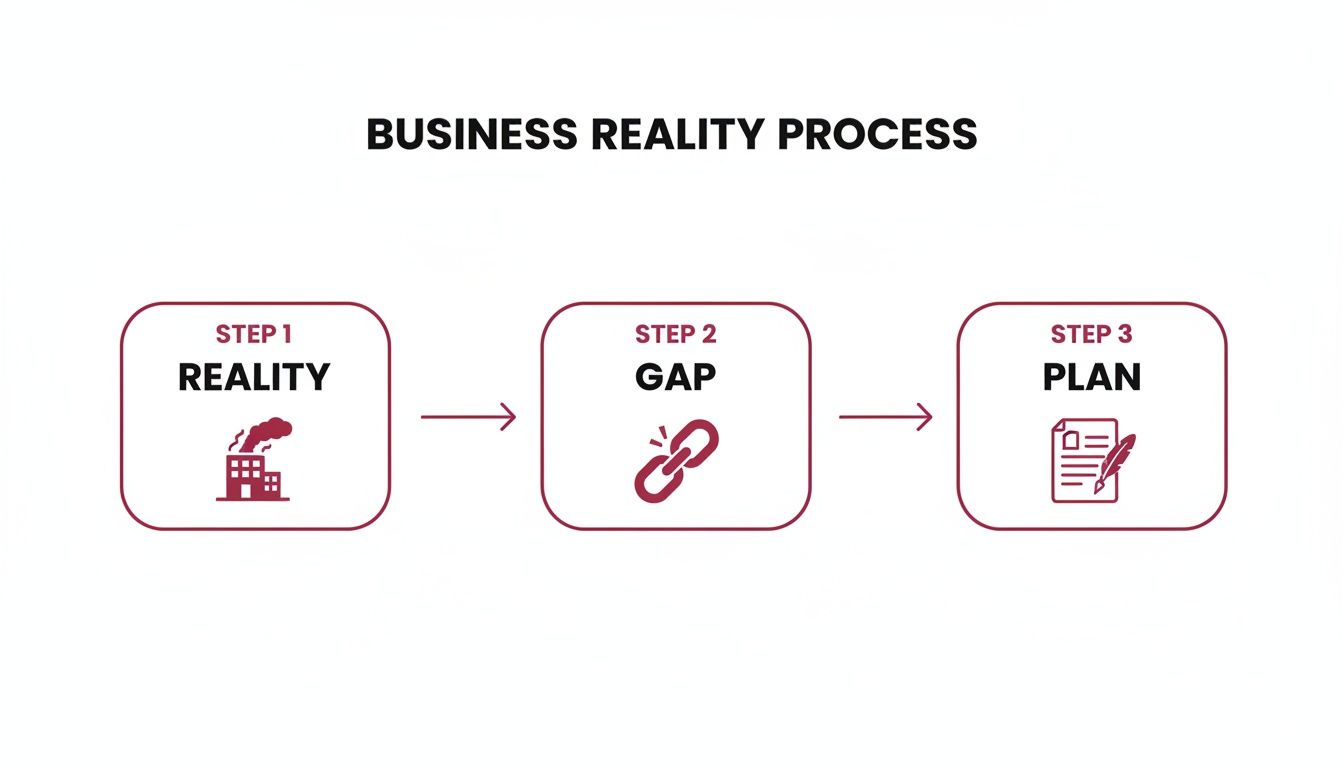
Think of your plan as that essential bridge connecting the chaos of a disaster to your business’s survival.
Starting with the Business Impact Analysis
The absolute bedrock of any good BCP is the Business Impact Analysis (BIA). This is far more than just paperwork; it's a deep dive into what truly makes your business tick. The goal here is to pinpoint your most critical functions and get brutally honest about what would happen if they suddenly stopped.
For instance, a small accounting firm in Perth would likely flag 'processing client payroll' as a top-tier critical function. If that goes down, the impact is immediate and severe—clients can't pay their staff, trust evaporates, and legal headaches pile up fast.
Meanwhile, a retail chain in Brisbane might identify its 'point-of-sale systems' and 'inventory management' as the most critical. Without them, sales halt, stock control is lost, and revenue flatlines.
The BIA forces you to ask pointed questions to quantify the damage a disruption would cause over time. This process gives you two of the most important metrics in business continuity:
- Recovery Time Objective (RTO): This is the non-negotiable deadline. It's the maximum time a critical function can be offline before your business suffers serious, potentially irreversible, damage. For that Perth accounting firm, the RTO for payroll might be a tight four hours.
- Recovery Point Objective (RPO): This is all about data. The RPO defines the maximum amount of data, measured in time, you can afford to lose. An RPO of one hour means you’ve decided you can live with losing up to 60 minutes of work.
A classic mistake I see is business owners declaring everything as 'critical'. The BIA forces you to be ruthless with your prioritisation. By sorting functions into tiers—like 'Mission-Critical', 'Business-Critical', and 'Essential'—you can focus your limited time and money on what truly keeps the lights on.
Performing a Thorough Risk Assessment
Once the BIA tells you what to protect, the Risk Assessment helps you figure out what you're protecting it from. This is where you identify potential threats, gauging how likely they are to happen and how much damage they could do. This has to be specific to your business and your location.
Your risks are unique. A warehouse in a flood-prone part of Queensland faces vastly different environmental threats than a tech startup in a Sydney high-rise.
One foundational risk that often gets overlooked in the early stages is data loss. For Australian small businesses, having a rock-solid backup strategy is non-negotiable. A great starting point is this comprehensive business backup guide, which covers the essentials for safeguarding your information.
Let’s look at a few distinct scenarios:
- A medical clinic might identify a prolonged power outage as a high-impact risk. Why? Because refrigerated vaccines would spoil, creating a health risk and a massive financial loss.
- A marketing agency could see a major social media platform outage as a significant threat, derailing client campaigns and impacting their service delivery.
- A manufacturing plant would be hyper-focused on supply chain disruption. A single missing component from one supplier could bring the entire production line to a grinding halt.
Developing Your Recovery Strategies
Now we're getting to the good stuff. With a clear picture of your critical functions (from the BIA) and the threats they face (from the Risk Assessment), you can finally develop practical Recovery Strategies. This is the part of your template that outlines the specific actions, people, and resources needed to get back up and running within your RTO.
This is where the plan becomes real. It's not enough to say, "we will recover our IT systems." You need to spell out exactly how.
Here are a few examples of what recovery strategies look like in the real world:
- Workplace Recovery: This could mean arranging a 'hot desk' agreement with another business, or simply ensuring your team has a well-tested plan to work from home effectively.
- IT and Data Recovery: This is where you detail your use of cloud backups, failover servers, or your contract with a third-party data recovery service.
- Supplier Diversification: Smart businesses identify and vet alternative suppliers for critical materials before they need them, avoiding a single point of failure.
- Manual Workarounds: What happens when the tech fails completely? Document how to perform essential tasks the old-fashioned way. For instance, how would a café take payments if its EFTPOS system goes down?
You have to weigh each strategy against its cost, how quickly you can implement it, and how effective it will be. A small business probably can't afford a fully mirrored secondary site, but a well-drilled remote work plan can provide incredible resilience for a fraction of the cost. The key is to choose strategies that are realistic for your budget and team, turning your template into a practical guide, not a dusty, aspirational document.
Who Does What, and When? Roles, Responsibilities, and Activation
A business continuity plan on paper is just that—paper. It's the people who bring it to life, and in the middle of a crisis, confusion is the last thing you need. A plan that works has a crystal-clear team structure, defined roles, and precise triggers for when to hit the 'go' button. This is where you get granular about who does what, and when.
Without that clarity, even the most brilliant recovery strategies will fall flat. People need to know exactly who's in charge, what they're supposed to be doing, and what specific event kicks the whole thing into gear.

Building Your Business Continuity Team
First things first, you need to formally establish a dedicated Business Continuity Team (BCT). This isn't just your executive suite; it should be a cross-functional crew representing all the vital parts of your business—think operations, IT, HR, and communications. Each person brings a unique perspective, making your response much more robust.
Think of them as your business's emergency response crew. When the alarm sounds, everyone knows exactly where they need to be.
A solid BCT structure usually includes:
- Team Leader: The shot-caller. They have the final say, officially activate the plan, and coordinate the entire response. This is often the CEO or another senior exec.
- Department Coordinators: These are your on-the-ground leaders from key departments (like IT, Finance, Operations). They manage their own team's response and feed information back to the Team Leader.
- Communications Lead: Your single source of truth. This person manages all messaging, both internally to staff and externally to clients, suppliers, and stakeholders.
- Administrative Support: Someone needs to handle the logistics—taking notes, tracking decisions, managing contact lists, and keeping an eye on expenses. This role frees everyone else up to focus on recovery.
Defining Crystal-Clear Roles and Responsibilities
"Manage IT" is not a crisis role. It's a job title. In an emergency, you need action-oriented descriptions for every single person on the BCT. This isn't about their day-to-day duties; it's about their specific responsibilities when things go sideways.
For instance, the IT Coordinator’s role isn't just to "handle IT." It’s to "initiate data backup restoration from the off-site server, verify system integrity, and report an estimated time for full system recovery to the Team Leader within 60 minutes of plan activation." See the difference?
One of the biggest mistakes I see is businesses assigning roles without checking if the person has the authority or training to actually do the job. Make sure every team member, and their designated backup, understands and accepts their role before an incident. Rehearsal is everything.
A simple organisational chart right in your plan can visually map out the chain of command. It instantly removes any doubt about who reports to whom when stress levels are high.
Setting Specific Activation Triggers
So, how do you know when it’s time to actually activate the plan? This can't be based on a gut feeling. Your template needs to spell out specific, measurable activation triggers—the clear-cut criteria that, once met, automatically put the plan into motion.
Triggers are your best friend because they eliminate hesitation. They stop the "is this serious enough?" debate cold and replace it with a pre-agreed, decisive action.
Different situations call for different triggers. For example:
- Sudden Power Outage: The trigger might be "a confirmed grid-wide power failure with an ETR (Estimated Time of Restoration) exceeding two hours." The response is immediate: the Team Leader is notified, who then activates the BCT to roll out work-from-home protocols and switch essential servers to backup power.
- A Brewing Supply Chain Issue: This is more of a slow burn. The trigger could be "notification from a primary supplier of a production halt expected to last more than five business days." This prompts the Procurement Coordinator to activate their part of the plan—contacting pre-vetted alternate suppliers and assessing the potential impact on operations.
Your Crisis Communication Playbook
Once the plan is active, communication becomes your number one priority. Silence breeds panic and misinformation. Your template absolutely must have a dedicated section for a crisis communication plan that details how you'll keep everyone in the loop.
This mini-plan should cover:
- Audience Identification: List every group you need to talk to—employees, customers, suppliers, investors, and even regulators.
- Message Templates: Write pre-scripted message templates for different scenarios. This is a huge time-saver and ensures your communication is consistent, accurate, and empathetic from the get-go.
- Communication Channels: Define the main channels and backups for reaching each audience (e.g., mass SMS for staff, a dedicated status page on your website for customers, direct calls to key clients).
By nailing down these roles, responsibilities, and activation procedures, your business continuity program transforms from a theoretical document into a practical, actionable playbook that will genuinely guide your team through any disruption.
Integrating Cyber Resilience Into Your Continuity Plan
In today's world, you simply can't separate your business continuity plan from cyber resilience. A single malicious click can bring your entire operation to a grinding halt, so treating a cyber-attack with the same urgency as a fire or flood is non-negotiable. This isn't just an IT department issue; it's a full-blown business threat that can trigger devastating legal, financial, and reputational fallout.
The solution is to weave a dedicated cyber incident response plan directly into your BCP. I’m not just talking about backing up your data. I mean creating a clear, actionable playbook that details exactly what happens the moment a threat is detected, ensuring your whole team can contain, eradicate, and recover from an attack in a coordinated way.
From Threat Detection To Full Recovery
A solid cyber incident response isn't a single event; it's a staged process. Each phase demands specific skills and pre-defined steps to minimise the damage and get you back to business as quickly as possible. Your plan needs to map this out clearly.
It all starts with detection and analysis. How do you spot a breach in the first place? What tools are you using, and who is responsible for monitoring them? Once you've confirmed an incident, the priority shifts instantly to containment. This is where you isolate the affected systems to stop the threat from spreading like wildfire across your network.
Only after containment can you move on to eradication and recovery. This is the heavy lifting—removing the malicious code from your environment and restoring everything from clean, verified backups. It's often the most technically challenging part of the whole response.
Core Components of Your Cyber Response Plan
To be effective in a real-world crisis, your BCP’s cyber section needs these crucial components:
- Incident Response Team: A dedicated crew with clearly defined roles. You'll need a leader, technical analysts, and someone to handle communications.
- Response Playbooks: Don't reinvent the wheel during an attack. Have step-by-step procedures ready for specific scenarios like ransomware, phishing, or a Distributed Denial-of-Service (DDoS) attack.
- Communication Plan: Pre-approved message templates for notifying employees, customers, regulators, and anyone else who needs to know.
- Third-Party Contacts: A list of your go-to external partners. Think cybersecurity forensics firms, legal counsel, and PR specialists.
A huge part of cyber resilience is getting your data back, fast. Depending on where you are, you might need specialised help. For instance, some companies keep contacts for New York data recovery services on hand as part of their response strategy. Knowing who to call before disaster strikes saves precious time when every minute counts.
I’ve seen it time and again: the biggest failure in cyber response isn't technical—it's organisational. A plan that just sits on a server, unread and untested, is completely useless. Real resilience is built by regularly drilling your team on these playbooks until their response becomes second nature, even under extreme pressure.
Aligning With Australian Standards and Regulations
Building cyber resilience into your plan isn't just smart; it's increasingly a compliance issue. For any Aussie business handling sensitive information, aligning your BCP with a robust framework like ISO 27001 is the gold standard for information security management.
On top of that, guidelines like the Australian Cyber Security Centre's Essential Eight offer practical, prioritised mitigation strategies that should absolutely be reflected in your planning.
The threat landscape here in Australia is escalating, and fast. The Office of the Australian Information Commissioner reported 1,113 notifications in a single year—the highest total since mandatory breach reporting became law in 2018. Even more concerning, 11% of cyber incidents specifically targeted our critical infrastructure, making Australia the fourth most frequently attacked country in the world. This reality makes a cyber-focused BCP not just a strategic advantage, but a fundamental necessity for survival.
Keeping Your Plan Alive: Testing, Maintaining, and Improving Your BCP
Putting together your business continuity program template is a fantastic first step, but the work doesn't stop there. I've seen too many businesses treat their BCP as a "set and forget" document, only to find it's completely useless when a real crisis hits. A plan is only as good as its last review.
Think of it like a fire drill. You don't just pin instructions to a noticeboard and hope for the best. You run the drill, find out where people get stuck, and refine the process. Your BCP needs that same hands-on, practical approach to be truly effective. It has to be battle-tested.
From Paper to Practice: How to Test Your Plan
Testing is where your plan meets reality. It's how you build muscle memory within your team and uncover the little gaps and assumptions that look fine on paper but fall apart under pressure. The goal here isn't to get a perfect score; it's to learn and get better.
You can scale the intensity of your tests depending on what you need to achieve:
- Tabletop Exercises: This is your entry point. Get your Business Continuity Team in a room and talk through a specific scenario—what if a key supplier suddenly goes out of business? It's a low-stress, high-value way to make sure everyone knows their role and the basic flow of the plan.
- Walk-through Drills: This takes it a step further. Team members physically go through the motions of their specific recovery tasks. Your IT lead might actually step through the process of initiating a data restore from a backup, just to confirm they have the right credentials and the instructions make sense.
- Simulations and Full-Scale Tests: These are the real deal. A simulation could involve a mock ransomware attack on a test system, forcing you to test your technical response and communication plan in a safe, controlled way.
One of the biggest mistakes I see is businesses only testing for a single, dramatic disaster. Real-world resilience comes from preparing for a mix of threats. One quarter, run a tabletop for a power outage. The next, simulate what happens if a key team member is unreachable for 48 hours. This is how you build a business continuity program template that’s truly flexible.
Sticking to a Practical Maintenance Schedule
To keep your BCP from gathering dust, you need a formal maintenance schedule. This isn't just about ticking boxes; it's about embedding preparedness into your operations. Assign these tasks to specific people to create clear ownership.
Here’s what your routine maintenance should look like:
- Quarterly Contact List Updates: People change jobs, suppliers update their contacts, and phone numbers get disconnected. Verifying all your key contact lists every three months is an absolute must.
- Annual BIA and Risk Assessment Review: Your business doesn't stand still. You launch new products, enter new markets, and face new threats. An annual review of your Business Impact Analysis and risk assessment ensures your plan reflects your company as it is today, not as it was a year ago.
- Ongoing Staff Training: Whenever someone new joins the continuity team or you make a significant change to the plan, they need immediate training. We dig deeper into setting the right recovery goals in our article on Recovery Point and Recovery Time Objectives.
This constant cycle of review is more important than ever. The Australian economy took a $1.2 billion hit to its GDP from lost work hours during Ex-Tropical Cyclone Alfred alone. And with projected disaster-related costs in Queensland expected to top $466 billion over the next 35 years, as reported by the Business Chamber Queensland, a static plan just won't cut it.
By committing to this cycle of testing, learning, and refining, you do more than just update a document—you build a resilient culture. This process of continuous improvement isn't just a good idea; it's a core requirement of standards like ISO 22301 and the true secret to creating a business that can weather any storm.
Got Questions About Your Business Continuity Program?
Diving into business continuity for the first time? It’s completely normal to have a few questions pop up. In fact, it’s a good sign—it means you’re thinking critically about what your business really needs to stay afloat during a crisis. Let's clear up some of the most common sticking points I hear from business owners.
How Often Should We Be Testing Our Plan?
This is a big one. It's easy to write a plan, file it away, and forget about it until it's too late. The key is to treat it like a living document, and that means regular testing.
While a big, all-hands-on-deck annual test has its place, it shouldn't be your only effort. A better approach is to create a rhythm of different tests throughout the year. This keeps everyone sharp without overwhelming them.
A practical schedule could look something like this:
- Quarterly: Run simple tabletop exercises. These are just discussion-based sessions where you walk through a minor scenario, like a key supplier suddenly going out of business. It’s a great, low-stress way to find gaps.
- Bi-Annually: Step it up with a more detailed simulation for a critical department. For instance, have your customer service team role-play how they'd handle a 48-hour system outage.
- Annually: This is when you can run a larger-scale exercise. Maybe you test a full site-failure scenario that involves both IT recovery and staff relocation to a backup site.
This multi-layered approach makes continuous improvement a natural part of your operations, not just a once-a-year headache.
The most powerful question I get asked isn't about the plan itself, but about people: "How do we convince management to actually invest in this?" My answer is always the same: stop talking about it as a cost and start framing it as a strategic investment. Use the numbers from your Business Impact Analysis. Show them exactly how many dollars are lost for every single hour your key services are down. That usually gets their attention.
What's the Difference Between a BCP and a Disaster Recovery Plan?
It’s easy to mix these two up, but they play very different roles.
Think of it like this: your Disaster Recovery (DR) plan is the specialist team that gets your core technology back online. It's highly technical and focuses on restoring servers, data, and IT infrastructure after a major outage.
Your Business Continuity Program (BCP) is the overall game plan. It’s the director of the entire response, covering everything from people and processes to communicating with customers and managing suppliers. The BCP is what ensures the business as a whole can keep operating, even if at a reduced level. It’s the BCP that triggers the DR plan as one of its critical components.
FAQ
Still have a few things on your mind? Here are quick answers to some other common questions we see.
| Question | Answer |
|---|---|
| How long should our BCP document be? | There's no magic number. A lean, 15-page plan that everyone understands is far more valuable than a 100-page binder gathering dust. Focus on clarity and actionable steps, not page count. |
| Do we need a BCP if we're a small business? | Absolutely. Small businesses are often more vulnerable to disruptions. A simple, practical plan can be the difference between a minor hiccup and a complete shutdown. |
| Should we map our BCP to standards like ISO 22301? | For many businesses, especially those wanting to demonstrate resilience to partners or clients, mapping to a standard like ISO 22301 is a brilliant move. It provides a proven framework and shows a serious commitment to best practice. |
Hopefully, that clears things up and gives you the confidence to push forward.
Building a robust business continuity program is one of the smartest moves you can make to protect your operations and reputation. We specialise in helping Australian businesses develop resilient frameworks that align with standards like ISO 27001 and ISO 22301. We turn preparedness into a real competitive advantage. Learn how our expert consultants can simplify the process for you.
Recent Comments