

Quick Summary: Effective compliance & risk management is a strategic framework for spotting threats, meeting legal duties, and building client trust. This guide provides a roadmap for small Australian businesses to integrate these functions using standards like ISO 27001, turning regulatory challenges into a competitive advantage by protecting data and ensuring resilience.
Effective compliance & risk management isn't just about ticking boxes; it's a strategic framework that helps small businesses spot threats, meet their legal duties, and build rock-solid client trust. For Australian businesses, weaving these functions together with a standard like ISO 27001 is crucial for protecting data and building a business that lasts. Think of this guide as your practical roadmap to turning these challenges into a real competitive edge.
Why Compliance and Risk Management Are Not Optional
For many small business owners, compliance and risk management can feel like two separate, and frankly, annoying chores. One seems like a box-ticking exercise for regulators, while the other is a vague attempt to stop things from going wrong.
The truth? They're two sides of the same coin, working in tandem to build a strong, resilient business. In Australia's increasingly regulated environment, ignoring either is simply not an option anymore.

Think of it like building a house. Compliance is getting the foundation right. It’s making sure your structure meets all the mandatory building codes, council regulations, and legal requirements. Without that solid base, the house is unsafe, illegal, and ultimately worthless.
Risk management is the security system you install. It protects your house from threats like break-ins, fires, or storms. It’s about spotting potential dangers and putting smart, proactive measures in place to guard against them. A house with a solid foundation but no security is a sitting duck; a house with a top-notch security system but a crumbling foundation is doomed to fail. You need both to be truly secure.
The Modern Threat Landscape
The need for this unified approach is being driven by a very clear and present danger to Australian businesses. The Office of the Australian Information Commissioner (OAIC) recently reported 1,113 notified data breaches, a massive 25% increase from the previous period. This spike is the highest yearly total since the Notifiable Data Breaches (NDB) scheme kicked off in 2018, and it’s a wake-up call for stronger information security.
This tough environment makes having a robust framework non-negotiable. As we all adopt new technologies, understanding frameworks for risk management and compliance for enterprise AI systems becomes vital to steer clear of hefty fines and protect your hard-earned reputation.
For small businesses, especially those handling sensitive client data or working with government, these aren't just numbers on a page—they are a direct call to action. A single breach can lead to crippling financial loss, regulatory penalties, and a loss of client trust that you may never get back.
A Roadmap to Resilience
This guide is here to show you a clear path forward. We'll dive into how you can build a single, unified strategy that tackles both your compliance duties and the specific risks your business faces every day. By understanding the powerful relationship between these two areas, you can stop seeing them as obligations and start using them as powerful tools for growth.
You can also learn more about the specific frameworks and how to manage your information security risks and compliance obligations in a way that makes sense for your business.
Getting to Grips with Compliance and Risk
Before we dive deep, let's get one thing straight: compliance and risk management aren't the same thing. They're two sides of the same coin, for sure, but they play very different roles in protecting your business. Understanding how they fit together is the first real step toward building a truly resilient operation.
Think of compliance as playing by the rules. It’s the baseline, the non-negotiables. It means sticking to the specific laws, regulations, and industry standards that your business is subject to. It's about meeting the set requirements, full stop.
Risk management, on the other hand, is your proactive game plan. It’s about looking ahead, identifying potential threats to your business, and figuring out how to handle them. These risks could be anything—from a new cyber threat or a dodgy supplier to a simple human error.
Let’s Use an Analogy: The Driver and the Road
Imagine you're driving a car. This simple picture really helps to nail the relationship between compliance and risk.
- Compliance is following the traffic laws. You stop at red lights, you stick to the speed limit, you wear your seatbelt. These are the mandatory rules you follow to avoid a fine or losing your licence.
- Risk management is driving defensively. This is all the other stuff you do to stay safe. It's checking your mirrors, anticipating what the driver in front might do, leaving a safe gap, and slowing down when it’s pouring rain.
Just following the road rules (compliance) is crucial, but it won't save you from a distracted driver who blows through a stop sign. That’s where your defensive driving skills (risk management) kick in. It’s what protects you from the unpredictable chaos the rulebook can’t account for.
How They Actually Work Together
Compliance gives you the "what," while risk management answers the "how" and "why." A compliance framework, like the Australian Privacy Act, will tell you that you must protect customer data. Risk management is the process you use to figure out how that data might get stolen and what specific controls you need to stop that from happening.
Compliance sets the minimum standard you have to meet. A solid risk management strategy is what keeps your business truly safe from harm. It forces you to think beyond a simple checklist and build a genuine culture of security.
For a small business, this partnership is absolutely critical. You might be perfectly compliant with basic data storage rules but completely overlook the risk of a sophisticated phishing attack tricking one of your team. That kind of oversight, while not a direct compliance breach, could easily lead to a data leak that costs you a fortune in both cash and reputation.
Key Differences at a Glance
Let's break it down into a simple table to see the core differences side-by-side:
| Aspect | Compliance | Risk Management |
|---|---|---|
| Focus | Sticking to external rules and laws (it's mandatory). | Finding and controlling threats (it's proactive). |
| Driver | Kicked off by legal and regulatory demands. | Kicked off by your own business goals and what could go wrong. |
| Goal | To meet your obligations and avoid getting penalised. | To protect your assets, stay in business, and minimise any losses. |
| Scope | Usually very specific and defined by the rule itself. | Broad, covering any and all potential threats to the business. |
At the end of the day, a strong compliance & risk management program weaves these two functions together. Your compliance obligations simply become one of the risks you need to manage. In turn, your risk assessments help you figure out the smartest, most efficient way to meet—and even exceed—those obligations. When you treat them like partners, you build a much tougher defence for your business.
Applying Your Risk Strategy to ISO 27001
This is where the rubber meets the road—turning your compliance & risk management strategy from a plan on paper into real-world action. And there's no better framework to apply it to than ISO 27001. A lot of business owners I talk to see the standard as just another intimidating checklist, but that’s a big misconception.
At its heart, ISO 27001 is all about managing risk. It doesn't force you to implement every single security control you can think of. Instead, it pushes you to put the right controls in place, based on the actual risks your business is facing. This approach saves you time, money, and a whole lot of headaches, while genuinely protecting your most important assets.
From Risk Assessment to Treatment
The standard gives you a clear roadmap for embedding your risk management process right into its core. It all boils down to two key clauses:
- Clause 6.1.2 Risk Assessment: This is the discovery phase. You’ll methodically identify, analyse, and evaluate your information security risks. It’s about asking the tough questions: what could go wrong, what’s the chance of it happening, and how bad would it be if it did?
- Clause 6.1.3 Risk Treatment: Once you know your risks, this clause is about deciding what to do about them. You'll create a risk treatment plan that lays out your strategy for each risk—whether you decide to reduce it, transfer it, accept it, or avoid it altogether.
This isn’t just about ticking boxes. It’s a structured process that ensures your security efforts are directly linked to real business threats, not just generic "best practices." You stop guessing what to protect and start knowing what to protect and, more importantly, why. When you're working through your ISO 27001 strategy, it helps to understand how the different parts of the standard work together. A great starting point is this practical comparison of ISO 27002 vs ISO 27001, which explains the guidance versus the requirements.
The Role of Annex A Controls
This is where the risk-based nature of ISO 27001 really shines. Annex A is a comprehensive catalogue of potential security controls, covering everything from access control and data encryption to physical security and how you manage suppliers.
But here's the crucial part: it is not a mandatory checklist. You absolutely do not have to implement every single one.
Think of Annex A as a menu of options, not a set meal. You pick and choose the controls from this list that directly address the specific risks you uncovered during your assessment. If a risk doesn't apply to your business, you don't need the control for it.
For instance, if your business is 100% remote with no physical office, then controls around physical building access are probably irrelevant. You’d simply document this in your Statement of Applicability (SoA)—another key ISO 27001 document—to justify why those controls were left out.
Building a Justifiable Security Program
For a small business, this risk-driven approach is a game-changer. It means you can channel your limited resources—your time, your budget, and your team's energy—into the security measures that deliver the most bang for your buck.
Instead of blowing your budget on a complex security system for a threat that’s highly unlikely, you can invest in practical staff training to tackle the very real and ever-present risk of phishing attacks. This targeted method means every dollar and every hour you invest in security is completely justifiable and effective. For a closer look at how these controls work in practice, you can learn more about the specific ISO 27001 controls and how they are applied.
At the end of the day, getting ISO 27001 certified isn't about building an impenetrable digital fortress. It’s about proving you have a smart, repeatable, and effective process for managing your information security risks. By mapping your unique risk profile to the standard's requirements, you build a security program that isn't just compliant—it's tailor-made for your business.
Navigating the Four Stages of the Risk Management Lifecycle
Good compliance & risk management isn’t a one-off task you can tick and forget. It's a living, breathing cycle—a constant process that keeps your business sharp and ready for new threats. By breaking it down into a clear, four-stage lifecycle, we can turn risk management from a daunting idea into a set of practical, repeatable steps.
This isn’t about just putting out fires; it’s about proactively building a more resilient business. Let’s walk through what this lifecycle actually looks like on the ground.
This infographic breaks down the core flow of risk management, especially as it applies to a framework like ISO 27001.
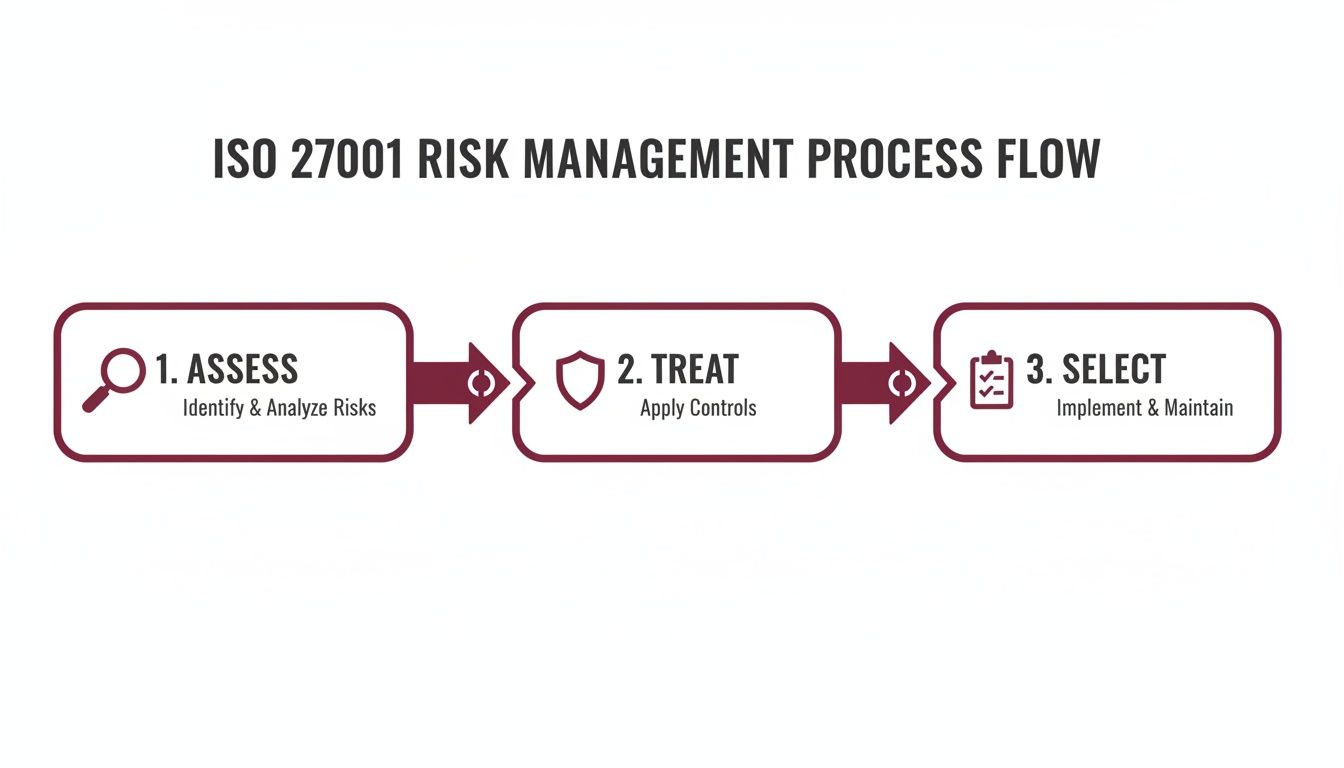
The real takeaway here is its simplicity. At its heart, the process is about looking at your environment, dealing with what you find, and choosing the right tools to stay secure.
Stage 1: Risk Identification
Let's be blunt: you can't manage a risk you don't know exists. The first stage is all about discovery. It's a methodical hunt for any and every potential security weakness across your entire business—and that means looking at your people and processes just as much as your technology.
For a small Australian business, these threats are very real. Think about:
- People: What happens if a staff member gets tricked by a clever phishing email, handing a hacker the keys to your network?
- Processes: Is your onboarding process for new hires actually secure? Do they get security training before you give them access to sensitive systems?
- Technology: What if that cloud provider you rely on for customer data has a massive breach? What’s your plan?
The goal here is simple: create a complete list of everything that could possibly go wrong and harm your information.
Stage 2: Risk Analysis
Once you have your list, it's time to figure out which risks actually matter. This stage is about weighing up the likelihood of each threat happening against the impact it would have on your business. After all, not all risks are created equal.
A vandal messing with your website is an annoyance. A ransomware attack locking up all your client files is a potential business-killer. In this stage, you get practical and assign a rating to both the probability and the potential damage of each risk you've identified.
For instance, the risk of an employee losing a work laptop might be rated 'likely' over a couple of years, with a 'moderate' impact on your finances and reputation. This analysis transforms your long, messy list into an organised and prioritised inventory of threats.
The whole point of risk analysis is to cut through the noise and get objective. It forces you to think critically about each threat, so you don't waste energy on low-probability fears or, worse, ignore the quiet but deadly dangers.
Stage 3: Risk Evaluation
With your risks analysed and rated, you've reached a crucial decision point. In the evaluation stage, you compare your findings against your company's predetermined risk tolerance. Put simply, you decide which risks are just too hot to handle and need immediate attention.
Your risk tolerance is basically your business's appetite for danger—the amount of risk you're willing to live with to get the job done. A threat that scores high on both likelihood and impact is almost certainly going to be above your tolerance level, flagging it for action.
This step is an absolute lifesaver for small businesses with tight budgets. It ensures you point your limited time, money, and effort at the problems that pose a genuine threat, rather than trying to fix everything at once.
Stage 4: Risk Treatment
The final stage is all about action. Now that you know your priorities, you need a plan to deal with them. This is called risk treatment, and you typically have four main options for every risk you've deemed unacceptable:
- Mitigate: This is the most common approach. You implement controls to reduce the risk's likelihood or impact. For that phishing threat, mitigation could mean running regular staff security training and installing better email filtering.
- Transfer: Here, you shift the financial fallout of a risk onto someone else. The classic example is taking out a solid cyber insurance policy to cover the clean-up costs after a data breach.
- Accept: Sometimes, the cost of fixing a risk is far greater than the damage it could cause. In this case, you might formally decide to accept it. The key is that this has to be a conscious, documented business decision, not just an oversight.
- Avoid: If a risk is just too big or too difficult to manage, you can change your business processes to eliminate it completely. For example, if a piece of software is riddled with security holes, you might avoid the risk by getting rid of it and finding a safer alternative.
This four-stage cycle isn't something you do once. It's a continuous loop that you should revisit regularly to keep your business secure, compliant, and ready for whatever comes next.
Side-Stepping the Common Pitfalls Small Businesses Face
Getting your head around compliance and risk management can feel like a minefield, especially when you’re a small business juggling a dozen other priorities. The path to getting properly secure is littered with common traps that can chew through your time, drain your budget, and ironically, leave you more exposed than when you started.
Knowing what these pitfalls look like is the best way to steer clear of them.
The "One-and-Done" Certification Myth
So many businesses treat getting a certification like ISO 27001 as the finish line. It's an intense sprint of audits and paperwork, and once that certificate is hanging on the wall, there's a collective sigh of relief. The job’s done, right? Wrong. This is a massive mistake.
Compliance isn’t a project you complete; it’s a commitment you live by. Threats are constantly changing, your business is evolving, and so your security measures have to keep up. Thinking of your certification as a "set and forget" achievement creates a false sense of security and leaves the door wide open for threats just months after you’ve passed the audit.
When Management Just Ticks the Box
Another classic blunder is when the push for compliance comes entirely from the IT team, without any real conviction from the leadership. Sure, management might sign off on the budget, but they often see it as a technical problem for the tech folks to handle, not as a core part of the business strategy.
Without genuine leadership driving the initiative, compliance efforts inevitably lose steam. Security tasks get bumped down the priority list, getting the right resources becomes a battle, and the whole thing just fizzles out. Real, effective compliance & risk management has to be championed from the C-suite and woven into the very fabric of your company culture.
This isn’t just a hunch; it’s a big problem for Australian businesses. A recent PwC survey revealed that a staggering zero Australian executives felt their organisations were leaders in compliance maturity, compared to 7% globally. With 56% of local leaders admitting that compliance failures hurt their business, it’s obvious that a top-down approach is non-negotiable. The good news? The same research showed that better compliance strategies led to sharper decision-making for 69% of Australian respondents. You can dig into the numbers yourself in the full PwC Global Compliance Survey analysis.
Over-Engineering Your Security Controls
It’s easy to get a bit carried away when you see a long list of potential risks. The temptation is to throw money at the problem and buy the most complex, expensive security tech you can find. Small businesses sometimes fall for the idea that fancier technology automatically means better security, but that’s rarely how it works out.
Going for overly complicated controls can cause more headaches than it solves.
- It bleeds your budget dry: Spending a fortune on one high-tech gadget can mean other critical areas are left underfunded.
- It adds needless complexity: Complex systems are a nightmare to manage and configure properly, which can accidentally create new security holes.
- Your team will just ignore it: If a security tool is a pain for your people to use, they’ll quickly find workarounds, making the whole thing pointless.
The goal isn't to build the most impressive-looking security fortress; it's to implement what's most effective for your business. More often than not, simple and consistently enforced controls—like mandatory multi-factor authentication and regular staff training—deliver far more bang for your buck than a single, pricey piece of kit.
Letting Your Documentation Gather Dust
Finally, one of the most common—and most preventable—traps is simply letting your documentation slide. Your policies, procedures, risk assessments, and incident response plans are the operational blueprint for your entire Information Security Management System (ISMS).
When this documentation is missing, out of date, or a complete mess, you’re asking for trouble. Auditors will pick up on the gaps in a heartbeat, instantly flagging you for non-compliance. But more importantly, when a real security incident kicks off, your team will be left scrambling without a clear plan. What could have been a manageable hiccup quickly spirals into a full-blown crisis. Good documentation isn't just bureaucratic paperwork; it’s your playbook for staying safe and in control.
Your Practical Next Steps Toward Certification
Alright, you've got the theory down. You understand the 'what' and 'why' of compliance and risk management. But turning that knowledge into action is what really counts. This is where the rubber meets the road. Getting your ISO 27001 certification isn't just a box-ticking exercise; it's a powerful strategic move that can give your business a serious competitive edge.
Let's talk about building momentum and making smart decisions that will safeguard your business for the long haul.

This whole movement is being driven by a clear need for stronger security. In fact, Australia's risk management market is set to explode, projected to hit USD 782.48 million by 2033. Why? Because the regulatory landscape is getting more complex by the day. A staggering 93% of Aussie executives say their business has been negatively impacted by compliance issues, with tech compliance risks now being their number one worry. You can dig deeper into these numbers in this detailed Australian market analysis.
Your Certification Kick-Off Checklist
Getting started shouldn't feel like you're trying to climb Everest in a day. It’s all about breaking it down into small, manageable steps. Here’s a simple checklist to get you on the right track with clarity and confidence.
- Do an Initial Gap Analysis: First things first, you need to know where you stand. A gap analysis is like putting your current security practices under a microscope and comparing them to the ISO 27001 standard. It shows you exactly where the gaps are.
- Get Genuine Management Buy-In: As we've mentioned, this has to come from the top. You need to build a solid business case for your leadership, spelling out the real-world benefits—from landing bigger clients to slashing operational risks.
- Define Your ISMS Scope: Decide which parts of your business will be covered by the Information Security Management System (ISMS). A tight, well-defined scope is your best defence against the dreaded 'scope creep' down the line.
- Talk to a Specialist Consultant: Seriously, don't try to do this alone. Bringing in an expert who lives and breathes ISO 27001 for small businesses is the single best thing you can do to make this process smooth and successful.
The Power of an Expert Partnership
Trying to juggle the certification process internally while still running your day-to-day business is a fast track to burnout and expensive mistakes. A specialist partner takes all the guesswork out of the equation.
We’ll dive into the nitty-gritty of the documentation, steer you through implementing the right controls, and get you fully prepped for the final audit. Our job is to make sure every single requirement is met, so you can stay focused on what you do best—running your business.
Partnering with an expert isn't just about crossing the finish line. It’s about ensuring a successful outcome and building a security foundation that will actually last. When you lean on proven expertise, you save time, cut down on stress, and gain a real advantage over your competitors.
Ready to make a move? Find out more about our proven pathway to ISO 27001 certification and see how we can help you get there.
Frequently Asked Questions
Getting your head around compliance and risk management can feel a bit like learning a new language. It’s completely normal to have questions, especially when you're just starting out on the path to ISO 27001 certification.
We've pulled together some of the most common queries we hear from business owners, IT managers, and compliance officers just like you. Think of this as a quick-reference guide to give you the clarity and confidence to take the next step.
How Long Does ISO 27001 Certification Take for a Small Business?
For most small businesses here in Australia, you're generally looking at a timeframe of 6 to 12 months. Of course, this isn't set in stone. The final timeline really depends on a few things: the size of your company, how complex your systems are, and what security measures you already have in place.
The whole journey involves a few key milestones. It starts with a gap analysis to see where you stand, then moves into creating the necessary documentation, putting the right security controls in place, and finally, facing the formal audits. Working with a consultant who knows the ropes can really speed things up, helping you sidestep common hurdles from day one.
Is ISO 27001 a Legal Requirement in Australia?
No, ISO 27001 isn't a blanket legal requirement for every business across the board. However, it's fast becoming a contractual requirement to get a seat at the table. If you want to work with government departments or land big corporate clients, they'll often demand to see proof that you take information security seriously.
Following the standard is also one of the best ways to demonstrate you’re meeting your obligations under Australian laws like the Privacy Act and the Notifiable Data Breaches (NDB) scheme. At the end of the day, certification is irrefutable, third-party proof that you’re committed to protecting data, which is gold when it comes to building trust with clients.
What Is the Biggest Risk Management Challenge for Small Businesses?
Hands down, the biggest challenge we see is a lack of resources. Small businesses are constantly juggling limited time, tight budgets, and often don't have a dedicated security expert on the payroll. This can make the detailed demands of ISO 27001 seem like an impossible mountain to climb.
Worse, it can lead to a really dangerous "set it and forget it" attitude once the certificate is on the wall. This is exactly where partnering with a specialist firm makes all the difference. We bring the focused expertise and a clear, structured process to build a security program that actually works for your business—and keeps working. You get to focus on what you do best, knowing your security and compliance are in safe hands.
Ready to turn compliance from a headache into a real competitive advantage? Our team has a 100% success rate in guiding Australian businesses through to certification. We simplify the process so you can secure your success. Find out how we can help at https://iso-27001.com.au.
Recent Comments