

Think of a computer incident response plan as your organisation's emergency playbook. It’s a detailed, pre-agreed set of steps you take the moment a security breach is suspected. Rather than descending into reactive panic, this plan gives you a structured, decisive process to follow, dramatically reducing the potential for operational chaos, financial bleeding, and reputational ruin.
Why an Incident Response Plan Is Non-Negotiable

Let's be blunt: in today's climate, it's not a matter of if your business will face a cyber attack, but when. Without a clear plan, a single incident can quickly spiral out of control, leading to operational paralysis and crippling financial strain. A well-crafted incident response plan isn't just an IT document; it's a core business continuity tool.
It provides a clear roadmap for everyone, from your tech team right up to the executive suite, ensuring everyone knows exactly what their role is when every second counts. That level of preparation is often what separates a minor disruption from a catastrophic business failure.
The Rising Tide of Cyber Threats in Australia
This isn't just hypothetical fear-mongering. The risk to Australian businesses is very real and growing. The Office of the Australian Information Commissioner (OAIC) recently reported a staggering 1,113 data breaches in a single year—that's a 48% jump from previous years.
This surge is largely driven by sophisticated ransomware and sneaky supply chain attacks, affecting, on average, over 10,000 people per incident. These aren't just numbers on a page; they represent a critical reality. Hope is not a strategy. Proactive preparation is the only way to build genuine resilience.
Moving From Chaos to Control
Picture this: it’s 4 PM on a Friday, and ransomware starts encrypting your servers. Without a plan, your team is scrambling. Who has the authority to pull systems offline? Who needs to tell your customers? How do you even begin to understand the scope of the breach while the clock is ticking and the damage is spreading?
This is precisely where your incident response plan proves its worth. It replaces that gut-wrenching uncertainty with a clear, step-by-step process. It empowers your team to act with coordinated precision, not disorganised panic.
A strong incident response plan doesn't just help you recover from an attack; it fundamentally changes the nature of the event itself. You shift from being a victim of circumstance to being in command of the situation, making strategic moves to protect your assets and stakeholders.
Protecting Your Business on Multiple Fronts
Before we dive into the nitty-gritty of building a plan, it's helpful to understand its core components. A formal plan offers crucial benefits that go far beyond just fixing the technical problem; it’s a strategic asset that protects your entire operation.
Let's break down the essential pillars.
Core Elements of an Effective Incident Response Plan
| Component | Core Function | Business Impact |
|---|---|---|
| Preparation | Equipping the team with tools, training, and processes before an incident occurs. | Reduces response time and improves efficiency when an attack happens. |
| Detection & Analysis | Identifying and verifying a security incident, determining its scope and severity. | Enables rapid, targeted action to stop the threat from spreading further. |
| Containment, Eradication & Recovery | Isolating affected systems, removing the threat, and restoring normal operations. | Minimises operational downtime, data loss, and overall financial damage. |
| Post-Incident Activity | Reviewing the incident to identify lessons learned and improve future responses. | Strengthens long-term security posture and prevents repeat incidents. |
Each of these elements works together to create a robust defence. It’s not just about recovering—it’s about safeguarding your business from every angle.
A plan helps you:
- Minimise Financial Loss: Quick containment and recovery mean less costly downtime. A structured response can also slash remediation expenses and help you avoid potential regulatory fines.
- Safeguard Your Reputation: How you communicate during a crisis is just as important as how you fix it. A plan ensures you're providing transparent, timely updates that preserve customer trust.
- Ensure Regulatory Compliance: For Australian businesses, complying with the Notifiable Data Breaches (NDB) scheme is a legal requirement. A documented plan demonstrates due diligence and ensures you meet your reporting obligations. This is a foundational step towards broader security standards; you can learn more about the value of ISO 27001 certification and how it complements these efforts.
While a solid incident response plan is your go-to for dealing with breaches after they happen, implementing strategies to prevent Man-in-the-Middle (MITM) attacks and other proactive measures can significantly strengthen your defences from the start. Ultimately, this plan is your business's playbook for turning a potential disaster into a managed, survivable event.
Assembling Your Incident Response Team
A polished incident response plan on paper is a great start, but it's nothing more than a document until you put the right people in place to bring it to life. When a real crisis hits, there’s simply no time to waste figuring out who’s in charge. That’s why building your Incident Response Team (IRT) is arguably the most important groundwork you can do.
For a small business, this might sound a bit over the top. Don't worry. This isn't about hiring a legion of cybersecurity experts. It's about assigning clear, specific responsibilities to the people you already have.
The whole point is to stamp out confusion before it has a chance to grow. During a breach, ambiguity is your worst enemy. Critical questions like, "Who has the authority to pull a server offline?" or "Who's actually allowed to talk to our customers about this?" need immediate, pre-determined answers. If you haven't defined these roles beforehand, you're guaranteeing hesitation, wasted time, and a whole lot more damage to your business.
Defining Roles with the RACI Framework
You don't need a complicated organisational chart to bring order to the chaos. A brilliantly simple tool I always recommend is the RACI framework. It’s a straightforward way to map out who does what when things go sideways.
RACI stands for Responsible, Accountable, Consulted, and Informed.
Think of it this way: for every major task during an incident, you assign a person or group to one of these four roles.
- Responsible: This is the 'doer'—the person who physically gets the task done. Your IT manager, for instance, is responsible for isolating an infected part of the network.
- Accountable: This is the person who owns the outcome. The buck stops with them. They are ultimately answerable for whether the task succeeds or fails. Often, the business owner is accountable for the entire incident response.
- Consulted: These are your subject matter experts, the people you turn to for advice. You’d consult with your external lawyer before making any public statements about a data breach.
- Informed: These are the people who just need to be kept in the loop. They aren’t directly involved in the decision-making, but they need status updates. Think of your department heads being informed as you work to get systems back online.
When you apply this model to key response tasks—like finding the breach, talking to stakeholders, or restoring from backups—you create a crystal-clear chain of command. No more guesswork under pressure.
Core Roles Your Incident Response Team Needs
Even the smallest business needs to have a few key functions covered. Remember, these are roles, not necessarily full-time positions. In many small businesses, one person might wear several hats, or you might lean on external partners. What truly matters is that the responsibility is clearly assigned before you need it.
1. Incident Response Lead
This is your quarterback. The person who is accountable for the entire response, directs the team's efforts, makes the tough calls, and makes sure everyone sticks to the plan. This is usually the business owner, a senior manager, or your go-to IT person.
2. Technical/IT Specialist(s)
These are your hands-on responders, the ones responsible for the technical heavy lifting. They're in the trenches investigating the breach, containing the threat by taking systems offline, getting rid of malware, and restoring everything from clean backups.
3. Communications Lead
How you communicate during a crisis is every bit as important as your technical fix. This person is responsible for writing and sending out all internal and external messages. They make sure your staff, customers, and any regulatory bodies get clear, accurate, and timely information. This could be your marketing manager or even the business owner.
4. Legal and Compliance Advisor
Cyber incidents can have serious legal consequences. This role, often an external legal expert you have on retainer, is consulted to ensure your response complies with Australian regulations like the Notifiable Data Breaches (NDB) scheme. They give you critical advice on reporting obligations and managing liability.
5. Executive Leadership
The business owner or CEO holds the ultimate accountability. They need to be kept informed of how things are progressing and will likely need to sign off on major decisions, like authorising big recovery expenses.
A common mistake I see is businesses treating incident response as just an IT problem. It’s not. A successful response is a team sport, requiring tight coordination between your technical, legal, communications, and leadership functions. Ignoring the non-technical roles is a surefire recipe for a mishandled crisis.
Building Clear Lines of Authority
Once you’ve got your people and their roles sorted, the final piece is establishing unambiguous lines of authority and communication. Your plan must spell out exactly who reports to whom and how information is supposed to flow when an incident is in full swing.
For example, a tech specialist shouldn't have to chase down three different managers for permission to disconnect a compromised server. The plan should empower them to act fast based on pre-defined triggers, while immediately notifying the Incident Response Lead.
This is the structure that turns a group of stressed-out individuals into a cohesive, effective team. When an attack finally happens, you won't lose precious minutes arguing about who has the final say. Instead, your team will act with coordinated precision, guided by a plan they already know and trust. You’ll be turning potential panic into a controlled, effective response.
Getting to Grips with the Incident Response Lifecycle
When a security incident hits, it's never a single, isolated event. It’s a process that unfolds in stages, and understanding this flow is what separates a managed incident from a full-blown catastrophe. A formalised approach, often called the incident response lifecycle, gives you a clear roadmap to follow when the pressure is on.
Let's ground this in reality. Imagine a clever phishing email lands in an employee's inbox. They click, and before you know it, ransomware is silently encrypting files across your network. This is the exact kind of scenario where a structured, six-phase lifecycle turns chaos into a controlled, methodical process.
Phase 1: Preparation – The Foundation for Success
Here’s a hard truth I’ve learned over the years: your success during a crisis is decided long before the attack ever happens. The Preparation phase is where you do all the heavy lifting, giving your team the tools, training, and documented plans they need to act with confidence. It’s about building muscle memory so that when an incident kicks off, the response is instinctive, not improvised.
So, what does good preparation look like?
- Documenting Your Game Plan: This is the computer incident response plan itself—a living document that clearly outlines roles, responsibilities, and how you'll communicate.
- Assembling Your Toolkit: Make sure you have the right security software, forensic tools, and secure communication channels ready to go before you need them.
- Training and Drills: Run regular tabletop exercises. These are invaluable for stress-testing your plan and finding the weak spots in a safe environment.
Without this groundwork, everything that follows will be reactive and disorganised, massively increasing the potential damage. The threat is real and growing. The Australian Cyber Security Centre (ACSC) recently reported responding to over 1,200 cybersecurity incidents, an 11% jump from the previous year, with ransomware leading the charge. This isn't just a statistic; it's a clear warning to be prepared. For more on the national threat landscape, the government's Annual Cyber Threat Report is an eye-opener.
Phase 2: Identification – Spotting the Threat
The moment a potential security event is flagged, the Identification phase begins. Your goal here is simple but crucial: swift and accurate triage. Is this a genuine threat or just another false alarm? In our ransomware scenario, this could be an alert from your endpoint security software screaming about suspicious file encryption, or perhaps an employee reporting that strange email.
Effective identification really comes down to a few key things:
- Keeping a Watchful Eye: Having tools like a Security Information and Event Management (SIEM) system or intrusion detection systems actively monitoring for anything out of the ordinary.
- Clear Reporting Lines: Every single employee needs to know exactly who to call and what to do the second they spot something suspicious. Time is critical.
- Sharp Triage Skills: Your technical team needs the training to dig into alerts, logs, and network traffic to quickly validate a threat and get a handle on its initial scope and severity.
I can't stress this enough: the speed and accuracy of your identification directly dictate the extent of the damage. A threat you catch in minutes is a world away from one that’s been hiding on your network for weeks, quietly spreading.
This is also where getting on the front foot pays dividends. Proactive techniques like threat hunting can be a proactive approach to identifying cyber threats before they ever have a chance to escalate into a full-blown incident.
And remember, this isn't just an IT problem. It's a business problem that requires a coordinated effort.
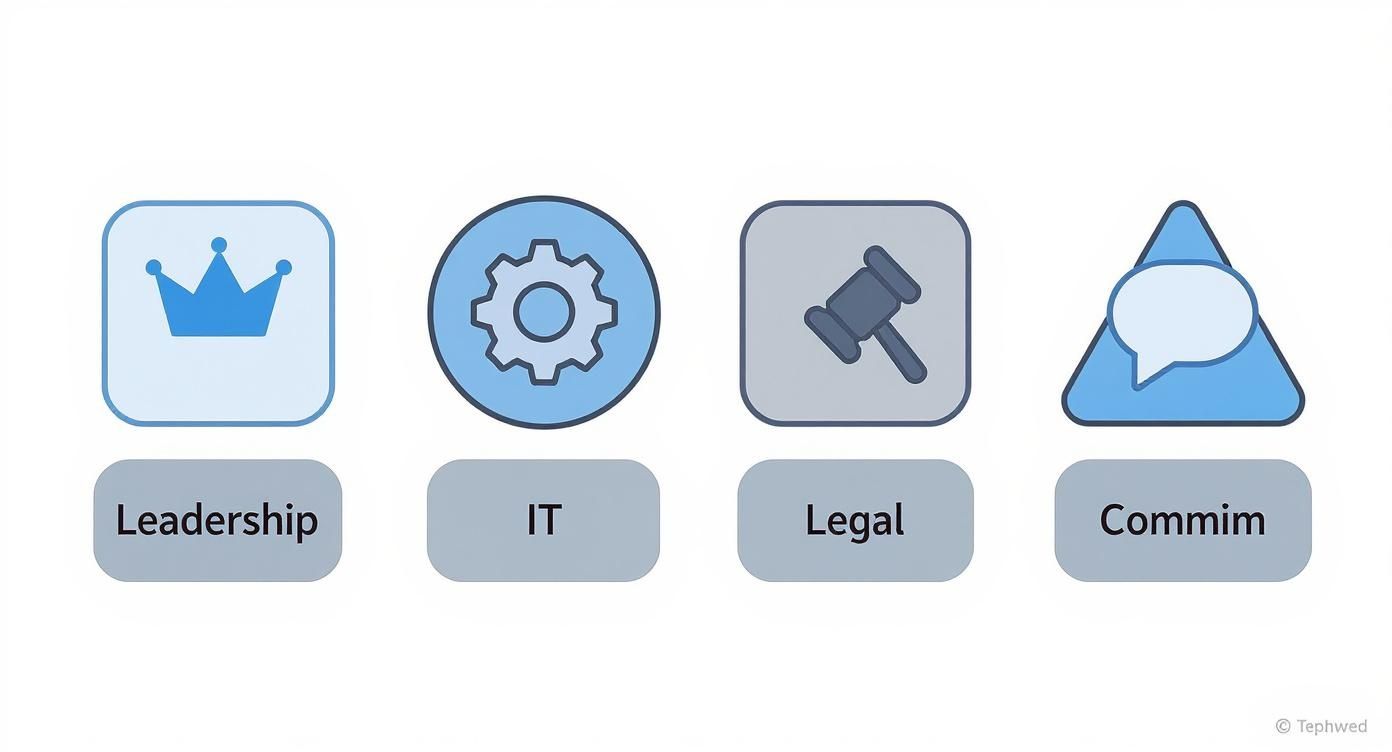
As you can see, leadership, IT, legal, and communications all have a vital role to play. A siloed response is a failed response.
Phase 3: Containment – Stopping the Bleed
Once you've confirmed you have a genuine threat on your hands, the priority shifts instantly to Containment. This is all about damage control. You need to isolate the affected systems to stop the attack from spreading across your network. It’s the digital equivalent of applying a tourniquet.
For that ransomware attack, your immediate containment actions would be:
- Isolating Infected Machines: Yanking compromised computers or servers off the network—literally unplugging them if you have to.
- Leveraging Network Segmentation: If you've segmented your network properly, you can slam the doors shut between different parts of your business, limiting the malware’s ability to move laterally.
- Disabling Compromised Accounts: Any user accounts the attacker might have hijacked need to be disabled immediately.
The key here is to act fast and be decisive. If you hesitate at this stage, you're giving the attacker time to dig in deeper, making the next phases infinitely harder and more expensive.
Phase 4: Eradication – Removing the Root Cause
With the threat contained, it’s time for Eradication. This is about methodically removing every last trace of the attacker from your environment. It’s more than just deleting the ransomware executable; it’s about digging down to find and eliminate the root cause so this can't happen again.
This involves some serious detective work:
- Deep Forensic Analysis: Investigating to figure out exactly how the attackers got in, which vulnerabilities they exploited, and what tools they deployed.
- Scrubbing the Systems: Securely wiping all malware, backdoors, and other nasty artifacts the attacker left behind.
- Patching the Holes: Applying the necessary security updates to close the very door the attackers walked through.
Let me be blunt: simply restoring from a backup without first eradicating the root cause is asking for reinfection. You have to be absolutely certain the threat is gone before you even think about recovery.
Phase 5: Recovery – Getting Back to Business
Now for the Recovery phase. This is where you carefully restore your affected systems and data to get the business back up and running. The key word here is carefully. Rushing this step could mean reintroducing the very threat you just worked so hard to remove.
Your recovery plan should include:
- Restoring from Clean Backups: Using trusted, verified backups that you know are uncompromised to restore your data and systems.
- Validating System Integrity: Once restored, every system needs to be thoroughly scanned and tested to ensure it’s clean before it goes back online.
- A Phased Return to Normal: Don't just flick a switch. Bring systems back online gradually while monitoring them like a hawk for any sign of trouble.
This phase is only truly over when your business is fully operational and you're confident that your environment is secure.
Phase 6: Lessons Learned – Strengthening Your Defences
The last phase is arguably the most important one: Lessons Learned. After the adrenaline has subsided and the dust has settled, you absolutely must conduct a post-incident review. This isn’t about pointing fingers or assigning blame. It’s a blame-free debrief focused on one thing: strengthening your defences for next time.
Your review needs to tackle some tough questions:
- What did we do well, and where did we drop the ball?
- How could we have spotted this threat sooner?
- Did our communication plan hold up under pressure?
- What specific changes do we need to make to our plan, tools, or team training?
The insights you gain here are pure gold. They feed directly back into the Preparation phase, creating a powerful cycle of continuous improvement that makes your organisation stronger and more resilient with every challenge you face.
Developing a Crisis Communication Strategy
When a cyber incident hits, your technical response is only half the battle. Seriously. How you communicate—or, more importantly, how you fail to communicate—can inflict more lasting damage on your business than the breach itself.
A clumsy, delayed, or vague message will destroy the trust you've built with customers, partners, and even your own staff. This is precisely why a pre-planned crisis communication strategy isn't just a nice-to-have; it's a core component of your entire computer incident response plan.
This isn't about trying to write the perfect press release while the building is on fire. It's about having a ready-to-go playbook that dictates what to say, who to say it to, and when. Without it, you’re just inviting a second crisis—a crisis of confidence that can haunt your reputation long after the technical mess is cleaned up.
Who Needs to Know What, and When?
Your communication plan has to speak to different groups of people, and each group has very different concerns. A one-size-fits-all email blast is a recipe for disaster. The real skill is getting the right information to the right people through the right channels, all while keeping control of the story.
I like to think of it as a series of expanding circles, starting with your immediate team and moving outwards.
- Internal Staff: Your own people must be the first to know, not the last. A quick, clear internal briefing stops the rumour mill cold, reduces panic, and gets everyone on the same page. It also prevents a well-meaning employee from accidentally telling a customer the wrong thing.
- Customers and Clients: They need honesty and reassurance, fast. Your message should acknowledge the problem, explain that you're all over it, and tell them exactly what they need to do to protect themselves, if anything.
- Business Partners and Suppliers: Your key partners need a heads-up about any potential impact on shared operations. A proactive call or email maintains those critical relationships and stops them from being blindsided.
- Regulatory Bodies: For any business in Australia, this is a big one. You have a legal duty to report certain data breaches to the Office of the Australian Information Commissioner (OAIC) under the Notifiable Data Breaches (NDB) scheme. Your plan needs to spell out the exact triggers and timelines for making that official notification.
Crucially, your strategy must name a single, authorised spokesperson. This is usually the CEO or another senior leader. Funnelling all communication through one person kills off conflicting messages and shows everyone that leadership has a firm grip on the situation.
Crafting Your Message: The Art of Transparency
When it comes to what you actually say, the golden rule is honesty without causing a stampede. You're walking a fine line between being transparent and maintaining operational security. Spilling too much technical detail too early could hand the attackers more ammunition.
Here’s a practical checklist for your initial public statements:
- Acknowledge the Incident: State clearly that you're aware of a security incident and are actively investigating.
- Show Some Empathy: Acknowledge the worry and hassle this might cause your customers. A little humanity goes a long way.
- Outline Your Actions: Briefly mention that you've brought in experts and are working around the clock to contain and fix the issue.
- Give Actionable Advice (If needed): If customer data is at risk, give them simple, direct steps to take. "We strongly recommend you change your password" is much better than a vague warning.
- Promise an Update: Give a clear timeframe for your next communication. This one small step can massively reduce customer anxiety and the flood of support tickets.
The worst thing you can do during a breach is go silent. When there’s an information vacuum, customers and the media will fill it with speculation and worst-case scenarios. You control the narrative by speaking first, even if you don’t have all the answers yet.
Measuring What Matters After the Dust Settles
Once the immediate fire is out, the job isn't over. The post-incident phase is your chance to turn a disaster into a powerful lesson. This means putting together a proper report that focuses on analysis, not blame. The whole point is to build a culture of learning that makes your business tougher.
Two of the most important metrics you need to get your head around are Mean Time to Detect (MTTD) and Mean Time to Respond (MTTR).
- MTTD (Mean Time to Detect): This is the clock that starts ticking the moment an attacker gets in and stops the moment you spot them. A lower MTTD is proof that your monitoring and alert systems are actually working.
- MTTR (Mean Time to Respond): This measures how long it takes your team to contain the threat, kick it out, and get everything back to normal after it’s been detected. A low MTTR shows your response plan and team are well-oiled machines.
These aren't just geeky acronyms; they're powerful business numbers. When you can walk into a management meeting and show how your MTTD and MTTR have improved, you’re demonstrating the real-world value of your security budget. For example, you can directly link a new security tool or team training session to cutting down response times in your latest incident.
This data-driven approach is the best way to justify future security spending. It turns the fuzzy idea of "cybersecurity" into a measurable business function, proving that a solid computer incident response plan isn't a cost—it's a critical investment in keeping the business running and customers happy.
Testing Your Plan with Realistic Drills

Let's be blunt. An incident response plan that just sits in a folder is nothing more than a document. It might tick a compliance box, but in the heat of a real crisis, it’s about as useful as a fire extinguisher you’ve never actually picked up. A plan only becomes a real strategic asset when you put it through its paces.
This is where drills and exercises come in. Their goal is simple: to find the cracks in your plan in a safe, controlled way. You want to discover that a key contact number is out of date or a technical tool isn’t working before an attacker is already inside your network.
Effective testing transforms theory into muscle memory. It’s the difference between your team managing a crisis with confidence and being completely overwhelmed by it.
Choosing the Right Drill for Your Team
You don't need to dive into a full-blown, company-wide simulation from day one. In fact, that's often a recipe for frustration. The smart approach is to pick the right drill for your team's current maturity and resources. For most small businesses, this means starting small and building up the complexity over time.
Think of it as building competence layer by layer.
A Comparison of Incident Response Testing Methods
Understanding the different ways to test your plan, from simple walkthroughs to full-scale simulations, helps you choose the most effective next step for your team.
| Testing Method | Complexity Level | Resources Required | Best For |
|---|---|---|---|
| Plan Walkthrough | Low | Minimal (a few hours, a meeting room) | Validating the basic plan structure and making sure everyone understands their roles. |
| Tabletop Exercise | Medium | Moderate (facilitator, defined scenario, half-day) | Stress-testing decision-making and communication in a discussion-based format. |
| Live Simulation | High | Significant (technical tools, dedicated time, potential for operational disruption) | Testing the team's technical skills and security tools in a realistic, hands-on scenario. |
Each of these methods provides unique value. A walkthrough is the perfect starting point. A tabletop exercise is where you see how your team really thinks under pressure. And live simulations are the final exam.
To complement these internal drills, engaging professional penetration testing services can give you an attacker's-eye view of your defences, uncovering weaknesses you might not see yourself.
Running an Effective Tabletop Exercise
For most businesses, the tabletop exercise hits the sweet spot between realism and practicality. It's essentially a guided conversation where your Incident Response Team (IRT) talks through a simulated crisis from beginning to end. The aim isn't to fix the technical issue on the spot, but to pressure-test your procedures and decision-making.
Let’s run through a common scenario.
Scenario Example: Data Leak from a Cloud Service
Imagine your marketing team uses a popular third-party cloud service to manage customer lists. You get a credible alert that this provider has been breached and data has been exposed—and your customer data was likely part of it.
The clock starts now. What do you do?
The facilitator's job is to push the team with probing questions at every stage.
- Identification: Who is responsible for verifying this alert? How do we find out if our specific data was actually stolen? What tools do we even have for that?
- Containment: What’s the first move? Do we have a way to remotely revoke access to that service for all staff, right now? Who has the authority to make that call?
- Communication: Who writes the first internal email to staff? Who is our spokesperson for customers? When do we call our lawyer to discuss our obligations under the Notifiable Data Breaches scheme?
- Recovery: How do we safely turn access back on once the threat is gone? How do we verify the cloud provider has actually fixed the problem? What’s our plan if we confirm customer data was leaked?
The true value of a tabletop exercise is found in the uncomfortable silences and the "I don't know" answers. Every gap you find in that room is a potential disaster you’ve just avoided in the real world.
Learning From Every Drill
After any exercise—from the simplest walkthrough to a complex simulation—the most important step is the post-mortem. This isn't about pointing fingers; it's a blame-free debrief focused entirely on getting better.
Document everything you find. Did the communication plan have a hole in it? Was there confusion over who could take a critical system offline? These aren't failures. They are priceless learning opportunities.
Use that feedback to update your computer incident response plan immediately. Every drill should make your plan stronger and clearer. This creates a powerful cycle of continuous improvement, ensuring you don't just have a plan, but have a living, battle-tested strategy that builds true resilience.
Weaving ISO 27001 and Australian Regulations into Your Plan
For any Australian business, having a computer incident response plan isn't just a smart move—it’s a fundamental part of your legal and regulatory obligations. A well-crafted plan does more than just see you through a crisis. It acts as your proof of due diligence, shielding you from the hefty legal and financial penalties that often follow a data breach.
Getting your head around these requirements doesn't need to be a major headache. Let's break down how your plan lines up with two key frameworks: the global gold standard for information security, ISO 27001, and our own local data breach law, the Notifiable Data Breaches (NDB) scheme.
Hitting Your ISO 27001 Marks
ISO 27001 is the benchmark for a solid Information Security Management System (ISMS). If you're aiming for certification, or even just adopting its best practices, your incident response plan is an absolute must-have. It directly ticks off several critical controls in the standard, proving you’re ready to handle security events like a pro.
Here’s how your plan satisfies some of the most important ISO 27001 requirements:
- A.16.1.1 – Responsibilities and Procedures: This control demands you define and document who does what during an incident. Your plan, especially with a clear RACI chart, nails this requirement perfectly.
- A.16.1.2 – Reporting Events: You need a formal channel for reporting security events. Your plan's communication strategy and escalation paths provide exactly that.
- A.16.1.5 – Response Actions: This is all about having a consistent and effective response. The entire lifecycle you've built—from detection to recovery—demonstrates this structured approach.
- A.16.1.7 – Collecting Evidence: You must have a process for gathering forensic evidence properly. Your plan should spell out how to do this so the evidence holds up and is actually useful.
If you want to get a better handle on information security management systems and what international compliance involves, it's worth reading What ISO 27001 Certification Entails. This guide unpacks the whole certification process and why it matters.
Staying on the Right Side of the Notifiable Data Breaches Scheme
Beyond international standards, Australian law has its own set of rules you can't ignore. The big one is the Notifiable Data Breaches (NDB) scheme, which is managed by the Office of the Australian Information Commissioner (OAIC). This law makes it compulsory to notify affected individuals and the OAIC when a serious data breach happens.
Your incident response plan must have a clear section dedicated to NDB compliance. This means getting specific about what triggers a notification.
A "notifiable breach" is when personal information you hold is accessed or disclosed without authorisation, and this is likely to cause serious harm to anyone affected. Your plan has to give your team the clarity and confidence to make this call quickly.
When a breach is deemed notifiable, you have very specific obligations:
- Act Fast: You need to take all reasonable steps to assess a suspected breach within 30 calendar days.
- Notify Promptly: Once confirmed, you must let the OAIC and the affected individuals know "as soon as practicable."
Your plan should have pre-approved communication templates ready to go for these notifications. This ensures your messaging is clear, compliant, and shows you actually care. Getting this wrong can lead to fines running into the millions for serious or repeated breaches.
Thinking this through isn’t just a theoretical exercise. The cyber threat landscape in Australia is genuinely challenging, with a staggering number of breaches reported each year. Despite this, too many businesses are caught without a formal plan, which just leads to chaos and bigger losses when an attack inevitably hits.
In the end, building ISO 27001 principles and NDB scheme requirements into your incident response plan isn’t just about compliance. It elevates your plan from a simple technical document to a powerful tool for resilience, legal defence, and keeping your customers’ trust when it matters most.
Got Questions About Your Incident Response Plan?
Stepping into cybersecurity can feel like learning a new language, and it’s completely normal to have a heap of questions when you’re building something as vital as a computer incident response plan. Frankly, it's better to ask them now than in the middle of a crisis. Let's tackle some of the most common things that come up when businesses get serious about their response strategy.
Getting these fundamentals sorted is what transforms your plan from a document collecting dust on a shelf into a real, practical tool that gives your team confidence when the pressure is on.
How Often Should We Actually Update This Thing?
One of the classic blunders is treating your incident response plan like a finished project. The truth is, it’s never finished. A plan is only as good as its relevance to your business right now. You should be dusting it off for a proper review and update at least annually, but you also need to revisit it any time there's a major shift in your business.
What counts as a "major shift"? Think about things like:
- New Tech: You've just rolled out a new CRM, migrated to a different cloud provider, or introduced some other critical piece of software or hardware.
- Team Shake-ups: Key people on your Incident Response Team (IRT) have left the company or moved into different roles. The last thing you want is to be calling someone who left six months ago.
- Business Changes: Maybe you’ve acquired another company, opened a new office, or significantly changed how you operate.
- Post-Mortem: After a real incident—or even just a drill—you will always find gaps. This is gold. It’s your single best opportunity to make meaningful improvements.
Look at your plan as a living, breathing document. An outdated plan with the wrong contact details or procedures for systems you no longer use can create more chaos than having no plan at all.
A static incident response plan isn't just outdated; it's a liability. Keeping it fresh isn't just about ticking a box for best practice. It’s about making sure the plan will actually work when you need it most.
What's the Single Biggest Mistake People Make?
Easy. They fail to test the plan. An untested plan is just a theory, a collection of hopeful assumptions. You have absolutely no idea if it will hold up until you put your team under a bit of pressure in a controlled drill or a tabletop exercise.
Testing is where the rubber meets the road. It’s how you find the hidden tripwires that look perfectly fine on paper. You might realise that your emergency communication channel is a mess, that two people think they’re in charge of the same thing, or that a critical technical step takes three hours, not thirty minutes. Discovering this during a drill is a win. Discovering it during a live ransomware attack is a disaster.
We Have a Plan, So Do We Still Need Cyber Insurance?
This is a brilliant question, and it gets to the heart of modern risk management. The answer is a definite "yes." Think of them as two sides of the same coin—they don’t replace each other; they make each other stronger.
Here’s how they fit together:
- Your Plan Reduces the Damage: A well-rehearsed plan can drastically cut the cost and impact of a breach. Insurers absolutely love seeing this. In fact, many won't even give you a quote these days unless you can show them you have a formal plan in place.
- Insurance Covers the Bill: Your plan is the instruction manual for your response, but the insurance is what helps you pay for it. This can be a lifesaver for covering the eye-watering costs of forensic investigators, legal advice, PR crisis management, and even regulatory fines or ransom demands.
Ultimately, having a solid plan shows you’re serious about managing your risk, which can often lead to better premiums. It’s not an either/or situation. A mature cybersecurity strategy has both.
Navigating the world of cybersecurity and ISO 27001 can feel complex, but you don't have to go it alone. If you're ready to create a security posture that not only protects your business but also meets global standards, learn more about our ISO 27001 consulting services.
Recent Comments