

Let’s be honest: computer security used to be the job nobody wanted, often lumped onto an already overworked IT admin's to-do list. Not anymore. Today, a robust cybersecurity framework is a core part of how any smart business operates, driven by a relentless barrage of digital threats. These roles are less about just fixing things and more about building a digital fortress to protect critical data and keep the business running smoothly. The variety of computer security careers available means there's a path for anyone passionate about technology and defense.
If you’re looking for a career path that’s not just stable but genuinely makes a difference, this is it.
The Ticking Clock: Why Demand for Security Experts is Skyrocketing
Think about how much business has changed in the last decade. Every time a company moves to the cloud, launches an app, or lets its team work from home, its attack surface—the number of potential entry points for a hacker—gets bigger. This digital expansion is fantastic for growth, but it also creates new cracks for attackers to slip through.
That’s where security professionals come in. They aren't just a technical backstop; they're essential for survival. Their work protects everything from customer trust and brand reputation to the company's bottom line. The need for people who can spot a threat before it becomes a disaster has never been more urgent.
A National Wake-Up Call
This isn’t just a corporate problem; it’s a national priority here in Australia. We’re facing a massive skills gap, and it's widening at a frightening pace. While the number of cybersecurity professionals in Australia grew by 5.5% in one year, the gap between open jobs and available talent blew out by over 70% in that same timeframe. That makes it one of the tightest and most in-demand job markets on the planet.
The stats tell a stark story. The Australian Signals Directorate fields nearly 84,700 cybercrime reports a year—that's a new incident hitting their desk every six minutes. To just keep our heads above water, Australia needs another 30,000 cyber security professionals right now. And looking ahead, we’ll need an extra 54,000 specialists by 2030 to handle what’s coming.
Whether you're looking to hire or looking for a new career, these numbers send a clear message: computer security careers are here to stay, and they are absolutely vital. You can dig deeper into Australia's hiring market projections and what it means for your career on paxus.com.au.
This isn't a short-term trend. It's a fundamental change in how businesses have to think. Having a strong security game is no longer optional—it's a competitive edge, and you can't build it without a team of real experts.
From the analysts on the front lines watching network traffic for anything unusual, to the strategic thinkers crafting company-wide security policies, the world of computer security careers is incredibly broad. In this guide, we'll walk you through the different paths you can take, breaking down the skills, certifications, and real-world experience you need to build a successful career in this critical field.
A Day in the Life of a Security Professional
So, what does it actually mean to work in computer security? The movies paint a picture of a lone wolf in a dark room, frantically hammering away at a keyboard to stop a global meltdown. The reality is far more structured, collaborative, and honestly, more strategic. It's less about those heart-pounding, last-second saves and more about building a fortress, brick by methodical brick.
Computer security careers aren't a monolith; they're an ecosystem of specialised roles working in concert. Let's pull back the curtain and see what a typical day looks like for the key players who keep an organisation’s digital world safe.
The hierarchy below gives you a quick snapshot of how these roles fit together. You've got the CISO at the top steering the ship, managers coordinating the efforts, and analysts on the front lines doing the hands-on work.
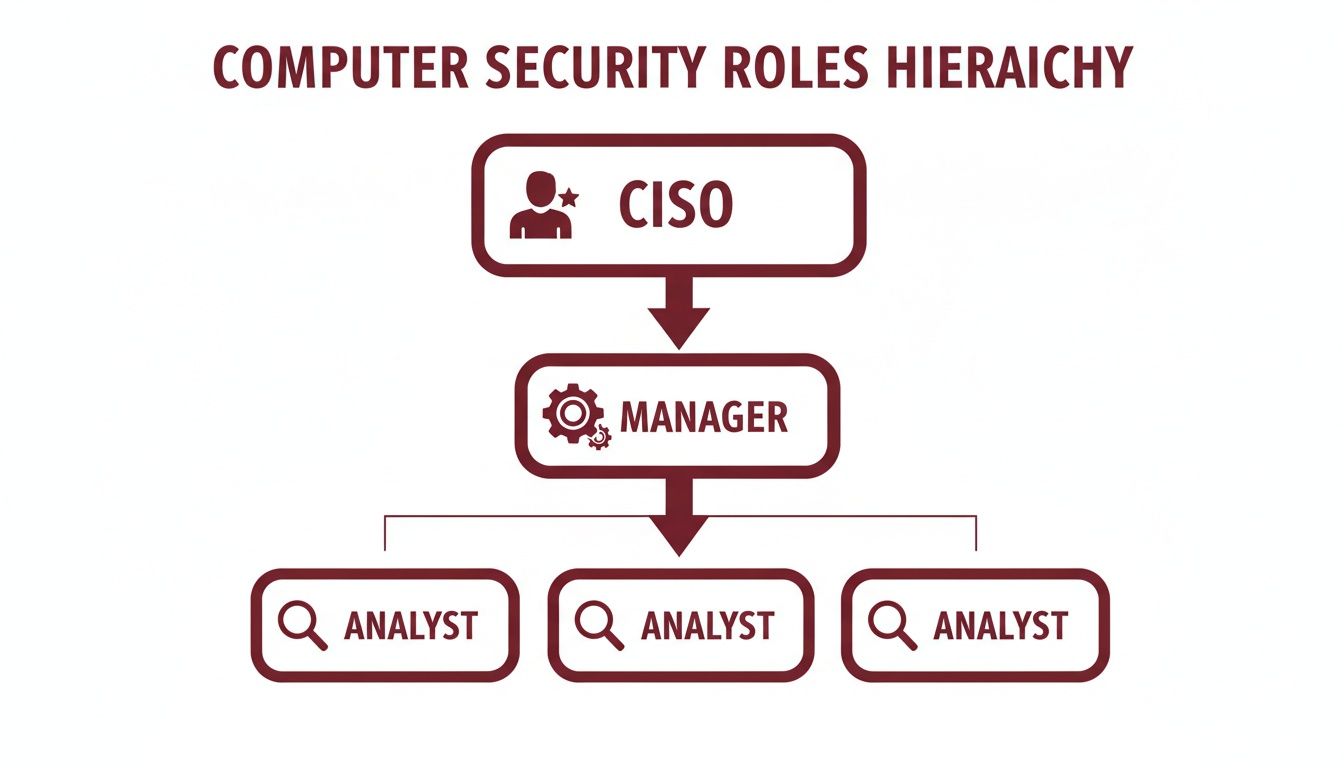
This structure is crucial because the tactical, in-the-trenches intelligence gathered by analysts directly fuels the big-picture strategic decisions made by leadership.
The Frontline Defender: The Security Analyst
A Security Analyst’s day doesn’t start with a coffee; it starts with data. Lots of it. These are the digital sentinels of the organisation, and their morning ritual is all about sifting through alerts from firewalls, intrusion detection systems, and SIEM (Security Information and Event Management) platforms. Their core mission? To find the real threats hidden in a mountain of digital noise.
Is that unusual login from an overseas IP address a genuine attack, or just an employee on holiday forgetting to use the VPN? Is a sudden spike in network traffic a coordinated assault, or did the marketing team just upload a massive video file? Analysts spend their day chasing down these anomalies, documenting everything, and escalating credible threats. They are the first responders of the digital world.
A Security Analyst's job is fundamentally about pattern recognition. You have to know your network’s normal rhythm inside and out to spot something that’s even slightly off-key. It takes a deeply curious and analytical mind.
On any given day, an analyst might be:
- Triaging alerts: Deciding which fires to put out first based on potential business impact.
- Digging deeper: Using a suite of tools to investigate suspicious activity and gather evidence.
- Reporting up: Clearly explaining technical findings to managers or incident response teams.
This role is a fantastic launchpad into the security field. If you want a more detailed look at the nitty-gritty, you can learn more about the day-to-day of a cyber security analyst in our detailed guide.
The Proactive Hunter: The Penetration Tester
While the analyst defends the castle walls, the Penetration Tester (or 'pen tester') tries to find ways to sneak past them. Their job is to think like a hacker and uncover vulnerabilities before the real bad guys do.
A pen tester's day is usually project-driven and intensely focused. They might spend their morning mapping out a simulated attack on a new web application the company is about to launch. This involves reconnaissance—gathering intel on the target—before methodically probing for weaknesses like SQL injection or cross-site scripting.
They don't just find the cracks; they exploit them to show exactly what a real attacker could achieve. The afternoon is often dedicated to writing a meticulous report for developers and management, outlining not just the problem but the clear, actionable steps needed to fix it.
The Strategic Organiser: The Information Security Manager
Step up the ladder, and you’ll find the Information Security Manager. Their day is less about the command line and more about people, processes, and policies. A manager's morning might kick off with a team huddle to review security metrics and set priorities for the week. They are the critical link between the technical team and the rest of the business.
Their time is spent ensuring the entire security program is actually helping the business achieve its goals. This means they are often:
- Developing and updating security policies and procedures.
- Managing the security budget and making the case for new technology.
- Overseeing compliance with standards and regulations like ISO 27001.
- Coordinating the troops during a real security incident.
Their focus is on building a mature, resilient security posture—not just playing whack-a-mole with individual threats.
The Meticulous Inspector: The Security Auditor
The Security Auditor’s world is one of verification and assurance. Their day is guided by established frameworks and controls. They might spend the morning interviewing department heads to see how security policies are really being followed on the ground, not just on paper.
In the afternoon, they could be buried in evidence—reviewing system configurations, access logs, and training records to make sure everything lines up with documented procedures. An auditor’s purpose is to provide an independent, objective assessment of the organisation's security, pinpointing gaps and areas for improvement. They are absolutely essential for maintaining certifications and proving compliance to clients and regulators.
The Visionary Leader: The Chief Information Security Officer (CISO)
At the very top sits the CISO (Chief Information Security Officer). A CISO’s calendar is packed with high-level meetings. In one day, they might present the company’s cyber risk posture to the board of directors, huddle with the legal team about data privacy laws, and then meet with their security managers to set the strategic direction for the next quarter.
Their entire focus is on managing risk at a business level. A great CISO ensures that security is seen as a business enabler, not a roadblock. They are masters at translating complex technical threats into business terms, which is how they secure the executive support and budget needed to build a truly world-class security program.
Computer Security Career Paths at a Glance
To tie it all together, here’s a quick-reference table that compares these core roles. It’s a great way to see how the focus and skills shift as you move through different areas of the security field.
| Role Title | Primary Focus | Core Skills | Typical Next Step |
|---|---|---|---|
| Security Analyst | Real-time threat detection and incident response | SIEM tools, network analysis, log review, incident triage | Senior Analyst, Incident Responder, Threat Hunter |
| Penetration Tester | Proactive vulnerability discovery and exploitation | Hacking tools (e.g., Metasploit), scripting, web app security | Senior Pen Tester, Security Consultant, Red Team Lead |
| InfoSec Manager | Program development, policy, and team leadership | Risk management, compliance frameworks (ISO 27001), budgeting | Senior Manager, Director of Security, CISO |
| Security Auditor | Compliance verification and control assessment | Audit frameworks (e.g., PCI DSS, SOC 2), evidence gathering | Senior Auditor, Compliance Manager, GRC Specialist |
| CISO | Executive leadership and business risk strategy | Business acumen, strategic planning, communication, risk governance | Board Advisor, vCISO, Executive Leadership |
As you can see, while each role is distinct, they all build upon a shared foundation of security principles. Understanding this progression is key to mapping out a successful and rewarding career path in this dynamic industry.
Building Your Skillset for a Security Career
Breaking into a computer security career isn't just about learning a few tools. It’s about building a robust arsenal of technical expertise, sharp strategic thinking, and the right credentials to prove you’ve got what it takes. You're not just a technician; you're a defender, and that means you need to be prepared on all fronts.
This preparation comes down to a solid foundation of both hard and soft skills.

Think of it this way: your technical knowledge is the bedrock. Without it, everything else crumbles. But it’s the soft skills—clear communication, critical analysis, and staying cool under pressure—that turn a good analyst into an indispensable leader.
Core Technical Proficiencies
To hold your own in any security role, you have to be fluent in the language of technology. This means mastering the very domains where threats are born and bred.
These skills are absolutely non-negotiable for anyone serious about building a lasting career in this field.
- Network Security: You need a deep understanding of how data moves. This means getting hands-on with firewalls, intrusion detection systems (IDS), VPNs, and knowing how to design a secure network from the ground up.
- Operating System Security: Whether it’s Windows, Linux, or macOS, you must know how to lock down these systems, manage user access properly, and dig through logs to find the faintest trail of an attacker.
- Threat Intelligence and Analysis: This is about getting inside the enemy's head. Who are the threat actors? What are their motives? What tactics, techniques, and procedures (TTPs) do they favour?
- Cloud Security: With nearly everyone moving to AWS, Azure, and Google Cloud, professionals who can secure these environments are worth their weight in gold. This involves everything from configuring cloud-native security tools to managing complex identity and access controls.
The Power of Soft Skills
Sure, technical chops will get you in the door. But it’s your soft skills that will determine how far you climb. When a real crisis hits, your ability to communicate clearly can be far more valuable than your slickest script.
Imagine you’ve just found a critical vulnerability. You have to explain the risk not only to your fellow techies but also to the non-technical manager who signs the cheques for the fix. This is where communication becomes your superpower.
"A security professional's greatest tool is often their ability to translate complex technical risk into clear business impact. When you can make executives understand why something matters, you get the resources you need to build a stronger defence."
The professionals everyone wants to hire are the ones who combine deep tech skills with these crucial abilities:
- Problem-Solving: At its heart, cyber security is about solving incredibly complex puzzles, often with the clock ticking.
- Communication: You must be able to write concise reports and verbally explain intricate problems to people from all walks of the business.
- Attention to Detail: It’s a cliché for a reason. One misconfigured setting or a single overlooked log entry can be the difference between secure and catastrophic.
Validating Your Expertise With Certifications
Certifications are the industry’s handshake—a recognised way of verifying your knowledge. They provide a standardised benchmark of your skills and show potential employers that you have a proven level of expertise. While nothing beats real-world experience, the right certification can absolutely unlock doors to bigger and better opportunities.
To stay relevant, it's vital to regularly assess where you stand and identify and bridge skill gaps for career growth. Certifications offer a fantastic, structured pathway to do exactly that.
Choosing the Right Certification Path
Different certifications are tailored to different computer security careers, so you need to choose wisely. Don't just collect acronyms for your resume; pick credentials that genuinely align with where you want to go.
- Foundational Certifications: Just starting out? Something like CompTIA Security+ is perfect for building that initial baseline of security knowledge.
- Offensive Security Certifications: If you're drawn to the thrill of ethical hacking, the Certified Ethical Hacker (CEH) is a well-known entry point. For those who want to prove serious hands-on skill, the Offensive Security Certified Professional (OSCP) is the gold standard.
- Defensive and Management Certifications: For anyone with leadership ambitions, the Certified Information Systems Security Professional (CISSP) is globally recognised and highly respected. It proves you have a wide-ranging understanding across multiple security domains.
- Strategic Framework Certifications: This is where you separate yourself from the pack. Expertise in ISO 27001 (as a Lead Implementer or Lead Auditor) shows you know how to build and manage a complete Information Security Management System (ISMS). This skill transforms you from a purely technical specialist into a strategic business advisor.
For those in Australia looking to skill up, exploring options like government-funded cyber security courses can be a brilliant move. These programs are often designed to fill the exact skill gaps the industry is crying out for, making graduates incredibly employable.
By strategically combining hands-on experience, essential soft skills, and the right certifications, you'll be well on your way to building a resilient and rewarding career.
What Can You Earn? A Look at Salaries and the Job Market
Let's talk about one of the biggest draws to a career in computer security: the powerful mix of great pay and rock-solid job stability. The demand for security experts isn't just hype you read in the news; it's a market reality that puts real dollars in your pocket and opens up a ton of opportunities.
So, what can you actually expect to earn? It’s not a simple question, because your paycheque is shaped by your experience, where you live, the certifications you hold, and the specific seat you take at the security table.
Cracking the Code on Australian Cyber Security Salaries
Here in Australia, the pay for security roles directly reflects just how critical they are to business. While you'll see some differences between cities like Sydney, Melbourne, and Canberra, there are some pretty clear salary bands you can expect as you climb the career ladder.
Even starting out, the financial incentive is strong.
- Security Analyst: If you're just getting your foot in the door as an analyst, you can realistically expect to start in the $80,000 to $110,000 range. Once you’ve got a few years of threat hunting and incident response under your belt, that number climbs quickly.
- Penetration Tester: Because their skills are so specialised and offensive in nature, pen testers often start on a higher footing. It's common to see starting salaries between $100,000 and $140,000.
- Information Security Manager: Stepping into management means more responsibility, and the pay packet reflects that. You’re looking at $150,000 to $200,000, and often more, depending on the size and complexity of the company.
- Chief Information Security Officer (CISO): At the top of the food chain, the CISO's salary is a measure of their strategic value. Compensation often kicks off north of $220,000 and can easily sail past $300,000 for seasoned leaders in big organisations.
For a much deeper dive into the numbers, check out our detailed guide on cyber security salaries in Australia, which breaks things down role-by-role.
The Levers That Boost Your Earning Potential
Your base salary is just that—a base. A few key things can seriously pump up your market value and give you a much stronger hand when it's time to talk money. Think of these as multipliers for your expertise.
The professionals who earn the most are the ones who never stop learning. This market doesn't reward standing still; it rewards growth, specialisation, and proving you can solve a company's biggest, scariest security problems.
Here’s what really makes employers open their wallets:
- Certifications: Holding a respected ticket like CISSP, OSCP, or ISO 27001 Lead Auditor is a massive green flag for employers. It’s verified proof of your skills, and it can easily add tens of thousands of dollars to your salary.
- Specialised Skills: It’s good to be a generalist, but specialists often get paid a premium. If you have deep expertise in hot areas like cloud security (think AWS/Azure), application security, or digital forensics, you’ll stand out from the crowd.
- Years in the Trenches: This one’s pretty straightforward. The more real-world security challenges you’ve navigated, the more valuable you become. A senior pro with a decade of experience is in a completely different negotiating league than someone fresh out of university.
- Industry Focus: Working in heavily regulated industries like finance, healthcare, or government usually comes with a bigger salary. These sectors have no choice but to take security seriously, and they’re willing to pay top dollar for talent that can keep them safe and compliant.
Job Market Outlook: Growth and Stability You Can Count On
The job market for computer security roles isn't just strong; it's tough as nails. While other tech sectors might ride the waves of the economy, the need for cyber defence never stops because the threats never do. That creates an incredibly stable world to build a career in.
Right now, the demand for security professionals is blowing past the available supply. This skills gap is great news for you—it means qualified people often have multiple job offers to weigh up, giving them huge control over their career path and their pay.
As businesses push further into the digital world, the need for people who can protect their data and systems is only going to grow. You can bet on a healthy and expanding job market for a long, long time to come.
Charting Your Path into Computer Security
Trying to break into a computer security career can feel a bit like trying to find a secret door in a castle wall. With so many specialisations and technical skills to master, the way forward can seem murky at best. But don't be put off—with a clear, actionable plan, that intimidating challenge becomes a very achievable journey.
Whether you're a fresh graduate, an experienced IT pro looking for a change, or shifting from a completely different industry, there's a path for you. The trick is to be strategic. It's all about building a solid foundation and then cleverly framing the experience you already have.
Starting From Scratch as a New Graduate
If you're just out of university, your main goal is to turn that hard-earned academic knowledge into practical, hireable skills. Let's be honest, the market for entry-level roles is tough, so you really need to find ways to stand out from the crowd.
Your first move? Get hands-on. Theory is great, but practical experience is what gets you hired. Set up a home lab with some virtual machines and start playing around—practise locking down a network or hardening a server. Jump into some online Capture The Flag (CTF) competitions; they're a fantastic, fun way to sharpen your problem-solving skills.
Next, get a well-regarded, entry-level certification under your belt. It proves you're serious and have a baseline of knowledge.
- CompTIA Security+: This is the undisputed industry standard for foundational security knowledge. Many government and corporate jobs won't even look at your CV without it.
- Cisco Certified CyberOps Associate: This one is brilliant because it focuses on the real-world, day-to-day tasks of a Security Operations Centre (SOC) analyst, making you a very attractive candidate for that first role.
Finally, you need to network like your career depends on it—because it does. Go to local security meetups, connect with people on LinkedIn, and even volunteer at conferences. These connections are often how you hear about internships or that first junior analyst job before anyone else.
Pivoting From an Existing IT Role
Already working as a network administrator, sysadmin, or on a help desk? You're sitting on a goldmine. You have a huge advantage because you already possess a tonne of transferable skills that are the very bedrock of a security career.
Your mission is to reframe your existing experience through a security lens.
Think about what you already do. A network admin doesn't just manage routers; they're the ones configuring firewall rules to secure the network. A sysadmin doesn't just deploy servers; they harden the operating systems against attack. You must highlight these security-focused tasks on your resume.
Start actively looking for the security angle in your daily work and ask to take on more. Volunteer to help with the next security audit, offer to manage firewall policies, or take the lead on a patch management project. This shows genuine initiative and lets you build valuable, real-world security experience without ever having to leave your current job.
For some personalised advice on mapping out your career change and hitting your professional targets, it can be incredibly helpful looking into hiring a career coach.
Making a Complete Career Change
Jumping into security from a non-technical field is definitely the most challenging path, but it's far from impossible. Success really boils down to your ability to leverage your unique background while you build up your technical skills from square one. People coming from fields like law, finance, or project management often have exceptional analytical and communication skills, which are incredibly valuable in security.
You'll want to take a very structured, methodical approach:
- Build Foundational IT Knowledge: Before you can secure a system, you have to understand how it works. Start with the basics of networking and operating systems. A course or certification like the CompTIA A+ or Network+ is the perfect starting point.
- Focus on a Niche: Don't try to boil the ocean. Pick an area that plays to your strengths. For instance, someone with a legal background could absolutely excel in a governance, risk, and compliance (GRC) role.
- Earn an Entry-Level Security Certification: Once you've got the IT fundamentals sorted, go for the CompTIA Security+ to put a formal stamp on your security knowledge.
- Showcase Your Unique Value: This is your secret weapon. Emphasise how your previous career gives you an edge. A project manager knows how to run complex initiatives—a skill that’s directly applicable to managing a security implementation project.
No matter where you're starting from, breaking into computer security is all about demonstrating your passion, building practical skills, and being strategic about your journey.
Why ISO 27001 Expertise Is a Career Superpower
In a field packed with technical gurus, how do you really stand out? The secret isn't just knowing the tech; it's learning to speak the language of business. This is exactly where the ISO 27001 framework comes in. It’s the one skill that can elevate you from just fixing problems to actually designing the entire system that prevents them in the first place.
For anyone serious about their computer security career, getting to grips with this international standard is a total game-changer. It shifts your perspective from the server room right into the boardroom. You stop just reacting to threats and start building a holistic Information Security Management System (ISMS) that meshes perfectly with the company's goals. This shows you understand not just the how of security, but the all-important why.

From Technician to Strategic Advisor
Knowing ISO 27001 inside and out instantly repositions you as a strategic partner to the business. You’re no longer just the person who fiddles with firewalls; you’re the expert who can help the company land major contracts, break into new markets, and build rock-solid trust with its clients.
Think of ISO 27001 as a universal translator. It takes complex technical controls and turns them into a clear story about risk management and business resilience—a story that executives can actually understand and get behind. That skill is incredibly rare and highly sought after.
This kind of strategic thinking opens up a whole new tier of career opportunities, roles that are often out of reach for purely technical specialists.
Unlocking High-Impact Career Paths
When you add ISO 27001 knowledge to your toolkit, you’re not just getting another line on your resume. You're opening doors to some of the most influential and well-paid roles in the industry.
- ISMS Manager: You're the architect and guardian of the entire security program, making sure it runs smoothly and gets better over time.
- Lead Auditor: You become the trusted professional who assesses other organisations' security, providing the independent stamp of approval they need for certification.
- High-Value Consultant: Companies will pay top dollar for your expertise to guide them through the complex certification maze, making them more secure and competitive in the process.
At the end of the day, understanding ISO 27001 fundamentally changes your career path. It gives you the power to build systems, lead teams, and offer the strategic guidance that modern businesses are desperate for. It’s not just another cert—it’s a career superpower.
Still Have Questions About a Career in Computer Security?
Let's clear up a few common questions that always seem to pop up when people are thinking about a move into computer security. Getting these answers straight can give you the confidence to take that next step.
Do I Really Need a University Degree?
Honestly? Not always. While a computer science degree can definitely give you a solid foundation, it's far from the only way into this field. I've met countless top-tier professionals who built their entire computer security careers on a bedrock of industry certifications and real-world, hands-on experience.
More and more, employers are realising that practical skills and a proven track record of solving problems are what truly count, especially when you're moving across from another area of IT.
What's the Best First Job to Get My Foot in the Door?
For most people, a Security Analyst role is the perfect launchpad, especially if you can land a spot in a Security Operations Centre (SOC). This is where you get thrown right into the deep end of cyber defence—you'll be monitoring networks for suspicious activity and responding to live security incidents.
It's a fast-paced environment, but there's no better way to learn the ropes. It gives you a fantastic base of knowledge that can springboard you into more specialised roles down the track.
How Much Coding Do I Actually Need to Know?
This is a great question, and the answer really hinges on where you want to go.
- Want to be on the attack? If you're looking at roles like a Penetration Tester, you'll need to be comfortable with scripting. Languages like Python or PowerShell are your bread and butter for automating attacks and building custom tools.
- More interested in the big picture? For governance and compliance roles—think Security Auditor or an ISMS Manager working with frameworks like ISO 27001—it's less about code and more about communication, policy writing, and sharp analytical skills.
At the end of the day, the single most important trait you can have is a commitment to keep learning. The threat landscape never stands still, so your ability to adapt and grow is what will make or break your career.
That drive to stay curious is what separates a good security professional from a great one.
Figuring out how to make your business secure and compliant can feel overwhelming, but you're not in it alone. Here at Anitech, we specialise in helping Australian small businesses achieve ISO 27001 certification, and we're proud of our 100% success rate. Strengthen your security posture and unlock new opportunities with our expert consulting services.
Recent Comments