

Don't think of computer security consulting as just another IT expense. It's much more than that. It's a strategic partnership that builds real resilience into your business, helping you grow and stand out from the competition. For small and medium-sized businesses, it’s the secret to turning cybersecurity from a nagging cost into a genuine competitive edge, helping you land bigger clients and earn rock-solid customer trust.
Why Smart Businesses Invest in Security Consulting
In a world where a single data breach can bring a company to its knees, treating cybersecurity as a simple IT problem is a massive misstep. Savvy Australian small business owners are realising that strong security isn't just about fending off attacks—it's about laying the groundwork for sustainable, long-term growth. This is exactly where professional computer security consulting comes into its own.
Picture a security consultant as the master architect for your digital world. They don't just turn up to patch holes after a storm has hit. Instead, they help you design and build a secure and resilient structure from the very beginning—what's known in the industry as an Information Security Management System (ISMS).
This methodical approach means your business can not only handle cyber threats but also meet the tough security standards that big corporate and government clients demand.
Moving Beyond Defence to Offence
A good security consultant's main goal is to shift your mindset from being reactive to being proactive. Instead of just waiting for things to go wrong and cleaning up the mess, they help you build a framework that spots and deals with risks before they can do any real harm.
This kind of strategic partnership delivers some serious benefits:
- Unlock New Opportunities: Many high-value contracts, especially with government bodies and large enterprises, require security certifications like ISO 27001. A consultant can navigate you through this complex process, opening doors to work you couldn't previously bid for.
- Build Unshakeable Trust: Proving you take security seriously makes a powerful statement. It shows your clients you respect and protect their data, which builds incredible loyalty and boosts your brand's reputation.
- Achieve Smoother Operations: A well-designed security system clarifies who is responsible for what, gets rid of the usual IT security chaos, and ultimately makes your entire operation run more efficiently.
A consultant's real value is their ability to turn complex technical jargon into a clear, actionable business strategy. They connect the dots between security controls and your commercial goals, making sure every single security measure serves a purpose.
This sharp focus on business outcomes is exactly why demand is soaring. The IT Security Consulting industry in Australia has grown significantly in recent years. This isn't surprising—as cyber threats get smarter, so does the need for expert guidance.
The Architect of Your Digital Fortress
Think about it this way: would you try to build a skyscraper without a blueprint or an experienced architect? You might get some walls up, but the whole thing would be unstable, unsafe, and definitely not up to code. The exact same principle applies to your business's cybersecurity.
Without an expert guiding you, it’s easy to fall into the trap of "security theatre"—buying random software and creating policies that look impressive but offer very little genuine protection. You can find some practical starting points in our guide on cybersecurity for small businesses, but a consultant takes you to a whole new level.
A computer security consultant is your architect. They systematically design a security framework that's built specifically for your business, your risks, and your goals. They make sure your "digital building" is constructed to world-class standards like ISO 27001, giving you a solid foundation to protect your assets and chase your biggest ambitions.
What a Security Consultant Actually Does for You
Let's cut through the jargon. When you bring in a computer security consultant, you’re not just buying a technical service. You’re hiring an expert problem-solver, someone who can translate complex security threats into real-world business solutions. A great consultant won’t baffle you with acronyms; they’ll start by understanding the challenges that keep you up at night.
Their real job is to systematically dismantle your digital risks and, in their place, build a rock-solid Information Security Management System (ISMS). This isn't just about putting up defensive walls. It’s about creating a business framework that fuels growth, wins client trust, and gives you a genuine competitive edge in the Australian market.
Finding Hidden Vulnerabilities Before the Hackers Do
One of the very first things a consultant does is a risk assessment. Think of your business like a house. You’ve probably locked the front door, but a consultant is the expert who checks for that one unlocked window on the second floor, a weak spot in the foundation, or the spare key everyone forgot was left under the welcome mat.
They methodically identify, analyse, and evaluate every potential threat to your company’s most valuable information. This isn't guesswork; it's a structured investigation designed to answer some pretty critical questions:
- What is our most valuable data and where is it?
- What are the specific threats that could compromise it? (Think ransomware, employee error, or a system failure).
- How likely is it that these things will happen, and what would the damage be if they did?
By getting clear answers, they create a prioritised map of your security risks. This means you can focus your time and money on fixing the biggest dangers first, instead of wasting your budget on generic solutions that don’t actually solve your unique problems.
Building Your Playbook for Winning Enterprise Clients
For many small businesses, landing a major contract with a big corporation or government department is the ultimate goal. The catch? These organisations have incredibly high security standards for their partners. This is where a consultant guides you through ISO 27001 implementation.
Think of ISO 27001 as the official playbook for information security. It's the globally recognised standard that proves you have a world-class system for managing and protecting data. A consultant helps you write, implement, and live by this playbook, turning complex requirements into a practical, step-by-step plan that gets you ready for the big leagues.
An Information Security Management System (ISMS) isn't just a collection of documents. It's the living, breathing operational framework that weaves security into the very DNA of your business, ensuring consistent and reliable protection day in, day out.
This process is about more than just ticking boxes on a checklist. It's about fundamentally improving how you operate to meet elite standards, proving to potential clients that you are a low-risk, high-value partner they can trust.
So, how does a consultant turn these high-level goals into tangible results? It comes down to a few core services, each with a direct impact on your business's health and growth.
Consulting Services and Their Direct Business Impact
Here’s a breakdown of the key services a security consultant delivers and what they actually mean for your bottom line.
| Consulting Service | What It Means for Your Business | The Strategic Advantage |
|---|---|---|
| Gap Analysis | An expert compares your current practices against the ISO 27001 standard to find every single gap. | You get a precise, actionable roadmap for certification, eliminating guesswork and wasted effort. |
| Policy & Procedure Development | They translate security goals into clear, easy-to-follow rules for your team. | Everyone knows their responsibilities, creating a strong security culture and proving compliance to auditors. |
| Internal Audits | A "friendly" practice run of the real certification audit to find and fix problems beforehand. | You walk into your official audit with confidence, drastically increasing your chances of passing the first time. |
| Risk Assessment | A deep dive to identify and prioritise the most significant threats to your information assets. | You invest your security budget where it matters most, protecting your business from the biggest dangers. |
These services aren’t just isolated tasks; they’re interconnected steps on the path to building a more resilient and competitive business.
Closing the Gap Between Where You Are and Where You Need to Be
Before you can build anything new, you have to know your starting point. That’s why a consultant starts with a gap analysis. It’s like a detailed audit of your current security setup, measured directly against a specific standard like ISO 27001.
The consultant meticulously compares what you’re doing now with what the standard requires. The result is a clear, actionable report that highlights every single shortfall, from a missing policy to an inadequate technical control. This isn't about pointing out flaws; it’s about creating a precise to-do list for improvement. With this analysis in hand, you know exactly what needs to be done, how to do it, and in what order.
This targeted approach prevents you from spinning your wheels and ensures every action you take moves you closer to your certification goal. And it’s not just about threats; a security consultant also helps businesses set up solid processes for essential operations like IT Asset Lifecycle Management, ensuring technology is managed securely from the day you buy it to the day you retire it.
Translating Security into Clear Business Rules
Vague security guidelines just create confusion and risk. A huge part of a consultant's job is policy and procedure development. They work with you to create clear, concise, and practical documents that spell out your company's security rules.
Forget about dusty binders sitting on a shelf. These are practical guides that tell your team exactly how to handle sensitive information, manage passwords, report a security incident, and much more.
When your security policies are effective, everyone in the organisation understands their role in protecting the business, creating a unified and consistent security culture. This clarity is crucial for your daily operations and for proving your compliance to auditors and clients. By turning abstract goals into concrete rules, a consultant makes good security an achievable, everyday practice. You can learn more about how a skilled cyber security consultant can tailor these policies specifically for your business needs.
Finally, to make sure the whole system is working properly, the consultant performs internal audits. Think of these as friendly "health checks" that simulate the real certification audit. They’ll test your controls, review your documents, and talk to your team to find any non-conformities before the official auditors do. This proactive review gives you the chance to fix any issues, ensuring you go into your certification audit with confidence and a high chance of success on the first try.
What Does a Security Consulting Project Actually Look Like?
Thinking about a major security overhaul, especially something like getting ISO 27001 certified, can feel like planning a serious mountain expedition. You know where you want to go—the peak—but the path from base camp looks incredibly steep and full of unknowns. This is where a computer security consultant comes in. They’re not just selling you gear; they’re the experienced sherpa who’s been up the mountain a dozen times and knows the safest, most efficient route.
The whole engagement isn’t a mad dash for the summit. It’s a carefully planned journey broken down into logical phases. Each step builds on the last, taking your business from its current state to a place of proven, battle-tested security.
This is the typical three-stage process we follow, moving from understanding your position to building your defences and finally, proving your strength.
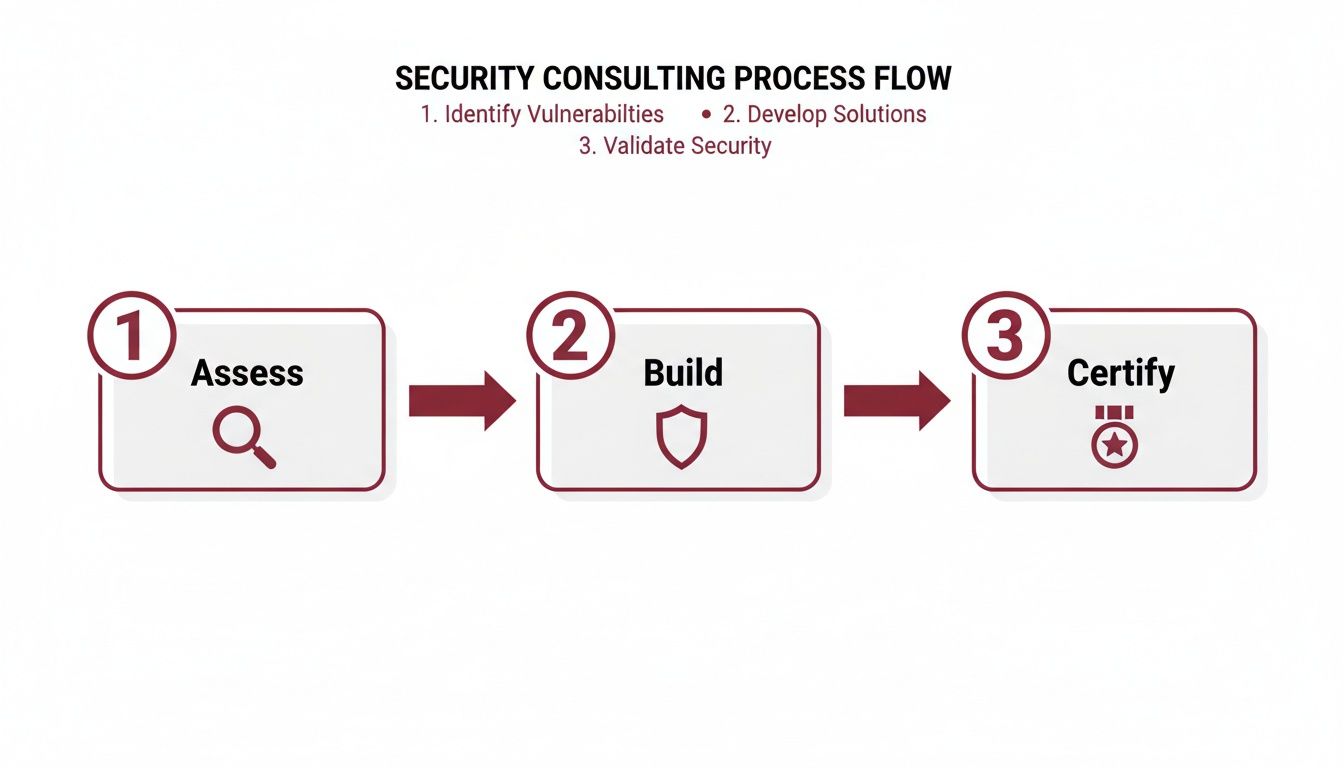
This flow shows how a proper engagement moves from discovery to development and, finally, to external validation. Let's break down what really happens at each stage.
Phase 1: The Lay of the Land (Discovery and Assessment)
Before you start climbing, you need a detailed map of the terrain. This first phase is all about creating that map. It kicks off with deep-dive conversations to get a handle on your business—what you do, how you operate, and what keeps you up at night when it comes to security.
The heavy lifting here is the gap analysis and risk assessment. Your consultant will painstakingly compare everything you’re currently doing—your policies, your tech, your processes—against the official requirements of a standard like ISO 27001.
- What it feels like: Expect workshops, interviews with your key people, and a fine-tooth-comb review of your systems and any existing documentation.
- Key deliverables: You’ll get a Gap Analysis Report that clearly shows where the holes are. You’ll also receive a formal Risk Assessment, which identifies and prioritises the most dangerous threats to your business information.
Think of these reports as your personalised itinerary. They show you exactly how far you have to go and highlight the specific cliffs you need to navigate, making sure you don't waste a single dollar or a minute of your time on the wrong things.
Phase 2: Building Your Defences (Implementation)
With a clear map in hand, it’s time to start the ascent. This is where the real work begins as we team up to close all the gaps we found. It’s a hands-on, collaborative effort to build your Information Security Management System (ISMS) from the ground up.
This isn't about theory; it’s about weaving robust security practices into the fabric of your daily operations. Your consultant guides you in creating the necessary documents and putting the right controls in place.
A good consultant doesn't just hand you a stack of templates. They help you build a security framework that actually works for your company culture and workflow. An off-the-shelf system is a recipe for failure; it has to be yours.
During this phase, your team gets heavily involved in:
- Writing the Rulebook: Crafting clear, simple policies for everything from how to use company laptops to disaster recovery plans.
- Putting Up the Fences: Implementing technical and procedural controls, like new access rules for critical data or a formal process for handling a data breach.
- Training the Troops: Making sure every single employee understands their role in protecting the business. Your people are your best defence, but only if they’re trained.
This is usually the longest part of the project because it involves real change. A critical document you'll create is the Risk Treatment Plan—a detailed action plan for how you’re going to tackle every significant risk we identified.
Phase 3: The Final Check (Audit and Certification)
You’ve reached the summit—or at least, you think you have. The certification audit is where an independent expert comes to verify your claim. An accredited auditor will arrive to assess your entire ISMS against the official ISO 27001 standard.
But you won't go into this cold. Before the big day, your consultant will run a full internal audit. Think of it as a final dress rehearsal. It’s designed to find any last-minute weak spots so you can fix them before the external auditor even sets foot in your office. This step is a massive confidence booster.
In preparation for this, you'll finalise the Statement of Applicability (SoA). This is a non-negotiable document that lists every security control in the standard and declares whether you’ve implemented it and why.
When the external auditor arrives, your consultant is right there with you, helping you present your case and navigate any tough questions. A successful audit results in your ISO 27001 certificate—the official, internationally recognised proof that you made it to the top.
Phase 4: Staying on Top (Maintenance and Improvement)
Getting the certificate isn’t the end. It's the beginning of life at the summit. Security is never "done." Threats are always changing, your business evolves, and your security framework has to keep up.
This is why most businesses keep their computer security consultant on retainer. This ongoing partnership provides crucial support, which usually includes:
- Regular Internal Audits: To make sure your ISMS stays sharp and effective.
- Management Reviews: Helping your leadership team track security performance and make smart decisions.
- Support During Surveillance Audits: Because the external auditors will be back (usually every year) to make sure you're still maintaining the standard.
This long-term relationship ensures your investment pays dividends for years to come, keeping your business secure, compliant, and ready for whatever comes next.
Calculating the Real ROI of Your Security Investment
How do you measure the value of a disaster that never happened? It’s a tricky question, and for many business owners, it's the central puzzle when trying to justify the cost of computer security consulting. It's all too easy to see security as just another expense—money going out the door to prevent some vague, far-off problem.
But that’s a dangerously narrow view. A smart investment in security isn’t just about stopping bad things from happening; it’s about making good things possible. It actively creates value and opens up new avenues for growth.
To really get your head around the ROI, you first need to understand how these services are priced. Once you know the common models, you can budget properly and make sure the consultant’s work lines up with your financial goals. Then, we can look beyond simply dodging a bullet and explore the powerful "opportunity ROI" that great security creates.
Common Pricing Models in Security Consulting
When you bring a security consultant on board, how they charge is usually tied to the size and length of the project. There's no one-size-fits-all price tag, but most jobs fall into one of these buckets.
- Fixed-Price Projects: This is perfect when you have a clear, defined goal, like getting your ISO 27001 certification. The consultant gives you a single, all-in price to get you from A to Z. It gives you absolute budget certainty and a clear finish line to work towards.
- Retainers: For ongoing advice and support, a retainer makes a lot of sense. You pay a set fee each month or quarter to have your consultant on-call. This is ideal for keeping your security management system in good shape after certification, running regular internal checks, and staying on top of emerging threats.
- Time and Materials: You’ll sometimes see this for initial discovery work or for quick, ad-hoc advice. You’re simply billed for the hours they put in and any resources they use. It’s flexible, but it doesn't give you the same budget predictability as a fixed-price project.
Knowing these models is step one. Step two is figuring out what you actually get back for your spend.
Moving Beyond Cost Avoidance
The most obvious ROI is what you didn't lose. A single data breach can cripple a small business. You’re looking at regulatory fines, legal bills, the cost of notifying customers, and the kind of damage to your reputation that’s hard to come back from. By preventing that breach, your security investment has effectively saved you a fortune.
But the real magic happens when you start looking at the 'opportunity ROI'—the new business and revenue that strong security unlocks. This is where your investment stops being a defensive shield and becomes a powerful tool for growth.
The true measure of security ROI isn't just about the money you save by avoiding a disaster. It's about the new business you win, the customer trust you build, and the competitive advantage you gain by proving your resilience.
This forward-thinking approach is becoming critical as Australian businesses face an ever-growing wave of cyber threats. It is a clear sign that expert protection is no longer a 'nice-to-have'. Let's break down how this investment turns into real, tangible growth.
The Opportunity ROI of Proven Security
Having strong, certified security opens doors that would otherwise be slammed shut. For an ambitious Australian SMB, this is where a consultant’s work can deliver a return that’s many times the initial cost.
Here’s what drives that opportunity ROI:
- Winning High-Value Contracts: Many government tenders and big corporate supply chain contracts now list ISO 27001 certification as a deal-breaker. If you don't have it, you can't even get in the game. Getting certified instantly puts you on the shortlist for these lucrative opportunities.
- Attracting Risk-Averse Clients: In a world where everyone is worried about data breaches, being able to prove you take security seriously is a huge selling point. It helps you stand out and win over discerning clients who see security as a top priority—and are often happy to pay more for it.
- Boosting Customer Lifetime Value: Trust is the glue that keeps customers loyal. When your customers feel their data is safe, they stick around longer, spend more, and are more likely to recommend you. This cuts down on churn and makes every customer more valuable over the long run.
- Increasing Business Valuation: A certified Information Security Management System (ISMS) is a genuine business asset. It shows you’re mature, you manage risk properly, and you’re resilient—making your company far more attractive to investors or a potential buyer if you ever decide to sell.
For a deeper dive into these financial benefits, explore our article on calculating the ROI of cyber security investments and how it strengthens your bottom line.
A Real-World Australian SMB Example
Let’s put this into practice with a realistic scenario.
- Company: An Australian software-as-a-service (SaaS) provider with 30 employees.
- Goal: To break into the enterprise market and sell to big financial services companies.
- Challenge: The big fish love the product, but their procurement teams won’t even look at a contract without proof of top-notch security. They are specifically asking for ISO 27001 certification.
The company hires a computer security consulting firm on a fixed-price project to get them certified. The investment covers everything from the initial gap analysis to helping them through the final audit.
The Payoff:
Within six months of getting their certificate, the SaaS provider signs two major financial firms they’d been chasing for more than a year. The combined annual value of those two contracts is more than ten times what they paid the security consultant.
In this case, the ROI isn't about some hypothetical breach they avoided. It’s about the $1 million in new, recurring revenue that was directly unlocked by their investment in security. That's the powerful, tangible return that smart businesses are chasing.
Choosing the Right Security Consulting Partner
Picking a partner for your computer security consulting is a massive decision. This isn’t just about hiring a tech guru; you’re handing someone the keys to your digital kingdom. The right partner is a genuine strategic asset, guiding you towards a stronger, more competitive business. The wrong one? Well, that path leads to wasted money, failed audits, and a dangerously false sense of security.
Making the right call means looking past the slick sales pitch and the lowest quote. You need a partner who gets the unique pressures and opportunities that Australian small businesses face, especially if you’re aiming for the gold standard of ISO 27001 certification. A generic, cookie-cutter approach just won't do the job.
Look for Proven ISO 27001 Success
When certification is the goal, the only metric that truly matters is their track record. Don’t be afraid to ask for proof. A consultant's history tells you everything you need to know about their process, their expertise, and their commitment to getting you over the line.
Get straight to the point and ask them directly:
- How many businesses have you actually guided through to full ISO 27001 certification?
- What’s your success rate on the first attempt at the external audit?
- Can you show me anonymised case studies or provide references from businesses like mine?
A firm with a 100% success rate isn't just getting lucky. It’s a dead giveaway that they have a meticulous, road-tested process. It means they dig deep during the gap analysis, build practical management systems, and run internal audits so tough that nothing is left to chance. That level of diligence takes a huge amount of risk off your plate.
Experience with the Australian Regulatory Environment
Security doesn't happen in a bubble. Here in Australia, it’s tangled up with legal and regulatory duties, especially the Privacy Act and its Notifiable Data Breaches (NDB) scheme. A consultant without deep, hands-on experience with these local rules is a serious liability.
Your partner has to understand how ISO 27001 controls map directly onto your Australian compliance obligations. They should be able to clearly explain how beefing up your information security management system (ISMS) also shores up your defence against regulatory heat. This local know-how makes sure your security framework isn't just compliant with an international standard, but is truly fit-for-purpose in the Australian market.
A great consultant is fluent in two languages: the technical jargon of security controls and the business language of risk, compliance, and growth. They must be able to translate one into the other, showing you precisely how a specific security measure helps protect you under Australian law.
A Tailored Approach, Not a Template
Watch out for consultants who show up with a pre-packaged "ISO 27001 in a box". Sure, templates can be a starting point, but a security system that isn’t built around your specific business processes, your company culture, and your unique risks is doomed from the start. Your staff will ignore it, and it will fall apart under the scrutiny of a real audit.
A real partner takes the time to get to know your business inside and out. They ask the right questions, they listen to your team, and they design policies and procedures that actually fit the way you work. This custom-fit approach is what turns an ISMS from a dusty pile of documents into a living, breathing part of your organisation.
Your Interview Checklist for Potential Partners
To help you make a confident decision, use this checklist when you're interviewing potential firms. Their answers will tell you a lot about whether they're the right long-term security partner for you.
1. Questions About Their Process
- Can you walk me through a typical project, from our first chat to what happens after we're certified?
- How do you make sure the ISMS you build is practical for a business our size and won't just bury our team in paperwork?
- What's your method for risk assessments, and how do you get our key people involved in that?
2. Questions About Their Expertise
- What specific qualifications do your consultants hold? (Look for things like ISO 27001 Lead Auditor, CISM).
- Tell me about a time you helped an Australian SMB in our industry tackle a specific security problem.
- How do you keep up with new cyber threats and the constant changes to Australian privacy laws?
3. Questions About Partnership and Support
- What kind of support do you provide during the actual external certification audit? Are you in the room with us?
- How do you help get our employees on board and train them to follow the new security policies?
- Once we’re certified, what ongoing support do you offer to help us stay compliant?
The quality and clarity of their answers will be your best guide. An experienced, confident consultant will welcome these questions and give you specific, evidence-backed answers. If you get vague replies or a lot of buzzwords, consider it a major red flag.
Choosing your computer security consulting partner is the first—and most critical—step on your certification journey. By focusing on proven success, local expertise, and a custom-fit approach, you can confidently find a firm that will not only get you certified but will set you up for lasting security and business growth.
So, Where Do You Go From Here?
We’ve covered a lot of ground together, stepping through what computer security consulting really means for an Australian small business like yours. From the first risk assessment to the nitty-gritty of ISO 27001 and seeing the real dollars and cents of your return on investment, we’ve laid it all out.
If there’s one thing to take away from all this, it’s that cybersecurity isn't just about putting up a digital fence. For a smart, growing Aussie business, it's a launchpad.
Making the call to bring in an expert is a deliberate move from being a potential target to being a fortress. It’s the decision to stop playing defence and start building a resilient, trustworthy business that big clients and government bodies want to work with. That's the mindset shift that sets the leaders apart from the followers.
Weaving Security into Your Business DNA
Real security isn’t a software subscription you set and forget. It's a culture, a way of doing things. Getting certified for a standard like ISO 27001 with a consultant who knows their stuff is the single best way to make this culture a reality in your day-to-day operations. It sends a powerful message to everyone—the market, your customers, and your own team—that you mean business when it comes to protecting information.
The process turns vague ideas about 'being secure' into concrete actions and daily habits. It clarifies who is responsible for what and gives you a repeatable system for managing risk. The end result? Your business doesn't just survive in a pretty hostile digital world; it actually thrives because it's built on a foundation of proven strength.
For an Australian small business, ISO 27001 certification isn't just a tick-box exercise. Think of it as a commercial passport. It opens doors to lucrative enterprise and government contracts that were previously locked shut, making your security a genuine competitive edge.
This certification is your proof. It's the tangible evidence that you operate at a higher level, building the kind of trust that can completely change your growth trajectory.
A Few Final Thoughts for the Road Ahead
As you think about what to do next, keep these key ideas we've talked about in mind. They're the building blocks of a solid security partnership and a safer future for your company.
- Security is a Strategy, Not a Cost: Look at your investment in consulting as a direct line to hitting your business goals—whether that’s landing bigger clients or increasing your company's valuation.
- A Proven Partner is Everything: The single best predictor of your success is your consultant's track record, especially with ISO 27001 and their understanding of the Australian business landscape. Don't settle for less.
- It’s a Journey, Not a Sprint: A proper engagement follows a clear path—from discovery and implementation right through to certification and ongoing support. This structure takes the guesswork out of it and ensures you get where you need to go.
- The Payback is Two-Fold: The value isn't just in dodging a costly data breach. It's also in the new revenue and opportunities that a rock-solid, certified reputation brings in.
Keeping these principles front and centre will help you pick the right partner and tackle your security overhaul with confidence, knowing exactly what you stand to gain.
Your Next Move Towards a Stronger Business
The path to becoming a secure, certified, and more competitive business starts with a simple chat. You don’t need to have all the answers right now. You just need to be ready to ask the right questions and see what’s possible.
The threats out there are very real, but so are the opportunities. By bringing in a specialist in computer security consulting, you’re not just buying their know-how; you’re investing in peace of mind, market credibility, and a sustainable future for your business.
Don't let complexity or a fear of the unknown hold you back from unlocking what your business is truly capable of. The journey to becoming safer, stronger, and more successful starts today.
Take that first step. Start the conversation, and find out how the right partnership can turn your biggest security headaches into your greatest business asset. Your future self will thank you for it.
Frequently Asked Questions
It's natural to have questions when you're thinking about bringing in a computer security consultant. After all, you’ve got a business to run. Here are some straight answers to the things we get asked most often by business owners just like you.
How Long Does It Take to Get ISO 27001 Certified?
This is usually the first question on everyone's mind, and the honest-to-goodness answer is, "it depends." For a typical small or medium-sized Aussie business, you're generally looking at a 6 to 12-month journey from our first chat to you holding that certificate.
What sways that timeline? A few key things:
- Your starting point: If you've already got some solid security habits, you're ahead of the game.
- Your team's availability: Getting certified is a team sport. The more your key people can be involved, the quicker and smoother things will go.
- Your business complexity: A business with intricate data systems will naturally take a bit longer than one with a more straightforward setup.
A good consultant won’t give you a vague estimate. They'll map out a realistic project plan with clear milestones right after getting to know your business.
What’s This Going to Cost My Business?
The cost really comes down to the scope of what you need. For something like ISO 27001 certification, most consultants will offer a fixed-price project, which is great because it gives you certainty for your budget. That fee covers all the expert guidance, documentation, and hands-on help you'll need to get through the audit.
Just remember, you'll also need to budget for the external certification audit itself. That's a separate cost you pay directly to the accredited auditor. While it feels like a big outlay, the real win is in the new clients it attracts and the costly risks it eliminates.
Don't think of it as just another business expense. See it as an investment in a powerful asset. A certified Information Security Management System (ISMS) can genuinely increase your company's valuation and open up doors to contracts that will pay for the initial cost many times over.
How Much of My Team’s Time Will This Take?
A very fair question for any lean business. Your consultant will absolutely do the heavy lifting, but we can't do it without your team's insights and input. It just wouldn't work.
Typically, you'll want to nominate a key contact—maybe a manager or even the owner—who can set aside a few hours each week for the project. Other staff will pop in for workshops and interviews, particularly when we're figuring out your risks and shaping new policies. An experienced consultant is a master at running this process efficiently, respecting your team's time and making sure their input is used to build a system they'll actually use.
Is It Possible to Fail the Certification Audit?
Look, it is possible, but it's incredibly rare if you're working with a seasoned consultant. A crucial part of our process is conducting a thorough internal audit. Think of it as a full dress rehearsal for the main event.
Your consultant will put your new system through its paces, deliberately trying to find any gaps or weak spots. We then help you fix everything before the official auditor even sets foot in the door. Taking this step virtually guarantees you’ll pass the first time around. A firm with a 100% success rate has this process down to a fine art, taking all the stress and guesswork out of it for you.
Ready to build a more secure and competitive business? At Anitech, we specialise in guiding Australian SMBs through to ISO 27001 certification with a proven 100% success rate. Start the conversation today and find out how we can help you turn security into your greatest asset.
Recent Comments