

So, what is the genuine cost for ISO 27001 certification in Australia? The straightforward answer is that it varies significantly. For the majority of businesses, the initial path to achieving certification falls somewhere in the range of AUD 20,000 to AUD 70,000. However, it's important to understand that this figure is merely a starting point.
The final cost truly depends on the size of your company, the complexity of your operations, and the security measures you already have in place. It's more beneficial to view this not as a one-off expense, but rather as a strategic, long-term investment in your business’s reputation, resilience, and its ability to navigate the turbulent waters of modern cybersecurity threats. This guide will provide a comprehensive, long-form exploration of every facet of this investment, ensuring you can build a realistic and effective budget.
Understanding the True Investment in Your Security: Beyond the Certificate
When businesses first begin their inquiry into ISO 27001, their attention is often immediately drawn to the cost of the certificate itself. This perspective, however, is akin to purchasing a house and focusing solely on the price of the front door key. The genuine value—and where the bulk of the investment is directed—lies in constructing the house itself: a robust and comprehensive Information Security Management System (ISMS).
This ISMS serves as the fundamental bedrock of your entire data protection strategy. It is the integrated system of policies, procedures, technical controls, and operational processes that collectively work to keep your critical information assets safe, day in and day out. Viewing the process through this lens fundamentally shifts the core question from, "How much does the certificate cost?" to a more strategic one: "What am I actually building for this price, and what value will it deliver?".
The investment can be broken down into several key areas, each contributing to the overarching goal of weaving a durable culture of security into the very fabric of your organisation. This is not just a technical project; it's a business transformation initiative that enhances operational excellence and market credibility.
Key Cost Components at a Glance: A High-Level Overview
Before we delve into the granular details, let's establish a clear understanding of the main categories where your budget will be allocated. Each of these components represents a crucial piece of the complex puzzle of achieving certification and maintaining long-term compliance. A failure to account for any of these can lead to significant budget overruns and project delays.
- External Audits: These are the non-negotiable fees paid directly to an accredited, third-party certification body. This body is responsible for conducting the formal Stage 1 and Stage 2 audits, which are designed to rigorously verify that your ISMS meets every requirement of the ISO 27001 standard.
- Consultancy and Implementation Support: Let's be realistic—most small to medium-sized businesses do not have a dedicated ISO 27001 expert on their full-time staff. Engaging a professional consultant can save an immense amount of time, prevent costly implementation errors, and significantly increase the likelihood of passing the audit on the first attempt.
- Internal Resources: This is often referred to as the "hidden" cost, representing the time and effort contributed by your own team. Your key personnel will be heavily involved in developing and documenting policies, implementing new controls, managing the project, and liaising with stakeholders.
- Technology and Tools: In many cases, a gap analysis will reveal areas where your current technology stack is insufficient to meet a specific security requirement. This can necessitate investment in new software, hardware upgrades, or subscription services to effectively mitigate identified risks.
By understanding these distinct categories, the total cost becomes far less intimidating. It transforms from a single, daunting number into a structured financial plan that you can manage with confidence and foresight.
The journey to ISO 27001 certification is a lot like building a house. You don't just pay for the final inspection; you invest in the foundation, the framework, and the security systems that keep it safe long-term. The certificate is simply the proof that you've built it to the highest standard.
Setting Realistic Budget Expectations Based on Business Size
Your company’s unique characteristics are the single most significant driver of the final cost. Recent data and market analysis from across Australia reveal a clear and consistent correlation between the size of a business and its total expenditure on ISO 27001 certification.
To provide you with a clearer and more practical picture, here is a rough guide based on current market rates and typical project scopes.
Estimated ISO 27001 Initial Certification Costs for Australian Businesses
| Business Size (Number of Employees) | Typical Cost Range (AUD) |
|---|---|
| Up to 50 employees | $20,000 – $40,000 |
| 50-200 employees | $40,000 – $70,000 |
| 200+ employees | $70,000+ |
As is evident from this table, a small technology startup operating from a single office will have a fundamentally different budget and timeline compared to a large manufacturing enterprise with multiple sites and complex supply chains. For a more detailed exploration of these figures, you can explore more detailed cost breakdowns about ISO 27001 for Australian businesses.
This inherent variability is precisely why a one-size-fits-all price tag is simply not feasible or helpful. By accurately assessing where your business fits within this spectrum, you can begin to construct a realistic and defensible financial plan for your own certification journey.
So, What Are You Actually Paying For? A Line-Item Look at Certification Costs
Obtaining a ballpark figure for ISO 27001 certification is a useful first step, but to truly gain control over your budget, you must understand precisely where every single dollar is being allocated. Think of it like a detailed quote from a builder – the total price is important, but the line items are what tell the real story and allow for informed decision-making. Deconstructing the costs transforms a large, intimidating number into a series of smaller, more manageable, and justifiable expenses.
Your financial journey to certification can be effectively categorised into two primary domains: External Costs and Internal Costs. External costs are the straightforward invoices you will receive and pay to third-party vendors and service providers. Internal costs represent the equally important investment of your own team's time, resources, and effort. Both are absolutely critical components for building a comprehensive and realistic budget.
Let's dive into the specifics of each of these categories.
External Costs: The Experts You'll Bring In
These are typically the most obvious and tangible expenses you will encounter. This is the money you will pay to accredited professionals, certification bodies, and technology vendors to guide you through the process, provide necessary tools, and ultimately, verify the effectiveness of your hard work.
The two most significant external cost items are almost always the consultant you hire to guide the project and the official auditors who provide the certification. While they may initially appear as hefty outlays, they represent the specialised expertise and the final, impartial stamp of approval required to earn your certificate and demonstrate compliance to the market.
To assist in your financial planning, we've compiled a table that outlines the common external expenses you can anticipate.
Breakdown of Potential ISO 27001 Expenses
| Expense Category | Description | Typical Cost Range (AUD) |
|---|---|---|
| Consultancy Fees | Hiring an expert to guide your implementation, provide templates, conduct gap analysis, and prepare you for the audit. This is highly recommended for first-timers. | $15,000 – $40,000+ |
| Certification Body Audit | The mandatory two-stage audit performed by an accredited external body. This includes the Stage 1 (readiness review) and Stage 2 (certification) audits. | $5,000 – $15,000 |
| Surveillance Audits | Annual check-up audits in years two and three to ensure you are effectively maintaining and improving your ISMS. | $3,000 – $8,000 (per audit) |
| Technology & Software | New tools you might need, such as password managers, advanced endpoint protection, firewalls, or vulnerability scanning platforms. | $2,000 – $10,000+ |
| Staff Training | Costs for security awareness training programs, which could include online modules, in-person workshops, or phishing simulation platforms. | $1,000 – $5,000+ |
This detailed breakdown provides a clear picture of where your budget will be allocated, helping you to avoid any unforeseen financial surprises as the project progresses.
The Certification Body Audit Fees
This is the one cost component that is entirely unavoidable. To obtain an official, internationally recognised certificate, an accredited certification body must conduct a formal, impartial audit of your Information Security Management System (ISMS). This is not a single event but rather a carefully structured two-part process.
- Stage 1 Audit: Consider this a 'readiness review' or a desktop audit. The auditor meticulously examines your documentation—your policies, procedures, risk assessment, and scope statement—to ensure that you have all the necessary components in place before they proceed to an on-site evaluation. It is a critical check to see if you are genuinely prepared for the main event.
- Stage 2 Audit: This is the comprehensive deep dive. The auditor arrives on-site (or conducts it remotely) to test your security controls in practice, interview your team members to verify their understanding and adherence, and gather concrete evidence that your ISMS is not just a collection of documents on a shelf, but a living, breathing, and effective part of your daily operations.
For a small to medium-sized business in Australia, these mandatory audit fees typically fall somewhere between $5,000 and $15,000 AUD. The final figure will be influenced by the size of your team, the complexity of your operations, and the scope of your ISMS. To gain a deeper understanding of what this entails, you can learn more about the complete ISO 27001 audit process and what you should expect on the day.
The Value of an Expert Consultant
While it is technically possible to undertake the certification journey alone, hiring an experienced ISO 27001 consultant is one of the most strategically sound decisions a small business can make. Attempting to interpret the standard's dense and sometimes ambiguous requirements without prior experience can lead to wasted months of effort, expensive implementation mistakes, and a significantly higher risk of failing your certification audit. A great consultant acts as your guide, your translator, your project manager, and your quality assurance specialist, all rolled into one.
An expert consultant doesn't just help you pass the audit; they help you build a stronger, more resilient security framework. Their guidance ensures your ISMS is practical and effective for your business, not just a set of documents to satisfy an auditor.
Yes, consultancy comes with a fee, but this investment almost invariably prevents much larger costs down the line by ensuring that the implementation is done correctly the first time.
Internal Costs: The Hidden Investment
Internal costs are the expenses that are dangerously easy to overlook because they do not appear as a line item on an external invoice. However, make no mistake, they represent a very real and significant investment of your company's time and resources. Ignoring these costs will not only blow a hole in your budget but will also place a huge, unexpected, and often unmanageable strain on your team.
This is the 'sweat equity' component of the project—encompassing all the hours your team will dedicate to building, implementing, and maintaining the ISMS.
Your Team's Time and Effort
Your people are the engine that will drive your ISO 27001 project forward. You will need to allocate significant time from key staff members to perform a range of critical tasks, including:
- Writing, reviewing, and refining new security policies and operational procedures.
- Conducting the internal risk assessment and developing the risk treatment plan.
- Implementing new security controls and processes across various departments.
- Collecting and organising all the evidence required to demonstrate compliance to the auditors.
This is not a task that someone can manage in their spare time; it demands genuine focus and dedication. To get a true picture of the total cost of certification, you must factor in the salary cost of the hours your team invests in the project.
Security Awareness Training for Everyone
ISO 27001 is unequivocal on this point: every single employee, from the CEO to the newest intern, needs to understand their individual role in protecting information. You cannot simply email out a new policy and hope for the best. You are required to provide effective, ongoing security awareness training.
This could involve investing in online training modules, conducting in-person workshops, or utilising simulated phishing attack platforms to test and enhance your team's vigilance. The ultimate goal is to create a deeply embedded culture where security is second nature to everyone in the organisation.
Upgrading Your Tech Stack
During your initial gap analysis and risk assessment, you will almost certainly identify a few security gaps that need to be addressed to meet the standard's requirements. This is a normal part of the process, but it often necessitates investment in better technology.
These costs could include a wide range of items, such as:
- New Software: Subscriptions for a company-wide password manager, more advanced endpoint protection (antivirus) for laptops, or a vulnerability scanning tool.
- Hardware Upgrades: This might include a more robust firewall, encrypted laptops for remote workers, or more secure servers for hosting critical data.
This chart provides an excellent visual representation of how the total costs can accumulate based on company size.

As you can see, the investment naturally scales with the size of the business, which is a direct reflection of the greater complexity, wider scope, and increased effort involved in certifying a larger organisation.
So, What Really Drives the Final Price Tag? Key Cost Variables Explored
Have you ever wondered why one small business in Sydney might pay AUD 30,000 for their ISO 27001 certification, while a similarly-sized company down in Melbourne faces a quote closer to AUD 80,000? This variation isn’t random. The final figure on your invoice is determined by a handful of powerful variables that collectively map out your company’s unique security landscape and implementation journey.
Gaining a firm understanding of these factors is the secret to building a realistic and accurate budget. They dictate everything from the number of hours a consultant will need to invest, to the number of days an auditor must spend on-site. Once you understand what moves the financial needle, you can transition from guesswork to strategic planning.
Your Company's Size and Complexity
The most immediate and obvious factor influencing cost is the size of your company. A certification body’s quote is heavily weighted by your employee headcount. This is because the number of employees serves as a primary metric for estimating the time an auditor needs to spend interviewing staff, observing processes, and verifying that your controls are consistently followed across the organisation. More people simply means more ground to cover and more evidence to review.
However, the analysis doesn't stop at the number of names on the payroll. The complexity of your day-to-day operations is an equally, if not more, important consideration. A business with multiple office locations, a significant remote or hybrid workforce, or a complex ecosystem of custom-built software and cloud services will naturally have a more intricate Information Security Management System (ISMS). This complexity increases the effort required for both the preparation phase and the audit itself.
- Number of Employees: This is a primary driver of audit time. A 20-person team in a single location is a much faster audit than a 150-person team spread across multiple departments.
- Number of Locations: Every physical site that you wish to include within the scope of your certification often requires its own on-site visit from the auditor, which adds significant time and travel costs to the final bill.
- Operational Complexity: A software development company that juggles multiple cloud environments, customer data, and third-party integrations has a far more complex risk profile than a straightforward consultancy. This complexity necessitates a much deeper and more time-consuming audit.
Think of it this way: inspecting a single-story, three-bedroom house is a relatively quick and inexpensive task. But inspecting a sprawling, multi-level mansion with a separate granny flat, a pool house, and advanced smart-home technology? That’s a whole different ball game. The more doors, windows, systems, and rooms there are to check, the longer and more expensive the inspection will be.
The Power of Scoping Your ISMS Correctly
Scoping is arguably the most powerful tool you have at your disposal for controlling the costs of certification. This cannot be overstated. The scope of your ISMS defines its precise boundaries—it dictates which parts of your business, which specific locations, which business processes, and which technologies will fall under the certification umbrella. Nailing down a tight, focused, and defensible scope can dramatically slash your workload, your timeline, and your overall expenses.
For instance, a software company might make the strategic decision to limit its initial certification to just the core development team and the cloud infrastructure that hosts its main product. This means that, for the initial certification cycle, the sales, marketing, and HR departments are considered "out of scope."
By carefully defining your scope, you focus your resources where they matter most. You're not trying to boil the ocean; you're securing the crown jewels of your business first. This makes the certification process faster, cheaper, and far more manageable.
A narrower scope directly translates to fewer policies to write, fewer controls to implement across the business, and a smaller volume of evidence for the auditor to review. This has a direct and positive impact on reducing both consultant fees and the duration (and therefore cost) of the external audit. You can always choose to expand the scope in subsequent years, once you have successfully passed your first audit and have a mature, functioning system in place.
Your Starting Point Matters: Assessing Your Security Maturity
The final major variable is your organisation's current security maturity. This concept refers to the security practices, documented policies, and ingrained cultural habits that you already have in place before you even begin your formal ISO 27001 project. A business that is already operating from a solid security foundation will have a much shorter—and consequently cheaper—road to certification.
Imagine two businesses aiming to run a marathon. One has been training consistently for months, has invested in the right running gear, and follows a strict nutrition plan. The other is starting their journey from the couch. Both can eventually cross the finish line, but the one starting from scratch has a much longer, tougher, and probably more expensive journey ahead, potentially requiring more coaching and resources.
To get a sense of your own starting point, ask your team these critical questions:
- Do we already have documented security policies and procedures, even if they're informal?
- Have we ever conducted any form of risk assessment in the past?
- Do we provide our staff with regular security awareness training?
- Are our systems and networks already configured with security best practices in mind?
If you find yourself nodding "yes" to most of these questions, your preparation work will likely be more about organising, formalising, and polishing what you already have. However, if you are mostly answering "no," your journey will involve building these essential security functions from the ground up, which naturally requires a much larger investment of time, resources, and budget.
Budgeting for Ongoing ISO 27001 Compliance: The Journey Continues

Receiving that ISO 27001 certificate is a massive achievement and a cause for celebration. However, it is crucial to recognise it for what it truly is: the start of a marathon, not the finish line of a sprint. The real, lasting value of ISO 27001 is derived from the continuous maintenance and improvement of your security posture, day in and day out. This means your budget cannot simply cease once the initial certificate is on the wall; you must proactively plan for the ongoing costs that are essential to keep your Information Security Management System (ISMS) alive, effective, and compliant.
A common and costly pitfall is for businesses to focus their entire financial planning on the upfront investment, only to be blindsided by the recurring fees and internal effort required to keep the certificate valid. The key to avoiding this is to shift your mindset. Think of compliance as a continuous operational cycle, an integral part of your business rhythm, rather than a one-off project with a defined end date.
This forward-thinking approach to your finances ensures that your hard-earned certification remains a powerful and credible asset, demonstrating to clients, partners, and regulators an unwavering commitment to security that they can rely on for years to come.
The Mandatory Surveillance Audits
Once you have achieved certification, your certification body will become a regular visitor. Each year, they will conduct an audit to ensure that you are still adhering to the standard and maintaining your ISMS effectively. These are known as surveillance audits, and they are a non-negotiable component of the three-year certification cycle, typically occurring at the end of year one and year two.
Rest assured, these audits are not as intensive or comprehensive as the initial deep dive (the Stage 2 audit), but they are every bit as important. The auditor's role during a surveillance audit is to check that you are actively maintaining your ISMS, following your own policies, conducting regular internal audits, holding management reviews, and making continuous improvements to your security controls. It is their way of verifying that your certificate represents a current state of compliance and is more than just a piece of paper.
For a small business in Australia, you should budget for these annual surveillance audits to fall somewhere in the AUD 5,000 to AUD 15,000 range. This is a predictable, recurring operational expense that needs to be factored into your annual budget from day one.
The Cycle of Recertification
At the conclusion of your third year of certification, it is time for the main event to happen all over again: a full recertification audit. This audit is much more comprehensive than a surveillance audit, closely resembling your initial Stage 2 audit in both its scope and its cost. It serves as the final check to confirm that your ISMS has matured, adapted to business changes, and remains fully compliant with the latest version of the ISO 27001 standard. Budgeting for this significant event every three years is absolutely essential for ensuring uninterrupted compliance and certification.
ISO 27001 is not a 'set and forget' standard. The annual surveillance audits ensure that security is a living part of your business culture, not just a project you completed once.
This constant cycle of internal improvement, external auditing, and formal recertification is precisely what gives the standard its weight, credibility, and high value in the marketplace.
Uncovering the Hidden Ongoing Costs
Beyond the clear-cut audit fees, a significant portion of your ongoing budget will need to be allocated to the internal activities that keep your ISMS functioning and improving. These are the costs associated with continuous improvement and maintenance, and frankly, they are often where businesses are caught off guard financially.
Think of these activities as the engine room of your security program; they are what turn policies on paper into effective security practices in the real world. If you skimp on them, you not only risk receiving a non-conformity during your next audit but, more importantly, you leave your business exposed to actual, evolving threats.
Continuous Improvement and Maintenance Activities
An effective ISMS is never static; it must constantly adapt to new threats, evolving business processes, and changing technologies. This means you need to dedicate budget and resources for a few key ongoing activities:
- Periodic Risk Assessments: The threat landscape does not stand still, and neither do your business risks. You must conduct regular risk assessments (at least annually is best practice) to identify new vulnerabilities and threats that may have emerged.
- Regular Internal Audits: Before the external auditor arrives for their surveillance visit, you need to have audited yourself. This is the best way to find and fix potential issues on your own terms, ensuring a much smoother and more successful external audit.
- Management Reviews: Your senior leadership team needs to meet regularly to review the performance of the ISMS. These sessions are crucial for reviewing security metrics, assigning necessary resources, and making strategic decisions to drive the security program forward.
- Documentation Updates: As your business evolves, so too must your policies, procedures, and other documentation. Keeping your documentation current is a critical, ongoing task that cannot be neglected.
For many smaller businesses, juggling all these mandatory tasks can be a significant drain on internal time and resources. This is where a service like an annual ISO support program can be a game-changer, offering expert guidance and taking the heavy lifting off your internal team.
Technology Subscriptions and Upgrades
Those security tools and software you implemented to get certified? Most of them come with annual subscription or maintenance fees. These are a core part of the ongoing cost for ISO 27001 certification and must be included in your operational budget.
- Security Software Renewals: This includes your licenses for antivirus/endpoint protection software, firewalls, vulnerability scanners, and those all-important security awareness training platforms.
- Patch Management Tools: Keeping all systems up-to-date with the latest security patches is a non-negotiable part of ISO 27001. Diligent vulnerability management, including tasks like patching Windows vulnerabilities, is essential, and the tools that automate or manage this process often have recurring costs.
- Hardware Lifecycle: Security hardware such as firewalls and servers will not last forever. You need to budget for their eventual upgrade or replacement to ensure they remain effective and supported by the vendor.
Employee Training and Awareness
Your team is your first and most important line of defence, but security knowledge has a shelf life. People forget things, new types of threats emerge, and new employees need to be brought up to speed on your security culture.
You absolutely must budget for ongoing security awareness activities to keep your staff sharp, vigilant, and informed. This means conducting annual refresher training for all employees and potentially providing more specialised training for individuals in high-risk roles, such as your IT, finance, and HR teams. This sustained investment in your people is one of the most effective ways to reduce the risk of human error and build a truly strong and resilient security culture for the long haul.
Proven Strategies to Lower Certification Costs
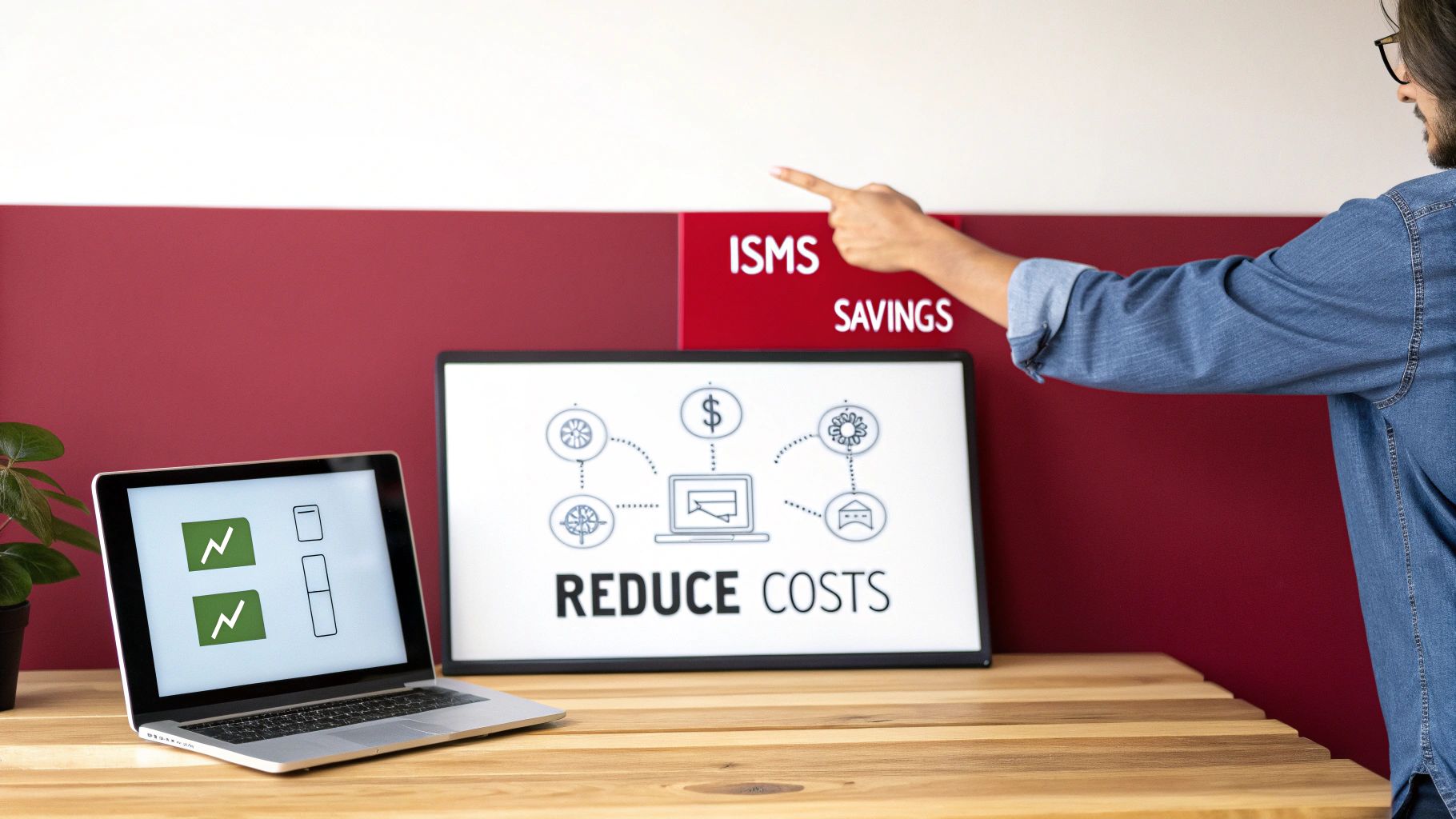
While achieving ISO 27001 certification is a serious investment, it definitely doesn’t have to drain your company’s bank account. With a combination of smart strategic planning and practical, efficient thinking, you can significantly reduce the overall cost without cutting corners on your actual security. This is not about finding loopholes or doing the bare minimum; it's about being efficient and focusing your resources where they will have the greatest impact.
For small and medium-sized businesses here in Australia, every dollar counts. The good news is that there are several proven and effective ways to make the path to certification far more affordable. From being clever about your project's boundaries to leveraging the right tools and existing strengths, you can get a firm grip on your budget and achieve your security goals in a cost-effective manner.
Sharpen Your Scope for Maximum Impact
Honestly, one of the most effective cost-control levers you have at your disposal is the scope of your Information Security Management System (ISMS). A tightly and intelligently defined scope is your best friend when it comes to managing the budget. Instead of attempting to certify your entire organisation from day one—a common and costly mistake—focus only on the most critical parts of your business first.
Think about it strategically: which departments, business services, or physical locations handle your most sensitive data or are most critical to your operations? Perhaps it’s just your product development team and the cloud platform your flagship application runs on. By limiting your ISMS to only these high-risk areas, you dramatically shrink the size and complexity of the project.
A smaller, more focused scope means:
- Fewer Policies to Write: You only need to develop and document processes for the specific areas that are actually in scope.
- Less Implementation Work: You can concentrate your team's efforts and your technology budget where they're needed most, rather than trying to boil the ocean.
- Shorter Audit Times: The external auditor has significantly less ground to cover, which directly translates to lower audit fees.
This focused, phased approach makes achieving that initial certification so much more manageable and affordable. You can always choose to expand the scope in subsequent years, once you've successfully passed your first audit and have a mature, well-functioning system humming along.
Build on Your Existing Security Foundations
So many businesses are pleasantly surprised to discover that they are not starting their ISO 27001 journey from scratch. It is highly likely that you already have numerous security controls in place, even if they aren't formally documented as part of an official ISMS. The key is to not reinvent the wheel; take credit for the great work you're already doing.
Kick off your project with a thorough gap analysis. This process simply involves comparing what you're doing now against the specific requirements of the ISO 27001 standard. You might discover that your existing data backup procedures, employee onboarding checklists, visitor access protocols, or network firewall rules already meet many of the standard's demands.
The point of ISO 27001 isn't to force you into a rigid, one-size-fits-all box. It’s about formalising and improving the security you already have, filling the gaps, and proving that your system actually works.
By identifying and leveraging these existing strengths, you can save a huge amount of time, effort, and resources. This makes the entire implementation phase faster and more efficient, which brings down the internal resource cost significantly.
Know When to Use Internal Teams vs Consultants
Deciding between a full do-it-yourself approach or hiring external help is a massive budgetary decision. While the full DIY route might appear cheaper on the surface, it often becomes a false economy. Wasted time, costly implementation mistakes, and misinterpretations of the standard can easily lead to a failed audit, sending you right back to square one with additional costs. The key is to find the right, strategic balance.
Consider a hybrid model. Use your internal team for tasks they already know inside and out, such as documenting familiar business processes or gathering evidence from systems they manage daily. This is a brilliant way to cut down on the billable hours you would otherwise pay to external experts.
However, for the really specialised and high-stakes components—like conducting the initial gap analysis, facilitating the risk assessment workshop, or performing the mandatory internal audit—bringing in a professional is a wise and cost-effective investment. An experienced consultant has walked this path hundreds of times. They bring proven templates, steer you away from common pitfalls, and ensure you’re fully prepared for the scrutiny of the certification audit. For more on this, you can learn about the specific benefits an ISO 27001 consultant brings to the table. This strategic use of expertise often accelerates the project timeline and prevents the costly rework that inevitably comes with a failed audit.
Explore Smart Savings Opportunities
Beyond these big-picture strategies, there are plenty of practical, tactical tips that can chip away at the total cost. These small wins can really add up over the course of your certification journey.
-
Bundle Your Audits: If your business is also considering certification for other management system standards like ISO 9001 (Quality Management) or ISO 45001 (Occupational Health & Safety), ask your certification body about an integrated audit. Auditing multiple standards at once can lead to substantial discounts, as the auditor can assess overlapping requirements (like document control and management review) in a single visit.
-
Investigate Government Grants: The Australian government, at both the Federal and State levels, sometimes offers grants to help small and medium-sized businesses enhance their cybersecurity capabilities. While you might not find a grant specifically named "ISO 27001 Grant," the activities and tools you need for certification (such as security upgrades, staff training, and expert consulting) often fall under the eligibility criteria for broader business improvement or cyber uplift programs. It's always worth checking websites like business.gov.au for current opportunities.
-
Use Open-Source and Cost-Effective Tools: You don't always need the flashiest and most expensive enterprise-grade software. There are many excellent and secure open-source or low-cost tools available for functions like password management, vulnerability scanning, and project tracking. Adopting a pragmatic and fit-for-purpose approach here can save you thousands of dollars in annual subscription fees.
Calculating the True Return on Your Security Investment (ROI)
Let’s be honest. When you first look at the numbers involved in getting ISO 27001 certified, it’s easy to focus exclusively on the upfront cost. However, treating this as just another business expense is fundamentally missing the point. It's like obsessing over the cost of building a ship while completely ignoring the incredibly valuable cargo it’s designed to carry and the new trade routes it will open.
The real conversation we need to have is about the profound strategic value this certification brings to your business. This is not just about getting a certificate to hang on the wall. It's about building a stronger, more trustworthy, more resilient, and far more competitive company. That piece of paper isn't the prize; it is simply the proof that you have made a foundational investment in your company's future. The real returns? They come from winning new opportunities, cementing rock-solid client relationships, and achieving a dramatic reduction in business-crippling risk.
The Tangible Returns You Can Bank On
Let's begin with the benefits that you can actually see and measure on a balance sheet. ISO 27001 is not some abstract security theory; it directly protects your bottom line and actively fuels growth in several very concrete ways.
First and foremost, it serves as a key that unlocks doors to new business that were previously bolted shut. Here in Australia, a rapidly growing number of large corporations and government departments now list ISO 27001 certification as a mandatory requirement in their tender and procurement processes. Without it, you cannot even get a foot in the door for those high-value, long-term contracts. The moment you achieve certification, you instantly become a more appealing and eligible partner, opening up significant revenue streams that were completely inaccessible before.
Secondly, it builds incredible and lasting customer trust. In an era where data breaches make headline news on an almost daily basis, your clients are rightly and increasingly concerned about how their sensitive information is being handled. Being able to show them an internationally recognised certificate is a powerful and unambiguous signal that you take their data security with the utmost seriousness. That confidence translates directly into better client retention rates and a stronger brand reputation that actively pulls in new business.
ISO 27001 certification is a business enabler disguised as a security standard. It doesn't just prevent losses; it actively generates revenue by making your business the trusted choice in a crowded market.
Finally, think of certification as one of your best and most cost-effective insurance policies against financial disaster. The costs associated with a single major data breach can be catastrophic, especially when you consider the rising threat of infostealer malware and data leaks. A single incident could lead to devastating fines under Australia’s Notifiable Data Breaches scheme and the Privacy Act, not to mention the eye-watering costs of incident response, remediation, and the permanent loss of customer loyalty. The investment you make in certification is a tiny fraction of the potential cost of a single serious security incident.
The Intangible Benefits That Fuel Long-Term Success
Beyond the hard numbers, the ROI of ISO 27001 is also derived from powerful internal shifts that fundamentally change how your entire organisation operates for the better. These are the advantages that don’t always show up neatly on a spreadsheet but are absolutely fundamental to building a sustainable and successful business.
The process of implementation itself forces you to meticulously map out your processes, clarify roles and responsibilities, and shine a bright light on hidden operational inefficiencies. This "house cleaning" effort almost always leads to smoother, more streamlined operations across the board. Suddenly, everyone knows their specific role in protecting data, approval workflows are clearer, and security is woven seamlessly into your daily workflows instead of being a clunky, inconvenient afterthought.
Even better, it fosters a much stronger, more security-aware culture throughout the organisation. When security is championed from the leadership down and every employee receives proper, ongoing training, it becomes an integral part of your company's DNA. This creates a vigilant and empowered team that becomes your best defence against everyday threats like phishing emails and social engineering attacks, dramatically cutting down on human error and making you far more resilient as a whole.
When you put it all together, these tangible and intangible benefits create a serious and sustainable competitive advantage.
- Market Differentiation: In a sea of competitors, being the ISO 27001 certified option makes you the obvious and safer choice for discerning clients.
- Operational Excellence: The structured, risk-based approach of the standard improves efficiency, consistency, and accountability right across the business.
- Enhanced Resilience: You are simply better prepared to handle—and recover more quickly from—any security incidents that may come your way.
So, when you look at the complete picture, the cost for ISO 27001 certification isn't a sunk cost at all. It is a strategic investment that pays for itself over and over again through more revenue, fortified client trust, better internal operations, and a brand reputation that sets you apart as a leader in your industry. It's about protecting what you've built today to secure your growth and success for tomorrow.
Answering Your Burning Questions About ISO 27001 Costs
Even with a detailed budget mapped out and a clear understanding of the process, you’re bound to have a few more questions rattling around. That’s completely normal. Getting clear, no-nonsense answers to these common queries is what gives you the confidence to move forward with your certification project.
Let's tackle some of the most frequent questions we hear from Australian businesses as they gear up for their certification journey.
How Long Does It Realistically Take to Get ISO 27001 Certified?
This is the classic "how long is a piece of string?" question, but based on extensive experience, I can give you a solid and realistic ballpark. For most small to medium-sized Australian businesses, you should plan for a timeline of 6 to 12 months from the day you formally start the project to the day you have the certificate in hand.
What fills that time? It’s a well-defined and structured path:
- Gap Analysis: The initial phase of figuring out what you already have in place versus what the standard demands.
- Risk Assessment: The core of the standard—a systematic process of identifying your unique security threats and creating a plan to tackle them.
- Documentation: This is where you write the rulebook for your Information Security Management System (ISMS), including all the necessary policies and procedures.
- Implementation: The practical phase of rolling up your sleeves and putting the new controls, policies, and technologies into practice.
- Internal Audit: A friendly "dress rehearsal" audit to find any weak spots or non-conformities before the official auditors arrive.
- External Audits (Stage 1 & 2): The final, formal check-up from an accredited certification body that leads to your certificate.
If your organisation has already invested in some solid security practices, you might be on the faster end of that scale. However, if you're starting from a very low base of security maturity, it’s wise to plan for the full year to ensure it's done properly without rushing.
Can We Do This Ourselves Without a Consultant?
Look, the short and simple answer is yes, you can. If you happen to have someone on your team who lives and breathes information security, has a deep understanding of management systems, and possesses excellent project management skills, it is definitely possible.
But here’s the honest and practical truth for most businesses: going it alone often turns into a false economy. It is a massive time sink for your internal resources, and the risk of failing your audit shoots way up. It is very easy to miss a crucial detail in the standard or misinterpret what an auditor is really looking for in terms of evidence.
A good consultant isn’t just a template provider. They’re bringing years of battlefield experience from dozens of audits across various industries. They know exactly what auditors fixate on, how to sidestep common traps, and how to build a system that actually works for your business—not just one that ticks a box. That experience can save you months of headaches and thousands in re-audit fees.
Are There Any Government Grants in Australia to Help with the Cost?
This is a great and frequently asked question, and the answer is a hopeful "sometimes". It is highly unlikely that you will find a government grant specifically named the "ISO 27001 Grant". However, the work you do and the investments you make to achieve the certification often overlap with the goals of broader business grant programs.
Both Federal and state governments regularly run programs designed to help Australian SMBs boost their cybersecurity posture, enhance their digital capabilities, or modernise their operations. The money you spend on new security tools, specialised staff training, and expert advisory services for your certification could easily fall under the eligibility criteria for these schemes. Your best bet is to keep a close and regular eye on official websites like business.gov.au and your state’s business development agency for any current or upcoming funding opportunities.
What Happens if We Fail the Audit?
First and foremost, don't panic! Failing an audit is not a final verdict; it is simply a part of the continuous improvement process. It happens more often than you might think, especially for companies going through it for the first time.
If the auditor finds problems, they will provide you with a detailed report outlining the 'non-conformities'. These are just specific points where your system does not quite meet the requirements of the standard.
You will then be given a set amount of time (usually 30-90 days) to put together and implement a corrective action plan. This means you need to investigate the root cause of each issue, fix it properly, and then provide the auditor with evidence of the fix. For minor non-conformities, they might just need to see your updated documents or a screenshot. For more serious issues, they may need to conduct a brief follow-up visit before they can issue your certificate. It’s a hurdle to be overcome, not a roadblock that ends the journey.
Ready to build a stronger, more trusted business with ISO 27001 certification? The expert team at Anitech is here to guide you every step of the way, making the complex process simple and ensuring your success.
Recent Comments