

Think of a cyber incident response plan as your business's emergency services number. It’s the playbook you pull out when things go wrong, turning the chaos of a security breach into a managed, controlled process. It’s what stands between a minor hiccup and a full-blown disaster that could cripple your operations and reputation.
Why an Incident Response Plan Is Non-Negotiable

Let's cut to the chase. In today's climate, a cyber incident isn't a possibility; it's a certainty. For small and medium-sized businesses across Australia, the conversation has moved on from if an attack will happen to when. This is exactly why a Cyber Incident Response Plan (IRP) is your most critical survival guide.
Picture this: a ransomware attack locks up your entire network at 2 AM on a Tuesday. Without a plan, it's absolute chaos. Who's the first person you call? How do you stop it from spreading to your backups? Are you legally required to report this? Panic sets in, and every wasted second costs you money, data, and customer trust.
Now, imagine that same scenario with a well-rehearsed plan. The on-call IT manager gets an alert and immediately consults a playbook. They know precisely who to contact and what systems to isolate. The designated response team is activated, communications are handled calmly, and recovery starts methodically. That’s the difference between a catastrophe and a manageable business challenge.
The Sobering Reality for Australian Businesses
This isn't just theory; the numbers tell a stark story. The Australian Cyber Security Centre (ACSC) fielded over 84,700 cybercrime reports in the last financial year—that's a new report every 6 minutes. Small businesses are squarely in the crosshairs, with the average cost of a breach hitting $56,600, a 14% jump from the previous year. A solid IRP is proven to bring these costs down by establishing clear roles, enabling quick containment, and speeding up recovery.
A formal plan does more than just outline technical fixes. It builds a foundation of resilience, ensuring everyone in your organisation knows their role when a crisis hits. This preparation is vital for a few key reasons:
- Minimising Financial Damage: A swift, organised response cuts down on downtime. Every minute your systems are offline is a minute you're not earning revenue or being productive.
- Protecting Your Reputation: How you manage a breach is often more important than the breach itself. A transparent, confident response maintains trust with your customers and partners.
- Meeting Legal Obligations: In Australia, the Notifiable Data Breaches (NDB) scheme is not optional. An IRP ensures you can meet those tight reporting deadlines and avoid potentially massive fines.
- Strengthening Defences: The 'lessons learned' phase of a good plan is pure gold. It helps you find your weak spots and reinforce them, making it harder for the next attack to succeed.
An incident response plan isn’t just an IT document; it’s a business continuity strategy. It ensures that when an attack occurs, your response is proactive and measured, not reactive and panicked.
Moving from Theory to Action
Creating a plan from scratch can feel overwhelming, especially when you're a small business juggling a dozen other priorities. But it doesn't have to be some monstrous, hundred-page document that no one ever reads. It starts simply by figuring out what you need to protect and who is responsible for what.
Too many businesses get bogged down in technical jargon or aim for a perfect plan that never gets finished. The key is to start small and build on it. A simple, tested plan that your team actually understands is infinitely more valuable than a perfect one collecting dust on a shelf.
For a structured approach to getting started, resources on building a comprehensive cybersecurity incident response plan can provide a fantastic roadmap. You can also dive deeper into defending your business from the growing rise of ransomware attacks.
Assembling Your Cyber Incident Response Team
An incident response plan is nothing more than a document until the right people are in place to bring it to life. When a breach happens, you don't have time to figure out who’s in charge. You need a well-drilled team that moves with precision and a clear sense of purpose.
Let's walk through how to build a Cyber Incident Response Team (CIRT) that can actually perform when the pressure is on. The whole point is to get rid of the guesswork before an incident. This means defining roles, setting up a clear chain of command, and making sure everyone knows their job the moment an alert fires. This groundwork is what turns chaos into a controlled, professional response.
Defining Core Roles and Responsibilities
For a small business, this isn't about going on a hiring spree. It’s about being smart and assigning specific incident-related duties to your existing people, while also knowing exactly who to call for specialist backup.
Every solid CIRT, no matter how big or small the company, needs to cover a few critical bases. Think of it like a first-response medical team—you’ve got a leader directing the effort, specialists doing the hands-on work, and someone managing communications to keep everyone informed. Your CIRT runs on the same logic.
At a minimum, your team needs to cover:
- Leadership & Coordination: You need a quarterback. One person who directs the entire response, makes the tough calls, and keeps the team on track.
- Technical Investigation: These are your boots on the ground—the people who can dive into the systems, figure out what happened, and stop the bleeding.
- Communications: A single source of truth is vital. One person or team needs to handle all messages, both internally and externally, to prevent rumours and protect your reputation.
- Legal & Compliance: This role is all about making sure your response ticks all the legal boxes, especially concerning Australian regulations like the Notifiable Data Breaches (NDB) scheme.
So many small businesses fall into the trap of thinking their "IT guy" can handle a cyber attack alone. That’s a huge mistake. A real incident is a business-wide crisis, not just a tech issue, and it demands a team with diverse skills to manage it properly.
The Small Business CIRT Structure
In a smaller organisation, it’s a given that people will wear multiple hats. Your office manager might double as the communications lead during a crisis. Your sole IT person is almost certainly going to be your technical lead. That's completely okay—as long as everyone understands their designated role and has practised it.
If you find you have gaps, building an effective team might involve bringing in new talent. Understanding the best strategies for hiring cyber security professionals can be a game-changer if you decide to grow your in-house expertise.
Let's get practical and break down what these core roles look like.
Core Incident Response Team Roles and Responsibilities
When an incident hits, clear roles prevent confusion and wasted time. This table outlines the essential functions your CIRT needs to cover, who might fill them in a small business, and what they're responsible for.
| Role | Primary Responsibility | Key Skills/Department |
|---|---|---|
| Incident Coordinator | Acts as the central commander, coordinating all response activities, making executive decisions, and ensuring the plan is followed. | Senior Management, IT Manager, or a trusted leader with strong decision-making skills. |
| Technical Lead | Manages the hands-on technical response, including forensic analysis, threat containment, and system recovery. | IT/Security Team, Managed Service Provider (MSP). |
| Communications Lead | Drafts and delivers all internal and external communications to employees, customers, regulators, and the media. | Marketing, HR, or a senior leader with excellent communication skills. |
| Legal/Compliance Advisor | Provides guidance on legal obligations, regulatory reporting (like the NDB scheme), and potential liability. | External Legal Counsel, Compliance Officer, or a consultant specialising in privacy law. |
| Support Team | Consists of other key personnel who can assist, such as HR (for insider threats), finance (for managing costs), and department heads. | Varies based on the incident; drawn from across the business as needed. |
Even with a defined internal team, it’s crucial to know your limits and have external experts on speed dial.
Knowing When to Call for Backup
Let’s be honest. Your internal team might be brilliant at their day jobs, but do they have deep experience in digital forensics or malware reverse-engineering? It's unlikely. Recognising your team's limitations before a crisis isn't a weakness; it's a strategic strength.
You need to build relationships with external experts now, not when your systems are encrypted. Get a cybersecurity firm and a legal advisor on a retainer, or at the very least, have their contact details saved and vetted. The middle of a ransomware attack is the worst possible time to start scrolling through Google for help.
Line up external support for things like:
- Digital Forensics: To dig deep and uncover the root cause and full scope of a breach.
- Legal Counsel: To help you navigate the tricky landscape of Australian data privacy laws.
- Public Relations: To manage your brand's reputation when an incident goes public.
- Specialised Recovery: To assist with rebuilding complex or critical systems.
Training Your Team for Success
Just having a team on paper isn't enough. They need to be ready to perform. Consistent training and awareness activities are what build the muscle memory needed to act decisively during a real incident.
A team that understands the current threat landscape and their individual roles will always respond faster and more effectively. This means technical upskilling for your IT people and general awareness for everyone. In fact, providing foundational cybersecurity training for employees is one of the smartest investments you can make to strengthen your human firewall and help your staff spot threats early.
Don't forget to run regular drills. Tabletop exercises, where you talk through a realistic scenario, are incredibly valuable. They expose the gaps in your plan, clarify roles under pressure, and build the team’s confidence, ensuring they’re ready to execute when it really matters.
Diving Into the Six Phases of Incident Response
A solid cyber incident response plan isn't just a document you write once and file away. It's a living, breathing process—a continuous cycle that guides your team from the first sign of trouble all the way through to making your defences stronger for next time. Let's walk through the six core phases, skipping the dry theory to give you a framework that actually works in the real world.
When an incident hits, it's never a one-person show. A successful response pulls together coordinated expertise from leadership, IT, and legal counsel to manage the chaos effectively.
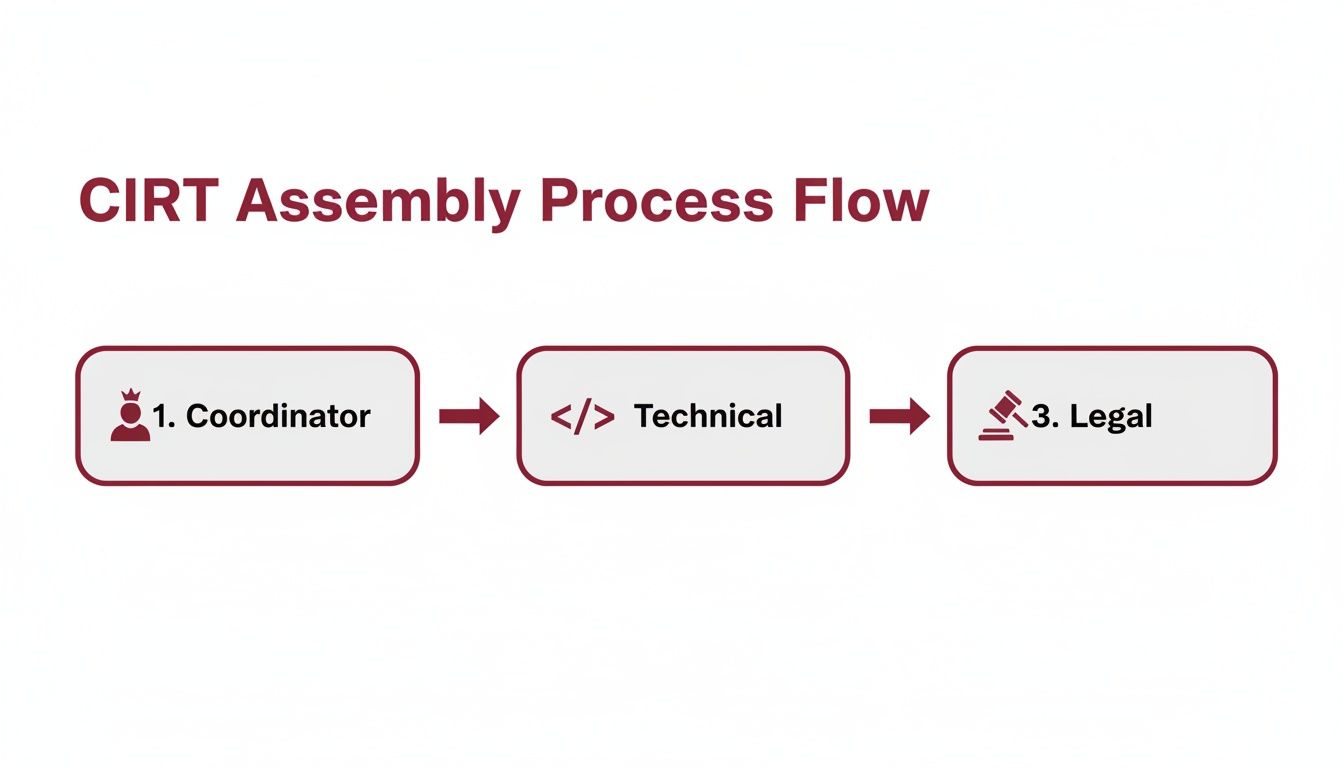
This flowchart shows how these essential roles come together, from the high-level coordinator to the technical and legal experts who execute the plan on the ground.
The Preparation Phase
Honestly, this is where you win or lose the battle before it even starts. Preparation is all about laying the groundwork so that when an incident kicks off, your team can act with speed and confidence, not panic and confusion. It’s about building the muscle memory for your response.
Think of it as your business's emergency kit. You don't wait for a cyclone warning to go looking for batteries and a torch. In the same way, you shouldn't wait for a breach to figure out who's in charge or what your most critical data assets are.
Here’s what you need to do now:
- Map Out Your Assets: You can't protect what you don't know you have. Document all your crucial hardware, software, and data. Know where it lives and who owns it.
- Run a Risk Assessment: Figure out the likely threats and weak spots for your business. A retail shop in Perth might worry about point-of-sale malware, while a Sydney consulting firm should be on high alert for business email compromise.
- Build Your Playbooks: Create simple, step-by-step guides for common scenarios like a ransomware attack or a major phishing campaign. These become your go-to guides when the pressure is on.
The Identification Phase
This phase is all about detection—spotting the faint signals of an attack before it turns into a full-blown crisis. Early identification is everything because it dramatically shrinks the potential damage. The sooner you know, the faster you can shut it down.
This really comes down to two things: training your team to be vigilant and having the right tools in place to monitor your systems for anything out of the ordinary.
Keep an eye out for common red flags:
- Odd Network Traffic: Is data suddenly flowing to an unknown country at 3 AM from a server that's usually dead quiet?
- Weird Account Behaviour: Is a single user account logging in from both Melbourne and London within minutes of each other?
- Surprise System Changes: Have new administrator accounts popped up out of nowhere? Has your antivirus software been mysteriously disabled?
The goal here is simple: move from "something feels off" to "we have a confirmed incident" as quickly as humanly possible. This takes a sharp combination of smart technology and a well-trained human eye.
The Containment Phase
As soon as an incident is confirmed, your first priority is to stop the bleeding. Containment is all about isolating the affected systems to prevent the threat from spreading like wildfire across your network. It’s a critical, time-sensitive move.
Imagine a fire has started in one room of your office. You don't start assessing the damage to the furniture; you slam the door shut to stop the fire from taking the whole building. That’s containment in a nutshell.
Containment strategies might include:
- Short-term fixes: Yanking the network cable from a compromised laptop or blocking its IP address on the firewall. It’s quick and dirty, but it works.
- Long-term solutions: Building a clean, isolated network segment for critical business functions to continue while the main network is being forensically examined.
This phase is a delicate balancing act. You need to be fast enough to limit the damage but not so hasty that you trample all over the digital evidence needed for the investigation.
The Eradication Phase
Okay, the threat is boxed in. Now it's time to get it out of your environment for good. This isn't just about deleting a malicious file; it's about digging deep to find and eliminate the root cause so the attacker has no way back in.
This could mean removing malware, patching the vulnerability the attackers exploited in the first place, and shutting down any backdoors they might have left for themselves. Eradication means you're absolutely sure the threat is gone.
This is more urgent than ever for Australian businesses. Recent data shows data breaches in Australia have shot up by 48%, with dozens of incidents reported every month. Without a plan, companies are thrown into chaos, which means slow detection and big problems under the Notifiable Data Breaches (NDB) scheme. The ACSC had to respond to over 1,200 incidents last year, and the story is always the same: unprepared organisations suffer far more, with the average loss for a small business hitting $80,850.
The Recovery Phase
After the threat has been kicked out, the focus flips to safely restoring your systems and getting back to business as usual. This has to be done carefully to avoid re-introducing the same vulnerability or any lingering traces of the attack.
This is much more than just flicking the power switch back on.
Your recovery checklist should include:
- Restore from Clean Backups: First, verify that your backups are actually clean and haven't been compromised before you even think about using them.
- Validate and Monitor: Once systems are back online, watch them like a hawk for any signs of strange activity. You need to be certain the threat is truly gone.
- Bring Systems Back in Stages: Get your most critical systems running first. Then, gradually reintroduce others to ensure everything remains stable.
The Lessons Learned Phase
This final phase is, without a doubt, the most important one for your long-term security. After the dust settles from the incident, you absolutely must hold a post-incident review. This is where you dissect what happened, what went well, and what was a complete mess. You're turning a painful event into a powerful opportunity to get stronger.
Get the team in a room and ask some honest questions:
- How exactly did the attacker get in?
- Did our security tools actually detect anything?
- Was our playbook clear and easy to follow under pressure?
- Where did our communication break down?
The answers should feed directly back into your preparation phase. Use them to update your plan, fine-tune your tools, and deliver better training. This creates a powerful cycle of continuous improvement that makes your organisation tougher and more resilient over time. You can use an incident response plan template to make sure this process is structured and covers all the critical bases.
Mastering Communications During a Crisis
When a cyber attack hits, fixing the technical mess is only half the problem. The other half—the part that can make or break your business—is what you say, who you say it to, and when. Get it wrong, and you could shatter your reputation beyond repair. A calm, controlled communications strategy is just as vital as shutting down a compromised server.
This is where your cyber incident response plan becomes less of a technical document and more of a business survival guide. It needs to lay out a clear roadmap for talking to everyone: your team, your customers, your partners, and, crucially, Australian regulators. Panic breeds misinformation; a solid plan ensures your message is consistent, transparent, and legally sound.
Building Your Communications Strategy
In a crisis, silence is your enemy. It creates a vacuum that will quickly fill with customer speculation, fear, and social media rumours. Your plan needs to be proactive, outlining exactly how you’ll manage the flow of information to different groups of people.
Let's be clear: a one-size-fits-all email blast will only make things worse. Each audience has completely different concerns. Your strategy has to be smart enough to address these unique perspectives.
- Your Team (Staff & Leadership): These people should be the first to know, not the last. Give them clear, honest updates on the situation and what their role is. This stops internal rumours dead in their tracks and makes sure everyone presents a united front.
- Customers & Partners: Your customers need reassurance, not technical jargon. Focus on how the incident affects them, what you're doing to fix it, and how you're protecting their data. A bit of honesty, even when the news is bad, goes a long way toward building trust.
- Regulators & Law Enforcement: This isn't a negotiation; it's a legal obligation. These communications are time-sensitive and demand factual, legally vetted information, especially when dealing with Australian privacy laws.
Your first public statement sets the tone for the entire crisis. Getting it wrong—by delaying, deflecting, or downplaying what happened—can cause irreversible damage to the trust you've built with your customers.
Demystifying the Notifiable Data Breaches Scheme
If you do business in Australia, you absolutely must get your head around your legal reporting duties. The Notifiable Data Breaches (NDB) scheme, which is policed by the Office of the Australian Information Commissioner (OAIC), isn't just a good idea—it's the law. Mess this up, and you could be facing some hefty fines.
The scheme forces organisations to notify individuals and the OAIC when a data breach is likely to result in serious harm. That phrase, "serious harm," is the critical bit you need to understand.
A breach officially becomes "notifiable" when it ticks three boxes:
- There’s been unauthorised access to, or disclosure of, personal information your business holds.
- This is likely to cause serious harm to one or more people.
- You haven’t been able to fix the problem and prevent that likely risk of serious harm.
What Triggers a Report?
"Serious harm" is the key concept here. It’s not just about someone losing money. It can cover serious physical, psychological, emotional, or reputational damage. Think about a leak of sensitive health records or identity documents—that would almost certainly tick the box.
The law gives you 30 calendar days to assess a suspected breach. That’s not a lot of time when everything is hitting the fan, which is exactly why you need a pre-defined process sitting in your incident response plan, ready to go.
If your assessment confirms a notifiable breach happened, you have to prepare a statement for the OAIC and a notification for every affected person as soon as you possibly can.
Practical Communication Templates
When you’re under immense pressure, having pre-drafted templates ready to go is a lifesaver. It saves precious time and helps you avoid making clumsy mistakes. These should live in your plan's appendix, waiting to be quickly adapted and deployed.
Here’s a rough idea of what a couple of key communications might look like.
Initial Customer Notification Email
The goal here is to be clear, concise, and empathetic. Ditch the technical speak.
| Element | Example Text |
|---|---|
| Subject Line | An Important Security Update from [Your Company Name] |
| Opening | We're writing to let you know about a security incident we recently identified. We are taking this very seriously and are working to secure our systems. |
| What Happened | On [Date], we discovered an unauthorised party gained access to a part of our network. Our investigation is ongoing, but we believe some customer information may have been involved. |
| What We Are Doing | We've brought in external cybersecurity experts to help us investigate and have taken immediate steps to contain the threat. We have also notified the relevant Australian authorities. |
| What You Should Do | As a precaution, we recommend you stay alert for any suspicious emails or messages (phishing) and keep an eye on your accounts. |
| Closing | We are truly sorry for any concern this may cause. Protecting your information is our priority, and we'll share more updates as soon as we have them. |
This kind of structured approach helps you deliver bad news without causing a full-blown panic. And one final, crucial tip: your legal team must review any external communication before it goes out, especially one admitting a breach. This makes sure what you’re saying aligns with your obligations under the NDB scheme and doesn't open you up to even more liability. Your cyber incident response plan is your guide to navigating these tough but essential conversations with confidence.
Putting Your Plan to the Test

Let’s be honest. A beautifully written cyber incident response plan that just sits on a digital shelf is completely useless. Its true worth only shows up under pressure, and you absolutely do not want the first real test to be a live attack. This is where testing stops being a "nice-to-have" and becomes a non-negotiable part of your defence.
By regularly testing your plan, you start to see the cracks. You find the gaps. Most importantly, you build the muscle memory your team needs to act without hesitation when things go sideways. It’s what turns a static document into a living, battle-ready playbook. Think of it exactly like a fire drill—you practise so that when the real alarm bells ring, everyone knows precisely what to do and where to go.
Without these practice runs, you’re just crossing your fingers and hoping for the best. And from what I’ve seen, an untested plan almost always crumbles at the first sign of a real crisis, creating chaos and costly delays right when you need speed and clarity the most.
From Simple Discussions to Full-Scale Drills
Testing doesn't have to be some massive, expensive production, especially when you're starting out. The smart move is to start small and gradually ramp up the complexity. The real goal is to get into a rhythm that works for your business, ensuring your plan never gets dusty.
Here are a few proven ways to put your plan through its paces:
- Walkthroughs: This is your starting line. Get the incident response team in a room (or on a call) and literally read through the plan, section by section. It’s a simple but effective way to make sure everyone understands their role and the procedures.
- Tabletop Exercises: This is the next level up and, frankly, where you get the most bang for your buck. You create a realistic but hypothetical scenario—say, a ransomware attack has just encrypted a critical server—and have the team talk through their response, step by step.
- Advanced Simulations: These are the full-dress rehearsals. It could involve bringing in "red teams" (ethical hackers) to actively try and breach your defences while your "blue team" (your defenders) works to stop them. They are more resource-intensive, but they provide the most realistic validation of your capabilities.
The point of any test isn’t to pass or fail; it’s to learn. Every single gap you uncover in a drill is a potential disaster you’ve just sidestepped in the real world. A tabletop exercise that reveals a broken communication channel isn't a failure—it's a massive win.
This proactive mindset is critical, especially with what we're seeing in Australia right now. The ACSC's latest Annual Cyber Threat Report painted a pretty grim picture. Incidents hitting our critical infrastructure made up 13% of all reports, and there was a staggering 111% jump in alerts. The report also shows that businesses without tested plans are falling behind; espionage-related incidents, for example, now take over two weeks longer to even detect. You can get more details straight from the Annual Cyber Threat Report on minister.defence.gov.au.
Measuring What Matters: Key Performance Indicators
If you want to get better at incident response, you have to measure it. Tracking key performance indicators (KPIs) is how you move from gut feelings to hard data, showing you exactly what’s working and what isn’t. These metrics are also your best friend when you need to justify cybersecurity spending to management.
When you can walk into a meeting and show a clear, data-backed improvement in your response times, arguing for a bigger budget for new tools or training suddenly gets a whole lot easier.
Here are the two most critical metrics you should start tracking immediately:
- Mean Time to Detect (MTTD): How long does it take your team to realise a security incident has occurred? This measures the time from the very start of an attack to the moment you discover it. A lower MTTD is always the goal—it means you’re catching threats before they can cause widespread damage.
- Mean Time to Respond (MTTR): Once you’ve detected an incident, how long does it take to shut it down? This tracks the average time from detection to full containment and eradication. Watching your MTTR shrink over time is a clear sign your team is becoming a well-oiled machine.
A Practical Testing Cadence for Small Businesses
For a small business, a realistic testing schedule is everything. You need to make progress without burning out your team. Here’s a simple, sustainable rhythm you can adopt to build and maintain your readiness.
| Frequency | Test Type | Objective |
|---|---|---|
| Quarterly | Plan Walkthrough | A quick check-in to review the plan for outdated contacts, tech changes, or process gaps. It keeps the plan fresh. |
| Annually | Tabletop Exercise | A proper scenario-based drill with the full incident response team to test decision-making and communication flows. |
| As Needed | Post-Incident Review | After any real security event (even a minor one), hold a "lessons learned" session. Feed those insights right back into the plan. |
Following a structured approach like this ensures your cyber incident response plan remains a living document that grows with your business and evolves with the threat landscape. By testing regularly and measuring your performance, you build a resilient organisation—one that’s ready to face a security incident not with panic, but with a calm, practised, and professional response.
Got Questions About Incident Response Planning? You're Not Alone.
Even with the best guide in hand, building something as important as a cyber incident response plan is bound to bring up a few questions. Let's walk through some of the most common ones we hear from businesses just like yours and give you some clear, practical advice.
How Often Should We Be Testing Our Plan?
Look, the single biggest mistake you can make is to write a plan, file it away, and never look at it again. An untested plan is just a collection of assumptions waiting to fall apart under pressure.
As a rule of thumb, you should run at least one full-scale test, like a tabletop exercise, every year. This is your annual health check to make sure the core procedures still work and to keep your team’s skills sharp.
But your plan isn't a static document; it’s a living thing. You need to be reviewing and tweaking it quarterly, or anytime something major changes in your business. Think new IT systems, a key person leaving, or a big shift in how you operate. For your absolute most critical systems, you might even want to run smaller, more targeted tests more often.
Regular testing isn't just about ticking a box. It’s about building muscle memory. It turns a theoretical document into a practical, battle-ready tool that gives your team the confidence to act decisively when things go wrong.
Does Our Cyber Insurance Mean We Don't Need a Plan?
That's a definite no. In fact, it's the other way around. Most Australian cyber insurance providers now require a documented and tested incident response plan just to get a policy. Many will even ask to see proof of recent tests before they’ll even give you a quote.
Here’s how to think about it: your incident response plan is what minimises the disaster in the first place. Cyber insurance helps you pick up the financial pieces after the disaster, covering things like legal bills, customer notifications, and business interruption costs.
A solid plan does things insurance just can't:
- Slashes Downtime: A fast, coordinated response gets you back online and trading sooner, stopping the financial bleeding from lost revenue and productivity.
- Saves Your Reputation: A chaotic, fumbled response destroys customer trust. A calm, professional one shows you’re in control and can actually strengthen it.
- Lowers Your Premiums: Insurers see a well-tested plan as a sign of a lower-risk client, which can directly lead to better policy terms and pricing.
They aren't substitutes; they're partners. Your plan reduces the chance and the impact of an attack, and your insurance provides a financial safety net for when it happens.
Can We Really Create a Plan Ourselves as a Small Business?
Absolutely. Not only can you, but you should create the foundation of your plan in-house. Using guides and templates, you can get the essential basics down pat. Start with what you can realistically handle.
Focus on defining who's on your core response team, mapping out the key communication steps for a few likely scenarios, and getting crystal clear on what your most critical business assets are. This initial work is incredibly valuable and creates the skeleton of your entire strategy.
That said, it's also smart to know where your expertise ends. When it comes to the really technical stuff like digital forensics or making sure you’re fully compliant with Australian laws like the Notifiable Data Breaches (NDB) scheme, bringing in an external expert is a very wise move.
For most small businesses, this hybrid approach works best. You build the practical, day-to-day framework internally, then bring in a specialist to check your work and plug the technical and legal gaps. This gives you a cyber incident response plan that’s not just practical, but genuinely strong and compliant.
At Anitech, we live and breathe this stuff. We specialise in helping Australian businesses navigate the world of information security. If you're looking to build a truly resilient security posture that meets the tough standards of ISO 27001, our team can help you forge a compliant and effective incident response plan from the ground up. Find out more about our ISO 27001 consulting services.
Recent Comments