

A cyber security analyst is a business's digital guardian, responsible for protecting its computer networks, systems, and sensitive data from the ever-present threat of cyber attacks. Think of them as the crucial first line of defence, combining the roles of a security guard, a detective, and an emergency responder to safeguard your organisation's most valuable information assets.
What a Cyber Security Analyst Really Does

Imagine a cyber security analyst as the dedicated guardian of your company’s digital crown jewels. Their job isn’t just about putting out fires; it’s a constant, looping process of building defences, watching the walls, and responding the moment an alarm sounds. They are the specialists who stand between your data and the persistent threats trying to get at it.
This role has become absolutely essential. With small businesses in Australia facing an average data breach cost of nearly $50,000, having a skilled analyst on your side is no longer a 'nice-to-have'. It's a core requirement for survival in the modern digital landscape.
The Core Mission
At its heart, a cyber security analyst’s mission is to shrink the organisation's security risk down to the smallest possible size. They do this by owning three critical areas:
- Proactive Defence: They're always on the hunt for weak spots before an attacker finds them. This means running vulnerability checks, testing systems, and fine-tuning security tools.
- Continuous Monitoring: Analysts are the eyes on the network. They watch the constant flow of traffic and system logs, searching for the slightest hint of suspicious activity.
- Rapid Response: When an incident happens, they are the first ones in. They dive deep to investigate what happened, stop the bleeding, and kick the threat out to get things back to normal.
In essence, a cyber security analyst is the crucial link between technical security controls and real-world business goals. They translate complex cyber threats into tangible business risks and lay out the plan to protect the bottom line.
Why This Role Is a Strategic Asset
A great cyber security analyst brings far more than just technical skill to the table; they deliver immense strategic value. They don’t just fix what’s broken—they build a stronger, more resilient security culture across the entire business.
This means staying ahead of the curve, studying the latest threat intelligence to see what new attack methods are coming, and making sure the company's defences meet industry benchmarks like ISO 27001. In doing so, they protect not just your data, but something even more valuable: your customer's trust and your hard-earned reputation.
A Day in the Life of Your Security Expert
Forget the idea of a quiet, predictable IT job. A cyber security analyst’s day is a dynamic mix of proactive defence-building and rapid-fire incident response. Think of them as both the architect meticulously reinforcing the castle walls and the guard on the watchtower, ready to sound the alarm at the first sign of trouble.
Every task they perform is a direct shield for your business operations, protecting your data, your reputation, and your bottom line. They’re the translators who turn streams of technical data and cryptic system alerts into a clear, simple question: "What does this mean for our business, and are we safe?"
This constant watchfulness is no longer a luxury—it’s a necessity. The Australian Cyber Security Centre (ACSC) recently recorded over 87,400 cybercrime reports, and the average cost of a breach for a small business has hit a staggering $49,600. These numbers show exactly why the Australian cybersecurity job market is crying out for skilled analysts.
To better understand what this role entails, let’s break down their daily workflow into two core functions: proactive and reactive tasks.
Cyber Security Analyst Daily Task Breakdown
Here’s a snapshot of the typical activities that fill an analyst's day. It's a constant juggle between strengthening defences (proactive) and fighting active fires (reactive), all with the goal of keeping the business secure.
| Task Category | Specific Actions | Business Impact |
|---|---|---|
| Proactive Defence | – Reviewing global threat intelligence feeds for new attack methods – Running vulnerability scans on company networks and apps – Fine-tuning security tools (firewalls, anti-virus) |
Prevents incidents before they happen, reducing risk and potential downtime. |
| Reactive Response | – Investigating and validating security alerts – Containing threats by isolating affected systems – Performing forensic analysis to understand the attack's scope |
Minimises the damage from an active security breach, protecting data and speeding up recovery. |
| Continuous Improvement | – Documenting incidents and creating post-mortem reports – Updating security policies based on new threats – Collaborating on security awareness training for staff |
Strengthens the organisation's overall security posture over time, making it more resilient to future attacks. |
As you can see, their responsibilities directly map to tangible business outcomes, moving cyber security from a cost centre to a crucial business enabler.
The Proactive Watch
A huge chunk of an analyst's time is dedicated to finding trouble before it finds the business. This is where the real value lies—preventing a crisis is always better than managing one.
Their day often kicks off with a review of the latest threat intelligence feeds. You can think of these as the cyber equivalent of a weather forecast, warning of new hacking techniques, emerging threat groups, and recently discovered vulnerabilities. Armed with this knowledge, the analyst can patch the company’s own weaknesses before attackers even know they exist.
The essence of proactive security is anticipation. A great analyst doesn't just sit and wait for an alarm. They're constantly thinking like an attacker, identifying the most likely targets in the business, and shoring up those defences first.
Other vital proactive tasks include:
- Vulnerability Scanning: Using specialised tools to methodically probe the company's digital footprint—networks, applications, and servers—to find and flag known security holes.
- Security Tool Optimisation: Tweaking the rules and settings on firewalls, intrusion detection systems (IDS), and endpoint protection to block new threats without accidentally disrupting legitimate business activity.
- Security Awareness Collaboration: Working with HR or communications teams to train staff on spotting phishing emails and practising good cyber hygiene, effectively turning every employee into a part of the human firewall.
The Reactive Response
The moment a security alert goes off, the analyst's focus snaps into reactive mode. This is where their cool-headed, methodical problem-solving skills are put to the test, often under immense pressure.
The first step is always triage. Is this a genuine threat, or just a false positive? If the threat is real, the mission immediately becomes containment. This means isolating the infected laptop or server from the rest of the network to stop the attack from spreading—much like a firefighter closing a door to contain a fire to a single room.
Once the immediate danger is contained, the deep-dive forensic analysis begins. The analyst becomes a digital detective, sifting through logs and network data to piece together the story of the breach. How did they get in? What did they access? And most importantly, how can we be certain they are gone for good? This investigation is critical not only for recovery but for learning from the incident to prevent it from ever happening again.
What Makes a Great Analyst Tick? The Essential Skills
When you’re looking to bring a cyber security analyst on board, you're not just hiring for technical know-how. You're searching for a specific mindset—a unique mix of deep technical skill, sharp strategic thinking, and a healthy dose of professional paranoia. This isn't a role you can master by just reading a book; it demands a real instinct for investigation and the ability to think like an attacker.
It’s this combination of hard and soft skills that separates a good technician from a genuine security asset. On one hand, you absolutely need the technical chops. An analyst has to speak the language of networks, systems, and security tools fluently. But without the right soft skills, all that technical wizardry stays locked away, useless for guiding business decisions or building a culture of security.
The Technical Toolkit
An analyst's technical arsenal is broad, but a few core skills are the absolute bedrock of their ability to protect your organisation. A great analyst doesn't just know of these tools; they know how to use them under pressure to find that one critical clue buried in a mountain of data.
Here’s what they need to have mastered:
- Security Information and Event Management (SIEM): Think of this as the analyst's mission control. Being a whiz with SIEM platforms lets them pull together log data from everywhere—servers, firewalls, laptops—and spot the subtle patterns that signal an attack is underway.
- Network Architecture and Protocols: You can't defend what you don't understand. A deep grasp of how data moves around a network is non-negotiable for spotting weird traffic, understanding vulnerabilities, and locking things down.
- Intrusion Detection and Prevention Systems (IDS/IPS): These are the digital tripwires of your network. Analysts need to know how to set them up, fine-tune them, and interpret the alerts they generate when something malicious tries to get in.
- Cloud Security Principles: So much of business now lives in the cloud. That means understanding the specific security puzzles of platforms like AWS, Azure, and Google Cloud isn't a bonus skill anymore—it's a must-have.
This need is made even more urgent by a major skills gap. The shortage of cyber security talent in Australia is creating a huge shift in the market, with skills in network security, encryption, and cloud platforms being incredibly sought after. While there are 3.5 million unfilled cyber security jobs globally, the Australian market is on fire, with specialist salaries ranging from AUD 70,000 to over AUD 135,000.
The Soft Skills That Seal the Deal
Technical skills will help an analyst spot a threat, but it’s the soft skills that truly shut it down and stop it from happening again. These traits are harder to list on a CV but are just as crucial for success.
A technically brilliant analyst who can't explain risk to the leadership team is only doing half their job. The real magic happens when they can bridge the gap between the server room and the boardroom.
Look for these essential qualities:
- Analytical and Critical Thinking: This is the ability to see a complex security alert, pull it apart piece by piece, and build a logical theory about what's really going on.
- Meticulous Attention to Detail: Attackers love to hide in the tiny details—a single typo in a line of code, an odd timestamp in a log file. A great analyst notices things others miss.
- Clear Communication: They must be able to translate dense, technical findings into plain English, explaining the business risk in a way that executives can immediately grasp and act on.
- Calm Under Pressure: When a security incident hits, chaos is the enemy. You need someone who stays methodical, focused, and level-headed when the stakes are at their highest.
This blend of proactive digging and clear-headed communication is what advanced security is all about. You can see how analysts put these skills to work by reading our guide to threat hunting a proactive approach to identifying and neutralising cyber threats.
How a Cyber Security Analyst Drives ISO 27001 Compliance
Getting ISO 27001 certified isn't just a box-ticking exercise. It's about weaving security into the DNA of your business, and a cyber security analyst is the person who makes that happen on the ground. They are the engine that powers your Information Security Management System (ISMS), transforming your policies from a binder on a shelf into active, real-world defences.
It's this hands-on work that makes compliance not only achievable but sustainable. While a consultant might design the ISMS framework, the analyst is the one implementing, monitoring, and gathering the crucial evidence to prove it’s actually working.
This chart breaks down the essential skills an analyst needs, separating the deep technical abilities from the equally important strategic soft skills.
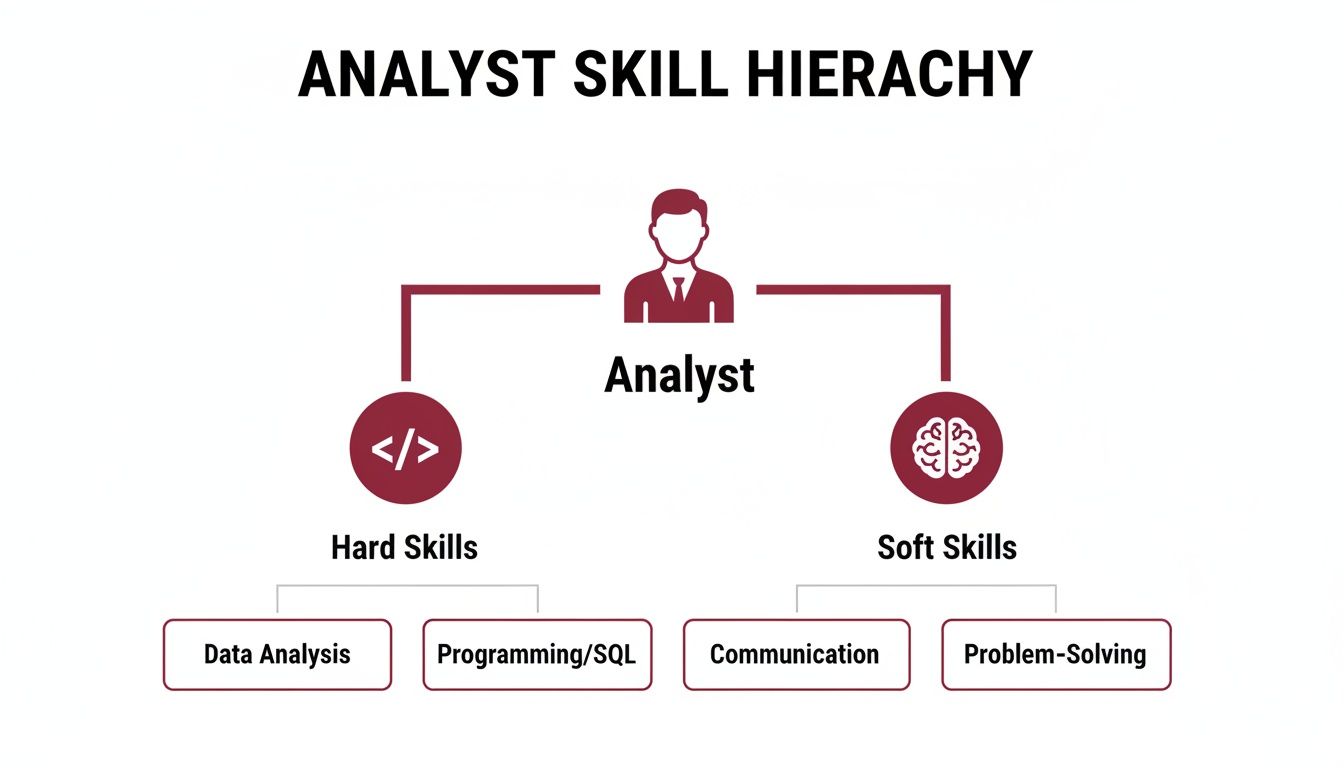
As you can see, a great analyst needs more than just technical chops. They must blend that expertise with sharp communication and critical thinking to apply their knowledge where it matters most.
Connecting Daily Tasks to Annex A Controls
Nearly everything a cyber security analyst does day-to-day maps directly to the security controls in ISO 27001. Their work provides the tangible proof an auditor needs to see—proof that your controls aren't just well-designed, but are alive and effective. They are the linchpin that connects compliance theory to operational reality.
Here’s a snapshot of how their role aligns with specific controls:
- Access Control (A.5): The analyst is your gatekeeper for user access. By enforcing the principle of 'least privilege'—giving employees access only to what they absolutely need—they directly demonstrate that your access management controls are working.
- Operations Security (A.8): From deploying and managing anti-malware software to monitoring system logs for strange activity and verifying data backups, the analyst is the one actively fulfilling these essential operational security requirements.
- Communications Security (A.8): They're the ones configuring and watching over your firewalls and intrusion detection systems. This work is vital for protecting information as it moves across your networks, a cornerstone of communications security.
A huge part of their role also involves making sure data is secure from cradle to grave, which includes following data security in IT asset disposition best practices to prevent leaks from old equipment.
The Analyst as an Evidence Collector
When an ISO 27001 audit comes around, you need to show, not just tell. You must provide concrete evidence that your security controls are functioning as intended, and your analyst is the primary person gathering that proof. They produce the logs, reports, and records that will satisfy an auditor.
An auditor won't just take your word for it that you're secure. They want to see the firewall logs, the access review reports, and the incident response tickets. The analyst is the person who produces and explains this crucial evidence.
For instance, when an auditor asks about your incident management process (A.5), the analyst can pull up detailed records of how a past security alert was handled. They can show the ticket from the SIEM, the investigation notes, the steps taken to contain the threat, and the final report. This kind of documentation turns a policy from a simple statement into a proven, effective process.
Finding the Right Cyber Security Talent
Bringing on your first dedicated security professional can feel like a massive step, especially for a small business. The cyber security analyst role is highly specialised, and let's be honest, it's tough to know what you’re looking for if you’re not already in the field. But finding the right person is absolutely critical to protecting your business and hitting your compliance goals, like ISO 27001.
Don’t let that intimidate you. With the right approach, you can confidently find, interview, and bring on board an analyst who will make a real difference. It all starts with a crystal-clear job description and an interview process that digs into how a candidate thinks, not just what they know.
Make no mistake, the competition for good analysts is fierce. Right now, Australia is seeing a huge hiring push in the public sector, putting national security front and centre. Even with our cyber workforce growing to around 125,791 professionals—a 9.5% jump in just one year—there's still a major skills shortage. This means skilled analysts have their pick of roles, with mid-level salaries often sitting between AU$115,000–$125,000 and senior positions commanding AU$180,000–$220,000 or more. You can read more about the surge in cyber security roles on paxus.com.au.
Crafting a Job Description That Actually Works
Think of your job description as your first line of defence in the hiring process. A great one filters out the noise. It needs to clearly spell out not just the technical must-haves but the real-world impact the role will have on your business. Ditch the generic, laundry-list style and focus on the outcomes you need.
Here’s a simple structure that cuts to the chase:
- Role Summary: Start with the 'why'. Why is this role so important to you right now? Something like, "We're looking for a sharp Cyber Security Analyst to be the guardian of our information assets and a key player in maintaining our ISO 27001 certification."
- Key Responsibilities: Use strong, action-focused verbs. Talk about what they will do: monitor security alerts, hunt for vulnerabilities, and lead the charge during incidents.
- Required Skills and Qualifications: Be specific. List the non-negotiable technical skills (e.g., hands-on SIEM experience, solid network security fundamentals) and the soft skills that matter just as much (e.g., clear communication, a cool head under pressure).
- Company Culture: Add a quick note about your work environment. You want someone who will thrive on your team, not just fill a seat.
And remember, you don't have to go it alone. It's often worth exploring the benefits of engaging a recruitment agency, as they have deep networks of pre-vetted candidates.
Asking Interview Questions That Reveal True Skill
The interview is where you move past the polished CV and see how a candidate really operates. Forget purely technical trivia. The best way to gauge their expertise is to throw them a realistic scenario and see how they handle it.
A great interview question tests not what a candidate knows, but how they think. The goal is to see their problem-solving methodology in action, especially when faced with an unfamiliar challenge.
Try weaving in questions like these:
- "You've just received an alert for unusual outbound network traffic from a C-level executive's laptop. Walk me through your first steps."
This isn't about finding one 'right' answer. It's about seeing their investigative process in real-time—from validating the alert to containment and figuring out what happened. - "Explain a concept like 'the principle of least privilege' to our head of sales, who has no technical background."
This is a brilliant test of their communication skills. An analyst who can translate complex jargon into plain English is invaluable for getting buy-in from the rest of the business.
Finding top-tier talent is a challenge everywhere, but it's particularly competitive in major business hubs. If you're based in New South Wales, you might find our specific insights on cybersecurity jobs in Sydney helpful.
Answering Your Key Cyber Security Analyst Questions
Bringing a dedicated security expert on board is a big step, and it naturally comes with a lot of questions. Business leaders want to know exactly what this role entails and how it will genuinely benefit the company. Whether you're a small business just starting to think seriously about security or a larger company looking to formalise your defences, getting clear on the cyber security analyst's value is crucial.
Let's cut through the jargon and tackle the most common queries head-on, so you can make the right call for your business's future.
Analyst vs. IT Administrator: What’s the Difference?
This is a classic point of confusion, but the distinction is vital. While both roles are critical to your operations, they have completely different primary missions.
Think of it this way: your IT Administrator is like your building manager. Their world revolves around keeping everything running smoothly. They set up the infrastructure, make sure everyone has access to the tools they need, and fix things when they break. Their focus is on availability and performance – essentially, keeping the lights on and the business productive.
Your Cyber Security Analyst, however, is your head of security. Their entire focus is on protection. They're the ones installing the alarm systems, watching the cameras, and walking the perimeter looking for weak spots. They actively hunt for vulnerabilities before a criminal does, monitor for suspicious activity, and are the first to spring into action when an alarm goes off.
One builds and maintains the office; the other keeps it safe from break-ins.
It's this specialised, laser-focus on protection that makes a cyber security analyst non-negotiable for serious compliance goals like ISO 27001, which demands a constant, dedicated watch over your security.
Can a Small Business Outsource This Role?
Absolutely. In fact, for most small and medium-sized businesses (SMBs), outsourcing is often the smartest and most cost-effective move you can make.
Hiring an experienced, full-time analyst is a major investment. You’re not just paying a salary; you're covering benefits, ongoing training, and the eye-wateringly expensive security tools they need to do their job. Partnering with a Managed Security Service Provider (MSSP) gives you access to an entire team of seasoned pros and their top-tier toolset for a single, predictable monthly fee.
An outsourced team brings some serious advantages to the table:
- 24/7 Monitoring: Attackers don't work 9-to-5. An MSSP ensures you have eyes on your network around the clock, not just during business hours.
- Threat Intelligence: They see threats across hundreds of clients, giving them a bird's-eye view of emerging attack methods they can proactively defend you against.
- Instant Incident Response: When the worst happens, you don't want someone learning on the job. An MSSP has the battle-tested processes and expertise to shut threats down fast.
This model is especially powerful if you're aiming for ISO 27001 certification. It delivers the consistent, expert management of security controls and the meticulous documentation that auditors demand.
What Certifications Should I Look For?
While nothing beats real-world experience, certifications are a great way to verify a candidate has a solid grasp of the fundamentals and is committed to their craft. They act as a reliable benchmark for knowledge.
When you're evaluating a cyber security analyst, think of certifications in these tiers:
- Foundational: The CompTIA Security+ is the industry-standard starting point. If a candidate has this, you know they understand the core principles of network security, common threats, and risk management.
- Intermediate/Specialised: Look for credentials that show a deeper, more hands-on skill set. A Certified Ethical Hacker (CEH), for instance, proves they know how to think like an attacker to find vulnerabilities. The GIAC Security Essentials (GSEC) is another highly respected, practical certification.
- Advanced: The Certified Information Systems Security Professional (CISSP) is the gold standard for senior security leaders. It signals a deep, strategic understanding of security architecture, governance, and management.
And if ISO 27001 is your main goal? Finding a candidate with an ISO 27001 Lead Implementer or Lead Auditor certification is like striking gold. They won’t just understand your objective; they'll have direct, hands-on experience with the exact framework you’re trying to build, making them an incredible asset from day one.
Figuring out the right path to a stronger security posture can feel overwhelming, but you don't have to go it alone. Anitech specialises in guiding Australian businesses through the complexities of ISO 27001 certification with a 100% success rate. Learn how we can help you achieve compliance and protect your business.
Recent Comments