

At its core, a cyber security audit is a deep-dive into your business's security measures. It's a thorough review of your policies, the tech you use, and the procedures your team follows to spot weaknesses and make sure you’re up to scratch with industry standards like ISO 27001.
This isn't just about running a technical scan. It's a strategic look at how well you can actually stand up to real-world cyber threats, moving you past just ticking boxes and towards building genuine security.
Why Your Business Can No Longer Ignore Cyber Security Audits

It’s tempting to see the news about major data breaches and think, "That's a problem for the big end of town." For most Aussie small business owners, just keeping the lights on, managing staff, and watching cash flow is more than a full-time job. Who has time to worry about some invisible digital threat?
The trouble is, that mindset is fast becoming one of the biggest risks you can take.
The threat isn't some far-off possibility; it's right here, it's happening constantly, and it’s increasingly targeting smaller businesses because they're seen as easy marks. Every digital tool you rely on—from your accounting software to your customer database—is a potential doorway for an attacker. A cyber security audit is simply about finding those unlocked doors before they do.
The Real Cost of a "She'll Be Right" Attitude
Picture this: a small Aussie retailer is using a point-of-sale (POS) system that hasn't been updated in over a year. An attacker finds a well-known vulnerability in that old software. In a flash, they're in. They don't just get access to the day's takings; they get the whole database of customer credit card details. The immediate financial hit is bad enough, but the damage to their reputation and the loss of customer trust could easily shut them down for good.
This isn't some far-fetched story. The numbers tell it all. Last financial year, the Australian Cyber Security Centre (ACSC) fielded over 84,700 cybercrime reports—that's a new report every 6 minutes. Small businesses copped the worst of it, with the average self-reported cost of an attack hitting $56,600, a figure that jumped 14% in just one year. You can dive deeper into these cyber incident trends to see just how big the problem is.
These stats make it crystal clear: being proactive isn't a "nice-to-have" anymore. It's essential for survival.
A cyber security audit shifts your strategy from panicked damage control to proactive defence. It’s the difference between finding a leak after the house has flooded versus fixing a dodgy pipe during a routine check. One is a disaster; the other is just smart maintenance.
From Compliance Headache to Business Advantage
Let's be honest, the word "audit" often makes people think of a painful, box-ticking exercise you have to do to keep a client or regulator happy. And while meeting standards like ISO 27001 is a great result, the real gold is how an audit strengthens your business from the inside.
Just think about the practical benefits:
- Protect Your Good Name: A security breach can wipe out customer trust in an instant. An audit proves you're serious about protecting their data, which is a massive selling point.
- Avoid Financial Ruin: The cost of cleaning up after a breach—including fines, downtime, and recovery—is almost always far higher than the cost of a preventative audit.
- Run a Tighter Ship: Audits often shine a light on clunky processes, unused software, and confusing access rights, giving you a clear path to streamline your whole IT setup.
- Get a Competitive Edge: In a crowded market, being the business that can prove it's secure can be the deciding factor, especially when you're trying to win contracts with bigger companies or government bodies.
To help you get started, here's a look at some of the key areas an audit for a small to medium-sized enterprise (SME) would typically focus on, and what’s at stake if they are overlooked.
Key Audit Focus Areas and Associated Risks for SMEs
| Audit Focus Area | Common Vulnerability | Potential Business Impact |
|---|---|---|
| Access Control | Weak or shared passwords; no multi-factor authentication (MFA). | Unauthorised access to sensitive data, leading to breaches and fraud. |
| Data Backup & Recovery | Infrequent or untested backups; backups stored on the same network. | Inability to recover from a ransomware attack, forcing a ransom payment or permanent data loss. |
| Software Patching | Using outdated software or operating systems with known security holes. | Easy entry point for malware and viruses that can cripple your systems. |
| Employee Training | Staff unaware of phishing scams or social engineering tactics. | Employees unintentionally clicking malicious links, leading to network compromise. |
| Network Security | Unsecured Wi-Fi networks; poorly configured firewalls. | Attackers can "listen in" on your network traffic or gain direct access to your devices. |
| Incident Response Plan | No clear plan for what to do when a breach occurs. | A chaotic and slow response that increases financial loss and reputational damage. |
Looking at a table like this makes it clear that these aren't just abstract IT issues; they are direct threats to your operations, your finances, and your reputation.
By tackling these areas head-on, an audit directly prepares you for the most common attacks we're seeing right now. It's the best way to get a clear, honest picture of where you stand and what you need to do to protect everything you've worked so hard to build.
Laying the Groundwork for a Successful Audit
A cyber security audit that actually delivers value doesn't kick off with a technical scan. It starts much, much earlier with some careful planning and a crystal-clear sense of purpose. Jumping in without this prep work is like trying to drive from Sydney to Perth without a map—you'll burn through time and resources, and you'll almost certainly end up lost.
For a small Aussie business, where every dollar and every hour is precious, this planning phase isn't just a nice-to-have; it's non-negotiable. This is where you turn a vague, daunting task into a structured project with a clear beginning, middle, and end. Getting it right makes the whole process sharper, more efficient, and far more useful.
Defining Your Audit Scope
The single most critical first step is pinning down the audit's scope. In simple terms, this just means deciding exactly what you're going to examine. An undefined scope is a surefire recipe for disaster, leading to an audit that either tries to boil the ocean or completely misses the things that could sink your business.
Think of it like getting a building inspection. You wouldn't just tell the inspector to "check the house." You'd get specific about whether you need them to look at the wiring, the plumbing, or the foundation. The same logic applies here.
To really nail down your scope, you need to ask a few tough questions:
- What systems are mission-critical? Is it your customer database, your accounting software, or the server that keeps your e-commerce site running? Start with the assets that would cause the most pain if they went down.
- What data are you trying to protect? Are you handling sensitive client information, payment details, or your own secret-sauce business plans? The type of data you hold will dictate how rigorous the audit needs to be.
- Are there specific compliance hoops to jump through? Do you need to align with ISO 27001, the Notifiable Data Breaches scheme, or other industry regulations? These standards will heavily shape what must be included in your scope.
A tightly defined scope is your best defence against "scope creep," where the audit spirals out of control and turns into an endless, expensive headache. It focuses your efforts where they matter most, guaranteeing a much better return on your investment.
Assembling Your Internal Audit Team
Let's be clear: a cyber security audit is not just an IT problem. It's a business-wide effort. You absolutely have to involve the right people from the very beginning to get a complete and accurate picture of where you stand. Trying to run it with only your tech person is like trying to build a house with just a plumber—you’re missing some pretty crucial expertise.
Your internal team should be a small but mighty group of people who bring different perspectives to the table.
Who to Include on Your Audit Team
| Role | Why They Are Essential |
|---|---|
| Business Leadership (Owner/CEO) | They provide the 'why' behind the audit, champion the process, and sign off on the resources. Without their buy-in, acting on the findings will be an uphill battle. |
| IT Manager / Tech Support | This is your go-to technical expert. They know the nuts and bolts of your systems, networks, and software and will be the main point of contact for any auditors. |
| Operations / Office Manager | They understand the day-to-day workflows and how your team actually uses technology. They’re brilliant at spotting where official policy and reality don't quite line up. |
| Key Department Heads | If you have a sales team hammering a CRM or a finance team in accounting software all day, their leaders need to be in the room to talk about the security of those specific systems. |
Once you've got your crew together, the first order of business is to communicate the audit's purpose. It's not about pointing fingers or finding someone to blame. It’s about working together to make the business stronger against very real threats.
Frame the cyber security audit as a collaborative health check, not a fault-finding mission. When your team understands it’s about protecting everyone's jobs and the company's future, you'll get cooperation instead of resistance.
Gathering Your Essential Documentation
With your scope locked in and your team assembled, the final piece of prep work is to gather all the necessary documents. Any auditor, whether they're from your own team or an external firm, will need this info to get a handle on your current security setup. Having it ready to go makes the whole process smoother and saves everyone a lot of time.
This can feel like a bit of an admin slog, I know, but it's incredibly valuable. It forces you to get organised and often shines a light on gaps before the audit even officially kicks off.
Start pulling together the following:
- Existing Security Policies: Grab any documented rules you have, like your password policy, acceptable use policy, or data backup procedures.
- Network Diagrams: A map of your IT infrastructure is worth its weight in gold. It should show how your servers, computers, printers, and Wi-Fi points are all connected.
- Asset Inventory: You need a list of all your critical hardware and software. What have you got, where is it, and who’s responsible for it?
- Previous Audit Reports: If you've done any security checks in the past, have those reports and any related fix-it plans on hand.
- User Access Lists: A clear record of who has access to which systems and what they’re allowed to do (their privilege level).
This collection of documents is really the foundation of a proper Information Security Management System (ISMS), which is the absolute cornerstone of standards like ISO 27001. You can get a better sense of how to build a solid framework by exploring what an Information Security Management System entails.
A cyber security audit is just one piece of a much larger puzzle. For a deeper dive into building proactive defences, take a look at these essential cyber security risk management strategies. Putting in this groundwork transforms what could be a chaotic, stressful ordeal into a structured and highly effective project for improving your business.
How to Execute an Audit Aligned with ISO 27001
Right, this is where the theory ends and the real work begins. Conducting a cyber security audit, especially one that lines up with a heavy-hitter like ISO 27001, can feel like an overwhelming list of technical jobs. But if you strip it back, it’s a really logical process: check your defences, get the proof, and figure out where you can be stronger.
Try to think of it less like some pass/fail exam and more like a proper health check for your business’s information security. You wouldn't dream of skipping a financial audit, and this is the exact same discipline but for your most critical digital assets. For any business serious about achieving a globally respected standard, getting your head around ISO 27001 Accreditation is the first major step.
It all really comes down to three key things: assessing what could go wrong (your risks), testing your security controls against those risks, and pulling together solid evidence to back up what you find.
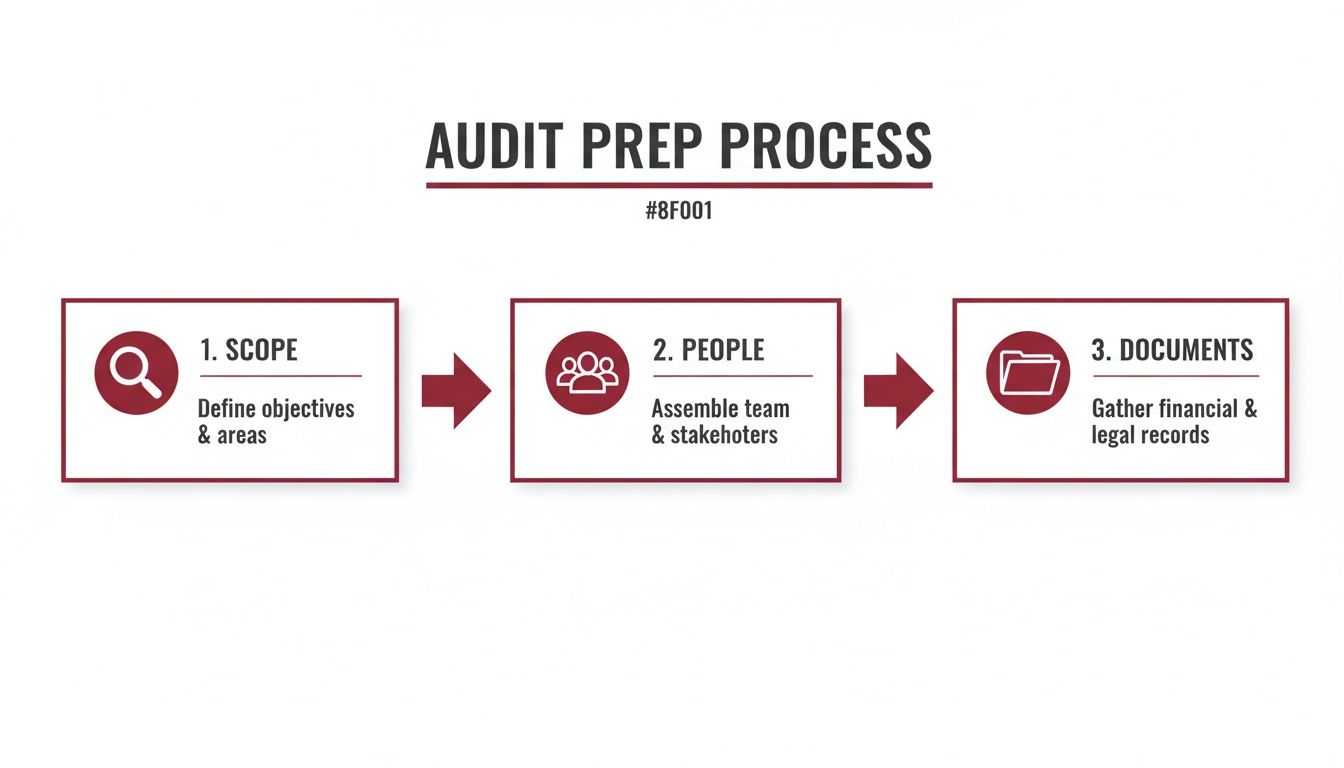
As you can see, a successful audit is built on a foundation of good organisation long before you start poking around in any systems.
Kicking Off with a Risk Assessment
You can't protect what you haven't identified, and you can't defend against threats you don't even know exist. That’s the entire point of a risk assessment. It’s the cornerstone of any ISO 27001-aligned audit because it connects the dots between potential threats and the things your business can’t live without.
First up, you need to map out your key information assets. This goes way beyond just your data. We’re talking about:
- Hardware: All your servers, laptops, firewalls, and other network gear.
- Software: Your CRM system, accounting package, and the operating systems they run on.
- Information: This is the obvious one—customer lists, financial records, your intellectual property.
- People: Don't forget the institutional knowledge locked away in the heads of your key staff.
Once you have your list, start brainstorming potential threats for each asset. For your customer database, a major threat is a ransomware attack. For key staff, it might be a cleverly worded phishing email.
Next, you look at the vulnerabilities that could let those threats become a reality. A vulnerability for that ransomware attack? Maybe your data backup and restore process has never actually been tested. For that phishing email? A lack of regular security awareness training for your team.
Finally, you have to analyse the potential impact. What’s the real-world damage if your customer data gets encrypted and you can’t get it back? The impact would likely be catastrophic, leading to massive downtime, lost revenue, and a seriously damaged reputation. By mapping this all out, you build a clear, prioritised action list of what to protect first.
The Core of the Audit: Control Testing
With your risk assessment done, you've got your roadmap. Now it's time for control testing. This is simply the process of checking whether the security measures you believe are in place are actually working the way they’re supposed to.
It's not enough to just ask, "Do we have a backup?" You need to be asking, "Can we prove our backup works and meets our recovery targets?" That difference is everything. An auditor doesn't care about promises; they want to see proof.
An untested security control is just a good intention. A tested control is a reliable defence. The purpose of an audit is to tell the difference between the two.
Let’s run through a few real-world examples of how you’d test common controls in a typical small business.
Control Testing Scenarios
- Multi-Factor Authentication (MFA): Your policy says all remote access requires MFA. The test is simple: try to log in to the company VPN or cloud email from an outside network using only a password. If the system demands a second factor (like a code from your phone), the control passes. If you get straight in, it fails.
- Data Backup Recovery: The procedure states you do daily backups of all sales data. To test this, you’ll need to grab a recent backup file and actually try to restore it to a separate test environment. The control passes if the data comes back complete, uncorrupted, and the whole process is done within an acceptable time.
- New Employee Onboarding: Your process dictates that all new hires must complete security awareness training in their first week. For the test, you'd pull the training records for the last three new starters. You're checking to see if they completed all the required modules and signed the acceptable use policy within that 5-day window.
These aren't deeply technical exercises. They are practical checks to confirm what you do in reality matches what you’ve written down in your policies. If you want to get into the nitty-gritty of the formal review process, you can find more detail on preparing for a formal ISO 27001 audit to make sure you're ready.
Gathering and Organising Evidence
As you work through your control testing, you absolutely must collect evidence meticulously. This evidence is what transforms your audit from a simple checklist into a credible report you can stand behind. An auditor’s mantra is, "If it's not documented, it didn't happen."
Good evidence is objective, timely, and relates directly to the control you’re testing. This isn't about creating mountains of paperwork; it's about collecting the right pieces of proof.
Here’s a look at what strong audit evidence actually looks like:
| Evidence Type | Description | Example |
|---|---|---|
| Configuration Files & Screenshots | This is direct, hard proof of how a system is set up. | A screenshot from your Microsoft 365 admin portal showing that password complexity rules are switched on. |
| System Logs | Logs give you an automated, time-stamped record of what happened and when. | Firewall logs showing that traffic from a known-bad IP range is actively being blocked. |
| Signed Documents & Training Records | This is proof that your team have acknowledged policies and done their training. | A scanned copy of the signed information security policy from a new employee's induction pack. |
| Physical Observation | Sometimes, the best evidence comes from just seeing something with your own eyes. | An auditor physically checking that the server room door is locked and that only authorised staff can get in. |
Just as crucial as collecting the evidence is organising it properly. A fantastic tip is to create a folder structure on your network that mirrors your audit plan or the ISO 27001 controls themselves. For every control you test, create a subfolder and drop all the relevant evidence in there—screenshots, exported logs, photos, and your notes.
This structured approach will not only keep you sane during the audit but also makes presenting your findings to management or an external auditor incredibly professional. When someone asks you to prove your firewall is configured correctly, you can pull up the exact evidence in seconds. It shows you’ve run a tight, thorough process.
Turning Audit Findings Into a Powerful Action Plan

The audit is done. You're now sitting on a pile of evidence, technical readouts, and pages of notes. Honestly, this is where most businesses drop the ball. A cyber security audit is only as good as the action it inspires, and a report filled with technical jargon is destined to gather dust on a shelf.
Your job now is to turn that raw data into a compelling story. It's a story that needs to clearly explain what you found, why it actually matters to the business, and precisely what to do next. This isn't about scaremongering; it's about building an undeniable, evidence-backed case for smart investment and meaningful change.
Without this crucial step, the entire audit effort was just a box-ticking exercise. The real goal is to move from identifying problems to actively solving them.
Analysing and Classifying Your Findings
Before you write a single word of your report, you need to make sense of your findings. This means looking at every weakness you've uncovered and figuring out its real-world risk level. Let's be clear: not all vulnerabilities are created equal. A missing software patch on a non-critical internal server is a completely different beast from weak remote access controls on your main customer database.
For each finding, you need to weigh up two things: the likelihood of it being exploited and the potential business impact if it were. This is how you transform a long, overwhelming list of issues into a prioritised roadmap for action.
A recent Audit Office of New South Wales report on cyber security highlighted major gaps in IT controls across government agencies, especially around logging and using old tech. This isn't just a public sector problem. It shows how, without a proper audit process to find and classify these risks, critical vulnerabilities can go unnoticed for years. You can see the common failings for yourself in the full cyber security insights report from the Audit Office of NSW.
To make this practical for your own business, a severity matrix is an incredibly helpful tool. It gives you a simple, visual way to categorise findings and decide what to tackle first.
Sample Audit Finding Severity Matrix
Classifying your findings with a simple matrix takes the guesswork out of prioritisation. It helps you focus your energy and budget where it will have the biggest impact, ensuring critical risks are handled immediately.
| Severity Level | Description | Example Finding | Recommended Action Timeframe |
|---|---|---|---|
| Critical | A flaw that could lead to immediate, catastrophic business impact, like a major data breach or total system shutdown. | Unprotected remote desktop protocol (RDP) access to the main server, open to the internet. | Immediate (within 24-48 hours) |
| High | A significant weakness that could result in substantial financial loss, reputational damage, or operational disruption. | No multi-factor authentication (MFA) on administrator accounts for cloud services. | Urgent (within 1-2 weeks) |
| Medium | A vulnerability that could be exploited but would likely have a more limited or indirect impact on the business. | Inconsistent software patching, with some staff laptops running outdated browser versions. | Important (within 1-3 months) |
| Low | A minor issue that represents a small risk or a deviation from best practice but is unlikely to cause significant harm. | The written password policy hasn't been officially reviewed and updated in over two years. | As resources permit (within 3-6 months) |
Using a framework like this ensures your response is proportional to the risk. It stops your team from getting bogged down with low-impact issues while a critical vulnerability is left wide open.
Structuring a Report That Drives Action
With your findings analysed and prioritised, you can finally build a report that speaks directly to the people who make decisions. The structure is everything. It needs to be clear, logical, and focused on business outcomes, not just technical specs.
Remember, a great audit report isn't written for other tech experts; it's written for the business owner, the CEO, and the management team holding the purse strings.
A structure I’ve found to be highly effective includes these key parts:
- Executive Summary: This is the most important page in the whole document. It should be a single page that sums up the key findings, the overall risk level, and the top three most critical recommendations. A busy director should be able to read just this and get the full picture.
- Scope and Objectives: Briefly restate what the audit covered (and what it didn't) and what you set out to do. This just provides essential context and manages expectations.
- Summary of Findings: Here, you present your prioritised findings, grouped by severity (Critical, High, Medium, Low). Avoid the deep technical weeds; focus on the business risk each finding represents.
- Detailed Findings and Recommendations: Think of this as the appendix for those who need more detail. Each finding gets its own entry detailing the vulnerability, the evidence, the potential business impact, and a clear, actionable recommendation to fix it.
Your audit report should tell a story that goes like this: "Here's our current security situation, here are the most significant risks to our business, and here is a clear, prioritised plan to make us stronger."
Crafting Recommendations That Get Approved
The final, and perhaps most crucial, piece of the puzzle is writing recommendations that are practical and persuasive. A recommendation to "improve network security" is completely useless. It's too vague.
On the other hand, a recommendation to "Implement a next-generation firewall with geo-blocking to prevent access from high-risk countries" is specific and actionable. That’s what you’re aiming for.
To make sure your recommendations lead to real change, follow these simple rules:
- Be Specific: Clearly state what needs to be done, who should be responsible, and what a successful outcome looks like.
- Provide Options: When you can, offer a "good, better, best" set of solutions with different costs and timelines. This empowers decision-makers instead of just giving them a demand.
- Connect to Business Goals: Frame everything in business terms. Instead of saying, "We need to patch our servers," try, "Consistent server patching will prevent 90% of common ransomware attacks, protecting our ability to process orders."
By turning audit data into a clear, compelling action plan, you elevate the whole exercise from a technical check-up to a strategic business initiative. This is the foundation for building a robust security posture and a crucial part of the journey towards ISO 27001 certification. Our guide on implementing a corrective action plan for ISO 27001 provides more detail on formalising this all-important remediation process.
Building a Culture of Continuous Security Improvement
So, the audit report is in your hands and the action plan is drafted. It’s tempting to breathe a sigh of relief and feel like you’ve crossed the finish line. But honestly, this is the real starting point. A cyber security audit isn't a one-off project you can just tick off a list; it’s a snapshot in time. The genuine value comes from what you do with that snapshot—how you use it to build a lasting, resilient security culture.
This is about shifting your mindset from "passing the audit" to "living the audit." The findings aren't just a list of problems to fix. They're a goldmine of insights that should inform how your business operates, how your team behaves, and how you plan for the future. The aim is to weave security into the everyday, making it a habit, not just an annual event.
Without this follow-through, even the most detailed audit is just an expensive box-ticking exercise. Lasting security is built by embedding these lessons into the very fabric of your business.
From Remediation to Resilience
First things first: you need to tackle that remediation roadmap. But how you approach this task matters. It shouldn't be a frantic scramble to patch every single hole. It needs to be a measured, strategic process that gets you the biggest security wins for your time and budget.
Your severity matrix is your guide here. All your immediate energy needs to go into the critical and high-risk items. These are the wide-open doors that need to be slammed shut, right now. This might mean urgent patching, disabling an insecure service, or getting multi-factor authentication enforced across every key account immediately.
Once you’ve put out the most urgent fires, you can move onto the medium and low-risk items with a more strategic hat on.
- Group Similar Tasks: Did the audit flag inconsistent software updates on multiple machines? Don't fix them one by one. Turn it into a single project to roll out a centralised patch management system. Problem solved, for good.
- Look for the Root Cause: If the audit found several staff members using weak, recycled passwords, the problem isn't just the passwords. The root cause is a lack of training and a missing policy. Fix that, and you prevent dozens of similar issues from ever cropping up again.
- Track Everything: Use a simple project management tool—even a detailed spreadsheet will do—to assign each task an owner, set a deadline, and track its status. This creates clear accountability and ensures nothing gets forgotten.
This structured approach transforms a chaotic to-do list into a manageable project, showing you’re taking the audit findings seriously.
Making Security a Continuous Cycle
A single audit gives you a baseline, but the threat landscape is constantly shifting. New vulnerabilities pop up daily, and attackers are always getting smarter. To keep up, you have to treat security as a continuous cycle of assessment, improvement, and monitoring.
This doesn't mean you need to commission a full-blown external audit every month. It’s about building a rhythm of internal checks and balances.
A cyber security audit should be the start of a conversation, not the end of one. It provides the agenda for your security discussions for the next 12 months, creating a cycle of constant, incremental improvement.
Here’s what that looks like in practice:
- Schedule Follow-up Audits: Lock in your next major audit for 12 months' time. But crucially, schedule smaller, internal "mini-audits" every quarter. These could focus on just one area, like reviewing who has access to what, or re-testing your backup restore process.
- Update Policies and Procedures: Your audit almost certainly found gaps where your written policies didn't quite match what was happening in reality. Use the findings to update your documents to reflect your new, stronger controls. An outdated policy is often worse than no policy at all.
- Monitor Your Controls: Put tools and processes in place to keep an eye on your key security controls. This could be as simple as setting up regular reports from your firewall or alerts from your cloud platform. The idea is to spot things drifting off course before they become major risks.
This continuous loop ensures your security posture doesn't just get fixed—it evolves and gets stronger over time.
Turning Findings into Training Gold
One of the most powerful—and most often missed—opportunities from a cyber security audit is for targeted team training. The findings give you concrete, real-world examples of the risks your business faces, which hits a lot harder than a generic PowerPoint presentation on security awareness.
Data from the Office of the Australian Information Commissioner (OAIC) really brings this home. It shows that Notifiable Data Breaches caused by human error are on the rise, now accounting for 37% of all incidents. The OAIC directly urges businesses to use audits to verify their controls, because even the best systems are useless without well-trained people. You can dig into the specifics in the latest OAIC data breach statistics report.
This statistic proves it: your team is your first and last line of defence. Use your audit findings to give them the knowledge they need.
Practical Training Scenarios from Your Audit Findings
| Audit Finding | Corresponding Training Module | Key Takeaway for Staff |
|---|---|---|
| Several phishing emails were found in employee inboxes. | Phishing Simulation & Awareness | How to spot the tell-tale signs of a scam email and the right way to report it—without clicking anything. |
| Weak or reused passwords discovered on multiple accounts. | Secure Password and MFA Workshop | Why password managers are non-negotiable and how to use multi-factor authentication to protect their accounts, both at work and at home. |
| Sensitive data was found saved on a local desktop. | Data Handling and Classification | Understanding what counts as sensitive company data and why it must only be saved in approved, secure locations. |
| Evidence of staff using unauthorised cloud storage services. | Acceptable Use of Company IT | Clarifying which software and services are approved for work, and explaining the security risks of using unvetted tools. |
By tailoring your training directly to the weaknesses uncovered in your cyber security audit, you make the learning relevant, practical, and immediately useful. This is how you transform your team from a potential liability into your greatest security asset. You’ll build a genuine culture of security that protects your business from the inside out, long after the auditors have gone home.
Your Top Questions About Cyber Security Audits Answered
Jumping into your first cyber security audit can feel a bit daunting. Even with a solid plan, questions are bound to pop up. That’s perfectly normal, and the good news is that most common worries have pretty straightforward answers.
This section is all about tackling those frequently asked questions head-on. My goal here is to clear up any lingering confusion and give you the confidence to push forward, knowing you're making a smart move for your business.
How Often Should My Small Business Run a Cyber Security Audit?
This is probably the number one question I get, and while there’s no single answer that fits everyone, there is a solid rule of thumb to follow.
For most small Aussie businesses, a full-blown cyber security audit should be an annual event. Treat it like a major yearly health check—a deep dive that establishes your security baseline and makes sure your defences are keeping up with the constant evolution of cyber threats.
That said, some situations absolutely call for more frequent checks. You should seriously think about an audit every six months if your business:
- Deals with highly sensitive data. We're talking about personal health information, detailed financial records, or other confidential client data. The stakes are just so much higher, and your security posture has to match.
- Just went through a security incident. After a breach or even a significant near-miss, an audit is non-negotiable. You need to understand exactly what went wrong and be certain the vulnerability has been properly patched.
- Is making big IT changes. Moving to a new cloud provider, launching a new CRM, or overhauling your network? An audit is vital to make sure the new setup is locked down and secure from day one.
Think of your annual audit as a comprehensive check-up with a specialist, and those more frequent scans as regular health screenings. The big review shapes your strategy, while the smaller ones keep you on track and flag new issues before they become real problems.
What’s the Difference Between a Vulnerability Scan and a Cyber Security Audit?
It’s easy to get these two mixed up, but they serve completely different purposes. Understanding the distinction is crucial.
A vulnerability scan is a purely automated, technical check. It’s software that scans your systems and networks for known weaknesses, like out-of-date software or common configuration errors. It's fast, efficient, and gives you a list of potential technical flaws. It basically answers the question, "Where are our known weak spots?"
A cyber security audit, on the other hand, is a far more strategic and comprehensive review. It’s the big picture. An audit almost always includes vulnerability scanning, but it goes much, much further by digging into:
- Policies and Procedures: Are your security rules actually written down? Are they current? More importantly, is anyone following them?
- People and Training: Does your team know how to spot a phishing email? Do they understand their role in keeping the business secure?
- Physical Security: Who can just walk into your server room? How do you dispose of old hard drives loaded with data?
- Compliance: Are your practices aligned with standards like ISO 27001 or legal obligations like the Notifiable Data Breaches scheme?
In short, a scan finds technical holes. An audit figures out if your entire security program—the people, the processes, and the tech—is truly managing risk for the business.
Can I Do My Own Cyber Security Audit, or Do I Need to Hire an Expert?
Great question. The best answer is, you should start by doing both.
Kicking things off with a basic internal audit is a brilliant first step. You can use a framework like the Australian Cyber Security Centre's (ACSC) Essential Eight as a simple checklist to get a surprisingly clear view of your security fundamentals. This kind of self-assessment is fantastic for spotting the low-hanging fruit and getting your head around where your biggest risks are.
But there comes a point where bringing in an independent external auditor is essential. Here’s why:
- An Unbiased Perspective: An external expert brings in a fresh set of eyes. They aren’t swayed by internal politics or used to "the way we've always done it," so they spot risks you’ve likely become blind to.
- Specialised Expertise: This is what professional auditors do all day, every day. They have access to sophisticated tools and a deep understanding of the latest attack methods and compliance rules that your internal team just won't have.
- Credibility and Assurance: If you’re aiming for something formal like ISO 27001 certification or need to satisfy a major client’s security demands, a report from a certified external auditor is the only thing that will cut it. It’s credible, third-party proof of your security posture.
A hybrid approach often works best. Run your own internal checks regularly to keep your security sharp, and bring in an external auditor once a year for that deep, objective, and thorough review.
How Much Does a Cyber Security Audit Cost?
Pinning down a single dollar figure is tough because the cost of an audit really depends on a few key things. The main factors that drive the price are:
- The Scope of the Audit: A tightly focused audit looking only at your public-facing website will cost a lot less than a full-scope review covering your entire IT infrastructure, cloud services, and internal policies.
- The Size and Complexity of Your Business: A small office with ten staff and a simple network is a much quicker job than a business with multiple locations, custom software, and complex server environments.
- The Level of Rigour Needed: An informal assessment to find general weaknesses is less expensive than a formal audit geared towards a certification like ISO 27001, which demands meticulous evidence collection and documentation.
Ultimately, it’s far more helpful to see an audit as an investment, not a cost. The potential financial fallout from a single data breach—from recovery costs and regulatory fines to lost customers—will almost always dwarf the price of a preventative audit. Your best bet is to get quotes from a few reputable firms to get a clear idea of the investment needed for your specific situation.
Navigating the world of ISO 27001 and conducting a proper cyber security audit is one of the most important things you can do to protect your business. We specialise in guiding Australian small businesses through this entire process. If you’re ready to trade uncertainty for confidence, let our experience make your certification journey a smooth one.
Secure your business and get a real competitive advantage by visiting us at https://iso-27001.com.au.
Recent Comments