

Cyber security consulting is more than just an IT service; it’s a strategic partnership. It’s about bringing in an expert to design and build a proactive defence for your business's digital lifeblood. We're not talking about fixing problems after they happen. We're talking about creating a resilient security posture from the ground up, making sure you’re ready for whatever threats come next. This shifts security from a reactive chore into a powerful business asset.
What Cyber Security Consulting Really Means For Your Business
Picture your company's data as its crown jewels. You wouldn't just stick them in a cheap safe with a flimsy padlock and hope for the best, would you? Of course not. You'd hire a specialist architect to build a modern fortress—complete with surveillance, reinforced walls, and a team of guards who know what they're doing. That’s exactly what a cyber security consultant does for your digital world.
They go way beyond the old-school IT approach of just bolting on another lock after someone’s tried to break in. Their real job is to get inside the mind of an attacker, anticipate their next move, and build solid defences before they even get a chance to strike.
This kind of strategic thinking is absolutely vital for survival, especially here in Australia. According to a recent Australian Annual Cyber Threat Report, a staggering 47% of surveyed businesses experienced at least one cyber incident. That number alone shows just how badly expert guidance is needed. It’s no wonder so many organisations are turning to consultants for everything from risk assessments to incident response planning.
From Cost Centre to Competitive Advantage
For far too long, businesses have seen cyber security as just another cost on the balance sheet—a necessary evil. A good consultant completely flips that script. They help you turn rock-solid security into a genuine competitive edge.
Think about it. When you can confidently tell your clients that their data is protected by the best in the business, you build incredible trust. This is a game-changer when you're bidding for large contracts or aiming to work with government bodies, where compliance with standards like ISO 27001 is often a deal-breaker.
This infographic gives you a great visual of how a consultant builds that digital fortress, layer by layer.
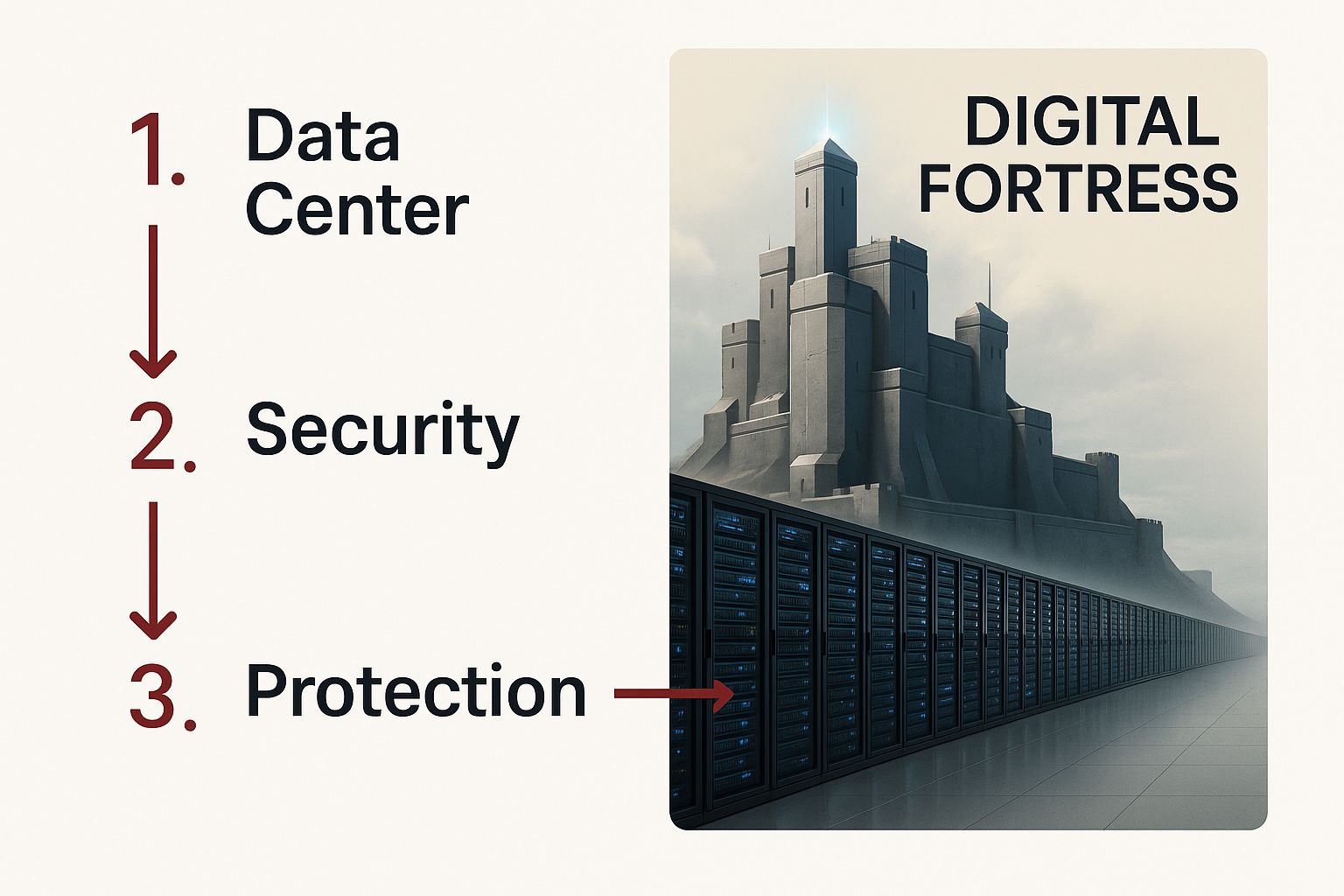
As you can see, it's about integrating multiple layers of protection to create a secure environment where your business can thrive, much like an architect would design a physical fortress.
Building a Security-First Culture
One of the biggest, and often most overlooked, benefits of bringing in a consultant is the cultural change they spark. They don’t just install some software and hand you a policy document. They educate, train, and empower your entire team.
They help nurture a "security-first" mindset, where every single employee understands their role in protecting the company. This happens through a few key actions:
- Targeted Training: Showing staff how to spot a phishing email a mile away, why strong passwords matter, and how to handle sensitive information properly.
- Clear Policies: Creating simple, easy-to-follow guidelines that eliminate confusion and set clear expectations for secure behaviour.
- Incident Response Drills: Running practice runs so that if a real incident happens, your team knows exactly what to do, which minimises panic and reduces the damage.
A consultant's true value lies not just in the systems they build, but in the security awareness they embed within your company's DNA. This cultural foundation is your most enduring defence against evolving cyber threats.
So, beyond just stopping attacks, what cyber security consulting really means for your business is creating a partnership focused on strengthening your defences while also improving operational efficiency through safer, smarter processes.
An Essential Investment for Growth and Resilience
Let's be realistic. For most Australian businesses, hiring a full-time, top-tier Chief Information Security Officer (CISO) just isn't in the budget. But the cost of a single data breach—from regulatory fines, a trashed reputation, and operational chaos—can be absolutely devastating.
This is where consulting shines. It bridges that gap perfectly. You get access to executive-level expertise on a fractional basis, giving you the strategic guidance you need to handle complex threats and regulations without the six-figure salary. By learning more about the role of a cyber security consultant, you'll quickly see how it delivers a clear return on investment.
At the end of the day, engaging a consultant is an investment in your company's future. It’s about building the resilience to weather any storm, the credibility to win over new clients, and the confidence to grow your business securely.
What a Cyber Security Consulting Engagement Actually Looks Like
Bringing in a cyber security consultant might feel like a leap into the unknown, but the reality is a structured, collaborative process. It's not about handing over the keys and hoping for the best. It’s a partnership with a clear path designed to lift your business from where it is now to a position of genuine digital resilience.
Think of it like building a custom home. You wouldn't just start laying bricks without a plan. You'd start with a deep conversation about your vision, draw up detailed blueprints, and then execute the build with an expert guiding the way. A cyber security consulting engagement follows the exact same logic.
Let's pull back the curtain on what really happens, stage by stage.
Phase 1: The Discovery Phase — Getting on the Same Page
The first step is all about you. A good consultant doesn’t walk in with a box of pre-made solutions; they walk in with good questions. This is a deep dive into your business, your goals, and what "secure" actually means for you.
They need to understand what your most critical digital assets are, what compliance pressures you're under, and your real-world appetite for risk. This initial alignment is the bedrock of the entire project. It makes sure the final security strategy is a business enabler, not a roadblock.
Phase 2: The Assessment Phase — Finding the Cracks in the Armour
With your goals locked in, it’s time for an honest look at your current security posture. This is the diagnostic stage. Consultants use their experience and specialised tools to find the vulnerabilities in your defences before a real attacker does.
And this goes far beyond just running a few automated scans. A proper assessment is a multi-pronged attack to uncover weaknesses that might otherwise fly under the radar.
- Penetration Testing: Think of this as hiring ethical hackers. They'll actively try to breach your systems to find exploitable holes in your network, apps, and infrastructure.
- Policy and Procedure Review: They'll dig into your existing security policies. Are they comprehensive? Are they up to date? And most importantly, is anyone actually following them?
- Vulnerability Scanning: Automated tools scan your entire digital footprint for known security flaws, unpatched software, and common misconfigurations that are an open invitation to attackers.
- Compliance Gap Analysis: Your current setup is benchmarked against specific standards like ISO 27001 to pinpoint exactly where you’re falling short of the mark.
This phase is the foundation for everything that follows. A critical part of this is a detailed analysis of potential threats, which you can learn more about in our guide to risk assessment for cyber security.
Phase 3: The Strategy Phase — Drawing Up the Blueprint
Now we get to the good part. Armed with a clear picture of your goals and your vulnerabilities, the consultant builds your strategic roadmap. This isn't some generic template; it’s a bespoke plan of action, designed from the ground up for your organisation.
The roadmap is all about prioritisation, tackling the biggest risks and business impacts first. It lays out what needs to be done, why it matters, and the most logical timeline for getting it done. This is the blueprint for your digital fortress.
The strategic roadmap is the single most important document you'll get from a consultant. It turns vague security ideas into a concrete, step-by-step plan that aligns your technology, people, and processes into a unified, resilient defence.
This plan deals with the immediate fires while also setting you up for long-term security maturity. It provides absolute clarity, ensuring every dollar you spend on security is working as hard as it possibly can.
Phase 4: The Implementation Phase — Making the Plan a Reality
A great strategy is worthless if it just sits on a shelf. The implementation phase is where the consultant rolls up their sleeves and works with your team to bring that roadmap to life. This is where the real work of hardening your defences happens.
It’s an incredibly collaborative stage where the consultant’s role shifts from analyst to project manager, mentor, and hands-on technical expert.
Here’s what that often looks like:
- Technology Deployment: Helping you choose, configure, and install the right security tools—things like next-gen firewalls, endpoint detection systems, or even a full SIEM platform.
- Policy Development: Writing clear, practical security policies and procedures that your team can actually understand and follow without a dictionary.
- Team Training: Running security awareness programs to teach your staff how to spot and report threats like phishing emails, effectively turning your people into a human firewall.
This hands-on support is what turns the blueprint into a functional, robust security framework that actually works in the real world.
Phase 5: The Monitoring Phase — Staying Strong for the Long Haul
Cyber security isn't a "set it and forget it" project. The threat landscape is always shifting, and your defences have to evolve with it. The final phase is all about continuous monitoring and improvement.
After the heavy lifting is done, a great consultant helps you build the processes to maintain your strong security posture over time. This usually involves setting up regular security reviews, ongoing vulnerability scanning, and making sure you have a plan for incident response.
This last stage ensures your investment keeps protecting you. By creating a cycle of assessment, improvement, and monitoring, the consultant helps you build a security program that is not only strong today but agile enough to handle whatever comes next.
How Consultants Streamline Your Path to ISO 27001 Certification
Trying to achieve ISO 27001 certification on your own can feel a bit like preparing to climb Mount Everest. You know getting to the top would be a monumental win for your business, but the path looks incredibly complex, demanding, and full of hidden dangers. Think of a cyber security consultant as your expert Sherpa—the guide who knows the terrain, makes sure you have the right gear, and helps you navigate the whole journey with confidence.
So, what exactly is this mountain we're climbing? At its heart, ISO 27001 is the world's most recognised standard for managing information security. It’s not a piece of software or a specific gadget; it's a framework. It's a set of best practices for building, running, and constantly improving an Information Security Management System (ISMS).
Your ISMS is like the central nervous system for your company's security. It ties together all your policies, procedures, technical defences, and risk management into one cohesive, organised whole. Proving you have a solid ISMS by getting certified is one of the most powerful ways to earn customer trust and land major contracts, especially with government agencies and big corporations who insist on it.
The Consultant as Your Certification Architect
Going it alone on the ISO 27001 journey is often a recipe for wasted time, spiralling costs, and a whole lot of frustration. The standard is notoriously detailed, and one wrong move can set you back months. A consultant turns this daunting compliance exercise into a manageable, streamlined project.
They bring years of hands-on experience and a proven game plan. They act as your project manager, technical advisor, and internal auditor all rolled into one. Their main job is to ensure you not only pass the final audit but also build a security system that adds real, lasting value to your organisation.
Kicking Off with a Gap Analysis
The very first thing a consultant will do is a thorough gap analysis. This is essentially the "you are here" map. It shows you exactly where your current security practices stand against the strict requirements of the ISO 27001 standard.
It's a completely objective, no-stone-unturned review of your existing controls, paperwork, and processes. The consultant will methodically pinpoint every single area where you fall short, giving you a clear, prioritised to-do list of what needs to be fixed, created, or improved.
This step is absolutely vital. It stops you from wasting energy on things that are already fine and focuses all your resources on closing the biggest gaps first.
Building Your Information Security Management System
Once the gaps are clear, the real work begins: building out your ISMS. A consultant guides you through this methodical process. This isn't just about writing a bunch of documents; it's about weaving security practices into the very fabric of how your business operates every day.
During this phase, you’ll tackle key activities like:
- Defining the Scope: You’ll pinpoint exactly which parts of your business the ISMS needs to cover. This is a crucial strategic decision that keeps the project from getting too big to handle.
- Developing a Risk Treatment Plan: This involves systematically identifying security risks, figuring out their potential impact, and then choosing the most effective controls to deal with them.
- Crafting Essential Policies: You'll create the core security policies that form the foundation of your ISMS, like your access control policy, data classification rules, and your incident response plan.
This is often the most intensive part of the project. It's where a consultant's expertise in turning the standard's dense requirements into practical, real-world controls really shines.
An experienced consultant doesn’t just hand you generic templates. They work with you to create a customised ISMS that fits your business like a glove, ensuring the controls are practical, effective, and sustainable long after the certificate is hanging on the wall.
Mastering the Art of Documentation
ISO 27001 certification is as much about proving your compliance as it is about being compliant. And that means documentation is king. Auditors need to see detailed, organised proof that your ISMS is not only designed well but is also running effectively.
This is where so many businesses get bogged down in a sea of paperwork. A consultant thrives here, helping you produce the clear, concise, and audit-ready documentation the standard demands.
Common Documentation a Consultant Helps Create:
- Statement of Applicability (SoA)
- Information Security Policy
- Risk Assessment and Treatment Methodology
- Internal Audit Reports
- Management Review Meeting Minutes
They make sure every document is correctly formatted, properly cross-referenced, and ready for an auditor's intense scrutiny. This alone lifts a massive administrative burden from your team.
Preparing Your Team for the Final Audit
The final stage is the certification audit itself, which is carried out by an external, accredited organisation. Walking into this unprepared is a huge gamble. A consultant makes sure your team isn't just ready, but genuinely confident. If you're serious about getting it right the first time, exploring dedicated ISO 27001 consulting services can provide the focused expertise you need to nail the audit.
The preparation typically involves:
- Conducting Internal Audits: The consultant runs a full "dress rehearsal" audit, simulating the real thing to find and fix any last-minute issues or weak spots.
- Training Your Staff: They'll coach key people on how to answer an auditor’s questions clearly, ensuring they can speak knowledgeably about their security roles.
- Organising the Evidence: They help you gather and arrange all the necessary evidence, making the auditor's job easier and creating a professional, organised impression right from the start.
This careful preparation takes the guesswork out of the audit and dramatically boosts your chances of passing on the first try. By partnering with a cyber security consulting expert, you transform the intimidating ISO 27001 climb into a strategic, well-guided ascent—delivering a huge return through new business opportunities and rock-solid customer trust.
Why Smart Australian SMEs are Investing in Cyber Security
If you're running a small or medium-sized enterprise (SME) in Australia, you know every dollar counts. Each decision gets weighed against the bottom line, and new expenses are rightly scrutinised. That’s exactly why it’s so important to see cyber security consulting not as a cost, but as a powerful strategic investment in your company's future.
It’s a common misconception that cyber criminals only go after the big fish. The truth is, they love targeting SMEs, viewing them as softer targets with fewer defences. The fallout from a single breach—from devastating financial losses to a permanently damaged reputation—can be enough to sink a smaller business.
This is where a consultant completely changes the game. They don’t just add a line item to your budget; they add a critical layer of resilience and unlock new opportunities across your entire operation.
Gaining C-Suite Expertise Without the C-Suite Salary
Let’s be realistic: hiring a full-time Chief Information Security Officer (CISO) is out of reach for most SMEs. These top-tier security executives command six-figure salaries, and that’s a cost most growing businesses simply can’t justify.
This creates a dangerous expertise gap. You're facing complex security threats but don't have the senior strategic leadership in-house to navigate them effectively.
A cyber security consultant is the perfect solution. Think of them as your fractional CISO, giving you access to enterprise-grade knowledge and real-world experience whenever you need it. You get the high-level strategic guidance to manage threats and compliance without the hefty price tag of a full-time executive.
Turning Compliance into a Competitive Edge
For many business owners, compliance standards like ISO 27001 can feel like a chore—a complex and expensive box-ticking exercise. A good consultant helps you flip that script and turn it into a powerful market advantage.
Achieving a globally recognised certification isn't just about playing defence; it's about going on the offence. It’s a clear signal to the market that you take security seriously, which instantly builds trust with new and existing clients.
A consultant can help you transform compliance from a mandatory headache into a powerful sales tool. When you can prove your security is world-class, you suddenly unlock opportunities with larger corporate clients and government bodies that were previously out of reach.
This shift in perspective is everything. Instead of just meeting a minimum requirement, you're actively building a reputation for excellence that makes you stand out from the competition.
Preventing Financial and Reputational Ruin
The cost of a data breach goes far beyond the initial IT clean-up. The ripple effects can be crippling:
- Regulatory Fines: Hefty penalties for not complying with data protection laws.
- Customer Churn: A catastrophic loss of trust that can take years to rebuild, if ever.
- Operational Downtime: Days or even weeks of lost revenue and productivity while your systems are offline.
- Legal Fees: The staggering cost of managing the legal fallout from a security incident.
A consultant’s primary job is proactive prevention. They find and fix your vulnerabilities before they can be exploited by criminals, effectively insuring your business against these disastrous outcomes. The investment in their expertise is a tiny fraction of the cost of a single serious breach. This proactive stance is more important than ever as Australia's cyber security market, valued at AUD 9.18 billion, is projected to hit AUD 32 billion by 2034. You can dig into the full Australian cyber security market research to see just how fast it's growing.
A Real-World Example: An Australian SME's Big Win
An ambitious Melbourne-based logistics SME was trying to land a game-changing contract with a major national retailer. The retailer loved their services, but they hit a roadblock: the SME's security measures were undocumented and unproven.
Before Consulting:
- Security was handled reactively by a small, overworked IT team.
- Their security policies were informal and inconsistent at best.
- They had no way to formally prove they could protect the retailer's data.
- The contract, and their chance to level up, was about to be lost to a bigger competitor.
Recognising what was at stake, the SME’s leadership brought in a cyber security consulting firm. The consultant ran a full assessment, pinpointed the critical gaps, and laid out a practical roadmap to get them where they needed to be. They helped build a formal Information Security Management System (ISMS) and guided the team through the entire certification prep process.
After Consulting:
- Implemented Robust Controls: The SME rolled out new security measures, from multi-factor authentication to endpoint protection.
- Developed Formal Policies: Clear, actionable security policies were created and embedded across the company.
- Achieved Certification Readiness: The consultant got them ready for their ISO 27001 audit, giving them the formal proof of security the retailer demanded.
The result? The SME went back to the retailer with a new-found confidence, presenting their fortified security posture backed by the consultant's detailed report. This professionalism and proven commitment to security sealed the deal. They won the contract, which paid for the entire consulting engagement many times over in its first year alone.
This story is the perfect example of how smart security consulting isn't an expense—it's a direct driver of business growth. It prevents disaster while unlocking revenue opportunities you couldn't access otherwise.
Finding the Right Cyber Security Consulting Partner
Choosing a cyber security consultant is one of the most important decisions you’ll make for your business. This isn't just about hiring a contractor; you’re bringing on a long-term partner who will become a core part of your defences. The right choice can turbocharge your growth and build rock-solid trust with clients. The wrong one? That leads to wasted money and, worse, a false sense of security.
Getting this right isn't about luck. It requires a thoughtful, structured approach that goes way beyond a slick website or a confident sales pitch. You need to dig into their real-world experience, challenge their methods, and make sure their culture is a good fit for yours. This guide will give you the tools and the tough questions you need to find a true partner who will genuinely strengthen your security posture.
Your Evaluation Checklist
Industry Expertise and Certifications
Let's be clear: not all cyber security consulting is the same. The threats facing a financial services firm in Sydney are worlds away from those targeting an e-commerce startup in Brisbane. Your very first step is to find partners who have direct, hands-on experience in your specific industry. They'll already get your unique regulatory headaches, common attack methods, and the day-to-day realities of your operations.
Beyond industry experience, professional certifications are a crucial benchmark. They show a consultant's personal commitment to their craft. While a long list of acronyms doesn't tell the whole story, a few key credentials are non-negotiable signs of a high standard of knowledge.
Look for consultants holding respected certifications like:
- CISSP (Certified Information Systems Security Professional): This is the global gold standard. It confirms an individual has deep technical skills and the management competence to lead.
- CISM (Certified Information Security Manager): This one zeroes in on the management side of things—governance, risk management, and building security programs that actually work.
- ISO 27001 Lead Auditor/Implementer: If certification is your goal, it’s a no-brainer. Your consultant absolutely must have formal qualifications in the very standard they're guiding you on.
These credentials prove a consultant has put in the hard yards to master their field and is serious about staying on top of their game.
Probing Questions to Separate Contenders from Pretenders
Once you’ve got a shortlist, the interview is where you can really separate the true experts from the smooth-talking salespeople. Your goal here is to push past generic answers and get a real feel for how they think on their feet and operate under pressure. Standard interview questions just won't cut it.
You need to hit them with pointed, scenario-based questions that force them to show you, not just tell you, their approach.
A great consultant welcomes tough questions. They don't see it as a threat; they see it as a chance to show off their expertise and prove how their strategic thinking fits with your business goals.
Get ready to ask direct questions. Listen carefully not just to what they say, but how they say it. A confident, clear, and business-focused answer is a very good sign.
Here are a few essential questions to have ready:
- "Walk me through how you'd manage an active security breach at our company, starting from the moment we call you." This tests their real-world incident response chops. Listen for key steps like containment, eradication, recovery, and a post-incident review.
- "Can you share an anonymised example of a security roadmap you built for a company similar to ours in size and industry?" This gets you past theory and into tangible proof. It lets you see if their strategic plans are practical and well-thought-out.
- "How do you measure success and show us a return on our investment?" A top-tier consultant will talk about business outcomes—like reduced risk, passing an audit with flying colours, or landing a new client—not just technical jargon.
- "What’s your communication and reporting style? How often will we hear from you, and what will your reports look like?" This is all about setting expectations for the partnership. You want someone who provides clear, jargon-free updates, not a ghost who disappears for weeks.
Their answers to these will tell you far more than any glossy marketing brochure ever could.
Warning Signs: Common Red Flags to Watch Out For
Just as important as knowing what to look for is knowing what to run from. Certain red flags can signal a consultant who is inexperienced, inflexible, or just more interested in their invoice than your security. Spotting these early can save you a world of pain.
Be wary of any firm that shows these warning signs:
- The "One-Size-Fits-All" Package: Every business is different, so your security strategy should be too. If a consultant tries to shoehorn you into a generic package without deeply understanding your specific needs, head for the door.
- A Lack of Focus on Your Business Goals: If the conversation is all about scary threats and complex tech but never ties back to your actual business objectives, that’s a huge red flag. Great security is an enabler for the business; it doesn't exist in a bubble.
- Guarantees of "100% Security": In cyber security, there are no guarantees. Anyone who promises to make you "unhackable" is either dishonest or naive. The goal is resilience, not a mythical state of invincibility.
- Poor Communication from the Get-Go: If they're slow to respond, vague in their answers, or hide behind overly technical language during the sales process, just imagine what it will be like once you've signed on the dotted line. A true partner values clear, consistent communication from day one.
Choosing your cyber security consulting partner is a decision that will echo through your business for years. By taking a structured approach, asking the tough questions, and keeping an eye out for red flags, you can confidently find a partner who will not only protect your assets but also help you thrive.
Real-World Examples from Aussie Businesses
To see the genuine value a cyber security consultant brings to the table, let's look at how it plays out in the real world. These anonymised stories from Australian businesses show how the right partnership can solve critical headaches and open up new avenues for growth.
These examples bring the benefits of consulting to life, moving beyond abstract ideas to show concrete business wins. They prove that smart security isn't just a cost centre—it's a proactive asset.
Case Study One: Fortifying a Sydney E-commerce Innovator
A fast-growing online store based in Sydney was seeing a scary spike in fraudulent transactions. Their payment system just couldn't keep up with the increasingly clever fraud tactics, and the resulting chargebacks were seriously chewing into their profits. Even worse, they could feel customer trust starting to slip.
The Business Problem:
The company was fighting a battle on two fronts. They desperately needed to stop the financial bleeding from chargebacks, but they also had to show customers their payment details were safe. Their in-house team was talented, but they simply didn't have the specialised skills to fight off these advanced attacks.
The Consulting Solution:
They brought in a cyber security consultant who lived and breathed e-commerce and Payment Card Industry (PCI) compliance. The consultant’s plan was methodical, focusing on getting quick, impactful wins.
- A Deep Dive Analysis: First, the consultant mapped out the entire payment process, from the moment a customer hits 'buy' to the final settlement. This uncovered the weak spots and vulnerabilities the fraudsters were exploiting.
- A Technology Overhaul: With a clear picture of the problem, the consultant recommended a new, more advanced payment gateway. It used AI-driven fraud detection that was miles ahead of their old system, and they helped get it implemented smoothly.
- Process Refinement: Technology alone isn't enough. The consultant worked with the store's team to tighten up their internal processes for reviewing suspicious orders, adding a sharp human eye to back up the new tech.
The Tangible Outcomes:
The results came through fast. Within just three months, the business saw a 65% drop in successful fraudulent transactions. This immediately slashed the number of chargebacks, saving them thousands of dollars every month. You could see the confidence return in their customers, too, with conversion rates and positive feedback on the rise.
This story highlights a core benefit of consulting: applying specialised knowledge to a specific, painful problem. The consultant didn't just hand over a generic report; they delivered a targeted fix with a clear, measurable financial payoff.
Case Study Two: Unlocking Big Clients with ISO 27001
A mid-sized financial services firm in Melbourne had huge growth ambitions. They were consistently making the shortlist for massive contracts with enterprise clients, only to hit the same wall every time. The big players all required their key vendors to be ISO 27001 certified—a standard the firm hadn't met.
The leadership team knew getting certified was the key to their next chapter, but the whole process looked incredibly complicated and time-consuming. It felt like too much for their internal team to handle alone.
The Business Problem:
Plain and simple, their lack of ISO 27001 certification was a dead end. They were losing out on game-changing revenue because they couldn't tick the one box enterprise clients cared about most.
The Consulting Solution:
Partnering with a cyber security consulting firm that specialised in ISO 27001 was the turning point. The consultant became their project manager and expert guide, walking them through every single step of the journey.
- Gap Analysis and Roadmap: The project kicked off with a detailed gap analysis. This gave them a clear, prioritised roadmap of everything they needed to do to meet the standard. No guesswork, just a straightforward plan.
- Building the ISMS: The consultant worked side-by-side with the firm’s IT and management teams to build a practical Information Security Management System (ISMS) from scratch.
- Audit Preparation: They ran internal pre-audits and coached the team, making sure everyone was ready and confident for the official certification audit.
This kind of focused guidance is becoming more vital as businesses invest heavily in their security posture. The Asia Pacific cybersecurity consulting market is on track to hit over USD 3.6 billion, with Australia’s mature economy playing a huge part. You can get a better sense of these market trends and projections to see just how serious this commitment is.
The Tangible Outcomes:
With the consultant's guidance, the firm sailed through and achieved ISO 27001 certification on their first try. The impact was immediate. They went straight back to the enterprise clients they'd lost out on before, and within six months, they’d landed two of the major contracts that were previously out of reach. The certification became their single most powerful selling point, proving that an investment in security is a direct investment in growth.
Your Top Questions About Cyber Security Consulting, Answered
Thinking about bringing in a cyber security consultant? It’s only natural to have a few questions about how it all works, especially when it comes to cost, timing, and whether it’s even necessary for a smaller business. Let's clear up some of the most common queries we hear from business owners.
How Much Does Cyber Security Consulting Cost in Australia?
The honest answer? It varies. A consultant’s fee is tied directly to the size of your business and what you need to achieve. A one-off project, like a specific risk assessment for a small local business, might only cost a few thousand dollars. On the other hand, getting your business ready for a full-blown ISO 27001 certification is a much deeper engagement and a more significant investment.
Good consultants don't just pull a number out of a hat. They’ll want to talk to you first, understand your operations and your goals, and then provide a tailored quote. It’s important to frame this cost as an investment. When you weigh it against the potential fallout from a single data breach—think regulatory fines, customer churn, and a trashed reputation—the consulting fee suddenly looks a lot more manageable.
Is Consulting Really Necessary for a Very Small Business?
Yes, absolutely. In many ways, it’s even more important for small businesses. Cybercriminals love targeting smaller companies precisely because they often lack dedicated security teams or robust defences. You're not "too small to be a target"; you're often seen as the perfect target.
A consultant essentially becomes your part-time security expert. They bring a wealth of experience and apply it to your specific situation, helping you focus on the biggest risks first. This means you get maximum protection for your budget, without having to hire a full-time CISO or get bogged down in technical details you don't have time for.
What's the Difference Between an MSP and a Security Consultant?
This is a great question, and it’s a common point of confusion. Think of it this way: your Managed Service Provider (MSP) is focused on keeping the lights on. They manage your day-to-day IT—making sure servers are running, software is patched, and your team can log in every morning. Their job is operational.
A cyber security consulting expert, however, is all about strategy and risk.
- Your MSP manages the technology that runs your business.
- A consultant strategises on how to protect that technology from attackers.
The best consultants don't replace your MSP; they work alongside them. The consultant develops the security roadmap, and the MSP helps implement it on the ground, ensuring everyone is pulling in the same direction.
An easy analogy is to think of your business as a ship. Your MSP is the engine room crew, keeping everything running smoothly. The security consultant is the navigator, charting a course to avoid pirates and storms.
How Long Does a Typical Consulting Engagement Last?
There’s no one-size-fits-all answer here, because every engagement is tailored to the business's unique goals.
A quick, focused project like a vulnerability scan or a penetration test might be wrapped up in a couple of weeks. But a more comprehensive overhaul, such as building a security program from the ground up or guiding you through the entire ISO 27001 certification process, could take several months. Many businesses also keep a consultant on a retainer for ongoing advice, helping them stay ahead of new threats as they pop up.
Ready to build a resilient security posture and unlock new growth opportunities? At Anitech, we specialise in guiding Australian small businesses through the complexities of ISO 27001 certification with a 100% success rate. Secure your business's future today.
Recent Comments