

Quick Summary: Discover the best cyber security courses Australia offers, from TAFE certificates and university degrees to essential industry certifications like CISSP and CISM. This guide helps individuals and businesses navigate training pathways, build skilled teams, and align education with critical compliance goals like ISO 27001 certification.
Let's cut to the chase: Australia has a huge range of cyber security courses out there. You’ve got everything from hands-on TAFE certificates and deep-dive university degrees to the big-ticket industry certifications like CISSP. Finding the right one really boils down to your career goals, and with so many online options, you can train pretty much however you like. Think of this guide as your map to navigating it all and building a rock-solid cyber defence.
The demand for people who genuinely know their stuff in cyber security has absolutely exploded in Australia. This isn't just a golden opportunity for anyone looking to build a career; it's a massive wake-up call for businesses to get their teams skilled up, and fast. This guide is for the IT managers, business owners, and aspiring pros trying to make sense of the cyber education maze. We’ll show you how the right training is about more than just technical tricks—it's about building a security-first mindset across your entire organisation.
Crucially, we'll connect the dots between learning and real-world business goals, like getting your organisation ready for an ISO 27001 certification. After all, a properly trained team is the backbone of any effective information security management system.
Understanding The Australian Cyber Threat Environment
The whole conversation around cyber security courses in Australia has changed. It's no longer a niche IT problem tucked away in a server room; it’s a critical strategic issue being discussed in the boardroom. The massive data breaches at household names like Optus and Medibank dragged the reality of digital threats out into the open for millions of Australians. Those incidents didn't just highlight technical vulnerabilities; they exposed a serious national skills shortage.
This new level of awareness has forced the government's hand. With the Cyber Security Act of 2024, larger organisations now have to report ransomware payments, ushering in a new era of accountability. This law is designed to give us a much clearer, more honest picture of the threat landscape, which has always been murky thanks to patchy, self-reported data.
Why This Matters for Your Business
If you're a business owner or IT manager, this shift in the regulatory climate really raises the stakes. Just reacting to threats as they pop up isn't going to cut it anymore. You need a proactive defence, and that starts with having people who are properly skilled and aware. The right training does more than just show someone how to block an attack; it gives your whole team the knowledge to build a stronger security posture from the ground up.
Investing in your people's education is a direct investment in reducing risk. Cybercrime is big business now, with ransomware-as-a-service models making it easy for criminals to target companies of all sizes. Keep these realities in mind:
- Growing Sophistication: The tools attackers are using are getting more powerful every day, making last year's security measures feel ancient.
- Regulatory Pressure: Failing to comply with the new laws can lead to some seriously hefty fines.
- Operational Resilience: When—not if—an incident happens, a well-trained team can get you back on your feet faster, saving you a fortune in downtime and lost revenue.
A proactive security culture, built through ongoing training, is your single most powerful defence. It turns your staff from a potential weak link into your first line of protection—people who can spot and stop threats before they cause real damage.
Ultimately, navigating the world of cyber security courses in Australia is all about building genuine capability. It’s about giving your team the practical skills they need to guard sensitive data, keep the lights on, and meet tough compliance standards like ISO 27001. That's exactly what this guide will help you do.
Your Guide to Cyber Security Education Pathways in Australia
Choosing the right cyber security training is a bit like building a high-tech fortress. You wouldn't start without a plan, and you certainly wouldn't use the same tools for every job. You need a solid foundation, a strategic blueprint, and specialised gear for specific threats. In Australia, the educational path you choose is all about picking the right materials to build a truly resilient defence.
And this decision has never been more critical. The Australian cyber security training market is booming, which tells you one thing: the demand for skilled professionals is through the roof. In 2023, the market was valued at a whopping USD 87.9 million and is expected to rocket to USD 308.2 million by 2030. This isn't just a trend; it's a direct response to the increasingly sophisticated cyber attacks hitting Australian businesses every day.
Think of cyber security education as a pyramid. It starts with skilled individuals, who then form capable teams, which in turn protect the entire business.

Ultimately, achieving robust, business-wide security—like getting ready for ISO 27001—all starts with having well-trained people on the ground.
To help you map out the best route, here’s a quick comparison of the main training pathways available.
Comparing Cyber Security Training Pathways in Australia
| Pathway Type | Typical Duration | Focus Area | Best For |
|---|---|---|---|
| TAFE Courses | 6 months – 2 years | Hands-on, practical skills for specific job roles | Individuals seeking entry-level positions or businesses needing to upskill IT staff quickly. |
| University Degrees | 3 – 4 years (Bachelor) | In-depth theory, strategic thinking, research | Aspiring senior leaders, security architects, and those wanting a deep theoretical grounding. |
| Bootcamps | 3 – 6 months | Intense, fast-paced technical skill development | Career changers or professionals needing to rapidly acquire job-ready technical skills. |
| Certifications | Days to months | Validating specific, industry-recognised expertise | Professionals wanting to specialise, prove competency, or meet job/compliance requirements. |
Each of these pathways serves a different purpose, so let's dig into what makes each one unique.
TAFE Courses: The Practical Foundation
TAFE courses are the bedrock of cyber security skills in Australia. Think of them as the concrete foundation of your fortress—they’re strong, practical, and absolutely essential for everything else you build on top.
These programs are all about hands-on, job-ready skills. You’ll find Certificates and Diplomas covering the core essentials like network security, the basics of ethical hacking, and incident response. They’re perfect for someone trying to land their first role in the industry or for businesses that need to get their IT staff up to speed on defence without the time commitment of a full degree.
University Degrees: The Strategic Blueprints
If TAFE lays the foundation, a university degree provides the detailed architectural blueprints for your entire security structure. A Bachelor's or Master's in Cyber Security digs deeper, moving beyond how things work to explore why they work.
These programs are where you get into the heavy stuff: advanced security principles, cryptography, and the strategic management of information security. They’re designed to create the critical thinkers and future leaders who can design and lead complex security programs.
This is the path for anyone with their sights set on senior roles like a Security Architect or Chief Information Security Officer (CISO). For a business, having team members with degrees brings a strategic depth that’s vital for long-term planning and building a robust Information Security Management System (ISMS). For those considering this academic route, an Access to Higher Education Diploma Computer Science can provide a fantastic entry point.
Professional Certifications: The Specialised Tools
Professional certifications are the specialised tools in your security toolkit. They are the industry's stamp of approval, proving you have expertise in a specific area, and are often a non-negotiable for certain roles.
These certifications provide highly focused knowledge for distinct functions. For example:
- CompTIA Security+: This is a fantastic starting point that confirms you have the baseline skills needed for pretty much any cyber security role.
- CISSP (Certified Information Systems Security Professional): A globally-recognised gold standard for experienced security managers and practitioners.
- CISM (Certified Information Security Manager): This one zeroes in on managing an organisation's entire information security program.
Certifications aren't just for individual career goals; they're incredibly valuable for businesses. Having certified staff shows a serious commitment to security and is often a key requirement for winning contracts or meeting regulatory demands, including achieving ISO 27001 certification.
Must-Have Certifications For Career And Business Growth
While courses give you knowledge, certifications are what prove you can apply it. Think of them as the universal language of cyber security expertise—the industry's stamp of approval that tells employers and clients you’ve met a specific, recognised standard.
For anyone serious about climbing the career ladder, or for any business wanting to build a genuinely resilient team, getting the right credentials isn't just a good idea. It's essential.
Let's break down the most respected and valuable certifications in the Australian market. We'll start with the ones that get your foot in the door and move up to the big-hitters needed for leadership and strategic roles. Understanding how these fit together is the key to mapping out a smart training path.
Foundational Certifications To Kickstart Your Career
Every expert has to start somewhere. In cyber security, that starting line is almost always a foundational certification. These qualifications confirm you’ve got a solid grasp of the core principles, making them perfect for newcomers or for IT pros looking to pivot into a security-focused role.
For businesses, getting your junior IT staff certified is a brilliant first move. It gives them the right vocabulary and a framework for spotting and flagging potential threats, which is the first step toward building a security-first culture.
- CompTIA Security+: This is probably the most recognised entry-level certification on the planet. It covers the essential skills you need in network security, compliance, threat management, and cryptography. Someone with a Security+ is ready to handle core security tasks and move on to more specialised training.
- (ISC)² SSCP (Systems Security Certified Practitioner): The SSCP is built for the hands-on practitioner—the person who actually monitors, manages, and implements IT infrastructure according to security policies. It validates the technical skills needed for day-to-day operational security, making it a great fit for network or systems administrators.
Think of these certifications like a driver's licence for the cyber security world. They don't make you a race car driver overnight, but they prove you know the rules of the road and can operate your vehicle safely. It's the solid foundation you build everything else on.
Advanced Certifications For Leadership And Strategy
Once you've nailed the fundamentals, it's time to specialise and start thinking more strategically. Advanced certifications are for seasoned professionals ready to design, manage, and govern an organisation’s entire security posture. These aren't just about technical know-how; they test your deep understanding of policy, risk management, and security architecture.
For Australian businesses, especially those working towards compliance with standards like ISO 27001, having people with these credentials is a massive advantage. It brings the expertise in-house to lead complex security programs and make those critical, risk-based decisions.
CISSP Certified Information Systems Security Professional
The CISSP is often called the gold standard of cyber security, and for good reason. It’s a beast of a certification, covering eight crucial domains like Security and Risk Management, Asset Security, and Security Operations. It’s designed for experienced practitioners, managers, and executives—the people tasked with building and running a company's entire security program.
Earning your CISSP shows you don't just understand the tech; you understand how security fits into the bigger business picture. It tells an employer you have what it takes to design, engineer, and manage a complete security solution from the ground up.
CISM Certified Information Security Manager
While the CISSP is broad, the CISM is laser-focused on one thing: management. Offered by ISACA, this certification is for the professionals who manage, design, oversee, and assess an enterprise's information security.
It’s built on four key areas:
- Information Security Governance
- Information Security Risk Management
- Information Security Program Development and Management
- Information Security Incident Management
If your sights are set on becoming a Chief Information Security Officer (CISO) or a senior security manager, the CISM is a must-have. For businesses, a CISM on the team is invaluable for aligning security work with business goals. This expertise is also vital for anyone stepping into a cyber security analyst role, where understanding risk is every bit as important as the technical side of things.
Certifications For ISO 27001 Readiness
For any organisation on the path to ISO 27001 certification, specific training isn't just helpful—it's practically mandatory. Having team members who are certified in ISO 27001 standards is direct proof that you’re serious about building and maintaining a proper Information Security Management System (ISMS).
These courses give your team an insider's understanding of the framework.
- ISO 27001 Lead Implementer: This certification gives a professional the skills to guide an organisation through the entire process of implementing an ISMS that meets the ISO 27001 standard. They become your internal project lead.
- ISO 27001 Lead Auditor: This one is for the people who will be responsible for auditing the ISMS, either internally or externally. It teaches them how to assess if the system truly meets the standard's requirements, which is a critical part of keeping your certification active.
Investing in these cyber security courses in Australia delivers a clear return. It smooths out your compliance journey, cuts down on what you’d spend on external consultants, and helps you build a lasting security culture from within.
How To Build Your Internal Cyber Defence Team
Your strongest line of defence against cyber threats isn't a firewall or a fancy piece of software—it's your people. For any business owner or manager, building this internal capability is easily the smartest security investment you can make. The real goal is to turn your employees from a potential weak link into your most powerful security asset.
This isn't about a one-off seminar. It's a structured, progressive training plan. It starts with getting everyone on the same page with a baseline of security awareness, then moves into specialised technical skills for your IT crew, and finally, develops strategic security leadership at the top.

Tackling The Critical Skills Gap
Why is building from within so important right now? It comes down to simple maths. Australia is staring down the barrel of a cyber security workforce shortage of 3,000 professionals by 2026. This isn't a small problem; it's a major hurdle for both government and private businesses, made worse by a drop in university ICT enrolments. The Australian Government's digital workforce plan lays out the full scale of the challenge.
This skills gap means you can't just throw money at recruiters and hope for the best. Growing your own talent is not only more sustainable but often far more effective in the long run.
A Three-Tiered Training Model
A solid internal defence program needs a clear plan. It’s all about giving the right training to the right people, at the right time.
- Foundational Security Awareness (For Everyone): This is non-negotiable. Every single person, from the CEO down to the summer intern, needs to understand the fundamentals—how to spot a phishing email, why strong passwords matter, and the basics of handling sensitive data. This needs to be regular and engaging to stick.
- Technical Upskilling (For IT and Tech Staff): Your IT team needs to go deeper. This is where you bring in specific cyber security courses in Australia that focus on the nitty-gritty of network defence, threat hunting, incident response, and locking down your systems.
- Strategic Leadership Training (For Managers and Executives): Your leaders need to see security as a business risk, not just an IT problem. This level of training is all about governance, compliance frameworks like ISO 27001, and how to make smart security investments that align with your company's goals.
The ultimate aim is to create 'Cyber Security Champions' inside your organisation. These are the people at every level who don't just follow the rules but actively encourage a security-first mindset. They are absolutely essential for maintaining something like an ISO 27001 certified Information Security Management System (ISMS).
Choosing The Right Delivery Model
Once you know what you need to teach, you have to decide how. The best method really depends on your team's schedule, location, and how they learn best.
- Online Training: This offers fantastic flexibility and is usually the most budget-friendly option. It’s perfect for rolling out foundational awareness training and letting people learn at their own pace.
- In-Person Workshops: Nothing beats a hands-on workshop for intensive technical skills. The ability to ask questions, collaborate, and solve complex problems in real-time is invaluable.
- Blended Learning: This hybrid model gives you the best of both worlds. It combines self-paced online modules for the theory with practical, in-person sessions to put that knowledge into practice.
This kind of structured approach to growing your own talent is a powerful strategy. For a more detailed look at putting a program together, check out our comprehensive guide to cybersecurity training for employees.
By investing in a multi-layered training program, you're not just ticking a box. You’re empowering your team to become a truly formidable defence, building a resilient security culture from the ground up, and creating the in-house expertise you need to manage your security posture and maintain critical certifications like ISO 27001 with confidence.
Getting Your Training in Lockstep With ISO 27001 Goals
If you're aiming for ISO 27001 certification, let's be clear: training isn't just a box-ticking exercise. It's the absolute foundation of your success. This standard is built as much on people and process as it is on technology. Getting certified really boils down to proving your team has the know-how to run, manage, and continuously improve your Information Security Management System (ISMS).
This is where a smart investment in the right cyber security courses Australia offers can make all the difference. It closes the gap between where your team is now and what the rigorous ISO 27001 framework demands. Suddenly, compliance feels less like a mountain to climb and more like a well-planned project.
Matching Skills to ISO 27001 Controls
Think of the ISO 27001 standard as a skills checklist for your organisation. To pass the audit, you need to show you have people who are genuinely competent in a few key areas. Your training plan should be a direct response to this, building the internal expertise you need to satisfy the auditors.
Here’s a breakdown of the core skills the standard demands and the kind of training that gets you there:
- ISMS Implementation and Management: This is the big picture—designing and running the whole security program. An ISO 27001 Lead Implementer course is tailor-made for this, giving a key team member the skills to steer the entire certification journey.
- Risk Assessment and Treatment: Identifying and dealing with information security risks is the heart and soul of ISO 27001. You’ll need training that focuses on risk management methods for the people in charge of these critical assessments.
- Internal Auditing: You can't just set up your ISMS and forget it. You have to audit it regularly to make sure it's working. An ISO 27001 Lead Auditor course teaches your team how to perform these internal checks, spot problems, and keep improving.
- Incident Response: When something goes wrong, you need a solid plan and a skilled team to handle it. Training here should cover everything from spotting an incident to containing it and recovering afterwards, ensuring you can respond quickly and properly.
- Technical Control Implementation: This gets into the nitty-gritty of access control, network security, data encryption, and more. Specialised technical courses give your IT staff the practical skills to implement and manage the controls defined in your ISMS.
Your Checklist for Choosing the Right Course
When you’re looking at training providers, you have to be sure their program directly supports your certification goals. Don't get drawn in by vague course descriptions. Use this checklist to dig deeper and make sure you're getting real value for your ISO 27001 project.
- Does It Cover the Full ISMS Lifecycle? The course absolutely must teach the Plan-Do-Check-Act (PDCA) cycle. It's the engine that drives ISO 27001.
- Is Risk Management a Central Focus? Look for specific modules on risk assessment frameworks and how to develop a risk treatment plan. It can't be an afterthought.
- Does It Get Practical with Annex A Controls? The training needs to offer real, practical advice on putting the security controls listed in Annex A of the standard into practice.
- Is There a Strong Emphasis on Documentation? A massive part of ISO 27001 is creating and keeping records, policies, and procedures. The course must cover these documentation requirements thoroughly.
For ISO 27001, effective cyber security training must also embed disciplined data management practices, often guided by established standards like NIST SP 800-88 for data sanitization. This ensures your team knows precisely how to handle data securely from creation to destruction, a crucial piece of any robust ISMS.
By investing in the right training, you take the mystery out of the certification process. You give your team the confidence and the skills to build and maintain a compliant ISMS, which ultimately creates a much smoother, more successful path to achieving—and keeping—your ISO 27001 certification.
Putting Theory Into Practice With Hands-On Training
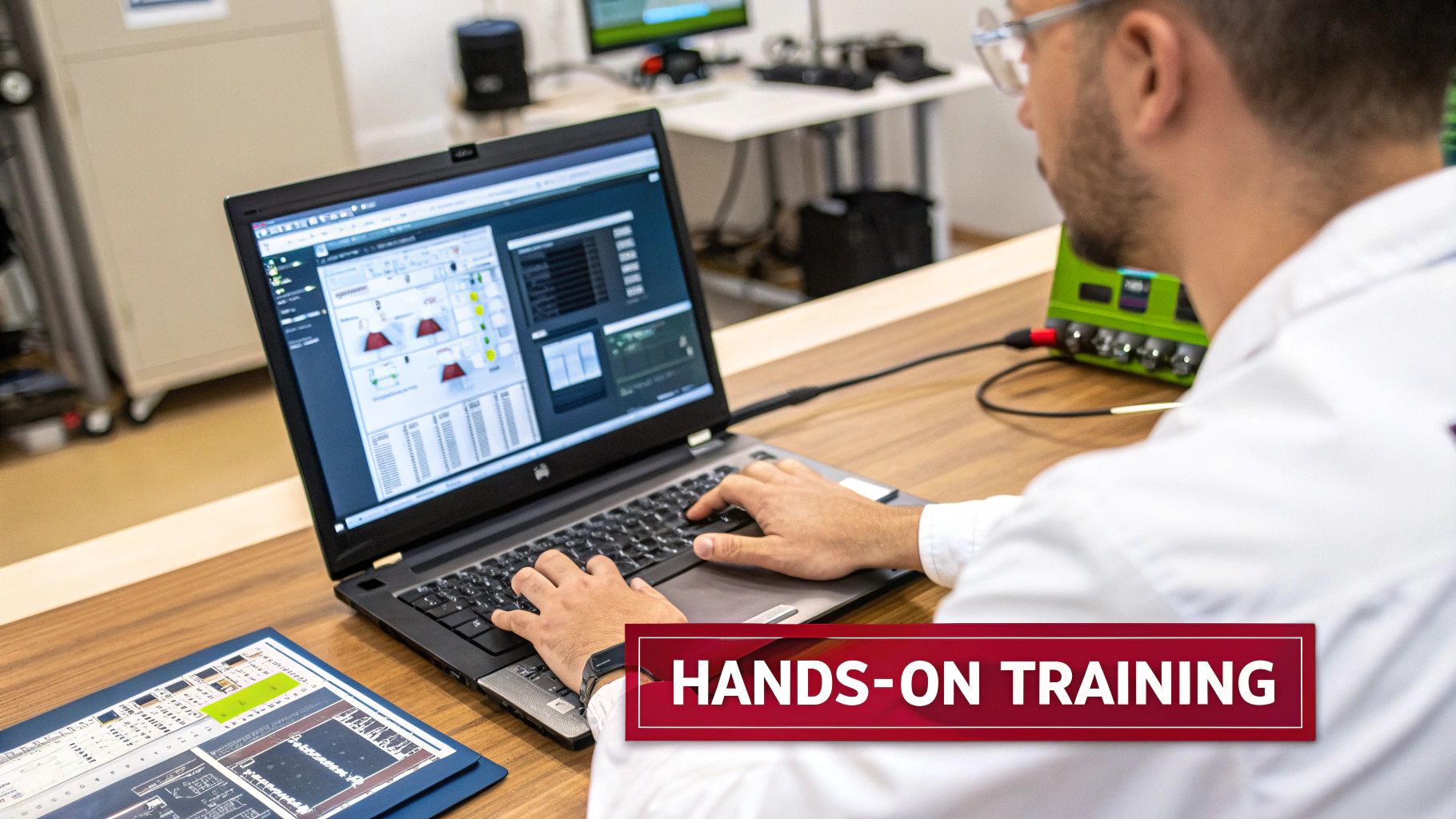
Knowing what to do during a cyber attack is one thing. Actually being able to do it under immense pressure is something else entirely. This is where theory hits a wall, and true operational readiness begins. That's why immersive, hands-on training formats like bootcamps and workshops are so vital for building a team that can react effectively when a real threat emerges.
Think of this style of training as a flight simulator, but for your cyber security professionals. It goes far beyond textbooks and lectures, dropping your team into realistic, high-stakes simulations where they can practise defending against attacks in a completely controlled and safe environment.
Building Battle-Ready Skills
In these intensive training settings, participants don't just learn about security tools—they actively use them to fight off simulated attacks, hunt for digital intruders, and conduct forensic analysis. You can't put a price on that kind of muscle memory. For business leaders, this practical experience is a direct investment in your company's resilience, ensuring your team can protect your systems and maintain your ISO 27001 certification when it truly counts.
Leading providers offer these highly practical cyber security courses in Australia, giving professionals the chance to sharpen their skills. For example, events like SANS Secure Australia 2026 in Canberra really spotlight this industry-wide shift towards practical education, offering intensive, lab-focused courses led by seasoned experts. These programs, which you can attend in person or online, are designed around real-world scenarios that genuinely prepare people for the threats they will face. You can find out more about SANS hands-on cyber security training.
Investing in hands-on training transforms your team from passive learners into active defenders. It builds the confidence and instinct required to make critical decisions in seconds, which is often the difference between a minor incident and a major breach.
The Value of Simulated Experience
At the end of the day, the goal is to make sure your team's response is swift, effective, and almost automatic. By practising in a simulated environment, they can make mistakes, learn from them, and fine-tune their strategies without putting your live operations at any risk whatsoever.
This approach ensures that when a genuine alert finally comes in, they have the experience to act decisively, protecting company data and keeping the business running smoothly.
Your Top Questions About Cyber Security Courses Answered
Diving into the world of cyber security courses in Australia naturally brings up a few questions. Whether you're mapping out a new career path or you're a business owner looking to protect your company by upskilling your team, getting straight answers is key. Let's tackle some of the most common queries I hear.
How Long Does It Take to Get Qualified?
There's no single "one-size-fits-all" timeline here. The time it takes to get qualified really depends on what you're trying to achieve.
- Quick Wins (Short Courses & Certifications): Need to learn a specific skill, fast? Think ethical hacking or mastering a new security tool. These focused courses can take just a few days or weeks.
- Solid Foundations (TAFE Diplomas): For a well-rounded set of practical skills, a Certificate IV or Diploma in Cyber Security is a great option. Expect this to take anywhere from six months to two years of full-time study.
- The Deep Dive (University Degrees): A Bachelor's degree is a three-to-four-year commitment. It’s perfect for those who want a deep, theoretical understanding of the principles behind cyber security.
For businesses, the smartest move is often a blend of all three. You can plug immediate skill gaps with short courses while sponsoring key team members to tackle a more comprehensive certification.
What’s the Average Cost?
Just like the timeline, the cost of cyber security courses in Australia is all over the map. The investment really hinges on the depth and type of training you go for.
You could be looking at a few thousand dollars for a foundational TAFE certificate, while a full university degree can climb past the $50,000 mark. Top-tier professional certifications like the CISSP also come with hefty price tags for training and exams, often running into the thousands.
Many savvy businesses now treat training as a crucial part of their operational budget. Paying for certifications and workshops for your IT staff isn't just another expense—it's a direct investment in your company's security and ability to bounce back from an attack. Don't forget to look into government funding or industry grants, either; you might be surprised what support is available.
Are Online Courses as Good as In-Person Training?
Without a doubt, yes. Any debate about this is pretty much a thing of the past. Today, online learning is a respected and incredibly effective way to get a cyber security education. In fact, online platforms often give you access to world-class experts and the very latest materials you might not find locally.
The real game-changer with online courses is the flexibility. Your team can sharpen their skills without having to step away from their day-to-day work. Modern courses use sophisticated virtual labs and real-world simulations, so you get the same hands-on, practical experience you’d find in a physical classroom.
At Anitech, we specialise in guiding Australian small businesses through the maze of information security. Our expert consultants can help you perfectly align your team's training with your ISO 27001 certification goals, transforming your staff into your number one security advantage. Visit our website to see how we can help you build a resilient and compliant security framework.
Recent Comments