

Quick Summary: Cyber Security GRC (Governance, Risk Management, and Compliance) is a strategic framework that aligns an organisation's security measures with its business objectives. It involves establishing clear security policies (Governance), identifying and mitigating threats (Risk Management), and adhering to legal and industry standards (Compliance) to build a resilient and trustworthy business.
So, what exactly is Cyber Security GRC? It's a bit of a mouthful, but the concept is straightforward. GRC stands for Governance, Risk Management, and Compliance. Think of it as the strategic playbook that aligns your organisation's security measures with its overall business goals. It’s about moving cyber security out of the server room and into the boardroom, making it a core part of how you run your business.
Getting to the Core of Cyber Security GRC

In a world where digital threats are around every corner, just having a firewall and some antivirus software doesn't cut it anymore. Businesses, especially small and medium-sized ones, need a unified strategy to protect their data, their reputation, and their bottom line.
This is where a cyber security GRC program comes in. It's not just another piece of software; it's a way of thinking that weaves security into the very fabric of your company. It ensures that every decision—from choosing a new cloud provider to onboarding a new staff member—is made with a clear-eyed view of the potential risks and compliance rules. This stops security from being a siloed, reactive task that only gets attention when something goes wrong.
Why GRC Is a Business Imperative
The numbers tell a sobering story. In the 2024-25 financial year alone, the Australian Cyber Security Centre (ACSC) fielded over 84,700 cybercrime reports—that’s a new report every six minutes. For small businesses, the hit is especially hard, with the average cost of a cyber incident jumping 14% to $56,600. A single attack can be devastating for a small operation. You can dig deeper into these trends by reading the ACSC's latest threat report.
A well-structured GRC framework isn't just about defence; it's about smart business.
To make this clearer, let's break down the three pillars of GRC. I like to use a simple analogy: building a house. It helps put these abstract concepts into a real-world context.
The Three Pillars of Cyber Security GRC
| Pillar | Core Function | Business Analogy (Building a House) |
|---|---|---|
| Governance | Establishes the rules, policies, and structures for security. | These are your blueprints. They define the house's design, materials, and who is responsible for what (the architect, the builder, the electrician). |
| Risk Management | Identifies, assesses, and mitigates potential threats. | This is surveying the land. You look for potential problems like flood zones or unstable soil and plan how to build safely around them. |
| Compliance | Ensures adherence to laws, regulations, and standards. | This is getting your building permits and meeting council codes. It ensures your house is legally sound and meets all required safety standards. |
Without all three, your house—and your business—is built on shaky ground. The blueprints might be great, but if you ignore the flood risk or fail the building inspection, you’re headed for disaster.
A solid GRC framework gives you some serious advantages:
- Smarter Spending: It makes sure your security budget is spent on things that actually support your business goals, not just the latest shiny tech.
- Better Decisions: With a clear picture of your risks, leaders can make informed choices that balance growth with protection.
- Stronger Customer Trust: When you can prove you take data protection seriously, you build confidence with clients and partners. That’s a real competitive edge.
- Less Wasted Effort: It gets different departments talking and working together, cutting down on redundant tasks and creating a unified front against threats.
By shifting from a reactive "firefighting" mode to a proactive, strategic posture, cyber security GRC transforms security from a cost centre into a powerful business enabler. It’s the foundation for building a resilient organisation that can not only survive but thrive in the face of persistent digital threats.
So, What Are the Three Pillars of GRC?
To really get a handle on cyber security GRC, we need to look past the acronym and see what it means on the ground, in the real world. A GRC framework isn't some lofty, abstract idea; it's a practical system built on three pillars that lean on each other: Governance, Risk Management, and Compliance. Getting to know how each one works is the first real step toward building a business that's not just secure, but genuinely resilient.
Think of it as a continuous loop. Governance sets the direction, Risk Management spots the roadblocks, and Compliance makes sure you're following the rules of the road along the way.
The First Pillar: Governance
Let’s start with Governance. This is the strategic brain of your security program. It’s all about setting the rules of the game, making it crystal clear who’s in charge of what, and ensuring everyone—from the top down—understands their part in protecting the company’s digital crown jewels.
You could call it the constitution for your organisation's security.
Without solid governance, security efforts descend into organised chaos. Nobody knows who's responsible for what, policies are all over the place, and when something goes wrong, the finger-pointing begins. It’s a recipe for disaster where security is supposedly everyone's job, but in reality, it's no one's.
Good governance, on the other hand, gives you a rock-solid foundation. This means:
- Defining Clear Security Policies: These aren't dusty binders on a shelf. They are simple, enforceable rules covering everything from how you create a strong password to the right way to handle sensitive customer data.
- Assigning Roles and Responsibilities: This is about giving people ownership. Even in a small team, someone needs to be the go-to person for data security, another for keeping the network safe, and so on.
- Setting Strategic Objectives: Your security goals can't exist in a vacuum; they have to support your business goals. For example, if you want to land a major government contract, your governance structure must be tough enough to meet their strict security demands.
A great way to put this into practice is by defining a strong Role Based Access Control (RBAC). This simple principle ensures people only have access to the information and systems they absolutely need to do their jobs, which dramatically shrinks your internal threat surface.
The Second Pillar: Risk Management
While governance sets the rules, Risk Management is where you get proactive. It’s the process of sniffing out, sizing up, and dealing with threats before they can do any real damage. You have to learn to look at your own business through the eyes of an attacker and ask the tough question: "Where are we weak?"
This pillar is absolutely crucial. You can't defend against a threat you don't even know exists. A formal risk management process stops you from just guessing and helps you build a defence strategy based on facts.
A mature approach to risk isn't about trying to eliminate it completely—that’s a fool's errand. It’s about understanding your risks, getting them down to an acceptable level, and making sure that level lines up with where you want to take your business.
Let’s say you’re a small online retailer. A risk assessment might uncover threats like:
- Phishing Scams: An employee clicks a bad link in an email, and suddenly, your company's credentials are in the wrong hands.
- Supply Chain Attacks: Your trusted third-party payment processor gets breached, and your customer data is exposed through no direct fault of your own.
- Insider Threats: A disgruntled employee decides to leak your entire customer database on their way out the door.
Once you’ve identified these risks, you prioritise them based on how likely they are to happen and how much damage they could cause. This lets you focus your precious time and money on fixing the problems that pose the biggest threat.
The Third Pillar: Compliance
Last but not least, there’s Compliance. This is the pillar that makes sure your business is playing by the rules—the external laws, regulations, and industry standards you have to follow.
Here in Australia, that could mean complying with the Australian Privacy Act, which dictates how you must handle personal information. If you take credit card payments, it means sticking to the Payment Card Industry Data Security Standard (PCI DSS). No exceptions.
Many people see compliance as a chore, a box-ticking exercise that just gets in the way. But a smart GRC program turns this on its head. When you use a structured framework like ISO 27001, compliance stops being a series of frantic, last-minute audits. Instead, it becomes a predictable, manageable part of how you do business.
This isn’t just about avoiding hefty fines. It’s about building trust. When you can prove you’re taking security seriously, customers feel confident giving you their data. It’s a powerful statement that you’re a responsible custodian of their information.
How ISO 27001 Builds Your GRC Framework
If you think of Governance, Risk, and Compliance (GRC) as the strategic blueprint for your organisation's security, then consider ISO 27001 the detailed, step-by-step construction manual. It’s what transforms those abstract GRC principles into tangible, everyday business practices.
Adopting this standard isn't about ticking boxes or hanging a certificate on the wall. It's about systematically weaving a powerful cyber security GRC system into the very DNA of your company, moving you from a reactive, firefighting mode to a proactive and continuously improving security program.
This diagram shows how Governance, Risk, and Compliance are three distinct but deeply interconnected pillars that form the foundation of a solid cyber security model.
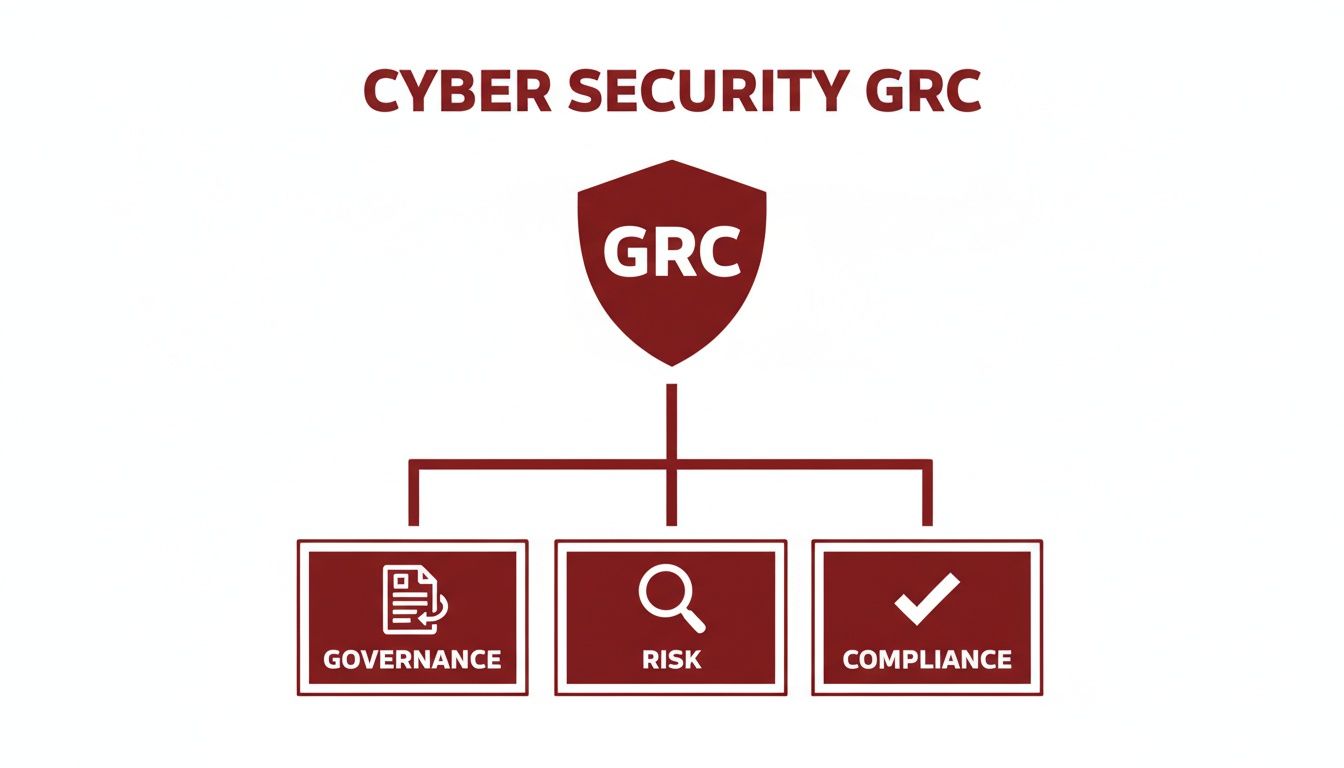
As you can see, each component works in concert with the others under a unified GRC shield, creating a holistic defence for your entire organisation.
Connecting ISO 27001 Clauses to GRC Pillars
The real magic of ISO 27001 is how its clauses and controls directly map to each pillar of the GRC framework. It's not a separate activity you do on top of GRC; it’s the very mechanism you use to bring it to life.
To make this crystal clear, let's look at how specific ISO 27001 clauses directly support each GRC function. The standard gives you the structure to turn high-level GRC goals into concrete actions with measurable outcomes.
How ISO 27001 Clauses Fulfill GRC Functions
| GRC Pillar | Relevant ISO 27001 Clause/Control | Practical Outcome for Your Business |
|---|---|---|
| Governance | Clause 5: Leadership | Top management is actively involved, setting clear security policies and defining roles. Security becomes everyone's responsibility, driven from the top down. |
| Risk Management | Clause 6: Planning | You have a formal process to identify, analyse, and treat security risks—not just once, but as an ongoing cycle to stay ahead of new threats. |
| Compliance | The Standard Itself | Achieving certification proves to clients, partners, and regulators that you meet a globally respected security benchmark, building trust and opening doors. |
By following the ISO 27001 standard, you're doing far more than just preparing for an audit. You are building a sustainable Information Security Management System (ISMS) that makes robust GRC an operational reality.
For a detailed roadmap, a comprehensive ISO 27001 compliance checklist can be an invaluable guide through the implementation and audit process, ensuring no stone is left unturned.
Annex A Controls: Where GRC Theory Becomes Action
If the main clauses are the strategy, then the Annex A controls are your tactical toolkit. This is where the rubber really meets the road. Annex A provides a catalogue of specific security controls that give you practical, concrete actions to mitigate the risks you identified back in the planning stage.
Let’s look at a few examples:
- A.8 Asset Management: This forces you to know exactly what data and systems you have and who is responsible for protecting them. It’s a foundational governance practice.
- A.12 Operations Security: This covers everything from malware protection to data backups, giving you direct, hands-on tactics for risk mitigation.
- A.15 Supplier Relationships: This requires you to manage the security risks coming from your supply chain—a critical compliance and risk function in today's interconnected business world.
These controls ensure your cyber security GRC strategy is more than just a dusty policy document; it's a living, breathing system of active protective measures.
How This Stops Real-World Attacks Like Business Email Compromise
The practical value of this GRC-driven approach becomes undeniable when you look at modern threats. According to the latest threat report from CyberCX, Business Email Compromise (BEC) was the number one cyber incident in Australia in 2024.
What’s truly alarming is that a staggering 75% of these attacks successfully bypassed multi-factor authentication. They succeeded by exploiting weaknesses in internal processes and third-party controls—exactly the kinds of gaps a strong GRC framework is designed to close.
At Anitech, we help Australian small businesses use ISO 27001 to build practical defences against threats like BEC. The standard’s specific requirements for access control, asset management, and supplier security directly target the vulnerabilities that BEC scammers love to exploit. This alignment transforms your GRC program from a theoretical exercise into a formidable defence against incredibly costly attacks.
Learn more about how we can help by exploring how Anitech simplifies the ISO 27001 certification process for businesses just like yours.
A Pragmatic GRC Implementation Plan for Small Businesses
Let's be honest, building a cyber security GRC framework can sound intimidating, especially for a small business. You hear terms like "governance" and "compliance" and immediately picture mountains of paperwork and a budget you just don't have. But it doesn't have to be that way.
The key is to be pragmatic. It’s not about building a fortress overnight; it's about taking practical, smart steps that give you the most security value for your effort. Think of it as translating complex standards into a simple, achievable game plan that fits your business, not the other way around.

This means starting small, zeroing in on your biggest risks first, and building up your capabilities over time. Let's walk through a realistic approach that’s actually built for the day-to-day reality of running a small business.
Step 1: Assign Clear Security Roles
In a small team, everyone wears multiple hats. That’s a strength, but when it comes to security, it can be a weakness. If everyone is responsible, then no one is. Without someone clearly owning security tasks, things inevitably fall through the cracks.
You don't need to go out and hire a full-time Chief Information Security Officer. Instead, just assign specific GRC duties to your existing team members based on what they already do well.
- Data Protection Lead: This is your point person, often the business owner or a senior manager. They are ultimately accountable for protecting sensitive information and making sure everyone follows the rules.
- IT Security Coordinator: This is your go-to tech person. They’re in charge of the hands-on controls—managing firewalls, patching software, and making sure only the right people have access to the right things.
- Compliance Champion: If you handle specific data types, like health or financial records, this person is your specialist. Their job is to stay on top of the relevant regulations and ensure your processes are always up to scratch.
By formally assigning these responsibilities, you build accountability right into your company culture. Everyone knows who to ask about security, creating a clear chain of command when it matters most.
Step 2: Develop Essential Policies
Policies are the rulebook for your GRC program—the foundation of your governance pillar. They spell out your security expectations in black and white. The goal here isn't to create a massive, dusty binder that no one ever reads. It's to develop a few core documents that are actually useful.
Start with these three essentials:
- Information Security Policy: Think of this as your constitution. It’s a high-level document stating your commitment to security and outlining the main goals of your program.
- Acceptable Use Policy: This is the "how-to" guide for using company tech. It covers the basics like creating strong passwords, responsible internet use, and how to handle company laptops and phones.
- Incident Response Plan: This is your fire drill plan. When something goes wrong—and it will—this document details the exact steps to take, from spotting the breach to getting back on your feet.
A policy is only as good as its implementation. Keep the language simple, focus on actionable rules, and run a quick training session to get everyone on the same page. This simple step turns your policies from forgotten documents into active, living defences.
Step 3: Conduct a Streamlined Risk Assessment
You can't protect what you don't know is at risk. A risk assessment is simply the process of figuring out where your biggest dangers lie. For a small business, this should be a straightforward, focused exercise, not a month-long project.
Here's a simple, three-step way to tackle it:
- Identify Your Crown Jewels: What data or systems would cripple your business if they were compromised? It might be your customer database, your financial records, or your unique product designs.
- Brainstorm the Threats: What could actually go wrong? Think about common scenarios like phishing emails, a ransomware attack, a hard drive failure, or even an employee accidentally deleting a critical file.
- Prioritise and Plan: Now, for each threat, make a quick judgement call: how likely is it to happen, and how bad would it be if it did? This simple matrix helps you focus your limited time and money on the biggest, scariest risks first.
Step 4: Implement Critical Security Controls
Once you know your risks, you can start putting controls in place to manage them. The trick is not to try and do everything at once. Start with foundational controls that deliver the biggest security bang for your buck.
For Australian businesses, the Essential Eight is the perfect starting point. It’s a set of baseline strategies from the Australian Cyber Security Centre (ACSC) that targets the most common attack methods. Focus on getting these right first:
- Application Control: Block unauthorised programs from running on your systems.
- Patching Applications and Operating Systems: Keep all your software updated to plug known security holes before attackers can exploit them.
- Multi-Factor Authentication (MFA): Add that crucial second layer of security to your logins. It's one of the single most effective controls you can implement.
These foundational measures will dramatically strengthen your defences. At Anitech, our whole focus is on helping small businesses implement these practical controls as part of a formal cyber security GRC program. This not only makes you safer but also paves the way for achieving globally recognised standards. If you're thinking about formalising your security, our guide on the ISO 27001 certification process is a great next read.
The threat landscape in Australia makes this structured approach more urgent than ever. The country recorded a staggering 47 million data breaches in 2024, placing it fourth globally. Meanwhile, phishing attacks doubled in just nine months. ISO 27001 directly addresses these threats by mandating risk assessments and incident response plans, which is why Anitech provides tailored support to help Australian SMEs get it right. You can learn more about Australia's evolving threat landscape in these recent findings.
Here’s the rewritten section, crafted to sound like an experienced human expert.
Common GRC Mistakes and How to Avoid Them
Putting a cyber security GRC framework in place is one of the smartest things you can do for your business. But the road to a successful program is littered with common traps that can easily derail your efforts. Knowing what these pitfalls are—and how to sidestep them—is the difference between a GRC program that’s just a paper-pusher and one that becomes a genuine asset for your business.
Too many organisations make the classic mistake of treating security as a one-and-done project. They throw a lot of time and money at it, get the certificate on the wall, and then breathe a sigh of relief. But that "set and forget" mindset is a huge gamble in a world where cyber threats shift and change every single day.
Treating Security as a Project, Not a Process
The most common stumble I see is when a business treats GRC like any other project—with a clear start and a finish line. But real security isn't a destination you arrive at; it's a constant journey of adapting and improving. When you see GRC as a project, it's already on its way to becoming outdated.
The only way to avoid this is to weave GRC activities into the very fabric of your daily operations. This means getting risk assessments in the calendar regularly, making security awareness training a normal part of the job, and keeping a constant eye on your controls. Your GRC framework has to be a living, breathing system that grows with your business and the threats around it.
The Dangers of "Checkbox Compliance"
Another major pitfall is what we call "checkbox compliance." This is where a company becomes so focused on meeting the bare minimum requirements of a standard like ISO 27001 that they lose sight of the bigger picture. They do just enough to pass the audit, get the piece of paper, and move on. While you might get certified, this approach often leaves you with a false sense of security.
Genuine GRC is about managing real-world risk, not just ticking boxes for an auditor. The whole point is to build a truly resilient business that can stand up to actual attacks.
The purpose of a GRC framework isn't just to make auditors happy. It's to build a culture of security that genuinely protects your most critical assets from the dangers you actually face.
So, instead of asking, "What do we need to do to pass this audit?", start asking, "What do we need to do to be truly secure?" That simple shift in mindset changes everything. It turns compliance from a chore into a practical blueprint for building a strong defence.
Selecting Overly Complex Tools
When looking for a solution, it's tempting to get dazzled by sophisticated GRC software that promises the world. But for a small business, a tool that’s too complex can be worse than having no tool at all. It ends up creating a massive learning curve, your staff won't use it, and you've just wasted a chunk of your budget.
Remember, the right tool should fit your business, not the other way around.
- Start Simple: Don't be afraid to begin with the spreadsheets and document systems you’re already comfortable with.
- Focus on Your Needs: Pick a tool that solves your most pressing problems right now, whether that's tracking risks or managing policies.
- Prioritise Usability: If the platform isn't intuitive for your team, it’s destined to become expensive digital dust.
The aim is to find technology that supports your GRC process, not one that takes it over and makes it more complicated.
Forgetting the Human Element
Finally, the biggest mistake of all is forgetting that security is fundamentally about people, not just technology. You can have the best policies in the world and the most expensive firewalls, but if your team doesn't understand their role in protecting the business, you're still wide open to attack. One study found that 1.2% of employees click on malicious links every month, and that number is jumping by 140% annually—a stark reminder of how critical your people are.
A truly effective GRC program is built on a company-wide culture of security. This means providing regular, engaging training that doesn't just list rules but explains why it all matters. You need to make sure everyone—from the sales team to the front desk—understands their personal responsibility. When your people become your first and best line of defence, that’s when your GRC program really starts to work.
Building a Resilient Business with GRC
Think of a cyber security GRC framework as less of a defensive shield and more of a powerful engine for your business. When you align it with a robust standard like ISO 27001, your approach to security becomes a cornerstone of trust. You're showing customers and partners that you're a responsible custodian of their data.
This isn't just about dodging breaches; it’s about forging a reputation for reliability and integrity.
That kind of reputation swings open the doors to bigger opportunities. Strong, provable security is often a non-negotiable for landing valuable government contracts or partnering with large enterprise clients. They're actively looking for suppliers who take a proactive stance on risk, which turns your investment in GRC into a real competitive advantage. Suddenly, you’re not just another vendor—you’re a trusted partner.
The journey to effective GRC transforms your company from being merely protected to being truly resilient. It fosters a forward-thinking culture where security is integrated into every business decision, preparing you for future challenges and opportunities.
This strategic shift changes the entire conversation from simply surviving threats to actually thriving in a secure way. By weaving governance, risk, and compliance into the fabric of your operations, you build a business that isn't just ready for today's dangers but is also perfectly positioned for sustainable growth.
For a deeper dive, check out our article on how to go beyond compliance to build business resilience. It’s the ultimate outcome of a GRC program done right.
Got Questions About GRC? We've Got Answers.
Getting your head around cyber security GRC can feel like learning a new language, especially when you're a small business just starting out. Here are some straightforward answers to the questions we hear most often.
How Long Does It Realistically Take a Small Business to Implement GRC?
There's no single answer here, as it really depends on your business's size, complexity, and where you're at with security right now. But for a small business starting from scratch and aiming for an ISO 27001 certification, you should probably budget for 6 to 12 months.
That timeframe covers everything from figuring out where your gaps are to developing policies, putting the right controls in place, and running internal audits before the official certification audit happens. Partnering with a consultant who's been down this road before can definitely speed things up; they bring templates, help you focus on what matters most, and make sure you tick all the boxes efficiently.
Is Cyber Security GRC Just Something for the Big Guys?
Absolutely not. While GRC might have its roots in the corporate world, its core ideas are just as crucial—if not more so—for small businesses. Let's be honest, most small to medium businesses don't have the deep pockets to bounce back from a major cyber attack, which makes getting ahead of risks a matter of survival.
GRC isn't about the size of your company; it's about the value of the data you're protecting. For a small business, that data is everything.
Modern frameworks like ISO 27001 and a new wave of affordable tools mean you can build a GRC program that actually fits your business and budget. It’s a powerful way to show clients you take their data seriously and build a solid security posture without needing a massive enterprise budget.
How Is GRC Different From a Security Operations Centre (SOC)?
Think of GRC and a Security Operations Centre (SOC) as two essential parts of the same team, each playing a different but equally important role. They're two sides of the same security coin.
- GRC is the strategy: It's the 'why'. It defines the big picture for security, sets the rules (policies), figures out what could go wrong (risk assessment), and makes sure you're playing by the rules (compliance). GRC is the game plan.
- A SOC is the tactical execution: It's the 'how'. This is your hands-on team in the trenches, providing 24/7 monitoring, hunting for threats, and jumping into action when an incident occurs. They are the players on the field, executing the game plan GRC created.
In short, GRC tells the SOC what to protect and why it’s important. The SOC then handles the active defence and feeds back intelligence on the real-world threats they're seeing. For security to really work, you need both the strategic direction from GRC and the on-the-ground capability of a SOC.
Ready to build a security foundation that won't crack under pressure? Anitech makes the journey to ISO 27001 certification straightforward with expert guidance designed specifically for Australian small businesses. Our 100% success rate speaks for itself. Contact us today to strengthen your cyber security GRC framework.
Recent Comments