

Let’s be blunt: a career in cyber security in Australia is lucrative, and understanding the current cyber security salary Australia landscape is key to maximizing your potential. We’re talking about a field where a six-figure salary isn’t just for the top brass; it’s rapidly becoming the standard for skilled professionals.
Right now, the average cyber security salary hovers around AUD $127,574 per year. Of course, that’s just an average. If you’re just starting out, you can expect to see offers around the $70,000 mark. For seasoned experts, that number can easily climb past $160,000. This isn’t just a small bump over a typical IT role anymore; it’s a significant premium for protecting the digital core of Australian businesses.
What’s Fuelling the Cyber Security Salary Boom in Australia?
It wasn’t that long ago that cyber security was a niche, almost an afterthought tucked away within the broader IT department. Now, it’s a boardroom-level concern, and the salaries tell that story loud and clear. The old days of a security analyst earning the same as a senior system admin are well and truly over.
So, what changed? A perfect storm of relentless cyber threats and ever-tighter government regulations has completely reshaped the landscape. Businesses aren’t just protecting files on a server; they’re defending their reputation, their ability to operate, and their very existence. This has turned cyber security professionals from back-room technicians into essential strategic partners, and their pay packets have shot up to match.
Key Drivers Shaping Your Paycheque
A few powerful forces are pushing these salaries skyward. Whether you’re a professional looking for your next role or a business leader trying to budget for a security team, you need to understand what’s at play.
- The Threats Are Getting Smarter: Cyber attacks are no longer simple smash-and-grab jobs. They’re sophisticated, targeted campaigns. That means companies are desperate for skilled defenders who can stay one step ahead, and they’re willing to pay a premium for that talent.
- Compliance Is No Longer Optional: With regulations like the SOCI Act and strict privacy laws, having experts who can navigate the legal minefield is non-negotiable. Skills in governance, risk, and compliance (GRC) are particularly hot commodities.
- Everything Is Digital: As more businesses move their operations online, the “attack surface”—all the potential points of entry for a hacker—grows exponentially. This creates a massive demand for security pros across every single industry.
- A Chronic Skills Shortage: The simple truth is there aren’t enough qualified people to fill all the open positions. This fierce competition for talent is the single biggest factor driving up salaries across the board.
Think about this: back in 2015, a cyber analyst might have been happy with a salary in the high AUD $80,000s. Today, that average has jumped to AUD $127,574, all thanks to the non-stop barrage of cyber threats and regulatory headaches. This isn’t just a trend; it’s a direct result of demand completely swamping supply. In fact, some forecasts predict a shortfall of 3,000 specialists by 2026. This is exactly why many companies decide it’s smarter and more cost-effective to partner with a specialist firm for something like ISO 27001 implementation instead of trying to hire expensive, hard-to-find talent in-house. You can even read more about the data behind Australian cybersecurity salaries to see the numbers for yourself.
How Your Role Defines Your Paycheque
In cyber security, your job title is far more than just a line on a business card—it’s one of the biggest factors determining your earning potential. While a national average gives you a decent starting point, the real story of the cyber security salary in Australia is told by the specific role you fill.
It’s simple, really. Not all roles carry the same weight or market value. A hands-on analyst sifting through network traffic has a different set of pressures and skills compared to a CISO who’s busy shaping the entire organisation’s security strategy in the boardroom.
Understanding this hierarchy is key. For professionals, it lays out a clear roadmap for climbing the ladder and boosting your pay. For business leaders and hiring managers, it paints a realistic picture of the investment needed to build a truly effective security team from the ground up.
From The Trenches To The Boardroom
A career in cyber security is a journey, moving from tactical, hands-on work to high-level strategic oversight. And, as you’d expect, your compensation grows with every step. Each role builds on the last, demanding a deeper understanding not just of technology, but of business risk, compliance, and leadership.
Let’s break down the key positions:
- Cyber Security Analyst: Think of them as the frontline defenders. Analysts monitor security alerts, spot potential threats, and handle the initial response when things go wrong. Their work is the bedrock of day-to-day security. You can dive deeper into the cyber security analyst role in our detailed guide.
- Cyber Security Engineer/Architect: A step up the ladder, these are the builders. Engineers and architects design and implement the security systems—the firewalls, intrusion detection systems, and secure cloud environments that keep attackers out. Their focus is on being proactive, not just reactive.
- Security Consultant: Consultants are the specialists you call in for targeted expertise. They might focus on penetration testing, GRC (Governance, Risk, and Compliance), or helping organisations get certified against standards like ISO 27001. Their high value comes from delivering deep knowledge exactly when it’s needed.
- Cyber Security Manager: This is where the pivot to leadership happens. Managers don’t just solve technical problems; they oversee the security team, manage budgets, write security policies, and report on the company’s security posture to the higher-ups.
- Chief Information Security Officer (CISO): Sitting at the top of the pyramid, the CISO is a strategic executive. They’re responsible for the entire information security program, making sure it aligns with business goals, manages enterprise-wide risk, and can be clearly communicated to the board of directors.
This chart shows just how dramatically salaries can climb as you move from entry-level roles into more senior positions.
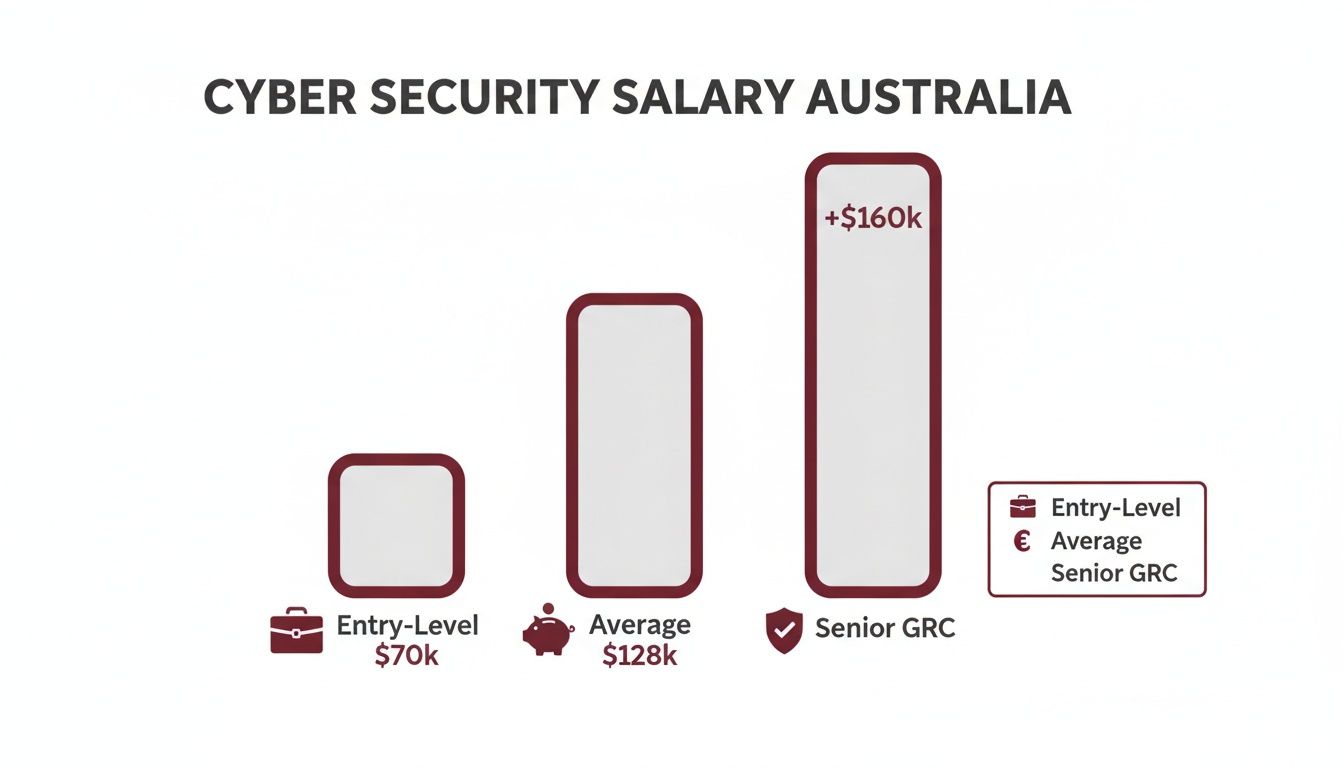
The numbers speak for themselves. There’s a powerful financial incentive for professionals to aim for those more specialised and senior GRC roles.
A Look At The Numbers In A Major Market
The seniority of your role is one of the biggest drivers of your pay packet. We’re seeing mid-level analysts and engineers comfortably earning between AUD $115,000–$125,000, putting them well ahead of many general IT positions.
Demand in the public sector is particularly hot, with advertised government cyber security jobs averaging around AUD $119,694. Once you move into senior roles that involve overseeing governance and compliance, especially those tied to frameworks like ISO 27001, salaries frequently jump into the $180,000 to over $220,000 range.
To give you a more concrete example, let’s look at Sydney’s competitive private sector.
Median Cyber Security Salaries In Sydney By Role
This table offers a snapshot of typical salaries in Sydney, showing the median and 75th percentile figures. The 75th percentile is a great indicator of what top-tier talent in each role can command.
| Role | Median Salary (AUD) | 75th Percentile Salary (AUD) |
|---|---|---|
| Cyber Security Specialist | $162,640 | $193,670 |
| Cyber Security Manager | $194,205 | $228,850 |
| Chief Information Security Officer (CISO) | $284,085 | $323,000 |
As you can see, leadership roles are incredibly rewarding. A Cyber Security Manager in Sydney pulls in a median salary of about $194,205, while a CISO commands a median of $284,085, with the top packages easily exceeding $323,000.
These figures highlight a critical challenge for many Australian businesses. The cost of hiring a full-time, in-house CISO or a senior compliance lead is a significant financial commitment—one that is often out of reach for SMEs and even some government contractors.
This economic reality is pushing many organisations to think differently. Instead of taking on the full cost of a CISO’s salary, they’re partnering with specialised consultancies. It’s a smart move that allows them to access CISO-level strategic guidance and internal audit expertise as a service, securing top-tier capability for a fraction of what a full-time executive would cost.
Why Your Location Matters For Your Pay Cheque
When it comes to cyber security salaries in Australia, your postcode can be just as important as your qualifications. It might seem odd, but the city you work in can mean a difference of tens of thousands of dollars in your annual pay. This isn’t just a random quirk; it’s a direct result of local economic forces and the concentration of different industries.
Think of it like this: a café in the heart of a bustling CBD can charge more for a coffee than one in a sleepy suburban town. The same principle applies here. A city teeming with corporate headquarters, financial institutions, or critical government agencies will have a ferocious appetite for top-tier security talent. That competition naturally drives salaries up.

Understanding these geographical nuances is crucial, whether you’re a professional plotting your next career move or a business trying to figure out how to attract the best people. Let’s break down what’s happening in Australia’s key cities.
Sydney: The Corporate Powerhouse
There’s no getting around it: Sydney consistently leads the pack for the highest cyber security salaries, especially in the private sector. It’s Australia’s financial capital and home to the ASX, meaning it’s packed with multinational corporations, major banks, and tech behemoths. These organisations aren’t just big; they have massive digital footprints, mountains of sensitive data, and strict regulatory hoops to jump through. For them, first-class cyber security is simply the cost of doing business.
This sheer concentration of corporate giants creates a hyper-competitive hiring market. To land the best people, companies in Sydney are willing to pay a premium, effectively setting the salary benchmark for the rest of the country. If you want a real sense of the opportunities on offer, exploring the landscape of cybersecurity jobs in Sydney is a great place to start.
Canberra: The Government Hub
While Sydney rules the corporate world, Canberra is the undisputed king for public sector and defence-related cyber roles. As the nation’s capital, it’s the nerve centre for federal government departments, intelligence agencies, and the big defence contractors. These aren’t your typical organisations; they’re handling Australia’s most sensitive information and are on the frontline against sophisticated, state-sponsored cyber threats.
This creates a unique and often very lucrative job market. The catch? Many roles in Canberra require a security clearance from the Australian Government Security Vetting Agency (AGSVA).
Holding a security clearance dramatically shrinks the available talent pool. It’s a classic case of high demand and low supply. Because of this, cleared professionals can command a significant salary premium—often called a “Canberra loading”—making the capital one of the highest-paying cities for specialised cyber experts.
Melbourne: The Thriving Tech Scene
Don’t count Melbourne out. It’s hot on Sydney’s heels and holds its own as a major player. The city’s economy is incredibly diverse, with booming tech, healthcare, and retail sectors all scrambling for skilled cyber professionals. Melbourne’s vibrant start-up culture also fuels demand, as new tech companies wisely realise they need to build security in from day one.
While the absolute top-end salaries might sit just a fraction below Sydney’s, they remain extremely competitive. And when you factor in the cost of living, many professionals find Melbourne offers a more attractive overall financial package.
Brisbane and Perth: The Expanding Frontiers
Brisbane and Perth are the markets to watch. Once seen as playing catch-up, they are now becoming serious contenders. Brisbane’s economy is on a tear, with growth in logistics, mining tech, and public administration all demanding more security expertise. Over in Perth, the massive resources and energy sector is having a wake-up call, realising its critical operational technology (OT) and industrial control systems are prime targets for attack.
Salaries in these cities have traditionally lagged behind the eastern giants, but that gap is closing—and fast. As these local industries dive deeper into their digital transformations, the need for cyber talent is skyrocketing. Keep an eye on them; they are the next boom towns for cyber careers.
Unlock a Higher Pay Packet with the Right Skills and Certifications
While your years on the job get your CV to the top of the pile, it’s your specialised skills and professional certifications that really open the door to top-tier salaries.
Think of it this way: your experience is the foundation of a house. It’s absolutely essential. But the certifications and niche expertise? That’s the high-end kitchen and luxury finishes that dramatically boost its market value.
In the competitive Australian cyber security market, employers are crying out for concrete proof of what you can do. A strong, relevant skillset acts as a powerful salary multiplier, turning a good offer into a fantastic one.
The Most In-Demand Technical Skills
Certain technical skills consistently command a premium. If you’re serious about boosting your earning potential, mastering these areas isn’t just a good idea—it’s a must. These are the skills that solve the most urgent problems Australian organisations are facing right now.
- Cloud Security (AWS & Azure): As businesses shift everything to the cloud, the demand for pros who can lock down these environments has gone through the roof. Knowing your way around AWS Security or Azure Security is no longer a “nice-to-have”; it’s a fundamental requirement for many high-paying roles.
- Ethical Hacking and Penetration Testing: Companies need to find their weaknesses before a real attacker does. Ethical hackers who can think like the enemy and legally probe for vulnerabilities are highly valued—and well-paid—for their unique, offensive mindset.
- Incident Response: When a breach hits, every second counts. Professionals who can stay calm and lead a methodical, effective response to contain threats and minimise damage are worth their weight in gold. This high-stakes skill translates directly to a higher paycheque.
The Real Game Changer: Governance, Risk, and Compliance (GRC)
Technical wizardry is vital, but the skillset that often separates the high-earners from the rest of the pack is a deep understanding of Governance, Risk, and Compliance (GRC).
This is where security stops being just about tech and starts being about business strategy, risk management, and regulatory survival. GRC is the framework that aligns security efforts with business goals while keeping the regulators happy. Here in Australia, it’s a massive area of focus, and professionals with solid GRC skills are in frustratingly short supply.
Proficiency in frameworks like ISO 27001 is a direct pathway to a higher cyber security salary in Australia. It proves you can do more than just configure a firewall; you can design, implement, and manage an entire Information Security Management System (ISMS) that protects the whole business.
This is the capability that boards and executives truly value because it manages business risk, not just technical risk. And they are more than willing to pay a premium for it.
Why ISO 27001 Expertise Is a Goldmine
Getting your head around a standard like ISO 27001 is one of the smartest career moves a cyber security professional can make. It elevates you from a technical specialist to a strategic business advisor.
Here’s why it has such a direct impact on your salary:
- It’s a Mark of Leadership: Implementing an ISMS isn’t a one-person job. It requires project management, clear communication, and getting buy-in from stakeholders—all hallmarks of a senior leader.
- It Demonstrates Business Acumen: You learn to talk about risk in a way the C-suite understands. This lets you justify security investments in terms of business value, not just tech jargon.
- It Opens Doors to Senior Roles: GRC Analyst, Security Consultant, and Compliance Manager roles almost always list ISO 27001 experience as a key requirement. These jobs are consistently among the highest-paid in the industry.
Beyond specific certifications, understanding the balance between soft skills vs hard skills is crucial for getting ahead. Ultimately, investing in skills that blend deep technical knowledge with sharp business strategy is the most reliable way to ensure your cyber security salary in Australia keeps climbing.
How to Confidently Ask for What You’re Worth
Knowing the numbers is one thing. Actually asking for them is another beast entirely. The real art—and where you can seriously boost your income—is in confidently negotiating what you’re worth. It can feel intimidating, but a little preparation can turn a decent offer into a brilliant one.
This isn’t about arm-wrestling or making bold demands. It’s about building a rock-solid, evidence-based case for why you’re the right person for the job and deserve to be paid accordingly. And for hiring managers, understanding this dance gives you a front-row seat to what truly motivates top talent in this ridiculously competitive market.
Do Your Homework (And Then Some)
Your negotiation strategy kicks off long before you’re sitting in an interview. You need to walk in armed with more than just gut feelings; you need data. While this guide gives you a great starting point, you need to dig deeper to build a case that’s impossible to ignore.
- Pinpoint Your Role and City: Use the salary data we’ve covered as your baseline. Then, jump onto Seek or LinkedIn and look at current job ads for similar roles in your specific city. What are they offering? That’s real-time, on-the-ground market intelligence.
- Be Honest About Your Experience: Are you a mid-level pro with five years under your belt or a senior specialist with a decade of hard-won wisdom? Your expectations have to match your track record. A 10% to 20% bump above the median for seasoned experts is a perfectly reasonable target.
- Size Up the Company: A major bank in Sydney is playing in a different league financially than a tech start-up in Brisbane. You have to tailor your expectations to the organisation’s size, sector, and maturity.
Show Them the Money (That You’ve Saved Them)
Once you’ve got the market data sorted, it’s time to define what makes you a premium hire. Don’t just rattle off a list of duties from your old job description. You need to connect those duties to tangible business results. This is how you prove you’re an investment, not just another line item on the payroll.
Think about your biggest wins and put a number on them. Did you roll out a project that tightened the company’s security? Don’t just say that. Frame it in a way that shows its impact on the bottom line.
Your most powerful negotiation tool is proof. Instead of saying, “I have experience with ISO 27001,” try this: “I led our ISO 27001 implementation, bringing the project in 15% under budget. That certification was instrumental in helping us land three major government contracts last year.”
Building and Presenting Your Case
With your research done and your value clearly defined, you can walk into that conversation ready. It’s all about presenting a calm, logical argument, not an emotional plea.
- Start with Enthusiasm: Always kick things off by saying how excited you are about the role and the company. It immediately sets a positive, collaborative tone.
- State Your Number: Based on all your research, clearly state the salary you’re after. Frame it as a reflection of the market rate for your specific skill set and experience. For example: “Based on my research into similar senior roles here in Melbourne, and considering my deep expertise in cloud security and GRC, I’m targeting a salary in the $170,000 to $185,000 range.”
- Back It Up: Now, connect the dots. Briefly mention two or three key achievements that prove you’re worth that figure. This is where you bring up your ISO 27001 wins or how you slashed security incidents.
- Think Beyond the Base Salary: Remember, your salary is just one piece of the puzzle. Be ready to talk about bonuses, professional development budgets, extra annual leave, or flexible working arrangements. Sometimes a company’s hands are tied on the base salary, but they have plenty of wiggle room on other perks. To get comfortable with this process, it’s worth learning how to negotiate your worth effectively, especially if you’re looking at contract or remote roles.
At the end of the day, confident negotiation comes down to solid preparation. When you know the market, can prove your contribution, and present your case like a professional, you put yourself in the best possible position to land the cyber security salary in Australia that truly reflects your value.
The Future Of Cyber Security Pay In Australia
If you think the demand for cyber security pros is high now, just wait. The field isn’t just growing; it’s morphing into something new. The forces shaping the future cyber security salary in Australia are directly tied to the tech on the horizon and the increasingly clever threats that come with it. This is creating some seriously lucrative niches, and your career—and pay packet—depend on getting ahead of the curve.
For anyone in the industry, from a junior analyst to a CISO, the takeaway is simple: the skills that will be worth the most tomorrow are being forged today. We’re moving past the age of the generalist. Deep, specialised knowledge is where the real money will be.
Hotbeds Of Future Salary Growth
Certain pockets of cyber security are about to explode. If you build your expertise in these areas, you’ll be in a prime position to write your own ticket. These aren’t just buzzwords; they represent a fundamental change in how businesses have to protect themselves.
Three fields, in particular, are standing out:
- Artificial Intelligence (AI) Security: Everyone is racing to plug AI into their business, and in doing so, they’re creating a brand-new playground for attackers. Experts who know how to lock down AI models, protect the data they’re trained on, and fend off AI-driven attacks are going to be worth their weight in gold. Getting your head around the rise of AI-powered cyber threats is the perfect starting point.
- Operational Technology (OT) Security: Think about Australia’s most critical infrastructure—power grids, water treatment facilities, manufacturing plants. All of it runs on OT. Protecting these industrial control systems has become a matter of national security, and the small handful of specialists who can do it are already seeing their salaries go through the roof.
- Data Privacy and Sovereignty: As privacy laws get stricter, professionals who can untangle the messy web of data protection, residency, and sovereignty rules are becoming incredibly valuable. Any business that holds customer data—which is pretty much every business—needs this expertise.
The Unchanging Bedrock Of Success
While chasing these shiny new specialisations is smart, it’s a huge mistake to forget the basics. In fact, all this new complexity makes the fundamentals more important than ever. When everything is in flux, you need a solid framework to manage risk effectively.
This is exactly why expertise in standards like ISO 27001 will always be a cornerstone of a high salary. It provides the strategic blueprint—the Information Security Management System (ISMS)—that all other security disciplines plug into.
It’s like building a skyscraper. AI and OT security are the flashy, high-tech penthouses. But you can’t build them on a shaky foundation. Your ISMS, built on the proven principles of ISO 27001, is that rock-solid foundation.
At the end of the day, the future for cyber security salary in Australia is incredibly bright, but it belongs to those who never stop learning. The path to a top-tier salary has two lanes: you need to jump on emerging specialisations while also mastering the foundational principles of good governance. Nail both, and you won’t just be advancing your career—you’ll be securing Australia’s digital future.
Got Questions? We’ve Got Answers
It’s completely normal to have questions when you’re trying to figure out what a cyber security salary in Australia really looks like. Let’s tackle some of the most common ones we hear from people in the industry.
What’s a Realistic Starting Salary in Cyber Security?
If you’re just kicking off your career, maybe as a junior analyst in a Security Operations Centre (SOC), you can realistically expect to start somewhere between AUD $70,000 and $85,000 a year.
Of course, your location and the company itself will play a big role. We’ve seen that candidates who have a solid internship under their belt or have already earned a foundational certification tend to land on the higher end of that scale. The good news? The path for pay rises is usually pretty quick from there.
How Much of a Bump Can I Expect with an ISO 27001 Certification?
There isn’t a magic number, but having an ISO 27001 certification is a serious career booster. It tells employers you’re not just a tech whiz; you understand the business-critical world of Information Security Management Systems (ISMS), which is gold dust for any organisation serious about governance and compliance.
Think of it this way: it opens doors to higher-calibre roles like Security Consultant or GRC Analyst. In our experience, people with this cert can command salaries that are easily 15-25% higher than their peers in purely technical roles. It’s a powerful way to fast-track your way into senior and leadership positions.
Which Australian City Offers the Best Pay Packet?
Right now, the salary hotspots are Sydney and Canberra. They’re consistently leading the pack, but for slightly different reasons.
- Sydney is the corporate and financial capital. The sheer number of big banks and company headquarters creates a bidding war for the best talent.
- Canberra is all about government and defence. The demand from federal agencies and major contractors is massive, and they’ll pay top dollar, especially if you have the right security clearances.
Melbourne isn’t far behind, though. As a major tech and business hub, it’s also offering some seriously competitive packages to attract and keep skilled professionals.
Getting your security posture right is essential, but wrestling with standards like ISO 27001 can feel overwhelming. At Anitech, our consultants live and breathe this stuff. We cut through the complexity and provide practical guidance to help your business achieve international security standards. It’s about protecting your organisation and building trust in the market.
Visit iso-27001.com.au to book a consultation and secure your business’s future.
Recent Comments