

Quick Summary: Cyber security services are specialised third-party solutions that act as your business's digital defence team. They protect your data, systems, and reputation from online threats like hacking and data breaches. Think of them not as an IT cost, but as a strategic investment in business continuity and customer trust.
Relying on just a basic antivirus program to protect your business is a bit like locking your front door but leaving all the windows wide open. Professional cyber security services are a whole different ball game; they're your dedicated digital defence team, providing a complete, monitored security system with 24/7 surveillance.
This shift from passive protection to active defence couldn't be more critical. A recent report revealed over 1,100 notifiable data breaches in Australia, a staggering 25% jump from the year before. The threats are real, and they’re growing.
What Are Cyber Security Services? Your Digital Bodyguard
So, what exactly are these services? Let's use a simple analogy. Imagine your business is a physical storefront. You wouldn’t just slap a single lock on the door and hope for the best, right? You’d install a multi-layered system—alarms, cameras, reinforced windows, maybe even a security guard—all designed to deter, detect, and respond to any threat.
Professional cyber security services work on that exact same principle for your digital assets. It's not about putting up a single firewall and calling it a day. It’s about building a living, breathing defence mechanism that evolves and adapts as new threats appear.
The Core Functions of Cyber Protection
A solid defence is built on a few key pillars. Each one handles a different part of the security puzzle, and together they form a robust shield around your company. Getting your head around these functions is the first step to seeing security not just as a technical headache, but as a fundamental part of your business strategy.
Here are the foundational concepts:
- Continuous Monitoring: This is your 24/7 surveillance feed. It involves keeping a constant eye on your networks, servers, and devices, watching for anything out of the ordinary.
- Threat Detection: Think of this as your alarm system. The moment any suspicious behaviour is spotted—like someone trying to access files they shouldn’t—it triggers an immediate alert.
- Incident Response: If the worst happens and a breach occurs, you need a trained team to spring into action. This is all about containing the threat, minimising the damage, and getting you back to business as fast as possible.
Think of it this way: You can buy the best security camera in the world, but it’s pretty useless if no one is watching the feed or ready to respond when an intruder shows up. Cyber security services are the expert team that watches, analyses, and acts on your behalf.
What Are the Different Types of Security Services?
Diving into cyber security can feel like learning a new language, full of confusing acronyms and technical jargon. To make the right calls for your business, you need to know what these different cyber security services actually do and how they work together to keep you safe.
Think of them not as standalone products, but as specialised teams you can call on, each with a distinct role in your overall defence strategy. One service might act as a 24/7 guard watching your network, while another stress-tests your defences by trying to break in. The key is understanding how they build on each other to create layers of protection.
The diagram below shows the basic security cycle in action. It’s a constant loop of monitoring, detecting, and responding.
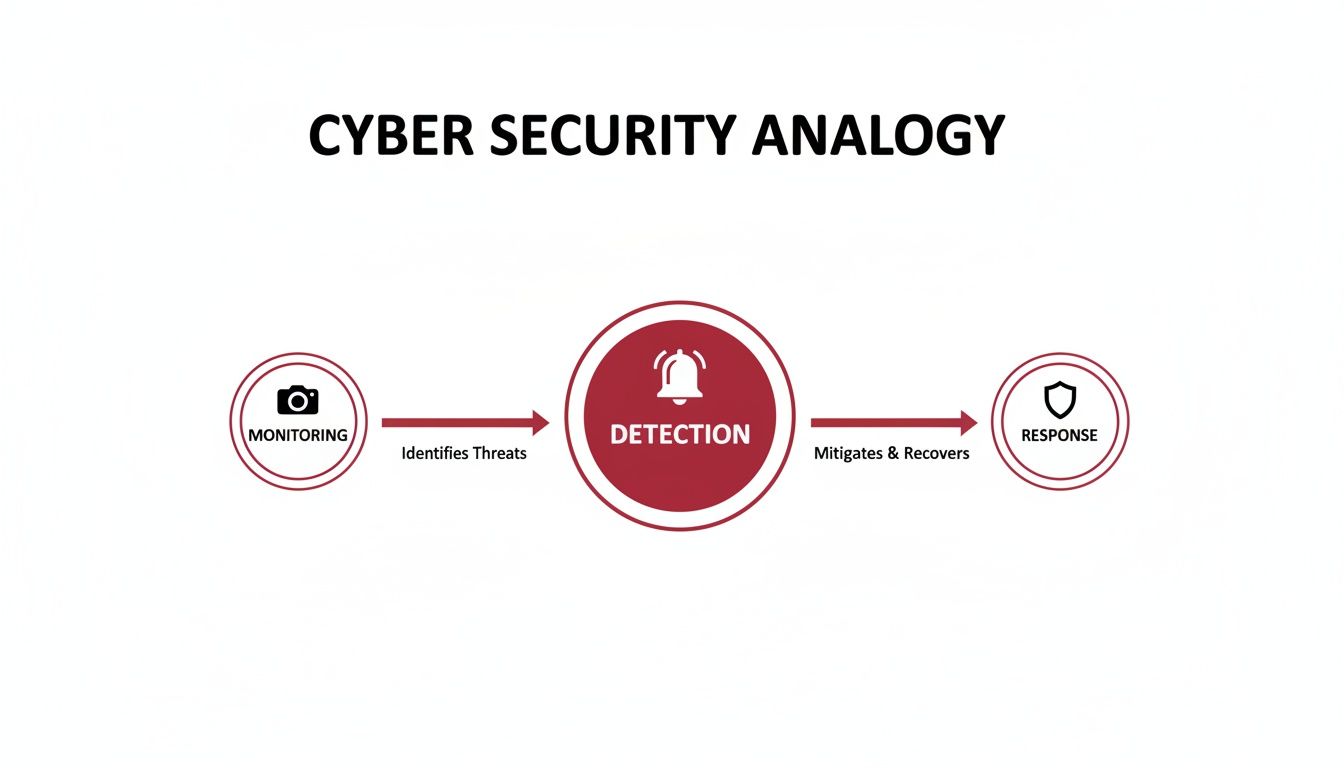
This process makes one thing clear: good security isn't a one-off task. It's a continuous effort where each step flows logically into the next, creating a comprehensive shield around your business.
Managed Security Service Providers (MSSPs)
Imagine hiring an entire security department that works around the clock, for a fraction of the cost of an in-house team. That’s exactly what a Managed Security Service Provider (MSSP) delivers. An MSSP becomes your security partner, taking the day-to-day management of your security infrastructure completely off your plate.
For many small and medium Aussie businesses, this is the perfect starting point. It’s for those who don't have the budget or in-house expertise to build and run their own security operations centre (SOC). Their main job is to manage and monitor the tools you already have, like firewalls, making sure they’re configured correctly and always on watch.
An MSSP’s toolkit usually includes:
- Firewall Management: They're the gatekeepers for your network, setting up, updating, and monitoring your firewalls to block unwanted traffic.
- Intrusion Detection: They actively watch for suspicious patterns in your network traffic that could signal an attack in progress.
- Security Reporting: You’ll get regular, easy-to-understand updates on security events, alerts, and the overall health of your digital defences.
- System Patching: They handle the crucial but tedious task of keeping all your software and systems updated with the latest security patches to close known loopholes.
By taking care of these fundamentals, an MSSP frees up your internal team to focus on what they do best—growing the business.
Managed Detection and Response (MDR)
If an MSSP is about managing your security tools, then Managed Detection and Response (MDR) is all about hunting for threats. This is a much more proactive and advanced service.
Here’s an analogy: an MSSP is like having a top-notch camera system. An MDR service, on the other hand, is like having a security guard actively patrolling the grounds, looking for anything out of place. They don't just wait for an alarm; they’re out there searching for subtle clues that might point to an intruder.
MDR providers combine clever technology with sharp human analysts to hunt for threats that have slipped past your initial defences. They're looking for those tiny "indicators of compromise" (IOCs) that signal a brewing attack.
The real magic of MDR is its speed and expertise. When they find a genuine threat, they don't just ping you an alert. They jump straight into action to investigate, contain, and neutralise it for you.
This immediate action is what saves businesses. A breach can go from a minor problem to a full-blown disaster in minutes, so having experts intervene instantly is priceless. If you’re looking to get serious about threat hunting, you can learn more about managed cyber security services and how they protect Australian businesses.
Penetration Testing
How can you be sure your security is as strong as you think it is? Simple. You test it. That’s what Penetration Testing—often called "pen testing" or "ethical hacking"—is all about. It’s a controlled, authorised cyber attack simulation carried out by experts to find and exploit weaknesses in your systems before a real attacker does.
Think of it like hiring a professional team to try and break into your office. They’ll jiggle every door, check every window, and test every lock to find weak spots. Their job is to show you exactly how a real criminal could get in.
A typical pen test follows a clear path:
- Reconnaissance: The ethical hackers start by gathering information about your business to find potential targets.
- Scanning and Exploitation: Next, they use specialised tools to probe your systems for vulnerabilities and then try to exploit them to gain access.
- Reporting: Afterwards, you get a detailed report explaining what they found, how they got in, and—most importantly—clear, actionable steps to fix the issues.
This service gives you a true, real-world picture of your security, moving beyond theory to show you exactly where you're exposed.
Vulnerability Management
While a pen test is like a deep-dive annual health check-up, Vulnerability Management is the ongoing, daily fitness routine for your systems. It’s a continuous process focused on systematically finding, classifying, and fixing security weaknesses.
This service is less about simulating an attack and more about maintaining excellent security hygiene. It involves regularly scanning your networks, servers, and applications to spot vulnerabilities like out-of-date software, misconfigurations, or missing security patches.
Once a weakness is found, it's prioritised based on how critical it is. This helps your team focus their efforts on plugging the biggest holes first. It’s a proactive, common-sense approach that ensures you’re consistently closing security gaps before they become a problem.
Why Australian Businesses Need Cyber Security Services
If you run a small or medium-sized business in Australia, you know the daily grind. Juggling operations, staff, and cash flow can easily push something like cyber security way down the to-do list. It can feel like a far-off, overly technical problem—the kind of thing that only happens to the big banks and multinational corporations.
Unfortunately, that way of thinking is a dangerous and increasingly costly mistake.
The reality is pretty confronting: it’s no longer a matter of if your business will face a cyber attack, but when. Cybercriminals are deliberately targeting smaller businesses, seeing them as easier prey with fewer defences than their larger counterparts. Thinking your business is "too small to be a target" is exactly the kind of assumption attackers love to exploit.

This isn't just a hunch; the numbers tell a story of escalating risk for Australian organisations. The Office of the Australian Information Commissioner recently recorded over 1,100 notifiable data breaches, a staggering 25% increase from the previous year. It’s a clear signal that the threat is getting worse. With phishing scams filling our inboxes and human error always a possibility, it’s obvious the old approach to security just doesn't cut it anymore. You can learn more about the increasing scale of these breaches and what they mean for businesses by digging into the latest industry reports.
The Real-World Impact of a Cyber Attack
Forget the statistics for a moment. The fallout from a single security incident can be absolutely devastating, and it goes far beyond a simple IT headache. The consequences ripple through every part of your business, threatening its very existence.
Getting a handle on these impacts is the first step to changing your mindset—to start seeing cyber security services not as another bill to pay, but as a crucial investment in your company’s future.
The damage typically falls into three main buckets:
- Financial Devastation: This is the one you feel first. The costs pile up fast—regulatory fines, legal bills, ransom demands, and the sheer expense of getting your systems and data back online. For many small businesses, these unexpected costs are simply too much to bear.
- Operational Chaos: A successful attack can bring your entire operation to a screeching halt. Imagine being locked out of your financial records, unable to process a single customer order, or watching your whole production line go dark. Every minute of downtime is a direct hit to your revenue and productivity.
- Reputational Damage: Trust is the bedrock of any business. A data breach shatters that trust, sometimes for good. Customers will rightly wonder if their information is safe with you and may take their business elsewhere. Winning back that confidence is an uphill battle that can take years.
A strong security posture is no longer a 'nice-to-have'. It's a fundamental pillar of modern business. It protects your bottom line, keeps the lights on, and—most importantly—preserves the trust you’ve worked so hard to build.
The Shifting Threat Landscape for SMEs
So, why the sudden focus on smaller businesses? It’s simple: cybercriminals run a business, too, and they're all about getting the best return on their investment. SMEs have become a very attractive target for a few key reasons.
You hold valuable data—customer details, financial records, unique business ideas—but you likely don't have the dedicated security teams and high-tech defences of a major corporation. To an attacker, that combination makes you a high-value, low-effort target.
On top of that, the way we work has changed. The shift to remote and hybrid models has dramatically expanded the "attack surface" for most organisations. With employees logging in from different locations and home networks, new security gaps are popping up every single day. This is why investing in professional cyber security services is the most practical way to manage these new risks, ensuring your defences can keep up with modern threats. It’s a proactive step that is absolutely essential for surviving and thriving in the current Australian market.
How Cyber Security Services Help You Nail ISO 27001 Compliance
Getting your ISO 27001 certification is a massive signal to the market. It’s you telling clients, partners, and regulators that you don't just talk about security—you live it, with a proven, systematic approach. But let's be honest, the road to compliance can feel like a maze of technical controls and complex requirements.
This is exactly where professional cyber security services shift from being a simple defensive tool to a powerful strategic partner. Instead of you having to build every single security capability from the ground up, you can bring in experts who already have the right tools, established processes, and skilled people to tick off specific ISO 27001 controls.
Think of it like getting a home built to code. You could spend months learning how to do the electricals and plumbing yourself. Or, you could hire licensed professionals who know the standards inside and out. Bringing in cyber security experts gets you there faster, with fewer mistakes, and ensures the foundation of your Information Security Management System (ISMS) is rock-solid from the start.
Connecting the Dots: Services to ISO 27001 Controls
The real magic happens when you see how neatly these services map directly to the framework's requirements. ISO 27001 isn't just a list to check off; it’s all about managing risk. Expert services give you a structured way to find, assess, and handle those risks in a way that auditors love to see.
For example, take a look at Annex A control A.8.23, which covers web filtering. A Managed Security Service Provider (MSSP) can set up and run web filtering tools that block access to malicious sites, satisfying this control right out of the box. Or consider control A.5.24, which is all about security for cloud services. A specialised cloud security team can audit your cloud setup and implement the necessary controls, giving you clear, documented proof of compliance.
This direct link doesn't just make your audit smoother; it makes your business genuinely safer.
The Key Services That Fast-Track Compliance
Let's get practical and break down how some of the most common cyber security services directly help you achieve your ISO 27001 ambitions. This is about more than just handing off a task; it's about embedding proven, auditable security processes right into your business.
- Vulnerability Management: This service is a direct answer to Annex A control A.8.8, "Management of technical vulnerabilities." A continuous scanning service provides the exact kind of documented proof an auditor wants, showing you’re on the front foot finding and fixing weaknesses.
- Managed Detection and Response (MDR): An MDR team is your best bet for meeting multiple controls around monitoring and incidents, like A.8.16 ("Monitoring activities") and A.5.26 ("Management of information security incidents"). You get 24/7 expert eyes on your network—something that’s incredibly tough for a small Aussie business to do on its own.
- Penetration Testing: To satisfy control A.8.8, you also have to prove you’ve fixed the vulnerabilities you find. An annual 'pen test' provides that independent, expert validation that your security measures actually work, giving both you and your auditor real confidence.
When you bring in these professional services, you're not just buying a piece of software. You're adopting mature security processes that demonstrate a commitment to continuous improvement—a core principle of the ISO 27001 standard.
Getting Asset Management and Disposal Right
The standard is also quite particular about managing your information assets through their entire lifecycle, right down to the moment you get rid of them. Annex A control A.8.10, "Storage media," demands that old media is disposed of securely. This is a classic stumbling block for many businesses, often because they just don't have a clear process.
For ISO 27001, you absolutely must ensure all electronic devices are properly sanitised before being thrown out or sold. This means implementing robust secure data wiping procedures. Working with a security provider helps you build and follow these policies, making sure sensitive data is gone for good. This creates a clear, auditable trail that proves you handle data responsibly from beginning to end, turning a common compliance headache into a genuine strength.
Your Checklist for Choosing the Right Cyber Security Partner
Picking a provider for your cyber security services isn't just another vendor contract. It's easily one of the most important partnerships your business will ever make. This is not a decision to be taken lightly. Get it right, and they become a true extension of your team; get it wrong, and you could be left exposed, out of pocket, and dealing with a mess.
I've put together this practical checklist to help you cut through the marketing fluff and focus on what really counts. It’ll give you the right questions to ask, so you can confidently choose a provider who gets your business, understands your risks, and knows the local Australian regulatory landscape.

Assessing Experience and Technical Expertise
Let's be clear: not all security providers are created equal. You need a partner with a solid track record, especially with businesses like yours, in your industry. A provider that only deals with massive financial institutions probably won't grasp the specific threats and budget constraints of a small Australian retailer.
Start digging deeper with these questions:
- Industry Specialisation: Have they worked with other businesses in your sector before? Ask for anonymised case studies or references.
- Business Size Focus: Do they specialise in small-to-medium businesses, or will you just be a tiny, overlooked client in a sea of corporate giants?
- Certifications and Credentials: Are their analysts properly certified (think CISSP, CISM, GIAC)? This isn’t just alphabet soup; it shows a real commitment to professional standards.
- Technology Stack: What tools and platforms are they using? You want to see partnerships with well-regarded, proven technology vendors.
A provider's past experience is the single best predictor of how they'll perform for you. You're looking for a team that has already seen and solved the kind of problems your business is likely to run into. That kind of foresight is priceless.
Evaluating Service Delivery and Support
Technical chops are only one piece of the puzzle. How a provider communicates, what their reports look like, and—most importantly—how they act in a crisis are just as critical. You need absolute clarity on their processes and a local team you can actually talk to when things go wrong.
Before you even think about signing a contract, get clear, concrete answers to these questions:
- Incident Response Process: What exactly happens the moment they detect a breach? How fast do they act, and who is your direct contact in an emergency?
- Reporting and Transparency: What reports will you get, and how often? Are they just technical data dumps, or do they provide clear, actionable insights you can actually use?
- Local Australian Support: Is their support team based here in Australia? Having local experts who are awake when you are is a massive advantage, especially during an active incident.
- Scalability: Can their services grow with you? Make sure their solutions can scale up as your business adds more staff, data, and complexity.
Finally, a good sign of a thorough partner is one who uses a comprehensive security audit checklist as part of their initial process. It shows they believe in a structured, detailed approach right from the start. Choosing the right cyber security services partner is a foundational move toward building a truly resilient and trustworthy business.
Understanding the ROI of Cyber Security
Every business decision eventually comes back to the bottom line, and cyber security is no exception. It’s easy to see it as just another expense, a cost centre you have to fund. But that’s the wrong way to look at it. The real conversation is about value and Return on Investment (ROI).
Thinking about security ROI isn’t just about dodging a costly breach. It's about seeing strong security as a strategic investment that actively builds your company's future, moving you from a defensive crouch to a confident stride forward. It’s about creating real business advantages that fuel your growth.
Beyond Breach Prevention
The most obvious return, of course, comes from what you don't lose. A single data breach can unleash a torrent of devastating costs—regulatory fines, legal bills, and crippling operational downtime. Preventing even one serious incident can easily pay for years of security services.
But the real, game-changing value lies in the opportunities that a rock-solid security posture unlocks. These benefits are less about surviving a disaster and more about enabling you to thrive.
- Winning Bigger Contracts: These days, large corporations and government departments won't even look at a supplier without proven security credentials. Being on the path to ISO 27001 can be the single factor that gets your foot in the door for those high-value contracts.
- Building Unbreakable Customer Trust: When customers know their data is safe with you, they stick around. That kind of trust is priceless. It translates directly into higher retention, a stellar brand reputation, and loyal customers who become your biggest advocates.
- Improving Operational Resilience: Professional cyber security services aren’t just about stopping hackers; they're about keeping your systems strong and available. This means less downtime, a more productive team, and a healthier revenue stream.
Investing in security isn't just an insurance policy; it’s a growth engine. It signals a level of professionalism and responsibility that makes your business a far more attractive partner, supplier, and employer.
The Financial Case for Investment
Putting numbers to this value helps build a powerful business case. As cyber threats get more complex, the need for proper protection is skyrocketing. Just look at Australia's cybersecurity market—it recently hit USD 7.6 billion and is forecast to climb to an incredible USD 19.3 billion by 2033, driven by escalating threats. This explosion in spending shows just how urgent it is for all businesses, especially smaller ones, to get their defences in order. You can discover more insights about the Australian cybersecurity market at imarcgroup.com.
When you start viewing security through this lens, everything changes. It’s no longer an IT cost but a vital part of your business strategy that protects the revenue you have and helps you create more.
We dive deeper into this topic in our guide on how investing in protection benefits your bottom line. By framing the discussion around ROI, you can confidently justify the expenditure and champion security’s role in your company's long-term success.
Your Questions About Cyber Security Services, Answered
Dipping your toes into the world of professional cyber security can feel a bit overwhelming, and it's only natural to have a few questions. Let's tackle some of the most common ones we hear from Australian business owners, so you can move forward with clarity and confidence.
How Much Do Cyber Security Services Actually Cost?
This is usually the first thing on everyone's mind, and the honest answer is: it really depends. The price tag is tied directly to what your business needs – think about your company's size, how complex your IT setup is, and the specific level of protection you're after.
Generally, you'll see pricing broken down in a few ways:
- Per-Device or Per-User: A straightforward model where you pay a set monthly fee for each computer or team member you want to protect. It’s common for services like endpoint security.
- Service Tiers: Many providers package their services into tiers, like basic, advanced, and premium. As you go up, you get more layers of defence and more hands-on support.
- Customised Quotes: If your needs are more specific, a good provider will first get to know your business, assess your unique risks, and then build a package just for you.
The most important thing is to shift your mindset from "cost" to "investment." The upfront expense of solid, proactive security is a tiny fraction of the cost of cleaning up after a data breach.
Can't We Just Handle This Security Stuff Ourselves?
It's tempting to think a DIY approach will save money, but it often leads to a false sense of security. Cyber threats today aren't just one-off viruses; they're sophisticated, constantly changing attacks run by organised criminals. Staying ahead of them demands specialist skills, enterprise-grade tools, and someone watching your back 24/7.
For most small to medium businesses, building an internal team with that kind of firepower just isn't practical or affordable. When you partner with a specialist provider, you're not just buying a piece of software; you're gaining access to an entire team of experts and their advanced tech for a predictable monthly fee.
Honestly, Are We Too Small to Be a Target?
This is one of the most dangerous myths out there. Attackers are actively going after smaller businesses precisely because they often have weaker defences. They see you as an easier win. Your data—whether it's customer lists, financial records, or internal plans—is valuable, no matter the size of your logo.
In fact, small and medium enterprises (SMEs) are a huge part of Australia’s cyber security landscape. The market for SME security is set to rocket past USD 3 billion by 2030, growing at a massive 17.8% CAGR. Why? Because attackers have shifted their focus. You can dig deeper into the Australian cybersecurity market at Mordor Intelligence. Ignoring the threat is simply no longer an option.
What's the First Step to Getting Started?
The perfect place to begin is with a proper risk assessment. A good provider won't just try to sell you a product. They’ll start by getting under the hood of your business to understand your current security setup, pinpoint your biggest weaknesses, and identify your most important data.
This initial audit gives you a clear, practical roadmap. It ensures you put your resources where they’ll have the biggest impact, building a security strategy that actually supports your business goals.
Recent Comments