

Quick Summary: Small businesses are prime targets for cyberattacks because they often have valuable data but weaker defenses. This guide explains why cybersecurity for small businesses is critical, identifies common threats like phishing and ransomware, and provides a practical roadmap for building a strong defense, including technical controls, operational policies, and staff training.
For many small business owners, cybersecurity often feels like someone else’s problem—a concern for the big end of town. There's a common, gut-level feeling that says, "We're just a small fish in a big pond. Who would bother with us?"
This is one of the most dangerous, and unfortunately, most common myths in business today. The hard truth is that cybersecurity for small businesses isn't an optional extra; it's a core part of keeping your doors open. Cybercriminals don't see you as a small fish. They see you as an easy, profitable target. Effective information security and data protection are fundamental to survival.
Why Your Small Business is a Prime Target for Cyber Attacks
Let's get inside the head of a cybercriminal for a moment. They're running a business, just like you. And like any business, their goal is to get the biggest return for the least amount of effort. They aren't always hunting for global brands with fortress-like security. More often, they're looking for the path of least resistance.
A small business often represents that perfect sweet spot: you have valuable data (customer information, financial records), money in the bank, and customer trust, but likely fewer resources dedicated to network security and threat detection.
Think of it this way: a burglar could spend weeks planning a high-stakes heist on a bank vault. Or, they could walk down a quiet street and check for unlocked doors. The houses with open windows are the easy, reliable paydays. In the digital world, many cyber attacks follow that exact same logic.
The Myth of Being "Too Small to Hack"
The belief that your size keeps you safe completely misunderstands how modern cybercrime works. Many attacks aren't personal. They're automated.
Cybercriminals use powerful tools that constantly scan the internet, not for company names, but for specific vulnerabilities. These bots are sniffing out unpatched software, weak passwords, or misconfigured cloud services. They don't know or care if you have two employees or two thousand. They just see an open digital door and walk right in.
Your business isn't being hand-picked by a shadowy figure in a hoodie. It's being flagged by a piece of code that found a weakness.
It's a jarring disconnect. While a recent study found 79% of small businesses had faced a cyber attack in the last five years, a staggering 64% still believe they aren't an attractive target. This gap between perception and reality is where attackers thrive.
Understanding the Real-World Consequences
When an attack lands, the damage goes far beyond a simple financial hit. It sends shockwaves through every part of your operation, and for many small businesses, the fallout is impossible to recover from.
What does this actually look like?
- Financial Devastation: Think about the costs. There's the expense of getting experts in to fix the mess, potential regulatory fines, and maybe even a ransom payment. For a small business, this can be a knockout blow.
- Operational Paralysis: Imagine your systems are frozen by ransomware. You can't process orders, you can't access customer files, you can't even send an invoice. Your business simply stops.
- Reputational Damage: Trust is everything. Once you tell your customers their personal information has been compromised, that trust shatters. Winning it back is a long, hard road, and many customers will simply walk away for good.
This isn't just fear-mongering; the numbers paint a stark picture. In the 2022-23 financial year, the Australian Cyber Security Centre (ACSC) received over 94,000 cybercrime reports. That’s a new report landing every six minutes. And small businesses are feeling the heat more than most, with criminals clearly focusing their efforts on Aussie SMBs they know have limited resources. You can read more in Australia's latest cyber threat report.
These threats are real, and they are hitting businesses just like yours every single day. The first step towards a solid defence is knowing what you're up against.

Top Cybersecurity Threats Facing Australian SMBs
To protect your business effectively, you need to know what the biggest dangers are. Here’s a breakdown of the most common cyber threats we see targeting Australian small and medium-sized businesses today.
| Threat Type | Description | Common Business Impact |
|---|---|---|
| Phishing & Social Engineering | Deceptive emails, messages, or calls designed to trick employees into revealing sensitive information (like passwords or bank details) or deploying malware. | Unauthorised account access, financial fraud, data breaches, and a gateway for ransomware. |
| Ransomware | Malicious software that encrypts your files, making them inaccessible. Attackers then demand a ransom payment in exchange for the decryption key. | Complete operational shutdown, significant financial loss (ransom and recovery costs), and potential data exposure if attackers also steal data. |
| Business Email Compromise (BEC) | Attackers impersonate a senior executive or a trusted supplier via email to trick employees into making unauthorised fund transfers or revealing confidential data. | Direct and often irreversible financial loss, sometimes in the hundreds of thousands of dollars. |
| Malware & Spyware | Software designed to disrupt operations, steal data, or gain unauthorised access to your systems. It can be hidden in attachments, downloads, or websites. | Data theft (customer lists, financial records, IP), system slowdowns, and backdoors for further attacks. |
| Insider Threats | Current or former employees, contractors, or partners intentionally or unintentionally misuse their authorised access to compromise data or systems. | Data leakage, intellectual property theft, and sabotage of internal systems. |
| Weak Password Security | Using simple, reused, or default passwords across multiple systems, making it easy for attackers to guess or "brute-force" their way in. | The primary cause of unauthorised access, leading to nearly all other forms of cyber attack. |
These aren't isolated incidents; they're calculated attacks targeting known weaknesses. Understanding these vectors, especially the ever-present danger of ransomware, is critical. You can learn more about how to defend your organisation from the rise of ransomware attacks.
Pinpointing Your Hidden Security Gaps and Vulnerabilities
Before you can build a fortress, you need to know where the cracks are in your foundation. It’s a simple concept, but one that’s easy to overlook when you’re busy running a business. The very first step in creating solid cybersecurity for small businesses isn’t about buying fancy software; it’s about looking inward to find the specific, often hidden, weak spots that cybercriminals are practically programmed to exploit.
This isn’t about vague, far-off threats. It’s about seeing your own day-to-day operations through an attacker's eyes. Many business owners are understandably worried about sophisticated hackers from across the globe, but the reality is that your biggest gaps are almost always internal. They’re the small, overlooked habits and processes that, when strung together, create an open invitation for an attack.
Let’s find those cracks before someone else does.
The Human Element: Your Weakest Link
Technology is only ever half the battle. Look at almost any successful cyber attack, and you'll find a human action—or inaction—at its core. People are creatures of habit, and criminals have become experts at twisting predictable human behaviour to their advantage.
Think about your team’s daily routines. Do people use simple, easy-to-guess passwords like "Winter2024!" for everything? Do they instinctively click on an email that looks like a panicked invoice from a supplier demanding immediate payment? These aren't signs of bad employees; they're just normal human tendencies that become critical security flaws in a digital world.
A single moment of distraction—an employee clicking a malicious link while juggling ten other tasks—can bypass thousands of dollars in security software. This is why staff training isn't just a 'nice-to-have'; it's a fundamental pillar of your defence.
The hard truth is that small and medium businesses in Australia are a prime target, precisely because attackers know these human vulnerabilities are common. In fact, they’re the fastest-growing group of victims, with research showing 43% of all cyber attacks are aimed at SMBs. Attackers know the security budget is often tight and that basic defences are sometimes missed.
Uncovering Technical and Procedural Flaws
Beyond individual actions, security gaps are often hiding in plain sight within your technology and your processes. To really get a handle on this, a robust approach to cyber security risk management is non-negotiable. It’s about systematically pulling apart how your business runs to find the weak points.
There’s no better way to do this than with a structured risk assessment. It’s how you move from guessing to knowing. If you're not sure where to begin, our guide on how to conduct a proper risk assessment for your cyber security is a great starting point.
Start by asking some tough questions across three key areas:
1. Your Technology Stack
- Outdated Software: When was the last time every app, operating system, and plugin was actually updated? A forgotten software update is the digital equivalent of leaving a window wide open.
- Remote Access: How do your staff connect when working from home? Are they using their personal laptops on unsecured Wi-Fi networks to handle sensitive company data?
- Cloud Configurations: Is your cloud storage set up correctly? A simple, innocent misconfiguration can expose your entire customer database to the public internet.
2. Your Internal Processes
- Access Control: Does a junior team member have the same level of system access as the CEO? Giving people more permissions than they need is a massive, and common, risk.
- Data Handling: Where does your most critical data actually live? Who can get to it, and how is it protected when it’s being sent or just sitting on a server?
- Employee Offboarding: When someone leaves the company, is their access to email, cloud drives, and internal software shut down immediately?
3. Your Vendor and Supply Chain
- Third-Party Risk: What level of access does your IT provider, accountant, or marketing agency have to your systems?
- Their Security Posture: Have you ever asked your critical suppliers about their cybersecurity? A breach on their end can quickly become your nightmare.
Each one of these questions points to a potential doorway for an attacker. By proactively finding and closing these doors, you stop being a passive target and become an active defender. It’s a shift in mindset that makes a structured security framework an undeniable business priority.
Building Your Defence With a Practical Security Roadmap
Staring down the mountain of cybersecurity advice can be overwhelming. I get it. The trick is to stop worrying and start doing, and for that, you need a clear, step-by-step plan. Let’s create a practical roadmap that builds up your defences in manageable stages without draining your budget. We'll cut through the jargon and make this an achievable journey.
The first step is figuring out where your weak spots are. These vulnerabilities almost always hide in one of three places: your people, your technology, or the external partners you rely on.
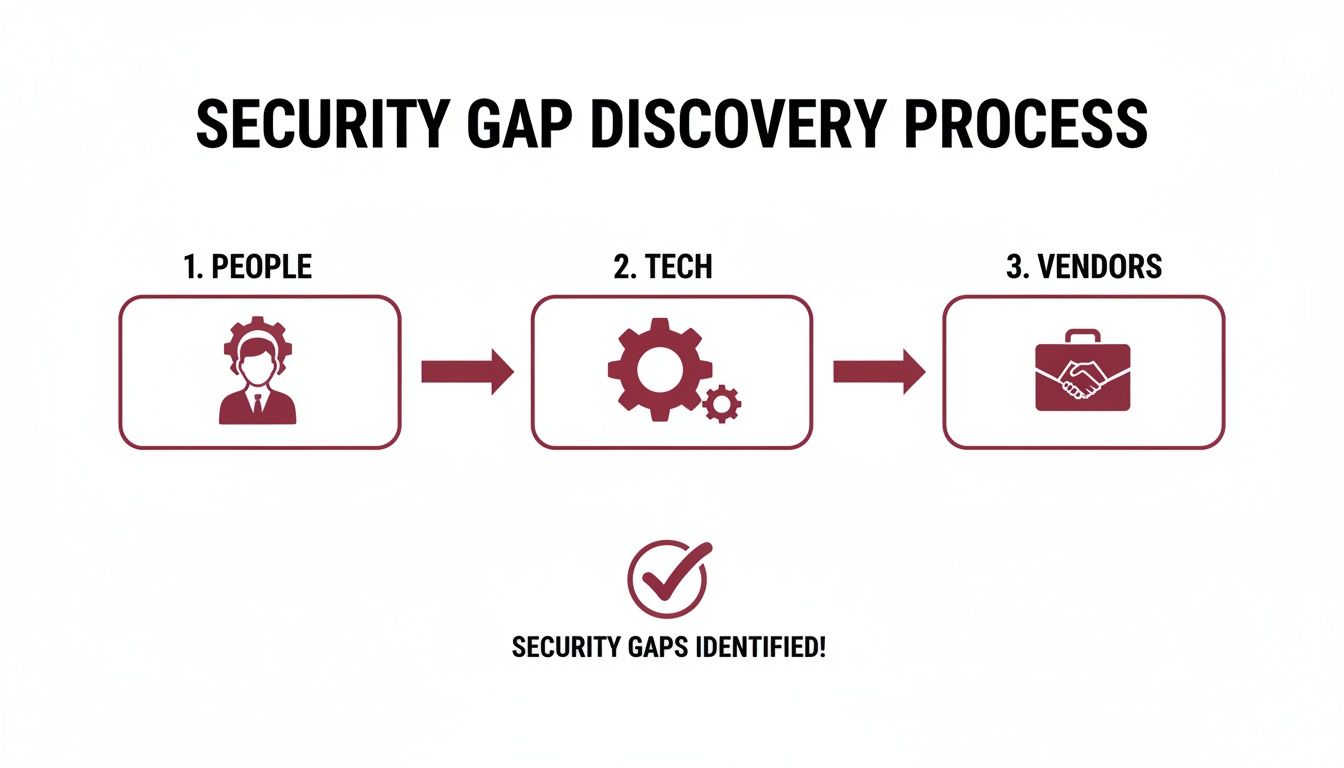
This diagram shows a simple way to think about finding those security gaps. By looking at each of these three pillars, you can start to see where your business is most exposed.
Stage 1: Foundational Fortifications
This first stage is all about covering the absolute non-negotiables. These are the fundamental controls that give you the biggest security bang for your buck. Think of this as locking the doors and windows of your business—it’s the essential first move that puts off casual, opportunistic attackers.
Multi-Factor Authentication (MFA): If you only do one thing from this list, make it this one. MFA is like adding a second, unique deadbolt to your digital doors. It demands another form of proof (like a code sent to your phone) on top of a password. This simple step makes it dramatically harder for criminals to get in, even if they manage to steal a password. A staggering number of breaches could be stopped by this control alone.
Automated Data Backups: Your data is your business's lifeblood. Regular, automated backups are your ultimate safety net against everything from ransomware attacks to simple hardware failure. Make sure you have at least one copy of your critical data stored offline or in a completely separate, secure cloud location. Just as important: test your recovery process every now and then to be certain it actually works when you need it.
Engaging Employee Security Training: Your team is your first and most important line of defence. But training can't be a dull, once-a-year slideshow. To be effective, it needs to be continuous and engaging, focusing on real-world skills like how to spot a convincing phishing email, create strong passwords, and who to call the second something feels off.
Stage 2: Intermediate Shields
Once you’ve got the basics locked down, it’s time to build out your defences with more structured policies and clear plans. This is where you shift from basic protection to proactive risk management. You’re no longer just locking the doors; you’re installing an alarm system and deciding exactly who gets a key.
A classic mistake small businesses make is thinking they're "too small" for formal policies. But even a simple, written-down rule is infinitely more effective than an unwritten assumption. A clear policy gets rid of any confusion and sets a consistent security standard for the whole team.
Here's what to focus on in this stage:
Implement Access Control Policies: Stick to the principle of least privilege. All this means is that people should only have access to the data and systems they absolutely need to do their jobs. A sales team member probably doesn't need access to payroll records, and there's no reason a short-term contractor should have full administrator rights.
Draft a Simple Incident Response Plan: What’s the plan when an attack actually works? Panic isn't a strategy. An incident response plan is your playbook for a crisis, laying out who to call, what steps to take, and how to communicate with staff and customers. Even a basic one-page plan is a world better than having nothing at all.
Establish a Patch Management Process: Outdated software is one of the biggest open invitations for attackers. Set up a simple process to make sure all your software—from your computer operating systems to your everyday apps—is updated quickly as soon as security patches are released.
Stage 3: Advanced Reconnaissance
With solid foundations and smart policies in place, the final stage is about adopting a more forward-looking security mindset. This is where you start actively looking for threats before they can do any damage. For most small businesses, this doesn't mean hiring a dedicated security team; it's about using smart tools and staying in the loop.
At this level, you’re ready to introduce concepts like continuous monitoring. This might involve using security software that actively scans your network for anything unusual or subscribing to threat intelligence services that are relevant to your industry. The goal is to spot the early warning signs of an attack—like strange login attempts from another country or unusual data transfers—and jump on them immediately.
This proactive stance is what truly separates a resilient business from an easy target.
How ISO 27001 Creates a Bulletproof Security System
There comes a point in every growing business when putting out security fires just isn't enough. You move past reactive fixes and realise you need a proper, professional strategy. This is where you graduate from just patching holes to building a fortress. This is where ISO 27001 comes in, offering a world-class framework for robust cybersecurity for small businesses.
Don't let the name intimidate you. Forget any idea of ISO 27001 being some rigid, soul-crushing checklist. It’s better to think of it as the architectural blueprint for your entire security operation. It’s not a list of rules to follow blindly; it’s a strategic management system designed to protect your most valuable asset: your information.

At its core, ISO 27001 is all about creating and running an Information Security Management System (ISMS). Think of an ISMS as the central nervous system for your security—a complete framework that weaves policies, procedures, and practical controls into the very fabric of your day-to-day operations.
The Blueprint for Your Digital Fortress
Imagine you’ve been hired to build a high-tech vault for priceless jewels. You wouldn't just show up with a pile of bricks and hope for the best. You'd start with a detailed architect's plan covering every angle, from the strength of the foundation to the locks on the doors and the surveillance systems.
That's exactly what an ISMS built on the ISO 27001 standard does for your data.
It gives you a structured, repeatable way to manage information security, making sure nothing gets missed. The whole system is built on a continuous cycle: plan, implement, check, and improve. It’s a loop that turns security from a list of one-off tasks into a living, breathing part of your business culture, ensuring your defences evolve as new threats pop up.
Core Components of an ISO 27001 ISMS
So, what’s actually in this blueprint? An ISMS brings together every piece of your information security puzzle into one logical, powerful system. The main pillars are:
- Risk Assessment and Treatment: This is ground zero. You methodically identify potential security threats, figure out how likely they are to happen and what the damage would be, and then decide on a plan to deal with them.
- Security Policies and Objectives: Here, you set the ground rules. This means creating clear, documented policies on everything from how employees should use company tech to how you classify sensitive data. It gives everyone a clear direction.
- Implementing Security Controls: Based on your risk assessment, you put practical defences in place. These are your firewalls, access controls, encryption, and staff training programs—the real-world tools protecting your assets.
- Continuous Monitoring and Review: Security is never a "set it and forget it" job. An ISMS demands regular internal audits and management reviews to make sure your controls are working and to spot any areas for improvement.
This structure ensures your security efforts are always directly tied to your real-world business risks and goals.
By adopting ISO 27001, you're not just buying a product; you're adopting a management philosophy. It forces you to think about security strategically, making it a board-level conversation rather than just an IT problem. This shift is what creates true, long-term resilience.
Beyond Security: The Broader Business Benefits
While a rock-solid security posture is the main prize, getting ISO 27001 certified delivers powerful benefits that echo across your entire business. For a small business, it’s a massive competitive advantage that helps you punch well above your weight.
Honestly, for many organisations, ISO 27001 certification isn't a "nice-to-have" anymore—it's a ticket to the game.
- Winning New Business: Many large corporations and government departments simply won't work with suppliers who aren't ISO 27001 certified. Holding that certificate opens doors to major contracts you couldn't otherwise bid for.
- Building Unshakable Trust: Certification is a powerful, globally recognised signal to your customers. It tells them you are serious about protecting their data, building brand confidence in a very crowded market.
- Meeting Compliance Demands: ISO 27001 gives you a solid foundation for meeting all sorts of legal and regulatory rules, like Australia's Privacy Act, which simplifies your overall compliance headache.
- Improving Internal Processes: You'd be surprised what you find. The process of building an ISMS often shines a light on operational weak spots, helping you streamline how your business runs.
Ultimately, ISO 27001 moves your business from a state of hoping you’re secure to proving you are. It’s how you build a truly bulletproof system you can count on.
ISO 27001 Implementation Phases Simplified
Getting certified might seem complex, but it boils down to a structured journey. The table below outlines the key phases you'll go through, from the initial decision to ongoing maintenance.
| Phase | Key Activities | Anitech's Role |
|---|---|---|
| 1. Planning & Scoping | Define the scope of your ISMS. Secure management buy-in. Conduct a gap analysis against ISO 27001 requirements. | We facilitate workshops to define your scope, build the business case for leadership, and perform the initial gap analysis. |
| 2. Risk Assessment | Identify information assets, threats, and vulnerabilities. Analyse risks and evaluate their potential impact. | Our experts guide you through the risk assessment process using proven methodologies to ensure all key risks are identified. |
| 3. Control Implementation | Develop a Risk Treatment Plan. Implement the necessary security controls from Annex A. Create required policies. | We help you select and implement practical controls that fit your business, providing templates and hands-on support. |
| 4. Internal Audit | Conduct a full internal audit of the ISMS to check for compliance and effectiveness. | Anitech performs an independent internal audit, giving you a clear picture of your readiness for the certification audit. |
| 5. Certification Audit | Engage an accredited certification body for the Stage 1 (documentation review) and Stage 2 (implementation) audits. | We prepare you for the audits, assist with auditor communication, and help address any findings (non-conformities). |
| 6. Continual Improvement | Maintain and improve the ISMS through regular reviews, monitoring, and corrective actions. | We provide ongoing support, managed services, and guidance to ensure your ISMS evolves and you maintain certification. |
Each phase builds on the last, creating a comprehensive and resilient security framework. With expert guidance, the path to certification is clear and manageable, turning a complex standard into a powerful business asset.
Your Essential Cybersecurity Action Checklist
Alright, let's move from theory to action. This is your get-it-done guide—a straightforward checklist you can start using today to immediately beef up your defences against cyber threats.
We’ve broken down the crucial steps into three key areas: the tech you use, the rules you follow, and the training you give your team. Think of this as your starting line for better cybersecurity for small businesses.
Technical Controls You Can Implement Now
These are the digital locks, alarms, and reinforced doors for your business. Putting these technical controls in place creates a tough first line of defence that can stop most opportunistic and automated attacks dead in their tracks.
Activate Multi-Factor Authentication (MFA) on All Critical Accounts: If you do only one thing from this list, make it this one. MFA demands a second proof of identity, like a code from your phone, which makes a stolen password practically useless. Get it switched on for your email, banking, and cloud storage accounts first.
Enable Automatic Software Patching: Outdated software is like leaving a window wide open for criminals. Turn on automatic updates for your operating systems, web browsers, and key business apps. This ensures security holes are plugged the moment a fix is released.
Deploy Endpoint Protection: Make sure you have reputable anti-malware and antivirus software running on all company devices—laptops, desktops, and even mobile phones. It acts as a 24/7 guard against nasty files and suspicious activity.
Use a Firewall: Your network and every device connected to it should be protected by a properly configured firewall. It acts as a gatekeeper, blocking dodgy traffic from getting into your network or sensitive data from getting out.
Operational Policies That Build Resilience
Great security isn't just about software; it's woven into the fabric of your daily operations. These policies help build consistent, secure habits across your entire organisation, dramatically cutting down the risk of human error.
"A security policy is not a document that sits on a shelf. It is a living guide that shapes secure behaviour every single day. Without clear policies, your team is simply guessing, and in cybersecurity, guessing is a losing strategy."
A clear set of rules takes the guesswork out of security and makes sure everyone knows their role in protecting the business. For a great summary of protective measures, check out these essential cybersecurity tips for small businesses.
Key Policies to Establish:
Develop a Strong Password Policy: Insist on long, complex, and unique passwords for every single business system. A password manager can make this much easier for your team to handle securely.
Establish a Data Backup and Recovery Plan: This is your ultimate safety net. Figure out what data needs backing up, how often, and where it will be stored. A good rule of thumb is the 3-2-1 rule: three copies, on two different types of media, with one copy stored off-site. Most importantly, test your backups regularly to make sure you can actually restore them.
Create a Simple Incident Response Plan: When a breach hits, panic is not a plan. Even a basic one-page document outlining who to call and what to do first is invaluable. Knowing how to react is half the battle. You can learn more in our guide on building a robust incident response plan.
Team Training That Creates Human Firewalls
Your employees are your greatest asset, but without proper training, they can also be your biggest vulnerability. Smart, ongoing education turns your team from a potential weak link into your most vigilant line of defence.
Conduct Regular Phishing Simulations: The best way to learn how to spot a dodgy email is by seeing them in a safe environment. Sending simulated phishing emails tests your team's awareness and provides a gentle, teachable moment for those who click.
Schedule Annual Security Awareness Training: Get everyone together for mandatory training that covers current threats, your company's security policies, and best practices. The key is to keep it engaging and directly relevant to their day-to-day work.
Promote a "When in Doubt, Shout Out" Culture: This is huge. You need to create an environment where employees feel comfortable reporting anything that looks suspicious, without any fear of getting into trouble. It's far better to check out a dozen false alarms than to miss the one real threat that could take your business down.
Your Top Cybersecurity Questions, Answered
Even with a clear plan, it's natural to have questions. Stepping up your cybersecurity for small businesses often brings up practical worries about costs, priorities, and where to even begin. Let's walk through the most common questions we hear from business owners, with straightforward answers to help you move forward.
How Much Should I Actually Budget for Security?
This is the million-dollar question, but thankfully, the answer doesn’t have to be a seven-figure sum. There’s no magic percentage that fits every business. Your needs will always depend on your industry, the kind of data you handle, and the specific threats you face. A much better approach is to think about your security spending in layers.
Start by focusing on the foundational, high-impact investments. This means getting the essentials right: a reliable endpoint protection service (think antivirus, but smarter), a good password manager for your team, and maybe a small budget for phishing simulation training. The initial outlay for these is often surprisingly low, but the return you get in reducing your risk is massive.
As your business grows, your budget can scale up to include more sophisticated measures. The trick is to tie your spending directly to your biggest risks. A proper risk assessment is the best tool for this, as it forces you to spend every dollar where it will have the biggest impact.
Don't ask, "What's the average security budget?" Instead, ask, "What are my most critical assets and my biggest threats?" Answering that second question practically builds your budget for you, ensuring your investment is smart and effective.
This risk-based approach stops you from wasting money on shiny new tools you don't need, while making sure your most vital operations are properly protected.
I'm Overwhelmed—Where Do I Even Start?
Feeling overwhelmed is completely normal. Cybersecurity can feel like a mountain to climb. The secret is to ignore all the noise and focus on the single most powerful action you can take right now: enforce Multi-Factor Authentication (MFA) everywhere you possibly can.
Think about all the places your team accesses company information—email, cloud storage like Google Drive or Dropbox, accounting software, social media accounts. Your absolute first priority is to switch on MFA for every single one of them. It is, without a doubt, the most effective way to stop criminals from getting into your accounts.
Once you’ve got MFA sorted, your next two priorities should be:
- Set up a reliable backup system. Make sure your critical data is being backed up automatically, and just as importantly, test the restore process to be certain it actually works when you need it.
- Run some basic security awareness training. Teach your team how to spot a dodgy phishing email and get them on board with using strong, unique passwords.
If you can master these three things—MFA, backups, and basic training—you'll have wiped out a huge chunk of the risk your business faces every day.
Do I Really Need Certifications for Government Tenders?
The short answer is: more and more, yes. As government agencies and large corporations tighten their own security, they're starting to demand the same from their suppliers. Winning those bigger contracts, especially in sectors like defence, health, or finance, often means you have to prove your security is up to scratch.
While the specific requirements can vary, a certification like ISO 27001 is fast becoming a non-negotiable prerequisite. Having that certification acts as a powerful signal to potential clients that you're a trusted and secure partner, often putting your proposal straight to the top of the pile.
Even when it's not officially required, showing that you follow a recognised security framework can give you a serious competitive edge. It demonstrates that you take this stuff seriously, which builds a huge amount of confidence.
How Can I Get Expert Help with a Small Team and Budget?
A lot of small business owners think expert help is out of reach, but that's a common misconception. You don't need to go out and hire a full-time Chief Information Security Officer (CISO) to get top-tier advice. There are a few really smart ways to get the expertise you need.
- Consulting Services: Bringing in a consultant for a specific project—like running a risk assessment or guiding you through your ISO 27001 certification—is incredibly efficient. You get world-class expertise exactly when you need it, without the long-term overhead.
- Managed Security Service Providers (MSSPs): Think of these as your outsourced security team. For a predictable monthly fee, they can handle the heavy lifting like monitoring your network for threats and responding to incidents.
- Virtual CISO (vCISO): A vCISO gives you high-level strategic leadership on a part-time or fractional basis. It's the perfect model for a small business that needs direction but doesn't need a full-time executive.
These options make expert-level cybersecurity for small businesses genuinely accessible and affordable. It frees you up to focus on running your business, with the peace of mind that your security is in capable hands.
Navigating the path to becoming a secure and compliant business is a challenge, but you absolutely don't have to do it alone. At Anitech, we specialise in making the ISO 27001 certification process straightforward for Australian small businesses. Our expert consultants provide the hands-on support and guidance you need to build a rock-solid security system, win bigger contracts, and protect what you've worked so hard to build.
Ready to turn your security posture into a competitive advantage? Learn more about how Anitech can guide you to ISO 27001 certification.
Recent Comments