

Sydney has become a serious hotspot for cybersecurity jobs, with a constant, almost insatiable, demand for skilled professionals across every specialisation imaginable. This isn't just a coincidence. The city's standing as Australia's financial and tech capital has created a perfect storm of opportunity for anyone looking to kickstart or accelerate a career in digital defence.
Why Sydney is the Epicentre of Australia's Cyber Boom

Sure, Sydney has the world-famous harbour and stunning beaches, but it’s also rapidly cementing its reputation as the command centre for Australia's entire cybersecurity industry. We're seeing an unprecedented surge in demand for talented people who can shield businesses, government agencies, and critical infrastructure from the relentless barrage of digital threats. This isn’t just a passing trend; it's a fundamental shift that positions Sydney as the top destination for a rewarding career in cyber defence.
This explosive growth is being fed by a unique mix of factors, all converging to create an incredibly vibrant and dynamic ecosystem. Think of it as several powerful currents meeting to generate huge momentum in the job market. Getting a handle on these forces is the first step to plotting your own course to success.
The Perfect Storm of Opportunity
The demand for cybersecurity jobs in Sydney is anything but accidental. It’s the direct result of a powerful trio of economic, governmental, and corporate drivers all pushing in the same direction. This convergence has created a strong, sustainable job market that shows no signs of hitting the brakes.
At its heart, this boom is built on three key pillars:
- Massive Private Sector Investment: As Australia's financial heartland, Sydney is home to the HQs of major banks, insurers, and fintech disruptors. These organisations are pouring billions into shoring up their digital defences, creating a constant need for analysts, engineers, and consultants.
- Government Initiatives and Defence Spending: Both the NSW and Federal governments have flagged cybersecurity as a top national priority. Huge investment in cyber resilience programs, coupled with the presence of key defence contractors in and around Sydney, creates a steady flow of high-stakes, mission-critical roles.
- A High Concentration of Digital-First Businesses: Sydney is packed with tech companies, e-commerce giants, and creative agencies that live and breathe online. For these businesses, strong cybersecurity isn't a "nice to have"—it's a matter of survival, which keeps the hiring engine running hot.
This unique blend means the variety of opportunities is staggering. One day you could be applying for a role protecting a major international bank; the next, you could be interviewing with a fast-growing tech startup that’s building the next big thing.
The sheer concentration of finance, tech, and government operations in Sydney creates a self-perpetuating cycle of demand. As one sector invests more in cyber defence, it raises the security bar for everyone, compelling others to follow suit and hire more talent.
Why Now Is the Ideal Time
Timing really is everything, and right now represents a golden window for anyone thinking about a cybersecurity career in Sydney. The market is mature enough to offer stability and impressive salaries, yet it’s still growing fast enough to provide plenty of room for rapid career progression. Put simply, there’s a recognised skills shortage, which puts qualified candidates squarely in the driver's seat.
This guide is your roadmap. We’re going to go beyond just listing jobs and give you a clear, actionable plan to navigate this exciting field. You'll get a deep understanding of the roles on offer, the salaries you can command, the skills you need to develop, and the strategies required to land that dream job. The opportunities are right here, and this guide will show you exactly how to grab them.
The Driving Forces Behind Sydney's Cyber Job Market
Sydney's emergence as a cybersecurity powerhouse isn't some happy accident. It's the result of a perfect storm—a powerful blend of national strategy, private sector ambition, and an ever-evolving threat environment. Understanding what's fuelling this demand is the key to seeing the real, long-term potential of cybersecurity jobs in Sydney.
Think of the job market as a high-performance engine. It needs fuel to run, and right now, it's getting a premium blend from three main sources: top-down government policy, relentless business innovation, and the cold, hard reality of cyber threats. Each one feeds the others, creating a self-sustaining cycle of growth that defines the city's entire cyber scene.
This infographic breaks down the three core drivers pushing Sydney’s cybersecurity job market forward.
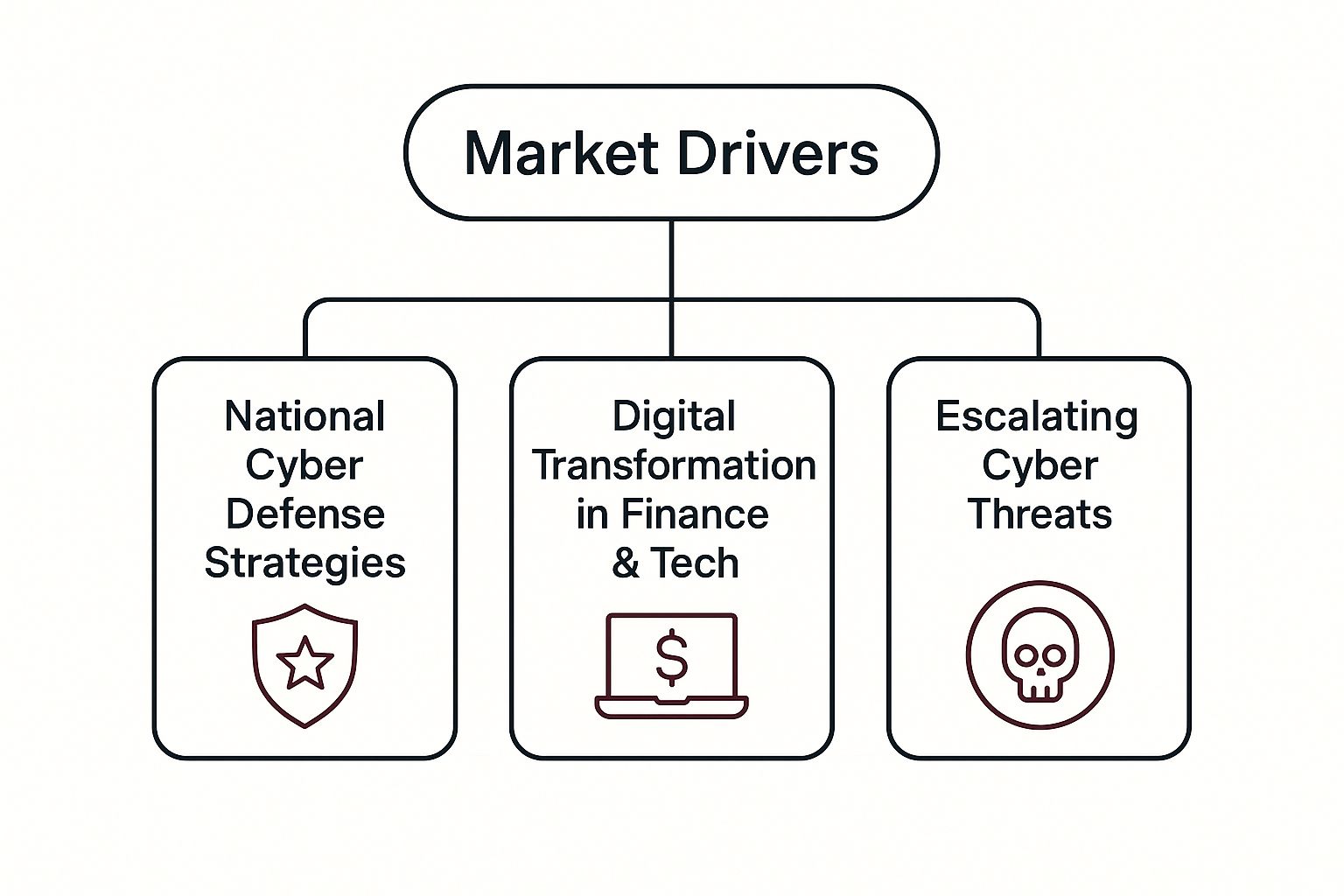
As you can see, it's a convergence of top-down strategy from Canberra, industry-led innovation from the ground up, and the constant pressure of real-world security needs that all come together to create jobs.
National Cyber Defence Strategies
At the very top, the Australian government has drawn a line in the sand, declaring cybersecurity a matter of national and economic security. This isn't just talk; it's translating directly into well-funded initiatives, tougher regulations, and a clear message for businesses to get their digital houses in order.
This national push is the foundation for job growth. When the government mandates higher security standards for critical infrastructure—think energy grids, banks, and telcos—it instantly creates a need for compliance officers, security architects, and policy advisors to make it happen.
The government's strong stance on cyber resilience sends a clear signal to the market. It tells every business that security isn't just an IT budget line item anymore; it's a fundamental cost of operating in Australia. That alone is a massive catalyst for hiring across Sydney.
These strategies also pump serious money into national cyber defence agencies and partnerships with private companies. This creates high-value government roles based in Sydney and a steady stream of contract work for the private firms they partner with, building a solid public-private employment pipeline.
Digital Transformation in Core Industries
Let's be clear: Sydney is the undisputed heart of Australia’s finance and tech industries. These sectors are in a constant state of flux, shifting to the cloud, embracing AI, and building incredibly complex digital products. Every single one of these moves creates new security headaches.
Take a major bank moving its core systems to the cloud. They don't just need cloud engineers; they need cloud security specialists who live and breathe the unique threats of that environment. Or consider a fintech startup building a new payment app—they absolutely need application security experts baked into the process from day one to protect customer data.
This constant evolution means the demand for cyber talent isn't a temporary spike; it's the new normal. The key sectors driving this are:
- Financial Services: Banks, insurers, and investment firms are the number one target for cybercriminals, which is why they have some of the largest and most sophisticated internal security teams.
- Technology and Startups: Sydney's fast-growing tech companies are building security directly into their products, creating huge demand for security-minded developers and DevSecOps engineers.
- Critical Infrastructure: Energy, water, and transport operators are connecting their industrial systems to the internet, opening a whole new front that requires specialists in industrial control system (ICS) security.
Escalating and Sophisticated Cyber Threats
The most immediate and urgent driver for cybersecurity jobs in Sydney is, without a doubt, the threat itself. Attacks are getting more frequent, more clever, and far more damaging. High-profile data breaches aren't distant news stories anymore; they're hitting Australian companies and consumers with alarming regularity.
This relentless pressure is forcing organisations to shift from a reactive to a proactive mindset. They simply can't afford to wait for a breach to happen. They have to invest in people who can see threats coming, find the weaknesses, and shut the door before disaster strikes. You can learn more about how businesses are adapting by checking out our guide on protecting your organisation and employees from escalating cyber threats.
This has lit a fire under the demand for very specific roles:
- Threat Intelligence Analysts: The fortune-tellers of the cyber world, who analyse data to predict where the next attack will come from.
- Penetration Testers (Ethical Hackers): Experts hired to think like the bad guys, break into systems, and find the holes before criminals do.
- Incident Responders: The digital paramedics who rush in when a breach is detected to stop the bleeding and minimise the damage.
This perfect storm of regulation, innovation, and real-world threats is causing Sydney’s job market to expand at a breakneck pace. With over 47 million data breaches reported nationally in 2024, the urgency for skilled professionals has never been greater. The Australian cybersecurity market is forecast to hit USD $8.4 billion in 2025 and is tipped to grow at a staggering 18.44% annually, potentially reaching USD $19.57 billion by 2030. This explosive growth is what makes Sydney the epicentre of opportunity for cyber careers right now.
What Are the Top Cybersecurity Roles in Sydney?

To really get a handle on the cybersecurity jobs Sydney has on offer, you need to look past the generic job titles. The city’s bustling market isn’t just one big thing; it’s a mosaic of highly specialised fields, each calling for a unique set of skills to solve very different problems. From the digital detectives on the front lines to the big-picture thinkers shaping security policy, there’s a role for almost any kind of mind.
This is your field guide to the most common gigs out there. We’ll get into what these professionals actually do all day, the real-world problems they solve, and which Sydney industries are snapping them up.
The Digital Guardian: Security Analyst
Think of a Security Analyst as a digital guard on patrol in a high-tech facility, glued to the surveillance feeds and watching for any sign of trouble. They are the first line of defence, spending their days inside Security Information and Event Management (SIEM) platforms, which pull in log data from every corner of an organisation's network.
Their main job? To spot, investigate, and shut down security incidents. When an alert flashes—maybe a user logging in from a weird location or a server talking to a known malicious address—the analyst jumps into action. They dig into the threat, figure out how bad it is, and kick off the process to contain the damage.
- Who's Hiring: You'll find them everywhere. Major banks in Martin Place, big retail companies, and managed security service providers (MSSPs) across the CBD are always looking for sharp analysts.
- Key Challenge: Their biggest battle is filtering out the noise. A large company can generate millions of security events a day, so an analyst needs sharp instincts to tell a real threat from a harmless false alarm.
The Ethical Hacker: Penetration Tester
Penetration Testers, or 'pentesters,' are the good guys paid to think and act like the bad guys. Their job is to legally and ethically hack into a company's systems to uncover vulnerabilities before criminals do. They're like digital locksmiths, testing every door, window, and hidden entry point to find the weak spots.
A typical project might see them trying to break into a new mobile banking app, find flaws in a corporate website, or even try to get physical access to a secure building. Afterwards, they write up a detailed report showing the vulnerabilities they found, how they exploited them, and—most importantly—how the company can fix them.
Penetration testing isn't just about breaking things; it's about building stronger defences. By finding and closing security gaps first, pentesters give organisations the vital intel they need to stay ahead of real-world attackers.
The demand for these skills is massive. As of 2025, Sydney is a key hub for cybersecurity in Australia, with over 500 job openings in the city alone. These roles range from junior positions like Security Code Reviewers to senior gigs like Red Team Penetration Leads. Employers are pulling out all the stops, offering great salaries, hybrid work arrangements, and even visa sponsorships to get the best people.
The Cloud Custodian: Cloud Security Engineer
With so many Sydney businesses moving their operations to cloud platforms like Amazon Web Services (AWS), Microsoft Azure, and Google Cloud, a new kind of expert has become indispensable. A Cloud Security Engineer is a hybrid, mixing deep knowledge of cloud architecture with a solid security mindset.
Their role is to design, build, and run a secure cloud environment. That means configuring access rules, setting up virtual private clouds (VPCs), encrypting data, and making sure everything complies with industry regulations. They're the architects making sure the digital fortress is just as strong in the cloud as it is on the ground. This job requires a forward-thinking approach, as they're not just securing servers in a rack anymore—they're protecting a fluid, software-defined infrastructure that can change in an instant.
The Strategic Advisor: GRC Consultant
Not every cybersecurity job is purely technical. Governance, Risk, and Compliance (GRC) Consultants work at the crossroads of security, business strategy, and the law. They help organisations build security programs that not only protect them but also align with business goals and meet legal requirements.
A GRC Consultant might be hired by a financial firm to ensure its operations are compliant with APRA standards or help a healthcare provider protect patient data according to privacy laws. They conduct risk assessments, write security policies, and get companies ready for big certifications like ISO 27001. If this strategic path sounds interesting, learning about the role of a cyber security consultant is a fantastic place to start. These professionals are master communicators, able to explain complex security risks to executives in plain English.
To give you a clearer picture, here's a quick look at where these roles typically fit within Sydney's major industries.
Popular Cybersecurity Roles in Sydney and Key Responsibilities
| Job Role | Primary Responsibilities | Common Industries |
|---|---|---|
| Security Analyst | Monitoring networks, investigating alerts, and responding to incidents. | Finance, Retail, Government |
| Penetration Tester | Proactively finding and exploiting vulnerabilities in systems and applications. | Tech Startups, Consulting Firms |
| Cloud Security Engineer | Designing and implementing security controls within cloud environments. | FinTech, E-commerce, SaaS |
| GRC Consultant | Aligning security strategy with business goals and regulatory compliance. | Banking, Healthcare, Professional Services |
Each of these roles is a crucial piece of the cybersecurity puzzle. Whether you get a thrill from hunting down threats or enjoy the strategic challenge of building resilient security programs, the wide range of cybersecurity jobs in Sydney offers a clear path to a fascinating and rewarding career.
What Can You Earn in Sydney’s Cybersecurity Scene?
Let's get straight to the point: a career in cybersecurity in Sydney is financially rewarding. But knowing exactly what you can expect to earn is crucial. It’s not just about paying the bills; it’s about understanding your market value so you can negotiate with confidence and build a lucrative career.
Sydney is a major hub for finance, tech, and global corporations. This creates a relentless demand for top-tier cybersecurity talent, and that competition drives salaries up. Put simply, companies are willing to pay a premium to protect their most valuable assets.
Breaking Down the Pay Packet
So, what do the numbers actually look like? In 2025, the figures are impressive and show a clear ladder of earning potential as you gain more experience.
Recent data paints a very compelling picture. The average salary for a cybersecurity professional in Sydney hovers around AUD $118,000 per year. But that's just the starting line. Experience is the real game-changer. Someone just starting out might begin around AUD $142,310, while a mid-level pro can expect to earn an average of AUD $162,640. For the seasoned experts—the specialists leading teams and shaping strategy—salaries often climb past AUD $193,670.
It's also important to remember that these are just base figures. They don't include bonuses, superannuation, or other perks, which can add a significant chunk to your total annual earnings.
While Brisbane might have a slightly higher average nationally for now, Sydney’s position as Australia's financial and tech capital keeps it firmly at the top for high-paying cybersecurity roles.
Sydney Cybersecurity Salary Benchmarks by Experience Level
To give you a clearer idea, here's a quick overview of what you can expect to earn at different stages of your career in Sydney.
| Experience Level | Typical Annual Salary Range (AUD) |
|---|---|
| Entry-Level (0-2 years) | $142,310 – $155,000 |
| Mid-Level (3-7 years) | $155,000 – $180,000 |
| Senior-Level (8+ years) | $180,000+ |
As you can see, the rewards for sticking with it and building your expertise are substantial.
Experience: The Ultimate Salary Booster
In Sydney's cybersecurity market, experience isn't just a number on your resume—it's your most valuable asset. It's the single biggest factor that separates a junior analyst's pay from a senior executive's package. The market pays top dollar for professionals who have been in the trenches and have a proven track record of deflecting threats.
Let's look at what this means in practice:
- Entry-Level (0-2 years): At this stage, you're all about learning. You might be a Junior Security Analyst sifting through alerts or a Helpdesk team member with a security focus. Your value is your potential and your hunger to grow.
- Mid-Level (3-7 years): You’re now a reliable operator. You can tackle problems on your own, manage projects, and have probably started to specialise in an area like cloud security or penetration testing. Employers are paying for your proven skills.
- Senior/Lead (8+ years): You've become a strategic thinker. You’re not just fixing problems; you're preventing them before they happen. You could be leading a team, designing security architecture, or advising the C-suite on risk. Your salary reflects your massive impact on the business.
Here’s a pro tip: Your career growth isn't just about years of service. It's about the complexity of the problems you've solved. Keep a running list of your wins—that major incident you helped contain, the critical vulnerability you found. This is the evidence you'll use to justify a bigger salary at every step.
Once you have an offer in hand, knowing how to negotiate salary effectively is a skill that can make a huge difference to your bottom line in this competitive market.
The Specialisations That Attract the Biggest Offers
While every cybersecurity role in Sydney pays well, a few specialisations are in such high demand that they command a serious premium. If you're looking to maximise your earning potential, focusing your skills in these areas is a brilliant strategic move.
These roles often sit right at the intersection of emerging tech and critical business needs.
Top-Paying Specialisations:
- Cloud Security: As businesses scramble to move their operations to AWS, Azure, and Google Cloud, professionals who can lock down these environments are incredibly valuable. Cloud Security Architects and Engineers are some of the highest earners in the city.
- Application Security (AppSec/DevSecOps): Sydney’s tech and startup scene is booming, creating huge demand for experts who can weave security directly into the software development process. These pros help companies build secure products from the very first line of code.
- Threat Intelligence: Professionals who can analyse the ever-changing threat landscape and give organisations a heads-up before an attack even happens are highly prized by large corporations and government agencies.
- Offensive Security (Penetration Testing/Red Teaming): Ethical hackers are the good guys who think like the bad guys. Their ability to simulate real-world attacks to find weaknesses makes them indispensable, especially in the finance and consulting sectors.
It's More Than Just the Base Salary
An offer for a cybersecurity job in Sydney is rarely just a single number. The city's top employers are in a constant battle for talent, and they use a whole range of benefits and bonuses to make their offers more appealing.
When you're looking at an offer, make sure you consider the entire compensation package.
- Performance Bonuses: Often tied to your and the company's performance, these are common in tech and finance and can add a juicy 10-25% (or more) to your annual income.
- Superannuation: The legal minimum is 11%, but many top-tier employers offer more generous contributions, giving a nice boost to your long-term savings.
- Training & Certifications: A dedicated budget for your professional development is a massive perk. It's a direct investment in your future skills and earning power.
- Flexible Work: A hybrid or fully remote arrangement isn't just convenient; it saves you money on commuting and gives you a much better work-life balance.
Getting a handle on these benchmarks and the factors that influence them is the first step toward getting paid what you're worth. In a market as fast-moving as Sydney's, knowledge isn't just power—it's profit.
What Sydney Employers Really Want: The Essential Skills
Knowing the roles and salaries is a great start, but to actually land one of the top cybersecurity jobs Sydney has to offer, you need the right tools in your toolkit. We’re not just talking about software. The city’s employers, from the big banks in Barangaroo to the scrappy startups in Surry Hills, are hunting for a specific mix of deep technical know-how and razor-sharp personal skills.
They don't just want someone who can run a script; they want a professional who thinks on their feet, adapts to the unknown, and can actually talk to other humans.
Think of it like being a top-tier surgeon. You need the technical skill to perform the operation (your hard skills), but you also need the calm bedside manner and clear communication to explain the procedure to the patient and their family (your soft skills). Nailing this combination is what separates a decent candidate from an unforgettable one.
This section is your roadmap. We’ll cut through the noise and show you the non-negotiable technical skills, the soft skills that will make you stand out, and the industry certifications that Sydney hiring managers actually care about.
Foundational Technical Skills
These are the absolute fundamentals. While every role has its specialisation, a solid grasp of these core concepts is your ticket to the game. It's the language you need to speak to be taken seriously in any technical interview in this city.
- Network Security and Defence: You have to understand how data moves and how to protect it in transit. This means being comfortable with firewalls, intrusion detection and prevention systems (IDS/IPS), and VPNs. It’s all about building and defending the digital walls of the castle.
- Cloud Security Expertise: With almost every business in Sydney running on AWS, Azure, or Google Cloud, this isn't a "nice-to-have" anymore—it’s a must. Employers need people who can lock down cloud environments, wrangle Identity and Access Management (IAM), and tackle the unique security puzzles of containers and serverless tech.
- Threat Intelligence and Analysis: This is the art of seeing the attack before it lands. It’s about getting inside the head of an attacker, understanding their tactics, techniques, and procedures (TTPs), and using that insight to build proactive defences. This skillset is the backbone of identifying and neutralising cyber threats through threat hunting, a function that every mature security team now relies on.
Without a strong footing in these areas, building a long-term career is going to be an uphill battle.
The Soft Skills That Clinch the Deal
If your technical skills get you the interview, it’s your soft skills that will get you the offer—and the promotions down the line. Sydney employers are putting a huge emphasis on these traits because they dictate how well you’ll actually perform as part of a team.
When things go wrong, your ability to communicate clearly under pressure is just as valuable as your ability to reverse-engineer malware.
A common trap candidates fall into is just listing their tech certs. Honestly, we’d often rather hire the person who can explain a complex risk to a non-technical executive than the one who can only recite acronyms. Communication is the crucial bridge between the security team and the rest of the business.
Here are the soft skills that hiring managers in Sydney are constantly asking for.
Strategic Communication
You need to be a translator. A huge part of the job is explaining a deeply technical security risk to a marketing director or a CFO who just wants to know the bottom line. You have to drop the jargon and articulate the "so what?"—the real-world business impact of a vulnerability—in a way that makes sense to everyone.
This is make-or-break in situations like:
- Incident Response: Keeping executives calm and updated during a crisis.
- Security Awareness Training: Actually engaging staff so they learn to spot phishing emails.
- Budget Approvals: Justifying the spend on a new security tool by tying it directly to protecting revenue or reputation.
Complex Problem-Solving
Cybersecurity is basically solving a puzzle where the pieces are always changing, half of them are missing, and you don’t have the picture on the box to guide you. A great security professional is relentlessly curious. They don’t just accept the first answer; they keep digging.
This means seeing a security alert not just as a ticket to close, but as a symptom of a potentially bigger problem. It’s about having the critical thinking to find the root cause, not just following a script.
Teamwork and Collaboration
The idea of the lone hacker in a dark room is a Hollywood cliché. Real-world cybersecurity is a team sport. Security teams in Sydney are deeply embedded with IT operations, software developers, legal teams, and more.
You absolutely must be able to share information, listen to other perspectives, and work toward a common goal. This is especially true in modern DevSecOps cultures, where security is a shared responsibility, not just one team's problem.
Industry Certifications That Open Doors in Sydney
Think of certifications as your professional credentials. They are a clear signal to employers that your skills have been validated against a recognised industry benchmark. While hands-on experience will always be king, the right certs on your CV can be the difference between getting screened out by HR and landing that first interview.
Looking at current listings for cybersecurity jobs in Sydney, these are the certifications that consistently pop up.
Foundational Certifications (For Getting Your Foot in the Door)
| Certification | What It Proves | Best For |
|---|---|---|
| CompTIA Security+ | A solid, vendor-neutral grasp of core security principles. | Entry-level analysts, IT pros transitioning into security. |
| Certified Ethical Hacker (CEH) | You know the tools and methods attackers use, and how to defend against them. | Aspiring penetration testers and red team members. |
Advanced Certifications (For Levelling Up Your Career)
| Certification | What It Proves | Best For |
|---|---|---|
| CISSP | High-level strategic and management knowledge across the security landscape. | Security managers, architects, and senior consultants. |
| CISM | Expertise in security governance, risk management, and program strategy. | GRC analysts and future security leaders (CISOs). |
| Cloud-Specific (AWS/Azure) | Deep, hands-on expertise in securing a major cloud platform. | Cloud security engineers and architects. |
The key is to be strategic. Pick the certification that aligns with where you want to go. A CISSP is fantastic, but it won’t help much if your goal is to be a hands-on penetration tester. Focus your efforts on the credentials that will have the biggest impact on the specific career path you're chasing.
How to Land Your Next Cybersecurity Role in Sydney

Knowing the roles, salaries, and skills is the essential groundwork. Now it's time to build a strategy that actually gets you a job offer. Landing one of the top-tier cybersecurity jobs Sydney has on offer takes more than just firing off applications into the void.
You need a game plan. This means creating application documents that speak directly to Sydney's leading employers, networking with a clear purpose, and walking into interviews ready to prove your worth. This is where all your preparation finally meets opportunity.
Crafting a Resume That Cuts Through the Noise
Picture this: a hiring manager at a big Sydney bank has a stack of 100 resumes on their desk. Yours needs to grab their attention in seconds. A generic, one-size-fits-all CV is the fastest way to the rejection pile.
Think of your resume as a targeted marketing document. For every single job you apply for, you need to tweak it. Mirror the language and priorities in the job description. If they're screaming for cloud security skills, your cloud projects and certifications better be right at the top.
Your resume isn't just a history of what you've done. It's an argument for why you're the solution to their current problem. Every bullet point should be another piece of evidence.
Most importantly, put numbers on your achievements. Don't just say you "improved security." That's meaningless. Instead, say you "reduced security incidents by 15% by rolling out a new EDR solution" or "cut false positive alerts by 40% by fine-tuning SIEM rules." Hard numbers are powerful; they show tangible impact and get you noticed.
Perfecting Your Application Documents
Your resume is just one piece of the puzzle. Your cover letter and online presence are crucial for telling a compelling story and making a great first impression.
- The Cover Letter: This is your chance to show a bit of personality and connect the dots for the recruiter. Tell them why you're excited about this specific role at this specific company. Check out these essential cover letter examples to get some ideas.
- LinkedIn Profile: Make sure your LinkedIn profile is polished and perfectly aligned with your resume. Get a professional headshot and write a headline that immediately tells people what you do, like "Cybersecurity Analyst specialising in Threat Intelligence" or "Cloud Security Engineer | AWS & Azure."
All these elements need to work together to present a consistent, professional brand that employers are looking for.
Networking Within the Sydney Cyber Community
In a city like Sydney, the cybersecurity scene is surprisingly tight-knit. The truth is, the best opportunities for cybersecurity jobs in Sydney are often found through people, not just job boards. You absolutely have to build a network.
Start showing up at local industry events. Meetups, conferences, and seminars are goldmines for meeting peers, hearing about roles that haven't even been advertised yet, and getting your name out there for the right reasons.
Here are a few simple things you can do right now:
- Join Local Groups: Find Sydney-based cybersecurity groups on Meetup or LinkedIn. The Australian Information Security Association (AISA) has a very active Sydney chapter worth joining.
- Connect Online (The Right Way): Don't just send a bland connection request on LinkedIn. Personalise it. Mention a post they wrote, a shared interest, or a mutual connection.
- Go for Coffee: Ask a professional working in a company you admire if they'd be open to a 15-minute coffee chat. The insights you can gain are invaluable, and it could easily lead to a referral.
This isn't just about schmoozing; it shows you're genuinely invested in the industry and helps you build real relationships.
Nailing the Technical Interview
This is where the rubber meets the road. The technical interview is your chance to prove you've got the skills to back up everything on your resume. Sydney employers will put you through your paces with hands-on labs, deep-dive theoretical questions, or real-world problem-solving scenarios.
Preparation is everything. Don't just re-read your notes—get your hands dirty. Use online platforms to practice challenges specific to your field. If you're a pentester, jump on some Capture The Flag (CTF) platforms. If you're an analyst, walk through your investigation process for common attack vectors.
Get comfortable talking through your thought process out loud. Interviewers don't just want the right answer; they want to see how you think. Explain your assumptions, the steps you're taking, and why you're choosing one method over another.
Navigating Salary and Offer Negotiations
When that offer finally comes through, the last step is negotiation. Armed with the salary data we've already covered, you can walk into this conversation with confidence. Remember, the first offer is rarely the final offer.
Politely and professionally, make your case based on your experience, your skills, and the going market rate for similar roles in Sydney. If they can't budge on the base salary, don't forget to negotiate other perks.
Negotiable Perks to Consider:
- A higher performance bonus
- A bigger budget for training and certifications
- Extra annual leave days
- A formalised flexible or hybrid work agreement
By following this strategic plan, you'll be in a powerful position to chase down and land a fantastic cybersecurity job in Sydney, turning your career goals into reality.
Your Questions Answered: The Sydney Cyber Job Market
Thinking about a cybersecurity career in Sydney? It's a smart move, but you probably have a lot of questions. Let's tackle some of the most common ones I hear from people looking to break into or move up in the industry.
What are the best entry-level roles to look for?
If you're just getting your foot in the door, you’ll most likely be looking at roles like Security Analyst (Tier 1), Junior Penetration Tester, or Cybersecurity Support Officer.
These are brilliant starting points. You’ll be on the front lines, learning the ropes by monitoring security alerts, helping with incident response, and getting your hands on the core tools of the trade. Keep an eye out for graduate programs and entry-level intakes, especially from Sydney's big banks and managed security service providers (MSSPs).
Is a university degree a deal-breaker?
Honestly, not always. While a computer science or IT degree definitely helps, it's no longer the only way in. I've seen countless successful pros in Sydney who have jumped over from other IT roles, proving their skills with top-tier industry certifications and real-world projects.
More and more, hiring managers are looking for practical skills and a genuine hunger to learn.
The best thing you can bring to an interview isn't just a piece of paper. It's proof you live and breathe this stuff. A solid GitHub portfolio, a history of competing in Capture The Flag (CTF) events, or even a personal blog where you break down security topics can often tell a much more compelling story than a university transcript.
Which certifications will get me noticed in Sydney?
The right cert can absolutely make your CV stand out from the pile. Here’s a quick breakdown:
- For foundational skills: You can't go wrong with CompTIA Security+. It's widely respected and shows you've got the fundamentals down.
- For "red team" roles: If you want to get into offensive security, the Certified Ethical Hacker (CEH) or the notoriously tough OSCP are what employers look for.
- For senior-level ambitions: As you climb the ladder, the CISSP (Certified Information Systems Security Professional) is the gold standard. You'll see it listed as a 'highly desirable' credential on almost every senior or management job ad in Sydney.
How much does networking really matter here?
It's everything. The Sydney cyber community is tight-knit, and you'd be surprised how many of the best jobs are filled through word-of-mouth before they ever hit a job board.
Getting your face out there is non-negotiable. Start by attending local meetups—the Australian Information Security Association (AISA) hosts great events. Go to conferences, connect with people on LinkedIn (and actually talk to them!), and build those relationships. It’s the single best thing you can do to fast-track your career.
At Anitech, we're experts in helping businesses build powerful Information Security Management Systems. If your organisation is aiming for ISO 27001 certification to fortify its defences, our consultants are here to guide you. Find out more at https://iso-27001.com.au.
Recent Comments