

A data breach response plan is your business's definitive playbook for when a security incident occurs. It's a detailed, strategic guide that meticulously lays out how to handle a security breach from the moment it’s discovered. This plan answers the critical questions: who is responsible for what, what are the immediate steps to take, and how do we communicate effectively with all stakeholders involved? A solid, well-documented plan ensures a coordinated, swift, and effective reaction, which is paramount to minimising the damage from a data breach. The goal is to move from a state of chaotic reaction to a structured, controlled response.
Why Your Business Urgently Needs a Data Breach Response Plan Now
If you’re running a small to medium-sized business, it is an all-too-common misconception to think that cybercriminals exclusively target large corporations. The reality, however, is starkly different. Small businesses are frequently perceived as softer targets, precisely because their security measures may not be as robust or comprehensive as those of their larger counterparts. This perception, often accurate, makes a proactive and multi-layered defence strategy absolutely essential for survival in the modern digital landscape.
A data breach is not merely a technical problem that can be resolved by the IT department; it represents a full-blown business crisis that can irrevocably destroy customer trust, tarnish a hard-won reputation, and result in devastating financial penalties and legal liabilities. The consequences can ripple through every facet of your organisation, impacting operations, sales, and long-term viability.
Without a pre-established plan, chaos is not just a possibility—it is a guarantee. When an incident strikes, panic invariably sets in, and it is in this high-pressure, reactive state that costly and often irreversible mistakes are made. Who is the first person to call? Which systems should be immediately disconnected from the network? How do you inform customers about the breach without causing a mass panic, or worse, inadvertently admitting legal liability before all the facts are known? A well-thought-out data breach response plan provides clear, unambiguous answers to these pressing questions before the pressure-cooker environment of a live cyber-attack. It transforms what would be a frantic, disorganised scramble into a calm, measured, and methodical response.
The Soaring Cost of Unpreparedness in the Digital Age
The financial fallout from a data breach extends far beyond the immediate costs of fixing the IT systems. Business owners must contend with a cascade of expenses, including significant regulatory fines, mounting legal bills for advisory services and potential litigation, the operational cost of notifying every affected customer, and the often-overlooked but substantial impact of business downtime. For a small business operating on tight margins, these cumulative costs can quickly become insurmountable, posing a genuine existential threat to the company.
Even more damaging, in the long run, is the severe harm to your reputation. Customers entrust you with their sensitive personal information, and a data breach shatters that fundamental trust. Rebuilding that confidence is an arduous, years-long process, and many customers will simply choose to take their business elsewhere rather than risk their data with a company they perceive as insecure. The loss of customer loyalty can be a final, fatal blow.
A well-structured data breach response plan is your most critical defence mechanism against these threats. It acts as a comprehensive crisis roadmap, guiding your team through the essential phases of detection, containment, investigation, notification, and recovery without the panic and confusion that lead to irreversible errors and amplified damage.
Navigating Australia's Strict and Evolving Regulatory Environment
In Australia, preparing for a data breach isn't just a prudent business practice—it is a legal mandate. The regulatory landscape has tightened significantly in recent years, placing serious and non-negotiable obligations on any business, regardless of size, that handles personal information. The official statistics paint a very clear and sobering picture of this new reality, highlighting both the increasing frequency of breaches and the heightened scrutiny from regulatory bodies.
The introduction of the Notifiable Data Breaches (NDB) scheme in 2018 was a watershed moment for data privacy in Australia. Since it came into effect, the number of reported data breaches has skyrocketed by an incredible 712%. This dramatic increase reflects both a rise in cyber-attacks and a greater legal requirement for transparency. In a recent year, Australian organisations notified the Office of the Australian Information Commissioner (OAIC) of 1,113 data breaches—a significant 25% jump from the previous year and the highest annual total on record.
This surge in reported incidents underscores two critical points for every business owner: the threat landscape is becoming more dangerous, and the authorities are watching more closely than ever. It is essential to stay informed about the latest trends. You can dig deeper into these Australian data breach trends and their implications.
This chart breaks down the core phases of a data breach response, illustrating the journey from the initial alarm to the final stages of recovery and business resumption.
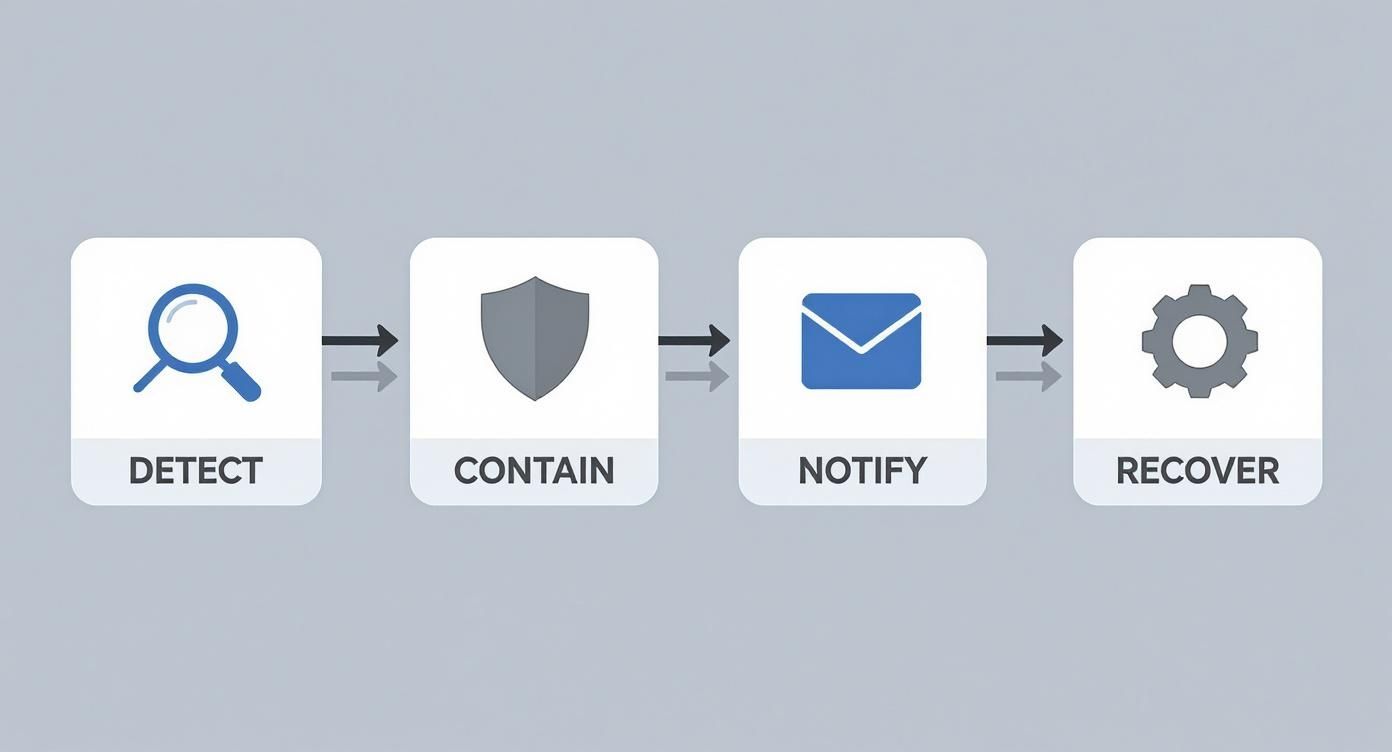
As you can see, a successful response is a logical, multi-stage journey, not a single, frantic action. It’s about moving methodically from identifying the problem to containing the damage, eradicating the threat, and ultimately restoring business operations to a secure state.
Here's a quick look at the fundamental stages of a data breach response plan. Understanding these distinct phases provides a clear and robust framework before we delve into the specific actions required for each one.
The Four Core Phases of Incident Response
| Phase | Primary Goal | Key Activities |
|---|---|---|
| Detection & Triage | To quickly identify a potential security incident and accurately assess its severity and scope. | Monitoring security alerts from various systems (firewalls, IDS/IPS, endpoint protection), analysing system and network logs, identifying affected systems and data, and classifying the incident's potential impact on the business. |
| Containment | To stop the breach from spreading further across the network and prevent additional data exfiltration or damage. | Isolating compromised systems from the network, disabling affected user accounts and services, blocking malicious IP addresses and domains at the firewall, and implementing emergency network segmentation. |
| Eradication & Recovery | To completely remove the root cause of the incident and safely restore normal business operations. | Removing malware and attacker persistence mechanisms, patching vulnerabilities, securely restoring data from clean backups, rebuilding compromised systems from scratch, and closely monitoring for any signs of re-infection. |
| Post-Incident Review | To learn from the incident, document lessons, and systematically improve the organisation's future security posture. | Conducting a thorough root cause analysis, documenting lessons learned in a formal report, updating security policies and procedures, refining the data breach response plan, and implementing new security controls. |
This framework isn't just about ticking boxes on a compliance checklist; it represents a proven, structured methodology for managing a crisis effectively, mitigating damage, and building long-term organisational resilience for the future.
Aligning With Global Best Practices Like ISO 27001
You don’t have to create your data breach response plan in a vacuum. International standards such as ISO 27001 provide a globally recognised and respected benchmark for establishing, implementing, maintaining, and continually improving an Information Security Management System (ISMS). Basing your response plan on this comprehensive framework does more than just prepare you for a crisis—it demonstrates a serious, top-down commitment to protecting sensitive data.
This alignment with a formal standard brings several tangible business advantages:
- A Structured and Systematic Approach: ISO 27001 provides a clear, logical, and systematic way to manage information security, ensuring that you don’t miss any critical steps in your planning, implementation, or review processes. It covers everything from risk assessment to access control and incident management.
- Enhanced Credibility and Trust: Being compliant with or certified against ISO 27001 sends a powerful message to customers, business partners, and regulators that you take data security seriously. In a competitive market, it can be a powerful differentiator and a key factor in winning and retaining business.
- A Culture of Continuous Improvement: The standard is built upon the Plan-Do-Check-Act (PDCA) cycle, a model for continuous improvement. This forces you to regularly review and refine your security controls and your response plan, ensuring they remain up-to-date as new threats emerge and your business evolves over time.
At the end of the day, a comprehensive data breach response plan is a fundamental investment in your company’s survival and future success. It's about fundamentally protecting the data you hold, honouring the trust of the customers you serve, and safeguarding the business you’ve worked so hard to build from the ground up.
Building Your Defence: Proactive Measures Before an Attack Happens
The most effective way to handle a data breach is to prepare for one long before it ever becomes a reality. This proactive stance is not just about ticking compliance boxes; it's about methodically building a strong and resilient security foundation so that if the worst-case scenario occurs, you’re dealing with a manageable incident rather than a full-blown, business-threatening catastrophe.
Think of it in these terms: you wouldn't wait for a fire to start before figuring out the location of the fire extinguishers and emergency exits. Your data breach response plan serves as your strategic safety map and operational guide for a cyber crisis. The dedicated work you invest now in planning, preparation, and practice is precisely what will separate a calm, coordinated, and effective response from a panicked, chaotic, and ultimately more damaging one later on.
Assembling Your Cyber Incident Response Team (CIRT)
Your very first and most critical move should be to formally establish a dedicated Cyber Incident Response Team (CIRT). This isn't just a list of names on a static document. It must be a hand-picked, cross-functional group of individuals who understand their precise roles and responsibilities the moment a security incident is declared.
In a small business, team members will likely need to wear several different hats, but the core functions are still absolutely critical to a successful response. You must clearly define who is responsible for what, leaving no room for ambiguity, confusion, or gaps in ownership when the pressure is on and every second counts.
Key Roles to Assign Within Your CIRT:
- Incident Coordinator: This person is your quarterback and overall leader of the response effort. They are responsible for leading the entire response, making the tough strategic decisions, and acting as the central point of contact for all team members. In a small business, this role is often filled by the business owner or a senior manager.
- Technical Lead: This is your on-the-ground technical expert who gets their hands dirty with the details of the investigation. They are responsible for the deep technical investigation, containment of the breach, and eventual eradication and recovery of affected systems. They dig into the logs, analyse the malware, and figure out exactly what happened and how to fix it.
- Communications Lead: This individual is the designated voice of your company during the crisis. This person is responsible for handling all internal and external messaging—from providing regular updates to staff to drafting customer notifications and responding to media enquiries. Consistency and clarity are their main goals.
- Legal/Compliance Advisor: This person is your guide through the complex legal and regulatory minefield. They ensure that all actions taken are in compliance with relevant laws and regulations, such as the NDB scheme. This might be an external lawyer or a compliance specialist you have on retainer.
When these roles are clearly defined and assigned before an incident occurs, you eliminate the time wasted debating who should be doing what. Everyone knows their specific lane and can get straight to work on their assigned tasks.
Conducting a Meaningful and Thorough Risk Assessment
A comprehensive risk assessment is the bedrock of your entire information security strategy. It is the process where you get brutally honest about what your most important data assets are, where they are stored, how they are protected, and what specific threats could realistically put them at risk. This is not a theoretical exercise; it is a practical, in-depth audit of your unique vulnerabilities.
Start by identifying your "crown jewels"—the data that would cause the most significant damage to your business if it were lost, stolen, or compromised. Is it your customers' personally identifiable information (PII)? Your company's sensitive financial records? Perhaps it's your unique intellectual property or trade secrets?
Once you have a clear understanding of what you need to protect, you can analyse the threats that target those assets. Is your biggest risk a sophisticated phishing attack that tricks an employee into revealing their credentials, or is it a brute-force assault on your public-facing website? Understanding your specific risk profile allows you to focus your limited time, budget, and resources where they will make the biggest and most meaningful difference.
The ultimate goal of a risk assessment isn't to eliminate all conceivable risk—that's an impossible and unrealistic objective. The goal is to understand your risks so intimately that you can make informed, intelligent decisions about how to manage them, prioritise your security spending effectively, and tailor your data breach response plan to the threats you are most likely to face.
Developing a Comprehensive Crisis Communications Playbook
When you're in the midst of a data breach, your communication—or lack thereof—is everything. A single, poorly worded email or a delayed public statement can shatter customer trust and ignite a public relations nightmare that spirals out of control. This is precisely why you need a detailed communications playbook with pre-approved messaging templates ready to go at a moment's notice.
This playbook should contain templates for different scenarios and audiences, including critical items such as:
- An initial holding statement for your website and social media channels to acknowledge an issue is being investigated.
- Internal memos and talking points to keep employees informed and prevent rumours and misinformation from spreading.
- Detailed notification letters for affected individuals that are fully compliant with legal and regulatory requirements.
- A comprehensive Q&A document that anticipates the hard questions you will receive from customers, partners, and journalists.
Having these templates drafted, reviewed, and approved by your legal and leadership teams ahead of time is an absolute game-changer during a crisis. It saves precious time, reduces stress, and prevents you from making a bad situation significantly worse with panicked, off-the-cuff remarks.
Of course, a robust defence also means thinking about the entire lifecycle of your IT assets, from procurement to disposal. To that end, it's worth learning how to strengthen your security by reviewing and implementing secure data destruction practices.
Running Realistic and Challenging Tabletop Exercises
A plan that sits unread in a folder is nothing more than theory. The only way to find out if your data breach response plan actually works is to put it to the test under realistic conditions. This is where tabletop exercises become invaluable. They are essentially simulated crisis drills where you gather your CIRT and other key stakeholders to walk through a fictional data breach scenario, step by painful step.
A facilitator might kick things off with a scenario like: "We've just received an alert that ransomware is actively encrypting files on our main server, and a ransom note has appeared on the screen. What do we do right now?" From that starting point, the team talks through their actions, decisions, and communications, all guided by the response plan.
This practice run is crucial for several very important reasons:
- It Reveals Gaps and Weaknesses: You will quickly discover holes, ambiguities, and incorrect assumptions in your plan that were simply not obvious on paper.
- It Builds Confidence and Reduces Panic: It gives your team a chance to feel the pressure of a crisis and work through the decision-making process in a safe, low-stakes environment.
- It Improves Coordination and Communication: Team members learn how to communicate and work together effectively, building the trust and familiarity they'll need when a real crisis counts.
Running these drills at least once a year is one of the most powerful and effective things you can do to prepare your organisation. It builds the critical institutional muscle memory needed for a swift, decisive, and coordinated response when a real incident hits. Just as important is making sure your staff can spot a potential threat in the first place, which is why ongoing and engaging cybersecurity training for employees is a non-negotiable part of any proactive defence strategy.
When you realise a security breach is happening, the clock is ticking. Loudly.
Every second you hesitate is another second an attacker has to burrow deeper into your systems, steal more data, and cause more widespread damage. This is the moment your data breach response plan stops being a theoretical document and becomes your real-world, operational playbook.
The first critical test is to determine if you are dealing with a real fire or just a bit of smoke. Not every unusual system alert or spike in network traffic constitutes a five-alarm crisis. The initial job of your technical team is to quickly validate the threat. Is that a genuine attack in progress, or is it just a team member running a large, unexpected, but legitimate report?
Your people on the ground need to be able to accurately distinguish a real incident from a false positive—and they need to do it fast. This means performing a quick, sharp analysis of system logs, firewall alerts, endpoint detection and response (EDR) tool notifications, and anything else your security tools are screaming about. A cool head at this stage prevents you from shutting down the entire business over what might be a minor, explainable glitch.
Immediate Containment: The First Critical Actions to Take
Once you’ve confirmed the incident is real, the mission changes instantly. You must move from analysis to decisive action. Containment is all about stopping the bleeding. The primary goal is to cut off the attacker's access and stop the breach from spreading laterally across your network like a digital virus.
This is no time to be timid or hesitant. Your response plan should have a clear, pre-defined list of immediate, decisive moves for your technical lead to execute without delay. Think of them as tactical plays designed to throw up a formidable wall between the attacker and your most valuable information assets.
Your First Moves Checklist:
- Isolate Affected Systems: The single most effective first move is often to get the compromised machine or server off the network entirely. While you can literally pull the network plug, it's usually more practical and forensically sound to use your network controls (like a VLAN or firewall rule) to digitally quarantine it, so it can't communicate with any other device.
- Force-Change Key Credentials: You must operate under the assumption that the attacker has stolen the login credentials for that machine and potentially others. Immediately reset passwords for every user account that had access, paying special attention to any administrator or service accounts with elevated privileges.
- Block Malicious IPs and Domains: If your initial investigation has identified the source IP addresses or command-and-control domains the attack is coming from, block them at your firewall immediately. This action can sever the attacker's connection and stop them from exfiltrating more data or sending further commands.
These moves are the digital equivalent of slamming a heavy fire door shut. They are designed to be fast, effective, and to buy your team the precious time you need to properly investigate and deal with the situation without it getting any worse.
From Containment to Complete and Verified Eradication
Getting the threat contained is a massive and critical win, but the fight isn't over. Now, you have to meticulously hunt down and remove every single trace of the attacker and their tools from your environment. This eradication phase must be methodical, painstaking, and absolutely thorough. You have to be certain they are gone for good.
Simply deleting a malicious file you found isn’t nearly enough to be considered effective eradication. Skilled attackers are adept at leaving behind hidden backdoors, rootkits, or other persistence mechanisms that allow them to waltz right back into your network whenever they please. Eradication isn't just about cleaning up the visible mess; it's about identifying and patching the original vulnerability they used to get in.
I've seen it happen time and again: a business gets hit with ransomware, restores their data from a backup, and thinks the job is done. But they never fixed the original vulnerability that allowed the attacker in. It's like replacing a smashed window but leaving the front door unlocked and wide open. The attacker walks straight back in and does it all over again.
This is where the real, deep security work begins—a thorough investigation to find the root cause. A proactive mindset is a game-changer here. To get on the front foot and stay there, you need to think more aggressively about security. Our guide on threat hunting as a proactive approach to neutralising cyber threats is a great place to start building that capability.
The High Financial Cost of a Slow Response
How quickly you are able to detect and contain a data breach has a direct, and often massive, impact on your bottom line. In Australia, malicious and criminal attacks are the number one cause of data breaches, accounting for a staggering 59% of all incidents reported in a recent six-month period. These are not accidental disclosures; they are deliberate attacks.
The numbers don't lie, and they are compelling. According to global research, breaches that take longer than 200 days to identify and contain cost businesses an average of $5.01 million. For breaches that are identified and contained within that 200-day window, the average cost drops significantly to $3.87 million. That is a more than one-million-dollar reason to be fast, efficient, and effective in your response. You can explore more interactive statistics for yourself on the OAIC’s new data breach dashboard.
Documenting Every Single Action with Precision
Throughout all the chaos of detection, containment, and eradication, one task is completely and utterly non-negotiable: document everything.
Your designated Documentation & Timeline Lead needs to keep a running, timestamped log of every single action taken, every significant decision made, and every piece of evidence discovered. This incident log becomes your single, authoritative source of truth for the entire event. It's not just for looking back on what happened—it's critical evidence for regulators like the OAIC, your legal counsel, and your insurance company. It's the unshakable timeline that proves you acted in a reasonable and responsible manner.
What to Record in Your Incident Log:
- Date and Time: Log every entry with a precise, consistent timestamp (e.g., using UTC).
- Action Taken: Be extremely specific. Instead of "server isolated," write "Isolated server XYZ (IP 192.168.1.100) from the production network by moving it to the quarantine VLAN."
- Who Did It: The full name of the person who performed the action.
- The 'Why': The rationale or reason for the action. For example, "To prevent lateral movement of detected malware."
- The Outcome: What happened as a result of the action? Was it successful? Were there any unintended consequences?
Keeping this detailed log in the middle of a high-stress crisis is tough, but it’s absolutely essential. This discipline is the backbone of your post-incident review and demonstrates a level of operational maturity that regulators and compliance frameworks like ISO 27001 demand. After the dust settles, this log will be one of the most valuable assets you have from the entire incident.
Navigating Your Communication and Legal Duties After a Breach
Once you’ve successfully put out the immediate technical fire, the job isn’t over. In fact, what comes next is just as critical to your business's survival, and it’s where your data breach response plan transitions from a technical manual into a comprehensive business survival guide. The focus now shifts squarely onto managing the legal fallout, complying with regulatory obligations, and protecting the reputation you've worked so hard to build.
This is the phase where I have seen many otherwise competent businesses stumble. It's rarely a lack of technical skill that trips them up, but rather a failure to have a clear, pre-planned, and well-rehearsed strategy for communication and compliance. Mishandling this stage can quickly escalate a contained technical incident into a full-blown reputational disaster and a legal nightmare.

Decoding Australia's Notifiable Data Breaches (NDB) Scheme
Let’s be perfectly clear: in Australia, the rules regarding data breach notification aren’t optional guidelines; they are the law. The Notifiable Data Breaches (NDB) scheme, which is managed and enforced by the Office of the Australian Information Commissioner (OAIC), lays out very specific legal obligations for how you must respond when personal information has been compromised in a way that could cause serious harm.
The term you absolutely need to get your head around is an ‘eligible data breach’. This isn’t just any minor security hiccup or internal policy violation. It is specifically defined as unauthorised access to, or unauthorised disclosure of, personal information that is likely to result in serious harm to any of the individuals to whom the information relates.
That "serious harm" test is the linchpin of the entire scheme. We're talking about the potential for physical, psychological, emotional, financial, or reputational damage. The moment you have reasonable grounds to suspect that an eligible data breach has occurred, a regulatory clock starts ticking.
You have a maximum of 30 calendar days from the time you first suspect a breach to conduct a swift and reasonable assessment to determine if the incident meets the criteria of an eligible data breach under the NDB scheme. That’s not a lot of time, so your investigation needs to be sharp, focused, and efficient.
Crafting Compliant, Clear, and Empathetic Notifications
If your assessment confirms that you are indeed dealing with an eligible data breach, you are legally required to notify both the OAIC and every affected individual as soon as practicable. Your communications must be prompt, clear, and genuinely helpful. This is absolutely not the time for vague corporate jargon, legalistic language, or attempting to downplay the seriousness of the situation.
Your notification to affected individuals must include:
- Your business's identity and contact details. People need an easy and direct way to reach you with their questions and concerns.
- A clear and straightforward description of the data breach. Explain what happened in plain English that anyone can understand, avoiding overly technical terms.
- The specific kinds of information that were involved. Don't just say "customer data was compromised." Be specific: was it names, addresses, phone numbers, dates of birth, tax file numbers, or credit card details?
- Clear recommendations for what individuals should do to protect themselves. Give them concrete, actionable steps they can take, such as changing passwords, enabling two-factor authentication, or keeping a close watch on their bank statements and credit reports.
Transparency is your best friend in this situation. An honest, direct, and empathetic notification builds far more trust than a defensive, delayed one that seems to hide information. Remember, the primary goal is to help your customers protect themselves, not just to tick a compliance box. Understanding the broader benefits of meeting security compliance helps reinforce why these steps are so crucial for protecting both your customers and your business's long-term health.
The Delicate Art of Crisis Communication
Beyond the legally mandated notifications, you need a solid and proactive communications plan for everyone else. If you leave an information vacuum, it will be filled with rumours, speculation, and misinformation—both inside and outside your company. You have to get out in front of the story and control the narrative from the very beginning.
This means actively managing two separate but equally vital streams of communication.
Keeping Your Internal Team Aligned and Informed
Your employees are often your frontline ambassadors during a crisis. If they are confused, uninformed, or getting mixed messages, that confusion will inevitably spill over to your customers, partners, and the public.
Internal Communication Best Practices:
- Create a single source of truth. Appoint a specific person or create a dedicated internal channel (like a specific Slack channel or intranet page) for all official updates regarding the incident. This kills conflicting stories and gets everyone on the same page.
- Be straight and honest with your team. Give them the facts as you know them. They need to grasp the seriousness of the event so they can act appropriately, without being sent into a state of unproductive panic.
- Arm them with approved messaging. Provide simple, clear talking points they can use if customers or partners ask them questions. Crucially, tell them who to direct more complex or sensitive enquiries to (usually the Communications Lead).
When your team feels informed, supported, and included, they become powerful advocates for your recovery efforts. If they are left in the dark, they can inadvertently make a bad situation much, much worse.
Managing External Perceptions and Rebuilding Trust
How you speak to your customers, suppliers, and the public during and after a breach will define their opinion of your business long after the technical issues are resolved. Empathy, honesty, and accountability must be your unwavering guiding principles.
Consider the example of a small online retailer that had a breach exposing customer names and addresses. Instead of issuing a sterile, jargon-filled legal notice, the CEO posted a direct and heartfelt video message. He explained exactly what happened, apologised sincerely for the failure, and detailed the precise steps they were taking to fix the problem and help affected customers. The public response was incredibly positive because the communication felt human, accountable, and transparent.
That's a powerful lesson. Your external communications plan should have pre-approved templates ready to go, but you must be prepared to adapt them with a human touch that fits the specific context of the situation. For businesses that handle payment card information, this is especially critical; you can learn more about how these responsibilities overlap by understanding the requirements of PCI compliance in Australia.
By navigating your legal duties with precision and your public communications with empathy, you do more than just manage a crisis. You demonstrate that even when things go wrong, your business is trustworthy, responsible, and committed to doing the right thing. This is how you preserve the vital customer and partner relationships that you have worked so hard to build over the years.
From Crisis to Catalyst: The Post-Incident Improvement Process
The immediate chaos of a data breach is over. You’ve successfully contained the threat, patched the critical vulnerability, and navigated the tricky, high-stakes waters of legal notifications and public communication. It’s incredibly tempting to breathe a collective sigh of relief, close the book on the incident, and just try to forget the whole painful episode ever happened. But doing that would be the single biggest missed opportunity in your entire data breach response plan.
What separates a truly resilient business from one that is doomed to repeat its past mistakes is what happens next. The dedicated work you do now, in the immediate aftermath, is what transforms a painful crisis into a powerful catalyst for genuine, lasting improvement. This is where you learn the hard-won lessons and use them to build a stronger, more secure, and more prepared organisation for the future.

Conducting a Blame-Free and Thorough Post-Incident Review
The cornerstone of this essential improvement process is the post-incident review. This is a structured, formal meeting where your Cyber Incident Response Team (CIRT) and other key stakeholders come together to dissect the entire incident, from the first signs of trouble and initial alerts to the final recovery and communication steps.
Crucially, this has to be a blame-free exercise. The goal is not to point fingers, assign fault, or single out individuals for mistakes made under pressure. The moment people feel they are being set up to take the fall, they will become defensive and clam up, and you will lose any chance of getting to the objective truth. The real objective is to collaboratively understand what happened, why it happened, and how you can collectively prevent it from happening again.
A post-incident review isn't a witch hunt; it’s an autopsy. You're collaboratively examining a past event to find the systemic root cause of failure so you can fortify your defences for the future. The focus must always be on improving processes, technology, and training—not on blaming people.
To get the most value out of this review, you need a clear and structured agenda. Your team should come to the meeting prepared to discuss and analyse the complete incident timeline, evaluating every decision made and every action taken along the way.
Key Questions to Drive Your Post-Incident Review:
- Timeline Accuracy: Was our documented timeline of events complete and accurate? Did we miss any key moments or were there gaps in our logging?
- Detection Speed and Efficacy: How quickly did we actually detect the incident once the initial compromise occurred? Could we have identified it sooner? What early indicators or alerts did we miss or misinterpret?
- Response Effectiveness: How well did our containment and eradication procedures work in the real world, under real pressure? Were there any unforeseen delays, technical hurdles, or points of confusion?
- Plan Performance: Did our data breach response plan hold up under the strain of a real incident? Where did it guide us well, and where did it fall short or prove to be inadequate?
- Communication Clarity and Timeliness: Was our internal and external communication timely, clear, consistent, and effective? Did we reach the right audiences with the right messages?
By honestly and openly answering these tough questions, you start to build a clear, evidence-based picture of what worked well and, more importantly, what broke down under pressure.
Uncovering the True Root Cause, Not Just the Symptoms
Finding the root cause of an incident is about digging deeper than the surface-level explanation. "The server was infected with malware" isn't a root cause; it’s a symptom of an underlying failure. To find the true root cause, you have to relentlessly keep asking why the malware was successful in the first place.
Was it because an employee clicked on a sophisticated phishing link? If so, why? Was our security awareness training inadequate or not engaging enough? Did our email filtering software fail to identify and block the malicious message? Was the endpoint protection software on their machine out of date or misconfigured?
This "Five Whys" line of questioning forces you to look beyond the immediate technical fix and examine the underlying weaknesses in your technology, your processes, and your people. A critical emerging threat within Australia's data breach landscape involves exactly this human element. The OAIC's latest statistics reveal that while the total number of data breaches in Australia fell during the first half of a recent year, there was a concurrent and significant rise in incidents caused by human error, marking a growing concern for the nation's privacy watchdog. This trend underscores that technical controls alone cannot adequately protect Australian organisations. As the data clearly shows, employee training and ongoing awareness must form integral components of any comprehensive data breach response plan. You can explore further details about this troubling trend and find out why human error is a growing threat in Australia.
Translating Lessons Learned into Concrete, Actionable Steps
The valuable insights gleaned from your post-incident review are useless if they remain as notes on a whiteboard or in a meeting summary. The final, most critical step of the entire process is to translate these lessons learned into a concrete, formal action plan with clear ownership, measurable outcomes, and firm deadlines.
This isn't about creating a vague, aspirational to-do list. It’s about making specific, measurable, achievable, relevant, and time-bound (SMART) improvements to your overall security posture. This action plan becomes the official roadmap for building your organisation's resilience.
Your Post-Incident Action Plan Framework:
| Category | Finding Example | Action Item | Owner | Deadline |
|---|---|---|---|---|
| Technology | The attacker exploited a known vulnerability on an unpatched public-facing server. | Implement a formal patch management policy with defined service-level agreements (SLAs) and deploy an automated vulnerability scanning tool. | IT Lead | 30 Days |
| Process | The CIRT was unsure who had the final authority to take critical production systems offline, causing a delay in containment. | Update the data breach response plan to explicitly define the chain of command and decision-making authority for various scenarios. | Incident Coordinator | 14 Days |
| People | The phishing email that initiated the breach was not reported by the employee who received it. | Roll out mandatory, interactive phishing simulation training for all staff, with remedial training for those who fail the tests. | HR/Comms Lead | 60 Days |
| Plan | Our pre-approved customer notification template was too generic and did not adequately address the specifics of this incident. | Develop multiple, scenario-specific communication templates for different types of data breaches (e.g., ransomware vs. data theft). | Comms Lead | 21 Days |
This structured approach ensures accountability and drives real change. Each finding from the review is directly linked to a tangible improvement, with a specific person responsible for seeing it through and a date by which it must be completed and verified.
By systematically updating your technology, refining your processes, and reinforcing your team's training, you do more than just recover from a data breach. You actively use the experience to evolve and mature as an organisation. You close critical security gaps, strengthen your response capabilities, and ultimately build a more secure and resilient organisation that is far better prepared for whatever threats come next.
Got Questions? Let's Talk Data Breach Response Plans
Even with a solid guide, building something as critical as a data breach response plan always brings up important questions. It's only natural. Let's tackle some of the most common ones I hear from small business owners, with direct, no-fluff answers to give you the clarity and confidence you need to move forward.
How Often Should We Actually Test This Plan?
Think of your response plan less like a dusty manual on a shelf and more like a critical muscle. If you don't exercise it regularly, it weakens and becomes ineffective when you need it most.
Industry best practice is to run a tabletop exercise or a more involved full simulation at least once a year. This is your cyber fire drill. It’s the perfect, low-stakes way to pressure-test your procedures, identify where the cracks are, and observe how your team really performs when the heat is on.
But it’s not just an annual event. You absolutely must revisit and potentially update the plan whenever your business goes through a major change. Have you hired new people for key roles on the response team? Have you switched to a new cloud provider or implemented a new critical software system? Even a minor security scare that was a false alarm is a good reason to pull out the plan and see if it still holds up. This regular attention builds that crucial institutional muscle memory, ensuring your plan is always relevant and ready for the real world, not just the world you had last year.
What's the Single Biggest Mistake Businesses Make During a Breach?
Without a single doubt, the most common and damaging mistake I see businesses make is waiting too long to communicate. So many businesses get paralysed by fear, uncertainty, or indecision and delay telling their customers and other stakeholders what's happened.
This hesitation usually comes from a fear of damaging their reputation, a desire to have all the facts before going public, or simply because they haven’t figured out what to say. But here’s the hard and unavoidable truth: that silence almost always makes a bad situation catastrophic.
Every minute you wait, you're actively eroding the trust you've built with your customers. You're also increasing your risk of incurring bigger fines under regulations like Australia's NDB scheme, which has strict timelines. And most crucially, you’re giving attackers a valuable head start to misuse the stolen data, causing even more harm to the very customers you're trying to protect.
A proactive, transparent, and empathetic communication strategy is your only real option. Get ahead of the story. Owning the narrative, even when the news is grim, shows that you’re taking responsibility and are in control. That single act of proactive communication can be the difference between losing customers for good and earning their long-term loyalty for how you handled a difficult situation.
I Have a Response Plan, So Do I Really Need Cyber Insurance?
Yes, absolutely. Thinking of a response plan and cyber insurance as an either/or choice is a massive and dangerous misstep. They are two essential sides of the same coin, working together in tandem to create a comprehensive safety net for your business.
Your response plan is your operational playbook. It’s the "what we do right now" guide that walks your team through the technical and procedural steps of stopping the attack, assessing the damage, and communicating with everyone involved.
Cyber insurance, on the other hand, is your financial backstop. It's there to absorb the staggering and often unexpected costs that come with a significant data breach—costs that can easily sink a small or medium-sized business.
Cyber insurance is specifically designed to help cover things like:
- Legal Fees: The high cost of getting expert legal advice and representation.
- Regulatory Fines: Those hefty penalties for not meeting your compliance duties under schemes like the NDB.
- Customer Notification Costs: It costs real money in postage, email services, and call centre support to contact every single affected person.
- Credit Monitoring Services: A common and expected offering to provide protection and peace of mind to customers whose data was exposed.
- Business Interruption Losses: Covering the income you lose while your systems are offline and you are unable to conduct business as usual.
One prepares you to act effectively; the other prepares you to survive the financial fallout. You truly and unequivocally need both.
When Is It Time to Call in the Experts?
Here’s the most important thing to know about engaging external experts: the time to find them and establish a relationship is before you need them. The middle of a five-alarm crisis is not when you want to be frantically Googling for a digital forensics firm or a specialist privacy lawyer and trying to vet them on the fly.
Get their details sorted out now, establish a retainer agreement if possible, and put their contact information directly into your data breach response plan. When a breach hits, you need to be making a call, not making a choice.
Engaging Legal Counsel
You should call your pre-vetted privacy lawyer the moment you suspect a breach might involve personal or sensitive data. Getting them involved from the very beginning wraps your entire investigation in legal privilege, which is a vital shield against potential future lawsuits and regulatory discovery. Do not skip this critical step.
Engaging Digital Forensics and Incident Response (DFIR)
If you can't quickly and with high confidence determine how the attackers got in, what data they took, and how far they got inside your network, it's time to bring in a professional digital forensics team. If you feel even slightly out of your technical depth, make the call immediately. Delaying can result in lost or contaminated evidence.
These specialists are crucial for two main reasons:
- Preserving Evidence Correctly: They know exactly how to collect, handle, and analyse digital evidence in a forensically sound manner so that it will stand up in court or in front of regulators. This is non-negotiable if you ever want to take legal action against the attackers or provide evidence to law enforcement.
- Ensuring Total Eradication: They have the advanced expertise and specialised tools to make absolutely sure that the threat is completely gone from your environment—including any sneaky backdoors or persistence mechanisms the attackers left behind for a return visit.
Building a robust data breach response plan aligned with global standards like ISO 27001 is a foundational and non-negotiable step in securing your business's future in an increasingly hostile digital world. It takes careful planning, real resources, and a continuous commitment to testing and keeping it sharp. If you need an expert hand to guide you through this complex but essential process, Anitech is here to help. Our specialists can help you develop a plan that doesn’t just tick a compliance box but gives you genuine, demonstrable resilience against today's sophisticated cyber threats.
Ready to build a stronger, more resilient defence for your business? Learn how Anitech can help you achieve ISO 27001 certification and develop a world-class incident response capability at https://iso-27001.com.au.
Recent Comments