

If your organisation handles sensitive data for Australian Government departments like the Department of Employment and Workplace Relations (DEWR), then a DESE ISMS certification isn't just an option—it’s a mandatory requirement. This certification serves as definitive proof that you have a robust, independently audited system for protecting critical government information, making it the essential key to unlocking high-value, long-term government contracts and establishing your business as a trusted partner.
Unlocking Government Contracts With DESE ISMS Certification
Picture this scenario: your business is in the final stages of competing for a major government contract. You possess the required expertise, have assembled the perfect team, and submitted a compelling, well-structured proposal. However, a single, overriding question can determine your success or failure: can the government trust you with its sensitive data? In this high-stakes environment, verbal assurances and a good reputation are insufficient. You need undeniable, third-party proof of your security capabilities.
This is precisely where the DESE ISMS certification steps in. Think of it as a specialised security clearance not just for individuals, but for your entire organisation's data handling practices and information security posture. It is far from being just another tick-box exercise; it's a powerful and unequivocal signal of trust. This certification communicates to government bodies that your systems are secure, have been independently verified against stringent standards, and are fully prepared to protect their most valuable and sensitive information assets.
Without this certification, your business is practically invisible during the tender process for relevant contracts. With it, you gain instant credibility, a significant competitive advantage, and a massive head start on any non-certified competitors.
Who Absolutely Needs This Certification?
The necessity for a DESE ISMS certification is crystal clear for a specific and growing group of businesses. If you provide services to, or partner with, Australian Government departments—particularly those like DEWR that handle citizen data—this compliance framework is aimed squarely at you. The scope of its application is broad, covering a wide range of third-party providers.
You will almost certainly need this certification if your work involves any of the following activities:
- Handling Personal Information: Managing, processing, or storing personally identifiable information (PII) of job seekers, apprentices, students, or other citizens on behalf of the government.
- Accessing Government Systems: Your operations require connecting to or integrating with secure government networks, databases, APIs, or other digital infrastructure.
- Storing Sensitive Data: Your systems hold information related to employment services, skills programs, educational outcomes, or other confidential government-led initiatives.
- Providing IT Services: Offering software-as-a-service (SaaS), cloud hosting, managed IT support, or application development to agencies that fall under the scope of this scheme.
Put simply, any third-party provider that interacts with, stores, or processes sensitive government data is expected to prove its security strength through this formal, rigorous certification process.
Safeguarding Australia's Critical Data
The information protected under the DESE ISMS scheme is far from trivial. It represents some of the nation’s most critical data assets, forming the digital backbone of Australia’s employment, skills, and education initiatives. A failure to protect this data can have far-reaching consequences for both individuals and national policy.
The certification is specifically designed to safeguard:
- Employment Data: This includes detailed personal and sensitive information on millions of job seekers, such as their identities, contact details, work histories, support needs, and social security information.
- Skills and Training Records: This encompasses crucial data related to vocational education and training (VET), apprenticeships, national skills programs, and individual educational attainment records.
- Provider Performance Metrics: This category covers confidential and commercially sensitive information on the performance and effectiveness of different employment and training providers contracted by the government.
A breach in any of these areas could be catastrophic. The potential impact ranges from severe personal privacy violations and identity theft for citizens to the undermining of national employment strategies and a loss of public trust in government services. DESE ISMS certification ensures that every organisation within the government's supply chain meets the same high bar for security, creating a unified and resilient defensive posture.
This framework isn't about simply ticking boxes. It's about building a resilient security culture that actively protects the data of Australian citizens and the integrity of government programs.
Why It's More Than Just a Recommendation
In the highly competitive world of government procurement, DESE ISMS certification has rapidly shifted from being a "nice-to-have" differentiator to a non-negotiable prerequisite. Tenders for contracts that involve sensitive DEWR data now explicitly list this certification as a mandatory hurdle that must be cleared to even be considered for the work.
This change reflects the government’s intense and growing focus on supply chain security. It is no longer sufficient for government departments themselves to be secure; every single partner they work with must demonstrate the same level of rigour and commitment to information security. For your business, this means the journey to winning these valuable contracts now unequivocally begins with achieving and maintaining this certification.
By setting this clear and unambiguous benchmark, the government streamlines its procurement processes. It can instantly filter potential partners, focusing its time and resources only on those who have already proven their commitment to robust information security. To get started on this path, it's worth taking the time to understand the core concepts behind information security management systems. For any business serious about working with the Australian Government, investing in DESE ISMS certification isn't an option—it’s the price of admission to a highly lucrative market.
The Strategic Business Value of Getting Certified
Looking at DESE ISMS certification as just another compliance hoop to jump through is like seeing a key and only thinking about how much it weighs. The real value isn't in holding the key, but in the doors it opens. Getting this certification takes your organisation beyond a simple tick-box exercise, turning it into a genuine strategic asset that drives real growth and resilience.
Think of it as an investment that pays dividends in reputation, revenue, and reliability. This isn't just an operational cost; it's a solid business case for long-term success, flipping a mandatory requirement into a powerful competitive advantage.
Ultimately, it’s about shifting your security mindset from a defensive chore to an offensive business strategy that actively propels your organisation forward.
Unlocking Exclusive Government Opportunities
Let's get straight to the point. The most compelling benefit of DESE ISMS certification is access. Without it, the door to lucrative government contracts, especially those with DEWR, stays firmly shut. It’s that simple.
Being certified instantly sets you apart from your non-certified competitors. Government procurement teams are laser-focused on minimising risk, and a certified partner is, by definition, a safer bet. The certification is independently verified proof that you meet the government's stringent security standards for handling sensitive Australian data.
This means you aren’t just eligible to throw your hat in the ring; you're starting the race from the front row. The certification signals that you’re a serious, capable, and trustworthy partner, making your tender submissions far more persuasive from the get-go.
Fortifying Your Data Security Posture
Beyond just winning new work, the process of getting certified forces you to fundamentally strengthen your defences against cyber threats. It imposes a disciplined, systematic approach to information security, moving you away from reactive, ad-hoc fixes to a robust and proactive framework.
This isn't just theory; the numbers back it up. The strict controls and regular audits required by the scheme have a direct impact on security outcomes. In fact, data shows that organisations certified under the DESE ISMS Scheme reported a 37% lower incidence of data breaches compared to non-certified providers handling similar government data.
In the last financial year alone, only 12% of certified providers had a reportable breach, a stark contrast to the 19% seen in non-certified organisations. You can dig into these findings over at the SAI Assurance website. A structured approach like this ensures security is woven into the fabric of your daily operations, not just bolted on as an afterthought.
Achieving DESE ISMS certification is the clearest way to demonstrate to clients and partners that you are a vigilant custodian of their data, transforming security from a liability into a cornerstone of your brand reputation.
Building Unbreakable Client Trust
In business, trust is the ultimate currency. When you're handling sensitive government information, the stakes are exponentially higher. A DESE ISMS certification is one of the most powerful tools you have for building and maintaining that critical trust.
It gives your clients concrete, third-party assurance that their information is protected by a management system meeting both international and Australian Government standards. This builds enormous confidence and is the foundation for stronger, longer-lasting partnerships.
And this trust isn't limited to your government clients. It polishes your reputation across the board, making you a much more attractive partner for any organisation that takes data security seriously.
Creating A Culture Of Security Resilience
A truly secure organisation isn’t built on technology alone; it’s built on a security-conscious culture. The journey to DESE ISMS certification is the perfect catalyst for creating that culture.
The whole process requires buy-in from every level of the business, from the C-suite right down to your frontline staff. It involves:
- Clear Policies: Setting out and communicating unambiguous rules for handling information.
- Ongoing Training: Keeping everyone educated on current threats and their personal role in stopping them.
- Defined Responsibilities: Making sure every single person understands their specific security obligations.
This collective effort fosters a shared sense of ownership for protecting information. It embeds security awareness into your company’s DNA, making your team the first and most effective line of defence. This cultural shift is perhaps the most enduring benefit of all, creating a truly resilient organisation from the inside out.
Getting to Grips with the Core Certification Requirements
Navigating the world of government compliance can feel like trying to learn a new language. The good news? The DESE ISMS certification isn't a completely new dialect. It’s more like a specialised vocabulary built on a language you might already know: the global standard for information security, ISO 27001.
This is a huge advantage. The scheme doesn’t ask you to reinvent the wheel. It takes the solid, internationally recognised framework of ISO 27001 and simply layers specific, government-mandated requirements on top.
Think of it like building a house. ISO 27001 gives you the universal blueprint for a strong foundation, solid walls, and a secure roof. The DESE ISMS scheme then adds the specific features required for a high-security government building, like reinforced doors, access control systems, and advanced surveillance. If you already understand the basics of a good security framework, you're halfway there.
The Foundation: A Formal ISMS
At the very heart of this certification is the need to build and maintain a formal Information Security Management System (ISMS). This isn't just a binder of policies gathering dust or a piece of software you install and forget. A real ISMS is a living, breathing system that gives you a structured, systematic way to manage sensitive company and client information.
An effective ISMS weaves together your people, processes, and technology to protect your digital assets. It ensures security isn't just an afterthought but is baked into the very fabric of your daily operations. This is exactly what government departments are looking for—proof that your security practices are deliberate, repeatable, and reliable. To get a better feel for this, it’s worth understanding the full ISO 27001 certification process.
Ultimately, your ISMS becomes the central command centre for everything security-related, from spotting potential threats to managing incidents and constantly improving your defences.
The Compass: A Tailored Risk Assessment
Once you have your ISMS framework in place, the next critical step is a comprehensive risk assessment. But this can't be a generic, tick-a-box exercise. The DESE scheme demands a risk assessment that is specifically tailored to the context of handling Australian Government information.
This means you need to look beyond typical business risks and focus intensely on the specific threats that come with managing government data. You'll have to systematically identify, analyse, and evaluate the risks to the confidentiality, integrity, and availability of the information you handle for departments like DEWR.
You need to be asking pointed questions like:
- What are the unique threats facing employment and skills data?
- What would be the real-world impact of a data breach on Australian citizens or government programs?
- Where is this sensitive data actually stored, how does it move, and who has access to it?
Your risk assessment has to provide clear, documented answers to these kinds of questions, creating a detailed map of your specific security weak spots. This targeted approach ensures your efforts and resources are focused precisely where they matter most.
The Armour: Specific Security Controls
With your risks clearly mapped out, it's time to put the right protections in place. While your risk assessment will guide many of your choices, the DESE ISMS scheme also mandates a number of specific security controls. These are drawn from authoritative Australian Government sources, primarily the Information Security Manual (ISM).
This adds a non-negotiable layer of protection on top of the broader controls suggested by ISO 27001. The government isn't just asking you to be secure; in many areas, it's telling you exactly how it expects you to be secure.
You are required to implement a Statement of Applicability (SoA) that not only addresses the 114 controls in ISO 27001 Annex A but also incorporates the additional, specific controls mandated by the DEWR. This ensures a security posture that is both internationally compliant and aligned with Australian national standards.
The DESE ISMS (Information Security Management Systems) Scheme has become a critical benchmark for service providers working with the Department of Employment and Workplace Relations (DEWR). Since it was introduced, the uptake has been significant. Industry reports show that over 1,200 Australian organisations had either achieved or were in the process of getting their DESE ISMS certification, with growth tracking at around 18% year-on-year. You can read the full report on the DESE ISMS Scheme from GCERTIFICATION for more details.
DESE ISMS vs Standard ISO 27001: A Quick Comparison
To put it all into perspective, it helps to see how the DESE scheme builds upon the standard ISO 27001 framework. While they share the same foundation, the DESE requirements are more prescriptive and tailored to the Australian Government's specific security needs.
| Aspect | Standard ISO 27001 | DESE ISMS Certification |
|---|---|---|
| Framework | Provides a flexible, risk-based framework applicable to any organisation. | Uses ISO 27001 as the core foundation but adds mandatory government requirements. |
| Control Selection | Organisations select controls from Annex A based on their own risk assessment. | Mandates specific controls from the Australian Government's ISM in addition to Annex A. |
| Risk Context | Focuses on risks to the organisation's own information assets and business objectives. | Requires a specific focus on risks to Australian Government data and citizen privacy. |
| Reporting | Internal and certification body audits. | Includes additional reporting obligations directly to the government department (e.g., DEWR). |
| Legal Context | Aligns with general international data protection and privacy principles. | Must align with specific Australian legislation like the Privacy Act and Notifiable Data Breaches scheme. |
This table shows that while ISO 27001 gives you the 'what' and 'why' of information security, the DESE ISMS scheme adds a very specific 'how', ensuring your security measures meet the high bar set by the Australian Government.
The Commitment: Continuous Monitoring and Improvement
Finally, getting your DESE ISMS certification isn't a finish line you cross and forget about. It's the start of an ongoing commitment to maintaining and improving your security. The entire framework is built on the principle of continual improvement, which means you need to be constantly monitoring, reviewing, and enhancing your ISMS.
This involves establishing a regular rhythm of activities designed to keep your security sharp. You’ll be conducting regular internal audits, holding management review meetings to discuss security performance, and implementing corrective actions to fix any weaknesses you find.
This commitment shows the government that your security isn't a static, one-time project. It proves you have a dynamic system that can adapt to new threats and challenges, ensuring the long-term protection of their critical data.
Your Step-by-Step Path to Certification
Getting started with DESE ISMS certification can feel a bit overwhelming at first. You know where you need to end up, but the path from here to there looks complicated. The good news is that it's a well-trodden path.
Think of it less like a tangled mess and more like a clear, step-by-step roadmap. We're going to walk through each stage together, breaking down this big project into a series of manageable chunks. Follow this guide, and you'll navigate the entire process with confidence, making sure nothing important gets missed.
Phase 1: The Initial Gap Analysis
Before you start any major project, you need to know your starting point. In the world of security certification, this is called a gap analysis. It's the crucial first step where you take a hard, honest look at your current security practices and measure them against the strict requirements of the DESE ISMS scheme.
This isn't just a quick check-the-box exercise. A proper gap analysis gives you a detailed report card on your security posture. It clearly shows you where you're already doing well and, more importantly, where the gaps are. It answers the simple but vital question: "How far off are we right now?"
The insights you get here are gold. They become the foundation for your entire project plan, helping you map out the time, people, and budget needed to get certified. Without this, you’re essentially flying blind.
Phase 2: Building Your Documentation Foundation
Once you know where the gaps are, it’s time to start building the framework to close them. This means creating the core documents for your Information Security Management System (ISMS). Think of these as the official blueprints and operating manuals for your security program.
This is the stage where you create and polish several key documents:
- ISMS Scope Document: This clearly fences off your ISMS, defining exactly which parts of your business—departments, people, locations, and technology—are included.
- Information Security Policy: This is the high-level document that shows your leadership is on board. It sets the tone and overall direction for information security in your company.
- Risk Assessment and Treatment Plan: Here, you'll document the specific risks you've found and detail exactly how you plan to manage them.
- Statement of Applicability (SoA): A really important one. It's a master list of all the security controls from ISO 27001 and the extra government rules, explaining why each one applies to you and how you've put it in place.
These documents aren't just for show; they are the primary evidence an auditor will scrutinise to understand how your security system works. For anyone new to this, looking at advice on choosing the right certification program can offer a wider perspective on planning for these kinds of requirements.
Phase 3: Implementing Security Controls
With your plans and paperwork in order, it's time to roll up your sleeves and get to work. This phase is all about putting the security controls you’ve identified into action. You're moving from theory to practice, actively strengthening your defences.
This is a hands-on process that will likely touch every corner of your organisation. It could involve a whole range of activities, such as:
- Technical Controls: Things like setting up multi-factor authentication, tightening firewall rules, encrypting sensitive data, or improving your backup systems.
- Procedural Controls: Creating new, documented processes for things like hiring and firing staff, managing who has access to what, or responding to a security breach.
- Physical Controls: Bolstering security in your physical office space, like adding better access control to server rooms or making sure paper documents are properly secured.
- Awareness Training: Running training sessions to make sure every employee knows their security responsibilities and can spot threats like phishing emails.
This is often the most time-consuming part of the journey, requiring close teamwork between your IT people, HR, and other departments to get everything implemented correctly.
The infographic below shows the cycle at the heart of the DESE ISMS framework—it's a continuous loop of checking for risks, putting controls in place, and then monitoring and improving.
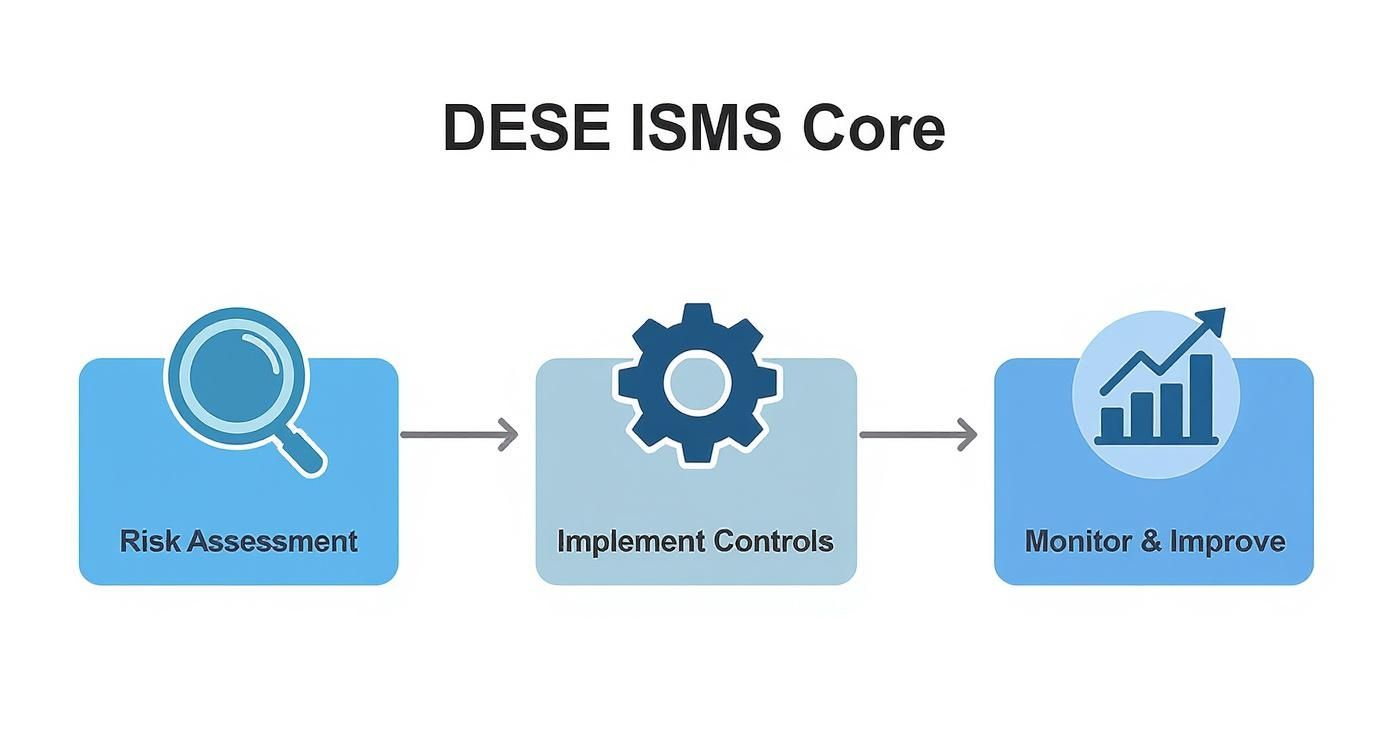
As you can see, certification isn’t a one-and-done deal. It’s about building a system of constant improvement.
Phase 4: Conducting Internal Audits
Before you invite the official auditors in, it's smart to run your own inspection first. This is what an internal audit is for. It's a full dress rehearsal for the real thing, designed to pressure-test your ISMS and catch any weak spots before an external auditor does.
An impartial auditor—either someone from inside your company who wasn't involved in the setup, or an external consultant—will comb through your documentation, talk to your team, and verify that your security controls are actually working as they should.
The internal audit is your most powerful tool for self-correction. It provides an objective, evidence-based assessment of your readiness and gives you a final opportunity to fix non-conformities before the high-stakes external audit begins.
A successful internal audit and a follow-up management review to discuss the findings are non-negotiable prerequisites before you can proceed to the final step.
Phase 5: Navigating the External Audit
This is it—the final inspection. An accredited, independent certification body sends an auditor to formally assess your ISMS against the DESE ISMS certification standard. It’s the moment of truth, and it usually happens in two stages.
-
Stage 1 Audit (Documentation Review): First, the auditor will review all your core ISMS documents—the Scope, Policies, SoA, and so on. They're making sure that, on paper at least, your system is designed to meet all the requirements. They’ll point out any major concerns before the main event.
-
Stage 2 Audit (Implementation Audit): This is the deep dive. The auditor will visit your offices (or join remotely) to find real-world evidence that your ISMS is fully up and running. They'll interview staff, watch processes in action, and check records to confirm that you’re actually doing what your policies say you do.
Once the auditor is convinced that your organisation ticks all the boxes, they'll give the green light and recommend you for certification. This guide on how to get ISO certified provides some great extra detail on what to expect during this kind of two-stage audit process. After a successful audit, you’ll be awarded your DESE ISMS certificate, giving you official proof of your commitment to protecting government information and unlocking new business opportunities.
Navigating Common Hurdles in the Certification Process
The path to DESE ISMS certification is a fantastic goal, but let's be honest—it’s rarely a straight line. Like any project worth doing, the journey comes with its own set of bumps and roadblocks. Knowing what these are ahead of time is the best way to sidestep them, letting you plan properly and put your resources where they’ll do the most good.
This isn’t about being pessimistic; it’s about being prepared. By understanding where other businesses have stumbled, you can reinforce your own strategy and turn potential headaches into manageable tasks. Let's walk through the most common challenges and how you can keep your certification journey on track.
Underestimating The Required Resources
One of the most common traps is simply underestimating the sheer commitment this takes. Getting DESE ISMS certified isn't a weekend project you can hand off to the IT department. It requires a serious investment of both time and money. Without a realistic budget and dedicated people, the whole thing can grind to a halt.
So many organisations don't account for the real hours needed for documentation, risk assessments, implementing controls, and training the team. This leads to burned-out staff and a project that drags on for months longer than planned, putting those crucial tender deadlines at risk.
The best way to combat this is to get genuine backing from your leadership team right from the start. I don't just mean getting a signature on a budget request. You need a champion in the C-suite who truly gets the strategic value this certification brings.
- Develop a Detailed Project Plan: Map out every single phase, from the initial gap analysis to the final audit. Put realistic timelines and clear responsibilities against each task.
- Create a Comprehensive Budget: Think about everything—consultancy fees, new tech you might need, the certification body's costs, and, crucially, the internal hours your team will be spending on this.
- Present a Clear Business Case: Don't frame this as a cost. Frame it as an investment that unlocks high-value government contracts and makes the entire business more secure.
Struggling With Complex Documentation
The paperwork required for a DESE ISMS certification can feel overwhelming. You’ve got the Statement of Applicability (SoA), detailed risk assessments, and a whole suite of policies and procedures that all demand absolute precision. It's easy for teams to get completely bogged down in the volume of it all, which is where errors and inconsistencies creep in—the kinds of things that lead to failed audits.
This documentation isn't just bureaucratic fluff; it's the core evidence an auditor will use to check if you're compliant. Poorly written or incomplete documents are one of the quickest tickets to failing an audit, causing expensive delays and a lot of rework.
The trick is to simplify and not be afraid to ask for help when you need it. You don't have to invent every document from scratch.
Your ISMS documentation should be a clear, practical guide for your team and a transparent record for auditors. Strive for clarity over complexity; a 10-page policy that everyone understands and follows is infinitely more valuable than a 100-page tome that no one reads.
As you get deeper into the process, understanding the ISO 9001 audit process can give you a great sense of the scrutiny your documents will face. Bringing in a consultant who lives and breathes ISO standards can be a game-changer here, providing you with templates and expertise to make sure your documentation is ready for prime time.
Failing To Secure Employee Buy-In
Here's a hard truth: you can have the best security tech and the most perfectly written policies, but if your employees don't follow them, your ISMS is nothing more than a nice idea on paper. A huge hurdle for many is treating certification as a purely technical exercise and forgetting to bring the rest of the team along for the ride. This leads to pushback on new processes, poor security awareness, and, ultimately, non-compliance.
Your people are your first and most critical line of defence. If they see new security rules as just another inconvenient hassle, they’ll find ways to work around them, creating the very risks you’re trying to eliminate. The goal isn't just to be compliant; it's to build a culture where security is second nature.
This means you have to put real effort into explaining the 'why' behind the 'what'.
To really build this culture, you need to make security personal and relevant to everyone's job.
- Conduct Engaging Training: Ditch the dry, text-heavy slideshows. Use real-world stories, interactive workshops, and even live phishing simulations to make the training stick.
- Communicate Clearly and Often: Keep everyone in the loop with regular updates on the certification journey. Show them how their individual actions directly contribute to the company's security and success.
- Involve Staff in the Process: When you're drafting new policies, ask for feedback. When people feel like they're part of the solution, they're far more likely to become champions for it.
By tackling these common hurdles head-on, you can navigate the certification process with a lot more confidence. Turning these challenges into opportunities won't just get you your DESE ISMS certification—it will help you build a stronger, more resilient, and security-savvy organisation for the long haul.
Your DESE ISMS Questions, Answered
Alright, let's get down to brass tacks. You understand what the DESE ISMS certification is and why it's a game-changer for winning government contracts. But now, the practical questions start bubbling up. How long will this take? What’s the real cost? And what happens after we get the certificate?
This is where the rubber meets the road. We're going to tackle these common queries head-on, giving you the clear, straightforward answers you need to plan your project with confidence. Think of this as the final briefing before you kick things off, clearing up any lingering doubts.
How Long Does The DESE ISMS Certification Process Typically Take?
This is always the first question, and the honest answer is: it depends. The timeline for achieving DESE ISMS certification hinges entirely on where you're starting from. Your company’s size, the complexity of your operations, and your current level of information security maturity are the main drivers.
For a small or medium-sized business that's building its security framework from the ground up, you should realistically budget for 6 to 12 months. This gives you enough time to do it properly—from the initial gap analysis and writing documentation, all the way through to implementing new controls, running internal audits, and passing the final two-stage external audit.
But what if you're not starting from scratch? Well, that can speed things up considerably.
- Already have ISO 27001? If you’re already ISO 27001 certified, you've done the bulk of the heavy lifting. Your job is to focus on the extra controls the government requires. In this case, you could be looking at a much shorter timeframe, maybe just 3 to 6 months.
- Have a solid (but uncertified) system? If you have a robust security system in place but just haven't formalised it, you’re also ahead of the game. The core structure exists; your work will be in documenting everything and aligning it with the standard.
The crucial thing to remember is that this isn't just a race to a piece of paper. You're fundamentally embedding security into your company culture. Rushing it often means cutting corners, which will come back to bite you during the audit.
A realistic schedule allows you to plan properly, implement controls thoroughly, and get genuine buy-in from your team. This sets you up for long-term security, not just a short-term win.
What Is The Typical Cost Of Getting DESE ISMS Certified In Australia?
Let's talk money. Budgeting for DESE ISMS certification is critical, and the final number depends on one key thing: the size of the gap between where your security is now and where it needs to be.
For a typical Australian SME, the total investment can be anywhere from AUD $20,000 to over $45,000. It’s important to understand this isn't just one single fee; it’s a combination of different costs.
So, where does that money actually go?
- Expert Guidance: Many businesses bring in consultants to steer them through the process. This is often the biggest slice of the pie, covering things like the gap analysis, documentation help, and running your internal audits.
- Tech Upgrades: The audit might reveal you need to invest in new tools—things like better endpoint protection, encryption software, or systems for managing security logs.
- The Audit Itself: The accredited certification body charges a fee for conducting the external audits. Over the three-year certification cycle, these fees typically account for $10,000-$20,000 of the total cost.
- Your Team's Time: Don't forget to factor in the internal cost. Your own staff from IT, HR, and management will be dedicating a significant amount of their time to this project.
It’s tempting to see this as just another business expense. But it’s far better to frame it as a strategic investment. The return on that investment is access to lucrative government contracts that would otherwise be out of reach, giving you a serious competitive edge.
What Happens After We Achieve DESE ISMS Certification?
Getting that certificate is a huge achievement, but it’s not the end of the road. In fact, it's the start of a new phase. DESE ISMS certification is a living commitment to maintaining and improving your security—definitely not a "set and forget" task.
Once you’re certified, you enter a three-year cycle. This cycle is designed to make sure your security system (your ISMS) stays effective and adapts to new threats and business needs. It’s a structured rhythm of check-ins and improvements.
Here’s what life after certification looks like:
- Annual Surveillance Audits: In the first and second years, the certification body will pop back in for a "surveillance audit." It's not as intense as the initial one, but it's a mandatory check-up to ensure you're keeping everything running smoothly.
- Recertification Audit: At the end of year three, you'll go through a full recertification audit to renew your certificate for another three years. This is a deep dive, much like the first time around.
- Ongoing Internal Work: You’ll need to keep up your own internal security activities. This means continuing with regular internal audits, risk assessments, and management reviews to stay ahead of any potential weaknesses.
This cycle gives government departments the ongoing confidence they need to know their data is safe in your hands.
Do We Need To Be ISO 27001 Certified First?
This question causes a lot of confusion, so let's clear it up. The short answer is no, you don't need a separate ISO 27001 certificate before you start the DESE ISMS process. But—and this is a big but—you can't ignore ISO 27001.
The DESE ISMS scheme is built directly on top of the ISO 27001 framework. It uses that global standard as its foundation and then bolts on extra security controls specific to the Australian Government. So, to get DESE certified, you absolutely must meet all the requirements of ISO 27001 along the way.
Here's an analogy: Think of DESE ISMS as a specialised master's degree. You can't get that advanced qualification without first completing all the core subjects of the foundational bachelor's degree (ISO 27001).
For this reason, many companies choose an integrated audit. Your auditor assesses you against both ISO 27001 and the DESE requirements in one go. It’s a much more efficient and cost-effective way to do it.
So, while a separate certificate isn't required beforehand, a fully working ISMS that complies with ISO 27001 is a non-negotiable part of the journey. You're effectively proving you meet both global best practices and specific Australian government standards at the same time.
Navigating the complexities of information security standards can be a significant challenge, but you don't have to do it alone. At Anitech, we specialise in guiding Australian small businesses through every step of the certification process. With our 100% success rate and over 20 years of experience, we can help you achieve DESE ISMS certification efficiently, turning compliance into your competitive advantage. Secure your future in government contracting by visiting us at https://iso-27001.com.au to learn more.
Recent Comments