

Quick Summary: A gap assessment template is a critical first step for ISO 27001 certification. This diagnostic tool helps you compare your current security posture against the standard's requirements, identify specific shortfalls, and create a prioritized remediation plan. Using a structured template simplifies the process, cuts certification timelines, and prevents costly mistakes.
If you're staring down the barrel of an ISO 27001 certification, you know it can feel a bit daunting. Especially for a small business, the 93 Annex A controls can look like a mountain of complex requirements, leaving you wondering where on earth to start. A gap assessment template is a crucial document that helps you systematically evaluate your current information security practices against the ISO 27001 standard.
This is exactly why a strategic gap assessment isn't just a good idea—it's your most critical first move. Think of it as a diagnostic tool that translates the dense, formal standard into a practical, real-world action plan tailored for your business. It's the starting point for your compliance journey, ensuring you have a clear roadmap to certification.
H2: Why a Gap Assessment Template Is Your First Strategic Move
Jumping into an ISO 27001 project without a plan is like trying to navigate the Melbourne CBD during peak hour with no map. You’ll get lost, frustrated, and waste a whole lot of time and money on wrong turns. A good gap assessment template is your GPS, giving you a clear, structured framework to see how your current security measures stack up against the standard's strict demands.
It takes you from a state of guesswork to one of genuine clarity. Instead of wondering where your weak spots might be, the template guides you through a methodical review, pinpointing the exact areas that need fixing. This structured approach is the absolute foundation of a successful certification project.
From Overwhelmed To Organised
At its heart, a gap analysis forces you to answer three brutally honest questions about your information security:
- Where are we now? This means taking a frank, objective look at your existing controls, policies, and day-to-day procedures.
- Where do we need to be? This is clearly defined by the clauses and Annex A controls in the ISO 27001:2022 standard.
- How do we close the gap? The answer to this becomes your remediation plan, turning weaknesses into a list of actionable tasks.
By working through these points, you turn that compliance mountain into a series of manageable steps. This clarity is more than just a convenience; for a small business with a tight budget and limited team, it’s the key to making it across the finish line.
The real power of a gap assessment lies in its ability to convert abstract compliance goals into concrete, prioritised actions. It stops you from wasting budget on low-priority controls and focuses your efforts where they will have the most impact on both security and audit readiness.
The Tangible Business Advantages
In the competitive Australian market, having ISO 27001 is fast becoming a must-have, not a nice-to-have. Local certification bodies have noted that organisations using a gap assessment template from the get-go can dramatically shorten their certification timeline.
This is a huge competitive advantage, especially when you consider that nearly 70% of government tenders now list ISO 27001 as a prerequisite. A structured template can help you slash certification timelines by up to 40%, getting you ready to bid for those contracts much faster. You can dig deeper into the latest ISO 27001 compliance trends in Australia to see just how important this is becoming.
This guide will walk you through how to use a template to make the whole process simpler. We'll show you how this one document can cut your certification timeline, help you avoid costly missteps, and give you a genuine edge.
H2: What a High-Impact Gap Assessment Template Really Looks Like
Let's be clear: not all templates are built the same. A truly effective gap assessment tool isn't just a long checklist of controls. It's a dynamic worksheet, a living document designed for clarity, evidence collection, and most importantly, strategic planning. A high-impact template turns the dense, abstract requirements of ISO 27001 into a concrete, actionable project plan.
Think of it this way. A basic template is like a paper map showing you the general direction. A great gap assessment template, on the other hand, is your team's GPS. It shows you exactly where you are right now, pinpoints your destination (certification), calculates the best route, and even flags potential roadblocks before you hit them. It’s built to guide you, not just to find problems.
The Core Anatomy of a Template That Works
From my experience, a robust template is meticulously organised to capture every little detail an auditor will eventually hunt for. Every column serves a specific purpose, collectively building a complete, honest picture of where your information security management system (ISMS) truly stands. Without these key pillars, you’re just ticking boxes and missing the vital context needed for real improvement and a smooth audit.
The real value lies in the detail. Let's break down the essential components of a comprehensive gap assessment template. A well-designed sheet will have dedicated columns for each piece of information, ensuring nothing gets missed.
Here’s what you should expect to see:
| Key Components of a Comprehensive ISO 27001 Gap Assessment Template |
| :— | :— | :— |
| Component | Purpose and Best Practice | Example Entry |
| Control Reference | Clearly lists the Annex A control number from ISO 27001:2022 (e.g., A.5.7). This is non-negotiable for mapping directly to the standard. | A.5.7 |
| Control Description | A simple, plain-English summary of the control's objective. This saves you from constantly referencing the full standard. | Threat intelligence |
| Current Status | An at-a-glance flag. Use clear terms like 'Implemented', 'Partially Implemented', or 'Not Implemented'. Avoid vague language. | Partially Implemented |
| Gap Description | The heart of the assessment. Be brutally honest and specific. "Needs work" is useless. "No formal process for gathering or analysing threat intelligence" is actionable. | We subscribe to a threat feed, but there's no formal process to analyse or act on the intelligence received. It's ad-hoc. |
This level of detail is what separates a tick-box exercise from a genuine assessment that drives improvement.
Moving from Finding Gaps to Actually Fixing Them
Identifying where you fall short is only half the battle. A truly valuable template pushes you towards a solution by forcing you to think about prioritisation and proof. These components are what transform your assessment from a simple report into a strategic roadmap for your entire certification project.
A common failure point I see is businesses treating the gap assessment as a one-time chore. A great template forces you to think like an auditor from day one by demanding proof and planning for every single control. That mindset is invaluable when the real audit begins.
Here are the columns that take a template from good to great:
- Evidence/Comments: This will be your best friend during the audit. This is where you link directly to your policies (like the access control policy), describe the process in action, or note who you interviewed. Auditors want to see proof, and this column is your evidence locker.
- Remediation Action: Define the exact steps needed to close the gap. For instance, "Develop and implement a formal threat intelligence procedure" or "Assign responsibility for reviewing threat feeds weekly."
- Priority Score: Look, not all gaps are created equal. A simple High/Medium/Low scoring system, ideally driven by risk, helps you focus your limited time and budget on the biggest vulnerabilities first. If you need to get more granular with risk, our cybersecurity risk assessment template can add another layer of structure.
- Owner & Due Date: This is about accountability. Assigning a name and a deadline turns a vague idea into a concrete task. It's how you keep the project moving forward.
Beyond just this one task, getting comfortable with structured templates can seriously boost efficiency across your entire business, bringing consistency to all your documentation. By making sure your gap assessment template has these crucial components, you’re giving your team a powerful tool that doesn’t just find weaknesses but carves out a clear, organised path toward a successful ISO 27001 certification.
H2: How To Run Your Gap Assessment Like a Pro
Right, let's move from theory to action. This is where the real work of getting ISO 27001 certified truly begins. A solid gap assessment template gives you the framework, but knowing how to wield it properly is what turns a simple checklist into a seriously powerful diagnostic tool. You’re not just ticking boxes here; you're conducting a strategic investigation into the health of your information security.
Forget the dry, academic instructions. What you're about to read is practical, actionable advice pulled from years of being in the trenches, helping businesses just like yours turn this daunting task into a project they can actually manage—and succeed at.
Let’s walk through the steps to make your assessment really count.
The whole process is actually quite straightforward. This visual breaks it down: you review the controls, pinpoint the gaps, and then map out a clear plan of action.
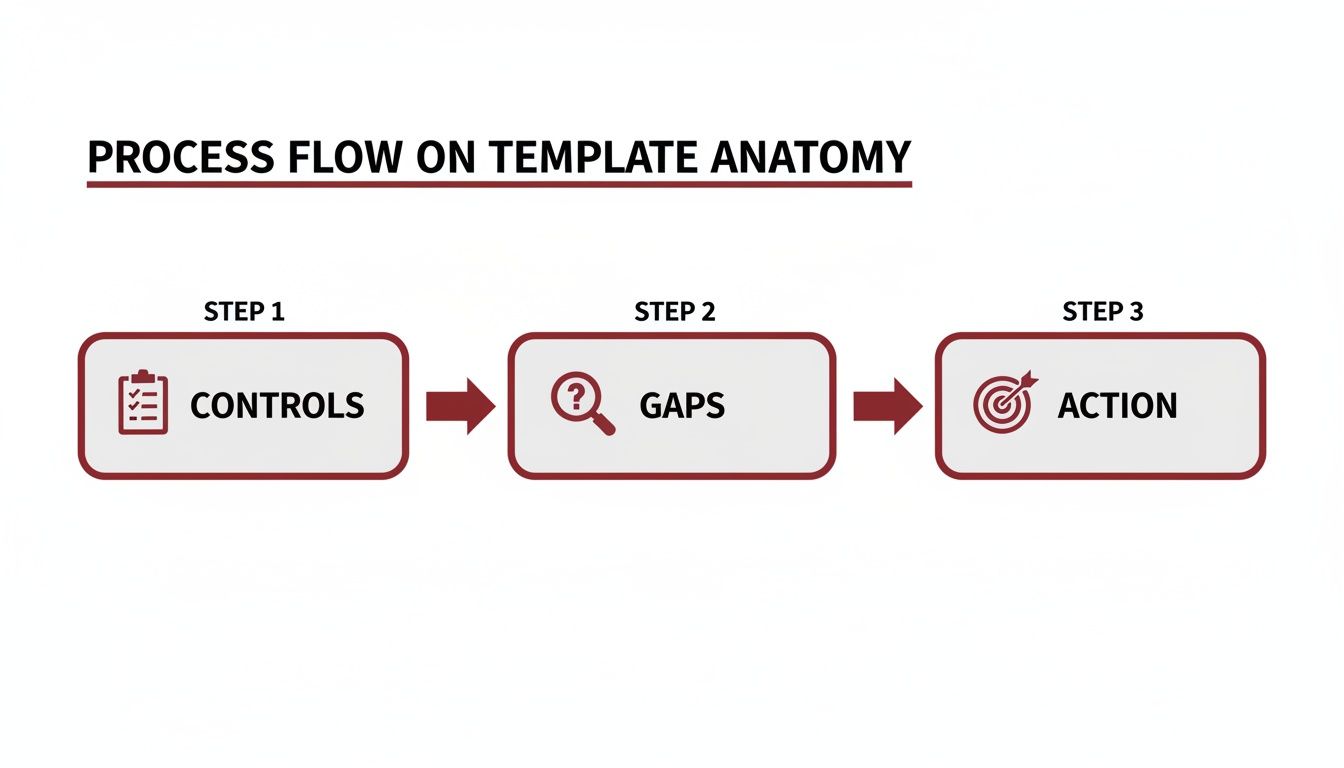
This simple rhythm ensures that for every single requirement, you’re methodically checking where you stand and creating a specific, concrete task to fix any shortfalls.
Assemble Your Compliance Squad
First things first: an information security gap assessment is not a one-person show, and it definitely can't happen in an IT silo. Your Information Security Management System (ISMS) touches every single corner of the business, so your assessment team needs to reflect that. Trust me, trying to go it alone is the quickest way to miss critical details and alienate the very people you need on your side for a smooth implementation.
Your aim is to get a complete, 360-degree view of how your organisation actually operates. That means pulling the right people into the room.
- IT & Technical Staff: These are your go-to people for the nuts and bolts—network setups, access controls, and system logs. You absolutely need them to verify the technical controls.
- HR Department: Who manages your joiners and leavers? HR is key for crucial controls around employee screening, security awareness training, and what happens when someone leaves the company.
- Senior Management: Their buy-in isn't just nice to have; it's non-negotiable. They provide the bigger picture, sign off on resources, and ultimately champion the entire project.
- Department Heads: These folks can tell you about the day-to-day realities and whether policies are actually being followed on the ground.
Master The Art Of Gathering Evidence
An auditor’s favourite sentence is, "Show me the evidence." Your gap assessment is the perfect time to start thinking like one. For every control in your template, you have to hunt down tangible proof that it’s being done.
This isn't about asking, "Do we do this?" and just accepting a "yes." You have to dig a little deeper.
- Review Documentation: Get your hands on existing policies, procedures, and process documents. Is there an Access Control Policy? Do you have a documented Incident Response Plan?
- Conduct Interviews: Talk to the staff who are actually responsible for these processes. Ask them to walk you through how they give a new employee system access or what they do when a security alert pops up.
- Observe Processes in Action: If you can, watch the process happen live. This might mean sitting in on a change management meeting or observing the physical security measures at your office.
- Verify System Configurations: This is where your tech team really shines. They can grab screenshots of firewall rules, pull user access lists from key applications, or show you logs from security monitoring tools.
A gap assessment without evidence is just an opinion. Documenting your proof for each control in the 'Evidence' column of your template is the single most important habit you can build for a successful Stage 1 audit.
A Practical Walkthrough With Real-World Scenarios
Let's make this real. Imagine you're a small Australian SaaS company looking at control A.5.7 Threat Intelligence.
Your team might discover you subscribe to a few security newsletters, but there’s no formal process behind it. In your gap assessment template, the entry could look something like this:
- Gap Description: "We get threat intelligence from various ad-hoc sources, but there's no formal process for collecting, analysing, or sharing it. Actions aren't tracked, and the info isn't tailored to our specific technology."
- Evidence: Chat with the IT Manager confirms it's all informal. No written procedure exists.
- Remediation Action: "Develop a formal Threat Intelligence Procedure. Assign someone to review intel weekly and create a process for raising action items from it."
Now, picture a small healthcare provider assessing A.8.10 Information Deletion. They have to make sure patient data is securely destroyed once it's no longer legally required.
- Gap Description: "We have a data retention policy, but no technical process to enforce it. Data on old hard drives isn't verifiably wiped, and old patient records in the database aren't systematically flagged for deletion."
- Evidence: A look at server decommissioning logs shows no proof of secure data wiping. The database has no automated deletion function.
- Remediation Action: "Bring in a certified data wiping tool for all retired media. Develop and run a script to flag and securely delete records that have passed their retention period."
For Australian organisations, gap assessment templates have become essential for navigating the ISO 27001:2022 transition, especially for mapping policies against new controls like these. In fact, using a robust template can slash non-conformance findings by as much as 85% during Stage 1 audits.
Prioritise Your Findings With a Simple Risk Matrix
Once you've finished your assessment, you'll be staring at a list of gaps. It can feel a bit overwhelming. The key is to prioritise, so you can tackle the biggest threats first with the resources you have. A simple risk matrix is perfect for this.
Give each gap a priority score based on two simple things:
- Impact: If this gap were exploited, how bad would the damage be (financially, reputationally, legally)?
- Likelihood: How likely is it that this weakness will actually be exploited?
Combine these to give each item a straightforward score: High, Medium, or Low. This immediately helps you focus your efforts where they'll make the biggest difference, creating a logical and defensible plan. This structured approach is fundamental, and you can get more expert advice by reading our detailed guide on how to perform a gap analysis the right way.
H2: From Findings to a Winning Remediation Plan
You’ve completed the gap assessment, which is a huge step. But the real work—and the real value—starts now. That gap assessment template isn’t just a checklist; it’s the raw material for building a strategic, persuasive action plan. This is the moment you switch from identifying problems to orchestrating solutions.
The aim here is to build a formal Remediation Roadmap. Think of it as your blueprint for getting from where you are today to being fully audit-ready. A daunting list of findings becomes a manageable, step-by-step project plan. The trick is to translate technical gaps into tangible business risks that your leadership team can immediately understand and get behind.

Translate Technical Jargon Into Business Language
Your IT manager gets the danger of an unpatched server. Your CEO, on the other hand, thinks in terms of financial loss, brand damage, and operational downtime. To get the resources you need, you have to frame your findings in the language of the C-suite.
So, instead of saying, "We have a gap in A.8.1 User endpoint devices," rephrase it. Try something like, "Our lack of mobile device management puts us at a 35% higher risk of a data breach from a lost company phone, which could trigger significant regulatory fines." This approach connects a technical control directly to a business outcome, making the need for action impossible to ignore.
When you're in front of leadership, always focus on the "so what?" for every gap you've found. Each finding needs to be paired with a clear statement on business risk and what the return on investment will be for fixing it—even if that return is simply risk reduction.
Turn Gaps Into SMART Tasks
A long list of problems is just overwhelming. A list of clear, actionable tasks? That inspires confidence and drives progress. The most effective way to build your remediation plan is to break down each gap into one or more SMART tasks.
Using the SMART framework makes sure every action you plan is:
- Specific: Nail down exactly what needs to be done. "Improve cloud security" is far too vague to be useful.
- Measurable: How will you know it’s done? Define what success looks like.
- Achievable: Do you have the skills and resources? Be realistic about what’s possible.
- Relevant: Does this task directly fix the gap and get you closer to ISO 27001 compliance?
- Time-bound: Set a firm deadline. This creates urgency and holds people accountable.
Putting SMART Into Practice
Let’s walk through a real-world example from your gap assessment. Imagine you’ve flagged a major gap in control 'A.5.23 Information security for use of cloud services'. Your template shows you have no formal policy for using platforms like AWS or Microsoft 365.
Here’s how you’d break that single gap into concrete, manageable SMART tasks:
-
Task 1 – Draft Cloud Security Policy:
- Specific: Draft a formal policy that defines acceptable use, data classification, and security configuration standards for all our cloud services.
- Measurable: A finalised document approved by senior management.
- Achievable: The IT Manager can draft this, using an information security policy template to get it done faster.
- Relevant: Directly closes the policy gap identified for control A.5.23.
- Time-bound: Final draft due for approval by the end of Q3.
-
Task 2 – Implement MFA on Cloud Platforms:
- Specific: Enforce multi-factor authentication (MFA) for all user accounts, especially admins, on all company cloud platforms.
- Measurable: 100% of user accounts on critical services are protected by MFA.
- Achievable: The tech is already included in our existing licences.
- Relevant: This is a core requirement for securing cloud services and a common thing auditors look for.
- Time-bound: Full rollout and verification to be completed by the start of Q4.
This structured approach takes the ambiguity out of it and gives you a clear project plan. As your assessment uncovers these kinds of weaknesses, you'll also need to develop critical documents like a solid security incident response plan template to address them properly.
By creating such a detailed roadmap, you’re not just listing problems; you’re giving leadership a clear path forward. This makes it infinitely easier to get the budget and buy-in you need to pave the way to certification.
H2: Common Gap Assessment Mistakes You Can Easily Avoid
I’ve guided countless Australian businesses through the ISO 27001 certification maze, and I’ve seen the same predictable mistakes trip people up time and time again. A powerful gap assessment template is a fantastic start, but how you use it is what really determines your success. Think of this section as your chance to learn from others’ missteps and keep your project on the straight and narrow.
We’re not talking about generic warnings here. These are the specific, costly pitfalls I see in the wild, along with practical advice on how to sidestep them entirely.
Treating It Like a Box-Ticking Exercise
The single biggest mistake I see is when people treat the assessment like a simple checklist. They’ll mark a control as 'Implemented' but fail to actually gather and link the evidence that proves it. Let me be clear: an auditor won't just take your word for it. Their entire job is to verify.
Without proof, your gap assessment is just an opinion piece. This approach will completely unravel during an audit, leaving you with a long list of non-conformities that were totally avoidable. Always ask yourself, "How would I prove this to a complete stranger?"
Remember, the goal of a gap assessment isn't just to find gaps—it's to build your evidence portfolio for the Stage 1 audit. Every piece of documentation, every screenshot, and every interview note you collect now saves you panic and rework later.
Conducting the Assessment in a Silo
Another classic error is leaving the whole thing to the IT department. Information security isn’t just an IT problem; it’s an organisation-wide responsibility. When you don't involve departments like HR, legal, and operations, you get an incomplete and dangerously inaccurate picture of your security posture.
For example, your IT team can’t verify HR's employee screening and offboarding processes (A.6.3). Nor can they confirm that the right security clauses are being baked into supplier contracts handled by procurement (A.5.20). This siloed approach guarantees you'll miss critical gaps that live outside of the server room, creating major headaches down the line.
Underestimating What It Takes to Fix the Gaps
Identifying the gaps is the easy part. Fixing them is where the real work—and the real investment of time and money—begins. So many businesses finish the assessment and are then blindsided by the resources needed for remediation. This shock often leads to the project stalling out and losing all momentum.
A proper gap assessment should be a tool for building your budget, not just your to-do list. As you identify each gap, start getting a rough idea of the effort and cost required to close it. This kind of proactive financial and resource planning is crucial for getting leadership on board and making sure your project doesn’t derail before it even truly begins.
The value of using a structured template isn't just anecdotal. In 2025, top auditors reported that firms using a standardised gap assessment template achieve a 95% first-time certification pass rate, a massive leap from the 62% for those without. This approach also helps small businesses cut audit preparation costs by 30-50%, saving an average of AUD 25,000. For more insights into this data, you can explore the findings from Australia's top ISO 27001 auditors.
H2: Your ISO 27001 Gap Assessment Questions Answered
As you gear up to tackle your ISO 27001 compliance project, it's completely normal to have a few questions. Getting your head around the process is the first step toward moving forward with confidence. To wrap things up, we've put together answers to the most common questions we hear from small businesses about using a gap assessment template and the road ahead.
Think of this as a quick-fire FAQ to give you that extra bit of clarity before you dive in.
How Long Does a Gap Assessment Take for a Small Business?
For a typical small or medium-sized business, you should set aside about two to four weeks for a proper ISO 27001 gap assessment. Of course, this timeline isn't set in stone. It can easily shift depending on the size of your company, how complex your operations are, and how mature your existing security measures already are.
If you’ve already got some solid security policies and controls in place, you’ll probably find yourself on the faster end of that scale. The most critical factor here is being thorough. Rushing this initial stage is a classic mistake that almost always leads to overlooked gaps and major headaches during your formal audit.
A well-structured gap assessment template is your secret weapon here. It helps you streamline the entire process without cutting dangerous corners, saving you a heap of time and preventing expensive rework down the line.
Can We Do a Gap Assessment Ourselves or Should We Hire a Consultant?
You can absolutely run a gap assessment internally, especially if you have someone on the team with a bit of experience in ISO standards or information security management. If you go the DIY route, a detailed gap assessment template isn't just helpful—it's essential. It becomes your roadmap, guiding you through every clause and control.
However, many businesses discover that bringing in a specialist consultant gives them a massive leg-up. An external expert provides an unbiased, fresh pair of eyes, deep knowledge of what auditors are looking for, and years of experience navigating the common roadblocks.
An experienced consultant can:
- Speed up the process by focusing your team’s energy on what truly matters.
- Guarantee no critical gaps are missed due to inexperience or internal bias.
- Help you build a much stronger remediation plan that's both practical and audit-proof.
More often than not, the investment in a good consultant pays for itself through saved time, less stress, and a clear, guaranteed path to certification.
What Is the Difference Between a Gap Assessment and an Internal Audit?
This is a really common point of confusion, but getting the distinction right is crucial to understanding your ISO 27001 journey. They are two very different tools used at very different stages of the game.
A gap assessment is the informal review you do before your Information Security Management System (ISMS) is fully built. Its whole purpose is to figure out what’s missing by comparing where you are now with the ISO 27001 standard. It's the diagnostic that helps you draw up the blueprint for your ISMS.
On the other hand, an internal audit is a formal, mandatory part of the standard itself (under Clause 9.2). You have to perform it after your ISMS has been implemented and is up and running. Its job is to check that your system is working as intended, meeting all the requirements, and actually achieving its security goals.
Here’s a simple way to think about it: the gap assessment helps you design and build the house correctly. The internal audit is the official inspection you carry out before the final sign-off to prove it's built to code. Both are vital, but they happen at opposite ends of the project.
Ready to turn your ISO 27001 goals into a reality? At Anitech, we specialise in helping small businesses navigate the complexities of certification with confidence. Our proven process and expert guidance ensure a smooth journey from your initial gap assessment to successful certification.
Start your stress-free path to ISO 27001 compliance today.
Recent Comments