

Quick Summary: Governance, risk management, and compliance (GRC) software provides a unified platform to manage regulatory requirements, identify potential threats, and ensure ethical business operations. This guide explores the core modules of GRC platforms, how they simplify certifications like ISO 27001, and key criteria for selecting the right solution for your business.
Are you trying to juggle endless regulations, stay ahead of unforeseen risks, and make sure your business runs ethically and above board? If that sounds familiar, you're not alone. For years, businesses tackled these jobs in separate departments, leading to a mess of disconnected data and a constant state of putting out fires. This is where effective governance risk management and compliance software comes in, acting as a central command centre to bring everything together under one roof. It’s about moving from a scattered, reactive approach to a unified, proactive strategy for handling rules, risks, and regulations.
Unifying Your Strategy with a GRC Platform
These powerful GRC platforms aren't just for large corporations anymore. They've become essential for any growing business that wants to build a resilient, competitive, and trustworthy operation. Adopting a unified GRC strategy can completely change how you deal with complex challenges, giving you a clear roadmap to operational excellence.
From Silos to Synergy
Imagine a business without a GRC platform is like an orchestra where every musician has different sheet music. The result is pure chaos. Governance sets the tune (your corporate policies), risk management tries to avoid hitting the wrong notes (potential threats), and compliance makes sure the performance follows the venue's rules (industry regulations).
A GRC platform is the conductor, making sure everyone plays in harmony from the same score. This integrated approach brings some serious advantages:
- A Single Source of Truth: All your risk and compliance data is consolidated in one place. No more conflicting spreadsheets or outdated documents.
- Smarter Decision-Making: When leaders have a clear, real-time view of the company’s risk posture, they can make strategic calls with confidence.
- Better Efficiency: Automating repetitive tasks like control testing and evidence collection frees up your team to focus on what really matters.
The Booming Demand for GRC Solutions
The move to integrated GRC systems isn't just a fleeting trend—it's a fundamental shift in how modern businesses operate. The global market for these platforms was valued at USD 40.55 billion and is expected to nearly double, hitting USD 78.89 billion by 2030.
Here in Australia, the growth is particularly strong. We have strict regulators like APRA and ASIC to answer to, plus a growing focus on Environmental, Social, and Governance (ESG) standards. Businesses are quickly realising that a solid GRC framework is non-negotiable.
A proactive GRC strategy does more than just help you avoid fines. It builds a foundation of trust with customers, investors, and regulators, turning compliance from a necessary evil into a real competitive advantage.
Thinking about GRC as a business must-have also ties into the wider benefits of responsible operations. For instance, things like e-waste recycling can improve data security, boost ESG goals, and deliver value that go far beyond basic compliance.
Ultimately, putting money into a robust GRC framework is an investment in your company's long-term stability and reputation. It's well worth looking into the ROI of cyber security to see just how valuable these strategic investments can be.
What Are the Core Modules of GRC Software?
To really get what governance, risk management, and compliance software can do for you, we need to pop the bonnet and look at the engine. Think of a GRC platform less like a single tool and more like your company’s central nervous system—a collection of specialised parts all working together to keep the business healthy, coordinated, and out of harm's way.
Each module plays a specific, vital role. Breaking down this internal architecture makes it clear how GRC software turns abstract ideas like "governance" into tangible, automated processes. It’s the difference between juggling scattered spreadsheets and running your operations from a single command centre.
To give you a clearer picture, here’s a breakdown of the essential modules you'll find in most GRC platforms and what they actually do.
Core GRC Software Modules Explained
| GRC Module | Primary Function | Key Business Problem Solved |
|---|---|---|
| Governance | Establishes the company's rulebook, aligning policies and decisions with strategic goals. | Prevents departments from operating in silos and ensures everyone is pulling in the same direction. |
| Risk Management | Identifies, assesses, and prioritises potential threats before they can cause damage. | Moves the business from a reactive "fire-fighting" mode to a proactive, forward-looking stance. |
| Compliance | Ensures the business adheres to all relevant laws, industry standards, and internal policies. | Ends the chaos of manual checklists and evidence-chasing, especially during audits. |
| Audit Management | Centralises and streamlines the entire audit process, from planning to remediation. | Drastically reduces the time, cost, and stress associated with both internal and external audits. |
These modules are the pillars of an effective GRC strategy. They're designed to be interconnected, sharing data to give you a complete and accurate picture of your organisation’s health at any given moment.
The Governance Module: The Strategic Brain
The Governance module is the brain of the whole operation. Its job is to set the direction and create the internal rulebook that guides your entire business. This is where your company's mission, ethics, and big-picture objectives get translated into actionable policies and procedures.
This module is the bedrock for everything else. Without solid governance, your risk and compliance efforts are just spinning their wheels without any real purpose.
A strong governance framework ensures that business decisions align with organisational values and strategic goals, preventing the kind of operational drift that can lead to significant risk exposure.
Key functions you'll find here usually include:
- Policy Management: A central hub for creating, approving, sharing, and updating all company policies. This makes sure every employee has the latest version and can acknowledge they've read it.
- Strategic Planning: Helps leadership see the big picture by aligning business goals with risk appetite and regulatory must-dos.
The Risk Management Module: The Early-Warning System
If governance is the brain, then the Risk Management module is the company's early-warning system. It’s constantly scanning the horizon—both inside and outside the business—to spot, analyse, and rank potential threats and opportunities. This is what builds true business resilience.
It’s all about answering the tough questions: "What could go wrong?" and "How bad could it be?" By putting a number on risk, you can focus your resources on fixing the things that matter most, first.
The Compliance Module: The Corporate Immune System
Think of the Compliance module as the organisation’s immune system. Its job is to protect the business by making sure it follows all the external laws, regulations, and industry standards, not to mention its own internal policies. It takes complicated legal jargon and turns it into a clear set of operational controls.
When done manually, this is often the most painful part of GRC, filled with endless checklists and a frantic search for evidence. A dedicated compliance module automates a huge chunk of this work. For businesses aiming for certifications like ISO 27001, understanding the core components of information security management systems is a non-negotiable first step, and this module makes that possible.
You’ll often see features like:
- Regulatory Library: An up-to-date database of all the rules and standards that apply to your industry.
- Control Mapping: Directly links your internal controls to specific legal requirements, making it easy to prove you're compliant.
- Automated Monitoring: Keeps an eye on your controls 24/7 and sends you an alert the moment something isn't working as it should.
The Audit Management Module: Your Audit Command Centre
Finally, the Audit Management module simplifies the entire audit process, from planning and fieldwork to reporting and fixing what's broken. It gives your internal team and external auditors a single source of truth, cutting down the time and stress of gathering evidence.
Instead of a last-minute scramble to find documents, auditors can log in and see a neat, organised repository of your controls, policies, risk assessments, and compliance records. This not only makes audits far less painful but also helps build a culture of constant improvement, as you can track and resolve audit findings right there in the platform.
How GRC Software Simplifies ISO 27001 Certification
Earning an ISO 27001 certification is a huge win, telling the world you’re serious about information security. But let's be honest—the process itself can feel like you're lost in a labyrinth of clauses, controls, and paperwork. This is precisely where governance risk management and compliance software steps in to turn a chaotic ordeal into a well-managed project.
Forget wrestling with disconnected spreadsheets, chasing email approvals, and digging through shared drives for the right policy document. A GRC platform becomes the command centre for your entire Information Security Management System (ISMS), giving you a clear, automated, and audit-ready path to certification and beyond.
This unified approach isn't just a nice-to-have; it's becoming a necessity for Australian businesses. The local GRC platform market, valued at USD 1.4 billion, is expected to explode to USD 3.7 billion by 2033. Why the massive growth? It’s a direct response to tougher regulations and a relentless wave of cyber threats, pushing companies to find smarter ways to manage their security risks.
Centralising Your ISMS Documentation
One of the biggest headaches of the ISO 27001 journey is the sheer volume of documentation. You have your main ISMS policy, your risk assessments, and the all-important Statement of Applicability (SoA), just to name a few. Keeping it all organised, up-to-date, and properly approved is a massive job on its own.
A GRC platform’s document management module brings order to this chaos by creating a single source of truth.
- Version Control: No more confusion over which document is the "real" one. Everyone works from the latest version, every time.
- Approval Workflows: The system automatically routes documents for review and sign-off, creating a perfect audit trail of who approved what, and when.
- Central Repository: All your ISMS documents live in one secure, easily searchable place, ready for your team or an external auditor.
This isn't just about being tidy. It demonstrates a mature, controlled approach to information security—a quality that auditors absolutely love to see.
Streamlining Risk Assessment and Treatment
At its heart, ISO 27001 is all about managing risk. The standard demands a systematic way of identifying, analysing, and treating information security risks. Trying to do this manually with complex spreadsheets is not only painful but also prone to mistakes. Those spreadsheets quickly become outdated and impossible to manage.
GRC software injects much-needed structure and automation into this crucial process.
A dedicated risk management module helps you graduate from a static, once-a-year risk assessment to a dynamic, continuous process. It links risks directly to your assets, controls, and policies, giving you a complete picture of your security posture.
The platform walks you through the entire risk lifecycle, from identification right through to treatment. You can assign owners to each risk, track the progress of mitigation tasks, and see how effective your controls are in real-time. Suddenly, your risk treatment plan is no longer a static document collecting dust; it's a living, breathing roadmap for improving your security. To get this right, you need to understand the tight link between GRC and cyber security as two sides of the same coin.
Automating Control Mapping and Audits
Proving your security controls are actually working as intended is a non-negotiable part of any ISO 27001 audit. A GRC platform makes this incredibly simple by letting you map your internal controls directly to the specific ISO 27001 Annex A controls and clauses.
This creates a crystal-clear line of sight between the standard’s requirements and what you’re doing on the ground. When an auditor asks for evidence for a specific control, you’re not scrambling for days. You simply generate a report with a click, showing them the relevant policies, risk assessments, and monitoring results. This level of automation transforms audit prep from a weeks-long fire drill into a calm, routine task.
Choosing the Right GRC Software for Your Business
Picking the right governance, risk management, and compliance software isn’t about finding the “best” platform on the market. It’s about finding the one that fits your organisation like a glove.
Get this decision wrong, and you're stuck with a wasted budget and a tool nobody wants to use. But get it right, and you’ve got a powerful asset that supports growth and builds resilience. This means looking beyond the flashy feature lists and asking the hard questions about what your business actually needs.
The whole process starts with an honest look at where you are now and where you’re heading. A platform that's perfect for a five-person startup will buckle under the pressure of a 500-person enterprise. Your choice has to be grounded in reality.
Key Evaluation Criteria
Before you even sit through a single demo, you need to map out your non-negotiables. Think of it as creating a blueprint for your ideal solution. This simple step will stop you from being dazzled by bells and whistles you’ll never use and keep you focused on what truly adds value.
Your checklist should nail down a few core areas:
- Scalability: Will the software grow with your business? You need to know it can handle more users, more regulations, and a lot more data down the track without slowing to a crawl.
- User Experience (UX): Is it actually easy to use? If the interface is clunky or confusing, your team will find every excuse not to use it. That defeats the whole purpose.
- Integration Capabilities: How well does it talk to your other systems? Seamless connections with your HR, IT, and ERP platforms are non-negotiable for creating a single source of truth.
The goal is to find a GRC solution that moulds to your processes, not the other way around. A platform that forces you to completely overhaul how you work is a recipe for disaster and will face serious pushback from your team.
Cloud-Based SaaS vs On-Premise Solutions
One of the first major forks in the road is deciding between a cloud-based (SaaS) platform or a traditional on-premise installation. Each has its own pros and cons, and the right choice really depends on your business needs, budget, and IT setup.
| Feature | Cloud-Based (SaaS) | On-Premise Solution |
|---|---|---|
| Initial Cost | Lower initial cost (subscription-based). | High upfront investment in hardware and licenses. |
| Maintenance | Vendor handles all updates and maintenance. | Your internal IT team is responsible for all upkeep. |
| Accessibility | Accessible from anywhere with an internet connection. | Typically accessed only within the company network. |
| Scalability | Easily scalable by adjusting your subscription plan. | Scaling requires purchasing additional hardware. |
| Customisation | Generally less customisable than on-premise. | Offers deep customisation to fit specific needs. |
For most small to medium-sized Australian businesses, the flexibility and lower upfront cost of a SaaS model just makes more sense. It gives you access to enterprise-grade tools without needing a big, dedicated IT team to keep the lights on.
Building Your Shortlist
Once you’ve got your criteria sorted, you can start putting together a shortlist of potential vendors. Look for providers who have a solid track record in your industry and can show you case studies from businesses your size. And don't forget to check out their customer support—a responsive and helpful support team is worth its weight in gold, especially when you're getting set up.
As you dig into GRC solutions, it can be useful to look at related, more specialised tools to get a feel for the market. For instance, reviewing insights from comparing HR compliance software can highlight important features around policy management or employee training that you might want in your GRC platform.
Ultimately, the right governance, risk management, and compliance software will feel like a natural extension of your team, giving you the confidence to make smarter, data-driven decisions.
A Roadmap for Successful GRC Implementation
Let's be blunt: even the best GRC software on the market is useless if nobody uses it properly. A successful rollout has far less to do with the tech itself and much more to do with the people, processes, and planning you put in place. Treating this as just another IT project is a surefire way to get low adoption rates and a wasted investment.
Instead, you need to see this as a core business initiative that demands a clear, strategic roadmap. Getting from software selection to actually reaping the rewards involves a few critical stages, and navigating them successfully comes down to foresight, getting the right people involved, and a genuine commitment to managing the change.
This visual flow breaks down the core stages of getting a GRC solution up and running, from the initial evaluation right through to final integration.
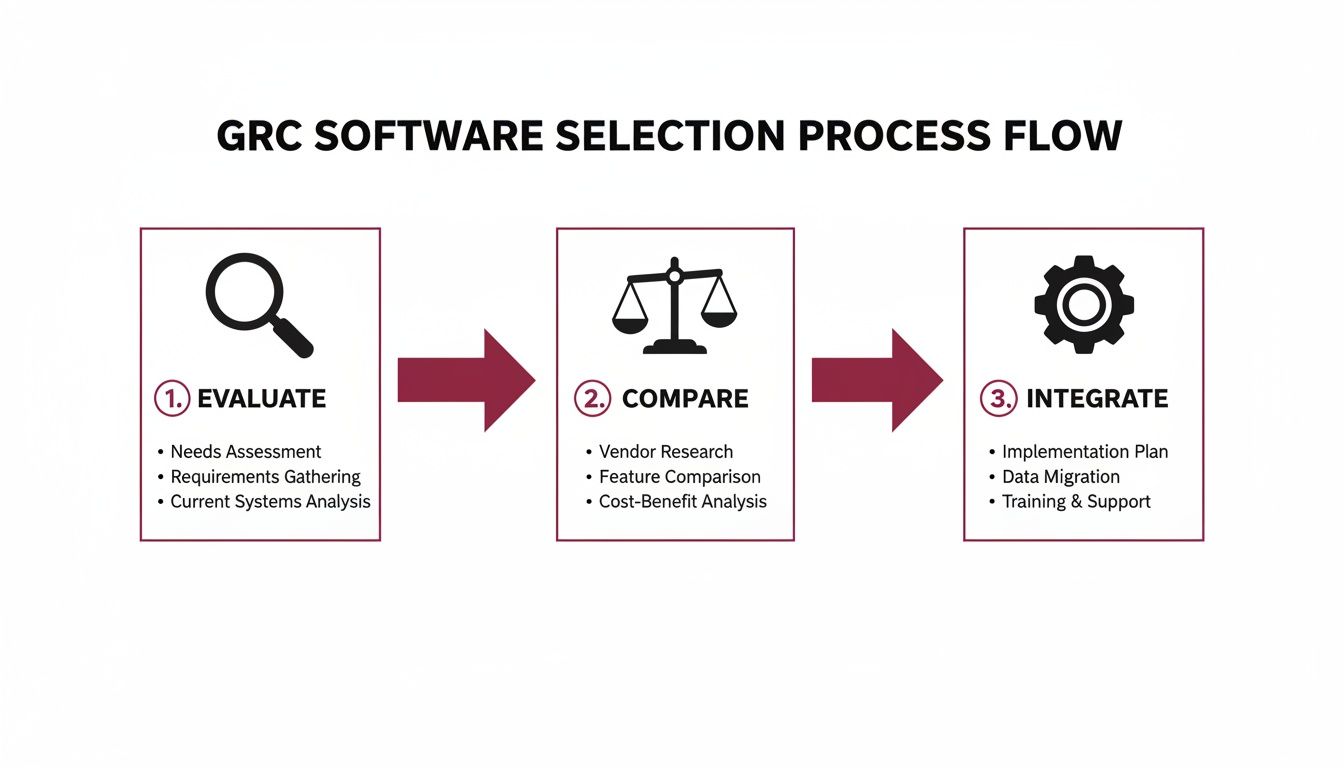
As you can see, evaluation, comparison, and integration aren't just boxes to tick; they’re sequential steps that build on each other to deliver a successful outcome.
Getting the Bosses On Board and Building Your Crew
Before you even think about configuring a single feature, your first and most crucial move is to get strong backing from the top. Without visible, vocal support from your leadership team, your GRC initiative will never get the momentum—or the budget—it needs to get off the ground.
You have to frame this as an investment in resilience and efficiency, not just another expense. Build a solid business case that speaks their language, focusing on tangible benefits like:
- Slashing the time spent preparing for audits.
- Cutting down the risk of copping hefty regulatory fines.
- Making smarter decisions with cleaner, more accessible data.
- Boosting day-to-day operational efficiency.
Once you’ve got leadership’s blessing, it’s time to assemble your implementation team. This can't be an IT-only affair. You need to pull in key people from compliance, legal, risk management, and operations. A diverse team like this ensures everyone's needs are heard and gives you a network of champions who can drive adoption across the entire business.
Planning the Project with a Phased Rollout
Going for a "big bang" implementation—where you try to switch everything on at once—is usually a recipe for chaos. A phased approach is almost always the smarter, safer bet. It allows you to deliver value quickly, learn as you go, and build user confidence step by step.
Start by tackling your biggest pain point. Is it managing audits? Getting policies out to the right people? Pick the module that will deliver the most immediate, visible impact. This gives you an early win, proves the value of the new GRC software, and gets everyone excited for what’s coming next.
A successful GRC implementation is a marathon, not a sprint. By breaking the project into manageable chunks, you minimise disruption, gather priceless user feedback, and make sure each new function is properly bedded in before you move on to the next.
The Tricky Bits: Data Migration and User Training
One of the most common tripwires is underestimating how complex data migration can be. The old 'garbage in, garbage out' rule is especially true here. Before you move a single byte of data, take the time to clean up and standardise your existing risk registers, control libraries, and policy documents. Kicking off with high-quality data is non-negotiable for the platform's long-term credibility and usefulness.
Finally, don't skimp on user training. It’s not enough to just show people which buttons to click; you have to explain the why behind the new processes. Run tailored training sessions for different teams, focusing on the specific tasks and benefits that matter to their roles. Ongoing support and a few refresher courses will help ensure the platform becomes a go-to tool in their daily workflow, not just another login they have to remember.
The drive for smarter solutions is clear. In Australia's patient safety sector, GRC platforms are the fastest-growing software segment, with the market forecast to hit USD 47.4 million by 2030. This highlights a powerful organisational shift towards investing in comprehensive tools, and you can learn more about this market shift in Australia.
Taking Your First Steps with GRC
We’ve covered a lot of ground, but the core takeaway is simple: governance, risk, and compliance aren’t separate headaches to be managed in silos. They're the interconnected foundations of a strong, resilient business. Thinking about governance risk management and compliance software isn't just an IT decision; it's a strategic move towards efficiency, better security, and lasting growth.
So, where do you begin? The journey starts with a few practical, clear-headed steps.
First, take an honest look at where your organisation stands right now with GRC. What are you already doing well? More importantly, where are the real gaps and weaknesses? This isn't about finding fault; it's about establishing a clear baseline to build from.
Figure Out What Hurts the Most
With that baseline in mind, it's time to pinpoint your most urgent pain points. Is your team buried in spreadsheets and manual tasks every time an audit looms? Are you losing sleep over third-party vendor risks? Or is the biggest struggle simply getting a straight answer on your compliance posture in real-time?
Knowing your specific problems is everything. It shifts the conversation from a vague hunt for software to a focused mission to solve tangible business issues.
This clarity is your best defence against being dazzled by shiny features you’ll never use. It keeps you focused on finding a solution that will make a real difference from the get-go.
Match Your GRC Strategy to Your Business Goals
Now you can start your research with purpose. You're not just looking for a GRC platform with the longest feature list; you're looking for a partner that aligns with your specific business goals. If getting that ISO 27001 certification is a top priority, then you should be zeroing in on tools with strong ISMS management, risk assessment workflows, and control mapping capabilities.
By taking these deliberate first steps, you're not just buying software—you're building a roadmap for a more secure, compliant, and efficient organisation. When you treat GRC as a strategic initiative, the platform you choose becomes a genuine asset that supports growth and resilience, setting you up for success long into the future.
Frequently Asked Questions
Navigating the world of governance, risk management and compliance software raises plenty of questions. To help you make informed decisions, we’ve gathered the answers business leaders ask most often.
How Long Does GRC Software Implementation Take
Implementation timelines vary based on your organisation’s size, existing processes and the amount of data you need to migrate. As a practical guide, small to medium businesses typically see a phased rollout complete in three to nine months.
Key Factors That Can Speed Up or Slow Down Your Project:
- Modules Deployed: Starting with one or two high-priority modules (for example, risk or compliance) is quicker than launching the full suite.
- Level of Customisation: An out-of-the-box configuration gets you up and running fast, while bespoke workflows require extra time.
- Data Quality: Clean, organised data dramatically shortens the migration phase.
Is GRC Software Only for Large Corporations
It’s a common misconception that only large enterprises can afford GRC platforms. Cloud-native, SaaS-based solutions have changed the game, making robust GRC tools accessible to businesses of all sizes.
The shift to Software-as-a-Service (SaaS) has democratised GRC. Small and medium businesses now access powerful automation and risk-management capabilities without the upfront expenses of legacy on-premise systems.
These flexible platforms let you pay for what you need today and add on as your organisation grows.
What Is the Typical Return On Investment For GRC Software
Calculating ROI for GRC software means looking at both hard and soft benefits. A well-rounded business case includes tangible cost savings alongside less-visible gains in resilience and reputation.
Quantifiable (Hard) Returns:
- Reduced Audit Costs: Automating evidence collection and audit workflows cuts hours of manual work.
- Lower Regulatory Fines: Proactive monitoring catches issues before they escalate into costly violations.
- Increased Operational Efficiency: Freeing your team from repetitive tasks lets them focus on strategic priorities.
Qualitative (Soft) Returns:
- Stronger brand reputation through consistent, visible compliance.
- Clear, data-driven insights that guide better decision-making.
- A more robust security posture that deters threats and builds stakeholder confidence.
Ready to build a more secure, resilient business? Anitech simplifies the path to ISO 27001 certification for Australian organisations. With 20 years’ experience and a 100% success rate, we’ll guide you every step of the way. Strengthen your security with Anitech today.
Recent Comments