

Quick Summary: Governance Risk Management Compliance (GRC) software is a central platform that unifies policies, risk assessments, and compliance tasks for standards like ISO 27001. It replaces inefficient spreadsheets, automates workflows, provides real-time visibility through dashboards, and helps organisations build a strong, auditable security program, turning compliance into a strategic advantage.
Think of Governance Risk Management Compliance (GRC) software as the command centre for your entire security program. It’s a single platform that helps you manage policies, get a handle on risks, and automate compliance tasks, especially for complex standards like ISO 27001. It’s the smart alternative to drowning in spreadsheets and manual busywork.
For a small business, this kind of system makes achieving serious compliance goals feel possible, even with a lean team.
What Is GRC Software and Why Does It Matter?
Trying to get and keep your ISO 27001 certification can feel like you're piecing together a massive puzzle without the box. For most small businesses, the reality is a messy collection of spreadsheets, shared folders, and endless email chains. This approach isn't just inefficient—it's a breeding ground for human error.
This is exactly the problem that governance risk management compliance software was built to solve. It’s not just another piece of tech; it's a strategic partner that acts as the central dashboard for your entire Information Security Management System (ISMS).
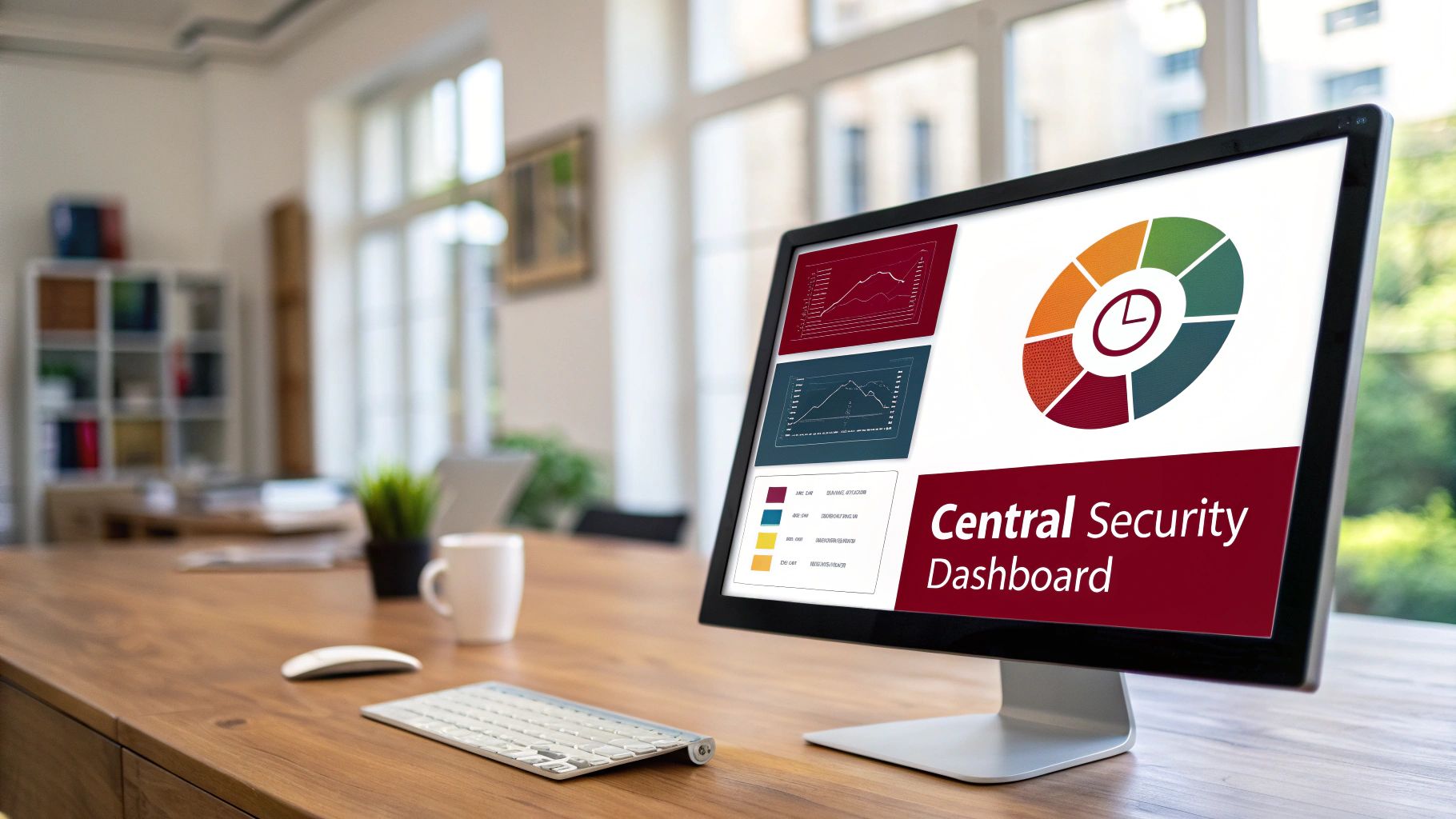
Unifying Your Security Efforts
The magic of a GRC platform is how it pulls together three critical functions that usually live in their own separate worlds. By connecting them, you build a much stronger, more cohesive security posture.
Here’s how it breaks down:
- Governance: This is about setting the rules of the game—your security policies and procedures. GRC software gives you a central library to store, manage, and update all your policies, making sure everyone is on the same page.
- Risk Management: This is where you identify, assess, and deal with potential threats. The software helps automate risk assessments, track what you’re doing to fix them, and gives you a live, clear picture of where you stand.
- Compliance: This means proving you’re following the rules, whether it's ISO 27001 or another standard. A GRC tool maps your internal security controls directly to these requirements, which makes audits smoother and less stressful.
By bringing these elements together, GRC software turns compliance from a reactive, scattered headache into a proactive and organised process. It gives you the clarity to make smart decisions and build a security framework that actually works.
The Problem with Manual Methods
Without a proper GRC solution, teams inevitably fall back on manual processes that create endless friction. You’re not just wasting time; you’re introducing risks that could derail your certification entirely.
Think about it. A risk register in a spreadsheet is instantly out of date the moment someone else opens it. Version control becomes a nightmare, and data consistency goes out the window.
This kind of manual chaos turns every audit preparation into a last-minute scramble for evidence. A centralised governance risk management compliance software platform gets rid of that panic. Everything is organised, up-to-date, and ready for inspection at a moment's notice. This lets your team stop chasing paperwork and start focusing on what really matters: making your business more secure.
How GRC Software Can Actually Make Your Life Easier
Let's cut through the noise and talk about what governance, risk management, and compliance (GRC) software really does on the ground. Think of it less as another piece of software and more as the command centre for your entire security and compliance world. It gets you out of the messy, disconnected world of spreadsheets, scattered documents, and never-ending email chains.
A good GRC platform takes compliance from being a frantic, reactive scramble to a calm, organised, and proactive process. It does this by tackling the biggest headaches IT and compliance managers face every day.
Getting All Your Documents in One Place
One of the first hurdles in any compliance project is just finding everything. Policies, procedures, and various guidelines are usually all over the place—stashed on different network drives, buried in inboxes, or saved on someone's desktop. This makes version control a nightmare and you can never be sure if everyone is looking at the most current document.
A GRC platform acts like a central library. Every single policy and procedure has a dedicated home, is easy to find, and has a clear audit trail of every update.
This is more than just good housekeeping. It simplifies the entire process of writing, reviewing, and approving documents. This applies to all sorts of operational documents, and there’s some great guidance on writing method statements that address risk if you need to spell out exactly how your organisation handles risk in its day-to-day work.
Putting Risk Assessments on Autopilot
Trying to run a risk assessment manually is a recipe for frustration. Juggling spreadsheets to track threats, vulnerabilities, and controls becomes almost impossible to manage as your business grows, and it’s incredibly prone to human error. This is where GRC software really starts to shine.
These platforms have risk assessment frameworks built right in, many of which are already set up for standards like ISO 27001. This lets you:
- Spot Risks Systematically: Use pre-built templates that walk your team through identifying potential threats to your critical information.
- Calculate Risk Scores Automatically: The software crunches the numbers for you, scoring risks based on impact and likelihood so you can focus on what matters most.
- Assign Fixes and Track Them: You can create and assign tasks to deal with risks directly within the platform, giving clear ownership and deadlines to your team.
This automated approach turns your risk register into a living, breathing tool, not a static file that's out of date the second you save it.
Connecting Your Controls Directly to ISO 27001
One of the biggest wins with a GRC platform is its ability to map your security controls directly to the specific requirements of ISO 27001. Forget spending hours manually cross-referencing everything you do against the Annex A controls; the software handles that tedious work for you.
This mapping feature is your secret weapon for audit readiness. When an auditor asks how you're meeting a specific requirement, you can show them instantly—complete with links to the right policy, the relevant risk assessment, and the proof that it's all working.
Seeing Everything on a Live Dashboard
Without a GRC system, getting a clear, real-time picture of your compliance status is next to impossible. You're constantly chasing people for updates and trying to stitch together reports from a dozen different places.
GRC software fixes this with live dashboards that give you a bird's-eye view of your entire compliance program. You get an instant snapshot of key metrics: the status of risk treatments, which policies are due for review, and how close you are to certification. This visibility means you can make smart decisions and fix compliance gaps before they ever become a real problem.
It's no surprise that businesses are catching on. Australia's GRC platform market was valued at USD 1.4 billion and is expected to hit USD 3.7 billion by 2033. This isn't just a trend; it's a fundamental shift toward a smarter way of managing compliance. You can read more in this market growth analysis.
Connecting GRC Features to ISO 27001 Controls
The real magic of governance risk management compliance software is how it takes the often abstract, high-level requirements of ISO 27001 and turns them into real, day-to-day tasks. For a lot of small businesses, the Annex A controls can look like an impossibly long to-do list. A good GRC platform is the bridge between that theory and practical action.
It maps each control to a specific feature, effectively giving you a toolkit to implement, monitor, and prove your compliance. This shifts your whole approach. You stop scrambling to gather evidence for an audit and start managing security proactively, with the proof being generated as a natural byproduct of your daily work.
At its heart, a GRC platform gives you three key advantages on your ISO 27001 journey: a single source of truth, automated workflows, and clear visibility over your entire security posture.
This diagram shows how GRC software brings everything together, helping you centralise data, automate critical tasks, and gain valuable insights into your security performance.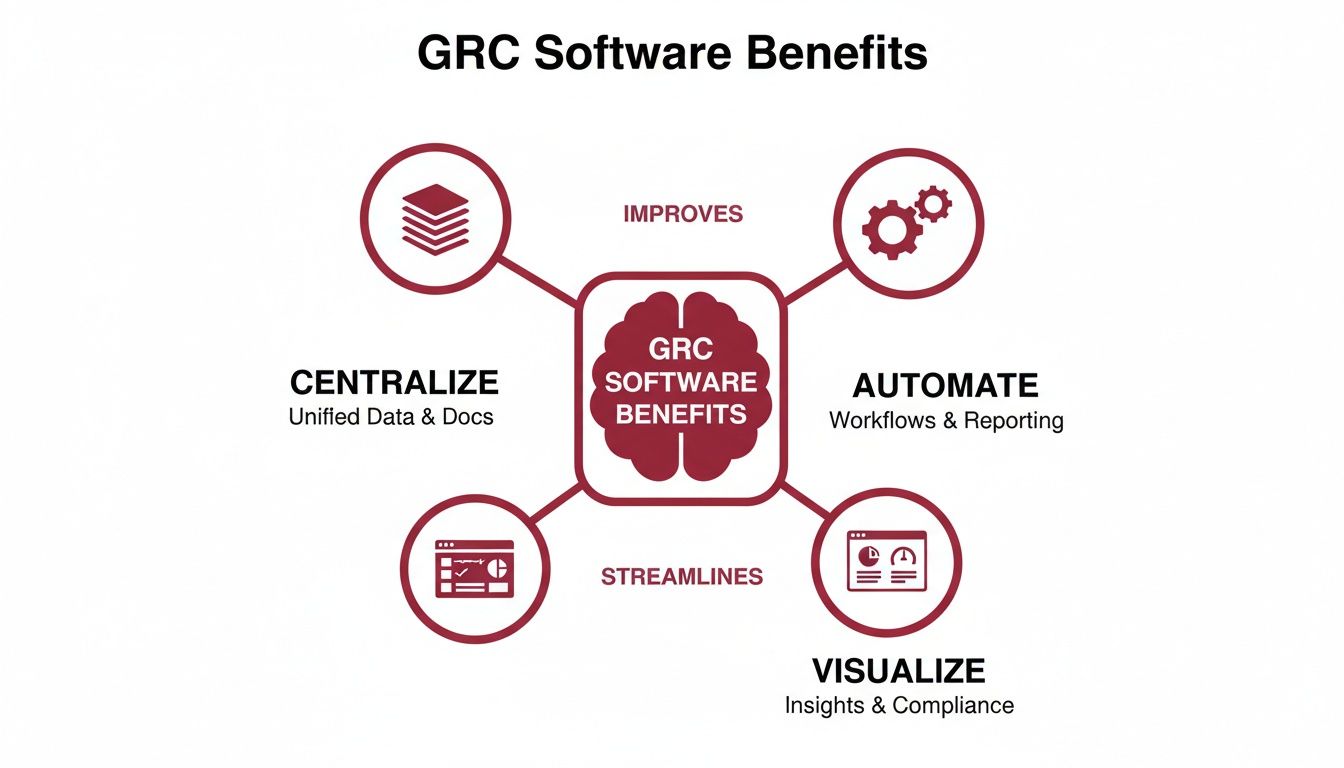
When these functions work in concert, managing ISO 27001 becomes a whole lot easier and far more effective.
Mastering Asset and Information Management
You can't protect what you don't know you have. It's a fundamental security principle and a core part of ISO 27001, specifically around asset management. Without a dedicated system, this usually ends up as a chaotic collection of spreadsheets that are out-of-date the moment you finish them.
GRC software provides a dedicated asset management module to solve this problem for good. This allows you to:
- Build a Central Inventory: Directly tackles Annex A control A.5.9 (Inventory of information and other associated assets) by creating one living list of everything that matters—servers, laptops, key software, and sensitive data sets.
- Assign Clear Ownership: Define who is accountable for each asset. This isn't just a tick-box exercise; it's crucial for good governance and a key requirement.
- Classify Your Information: Systematically apply data classification labels (like Public, Confidential, or Restricted) as required by control A.5.12 (Classification of information), so everyone knows how to handle different types of data.
Suddenly, your asset register is no longer a static document gathering dust. It becomes a dynamic, genuinely useful tool for managing risk.
Automating Incident Response and Management
When a security incident hits, your response needs to be fast, consistent, and organised. The Annex A controls from A.5.24 to A.5.27 lay out exactly what’s expected. Trying to coordinate this manually in the middle of a crisis is a recipe for mistakes and missed steps.
This is where a GRC platform's incident management workflow really shines. It automates the entire process from detection to resolution. For example, an employee spots something suspicious and logs it using a simple form in the software.
That single action can automatically kick off a pre-defined workflow. It assigns tasks to the right IT people, notifies senior management, and logs every single step taken. This creates a perfect, time-stamped audit trail, proving you followed your own procedures.
This built-in process means nothing gets forgotten, your team follows the same playbook every time, and you can produce solid evidence for auditors without breaking a sweat.
Simplifying Access Control and Audits
Figuring out who has access to what is a cornerstone of information security, covered in detail by controls A.5.15 to A.5.18. Manually tracking user permissions across dozens of different systems isn't just a headache; it's a huge security gap waiting to be exploited.
GRC software fixes this by centralising user access reviews. You can schedule regular, automated checks where system owners are prompted to confirm or deny access for their team members. Every decision is logged, creating an airtight audit trail that proves you're actively managing user privileges.
To get a feel for the full scope of what's required, you can explore the complete list of ISO 27001 controls and see just how many areas a GRC tool can touch.
The table below shows a few clear examples of how specific GRC features map directly to the ISO 27001 controls, turning compliance from a burden into a manageable process.
Mapping GRC Software Features to Key ISO 27001 Annex A Controls
| ISO 27001 Annex A Control | Control Objective | How GRC Software Helps | Relevant Software Module |
|---|---|---|---|
| A.5.9 | To identify the organisation’s information and other associated assets. | Provides a centralised, searchable database to log, track, and manage all assets. | Asset Management |
| A.5.12 | To ensure that information receives an appropriate level of protection. | Allows for systematic classification and labelling of assets based on sensitivity. | Data Classification / Asset Management |
| A.5.15 | To ensure that users are only provided with access to the information they need. | Automates periodic user access reviews and creates an audit trail of approvals. | Access Control / Identity Management |
| A.5.24 | To ensure a consistent and effective approach to managing information security incidents. | Creates structured workflows for logging, assigning, tracking, and reporting incidents. | Incident Management |
| A.5.34 | To ensure protection of the organisation’s information in supplier agreements. | Provides a central repository for supplier contracts and automates risk assessments. | Vendor Risk Management |
This direct mapping is what moves your organisation from a state of "compliance chaos" to one of genuine "compliance control." It makes achieving ISO 27001 not just a one-off project, but a sustainable part of how you operate.
Choosing the Right GRC Software for Your Business
Picking a governance, risk management, and compliance (GRC) software platform is a big deal. Get it wrong, and you’re looking at a world of frustration, wasted time, and a hefty subscription that just gathers dust. To choose wisely, you need to cut through the marketing noise and zero in on what will actually help you achieve your compliance goals.
For Australian businesses, this isn't just a technical decision—it's a strategic one. Things like data sovereignty aren't just buzzwords; they're deal-breakers for meeting local regulations and client demands. You need a clear, methodical way to compare your options to make sure you’re investing in an asset, not just another piece of software.
Evaluating Key Platform Capabilities
Before you even think about booking a demo, sit down and make a checklist of your non-negotiables. A great GRC platform should feel like another member of your team—one that makes life simpler, not more complicated.
Think of it in terms of these core pillars:
- Scalability: Your business is going to grow, and your GRC software needs to keep up. Can it handle more users? Can you add new compliance standards later on? Ask potential vendors how their platform and pricing scales as you expand.
- Ease of Use: This one is simple. If the software is clunky or confusing, your team just won’t use it. An intuitive, clean interface isn't a luxury; it’s a must-have. Your people should be able to jump in and manage risks and controls without needing a PhD in the software itself.
- Integration Potential: A GRC tool can't live on an island. It needs to play nice with the tools you already use every day, like Microsoft 365, Jira, or Slack. Strong integrations are the key to automating workflows and getting rid of the soul-crushing task of manual data entry.
The best GRC platforms become the central nervous system for your compliance efforts. They seamlessly pull data from your other tools to give you a single, unified view of where you stand with risk.
Australian-Specific Considerations
If you’re operating in Australia, your checklist needs a few more items. The governance, risk management, and compliance software you choose has a direct impact on your ability to meet local laws and, just as importantly, your clients' expectations.
Pay close attention to these two points:
- Data Sovereignty and Hosting: Where is your data actually stored? This is a critical question. Many Australian clients, particularly in government and finance, have strict rules that their data must never leave the country. You need to get a straight answer from vendors about where their servers are physically located to meet these requirements and stay aligned with the Australian Privacy Act.
- Alignment with Local Regulations: ISO 27001 is a global benchmark, but your GRC tool should also understand the local landscape. Look for platforms that support frameworks like the Australian Signals Directorate's (ASD) Essential Eight. Having this built-in makes life much easier. You can explore a variety of risk management frameworks to see what else might apply to your operations.
Unpacking Vendor Pricing and Support
Finally, let’s talk money. A confusing pricing model is a massive red flag. You want a vendor who is upfront and transparent, with clear tiers that spell out exactly what you get for your investment.
Dig a little deeper and ask about the costs that might be hiding in the fine print:
- Implementation and Onboarding Fees: Is setup included in the price, or is it an extra line item on the invoice?
- Ongoing Support Costs: What kind of support comes standard? If you run into a major issue, can you get help quickly, or will you have to pay for premium support?
- Training and Resources: Does the vendor provide good documentation and training to help your team get up to speed? A tool is only as good as your ability to use it.
Choosing the right GRC software is a long-term strategic move. By being thorough and asking the tough questions now, you can find a partner that not only gets you over the line for ISO 27001 certification but also makes your entire business stronger and more resilient.
Your Roadmap for a Successful GRC Implementation
A powerful tool is only as good as its rollout. Choosing the right governance, risk management, and compliance software is step one, but the real magic happens when you thoughtfully weave it into the fabric of your organisation. Without a clear roadmap, you risk ending up with another expensive, unused subscription instead of an indispensable asset.
This isn't just a tech project; it's a strategic shift. It's about people, processes, and getting everyone on board from the very beginning.
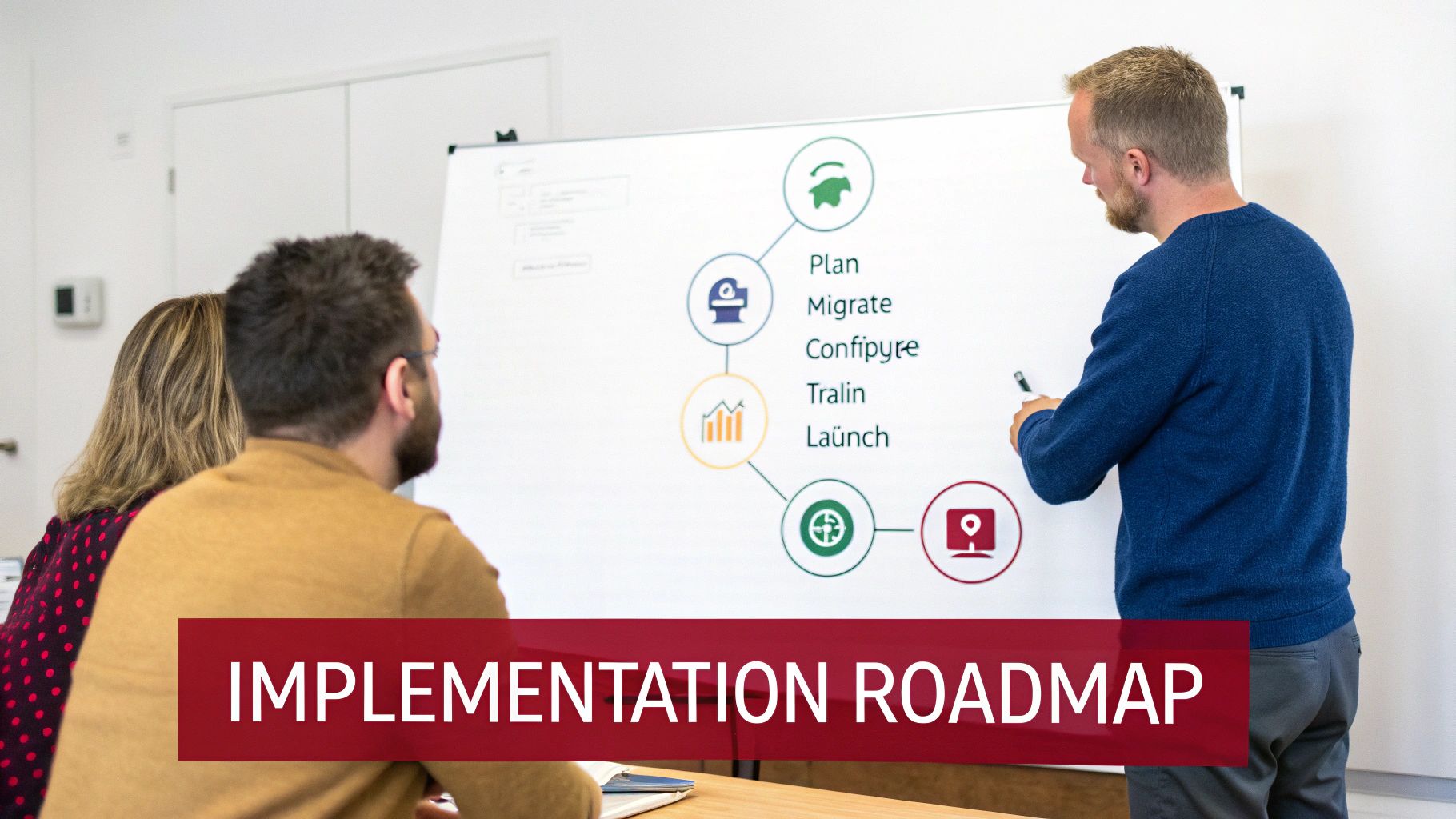
Phase 1: Planning and Scoping
Before a single piece of data is touched, you need a rock-solid plan. This first phase is all about defining what success actually looks like and getting the right people in the room. If you skip this groundwork, even the best software on the market will fall flat.
Start by setting a clear scope. Are you laser-focused on ISO 27001 for now, or are other standards on the horizon? Answering this helps you prioritise which modules and features to tackle first.
Next, build your implementation team. This can't be siloed in IT. You need key people from legal, HR, and operations to make sure the platform is configured for the entire business, not just one department. Getting leadership buy-in early is also critical—it gives you the authority and resources needed for a smooth ride. A great first step here is to use the new platform to get a baseline, and our guide on how to perform a gap analysis is the perfect place to start.
Phase 2: Data Migration and System Configuration
Now for the technical heavy lifting. The goal here is to finally escape the chaos of scattered spreadsheets and documents and bring everything into one central hub. You'll need to methodically migrate your existing risk registers, asset lists, policies, and control evidence into the GRC platform. It can be a tedious job, but getting a clean data import is absolutely vital for the system's long-term integrity.
With your data in its new home, it's time to configure the system to fit your unique workflows. This typically involves:
- Setting up user roles and permissions: Deciding who can see, edit, and approve different pieces of information.
- Customising risk assessment templates: Tweaking the out-of-the-box frameworks to reflect your company's specific risk appetite.
- Building automated workflows: Setting up smart notifications for things like policy reviews, incident escalations, and task reminders.
A well-configured GRC platform should feel like it was custom-built for your organisation. It needs to adapt to your processes, not force you into a rigid, one-size-fits-all box.
Phase 3: Training and Launch
Once the system is set up, the spotlight turns to your team. A successful launch lives and dies by user adoption, and that journey starts with great training. Don’t just show people where to click; explain why this new system matters and how it will genuinely make their jobs easier.
Run role-specific training sessions. A system administrator needs a much deeper understanding than a policy owner or an employee who just needs to report an incident. Make sure you provide simple documentation and quick-start guides they can refer back to later.
Finally, think about a phased go-live. You might launch with just one department or focus on a single process, like incident management, to iron out any kinks before a full company-wide rollout. When you do launch, celebrate it! Then, make sure to provide ongoing support as your team gets comfortable with the new way of managing governance, risk, and compliance.
Building the Business Case for GRC Software
So, you're convinced about the technical merits of a GRC platform. But how do you get the sign-off from leadership? The key is to stop talking about it as another IT cost and start framing it as a strategic investment.
This isn’t just about ticking boxes to pass an ISO 27001 audit. It's about building a compelling business case that speaks the language of the C-suite: growth, resilience, and a solid return on investment (ROI). You need to show them how this software makes the entire organisation stronger, smarter, and more competitive.
Quantifying the Return on Investment
Let's be honest, the most convincing arguments always come down to the numbers. While your specific situation will be unique, you can build a rock-solid financial case by focusing on three areas where you'll see real, tangible gains.
- Slash Audit Preparation Time: Think about the last time you prepared for an audit. The frantic scramble to gather evidence, chase down documents, and prove compliance is a massive time-drain. A GRC platform automates this, linking your controls to policies and risks in real-time. Just calculate the hours your team currently spends on this manual grind and multiply it by their salary. The savings are often eye-watering.
- Boost Operational Efficiency: Automation is where the magic really happens. Imagine all the time you'll get back from manual risk assessments, policy update cycles, and coordinating incident responses. This frees up your best people from tedious admin to focus on high-value work, like actual strategic security improvements.
- Dodge Hefty Fines and Penalties: We all know the cost of non-compliance can be brutal. A breach can lead to significant fines, not to mention the reputational damage and lost business that inevitably follows. A GRC platform gives you the oversight to prevent these incidents from happening in the first place.
This move towards integrated risk management isn't just a niche trend. Across Australia's wider compliance software market, the patient safety and risk management software sector is projected to hit USD 47.4 million by 2030. What's really telling is that GRC solutions are the fastest-growing part of that market. It's a clear signal that businesses are prioritising these integrated platforms. You can dig into these market insights on Grand View Research.
Gaining a Powerful Competitive Advantage
Beyond the cost savings, a well-implemented GRC system is a seriously powerful tool for winning new business. In today’s market, proving your security credentials isn't just a "nice-to-have"; it’s a non-negotiable for landing bigger contracts, especially with enterprise and government clients.
An investment in governance risk management compliance software is an investment in trust. It provides tangible proof to clients and partners that you take security seriously, transforming your compliance posture from a defensive necessity into a proactive sales tool.
Imagine being able to instantly generate a report that shows your real-time risk status and control effectiveness. You’ll immediately stand out from competitors who are still wrestling with outdated spreadsheets. This ability to demonstrate mature security practices can be the single factor that tilts a lucrative deal in your favour.
Ultimately, a GRC platform is about creating a more resilient and agile business. It gives your leadership team the clear, data-driven insights they need to make better strategic decisions, turning risk management from a chaotic guessing game into a precise discipline. That kind of clarity doesn’t just get you through an audit; it helps you build a fundamentally stronger company that's ready for sustainable growth.
A Few Common Questions About GRC Software
Stepping into the world of governance, risk, and compliance (GRC) software can feel a bit daunting, especially with a major goal like ISO 27001 certification on the line. It's only natural to have questions. Here are some straightforward answers to what business leaders and IT managers often ask us.
Can We Really Manage ISO 27001 Without GRC Software?
Look, technically, you could try to wrangle ISO 27001 with a labyrinth of spreadsheets and Word documents. But let’s be honest—it’s a recipe for headaches. That manual approach is not only incredibly time-consuming but also riddled with the potential for human error, and it simply doesn't scale as your business grows.
For most teams, the sheer administrative drag of manually chasing evidence, updating risk registers, and scrambling for audits just isn't worth it. A dedicated GRC platform automates the grunt work, centralises everything, and gives you the clear, traceable audit trail you need to build a compliance program that actually lasts.
What's the Typical Cost of GRC Software in Australia?
The price tag on GRC software can vary quite a bit, depending on the features you need, how many people will use it, and the provider you choose. For a small to medium-sized business here in Australia, you can expect entry-level SaaS solutions to run anywhere from a few hundred to several thousand dollars per month.
The key is to find a vendor with transparent, flexible pricing. You want a plan that lets you start with the essentials and add more functionality as your compliance program matures. Always be sure to ask about any hidden implementation fees or extra support costs to understand the full investment.
How Long Does It Take to Get GRC Software Up and Running?
This really depends on the size of your organisation, how complex your current systems are, and how much data needs to be pulled across. For a well-prepared small business, a standard implementation can often be wrapped up in four to eight weeks.
That timeframe usually covers the initial setup, configuring the system to your needs, training your key staff, and getting your core policies and asset lists loaded in. Having a clear game plan and a dedicated internal champion makes the whole process faster and a lot smoother.
A focused implementation means your team starts seeing the benefits—and feeling the relief—of streamlined compliance management much sooner.
Ready to simplify your ISO 27001 journey and build a security posture you can be proud of? At Anitech, we specialise in guiding Australian businesses through every step of the certification process. Learn how our expert consulting can help you achieve compliance with confidence.
Recent Comments