

Navigating the complex world of cyber threats and stringent government tender requirements can feel overwhelming for any Australian business. The pressure is immense. But what if you could turn a national security priority into your own strategic advantage? That's exactly what government funded cyber security courses are designed to help you do—build a top-tier cyber defence without breaking the bank. These free or subsidised cyber security training programs are a key part of Australia's national strategy.
Turn Government Support Into Your Competitive Edge

Picture a small to medium-sized business that was previously locked out of lucrative government contracts because of tough security prerequisites. Now imagine that same business, after accessing funded training, not only bolstering its defences but also unlocking a whole new level of revenue. This isn't just a hopeful hypothetical—it's the reality for businesses that smartly tap into these national cyber initiatives and government grants for cyber security.
The Australian government is pouring serious money into cyber skills because it sees a resilient private sector as a cornerstone of national security. This guide is your roadmap to accessing that investment. We’ll show you how to connect these training opportunities to the practical, high-value goal of achieving ISO 27001 certification, effectively turning government grants into a powerful engine for your company's growth.
Why This Matters for Your Business Right Now
If you work with the government, you already know the bar is getting higher. State-sponsored cyberattacks targeting critical infrastructure jumped by roughly 30% in 2023, and the fallout has been a major clampdown on security standards for contractors. Simply saying you’re secure won't cut it anymore; you need to prove it with certified skills and audited systems.
Investing in your team's cyber skills through these programs does more than just tick a box. It builds a genuine culture of security, dramatically cuts your risk of a costly data breach, and positions your business as a reliable, trustworthy partner in any supply chain.
This is your direct path to strengthening your security posture and meeting those tough tender requirements without the often-prohibitive costs. Once you understand the real ROI of cyber security, you’ll see how this subsidised effort pays dividends for years to come.
Broadening Your Funding Horizon
It's also worth looking beyond programs labelled specifically for "cybersecurity." Understanding the wider range of funding options for empowering businesses can give you an even bigger competitive advantage. By exploring all the support channels available, you can fuel growth and innovation right across the organisation.
The principle is simple: use external support to build your internal strength and market credibility. In the next sections, we'll get into the nitty-gritty of the specific government initiatives out there and how you can get your team enrolled.
Why Australia Is Investing Billions In Cyber Skills

To really get the most out of these training opportunities, it helps to understand why the government is pouring so much money into them. This isn't just about handing out a few random grants. It's a calculated, long-term strategy to build a national defence line against increasingly sophisticated cyber threats—a strategy your business can tap into directly.
For a long time, funding for cyber security felt reactive, often a response to the latest breach. That's all changed. Today, it’s a central pillar of Australia's economic and national security. The government gets it: a supply chain is only as strong as its weakest link, and that includes the thousands of small and medium-sized businesses that are the lifeblood of our economy.
From Ad-Hoc Grants to a National Priority
The shift in thinking has been huge. Between 2016 and 2024, we saw a move away from generalised awareness campaigns towards a structured, skills-first model. Now, government-funded cyber security courses are being embedded right across the public sector and its vast network of partners.
The Australian Public Service (APS) Data, Digital and Cyber Workforce Plan spells it out clearly: attracting, training, and keeping top cyber talent is a massive priority. This is a core part of the 2023–2030 Australian Cyber Security Strategy, which has earmarked over A$2.3 billion for total cyber security investment. That includes an extra A$586 million announced in 2023 specifically for skills. Diving into the full government workforce plan really shows you the scale of this commitment.
What This Investment Means for Your Business
So, what does this multi-billion-dollar push mean for you on a practical level? It translates directly into real-world opportunities for your organisation by making the training market more accessible and diverse.
You'll find:
- More High-Quality Courses: All this funding incentivises training providers to create and offer specialised, relevant courses that are actually up-to-date.
- Targeted Micro-credentials: Need to get your team skilled up quickly in a niche area like incident response or cloud security? Funded short courses and micro-credentials are now much easier to find.
- Advanced Training Pathways: The focus isn't just on the basics anymore. There are now clear pathways for your staff to gain advanced qualifications and professional certifications.
This strategic investment ensures that funded training isn't just a short-term perk. It's a reliable, ongoing resource for building a team with the documented competencies needed to achieve and maintain rigorous security standards like ISO 27001.
At its core, the government is offering to co-invest in your company’s resilience. By taking part in these programs, you're not just strengthening your own defences; you're also playing a role in creating a more secure Australian economy. That alignment is exactly what makes your application for funded training so much more powerful.
Find and Qualify for Funded Training Programs
Alright, let's get down to the practical steps. You know the training is out there, but how do you actually get your team into a funded program? This isn't about just browsing the web; it's about having a smart, targeted approach to find and qualify for government funded cyber security courses.
Forget wading through endless search results. The key is knowing where the real opportunities are hidden. These programs are scattered across federal, state, and even industry-specific channels, and each has its own flavour. While the big national portals are a great place to start, some of the best-kept secrets are the state-based initiatives specifically designed for small and medium-sized businesses (SMEs).
Think of these programs as an investment in the entire business community. By figuring out which avenue best suits your company’s size, sector, and goals, you massively boost your chances of getting a "yes."
Where to Uncover Funding Opportunities
A methodical search is your best friend here. If you cast a wide but targeted net, you’re far less likely to miss that perfect opportunity that could give your team a serious skills upgrade.
Kick off your search by digging into these key areas:
- Federal Government Portals: Keep an eye on sites like the APS Academy. While they focus on the public sector, they often partner with private training providers or have streams designed to help government contractors.
- State-Based Business Initiatives: Check in with your state government’s department for small business or innovation. They are constantly running grant programs that cover skills development, and cybersecurity is almost always on the list.
- Industry-Specific Grants: Are you in defence, health, or critical infrastructure? These sectors often have dedicated funding pools to secure their supply chains. Your industry association or growth centre is the first place to ask.
As you explore these options, it's also helpful to understand the broader landscape of information technology grants. Knowing the general principles behind these applications will give you a real edge.
Decoding Eligibility and Building Your Case
Found a program that looks promising? Great. The next step is navigating the eligibility maze. Every grant has its own unique rules, but they usually share a common goal: strengthening Australia's economy and its digital defences.
Most of the time, you'll need to show:
- Your Business Status: Have your ABN ready. You'll need to prove you’re a registered Australian business, and many programs have specific headcount rules to qualify as an SME.
- Industry Alignment: Some funding is earmarked for businesses in critical sectors or those already in a government supply chain. Be prepared to demonstrate that link clearly.
- A Compelling Business Case: This is where you win or lose. You have to clearly explain how this specific training will directly benefit your organisation and, just as importantly, the wider economy.
Expert Tip: The best applications tie the training directly to a concrete business outcome. For instance, stating that "this training is a critical step for us to achieve ISO 27001 certification" shows funders you have a clear, strategic plan. They love that.
Your application is more than just filling out forms; it's about telling a compelling story of risk reduction and business growth.
I recently worked with an IT manager at a regional consulting firm who nailed this. He framed his application around the need to protect sensitive client data to win a major local government contract. He successfully argued that the training wasn't just a perk for his team—it was a direct enabler for regional business growth. That’s the kind of powerful narrative that gets applications approved.
Ultimately, effective cybersecurity training for employees is a smart investment that strengthens both your security and your reputation in the market.
Select the Right Course for Your Business Goals
You’ve done the hard work and found a government-funded cybersecurity course. That's a huge step. But the real win isn't just getting the training paid for; it’s choosing a course that actually moves the needle for your business.
Too many businesses grab the first funded spot they see, and that’s a massive missed opportunity. You have to think strategically. Are your biggest vulnerabilities on the technical frontline, or are you struggling with the high-level policies and risk management needed for something like ISO 27001 certification? Knowing the answer to that question is what turns a free course into a genuine competitive advantage.
Technical Skills vs. Governance: What's the Difference?
Cybersecurity training generally splits into two main streams. One creates the specialists who get their hands dirty configuring firewalls and hunting for threats. The other develops the leaders who build and manage the entire security framework from the top down.
-
The Technical Deep Dive: These courses are all about practical, hands-on skills. We're talking penetration testing, secure coding, network defence, and what to do when an incident actually happens. This is for the doers on your team.
-
The Governance & Risk Angle: This is the training for your managers, compliance officers, and future leaders. It’s less about code and more about creating security policies, conducting risk assessments, and managing an Information Security Management System (ISMS) – skills that map directly to the principles of ISO 27001.
Deciding which path to take can feel a bit daunting, but this flowchart can help you visualise the best route based on your company's profile.
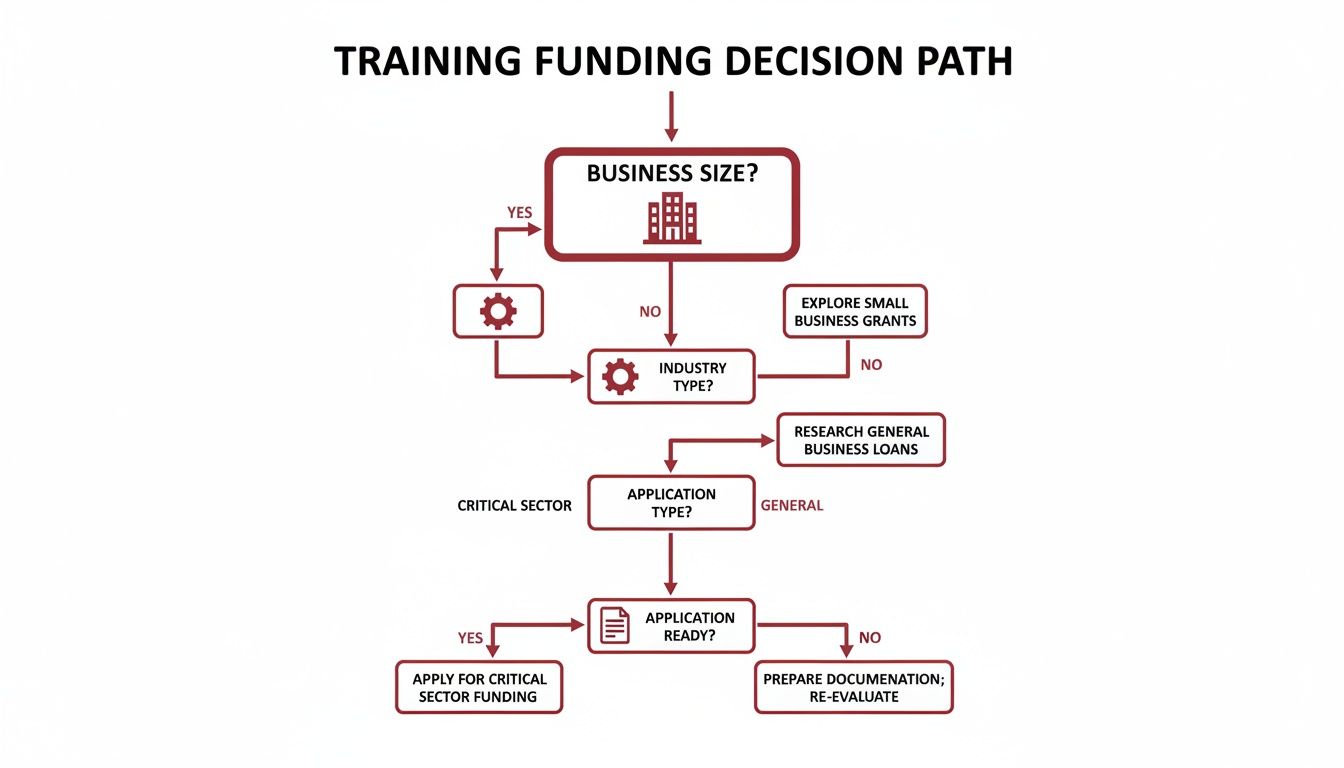
As you can see, things like your business size and industry can point you toward the training—and funding streams—that make the most sense for you.
Mapping Your Training Directly to Your ISO 27001 Journey
If ISO 27001 certification is on your roadmap, funded training can be an incredible accelerator. The trick is to be deliberate. Map the skills and outcomes from the course syllabus directly to the specific controls in the ISO 27001 standard.
When you do this, a simple training day becomes a piece of documented, auditable evidence that proves your team's competence.
Think about it: sending your team to a course on developing robust security policies isn't just upskilling. You are actively creating the proof you need to satisfy Control A.5 (Information Security Policies). It's a straight line from learning to compliance.
To help you connect the dots, here’s a look at how different types of courses align with your ISO 27001 implementation plan.
Comparing Government Funded Cyber Security Course Types
This table breaks down some common course types to help you match your training investment to your business needs, whether that’s building technical muscle or strengthening your governance and compliance framework.
| Course Type | Best Suited For | Key Skills Gained | ISO 27001 Alignment |
|---|---|---|---|
| Technical Incident Response | IT support staff, network administrators | Malware analysis, forensic investigation, containment strategies | A.16 Incident Management |
| Governance & Policy Writing | Compliance managers, IT leaders, executives | ISMS framework design, policy development, risk assessment | A.5 Policies, A.8 Asset Management |
| Cloud Security Essentials | System architects, developers | Secure cloud configuration, identity and access management | A.14 System Acquisition, Development & Maintenance |
| Certified Information Systems Auditor (CISA) Prep | Internal auditors, quality managers | Audit planning, control testing, compliance reporting | Clause 9.2 Internal Audit |
When you choose this deliberately, every dollar of government funding becomes a direct investment in your compliance journey. That's how you save a huge amount of time, money, and headaches down the track.
Embed New Skills Into Your ISO 27001 Framework

Getting your team into a government-funded cyber security course is a fantastic win, but it’s really just the starting line. The real value comes when that newfound knowledge is woven directly into your daily operations and, most importantly, into your Information Security Management System (ISMS).
This is the point where a training certificate evolves into a powerful, auditable asset for your business.
For any business on the path to ISO 27001 certification, bridging the gap between learning and doing isn’t just good practice—it's a hard requirement. You have to prove your team is competent to handle their security roles, and this is how you do it.
Turning Training Into Auditable Evidence
The ISO 27001 standard talks a lot about competence, awareness, and communication. This is exactly where that investment in funded training really starts to pay dividends, especially when an auditor comes knocking.
Here’s how to make that training count:
- Document Everything: Keep detailed records of who attended what, the course curriculum, and their completion certificates. This isn't just paperwork; it's the concrete evidence you need to satisfy Clause 7.2 (Competence).
- Update Role Descriptions: As soon as someone is trained, revise their job description to reflect their new security responsibilities. This draws a clear, undeniable line for an auditor between the training received and the duties assigned.
- Empower Control Owners: Give your newly skilled people ownership of specific security controls. For example, the person who just finished an incident response course? They should be a key figure in managing your processes under Control A.16 (Information security incident management).
This isn’t just theory; it’s exactly what the government itself is doing. The Australian Government’s “The Commonwealth Cyber Security Posture in 2023” report shows a massive push for role-specific training, with 78% of Commonwealth entities providing these kinds of targeted courses. This focus on specialised skills directly backs up the need for the tangible proof of competence that auditors are looking for.
A Real-World Success Story
We saw this play out perfectly with a client not long ago. They sent their IT team to a funded course on incident response. Before the training, their incident plan was basically a generic template they'd downloaded—it wouldn't have survived five minutes of real-world scrutiny.
After the course, they didn't just tweak the plan; they tore it down and rebuilt it from scratch. They applied their new skills to create a process that was practical, specific to their actual environment, and genuinely robust. When the auditor arrived, they didn't just hand over a document. They confidently walked them through their new incident drills, step-by-step.
That single move saved them thousands in potential consulting fees and was a major reason they sailed through their certification audit. It’s a textbook example of how a government-funded course can become a cornerstone of your ISO 27001 implementation.
Ultimately, embedding these new skills is less about ticking boxes and more about fostering a living, breathing culture of security. When you document your team's growth and empower them to put their knowledge into action, you build a far more resilient organisation and a much smoother path to certification.
Got Questions About Funded Cyber Courses? We’ve Got Answers.
When you start digging into government-funded cyber security courses, it’s natural to have a few questions. Getting straight answers is the first step to building a solid business case and moving forward. Let's tackle some of the most common queries we hear from Australian businesses just like yours.
"Are these courses just for government employees?"
That’s a very common assumption, but thankfully, it’s wrong. While plenty of programs aim to boost skills within the Australian Public Service (APS), the government's strategy is much bigger. The real goal is to secure our entire digital economy, and that absolutely includes private businesses.
More and more funded spots are opening up for the private sector, particularly for SMEs that are part of government supply chains or work in critical infrastructure. The trick is to show how training your team directly contributes to Australia's economic and security strength.
- Where should you look? Start with industry growth centres, your state government’s business support website, and any specific programs for Defence industry partners.
- How should you pitch it? Frame your application as a win-win. You’re not just asking for funding; you’re proposing a partnership that strengthens Australia’s sovereign capabilities.
"What kind of paperwork is involved?"
The application process is thorough, but it's not designed to be a nightmare. You’ll definitely need your ABN and some proof of your business size, like your current headcount.
If you’re applying for an industry-specific grant, you might also need to prove you operate in a priority sector. But the real make-or-break document is your business case. This needs to be a short, sharp explanation of how the training will directly improve your cyber defences, protect sensitive data, and ultimately, help you win more work.
Insider Tip: Don't be shy about mentioning your goal is to achieve ISO 27001 certification. Funders love to see a clear, measurable outcome like that. It shows them you’re serious and that their investment will deliver tangible results.
"How do I justify the ROI to my boss (or myself)?"
Think about the return on investment (ROI) in two ways: cutting risk and driving growth. First, do a quick back-of-the-envelope calculation of what a data breach could cost your company. Now, compare that terrifying number to the minimal—or often zero—cost of the funded training. It’s a pretty compelling argument.
Next, shift the focus to opportunity. Government tenders increasingly demand high security standards and certifications like ISO 27001. This training isn’t just a cost centre; it’s a business enabler. The ROI becomes crystal clear: the course reduces the time and money you’d otherwise spend on implementation and gives you the auditable proof of staff competence you need to get certified.
"Will this training actually prepare us for future threats?"
Yes, absolutely. A core purpose of these government programs is to get Australian businesses ready for what’s coming next. The course content is often developed with input from the Australian Cyber Security Centre (ACSC) and is aligned with the latest threat intelligence.
The government’s 2023–2030 Australian Cyber Security Strategy is all about building a skilled workforce that can handle the challenges of the next decade. When you see reports from firms like KPMG highlighting the "imminent shortfall of cyber security jobs" in Australia, it just reinforces why the government is so committed to funding these programs. The skills you gain won't just be relevant today; they'll be a strategic asset for years to come.
Ready to turn government funding into a powerful asset for your ISO 27001 certification journey? At Anitech, we specialise in guiding businesses through every step of the process. Our expertise ensures you not only gain new skills but also successfully embed them into a certified, audit-proof security framework. Contact us today to learn how we can help you achieve your compliance goals.
Recent Comments