

When people talk about Governance, Risk, and Compliance (GRC), they're really talking about the strategic glue that holds an organisation's entire information security approach together. It’s about moving past the idea that security is just a technical problem that lives in the IT department. Instead, GRC weaves security directly into your business goals, transforming your posture from reactive and scattered to proactive and resilient.
What Is GRC in Cyber Security and Why Does It Matter?
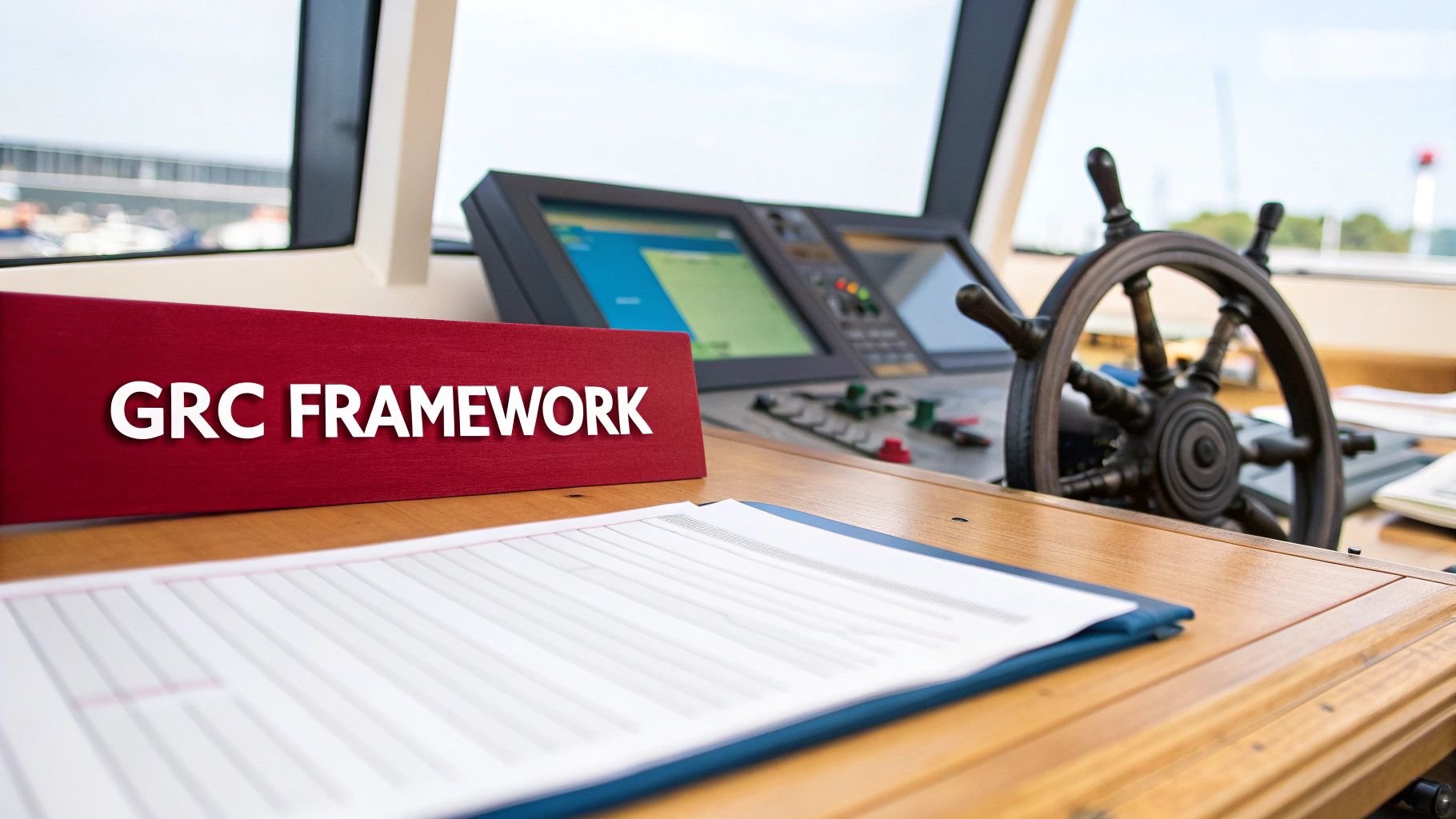
Trying to handle cyber security without a GRC framework is a bit like captaining a ship in a storm with no map, no lookout, and no one at the helm. You might have a great crew and a solid vessel, but without direction, you’re just reacting to whatever comes your way—plugging leaks as they spring up instead of steering a clear course away from the rocks.
This is the reality for too many businesses. They buy firewalls, install antivirus software, and treat security like a technical to-do list. That approach completely misses the point. Real security isn’t about the tools you have; it's about aligning those tools with your business objectives, truly understanding the risks you face, and making sure you meet your legal and contractual obligations. That unified strategy is the heart of GRC cyber security.
From Disjointed Actions to a Cohesive Strategy
A solid GRC framework gives you the structure to connect the dots between the big-picture vision from the boardroom and the day-to-day actions of your IT team. It stops security from being an isolated silo and makes it a core part of how you run your business.
Let's jump back to our ship analogy to see how the three pieces fit together.
-
Governance: Think of this as the captain on the bridge, setting the ship’s destination and making the rules for the crew. In business, governance defines the policies, objectives, and lines of responsibility for your security program. It answers the fundamental question: "What are we trying to achieve with security, and who's in charge of making it happen?"
-
Risk Management: This is your lookout in the crow's nest, scanning the horizon for icebergs, pirates, or approaching storms. In cyber security, risk management is the active process of finding threats, figuring out how badly they could hurt the business, and deciding what to do about them. It’s all about answering: "What could go wrong, and what’s our plan to deal with it?"
-
Compliance: This is the ship’s navigator, making sure you’re following all maritime laws and port regulations. For your organisation, compliance means ensuring your security practices tick all the boxes required by law, regulators, and client contracts—like those set out in standards such as ISO 27001. It answers the simple question: "What rules do we absolutely have to follow?"
When these three pillars are siloed, you get chaos. Great policies (Governance) are worthless if no one is actually looking for threats (Risk). And finding threats is pointless if your response doesn't meet legal standards (Compliance). A GRC framework forces them to work as one integrated, well-oiled machine.
The Business Case for Embracing GRC
Adopting a GRC framework isn't just about dodging breaches; it’s a powerful way to strengthen your business. When security is aligned with your core objectives, it stops being a confusing cost centre and becomes a real competitive advantage.
By integrating Governance, Risk, and Compliance, organisations move beyond 'checkbox security.' They build a resilient culture where informed decision-making protects not just data, but reputation, customer trust, and the bottom line itself.
This strategic approach delivers real-world benefits that you'll feel far beyond the IT department. A well-designed GRC program helps you make much smarter, risk-based decisions about where to spend your time and money. It gives you a clear, defensible reason for your security budget, changing the conversation from "How much is this costing us?" to "How much value are we getting from our security program?"
Even better, in a world where everyone is worried about supply chain security, showing you have a mature GRC program builds enormous trust with partners and customers. It proves you’re a safe pair of hands for their data and a strong link in their value chain. This is especially true for businesses pursuing certifications like ISO 27001, which is essentially a GRC framework put into practice.
Ultimately, GRC is the difference between just owning a pile of security tools and building a truly secure organisation. It’s the blueprint for a seaworthy vessel—one that can not only handle any storm but also navigate confidently towards its destination.
The Three Pillars of an Effective GRC Framework
A solid GRC cyber security strategy isn't a single, one-off project. Think of it as a powerful structure built on three distinct but tightly connected pillars. If one of those pillars starts to wobble, the whole thing is at risk of coming down. Getting your head around how Governance, Risk Management, and Compliance work on their own—and, more importantly, together—is the first real step to building a security posture that can actually protect your business.
It’s a bit like building a house. Governance is your architectural blueprint and the foundation; it lays out the purpose, structure, and rules of the house. Risk Management is the team of engineers and builders, spotting potential weak points like flood zones or seismic activity and reinforcing the structure to handle them. Compliance is the final inspection, making sure every part of the build meets the required codes and safety standards.
Let's break down each of these essential pillars.
Governance: The Strategic Foundation
Governance is the absolute bedrock of your entire GRC framework. This is the 'G' that provides direction, authority, and accountability for everything you do in security. It’s not about getting bogged down in day-to-day IT tasks; it’s about setting the strategic course from the very top of the organisation.
This pillar answers the big, fundamental questions:
- What are our security goals, and how do they actually support our business objectives?
- Who is ultimately on the hook for information security?
- What are the non-negotiable policies and procedures everyone has to follow?
Good governance turns high-level business goals into clear, actionable security policies. For instance, a business goal to launch an online store (the "what") needs a governance decision to create a strict policy on protecting customer payment data (the "how"). This pillar sets up the chain of command, making sure everyone from the boardroom to the front-line staff knows exactly what their role is in protecting the company’s information.
Without strong governance, your security efforts will be chaotic and rudderless. You can have the best security tools in the world, but if there are no clear policies or defined responsibilities, they’ll be used inconsistently, leaving massive gaps for attackers to walk right through.
Risk Management: The Proactive Engine
If governance sets the destination, Risk Management is how you actively navigate the journey. The 'R' in GRC is the proactive engine that systematically finds, analyses, and treats potential cyber threats before they can do any real damage. It’s all about looking ahead, anticipating problems, and making smart, informed decisions to reduce their likelihood or impact.
This continuous cycle involves a few key steps:
- Identifying Threats: Pinpointing what could go wrong, from external attacks like phishing and ransomware to internal risks like an employee accidentally deleting a critical file.
- Assessing Vulnerabilities: Finding the weak spots in your systems, processes, or even your people that these threats could exploit.
- Analysing Impact: Figuring out what the damage would be if an attack succeeded—financially, to your reputation, and to your daily operations.
- Treating the Risk: Deciding what to do about it. Do you mitigate it with new controls, accept it, transfer it (through insurance, for example), or avoid it entirely?
A core part of risk management involves regularly and systematically identifying and evaluating threats. For this, a comprehensive cybersecurity risk assessment template is an invaluable tool. A methodical approach ensures you focus your limited time and money on the threats that pose the greatest danger. To really get into the weeds of this crucial process, you can explore our detailed guide on conducting a risk assessment for cyber security.
Compliance: The Critical Validation
Compliance is the third and final pillar, acting as the proof that your GRC framework is working. The 'C' in GRC is the process of making sure your organisation’s security practices meet all the mandatory laws, regulations, industry standards, and contractual agreements you’re bound by. It’s the evidence that you’re not just saying you’re secure—you can actually prove it.
These obligations can come from all over the place:
- Legal Requirements: Such as the Australian Privacy Act.
- Regulatory Standards: Specific rules for industries like finance or healthcare.
- Contractual Mandates: Security requirements your clients or partners insist on.
- Voluntary Standards: Certifications like ISO 27001 that show you’re committed to security excellence.
Compliance isn’t the goal itself. It's the natural result of good governance and effective risk management. Simply chasing compliance for its own sake leads to a fragile, "checkbox security" mindset that often misses the real-world risks.
For example, a business might tick the compliance box by installing a firewall. But if its governance is weak (no one is responsible for updating the firewall rules) and its risk management is poor (it hasn't identified new types of web attacks), it's still wide open to attack despite being "compliant." A strong GRC framework connects compliance activities directly to genuine risk reduction, making them meaningful rather than just another bureaucratic hoop to jump through.
How the Pillars Support Each Other
The real power of GRC for cyber security kicks in when these three pillars work together. A failure in one area will inevitably weaken the others, creating a domino effect that can leave your business badly exposed.
The threat landscape doesn't sleep. The Australian Cyber Security Centre (ACSC) recently received over 84,700 cybercrime reports in a single financial year—that averages out to one report every 6 minutes. Small businesses are squarely in the crosshairs, with the average self-reported cost per incident climbing 14% to $56,600. You can find more insights on these threats and their impact on Australian businesses over at NeweraTech.com.au.
Picture this all-too-common scenario:
- A Governance Failure: A company's board doesn’t bother to set a clear policy for vetting third-party software, seeing it as just a minor IT decision.
- A Risk Management Breakdown: With no guiding policy, the IT team doesn’t do a proper risk assessment on a new, free productivity tool. They completely miss the fact that it’s riddled with major security flaws.
- A Compliance Catastrophe: The tool gets breached, leading to a massive leak of customer data. The company is now in breach of the Privacy Act (a compliance failure) and is staring down the barrel of huge fines and lasting reputational damage.
This entire disaster started with a crack in the governance pillar. A proper GRC approach connects these dots, ensuring that leadership decisions (Governance) inform threat analysis (Risk), which in turn guarantees that the organisation meets its legal and contractual duties (Compliance). By building on this three-pillared foundation, you shift from a position of constant vulnerability to one of structured, durable resilience.
How ISO 27001 Brings GRC to Life
Too often, business leaders look at ISO 27001 as just another certificate to frame—a necessary, but frankly, tedious box-ticking exercise. This view completely misses the point. The journey to ISO 27001 certification isn't a separate task you do alongside building a GRC program; it is building your GRC program, just with a world-class blueprint in hand.
The standard is so much more than a checklist. It’s a structured, internationally recognised method for weaving the core principles of Governance, Risk Management, and Compliance right into the fabric of your organisation.
When you commit to implementing ISO 27001, you're signing up for a systematic approach to GRC cyber security. Let’s break down exactly how the standard provides a ready-made framework for each of these three GRC pillars.
Governance: The ISO 27001 Leadership Mandate
Strong governance is the bedrock of any successful security strategy, and ISO 27001 puts it front and centre. The standard is crystal clear: information security must be driven from the top down. It throws out the old idea of security as a siloed IT function and makes it a core responsibility of senior leadership.
A few key clauses in ISO 27001 really cement this governance framework:
-
Clause 5 (Leadership): This isn't a friendly suggestion; it's a direct mandate. It requires top management to actively demonstrate leadership and commitment to the Information Security Management System (ISMS). They must establish the security policy, ensure clear objectives are set, and integrate security into the business's day-to-day processes.
-
Clause 7.4 (Communication): You can't have good governance without clear communication. This clause forces you to map out what needs to be communicated, when, to whom, and by whom. This ensures everyone, from the intern to the CEO, understands their security responsibilities.
These requirements push your organisation to answer the big governance questions. Who is ultimately accountable for protecting our information? What are our strategic security goals? How do we make sure everyone knows the role they play? By satisfying these clauses, you’re not just prepping for an audit—you're building a robust governance structure with the clear direction and authority needed to succeed.
ISO 27001 transforms security from a technical afterthought into a strategic business function. It forces leadership to take ownership, providing the essential top-down direction that is the hallmark of effective governance.
Risk Management: The Proactive Engine of the Standard
The very heart of ISO 27001 is a formal, repeatable risk management process. The standard doesn't just suggest you think about risks; it demands a systematic way of identifying, analysing, evaluating, and treating them. This is the 'Risk' pillar of GRC in action.
The core of this process lives in Clause 6.1.2 (Information security risk assessment) and Clause 6.1.3 (Information security risk treatment). These clauses require you to:
- Establish a Risk Assessment Process: Define and apply a consistent method for finding risks related to the confidentiality, integrity, and availability of your information.
- Identify Risk Owners: For every risk you find, someone has to be assigned clear ownership. No more pointing fingers.
- Analyse and Evaluate Risks: Develop a system to weigh the potential impact of a risk against the likelihood of it happening. This helps you focus your energy on the threats that matter most.
- Select Risk Treatment Options: Based on your evaluation, you must consciously decide how to handle each risk—whether you mitigate it with new controls, accept it, avoid it, or transfer it (like through insurance).
This structured process ensures your security decisions aren't based on guesswork or the latest scary headline. Instead, they become informed, evidence-based choices aligned with your business's specific appetite for risk. It’s the engine that powers a proactive security posture, finally moving you away from simply reacting to incidents.
Compliance: Verifiable Proof Through Controls
Finally, ISO 27001 provides a clear path to achieving and proving compliance. While the standard itself is a framework, its most famous part—Annex A—offers a comprehensive menu of potential security controls. These are the practical measures you put in place to treat the risks you’ve identified.
This is where the 'Compliance' pillar of GRC truly comes to life. It all connects like this:
- Your risk assessment (the Risk pillar) flags a threat, like unauthorised access to client data.
- Your leadership (the Governance pillar) has set a clear policy stating that all customer data must be protected.
- To comply with this policy and reduce the risk, you select and implement relevant controls from Annex A, such as A.9.4.1 (Access control to program source code) or A.5.1.2 (Review of the policies for information security).
This is the real power of the system. The GRC pillars aren't separate ideas; they are interconnected components that ISO 27001 helps you weave together.
To make this connection even clearer, this table shows how the GRC pillars map directly to key clauses within the standard.
Mapping GRC Pillars to Key ISO 27001 Clauses
| GRC Pillar | Core Function | Relevant ISO 27001 Clause(s) |
|---|---|---|
| Governance | Sets direction, defines roles, and ensures accountability from the top down. | Clause 5: Leadership & Commitment Clause 4: Context of the Organisation |
| Risk | Systematically identifies, assesses, and treats information security threats. | Clause 6: Planning (esp. 6.1.2 & 6.1.3 Risk Assessment/Treatment) Clause 8: Operation |
| Compliance | Implements controls and provides evidence that obligations are being met. | Annex A: Control Objectives & Controls Clause 9: Performance Evaluation Clause 10: Improvement |
By implementing these controls, you build the concrete evidence needed to prove you are meeting your security obligations. This creates a clear, auditable trail that links your high-level policies directly to your on-the-ground technical and procedural safeguards. Certification is simply the independent verification that your controls aren't just in place, but are actually working.
A well-implemented ISMS is an incredibly powerful tool. To dig deeper into this, you can learn more by exploring our guide on Information Security Management Systems.
The synergy is undeniable: ISO 27001 isn't an alternative to GRC. It is a practical, globally respected framework for putting GRC theory into action, turning abstract concepts into tangible processes that protect your business.
Your Step-by-Step GRC Implementation Roadmap
Moving from GRC theory to a real-world, working framework can feel like a massive undertaking, especially for a growing business. But it doesn't have to be. The secret is to treat your GRC cyber security implementation not as one giant, overwhelming project, but as a series of deliberate, manageable stages.
This roadmap is designed to walk you through that process, turning abstract principles into concrete actions. By taking it one step at a time, you can build a powerful GRC program that scales with your business, protects you from genuine threats, and aligns perfectly with the demands of ISO 27001.
You can see below how the core components of Governance, Risk, and Compliance map directly onto the ISO 27001 certification journey.
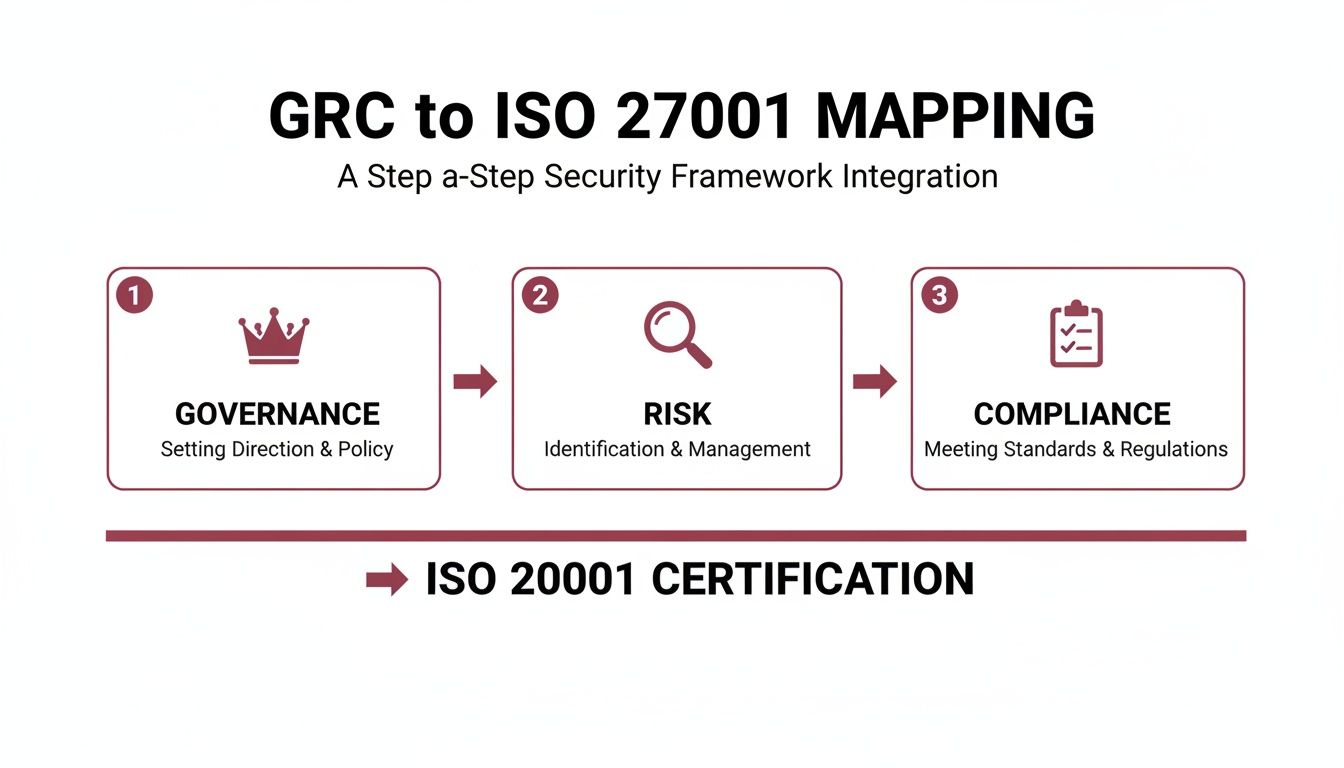
As the infographic shows, strong Governance is the starting line. This naturally leads into a systematic Risk assessment process, which then informs the Compliance activities you need to nail down the standard.
Stage 1: Secure Leadership Buy-In and Define Your Scope
Before you even think about writing a policy or assessing a risk, your GRC journey has to start in the boardroom. Let's be blunt: without genuine, vocal support from your leadership team, any GRC initiative is dead in the water. This isn't just about getting a budget approved; it's about embedding security as a shared, top-down responsibility.
Start by speaking their language. Frame GRC in business terms. Forget talking about firewalls; talk about protecting revenue streams and customer trust. Present a clear business case that shows how a structured GRC program slashes the risk of costly breaches, opens doors to bigger contracts, and builds a more resilient organisation.
Once you have that commitment, the next crucial step is to define the scope of your program. A classic mistake is trying to boil the ocean. Instead, start with your most critical assets and processes—the real "crown jewels" of your business.
A well-defined scope is the absolute foundation of a successful GRC implementation. Focus first on what truly matters—the data, systems, and operations that are essential for your business to function and thrive.
For most businesses, this initial scope will include things like:
- Customer databases and any personally identifiable information (PII).
- Financial systems and precious intellectual property.
- The core operational systems that keep the lights on.
Stage 2: Perform a Business-Centric Risk Assessment
With leadership backing and a clear scope, you're ready to tackle the heart of the 'R' in GRC: the risk assessment. This is where you methodically identify the specific threats facing your critical assets and figure out their potential impact. The aim is to move beyond vague worries and create a prioritised list of your most significant risks.
A business-centric approach means you're not just hunting for technical vulnerabilities. You have to consider threats related to people, processes, and even your third-party suppliers.
This is more critical today than ever. Many recent major data breaches stemmed from vendor access gaps, highlighting the very real dangers of third-party risk. In fact, these types of incidents contributed to a staggering 111% surge in critical infrastructure alerts, reinforcing the need for airtight controls and audits. You can get a clearer picture of this persistent threat landscape and its impact on the Australian economy by reviewing the latest Annual Cyber Threat Report findings.
Your risk register is the output here. It should document each risk you've identified, its potential business impact, how likely it is to happen, and who in the company owns it.
Stage 3: Select and Implement Pragmatic Controls
Your risk assessment tells you what could go wrong. This next stage is all about deciding what to do about it. Here, you'll select and implement security controls—the practical safeguards that reduce or eliminate those risks you've just identified.
For businesses aiming for ISO 27001, Annex A provides a fantastic menu of potential controls to choose from. But the key here is to be pragmatic. You don't need to implement every single control at once. Use your risk assessment as your guide to prioritise. If your biggest risk is a ransomware attack, your first controls should logically focus on things like backups, access control, and security awareness training for your team.
It's also essential to embed security into how you build things. Integrating security from the start of the development lifecycle is far more effective than trying to bolt it on afterwards. You can get a head start by mastering software development security best practices for your applications.
Ultimately, you want to select controls that give you the biggest risk reduction for a reasonable amount of cost and effort.
Stage 4: Develop a Culture of Continuous Monitoring
One of the most common GRC failures is treating it like a one-off project. You can't just set your controls and forget about them. The threat landscape is always changing, your business is evolving, and your controls have to adapt. This is precisely why continuous monitoring is a non-negotiable part of any mature GRC program.
This stage is all about establishing processes to regularly check that your controls are actually working as intended.
Key Monitoring Activities:
- Regular Vulnerability Scans: Proactively search for new weaknesses in your systems.
- Log Reviews: Analyse system logs for any signs of suspicious activity.
- User Access Reviews: Periodically verify that employees only have access to the information they absolutely need for their job.
- Performance Metrics: Track key indicators to measure how effective your security program is over time.
This kind of proactive monitoring transforms GRC from a static checklist into a dynamic, living system that actively defends your organisation, day in and day out.
Stage 5: Build a Living Documentation System for Audits
Finally, you need to prove it all. A GRC program without documentation is just a collection of good intentions. Your documentation is the hard evidence that connects your governance policies to your risk assessments and your implemented controls. It’s what you’ll hand over to auditors, regulators, and potential clients to demonstrate your commitment to security.
Your documentation system needs to be organised, accessible, and—most importantly—alive. It should be regularly updated to reflect any changes in your business, risks, and controls.
Think of it as your GRC library. It will typically include:
- Your overarching information security policy.
- Your risk assessment methodology and the risk register itself.
- Your Statement of Applicability (a key document for ISO 27001).
- Evidence that controls are implemented (e.g., screenshots, logs, reports).
- Records of security incidents and how you handled them.
By following these five stages, you can demystify the process of building a GRC cyber security framework. You create a structured, repeatable system that not only gets you ready for ISO 27001 certification but also builds genuine, lasting security resilience right into the DNA of your business.
How Do You Know Your GRC Program Is Actually Working?

Putting a solid GRC framework in place is a huge win, but how do you prove it’s making a real difference? To justify the time, effort, and money you’ve invested, you need to go beyond just "feeling" more secure. Success in GRC cyber security has to be measured with clear, tangible data that shows its value.
It all comes down to tracking the right Key Performance Indicators (KPIs). These are the numbers that tell a powerful story about how you're reducing risk and making the business stronger. The goal isn't just to track metrics for the sake of it; it's to translate your team's hard work into business outcomes that the leadership team understands and values.
Speak the Language of the Boardroom, Not the Server Room
To get buy-in from your executive team, you have to present data that connects directly to the business. Metrics like "firewall blocks" might be useful for your IT crew, but they don't mean much to a CEO. You need to focus on KPIs that answer the big-picture questions.
Think about it this way: instead of reporting on the number of patches deployed, shift the conversation to the Percentage of Critical Systems with Zero Known High-Severity Vulnerabilities. One is a technical task; the other is a direct measure of how you're protecting the company's most important assets from a real-world threat.
The GRC KPIs That Really Matter
To paint a clear picture of your GRC program's success, you don't need dozens of complex metrics. A handful of high-impact KPIs will do the trick, showing how your security posture is maturing and directly contributing to the organisation's health.
Here are four essential KPIs to get you started:
-
Mean Time to Detect (MTTD) & Respond (MTTR)
- What it is: MTTD tracks how quickly your team spots a security incident. MTTR measures how fast you can shut it down and fix the problem.
- Why it matters: Seeing these numbers drop is one of the clearest signs your GRC program is working. It’s hard evidence that your monitoring, incident response plans, and team coordination are getting sharper, minimising the damage an attack can cause.
-
Percentage of Critical Assets Covered by Risk Assessments
- What it is: This tracks how many of your "crown jewels"—the most vital systems and data—have been through your formal risk assessment process.
- Why it matters: A high percentage here shows you're being strategic. It tells leadership that you're not just reacting to threats but proactively protecting the things that are most crucial to the organisation's survival.
Show Your Progress and Prove Your Worth
By tracking these metrics consistently, you can show real, tangible progress over time. The key is to set realistic goals. For instance, you could aim to cut your MTTR by 20% in the next six months or get your critical asset risk assessment coverage up to 95% by the end of the year.
This data-driven approach completely changes the conversation. Security stops being seen as just a cost and starts being recognised as a critical part of the business.
When you can consistently show KPIs that demonstrate lower risk and better operational resilience, you're not just asking for a budget—you're justifying an investment with undeniable proof.
Here are two more KPIs that offer powerful insights, especially when it comes to the human side of security.
-
Audit Finding Remediation Rate
- What it is: This tracks how quickly and thoroughly your team resolves issues found during internal or external audits. A great related metric is seeing fewer repeat findings from one audit to the next.
- Why it matters: A high remediation rate proves you're serious about continuous improvement, which is at the heart of both GRC and ISO 27001. It shows auditors and leadership that you treat compliance and risk seriously. For a closer look at what's involved, our guide to the ISO 27001 audit process is a great resource.
-
Employee Phishing Simulation Click-Rates
- What it is: This one's simple: what percentage of your team clicks on the links in your controlled phishing tests?
- Why it matters: This is a direct measure of how well your security awareness training is working. A falling click-rate is concrete proof that your "human firewall" is getting stronger, which is vital when social engineering is a top threat.
By focusing on these kinds of business-aligned KPIs, you build a powerful dashboard that not only steers your security strategy but also proves its worth to everyone in the organisation. You'll transform GRC from a behind-the-scenes function into a visible, valued driver of business success.
Common GRC Implementation Mistakes (And How to Dodge Them)
Setting up a GRC framework is a journey, and like any journey, there are plenty of wrong turns you can take. Even with the best intentions, a few common pitfalls can stall your progress, burn through resources, and ultimately leave your organisation exposed. Honestly, the smartest way to get this right is to learn from the mistakes others have already made.
Think of it as getting a map of all the potholes before you start driving. By knowing what to look out for, you can sidestep the frustrations that derail so many GRC projects and build something that delivers real, lasting value from day one.
The "One-and-Done Project" Trap
I’ve seen this happen more times than I can count. A company treats GRC like a one-off project. They assemble a team, write a bunch of policies, scrape through an audit, and then everyone high-fives and goes back to their normal jobs. This "set it and forget it" attitude is probably the single biggest mistake you can make.
Security isn't a static thing you achieve. New threats pop up constantly, your business changes, and regulations evolve. A GRC framework that isn’t a living, breathing part of the business becomes obsolete almost instantly. Before you know it, it’s just a set of dusty binders on a shelf, offering zero real protection.
The point of GRC isn't to finish a project; it's to build a permanent business function. It needs to be a continuous cycle of assessing, improving, and adapting that’s woven directly into how your organisation operates.
The fix? Schedule regular GRC reviews—quarterly, at a minimum. Assign permanent ownership of key processes so someone is always responsible. Make GRC activities a standard part of your business calendar, just like you would with financial reporting.
The Checkbox Compliance Mindset
Another classic pitfall is chasing compliance for its own sake. This is what happens when the goal shifts from managing actual risk to just ticking boxes to keep an auditor happy. Teams get obsessed with meeting the letter of a standard like ISO 27001 but completely miss the spirit behind the rules.
This approach creates a dangerous false sense of security. You might be "compliant" on paper, but if your controls don't actually counter the specific threats your organisation faces, you're still a sitting duck. An attacker doesn't give a damn if you’ve passed an audit; they only care if your defences hold up in the real world.
Always let risk be your guide. Every single control you put in place should clearly and directly map back to a specific risk you've identified. That way, you know your efforts are focused on genuinely reducing risk, and compliance simply becomes the natural, positive side effect of having a strong security posture.
Forgetting to Get Real Executive Backing
A GRC program without an active, visible executive sponsor is an orphan. It will constantly struggle for budget, authority, and buy-in from other departments. Without a powerful champion in the C-suite, it gets written off as "just another IT thing" instead of the critical business function it is.
And this sponsorship has to be more than just a signature on a purchase order. You need a leader who will:
- Tell the Story: Clearly explain the business value of GRC—why it matters—to the rest of the company.
- Clear the Path: Use their influence to break down departmental silos and push back against any resistance.
- Demand Results: Hold people and teams accountable for their GRC responsibilities.
The only way to get this level of support is to talk their language. Frame GRC in terms of business outcomes—we’re reducing operational risk, we’re building resilience, we’re creating a competitive advantage—not in technical jargon.
Working in Departmental Silos
You can't do GRC effectively if everyone is locked in their own department. Security, IT, legal, HR, and finance all have a massive part to play. When they don't talk to each other, you get a fragmented, inconsistent mess that's doomed from the start.
For example, IT might roll out a new security tool without talking to the legal team, accidentally creating a privacy nightmare. Or HR might onboard a new hire without making sure they get the security awareness training the GRC team mandated.
Breaking down these silos is non-negotiable. The best way to do this is to set up a cross-functional GRC steering committee with people from every key department. This forces everyone to make decisions together and helps them see how their piece of the puzzle fits into the organisation's overall security and compliance picture.
GRC Cyber Security Questions We Hear All the Time
Diving into Governance, Risk, and Compliance can feel like learning a new language. To cut through the noise, we've put together answers to the most common questions we get from businesses just starting their GRC journey. These are the straightforward answers you need to get moving with confidence.
What’s the Best First Step for a Small Business Starting with GRC?
The single most powerful first step is a risk assessment that’s focused squarely on your business. Don't rush out to buy expensive software or start writing a hundred different policies. Before you can govern anything or comply with a standard, you have to know what you’re protecting and what you’re protecting it from.
This initial assessment forces you to pinpoint your crown jewels—the data, systems, and processes your business simply cannot live without. From there, you connect those critical assets to real-world threats. This gives you a clear, prioritised roadmap, making sure your first moves are spent tackling the risks that pose the biggest danger, not just the ones that seem easiest to fix.
How Does a Good GRC Framework Help Beyond Just Getting ISO 27001 Certified?
Getting your ISO 27001 certificate is a brilliant result of a solid GRC program, but the real value goes so much deeper. When you build a mature GRC framework, you fundamentally upgrade your business's ability to bounce back from trouble and make smarter decisions.
A strong GRC framework flips security from being a cost centre to a strategic advantage. It gives your leadership a clear view of business risks, creating a culture where informed, proactive decisions protect the company’s future.
Beyond just the certificate, a well-run GRC program delivers some serious perks:
- Builds Real Customer Trust: Showing you have a structured, serious approach to managing risk is a massive competitive advantage. It tells clients you’re a safe pair of hands.
- Makes You More Efficient: GRC helps break down the walls between departments, streamlining processes and cutting out wasted, overlapping security efforts.
- Sharpens Your Strategy: When leadership truly understands the risks, they can make far better strategic calls about where the business should go next.
Is a GRC Program Always Going to Be Expensive for a Small Business?
Absolutely not. It’s a huge myth that GRC demands a massive budget for specialised tools and a team of consultants. For a small business, a powerful GRC framework can be built on practical, smart processes.
The trick is to start small and let it grow with you. Your first GRC program might run perfectly well on spreadsheets and a set of clear, documented manual processes. By focusing your energy on your biggest risks first, you guarantee that every dollar you spend on security gives you the most bang for your buck. It’s more about focused effort than big spending.
How Often Should We Be Reviewing and Updating Our GRC Strategy?
Think of your GRC strategy as a living thing, not a dusty document on a shelf. You should be doing a formal, top-to-bottom review of the whole framework at least once a year. This keeps it perfectly aligned with your business goals and the ever-changing threat landscape.
But some parts need more regular attention. Your risk register, for instance, should be a dynamic tool. It needs to be updated anytime something significant changes—you bring in new technology, your operations shift, or a major new threat pops up on the radar. The aim is constant, gradual improvement, not a frantic scramble right before an audit.
Navigating GRC cyber security and achieving ISO 27001 certification can feel like a mountain to climb, but you don’t have to go it alone. At Anitech, our experts are pros at guiding Australian small businesses through every single step. With our proven method and a 100% success rate, we make certification achievable.
Ready to build a truly resilient security posture and stand out from the competition? Contact Anitech today for an ISO 27001 consultation.
Recent Comments