

Quick Summary: GRC (governance, risk, and compliance) software is an integrated platform designed to unify an organization's governance policies, risk management processes, and compliance obligations. It replaces disconnected spreadsheets and siloed efforts with a single, centralized system, providing clear visibility and control for strategic decision-making and enhancing business resilience.
Choosing the right GRC governance risk compliance software is a critical step for modern businesses. At its core, GRC software is a centralised platform that brings together your company’s governance policies, risk management activities, and compliance obligations. It’s designed to replace the chaotic mess of spreadsheets, disconnected documents, and siloed department efforts with one unified system. This gives you a clear, single source of truth for making strategic decisions and building a more resilient business.
Unifying Your Business Command Centre
Let's cut through the jargon. Think of GRC software as the central nervous system for your entire operation. Right now, you might be tracking business risks in one spreadsheet, juggling compliance checklists in another, and storing critical policies on a shared drive somewhere. It's a common approach, but it’s dangerously disconnected and creates blind spots you can't afford.
Imagine you're the captain of a ship. You wouldn't rely on a separate, unlinked device for radar (detecting risks), another for nautical charts (following the rules), and a third for the steering controls (governance). A modern cockpit integrates all of these into one cohesive dashboard, giving you clear, immediate command. That's exactly what a GRC platform does for your business—it turns separate, chaotic functions into a powerful, unified strategy.
This integrated approach isn't a luxury anymore; it's a necessity, especially with Australia's complex and ever-changing regulatory environment. Getting this right is fundamental to building an organisation that's both resilient and secure. To truly get a handle on GRC, you need to understand its individual components and how they interlock, especially when it comes to having a structured risk management process.
The Three Pillars of an Integrated GRC Framework
A solid GRC framework is built on three pillars. Each pillar addresses a unique part of your business, but their real power comes from how they work together inside a single software solution.
Here’s a breakdown of how these components fit together and what they mean for your business on a strategic level.
| Pillar | Core Function | Strategic Business Impact |
|---|---|---|
| Governance | Establishes the rules, policies, and processes that steer the company toward its goals. | Ensures accountability, ethical conduct, and clear, consistent decision-making from the top down. |
| Risk Management | Involves identifying, assessing, and mitigating potential threats to the business. | Proactively protects against financial, operational, and reputational damage, safeguarding long-term success. |
| Compliance | Ensures adherence to external laws, regulations (like ISO 27001), and internal policies. | Avoids penalties, builds trust with customers and partners, and maintains a strong market reputation. |
Trying to manage these three pillars in isolation is like trying to build a puzzle using pieces from three different boxes. An integrated GRC platform makes sure all the pieces fit together, giving you a complete picture of your organisation's health and resilience.
The market backs this up. The Australian Governance, Risk, and Compliance (GRC) platform market was recently valued at USD 1.4 billion, a clear signal that businesses are feeling the pressure to adopt integrated tools. That figure is expected to more than double, hitting USD 3.7 billion by 2033, which really speaks to how critical these systems have become.
Ultimately, a strong GRC framework, powered by the right software, is what connects your security efforts to real business outcomes. When implemented well, it helps you manage the crucial intersection of GRC and cyber security, ensuring your protective measures aren't just technical tick-boxes but are strategically aligned with your company’s goals.
What Does GRC Software Actually Do? Core Platform Capabilities
Knowing you need a GRC platform is one thing. Understanding what it actually does is where the lightbulb really goes on. A modern GRC platform isn't some digital filing cabinet where policies go to be forgotten. Think of it more like a central command centre—an active, living system that automates grunt work, gives you real-time intelligence, and pulls all your organisation's protective threads together.
These platforms are built on a handful of core capabilities that work in harmony. Instead of trying to patch together spreadsheets, email threads, and a dozen different apps, a GRC solution offers a single, unified view of your organisation’s health.
Centralised Policy Management
Remember the old way? Policies were scattered everywhere—shared drives, dusty binders, buried in email chains. It was pure chaos. You could never be sure if people were looking at the latest version, and consistent application across the business was a pipe dream.
A GRC platform cleans all that up by creating a single source of truth for every policy and procedure. But this is about more than just storage; it’s about active, intelligent management.
- Version Control: The system meticulously tracks every single change. This creates a crystal-clear audit trail and guarantees everyone is working from the most current document.
- Automated Distribution: Update a policy, and the software can push it out to the right people automatically. It even tracks who has read and signed off on it, giving you concrete proof of attestation.
- Mapping to Controls: This is the game-changer. You can directly link policies to the specific risks and compliance controls they address. For an auditor, this is gold—it shows exactly how your documented rules are being put into action.
Suddenly, policy management shifts from a soul-crushing admin chore to a powerful strategic tool.
Automated Risk Assessment Workflows
Proper risk management needs a structured, repeatable process. Doing it manually with spreadsheets is not only painfully slow but also riddled with human error. Worse, it’s nearly impossible to get a clear, consolidated picture of your total risk exposure. This is one area where GRC software delivers a massive, immediate upgrade.
A mature GRC platform transforms risk management from a frantic, periodic exercise into a continuous, proactive discipline. It embeds risk-aware decision-making into your company culture, allowing you to spot, assess, and deal with threats as they happen.
GRC tools put the entire risk lifecycle on autopilot. You can design custom assessment templates, fire them off to business unit owners, and have the results flow back and aggregate automatically. Risk registers and heat maps update on the fly, giving leadership an instant, visual snapshot of the most pressing threats. This systematic approach is the backbone of any strong risk management frameworks that genuinely protect your business.
Real-Time Compliance Dashboards
Proving you’re compliant with a standard like ISO 27001 can be a nightmare. It usually involves a last-minute scramble to chase down evidence from different teams, culminating in a mountain of paperwork that’s already out of date by the time you hand it over.
A modern GRC platform completely flips that script, replacing the chaos with clarity.
- Continuous Monitoring: The software can plug into your other business systems, automatically pulling in evidence that your controls are working as they should be.
- Unified Reporting: Your compliance officer can generate audit-ready reports with a few clicks, using live data to show the exact state of compliance against any standard, at any time.
- Gap Analysis: Dashboards instantly flag any areas where you’re falling short. This lets you focus your remediation efforts where they’ll have the biggest impact.
Just imagine an auditor asks for proof of your access control measures. Instead of spending days digging through logs, you pull up a dashboard that shows, in seconds, that every control is active, tested, and backed by evidence. That’s the power of a real-time view.
How GRC Software Streamlines ISO 27001 Certification
Let's be honest: pursuing ISO 27001 certification can feel like you're trying to tame a beast. It’s a marathon of manual evidence collection, endless documentation, and the constant headache of herding different teams using a patchwork of spreadsheets and email chains. This administrative overload is where so many organisations stumble, but it's also where GRC software can be a genuine game-changer.
A modern grc governance risk compliance software platform takes the certification journey from a tangled, frustrating mess and turns it into a structured, manageable process. Think of it as the central nervous system for your certification efforts. It creates a single source of truth that auditors love and your team can actually rely on. Suddenly, you're not just chasing paperwork; you're actively managing your information security management system (ISMS) with clarity and control.
This diagram shows how a GRC platform connects the dots, creating a logical flow from high-level policies down to the nitty-gritty of compliance.
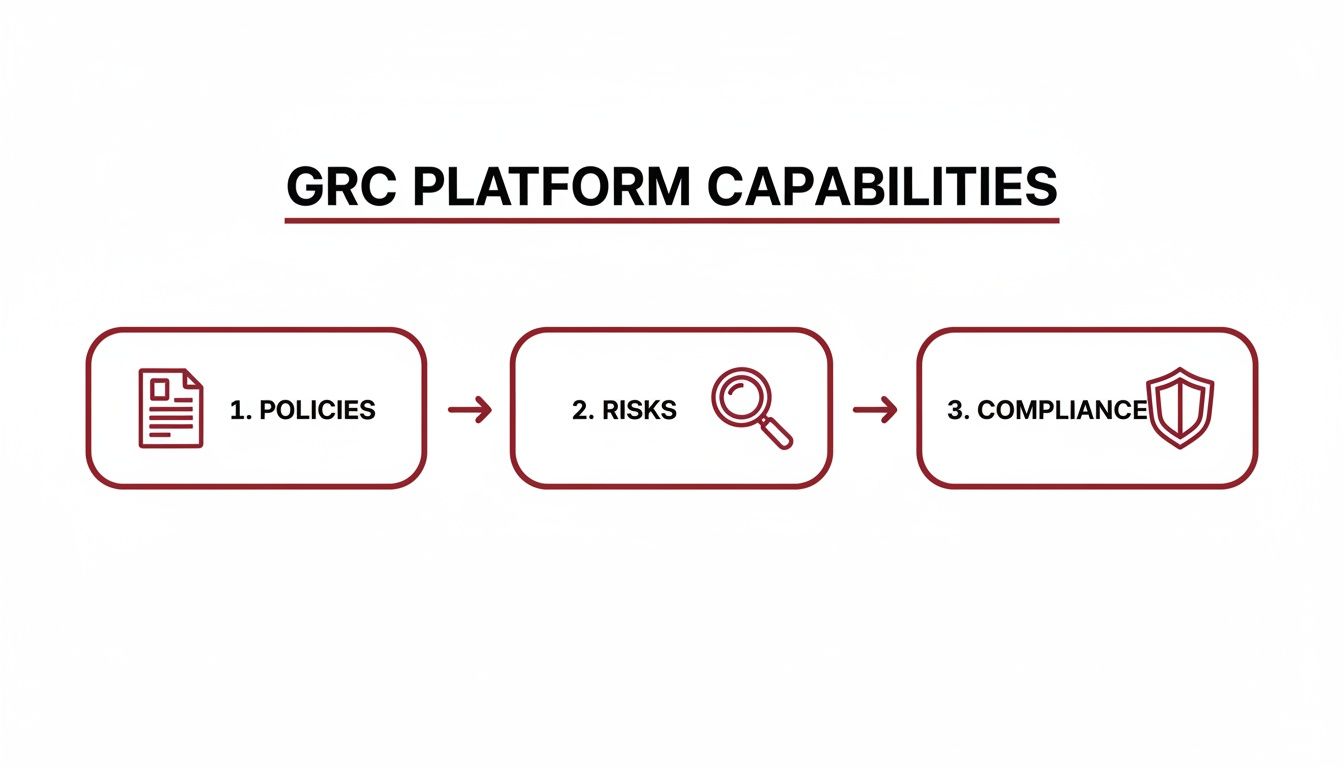
As you can see, it's not just a checklist of tasks. A solid GRC approach is a connected cycle where your governance (policies) informs risk management, and your risk management activities directly prove your compliance.
Centralising Your Statement of Applicability
The Statement of Applicability (SoA) is the absolute heart of any ISO 27001 audit. This is where you formally declare which of the Annex A controls apply to your organisation and, just as importantly, justify your reasoning. Trying to manage this document in a spreadsheet is not just clunky—it’s a recipe for version control nightmares and audit-day panic.
GRC software gives your SoA a proper home.
- Direct Control Mapping: You can link each Annex A control directly to your specific internal policies, procedures, and risk assessments right inside the platform.
- Live Evidence Repository: For every single control, you can attach real-time evidence—like system logs, penetration test reports, or signed policy documents—creating an instant, audit-ready portfolio.
- Clear Justification and Notes: The platform gives you a dedicated spot to explain why you’ve included or excluded certain controls, ensuring your logic is crystal clear and consistent for auditors.
This transforms your SoA from a static, easily outdated document into a living, breathing part of your ISMS that always reflects your current security posture.
Automating Risk Assessments and Treatment
Risk assessment is another area where manual methods just can't keep up. A GRC platform automates the heavy lifting, making the entire process repeatable, consistent, and far more thorough. You can build out standard risk assessment templates based on ISO 27001, send them out to asset owners, and watch as the results flow back to populate a central risk register automatically.
By automating the mechanics of risk assessment, GRC software frees up your team to focus on what actually matters—analysing the results and making smart decisions about risk treatment. You shift from being a data entry clerk to a genuine risk manager.
Once your risks are identified and scored, the software helps you manage the full treatment lifecycle. You can assign mitigation tasks to the right people, set clear deadlines, and track progress without chasing anyone down. For an auditor, this creates a perfectly documented trail that proves you are proactively managing your information security risks. To see where this fits into the bigger picture, it’s worth understanding the entire ISO 27001 certification process.
Simplifying Audits and Continuous Improvement
The audit is the final exam. With GRC software, preparing for it is as simple as giving the auditor read-only access to the platform. They can see your entire ISMS laid out before them: policies, risk assessments, the SoA, linked evidence, and how you track non-conformities. Everything is in one place. That level of transparency builds incredible trust and can dramatically speed up the audit cycle.
Better yet, the platform becomes the engine for continuous improvement—a non-negotiable part of ISO 27001. Any findings from your internal or external audits get logged as non-conformities, with corrective action plans assigned and tracked through to completion. This demonstrates a mature, proactive approach to security. Using the right tool is a crucial part of a successful ISO 27001 implementation, helping to turn a one-off project into a sustainable, long-term security program.
How to Choose the Right GRC Solution for Your Business
Picking the right GRC governance risk compliance software can feel overwhelming. The market is crowded, and it's easy to get dazzled by slick sales demos and endless feature lists. But let’s be clear: the best platform for your business is more than just a piece of software. It's a strategic partner that needs to align with your long-term security goals and business growth.
This decision is especially critical for Australian businesses right now. The threat level is climbing. The Australian Cyber Security Centre (ACSC) recently fielded 76,000 cybercrime reports in just one year—that's a 13% jump from the year before. Those aren't just numbers; they represent real threats to businesses like yours. Having an effective GRC tool isn't a luxury anymore; it's a fundamental part of modern risk management. To get a better handle on this, it's worth exploring some insights on the growing governance, risk, and compliance platform market.
Evaluate Scalability and Future Growth
One of the most common pitfalls is choosing a solution that only solves today's problems. A GRC platform is a significant investment, and it needs to grow with you. Think about where your organisation will be in three, or even five, years. Can the software handle more users, more assets, and new regulations without the price skyrocketing or performance grinding to a halt?
A genuinely scalable platform should let you:
- Adapt to new regulations without the headache: As you expand, you might find yourself needing to comply with new standards. Your platform should make adding new frameworks a simple process, not a complete system overhaul.
- Add modules as you need them: Maybe risk management is your focus today, but what about audit management or vendor risk down the line? Look for a tool that lets you switch on new capabilities when you're ready for them.
- Handle major business changes: Mergers, acquisitions, and restructures happen. Your GRC tool needs to be flexible enough to reflect these new organisational realities without breaking.
Prioritise Integration and User Adoption
Here’s a hard truth: the most powerful GRC software on the planet is completely useless if it doesn't talk to your other systems or if your team hates using it. If the platform creates more manual work than it automates, it will quickly become expensive "shelfware."
A great GRC platform should feel like a natural extension of your workflow, not another siloed system your team has to fight with. Seamless integration and an intuitive interface are non-negotiable for successful adoption and long-term value.
Dig into how well the platform will connect with the tools you already rely on, like your IT service management (ITSM) system, security information and event management (SIEM) tools, or even your HR platform. A well-integrated system pulls data automatically, giving you a much more accurate and real-time picture of your risk and compliance posture.
Ask the Right Questions During Vendor Evaluation
To see past the marketing spin, you need to ask sharp, specific questions that get to the heart of how a solution will actually perform in your environment. A thorough evaluation is your best defence against making a costly mistake.
I've put together a list of critical questions to ask during your vendor discussions. Think of this as a checklist to move beyond the sales pitch and focus on the practical realities of implementation, support, and what the long-term partnership will really look like. Getting clear answers here is essential for finding a platform that will truly support your compliance journey, especially for a demanding standard like ISO 27001.
Critical Questions for Evaluating GRC Software Vendors
Use this checklist to conduct a thorough evaluation and compare GRC governance risk compliance software solutions effectively.
| Evaluation Category | Essential Question to Ask | Why This Question Matters |
|---|---|---|
| ISO 27001 Functionality | "Can you show me exactly how your platform manages the Statement of Applicability (SoA) and links controls to evidence?" | This reveals if the tool is genuinely built for ISO 27001 or if it's a generic platform with a compliance label tacked on. |
| Data & Security | "Where will our data be hosted, and what are your data residency and security certifications?" | This is crucial for Australian data sovereignty laws and for making sure the vendor actually practises what they preach on security. |
| Implementation & Support | "What does your typical implementation process look like, and what level of post-launch support is included in the price?" | This uncovers hidden costs and clarifies whether you'll have expert help when you inevitably need it. |
| Cost & Licensing | "Can you provide a clear, all-inclusive pricing model, including any potential future costs for new modules or users?" | This helps you avoid unexpected budget blowouts and ensures the total cost of ownership is transparent from day one. |
Asking these tough questions upfront ensures there are no surprises down the road. It forces a level of transparency that helps you separate the true partners from the mere product vendors, leading you to a solution that genuinely fits your needs.
Beyond Software: Maximizing Your GRC Tool with Expert Guidance
Picking a powerful GRC governance risk compliance software platform is a brilliant start. But let's be honest—the software itself is just a tool. It's like buying a top-of-the-line race car. You still need an experienced driver who knows the track to win the race.
Too often, we see businesses invest in a GRC platform, hoping it will magically solve all their compliance problems. The reality? Without expert guidance, it often ends up as expensive, underused 'shelfware'. Technology can’t interpret the subtle nuances of ISO 27001 clauses or make a strategic call on your risk appetite. That’s where the human element is absolutely critical.
From a Simple Tool to a Strategic Asset
This is exactly where expert guidance comes in. The goal is to bridge that crucial gap between your new software and your certification goals. With hands-on experience, a GRC platform can be configured to deliver on its promise. It can be transformed from a passive data-gathering tool into the active, beating heart of a secure and compliant organisation.
The most common reason GRC implementations fail to deliver ROI is a lack of expert guidance. The software can automate workflows, but it can't provide the strategic oversight needed to align those workflows with your unique business context and complex compliance requirements.
Experts can work right alongside your team. They translate the dense, often confusing language of compliance standards into practical, real-world controls that you can manage directly within your software. This hands-on guidance is what turns a software purchase into a guaranteed outcome.
Hands-On GRC Support and Implementation
A good implementation partner doesn't just send you a report and wish you luck. They roll up their sleeves and get into the nitty-gritty to ensure every single part of your GRC software is set up for success. It's this deep involvement that ensures you get the maximum return on your investment and a clear, efficient path to certification.
Here’s how expertise amplifies your technology:
- Tailored Platform Setup: Configure the platform to perfectly mirror your specific business processes, risk tolerance, and industry rules, making it a natural fit from day one.
- Practical Control Implementation: Guide your team in turning abstract ISO 27001 clauses into concrete, manageable controls that your software can actually track and report on.
- Audit-Ready Evidence Management: Pinpoint and organise the exact evidence auditors want to see, linking it directly to the right controls in your GRC tool for a smooth and stress-free audit process.
Choosing a GRC platform is a big decision, but it’s the expertise driving the implementation that truly seals the deal. This partnership combines your team’s invaluable internal knowledge with specialised ISO 27001 experience. This ensures that every feature of your GRC governance risk compliance software is used to its full potential, moving you from setup to certification with absolute confidence.
Ultimately, the goal isn’t just to pass an audit. It’s to build a lasting security program that protects your business, builds trust with your customers, and becomes a genuine competitive advantage.
Common Questions About GRC Software
Even with a clear understanding of the benefits, taking the plunge into the world of GRC software can feel like a big step. It’s a significant investment, and you naturally want to be sure you’re making the right call. Let's tackle some of the most common questions we hear from business leaders who are on the verge of adopting a GRC platform.
Isn't GRC Software Just for Big Companies?
That’s a common misconception, but the market has changed completely. It’s a firm "no." While massive corporations were definitely the early adopters, today’s cloud-based GRC platforms are built for scalability. There are plenty of affordable, flexible options designed specifically for small and medium-sized businesses right here in Australia.
These modern tools really do level the playing field. They give smaller organisations the power to manage risk and nail tough compliance standards—like ISO 27001—that used to be out of reach without an enterprise-sized budget. This is how you start competing for those high-value contracts and building serious trust with bigger partners.
How Long Will It Take to Get This Up and Running?
The honest answer? It depends. Implementation timelines can vary quite a bit based on your company's size, how complex your current processes are, and which parts of the software you want to roll out first. There’s no magic number, but I can give you a general idea.
A simple, focused setup—say, just for automating your risk assessments—could be up and running in a few weeks. But if you're looking at a comprehensive, business-wide implementation that ties together multiple departments and compliance frameworks, you’re more likely looking at a few months.
The success of an implementation has less to do with the software itself and more to do with the quality of the planning and the people guiding it. A rushed rollout is a messy rollout.
Bringing in an experienced team is the fastest way to get it right. Good project planning, careful data migration, and proper training for your people are what make the difference between a smooth launch and a frustrating slog.
Can I Just Set It and Forget It? Does It Automate Everything?
GRC software is an incredible automation tool, but it's important to have realistic expectations. It’s brilliant at handling the repetitive, soul-crushing tasks that eat up hundreds of hours of manual work.
Think of it as the best assistant you've ever had, taking care of things like:
- Continuous control monitoring: It never sleeps, constantly checking that your security controls are working as they should.
- Evidence collection: No more chasing people for documents before an audit; the software gathers it for you.
- Automated reporting: Need an up-to-the-minute compliance report? Just a few clicks and it's done.
But it’s here to support your experts, not replace them. The big-picture strategic thinking, interpreting nuanced risks, and setting the overall direction for the business—that still needs a human brain. The software gives your team the real-time data and solid framework to make better decisions, freeing them up to focus on strategy instead of being buried in spreadsheets.
How Does GRC Software Actually Pay for Itself?
The return on investment (ROI) from a well-implemented GRC platform is huge, and it goes far beyond just ticking a compliance box. You’ll see real, tangible value you can measure in both saved time and money.
The most obvious wins come from sheer efficiency. It cuts down the manual hours your team wastes preparing for audits and pulling together reports. For many businesses, that alone is enough to justify the cost. But the financial upside goes much deeper.
By systematising compliance, the platform actively reduces your risk of copping expensive fines and penalties. More importantly, by strengthening your security, it helps you sidestep the catastrophic financial and reputational fallout of a data breach.
On a strategic level, GRC software gives your leadership team a single, clear view of business risk. This leads to smarter, more confident decisions that protect your brand, build customer trust, and drive long-term, sustainable growth. It’s not a cost; it's an investment in resilience.
Ready to turn your compliance from a burden into a genuine strategic advantage? Combine deep expertise with the right GRC software to ensure your ISO 27001 certification and deliver maximum value. Learn more about professional GRC and ISO 27001 services at https://iso-27001.com.au.
Recent Comments