

Getting your business ISO certified can feel like a huge mountain to climb, but it's one of the smartest moves you can make for your credibility and long-term growth. The process involves building a management system that meets the standard, checking your own work, and then having an external auditor give you the final tick of approval.
This guide is designed to cut through the jargon and provide a straightforward, practical roadmap specifically for Australian businesses.
Your Roadmap to ISO Certification in Australia
Starting the journey towards ISO certification is about more than just ticking boxes for compliance; it's about turning that effort into a real competitive edge. When you achieve a standard like ISO 27001, you're sending a clear message to clients and partners: you're serious about excellence and security.
The process is deliberately structured. It’s not about cramming for an exam but weaving best practices into the very fabric of your daily operations.
For many businesses in Australia, the goal isn't just about landing that next big contract. It’s about building a fundamentally stronger, more efficient, and resilient organisation. The frameworks force you to hold a mirror up to your own processes, find the cracks, and make changes that actually matter.
Why Australian Businesses are Pursuing Certification
More and more, Australian companies are seeing certification as a non-negotiable. It's quickly becoming a key differentiator for building customer trust and staying competitive on a global scale.
By 2025, it’s expected that industries from tech to manufacturing will have widely adopted standards like ISO 9001 (Quality Management) and ISO 14001 (Environmental Management). These standards set clear benchmarks that help improve product quality, cut down on waste, and open doors to international markets, especially in Asia and Europe. You can find more details on these industry-specific trends and how they impact local businesses at https://iso-27001.com.au/iso-27001-certification-australia/.
This trend shows a growing realisation that a well-structured management system delivers real, measurable results:
- Better Efficiency: When processes are standardised, mistakes drop and waste is reduced. That saves you time and money.
- Happier Customers: Delivering a consistently high-quality service or product builds the kind of trust that creates loyal customers.
- Wider Market Access: Certification is often a prerequisite for government tenders and is essential for many international trade partners.
- Smarter Risk Management: A formal system helps you spot and handle operational and security risks before they become major problems.
The image below breaks down the fundamental stages you'll go through. It's a journey, not a sprint.
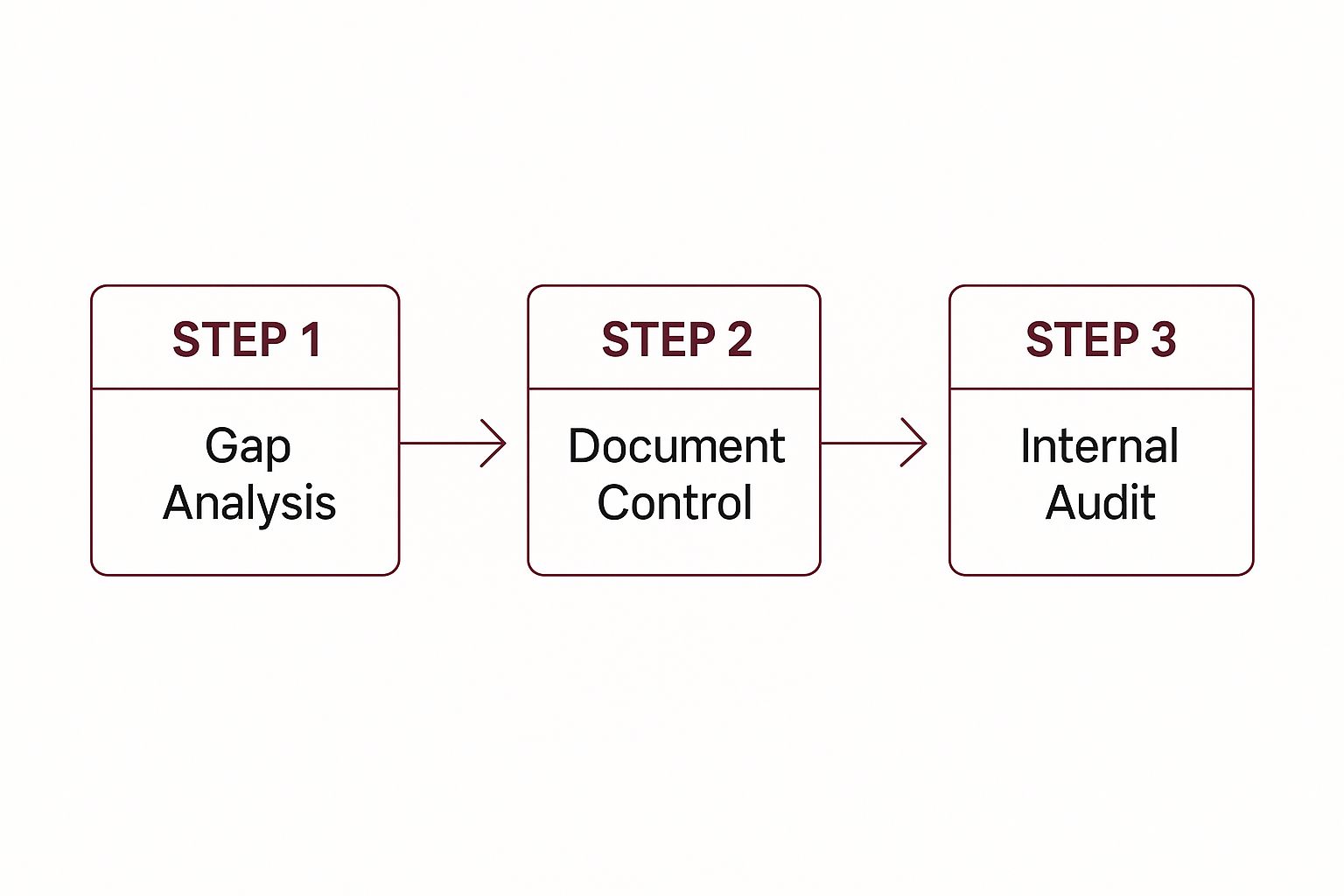
As you can see, it all flows logically, starting with figuring out where you are now and moving methodically towards that final verification.
The ISO Certification Journey At a Glance
To give you a clearer picture, here’s a quick summary of the path ahead. This table breaks down each major phase, its primary goal, and the key things you'll be doing.
| Phase | Primary Goal | Key Activities |
|---|---|---|
| Preparation & Gap Analysis | Understand your starting point. | Reviewing current processes against ISO requirements; identifying gaps and creating a project plan. |
| Documentation & ISMS Build | Create the formal system. | Writing policies, procedures, and the Statement of Applicability (SoA); defining roles and responsibilities. |
| Implementation & Training | Embed the system into daily operations. | Rolling out new processes, training staff on their new responsibilities, and gathering evidence of compliance. |
| Internal Audit & Review | Check your own work. | Conducting an internal audit to find non-conformities; holding a management review to assess performance. |
| External Certification Audit | Achieve official certification. | Undergoing the Stage 1 (documentation review) and Stage 2 (implementation) audits with an accredited body. |
This journey is designed to be a continuous cycle of improvement, ensuring the benefits last long after the certificate is issued.
Understanding the Core Journey
The entire process is really a loop: you plan, you do, you check, and you act. It’s not a one-and-done project but a commitment to always getting better. In the sections that follow, we’ll break down each of these phases in detail, from laying the initial groundwork to confidently facing your final audit.
Think of this as your insider’s guide, packed with actionable advice from the field to make your certification journey as smooth and valuable as possible.
While the principles discussed apply to most ISO standards, this guide will focus specifically on ISO 27001 certification in Australia, giving you a detailed roadmap for protecting your information assets. This standard is absolutely critical for any organisation that handles sensitive data, as it proves you have a robust information security management system.
This guide will show you how to turn this requirement into a powerful asset that not only protects your business but also builds unshakable client confidence.
Laying the Groundwork for a Smooth Certification
Jumping into an ISO project without a clear strategy is like setting sail without a map. You might get somewhere eventually, but it won't be efficient, and it certainly won't be where you intended to go. The real work of a successful certification journey starts long before you draft a single policy. It begins with careful, strategic planning. This is where you set the stage, make the tough decisions, and build the momentum that will see you through to the finish line.

Before you get lost in the details, you need to ask some big-picture questions. What are we actually trying to achieve here? Which standard really fits our business goals? Getting these answers right from the outset saves a world of pain later and makes sure the certificate you earn delivers genuine business value.
Choosing the Right ISO Standard
Not all ISO standards are the same, and picking the right one is your first critical decision. Think of it as choosing the right tool for a specific job. If you’re focused on proving consistent quality and making your customers happier, ISO 9001 (Quality Management) is the obvious choice.
But if your business handles sensitive data, whether it's customer information or your own intellectual property, then ISO 27001 (Information Security Management) is non-negotiable. This standard gives you a solid framework for building and maintaining an Information Security Management System (ISMS). As you lay the groundwork, implementing essential cybersecurity measures is a crucial part of protecting your company’s information and meeting the tough requirements of standards like ISO 27001.
Conducting an Effective Gap Analysis
Once you’ve locked in your standard, your next move is a gap analysis. This is basically a health check for your current systems, showing you how they measure up against the ISO requirements. It’s your "you are here" pin on the map, clearly marking the distance between where you are now and where you need to be.
A proper gap analysis will:
- Shine a light on weaknesses: It will uncover every process, policy, or control that's either missing or not up to scratch.
- Build your project plan: The gaps you find literally become the to-do list for your implementation.
- Eliminate nasty surprises: It’s far better to find your own weak spots than to have an external auditor point them out during the official audit.
A gap analysis is not about admitting failure; it is an act of strategic foresight. It transforms a mountain of unknowns into a clear, manageable checklist—the most powerful tool you can have at the start of any ISO project.
Many businesses start this with a simple spreadsheet. You just list each clause of the standard in one column and map your current state against it in the next. For an ISO 27001 analysis, you might discover you have great password policies but no formal process for managing third-party vendor access. That discovery instantly becomes a high-priority task.
Defining Your Management System Scope
Defining the scope of your management system is one of the most important—and most frequently misunderstood—steps. The scope is a formal statement that draws a boundary around the parts of your business the certification will cover. It has a direct impact on the project's cost, timeline, and overall complexity.
Getting the scope right is a balancing act. If it's too narrow, the certification might not even apply to the services your most important clients use. If it's too broad, you risk biting off more than you can chew, creating a project that’s bloated and needlessly expensive.
When setting your scope, think about:
- Physical locations: Will it just be the head office, or all your sites?
- Departments: Is this just an IT and Operations thing, or are we including HR, finance, and sales?
- Products and services: Which specific offerings need to sit under the certification umbrella?
For example, a software company might decide to scope its ISMS to only include the development and hosting environments for its main product. This is a smart approach—get certified for the most critical area first, then expand the scope later on if needed.
Securing Leadership Buy-In and Assembling Your Team
An ISO project that lives only within the IT or compliance department is destined for a tough road. For it to truly succeed, you need genuine buy-in from the very top. The leadership team has to see this for what it is: not just a line item in the budget, but a strategic investment that strengthens the business and builds rock-solid client trust.
Take the findings from your gap analysis to them. Don’t just talk about compliance; frame the conversation around business benefits like reduced risk, better efficiency, and a powerful competitive edge. Show them why it matters before you tell them how much it will cost.
Once you’ve got their backing, it’s time to build your project team. This is not a one-person job. You need a cross-functional team with people from key departments like IT, HR, and Operations. This ensures the system you create is practical, relevant, and actually gets adopted across the whole organisation.
Designing a Practical Management System
You have established your strategic direction. Now comes the part where you turn those high-level plans into a living, breathing system. This is where you’ll build the operational backbone of your ISO 27001 certification—the policies, procedures, and documents that will guide your team’s actions every single day.
Forget any preconceived notions of dusty manuals sitting on a shelf, never to be seen again. The goal here is to craft a practical system that your team not only understands but actively uses to make smarter, more secure decisions.

This phase is less about bureaucratic box-ticking and more about creating absolute clarity. A well-designed management system strips away ambiguity. It streamlines your processes and hands everyone in the organisation a clear roadmap for handling information securely. In short, it transforms abstract compliance goals into concrete, actionable steps.
Moving From Theory to Tangible Policies
The first order of business is to get your high-level policies down on paper. Think of these documents as the constitution for your entire information security program. They clearly state management's intentions and outline the core principles that will underpin everything else you do.
A common mistake is making these policies painfully complex or technical. Your main Information Security Policy needs to be the exact opposite—clear, concise, and accessible to everyone, from the CEO right down to the newest hire. It simply needs to state your organisation's commitment to protecting its information and meeting all the relevant requirements.
Once that foundational policy is in place, you can branch out into more specific, topic-based policies. Some of the usual suspects include:
- Access Control Policy: This lays out the rules for who gets access to what information, and under which specific conditions.
- Acceptable Use Policy: This defines the dos and don'ts for using company IT assets, like email, internet access, and company devices.
- Data Classification Policy: This is where you establish different levels of data sensitivity (e.g., Public, Internal, Confidential) and the handling rules for each.
The real measure of a good policy is not its length or technical jargon, but its usefulness. If an employee cannot read it and immediately understand what is expected, the policy has failed, regardless of how perfectly it aligns with the ISO standard.
Creating Key ISO 27001 Documents
For ISO 27001, there are a few non-negotiable documents that form the heart of your Information Security Management System (ISMS). These aren’t just for the auditor’s benefit; they are vital, everyday tools for managing your security risks effectively.
The two most critical documents you'll create are the Statement of Applicability (SoA) and the Risk Treatment Plan. The SoA is essentially your declaration of which of the 114 security controls from ISO 27001's Annex A are relevant to your business, and just as importantly, why.
For instance, if your company doesn't develop software in-house, you’d mark the controls related to secure development as 'not applicable' in your SoA, along with a clear justification. This demonstrates a thoughtful, risk-based approach, not just blind implementation.
The Risk Treatment Plan, on the other hand, is your action plan. It’s where you detail exactly how you're going to address the risks you uncovered during your analysis.
For each significant risk, your plan should clearly specify:
- The Treatment Option: Are you going to reduce the risk (e.g., implement a new control), avoid it, transfer it (perhaps through insurance), or formally accept it?
- Required Resources: What budget, tools, or people are needed to get this done?
- Responsibilities: Who, by name or role, is accountable for implementing the treatment?
- Timelines: When will this treatment be completed and reviewed?
This structured approach gives you a clear and auditable trail of how you’re actively managing your information security risks.
Making Documentation Usable and Maintainable
Let's be honest: the biggest challenge here is creating documentation that people will actually use. If your procedures are buried in a 100-page PDF that no one can find, they will be ignored. The trick is to prioritise clarity and accessibility over stuffy formality.
Here are a few practical tips for creating user-friendly documentation:
- Use Flowcharts and Visuals: A simple diagram can explain a complex process like incident response far more effectively than five pages of dense text.
- Keep it Short and Sharp: Use simple language, bullet points, and short paragraphs. Focus on what the user needs to do.
- Store it Centrally: Put everything on a shared platform like the company intranet, SharePoint, or a dedicated wiki. Everyone needs to know exactly where to find the latest versions.
- Implement Simple Version Control: You don't need a complex system. A basic naming convention (e.g.,
PolicyName_v1.2_Date) is often enough to prevent confusion.
By focusing on usability, you transform documentation from a compliance burden into a valuable operational asset that genuinely helps your team work more efficiently and securely. If you want a deeper dive into what's absolutely essential, you can learn more about the minimum documented information for achieving ISO 27001 certification to make sure you're covering all your bases without creating unnecessary paperwork.
Bringing Your ISO System to Life
You've done the heavy lifting on paper, and your framework is documented. But now comes the real test: turning those policies and procedures into the living, breathing reality of how your organisation operates every day. This is the implementation phase, where your Information Security Management System (ISMS) goes from theory to practice.
It’s about more than just rolling out new rules. You're trying to shift mindsets and build a genuine culture of security awareness from the ground up.
This is where most ISO journeys either succeed or fail. It’s one thing to have a perfect plan, but it’s another thing entirely to see your team execute it flawlessly under pressure. To get this right, you need to nail two things: meaningful training and a thorough internal audit.
Cultivating a Culture of Awareness Through Training
Your ISMS is only as strong as its weakest link, and that link is almost always human error stemming from a lack of awareness. Simply emailing out a new policy and hoping for the best is a recipe for disaster. Real, continuous training is what makes the difference, ensuring everyone understands their specific role in protecting the company’s information.
Effective training isn't a one-off town hall meeting. It needs to be tailored and ongoing. For example, your developers need deep dives into secure coding practices, whereas your sales team needs to know exactly how to handle sensitive client data within your CRM.
Here are a few ways companies can make their training stick:
- Role-Specific Workshops: Ditch the generic all-hands meetings. Run smaller, targeted sessions for each department focusing on the processes that directly affect them.
- Real-World Scenarios: Don't just talk about theory. Use practical examples of common security slip-ups—like clicking on a phishing email or leaving a visitor unattended in the office—to make the risks feel real and immediate.
- Gamification: A bit of friendly competition can work wonders. Use quizzes or even simulated phishing campaigns to keep people engaged and see where the knowledge gaps are.
The goal of training isn't just to inform; it's to empower. When your team understands the 'why' behind a security control, they stop being passive rule-followers and become proactive defenders of your system.
Planning and Executing Your Internal Audit
Think of the internal audit as your dress rehearsal for the main event. It's a full-scale self-assessment designed to find any gaps, weaknesses, or non-conformities before the external auditor shows up. This is your chance to fix things without the pressure of a formal certification audit hanging over you.
Frame it as a helpful critique, not a fault-finding exercise. The goal is to uncover areas for improvement and gather hard evidence that your ISMS is actually working as designed. This isn’t about ticking boxes; it’s about stress-testing your system in a live environment.
A solid internal audit follows three key stages:
- Planning: Find an impartial auditor. This could be someone from another department who has been trained, or you might bring in an external consultant. They'll create an audit plan that maps out the scope, objectives, and schedule.
- Execution: The auditor gets to work. They’ll review your documentation, interview staff, and observe processes to see if what you do matches what you say you do. They might ask a project manager how they classify data for a new project and then check if the steps they describe align with your official Data Classification Policy.
- Reporting: Finally, the auditor will pull together a report detailing their findings, including any non-conformities and opportunities for improvement. This report is your roadmap for corrective action.
Addressing the Management Review Meeting
The management review is a formal checkpoint where your leadership team gets directly involved in assessing the ISMS's performance. This isn't just another status update; it's a strategic meeting to ensure the system is still effective, relevant, and aligned with your core business goals. It’s also proof of that critical top-down commitment that ISO auditors love to see.
The process of obtaining ISO certification in Australia is well-defined, helping businesses become compliant efficiently and transparently. Organisations generally follow a clear, multi-step approach that involves submitting an application, developing an audit plan, and undertaking rigorous Stage 1 and Stage 2 certification audits. To get a better sense of this structured process, you can learn about the local certification journey in Australia.
During this meeting, a clear agenda is crucial for a thorough review.
Key Inputs for a Successful Management Review
| Input Category | Specific Topics to Discuss | Purpose |
|---|---|---|
| Performance Data | Results from the recent internal audit, feedback from clients or regulators, and metrics showing performance against security objectives. | To assess if the ISMS is actually achieving what it set out to do. |
| Non-Conformities | A review of all identified non-conformities and the status of the corrective actions being implemented to fix them. | To ensure problems are being properly resolved and won't happen again. |
| Resource Adequacy | An honest discussion about whether the team has the budget, tools, and people needed to maintain and improve the ISMS. | To secure ongoing commitment and necessary resources from leadership. |
| Opportunities for Improvement | A forward-looking chat about potential enhancements, emerging threats, and any necessary updates to the ISMS. | To champion the principle of continual improvement, which is the heart of ISO 27001. |
This meeting closes the loop. It ensures your ISMS doesn't just run on autopilot but actually evolves with your business. The documented outputs—the decisions made and actions assigned—are gold-dust evidence for your external auditor, proving that your organisation is fully invested in its security posture.
Navigating the Final Certification Audit
So, you’ve done the hard yards. All the meticulous planning, endless documentation, and careful implementation have led to this moment: the external certification audit. It can feel like a final exam, but it’s more of a professional verification of the robust security system you’ve so diligently built.
The best mindset to adopt is to see the auditor as a partner, not an adversary. Their role is simply to confirm that your management system works in practice, just as you’ve designed it. A bit of preparation and a positive, organised approach will make their job easier and show your company’s security culture in the best possible light.
The whole process is neatly broken down into two parts: the Stage 1 and Stage 2 audits. Each has a distinct purpose, taking you from a high-level paperwork check to a deep dive into your live, operational environment.
Understanding the Stage 1 Audit: The Documentation Review
Think of the Stage 1 audit as a readiness check. It's essentially an open-book exam where the auditor scrutinises your documented Information Security Management System (ISMS) to make sure you have all the essential policies, procedures, and controls down on paper.
During this stage, they'll be laser-focused on:
- Core Documentation: Expect a close look at your Information Security Policy, Statement of Applicability (SoA), and your risk assessment and treatment plan.
- Scope Verification: They’ll confirm that the scope you’ve defined for your ISMS is appropriate and clearly articulated.
- System Design: They’re assessing whether your management system has been designed from the ground up to meet the ISO standard's requirements.
Your Stage 1 audit is your first impression. When your documentation is well-organised, clear, and comprehensive, it sends a powerful signal to the auditor that you're serious. It sets a positive tone for the entire certification process.
This stage is often done remotely. Afterwards, the auditor will give you a report highlighting any areas of concern, which is incredibly valuable. It gives you a window to make corrections before the more hands-on Stage 2 audit kicks off.
Excelling in the Stage 2 Audit: The On-Site Implementation Check
The Stage 2 audit is where the rubber meets the road. Here, the auditor moves beyond the paperwork to verify that your ISMS is a living, breathing part of your organisation. This is where your team’s hard work and training really get to shine.
Auditors will conduct interviews, watch processes in action, and review records to gather tangible evidence of compliance. The key to success here is communication. Give your team a heads-up on what to expect. Encourage them to answer questions honestly—if they don't know an answer, it's far better to say, "I'm not sure, but I can find the right person for you," than to guess.
A huge part of this audit is showing, not just telling. For instance, being able to demonstrate how your system helps to achieve network security compliance is a powerful way to prove your controls are effectively managing real-world risks.
This is where all the evidence you’ve been collecting comes into play. For example:
- An auditor might ask an HR team member to walk them through the new employee onboarding process to see how security awareness training is actually delivered.
- They might ask an IT administrator to pull up the access control logs for a critical system to check they are being monitored.
- They could ask to see the minutes from your management review meetings to confirm that leadership is actively involved.
The demand for this level of assurance is growing fast. The Australian ISO certification market is part of a booming Asia Pacific market, which is forecasted to grow at a Compound Annual Growth Rate (CAGR) of around 16.7%. In 2024, Australia's market was valued at roughly USD 122.7 million, part of a wider Asia Pacific market worth over USD 2.35 billion. This trend makes it clear just how much value businesses are placing on certified management systems.
Responding to Non-Conformities: Calm and Professional
Don't panic if an auditor finds a non-conformity—it's actually quite common. The most important thing is how you respond. Instead of getting defensive, treat it as a piece of valuable, free consulting. Thank the auditor for spotting the gap and discuss it openly. A calm, professional response shows maturity and a genuine commitment to getting things right.
When a non-conformity is found, the process is straightforward. The auditor will formally document it. You’ll then need to submit a corrective action plan that details how you’ll fix the root cause and stop it from happening again. Minor issues usually won't stop you from getting certified, as long as you have a solid plan to address them.
Once the audit is complete and all non-conformities are addressed, the certification body's independent review panel gives the final sign-off. This is the moment you officially become ISO 27001 certified—a powerful testament to your organisation’s dedication to information security. To get a head start, it helps to understand the principles of auditing itself; you can learn more in our guide on what is an ISO internal audit.
Answering Your Top Questions About ISO Certification
Diving into ISO certification often brings up a heap of questions. It's completely normal to wonder about the nitty-gritty details—like how long it all takes, what it's going to cost, and what life looks like after you've got that certificate on the wall. Let's tackle some of the most common queries we get from Australian businesses just like yours.
How Long Does It Take to Get ISO Certified in Australia?
There's no one-size-fits-all answer here. The timeline really hinges on where your business is at right now. The biggest factors are your company's size, the complexity of your operations, and how many compliant processes you already have ticking along.
For a typical small to medium-sized Aussie business starting from a clean slate, you're generally looking at a 6 to 12-month journey. That timeframe gets you from the initial gap analysis and building your management system all the way through to passing the final external certification audit.
If you're a larger organisation, or one with more complex processes spread across multiple sites, you might be looking at a timeline closer to a year or more. The real secret to speeding things up? A thorough, no-stone-unturned gap analysis right at the beginning. It sets the stage for everything that follows.
What’s the Difference Between an Internal and External Audit?
This is a great question, as the two sound similar but play very different roles in getting you certified.
An internal audit is like a dress rehearsal. It’s a self-check you conduct to find and fix any issues before the official auditors show up. You can have your own trained staff do it, or you can bring in an independent consultant. The goal is simple: find any non-conformities, implement corrective actions, and make sure you're rock-solid for the real thing.
The external audit, on the other hand, is the main event. This is carried out by a qualified auditor from an accredited certification body. They're the independent third party who determines if you’ve met every single requirement of the ISO standard. Passing this audit is the final hurdle to earning your official certification.
How Much Does ISO Certification Cost for a Business in Australia?
The cost of getting ISO certified isn't just a single line item; it’s a mix of a few different expenses. To get a realistic budget, you need to think about both the direct and indirect costs.
Here’s what usually makes up the total investment:
- Certification Body Fees: This covers the cost of the Stage 1 and Stage 2 audits, plus the ongoing annual surveillance audits.
- Consultant Fees: If you decide to work with a consultant, their fees will be a key part of your budget.
- Internal Resource Costs: Don't forget to account for your own team's time. They'll be busy developing documentation, implementing new controls, and taking part in the audits.
For a smaller business in Australia, the total cost can fall anywhere between $10,000 and $50,000+. The final figure really depends on the scope of your certification and how much heavy lifting is needed to get you compliant.
The smartest way to approach the cost is to see it as an investment, not an expense. The operational efficiencies, reduced risks, and stronger market reputation you'll gain will deliver a return that far outweighs the initial price tag.
What Happens After We Achieve ISO Certification?
Getting certified is a huge achievement, but it's not the end of the journey—it's the beginning of an ongoing commitment to excellence. Your certificate is usually valid for three years, and keeping it active means showing you're dedicated to continual improvement.
During this three-year cycle, you'll have annual surveillance audits. These are basically quick check-ins from your certification body. They’re less intense than the initial audit and are designed to make sure your management system is still running effectively and that you're sticking to your processes.
Once the three years are up, your organisation will undergo a full recertification audit. This is a deep dive, much like your initial Stage 2 audit, to confirm your ongoing compliance and renew your certificate for another three years. This cycle is what gives your ISO status its long-term value and integrity.
At Anitech, we specialise in guiding Australian small businesses through the complexities of ISO 27001 certification. With a 100% success rate, we simplify the process, helping you protect your information, build client trust, and gain a powerful competitive advantage.
Ready to start your journey? Explore our ISO 27001 consulting services.
Recent Comments