

Performing an ISO 27001 gap analysis is about systematically laying your current information security practices side-by-side with the standard's requirements. This process is designed to pinpoint specific shortfalls, help you gauge the real effort involved in compliance, and ultimately, build a smart, prioritised roadmap to get you certified.
Why a Gap Analysis Is Your Most Critical First Step
Before you even start thinking about certification, you need a clear, honest map of where you are right now. This is precisely where a gap analysis becomes non-negotiable. Think of it as the foundational diagnostic for your Information Security Management System (ISMS), showing you the exact distance between your current security measures and the ISO 27001 finish line.

It’s a strategic deep-dive meant to head off expensive missteps and wasted effort down the track. For Australian small and medium-sized businesses, especially those handling sensitive client data or chasing government contracts, this initial review provides an immediate, actionable plan.
From our experience, companies that dive headfirst into implementation without this diagnostic phase almost always hit significant roadblocks. They might pour money into tech they don’t actually need or completely overlook critical documentation, leading to failed audits and frustrating project delays.
Setting the Stage for Success
A properly conducted gap analysis does more than just shine a light on your weaknesses; it builds the business case for your entire information security program. By putting real numbers and facts behind the gaps, you can communicate the required resources, timelines, and potential risks to management much more effectively.
This assessment gives you a solid baseline from which all your future security efforts can be measured. It turns a vague ambition like "get ISO 27001 certified" into a series of concrete, bite-sized tasks with clear owners and deadlines. That kind of clarity is priceless for keeping the whole project on track and making sure everyone knows what they need to do.
The process itself forces important conversations between different parts of the business—from IT and HR to legal and operations. It reveals how information really flows through your company and where weak spots might be hiding in processes you’ve always assumed were secure.
The Strategic Value Beyond Compliance
While getting that ISO 27001 certificate is often the main goal, the insights from a gap analysis offer huge strategic value that strengthens your business's overall security posture.
Let's look at the real-world advantages:
- Uncover Hidden Risks: It brings to light vulnerabilities in your systems and processes that could lead to a data breach or business disruption, allowing you to fix them before they become a real problem.
- Smarter Spending: Instead of guessing where to put your money, you can focus your budget and your team's time on the areas of highest risk and non-compliance. This means a much better return on your security investment.
- A Smoother Path to Certification: By tackling all the non-conformities upfront, you make the formal certification journey far less stressful. You'll go into your stage 1 and 2 audits with confidence. Our guide on the ISO 27001 audit process breaks down what to expect here.
- Foster a Security-Aware Culture: The analysis gets people from all over the business involved, educating them on their security responsibilities and planting the seeds for a stronger, more aware culture.
A gap analysis isn't an admission of weakness; it's a statement of intent. It shows a commitment to understanding your true security posture and a determination to systematically improve it. This is what separates proactive security programs from reactive ones.
A Practical Analogy for Business Leaders
Imagine you’re planning a road trip from Perth to Sydney. You wouldn't just jump in the car and hope for the best. The first sensible thing you'd do is take your car to a mechanic for a full inspection.
That mechanic's report is your gap analysis. It tells you the engine oil is dangerously low (a critical gap), the tyres are worn but have a few thousand k's left (a medium-priority gap), and you're out of air freshener (a low-priority gap). Armed with this report, you can plan your next steps: change the oil now, book a tyre change for when you hit Adelaide, and grab an air freshener at the next petrol station.
Trying to implement ISO 27001 without a gap analysis is like starting that road trip with no inspection. You might make it, but there's a good chance you'll end up broken down on the Nullarbor Plain, facing unexpected and costly repairs. The same principles of comparing your current state to a desired future state are applied in many other areas, including personal and professional career development.
At the end of the day, a gap analysis is the most logical, efficient, and cost-effective way to kick off your journey to ISO 27001 certification. It provides the clarity you need to build a resilient security framework from the ground up, turning compliance from a burden into a genuine business advantage.
Defining Your Scope and Assembling Your Internal Champions
Before you can dive into a single security control, you need to draw a map. A successful gap analysis lives or dies on setting clear, unambiguous boundaries. This is what we call defining the scope of your Information Security Management System (ISMS), and it's a decision that sets the entire focus, budget, and timeline for your project.
Trying to run a gap analysis without a well-defined scope is like trying to do a stocktake without knowing which warehouse you're in. You'll end up counting irrelevant things, miss the critical stuff, and get a result that's completely useless.
Drawing the Lines: What’s In and What’s Out
Defining your scope is all about deciding which parts of your business will be covered by the ISMS and, therefore, measured against the ISO 27001 standard. This isn't just some technical box-ticking; it’s a strategic business decision.
Think hard about what you're trying to protect and why. Are you chasing certification to win a specific government contract? If so, your scope might just include the people, processes, and technology that touch that contract's data. Nothing more, nothing less.
Consider these common ways to draw your boundaries:
- Business Units or Departments: You might choose to certify only your product development team or the client-facing service department.
- Physical Locations: For a business with multiple offices, say one in Sydney and another in Melbourne, you could start by scoping the ISMS to cover just one location.
- Specific Products or Services: A software company could limit its scope to a single flagship app that handles sensitive customer data.
- Key Business Processes: This could zero in on crucial workflows like customer onboarding, payment processing, or data analytics.
A solid understanding project scope is crucial here. Getting this right from the start saves you from the dreaded "scope creep" that can completely derail a certification project.
Real-World Scoping Scenarios for Australian Businesses
Let’s get practical. Imagine a Sydney-based FinTech startup with a new payment processing app. Their main reason for getting ISO 27001 certified is to build trust with major banks.
Their scope statement might read something like this: "The ISMS applies to all employees, systems, and data involved in the development, operation, and maintenance of the PayRight mobile application, hosted within our Australian AWS environment." It's clean and concise. It deliberately excludes internal corporate functions like HR and finance, which dramatically simplifies the initial work.
Now, picture a Melbourne-based healthcare provider storing sensitive patient records. Their motivation is regulatory compliance. Their scope would likely be much broader: "The ISMS covers all systems, processes, and personnel involved in the collection, storage, and processing of patient information at our Melbourne clinic."
Start small and focused. It's almost always smarter to define a narrow, achievable scope for your first certification, then expand it later. This gets you an early win and builds momentum for the bigger journey ahead.
Assembling Your Team of Internal Champions
A gap analysis is not a solo mission for the IT manager. To get a real, accurate picture of your security posture, you need buy-in and help from across the business. More than that, you need a crew of internal champions—people who are genuinely invested in making this work.
This isn’t about forming another committee. It’s about building a cross-functional coalition with the clout to get things done. Without this team, you'll be fighting an uphill battle for evidence, facing resistance and delays at every turn.
Who to Recruit for Your A-Team
- IT and Technical Staff: These are your experts on the ground. They live and breathe the network architecture, server configs, and software systems. They are absolutely essential for assessing the technical controls.
- Human Resources (HR): HR manages critical processes like employee onboarding, security awareness training, and exit procedures. Their input is non-negotiable for the personnel security controls.
- Legal and Compliance: If you have one, this person can help translate legal and regulatory jargon, ensuring your scope and controls tick all the necessary boxes.
- Senior Management: This is the big one. You must have an executive sponsor who can champion the project, secure the budget, and knock down any political roadblocks. A project without genuine executive backing is usually dead on arrival.
Once you’ve got your team, one of the first jobs is often to draft foundational documents. A good template is a massive help here; you can see what a formal policy looks like with this information security policy template.
Securing Genuine Executive Buy-In
Let's be crystal clear: buy-in isn't a one-off email approval. It’s an ongoing commitment from the top. To get it, you need to frame the ISO 27001 project not as an IT cost, but as a powerful business enabler.
Make your case by connecting the gap analysis to real business outcomes. Show them how certification will:
- Unlock new revenue by meeting tender requirements.
- Slash the financial risk of a data breach.
- Improve operational efficiency by standardising how you work.
- Boost your brand reputation and build rock-solid customer trust.
When management truly understands the "why," they're far more likely to give you the resources and authority needed to succeed. This support is the fuel for your entire journey. It ensures that when your team needs something from a busy department, they’re met with help, not a brick wall.
Right, you've defined your scope and rallied the troops. Now comes the real work: figuring out exactly where you stand against the ISO 27001 Annex A controls. This is the heart of the gap analysis, where we methodically line up what you actually do with what the standard expects.
Think of it less like a test and more like an investigation. We’re moving past gut feelings and assumptions to build an objective, evidence-based picture of your security posture. This means digging into everything from your access control policies to how you handle a security incident.
The initial setup for this deep dive is crucial. You have to get the foundations right before you start assessing controls.
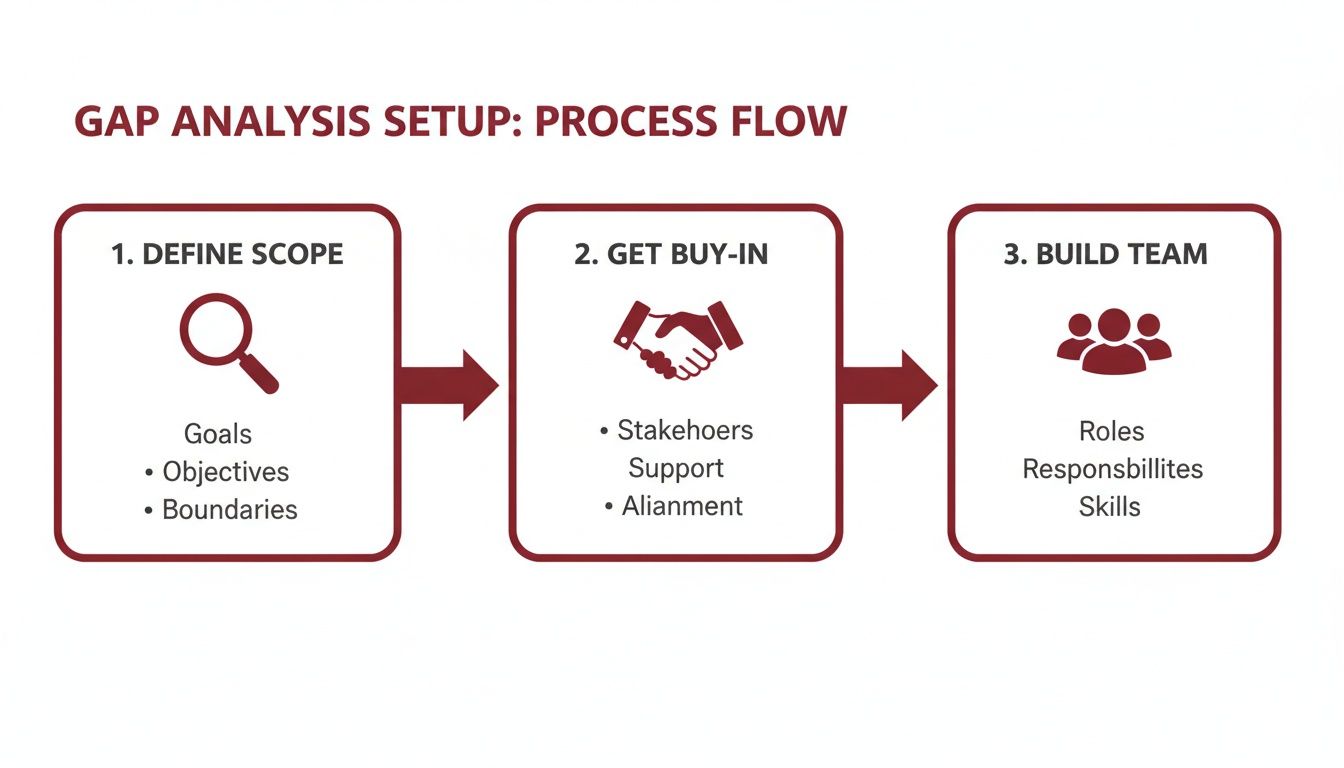
As you can see, a tight scope, genuine leadership buy-in, and the right team are the non-negotiables. Nail these first, and the rest of the process becomes much smoother.
Ditch the Checklist Mindset
Here’s a common mistake I see all the time: businesses treat Annex A like a simple to-do list. They run down the 93 controls, ticking "yes," "no," or "sort of" next to each one. This approach is dangerously shallow and will fall apart the moment an auditor starts asking questions.
A proper gap analysis is about asking the hard questions for every single control.
- Is there a documented policy for this? Where is it, and when was it last reviewed?
- Who actually owns this control? Is their responsibility clear?
- How is this control implemented in the real world? Is it a tool, a manual process, or a bit of both?
- And the big one: Where's the proof? Can we pull up logs, reports, or records to show it’s working?
Adopting this investigative mindset turns the gap analysis from a paper-pushing exercise into a fact-finding mission that delivers real value.
How to Gather Real-World Evidence
To get solid answers, you'll need to use a few different techniques. Relying on just one method won't give you the full picture, so a multi-pronged approach is always best.
1. Go Through the Paperwork
This is always your first port of call. Start gathering and reviewing all the relevant documentation. Don't just look for security policies; you need to cast a wider net.
- HR policies (think onboarding and offboarding checklists)
- Network maps and asset registers
- Incident response and business continuity plans
- Acceptable use policies for staff
- Key supplier contracts and their Service Level Agreements (SLAs)
2. Talk to Your People
Policies are one thing, but reality is often another. The only way to find out what really happens is to talk to the people on the ground. Interviews can expose the critical gaps between what's written down and what's done every day.
For instance, have a chat with your IT admin about how they handle server patching. Then, go ask a department manager how they request system access for a new hire. These conversations are goldmines for uncovering informal workarounds and undocumented processes—which are often major security risks.
3. See It for Yourself
Sometimes, you just need to get up from your desk. Walk around the office and observe the physical security. Is the server room door propped open? Are there sensitive printouts sitting on desks in plain sight?
The same goes for your tech. Dig into the configurations of your firewalls, check user permissions in your core systems, and verify that your backup jobs are actually running successfully. This gives you undeniable proof of whether a control is truly working or not.
A Scoring System That Actually Works
Once you've gathered all this information, you need a structured way to make sense of it. A vague "we're doing okay here" isn't going to cut it. To make your findings actionable, you need clear, objective data. This is where a simple scoring system becomes your best friend.
Benchmarking your current setup against Annex A is the standard way to do this in Australia. From what I’ve seen, an initial gap analysis often flags issues across 15–40% of the required controls. For small businesses, the biggest headaches are usually administrative controls—things like missing policies and procedures. In fact, SME audits typically find about 22% of Annex A controls don't have enough documentation.
By assigning a simple score to each control, you turn a subjective assessment into hard data. This makes it so much easier to pinpoint your biggest weaknesses and explain the urgency to management in a language they understand.
Putting the 0-2 Scoring Scale into Practice
Many Australian practitioners, myself included, favour a simple 0-2 scale. It’s clear, easy to use, and forces you to make a decisive judgement on each control.
Here’s the breakdown:
- Score 0 (Non-Conformant): Nothing is in place. There's no evidence of a control, or what exists is completely ineffective.
- Score 1 (Partially Conformant): Something is there, but it’s not fully implemented, documented, or followed consistently. A classic example is having a password policy that isn't actually enforced on all systems.
- Score 2 (Fully Conformant): The control is implemented, documented, consistently followed, and you have solid evidence to back it up.
To make this tangible, let's create a small scoring matrix. This helps standardise how you evaluate the evidence for each control.
Example Gap Analysis Scoring Matrix
| Score | Definition | Example Evidence for Control A.5.15 (Access Control) |
|---|---|---|
| 0 | Non-Conformant | No documented user access policy exists. Permissions are given out randomly with no formal approval trail. |
| 1 | Partially Conformant | A user access policy is written down but hasn't been touched in three years. There's a formal request process, but people often bypass it for "urgent" requests. |
| 2 | Fully Conformant | A formal, board-approved User Access Control Policy is in place and reviewed annually. All access requests are logged, require manager approval, and are audited quarterly. |
This scoring system is the engine of your gap analysis. You'll work through the Annex A controls, filling out a spreadsheet with the control number, your findings, the evidence you collected, and—most importantly—your score from 0 to 2.
Getting your head around the specifics of each control is key, and our detailed breakdown of the ISO 27001 controls is a great resource to have open as you go through this process.
By the end, you’ll have much more than a vague feeling about your security. You'll have a detailed, evidence-backed report card that shows exactly where you stand and gives you the hard data needed to build a smart, prioritised roadmap to certification.
Analysing Gaps and Building Your Remediation Roadmap
So, you’ve gathered your evidence and tallied the scores. You're now looking at a spreadsheet full of data, but this is where the real work begins. This is the moment a simple administrative task transforms into a powerful strategic exercise. Finding the gaps is one thing; turning those findings into a practical, persuasive action plan is what truly matters.
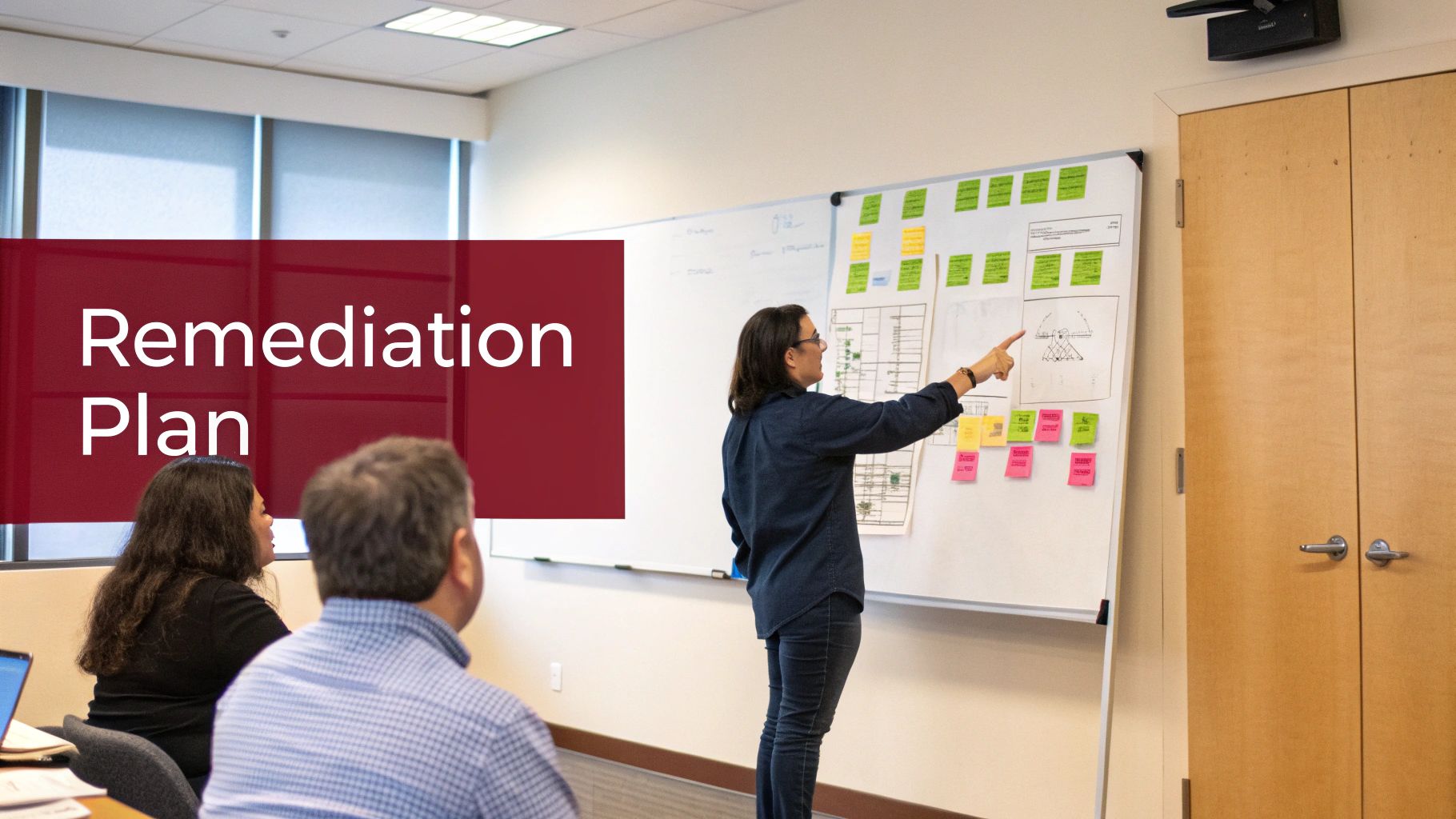
We're about to move from a basic list of what’s wrong to a proper remediation roadmap. This is your blueprint for achieving ISO 27001 certification, and it needs to speak the language of the C-suite: risk, cost, and return on investment.
From Scores to Strategic Priorities
That scoring spreadsheet—with all its 0s, 1s, and 2s—is your starting point. It’s easy enough to filter the list and see every control that scored a 0 or 1. The temptation is often to jump on the "easy wins" first, but that's a classic rookie mistake. A truly effective plan is always built on risk.
You have to prioritise the gaps that pose the biggest threat to your business. Sure, a missing policy for physical security in a branch office is a problem. But it pales in comparison to having no multi-factor authentication on the database holding all your client information.
To get this right, you need to look at each gap through two critical lenses:
- Likelihood: How likely is it that someone could actually exploit this weakness?
- Impact: If they did, what would the damage be to the business?
This simple shift changes the conversation entirely. You're no longer just saying, "We're not compliant." You're saying, "This specific gap exposes us to a significant risk of financial loss and serious reputational damage."
Quantifying Risk The Australian Way
I can tell you from experience, Australian certification bodies are getting much more sophisticated. They expect to see this kind of mature risk assessment. They want proof that you understand the real-world business implications of your security gaps, not just a checklist of things you've found.
This means you need to tie your findings to numbers. A statistically driven gap analysis in the Australian context should align identified gaps with measurable risk and cost metrics. The Australian Cyber Security Centre (ACSC) regularly reports on the rising number of cyber incidents targeting small businesses. When it comes to your ISO 27001 readiness, auditors now expect you to show how you've treated risks based on their likelihood and impact.
One of the most effective ways to do this is by assigning each gap an estimated annualised loss expectancy (ALE). For example, say you found a missing backup and recovery control for confidential client data. We know from recent reports that the average cost for a similar incident for an Australian small business was around AU$85,000. If you judge the probability of that happening within a year to be 50%, then the ALE for that single gap is AU$42,500.
This approach is incredibly powerful when you need to justify spending to your executive team. For more on this, you can discover some great insights about what Australian businesses need to know for ISO 27001 on iqcglobal.com.au.
Building Your Remediation Roadmap
Once you have your risk-prioritised list, it's time to build the roadmap. This isn't just a to-do list; it's a proper project plan detailing exactly how you’re going to close every single gap.
The key is to be specific and assign clear accountability. "Improve access control" is a useless instruction. It’s vague and impossible to track. A proper remediation task leaves no room for interpretation.
Your remediation roadmap is the bridge between where you are now and where you need to be for certification. Each task is a paving stone on that bridge. Without clear owners, deadlines, and resources, you'll never make it to the other side.
For every gap on your prioritised list, your roadmap needs to spell out the following:
- Specific Remediation Task: A clear, concise action. Instead of "Improve backups," write "Implement daily, encrypted, off-site backups for all production servers."
- Assigned Owner: The one person ultimately responsible for getting it done. This is non-negotiable for accountability.
- Estimated Effort (Person-Days): A realistic guess at the time and labour involved. This is essential for planning and budgeting.
- Required Resources: Does it need new software? Hardware? An external consultant? List it all here.
- Timeline (Start/End Dates): Put achievable deadlines on everything to maintain momentum.
- Dependencies: Note if a task can’t start until another one is finished.
This level of detail is what turns your gap analysis from a report that collects dust on a shelf into a living project plan that drives real, measurable change.
Example Remediation Plan Entry
Let's see how this works for a very common gap I see all the time.
| Gap Identified | Annex A Control | Risk Rating | Remediation Task | Owner | Effort | Timeline |
|---|---|---|---|---|---|---|
| No formal security awareness training program exists for new hires. | A.6.3 Information security awareness, education and training | High | Develop and deploy a mandatory security awareness training module for the new employee onboarding process. | HR Manager | 5 Days | 1 Oct – 30 Oct |
This simple format gives any manager everything they need to understand the problem, the solution, and what it’s going to take to fix it.
Getting Approval and Executing the Plan
With this detailed roadmap in your hands, you’re ready to talk to senior management. And here's the best part: you're not just showing up with a list of problems. You're bringing them a prioritised, costed, and scheduled plan of solutions.
Focus your presentation on the high-risk items first. Use your ALE calculations and business impact analysis to explain why these things need to be fixed urgently. Frame the entire project not as a cost, but as a critical investment in business resilience—one that can help win new contracts and protect the bottom line.
Once you get the green light, it’s all about execution. Your role shifts to that of a project manager. This means:
- Regular Check-ins: Holding weekly or fortnightly meetings with task owners to see where things are at.
- Removing Blockers: Proactively finding and solving any issues that are holding up progress.
- Updating Stakeholders: Keeping management in the loop on your progress against the roadmap.
Nailing this final phase is what separates a gap analysis that just sits there from one that leads to meaningful improvement and, ultimately, successful ISO 27001 certification.
Common Pitfalls That Can Derail Your Gap Analysis
I’ve spent decades helping Australian businesses get certified, and I’ve seen firsthand how a promising gap analysis can completely fall apart. A few common, seemingly small mistakes can sabotage the whole process, turning a valuable strategic exercise into a frustrating waste of time and money.
Knowing what to do is one thing; knowing what not to do is just as critical. If you can sidestep these common traps, you’ll be on the fast track to a solid, actionable plan for your ISO 27001 implementation.
The Treachery of Scope Creep
Scope creep is the silent killer of projects, and a gap analysis is prime hunting ground. It always starts innocently. Someone from another department hears what you’re doing and asks, "While you're at it, can you just have a quick look at our systems, too?"
This gradual expansion might seem harmless, but it quickly dilutes your focus, blows out your timeline, and turns your data into a mess. That well-defined scope we talked about earlier? That’s your project’s anchor. Without it, you're adrift, trying to assess everything at once and achieving nothing meaningful.
You need to be ruthless in defending your initial scope.
- Be Crystal Clear on the Boundaries: Make sure every single stakeholder knows exactly what is in scope and—just as importantly—what is out.
- Have a Formal Change Request Process: If someone wants to expand the scope, make them justify it in writing. This forces a proper look at the impact on your resources and schedule.
- Keep Your Eyes on the Prize: Constantly remind yourself and the team why you started this. Does that "quick look" at another system actually help achieve your primary business goal? Almost never.
Collecting Superficial Evidence
Another classic mistake is treating evidence collection like a simple box-ticking exercise. An auditor isn't going to be happy when you just say, "Yep, we have an access control policy." They'll demand to see it. Then they’ll want to know when it was last updated, who approved it, and how you can prove it's actually being followed by staff.
Gathering superficial evidence just gives you a false sense of security. You might finish your analysis thinking you’re in great shape, only to have an auditor tear your findings apart later.
Think of your gap analysis as a dress rehearsal for your certification audit. If the evidence you've gathered wouldn't stand up to an auditor's scrutiny, it's not good enough. You need concrete, verifiable proof for every single control you claim to have in place.
So, what does good evidence actually look like?
- For a policy: A version-controlled document showing review dates and approval signatures.
- For a process: Screenshots of system configurations, actual log files, or completed request forms.
- For awareness: Signed training attendance sheets or completion records from your learning management system.
The golden rule is: never take someone’s word for it. Always insist on seeing the proof for yourself. This kind of rigour is what separates a truly useful gap analysis from a theoretical one.
Lack of Genuine Stakeholder Engagement
You can’t run a gap analysis from the IT department’s basement. Information security is everyone’s job, and you absolutely need people from across the business to actively participate if you want an accurate picture.
When key people aren't properly engaged, you’ll hit brick walls. Suddenly, everyone is "too busy" for an interview or takes weeks to send you a document. It’s not usually malicious; it’s because they don’t understand why the project matters or what's in it for them.
Getting people on board is all about communication and building relationships.
- Explain the "Why": Don't just tell the HR manager you need to see their onboarding checklist. Explain that it’s critical evidence for Annex A control A.7.1, which is what protects the whole company from unauthorised access by new staff.
- Respect Their Time: Be prepared. Send interview questions in advance, stick to the schedule you agreed on, and be incredibly clear about what you need from them.
- Share What You Find: Keep them in the loop. When you find a gap in their area, work with them to understand the cause and figure out a practical way to fix it.
Drastically Underestimating Remediation
This is perhaps the most dangerous pitfall of all. You complete a fantastic, detailed gap analysis… and then completely fail to appreciate the sheer scale of the work needed to fix the problems you've found. Identifying a gap is the easy part. Actually closing it can take a huge amount of time, money, and political will.
Underestimating the remediation effort leads to promising unrealistic timelines to management. This sets the entire project up for failure and really damages your credibility.
To avoid this trap, you have to attach realistic estimates to every gap you identify.
- Break It Down: "Implement a new backup system" is way too big. Break it down into smaller tasks like research, procurement, configuration, testing, and rollout, then estimate the person-days for each step.
- Account for the "Soft" Costs: It's not just about the budget for new software. Remember to factor in the cost of staff time for training, developing new procedures, and managing the change.
- Prioritise Ruthlessly: You can't fix everything at once. Use a risk-based approach to tackle the highest-priority gaps first. This ensures you’re putting your limited resources where they’ll have the biggest impact.
By looking out for these common mistakes, you can steer your project clear of trouble. A successful gap analysis is methodical, evidence-based, collaborative, and realistic—the perfect launchpad for your certification journey.
Common Questions We Hear About ISO 27001 Gap Analysis
Stepping into the world of ISO 27001 certification can feel a bit daunting, and the gap analysis is often where the real questions start to pop up. We've worked with countless Australian business owners, IT managers, and compliance officers, and we tend to hear the same questions time and again. Here are the honest, straightforward answers we give them.
How Long Does a Gap Analysis Actually Take?
This is the big one, and the real answer is: it really depends. The timeline for a gap analysis is tied directly to the size and complexity of the Information Security Management System (ISMS) you’re trying to build.
For a small tech startup in Sydney with a very tight scope—say, just their core application—we might get it done in a couple of weeks. On the other hand, a larger Melbourne-based healthcare provider with multiple sites and intricate data flows could easily be looking at one to two months of solid work.
The timeline really hinges on a few key things:
- Scope Complexity: Is it a single product or your entire organisation? A narrow scope is always faster.
- Company Size: More people and more departments mean more interviews and more evidence to track down. Simple as that.
- Security Maturity: If you've already got good security habits and some policies in place, you’re way ahead. Starting from zero just takes longer.
- Who's Available: The whole thing moves a lot quicker if your team can actually dedicate time to it.
For a typical Aussie small business of about 50 staff with a clear scope, you should probably budget three to four weeks from the initial kickoff meeting to having a final report in your hands.
Can We Do This Ourselves, or Do We Need a Consultant?
You absolutely can tackle a gap analysis on your own. Many businesses do, and it’s a fantastic way to get your team deeply familiar with both the ISO 27001 standard and your own internal workings. It can definitely save you some money upfront.
But, there's a strong case for bringing in an expert. An experienced consultant has been through this dozens, if not hundreds, of times. They know precisely what auditors are looking for, they've seen all the common mistakes, and they bring an objective eye that’s almost impossible to have when you're looking at your own company. They're usually faster, too.
Here’s a quick way to weigh it up:
| Factor | The DIY Route | Bringing in a Consultant |
|---|---|---|
| Cost | Lower initial cash outlay. | Higher upfront investment. |
| Speed | Generally slower. There's a learning curve and day-to-day work gets in the way. | Much faster. This is what they do all day, every day. |
| Objectivity | It's tough to be impartial about your own work and processes. | You get a completely unbiased, external view, free from office politics. |
| Expertise | You're relying on what your team knows about ISO 27001. | You get deep, practical knowledge of the standard and audit expectations. |
The right choice really comes down to your internal capability. If you have someone on your team who genuinely understands ISO 27001 and has the time to dedicate to it, going DIY is a solid option. If not, a consultant is a smart investment to make sure you start on the right foot.
What's the Hardest Part of the Whole Process?
You might think it’s the technical side of things, but in our experience, the biggest headache is almost always collecting the evidence and getting people to engage.
It’s one thing to say you have a process for, say, new employee onboarding. It’s a whole other challenge to find the documented procedure, the filled-out checklist, and the system logs to prove it. This part of the job involves chasing busy people, digging through old files, and trying to get on everyone’s calendar.
This is exactly why having strong, visible support from the leadership team is a must. When the CEO is behind the project, managers make time. Without that backing, the process can get bogged down in delays and a frustrating lack of cooperation.
What Documents Should We Pull Together Before We Start?
A little bit of prep work here can save you a massive amount of time later. Before you or a consultant dives in, try to get a digital folder ready with as many of the following as you can find.
Your Gap Analysis "Go-Bag"
- Existing Policies & Procedures: Grab anything you have written down about information security, acceptable use, access control, or how you handle data.
- Org Charts: A simple chart showing who reports to whom is invaluable for figuring out who to talk to.
- Network Diagrams & Asset Registers: These are gold. They give a clear picture of all the hardware, software, and devices in your scope.
- Incident Response Plans: If you have a plan for what to do when things go wrong, have it ready.
- HR Onboarding & Offboarding Checklists: These are key for checking controls around user access from start to finish.
- Key Supplier Contracts: Pull out any contracts with major vendors. They often contain security clauses that are part of your overall ISMS.
Don’t stress if you can’t find everything on this list. The process of looking for these documents is actually part of the analysis itself—it immediately shows you where your first documentation gaps are. Getting this sorted just makes the whole experience of how to perform a gap analysis run so much more smoothly.
Navigating the path to ISO 27001 certification can feel complex, but it doesn't have to be. At Anitech, we specialise in guiding Australian small businesses through every step, ensuring a smooth and successful journey. Our 100% success rate is built on over 20 years of experience.
Ready to turn compliance into your competitive advantage? Get in touch with our experts today and build a security framework that protects your business and inspires confidence.
Recent Comments