

When a cyber attack hits, chaos is your worst enemy. A solid incident response plan template is the one thing that can cut through the noise, turning blind panic into a calm, methodical process. This isn't just another IT document; it's a genuine blueprint for business survival.
Why a Plan Is Your Best Defence in a Crisis

Let's be honest. Without a plan, the first few hours of a cyber incident are a frantic mess. People are running on adrenaline and guesswork, a recipe for mistakes that only make things worse. A disorganised response almost always leads to longer downtime, skyrocketing recovery costs, and a massive hit to customer trust. Improvising is not a strategy.
An incident response plan gives you the framework to make smart calls when the pressure is on. It lays out who does what, how everyone communicates, and the exact steps to take to contain the damage and get back on your feet. It’s what turns reactive chaos into a proactive, controlled response.
The Escalating Threat to Australian Businesses
This isn't some far-off threat; it's happening every day to businesses right here in Australia. Cybercriminals are getting smarter and more aggressive, and the financial and reputational damage they can cause has never been greater. For a small or medium-sized business, a single breach can be a knockout blow.
The numbers don't lie. According to the Australian Cyber Security Centre (ACSC), there were over 84,700 cybercrime reports filed last year. That’s a new report landing every six minutes. Even more concerning, the ACSC found the average cost of an incident for a small business jumped 14% to $56,600. This makes it crystal clear: a well-rehearsed plan isn't a "nice-to-have"—it's an absolute must.
I always tell my clients: a great incident response plan is like a fire drill for a data breach. You practise the steps when things are calm so that when the alarm sounds, muscle memory takes over and everyone knows exactly what to do.
Moving from Theory to Action
Building this plan forces your team to walk through the worst-case scenarios before they're a reality. It makes you answer the tough questions that are nearly impossible to figure out in the heat of the moment:
- Who’s in charge? A clear chain of command stops people from stepping on each other's toes and ensures someone is making the final call.
- How do we stop the bleeding? The plan needs to detail the immediate steps for containing the threat so it can't spread further.
- Who do we need to tell, and when? It should set out a clear communications protocol for everyone from your staff and customers to regulators.
- How do we get back online safely? This is where your plan links up with your recovery processes, guiding a structured return to business as usual.
A well-structured IT disaster recovery plan template can be a huge help here, giving you a solid framework for those critical recovery steps. Answering these questions now gives you a massive advantage when it matters most.
Here's a quick look at the core pillars our template covers, which are essential for any robust plan.
Core Pillars of an Effective Incident Response Plan
| Component | Why It's Critical | Example Key Action |
|---|---|---|
| Roles & Responsibilities | Prevents confusion by defining a clear chain of command and assigning specific duties. | Assigning a single 'Incident Commander' to lead the response effort. |
| Incident Lifecycle | Provides a structured framework (Prepare, Detect, Analyse, Contain, Eradicate, Recover, Post-Incident) to guide actions. | Documenting the move from the 'Containment' to the 'Eradication' phase once the threat is isolated. |
| Communication Plan | Ensures timely and accurate information is shared with stakeholders (internal teams, customers, regulators) to manage expectations and reputation. | Preparing pre-approved statement templates for notifying customers of a data breach. |
| Evidence Handling | Maintains the integrity of forensic evidence for investigation and potential legal action. | Creating a secure, isolated copy of an affected system before performing any recovery actions. |
| Testing & Maintenance | Keeps the plan relevant and effective by ensuring it's regularly updated and practised. | Running a tabletop simulation of a ransomware attack with the response team every six months. |
Having these components locked in is non-negotiable for a plan that actually works under pressure.
Ultimately, a good incident response plan is an investment in your business's resilience. It gives you peace of mind and shows your customers, partners, and insurers that you take security seriously. This guide and our template are designed to give you a powerful head start on building that protection.
Bringing the Six Phases of Incident Response to Life
An incident response plan template is a fantastic starting point, but it's just that—a start. Think of it as the basic blueprint for a house. Its real value emerges when you adapt it to your own block of land, your climate, and how your family actually lives. You need to turn that generic blueprint into a home that works for you.
The globally recognised six-phase model—Preparation, Identification, Containment, Eradication, Recovery, and Lessons Learned—is our roadmap. Let’s go beyond the textbook definitions and get into how you can make each of these phases a practical, living part of your cyber defence. This is all about turning a static document into a dynamic playbook your team can actually use when the pressure is on.
Phase 1: Preparation
This is where you do all the hard work before an incident ever happens. Honestly, this phase is everything. It’s about getting your house in order so you’re not desperately searching for a phone number, a password, or a network diagram while the building is on fire.
A huge part of preparation is putting together your "incident response kit." This isn’t just software; it's a pre-packed go-bag of resources your team will need at a moment's notice.
- Your Toolkit: Have a list of all your security software, up-to-date network diagrams, and secure access to credentials for your critical systems.
- The Black Book: You'll need current contact details for everyone on the response team, key executives, legal counsel, your cyber insurance provider, and any external cybersecurity partners you lean on.
- Ready-Made Comms: Drafts for internal announcements, customer notifications, and regulatory disclosures should be written and approved before you need them.
The preparation phase is where you win or lose the battle before it even begins. A well-stocked response kit and a trained team mean you start the incident on the front foot, not scrambling to catch up.
Phase 2: Identification
How do you even know you're under attack? The Identification phase is all about spotting that something is wrong and figuring out what it is, fast. This means you have to know what "normal" looks like for your network, so you can immediately recognise when something is out of place.
For instance, your firewall logs might suddenly show a spike in failed login attempts from a country you never do business with. By itself, that could just be noise. But what if it happens at the same time as your endpoint security software throws an alert on a key server? Now you've got a credible threat. Your plan needs to spell out who connects these dots and who has the authority to officially declare an incident.
Getting this right, and getting it right quickly, can dramatically shrink the total impact of an attack.
Phase 3: Containment
Once you've confirmed an incident, your first priority is to stop the bleeding. Containment is pure damage control. The goal is to isolate the affected systems to prevent the attacker from digging deeper into your network.
Imagine you've found a ransomware infection on a single department's file server. A simple, immediate containment step in your plan might be to physically unplug that server's network cable. A more advanced move could be to use your network switches to quarantine the entire department's VLAN, cutting it off from the rest of the business network.
The trick is to have both short-term and long-term containment strategies documented. Quick, decisive actions limit the immediate blast radius, while a longer-term strategy lets you operate securely while you work on a permanent fix.
Phase 4: Eradication
With the threat boxed in, it’s time to get rid of it for good. Eradication is about finding and removing the root cause of the incident. This isn’t just about deleting a malicious file. It’s about figuring out how the attacker got in and slamming that door shut permanently.
If the breach started with a phishing email that gave up someone's password, eradication means doing more than just cleaning the infected computer. It means you must:
- Force a password reset for the affected user immediately.
- Hunt through all your systems for any other signs of the attacker using those stolen credentials.
- Patch whatever vulnerability allowed the initial access in the first place.
This methodical approach is the only way to be sure the threat is truly gone and won't pop up again through the same weak spot.
Phase 5: Recovery
Once the threat has been wiped out, it's time to get back to business as usual. The Recovery phase focuses on bringing your systems back online safely and making sure they're clean. This isn't a race. It's a careful, deliberate process to ensure you’re not reintroducing a compromised machine back into your live environment.
You have to verify that systems are completely clean and fully patched before they're reconnected. Most of the time, this involves restoring from clean backups taken before the incident. In the heat of the moment, it's absolutely vital to know where to find reliable data recovery services to help restore compromised or lost data quickly. Once systems are back, keep a close eye on them for any unusual activity—it's a critical final check.
Don't underestimate the need for this. Recent data from the Office of the Australian Information Commissioner (OAIC) shows there were 532 data breach notifications in just one six-month period. Malicious attacks were the leading cause, making up 59% of these incidents, and the average cyber incident impacted just over 10,000 people. These aren't just numbers; they represent real businesses and real people affected. This is exactly why a solid incident response plan is non-negotiable. You can read more in the latest OAIC notifiable data breach statistics.
Phase 6: Lessons Learned
This might just be the most important phase for your long-term security. It's where you turn a crisis into a powerful opportunity to get better. Within a week or two of resolving the incident, get the entire response team in a room for a "no-blame" retrospective.
The aim is to have an honest conversation about what happened and how the response played out. Focus on these questions:
- What did we do well? What should we keep doing?
- Where did we struggle? What could have been handled better?
- Did we have the right tools and procedures? Were there gaps?
- How can we update our incident response plan to be sharper next time?
The answers to these questions should feed directly back into your plan, your security tools, and your team's training. This is the feedback loop that turns your plan from a document that gathers dust into a living, breathing defence that constantly evolves to handle new threats.
Building Your Cyber Incident Response Team
Let's be blunt: technology alone won't save you in a cyber attack. A plan is just a document until people bring it to life. When a crisis hits, the most detailed template in the world is useless if your team is stumbling around, unsure of who’s in charge.
This is where you prevent chaos. Getting the human element right—assigning clear roles, establishing a chain of command, and ensuring everyone knows their job under pressure—is what separates a swift, controlled recovery from a costly, brand-damaging mess.
The workflow below maps out the six core stages of incident response. Think of it as the journey your team will take, moving methodically from preparation right through to post-incident analysis.
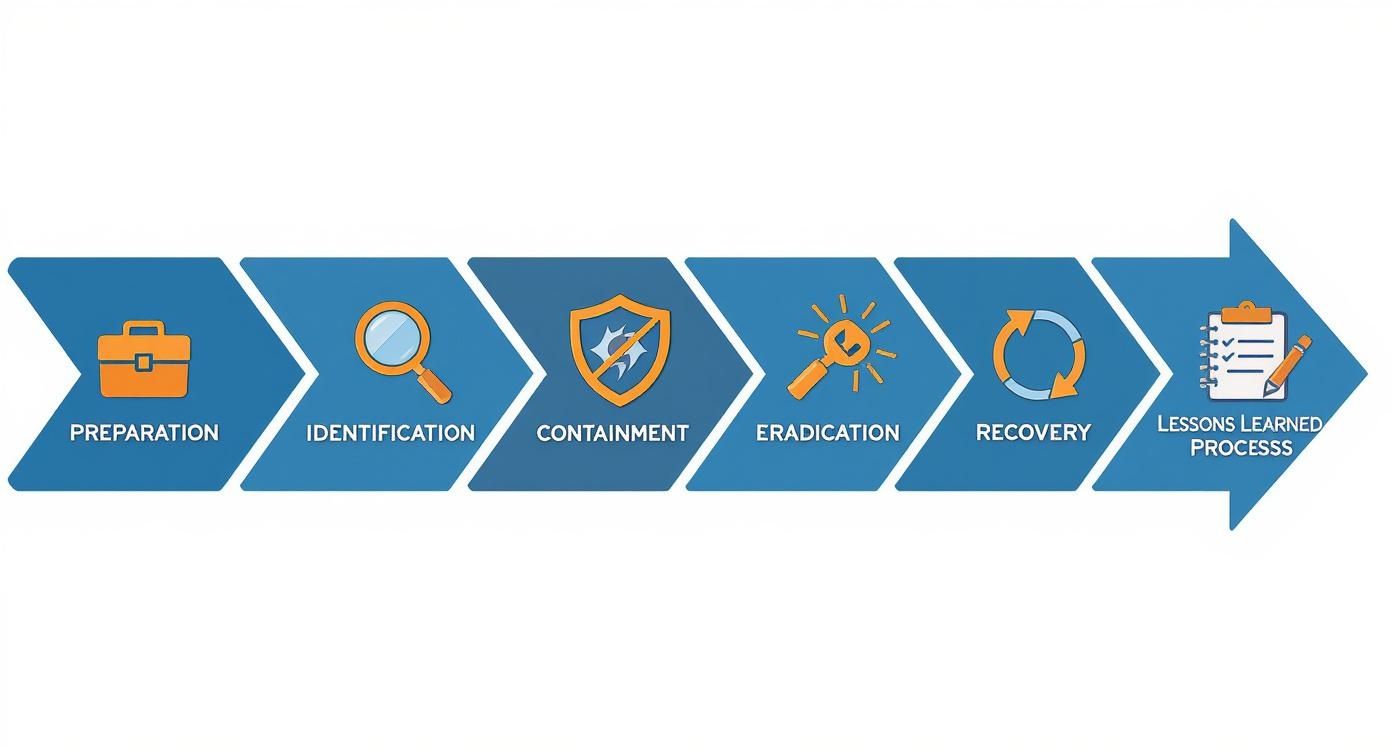
A successful response isn't a single frantic event; it's a structured process.
Defining Key Roles in Your Incident Response Team
For a small Australian business, your Cyber Incident Response Team (CIRT) probably isn't a massive, dedicated department. More often than not, it’s a "virtual team" made up of people who wear multiple hats. That’s perfectly fine. The crucial part is that these roles are formally assigned and understood long before you ever need them.
Here are the core players you need to designate:
-
Incident Commander: This is your field general. They have the final say during an incident, making the critical decisions and coordinating the team’s efforts. They don’t have to be the most technical person in the room, but they must be the ultimate decision-maker.
-
Technical Lead: This is your hands-on expert, deep in the trenches. They lead the technical investigation, containment, and eradication, digging through logs, figuring out the scope of the breach, and guiding the IT team to kick the threat out and restore systems.
-
Communications Lead: A data breach rattles more than just your network; it shakes customer trust. The Comms Lead manages every message, both internal and external. Their job is to keep everyone—from your staff and customers to regulators—in the loop with clear, accurate updates.
-
Legal/Compliance Advisor: This person ensures every action you take lines up with your legal and regulatory duties. For any Aussie business, this is absolutely vital for navigating the Notifiable Data Breaches (NDB) scheme and sticking to ISO 27001 requirements.
Many smaller businesses find it’s a smart move to bring in outside help. It’s worth taking a moment to understand what a cyber security consultant does and how they can plug critical gaps in your team, especially for the highly specialised Technical Lead or advisory roles.
Using a RACI Matrix for Absolute Clarity
Defining roles is the first step, but how do they connect to specific tasks during an emergency? This is where a RACI matrix proves its worth.
RACI stands for Responsible, Accountable, Consulted, and Informed. It's a simple but powerful chart that wipes out confusion and makes sure nothing falls through the cracks.
The RACI matrix is the ultimate antidote to the dreaded phrase, "I thought someone else was handling that." In a crisis, that kind of ambiguity is a killer. It forces you to pre-assign ownership for every single critical task.
Imagine the task is "Isolate affected systems." The Technical Lead would be Responsible (they do the work), but the Incident Commander is Accountable (they own the outcome). The Comms Lead might be Consulted on the customer impact, while the leadership team is kept Informed of the action.
This simple exercise ensures there’s zero guesswork about who does what when the clock is ticking.
To help you get started, we've put together a sample RACI matrix. You can use this as a model when customising your own incident response plan.
Sample Incident Response Team RACI Matrix
| Task | Incident Commander (A) | Technical Lead (R) | Comms Lead (C) | Legal (I) |
|---|---|---|---|---|
| Declare an Incident | Accountable | Consulted | Informed | Informed |
| Isolate Affected Systems | Accountable | Responsible | Consulted | Informed |
| Analyse Forensic Data | Informed | Responsible | Informed | Consulted |
| Draft Customer Notification | Accountable | Consulted | Responsible | Consulted |
| Report to the OAIC | Accountable | Informed | Consulted | Responsible |
| Conduct Post-Incident Review | Accountable | Responsible | Consulted | Consulted |
As you can see, this simple grid provides an at-a-glance view of who needs to do, own, advise on, or be aware of every critical step.
Mapping Your Communications Strategy
Fumbling your communications can inflict just as much reputational damage as the breach itself. Your plan needs to be incredibly specific about who to contact, when, and what to say.
Internal Communications
Your own people are your first line of defence. They need clear instructions from the get-go.
- Initial Alert: An immediate, straight-to-the-point notification to activate the CIRT.
- All-Staff Briefing: A simple, high-level update for everyone else. Reassure them, give them clear instructions (e.g., "do not speak to the media"), and tell them who to forward inquiries to.
External Communications
Controlling the external narrative is non-negotiable for protecting your brand.
- Customers: If their data has been compromised, you must communicate with them quickly and transparently. Your plan should have pre-approved message templates ready to go. Honesty, even when it's tough, is what rebuilds trust.
- Regulators: As an Australian business, your obligations under the NDB scheme are set in stone. Your plan must detail the process for assessing a breach and the exact steps for reporting to the Office of the Australian Information Commissioner (OAIC).
- Suppliers and Partners: Think about key partners who might be affected. They may need to be informed if the incident could impact their own operations.
By building a strong team with crystal-clear roles and a battle-tested communications plan, you turn your incident response document from a static file into a dynamic, human-powered defence mechanism ready to act decisively.
Aligning Your Plan with Australian Regulations
Let’s be honest: compliance can feel like a box-ticking exercise. But when a real cyber incident hits, it’s the shield that protects your business from serious legal and financial pain. A solid incident response plan isn’t just about having the right technical steps; it’s about making sure your actions are legally defensible. For any Australian business, this means getting to grips with two key frameworks: the global gold standard, ISO 27001, and our own national laws.
Thinking about this upfront is a game-changer. When you build your plan around these standards, you're not just preparing for a crisis—you're demonstrating maturity and diligence to customers, partners, and regulators. It turns a potential compliance headache into a genuine competitive advantage.
Meeting ISO 27001 Incident Management Controls
If you want to prove you’re serious about protecting data, ISO 27001 is the international benchmark for an Information Security Management System (ISMS). Getting certified tells the world you mean business, and a huge part of the standard is dedicated to how you handle security incidents.
ISO 27001 doesn't just ask if you have a plan. It demands a formal, structured approach to incident management. The key controls in Annex A are non-negotiable and require you to:
- Define Responsibilities and Procedures: You must have everything documented, with clear roles assigned for managing incidents. No grey areas allowed.
- Report Events: There needs to be a straightforward way for any staff member to flag security events and weaknesses the moment they spot them.
- Assess and Decide: You need a consistent method to evaluate security events and determine if they cross the line into an official "incident."
- Respond to Incidents: A documented process for responding, containing the threat, and getting back on your feet is mandatory.
- Learn from Incidents: You're expected to collect evidence and conduct a proper post-incident review to make sure it doesn't happen again.
Our template was built from the ground up with these controls in mind, giving you the structure to satisfy auditors and build a truly resilient system. For a deeper look into the certification journey, our guide on achieving ISO 27001 compliance has all the details.
As you can see, ISO 27001 isn't just an IT checklist. It's a holistic management framework that helps organisations of any size protect their information assets in a systematic way.
Navigating the Notifiable Data Breaches Scheme
Beyond international standards, Australian businesses have very specific legal duties under the Privacy Act 1988. The big one is the Notifiable Data Breaches (NDB) scheme, which is overseen by the Office of the Australian Information Commissioner (OAIC). Get this wrong, and you could be facing some hefty penalties.
Your incident response plan must have a dedicated section for dealing with potential data breaches under this scheme. This isn't a "nice-to-have"—it's the law.
At its heart, the NDB scheme is all about transparency. If a data breach is likely to cause serious harm to the people whose personal information is involved, you are legally obligated to tell them and the OAIC. Your plan has to be ready to kick this process off without a moment's delay.
To stay on the right side of the law, your plan needs to guide your team to answer three critical questions the second you suspect personal information is compromised:
- Is a breach confirmed? You need to quickly work out if personal information has been accessed or disclosed without authorisation.
- Is serious harm likely? This is the crucial test. You have to evaluate the odds of financial loss, reputational damage, or even emotional distress for the people affected.
- Can we take remedial action? Is there anything you can do right now to prevent that serious harm from happening? If so, you might not need to notify.
If the answer to the first two questions is "yes" and the third is "no," you've got a notifiable breach on your hands. From the moment you become aware of the breach, your plan must trigger a strict reporting timeline. You have just 30 days to complete your assessment and, if required, notify the OAIC and the affected individuals. That tight deadline is precisely why having a pre-defined plan is absolutely essential.
For expert guidance, the Australian Cyber Security Centre (ACSC) provides a fantastic incident response plan template used by organisations all over the country. It covers vital areas like authority, roles, incident classification, and communication protocols, reinforcing why a standardised approach is so important. You can discover more about the ACSC's framework and download their template. By baking these legal duties directly into your own incident response plan, you ensure your response is not just fast, but fully compliant.
How to Test and Maintain Your Response Plan

Putting an incident response plan on paper is a great start, but that's all it is—a start. An untested document gathering dust on a server is a risk you simply can’t afford. This is where theory meets reality, where your plan evolves from a static file into a dynamic, battle-ready strategy your team can actually execute under immense pressure.
Let’s be honest, a plan that hasn't been tested is just a collection of hopeful assumptions. It's time to move beyond theoretical discussions and put your plan through its paces with real-world testing. This is the only way to ensure everyone knows their role, communication flows without a hitch, and your technical procedures work as expected.
Running a Ransomware Tabletop Exercise
The single most effective way to find the cracks in your plan is to run a crisis simulation in a controlled setting. A tabletop exercise is essentially a guided walk-through of a realistic incident. It’s designed to pressure-test your procedures, decision-making, and teamwork without any of the real-world chaos.
Here’s a scenario you can run with your team this week.
The Scenario: Someone in the finance team clicks a malicious link in a very convincing phishing email. Suddenly, ransomware starts encrypting files on the main company server, and a ransom note flashes up on their screen.
Now, get your Cyber Incident Response Team (CIRT) in a room and walk through the entire incident using your plan as a script. You need to ask some hard questions at each stage:
- Identification: Who gets the first frantic call from the user? How quickly is the CIRT actually assembled and ready to act?
- Containment: What’s the very first thing the Technical Lead does? Do they have the admin access they need to isolate that server from the network right now?
- Communication: Who does the Communications Lead notify first? What’s the initial message to all staff to prevent panic? At what point do you need to think about calling customers or the OAIC?
- Eradication & Recovery: How can you be 100% sure the ransomware is gone? What are the exact steps to restore from backups, and do you know who to call if those backups fail?
A tabletop exercise isn't about passing or failing; it's about discovery. The goal is to find the gaps, the outdated contacts, and the flawed assumptions that will absolutely cripple your response in a real emergency. Every weakness you find in a simulation is a major crisis you’ve just prevented down the track.
An exercise like this will quickly tell you if your plan is practical or just paper. It shines a bright light on whether people truly understand their roles or if there's confusion about who has the final say.
Establishing a Simple Maintenance Schedule
Your business is always changing, and so are the threats you face. Your incident response plan has to be a living document, constantly updated to reflect changes in your people, processes, and technology. A simple, consistent maintenance schedule is non-negotiable.
Think of it like getting your car serviced. You don't wait for it to break down on the motorway to check the oil. Regular check-ups keep it reliable and ready to go.
This rhythm of review and refinement ensures your plan remains a genuinely useful tool instead of an obsolete relic. It's a small investment of time that pays off enormously when a crisis hits. This proactive approach to readiness is a cornerstone of resilience, aligning perfectly with the principles in a solid business continuity strategy template.
Key Maintenance Tasks
Here's a straightforward schedule you can adopt to keep your plan sharp and effective.
Quarterly Checks (Every 3 months)
- Update Contact Lists: This is critical. People leave, and roles change. Verify every phone number and email for your CIRT, key executives, third-party vendors, legal counsel, and your cyber insurance provider. A wrong number at 2 AM can cause catastrophic delays.
- Review Your Tech Stack: Have you brought in new security tools or retired old software? Your plan must reflect the technology your team is actually using today, not six months ago.
Annual Deep-Dive Review (Once a year)
- Full Plan Read-Through: The Incident Commander should lead the entire CIRT in a complete review of the document, page by page.
- Assess Against New Threats: Look at the latest attack trends. Does your plan properly address the new wave of sophisticated phishing, AI-driven social engineering, or supply chain attacks?
- Incorporate Lessons Learned: Review the findings from any real incidents or tabletop exercises from the past 12 months. Integrate those hard-won lessons directly into your procedures.
This commitment to continuous improvement is what transforms your plan from just another document into a core part of your company's resilience. It ensures that when—not if—an incident happens, your team is ready to respond with confidence and control.
Your Incident Response Questions Answered
Even with a solid template in hand, putting together an incident response plan always brings up a few questions. That’s perfectly normal. It’s a complex area, and getting the details right is what turns a document into a real-world tool that works under pressure.
Let’s tackle some of the most common questions I hear from business owners and managers. These are the practical points that will help you build a plan that truly protects your organisation when things go sideways.
How Often Should We Actually Test Our Incident Response Plan?
This is probably the most important question on the list, and my answer is always: more often than you think.
For most small businesses, running a tabletop exercise at least twice a year is the sweet spot. It's frequent enough to keep the plan fresh in everyone’s minds and build that crucial muscle memory, but not so often that it becomes a huge drain on your team's time.
A simple tabletop discussion, where you walk through a scenario like a ransomware attack or a serious data leak, is incredibly powerful. You'd be amazed at the gaps you can uncover in just a couple of hours simply by talking through the steps.
On top of that, you need to schedule a full, deep-dive review of the entire document once a year. This is your chance to update contacts, account for new systems you've brought online, and make sure your plan reflects the latest threats you’re seeing out in the wild.
This rhythm of semi-annual testing and an annual review creates a powerful cycle of improvement.
What Is The Single Biggest Mistake People Make with Their Plan?
Easy. It's the "set it and forget it" mentality. I've seen it time and time again. A business puts in the effort to create a great plan, files it away, and breathes a sigh of relief. But creating the plan is only about 20% of the job.
The other 80% is the ongoing work: the testing, the training, and the maintenance.
An out-of-date plan is almost worse than no plan at all because it gives you a false sense of security. Imagine the chaos at 2 AM when you discover the emergency contact for your IT provider is a guy who left the company six months ago. That’s not a theory; it happens.
The goal of an incident response plan isn't just to have a document; it's to build a capability. That capability only exists if the plan is current, the team knows their role, and the procedures have been stress-tested.
An untested plan is just a good idea. A regularly tested one is a genuine business asset.
If We Have Cyber Insurance, Do We Still Need a Plan?
Absolutely, 100%. This is a massive point of confusion for many business owners. Think of it this way: they are two completely different tools that work together.
Your incident response plan is your fire drill and your fire extinguisher. It’s what you use to contain the incident and minimise the damage while the fire is burning.
Cyber insurance is what helps you pay for the repairs and recovery after the fire is out.
In fact, insurers are increasingly demanding to see evidence of a well-maintained incident response plan before they’ll even offer you a policy. Many will even offer better premiums to businesses that can show they are actively testing their plan. It proves you’re a lower-risk client, and they love that.
Where Is the Best Place to Store the Incident Response Plan?
The golden rule is this: your plan must be accessible even when your entire network is down. Storing your only copy on the company file server is a recipe for disaster. If that server gets hit with ransomware, your guide to recovery will be encrypted along with everything else.
You need redundancy. Store it in multiple, secure locations—both digital and physical.
- Secure Cloud Storage: Use a dedicated, secure cloud folder that's separate from your main operational network. This could be a specific SharePoint site, a Google Drive folder, or another service with tightly controlled access permissions.
- Printed Hard Copies: Never, ever underestimate the power of paper in a crisis. When the power is out and the internet is down, a printed copy is priceless. Key members of your Cyber Incident Response Team (CIRT) should have a hard copy stored somewhere safe and accessible, like at home or in a secure office locker.
When a real incident hits, you won't have time to go searching. You need to be able to grab your playbook and get to work immediately, no matter what.
Ready to build a resilient defence against cyber threats? At Anitech, we specialise in helping Australian businesses achieve ISO 27001 certification with a 100% success rate. Let our 20 years of experience simplify the process and give you the peace of mind that comes with a robust Information Security Management System. Find out how we can help your business get ISO 27001 certified.
Recent Comments