

Quick Summary: An incident response plan is a documented strategy detailing how your business will handle a security breach. It outlines specific steps for identification, containment, and recovery to minimise damage, reduce downtime, and ensure regulatory compliance. For Australian businesses, a robust plan is essential for survival and maintaining customer trust.
An effective incident response plan is your organisation's predefined playbook for a cyberattack or security breach. It’s a detailed document that spells out exactly who does what, when, and how—from the moment you suspect something is wrong until you’re fully recovered. This structured approach is designed to turn a high-stress, frantic situation into a manageable and methodical process.
Without a plan, chaos tends to take over. Teams scramble, precious time is wasted, and the threat has more opportunity to do serious damage. It's the difference between a controlled fire drill and a stampede.
A well-crafted plan is the very foundation of your cyber resilience. It’s what helps you:
- Drastically reduce operational downtime and financial bleeding.
- Protect the hard-won trust you’ve built with your customers.
- Meet your legal and regulatory compliance duties, like those under the Privacy Act.
Ultimately, it’s not about foolishly thinking you can prevent every single attack. It's about being smart enough to ensure you can withstand one when it inevitably comes.
Why Your Business Needs an Incident Response Plan
For too long, small businesses have treated cybersecurity incidents as something that happens to other companies. They operate on a 'hope for the best' strategy, and when a breach hits, it’s pure chaos. This reactive approach is no longer just a bit risky—it’s a direct flight path to financial and reputational ruin.
Waiting for an attack to decide how you'll respond is like trying to learn how to use a fire extinguisher while the building is burning down around you. It just doesn't work.
The reality of today’s threat landscape demands a complete shift in mindset, from reaction to readiness. A proper incident response plan is what turns a full-blown crisis into a structured, manageable process. It’s your roadmap for minimising downtime, protecting customer data, and safeguarding the trust you've spent years building. Without one, you’re essentially gambling with the future of your business.
The Real-World Cost of Being Unprepared
The fallout from a poorly handled incident goes way beyond the initial financial hit. Picture this: a ransomware attack locks up every single one of your critical files. Without a plan, your team descends into panic. Operations grind to a halt. Every hour that ticks by is another hour of lost revenue and eroding customer confidence. You're not just losing money; you're losing your place in the market.
Let's break down the tangible impacts:
- Crippling Financial Losses: This isn’t just about paying a ransom. It’s the lost revenue from being offline, the potential for hefty regulatory fines, and the inevitable legal fees that follow.
- Severe Reputational Damage: Word of a breach gets out fast, and customer trust can evaporate overnight. A clumsy response can permanently tarnish your brand, sending clients straight to your competitors who look like a safer bet.
- Operational Paralysis: When your systems are down and nobody knows what to do, your business simply stops. This paralysis can drag on for days, sometimes even weeks, causing damage that's impossible to undo.
The Australian threat landscape is only getting worse. A recent report from the Australian Signals Directorate (ASD) revealed they responded to over 1,200 cyber security incidents in 2025 alone—an 11% jump from the year before. For small businesses, the average self-reported cost of a single cybercrime incident has ballooned to $56,600. It's a stark reminder that the unprepared suffer the most. You can get the full picture by reading the ASD Cyber Threat Report 2025.
More Than Just Defence: It’s About Compliance and Trust
For any Australian business, the stakes are even higher thanks to the Notifiable Data Breaches (NDB) scheme, part of the Privacy Act 1988. If you fail to manage and report a data breach correctly, you’re looking at serious penalties. An incident response plan isn't just good business practice anymore; it's a non-negotiable part of staying compliant.
An ISO 27001-aligned incident response plan isn't just a defensive shield—it’s a competitive advantage. It tells partners, clients, and regulators that you take security seriously, making you a more trusted and reliable choice in a crowded market.
Having a well-documented and regularly tested plan is proof of due diligence. It shows you have a mature, professional process for protecting sensitive information, and that’s a powerful differentiator. When a potential client is weighing you up against a competitor, evidence of a robust security posture can be the very thing that gets you the contract.
Ultimately, this commitment to security turns your investment into a real business asset, building the kind of long-term resilience and trust that keeps you ahead of the game.
Building Your Incident Response Framework
Alright, you understand why you need an incident response plan. Now, let’s get our hands dirty and build one that actually works when things go sideways. A documented plan is the backbone of your cyber resilience; it’s what turns panicked scrambling into a calm, methodical response.
The goal here isn't to create a dusty document that just ticks a compliance box. We’re building a living, breathing framework that gives your team the confidence to act decisively when a security event hits. This means getting the right people in the room, setting up crystal-clear lines of communication, and mapping out exactly what to do for the threats you’re most likely to face.
Assembling Your Incident Response Team
First things first: you need to establish your Incident Response Team (IRT). And let me be clear, this is not just an IT problem. A real security incident ripples through the entire business, so your team needs to reflect that. It should be a cross-functional group with experts from different departments who can bring their unique perspectives to the table.
Think of them as your business’s emergency services crew. You’ve got the technical experts who fight the fire, the legal and HR folks who provide triage and care, and the leadership team who manage the scene and communicate with the public.
To make this concrete, here’s a breakdown of the key roles you'll want to assign. Getting this structure right from the start is crucial for a coordinated and effective response.
Key Roles Within Your Incident Response Team
| Role | Primary Responsibilities | Reports To |
|---|---|---|
| Incident Response Manager | Leads and coordinates the entire response effort, makes critical decisions, and acts as the central point of command. | Executive Leadership |
| Security Analyst | Performs the technical heavy lifting—investigating the breach, analysing logs, and identifying the root cause. | Incident Response Manager |
| IT/Infrastructure Lead | Executes containment and recovery actions, such as isolating systems, restoring from backups, and applying patches. | Incident Response Manager |
| Legal & Compliance Officer | Advises on legal obligations, regulatory reporting (like the NDB scheme), and potential liabilities. | Executive Leadership |
| Communications Lead | Manages all internal and external communications, ensuring a clear, consistent message to stakeholders, customers, and staff. | Executive Leadership |
| Human Resources Manager | Handles internal employee communications, addresses staff concerns, and manages any insider threat-related issues. | Executive Leadership |
Defining these roles ahead of time means that when an incident occurs, everyone knows their job and who to report to, eliminating confusion when every second counts.
Developing Communication Protocols
In the middle of a crisis, rumours and panic can spread faster than the incident itself. They are your worst enemies. That's why a clear, pre-approved communication protocol is non-negotiable. It keeps you in control of the narrative and makes sure the right people get the right information at the right time. Your plan has to separate how you talk to your own team versus how you talk to the outside world.
For organisations looking to build this kind of robust structure, aligning with a proven framework is a smart move. A practical guide to ISO 27001 ISMS certification can provide the blueprint you need, ensuring your protocols meet international standards.
Internal Communications:
- The Initial Alert: How does the IRT get activated? Who has the authority to pull the alarm?
- Status Updates: Set a regular rhythm for updates to leadership and affected employees. Crucially, use a secure, out-of-band channel (like a dedicated Signal or WhatsApp group) in case your primary email and messaging systems are down or compromised.
- Employee Guidance: Give all staff clear, simple instructions on what to do and, more importantly, what not to do—especially when it comes to talking to anyone outside the company.
External Communications:
- Customer Notifications: Don't write these from scratch under pressure. Have draft templates ready that are transparent and provide clear next steps for anyone affected.
- Regulatory Reporting: Know your obligations under the Notifiable Data Breaches (NDB) scheme inside and out. Have a process ready for reporting to the Office of the Australian Information Commissioner (OAIC).
- Media Statements: Prepare holding statements you can use immediately if the incident goes public. This ensures your first message is calm, consistent, and professional.
There's a startling gap in Australia's cyber defences. While a commendable 90% of Commonwealth entities had an incident response plan in 2025, many small businesses are still lagging. This leaves them dangerously exposed to the 47 million data breaches reported in 2024 alone. This contrast shows just how badly an inadequate plan can lead to chaos and bigger losses. You can read more in the Commonwealth Cyber Security Posture report.
Creating Practical Incident Playbooks
A high-level response plan is a good start, but what makes it truly effective are specific, actionable playbooks for the threats you're actually likely to encounter. These are your detailed, step-by-step guides for handling particular types of incidents.
Think of playbooks as your emergency checklists. When you’re hit with a ransomware attack, the last thing you want is to be making up the procedure as you go. You need a clear, well-rehearsed set of actions to fall back on.
Start by creating playbooks for the most common scenarios that could target a business like yours:
- Ransomware Attack Playbook: This should cover immediate actions like isolating infected machines to stop the bleeding, steps for evaluating if your backups are viable, and a firm policy on paying the ransom (official advice is a hard no).
- Phishing and Business Email Compromise (BEC) Playbook: This playbook needs to outline exactly how to handle a compromised email account. It should include locking down the account, resetting credentials, checking for malicious mail rules, and notifying contacts so the attack doesn't spread further.
- Data Breach Playbook: This guide is all about damage assessment and management. It needs to focus on identifying precisely what data was stolen, which systems were hit, and how to kick off the notification process your legal and compliance teams require.
Each playbook should be a simple, no-nonsense document that anyone on the IRT can grab and follow, even when the pressure is on. To get a head start, you can use a proven structure like our incident response plan template to build out your playbooks. It'll help you create a framework that’s not just compliant, but genuinely battle-ready.
Navigating a Security Incident Step By Step
When a security incident hits, your biggest enemy isn't the attacker—it's the chaos that follows. A structured, methodical approach is the only way to contain the damage and steer your business through the storm. At the heart of any effective incident response plan is a clear, step-by-step process that guides your team from the first alert to the final lessons learned.
This process, which often lines up with frameworks from NIST and is a must for ISO 27001, ensures nothing critical gets missed when the pressure is on. It’s all about moving with purpose, not panic.
The following infographic lays out the fundamental building blocks of a prepared response, zeroing in on getting the right team, protocols, and playbooks in place first.
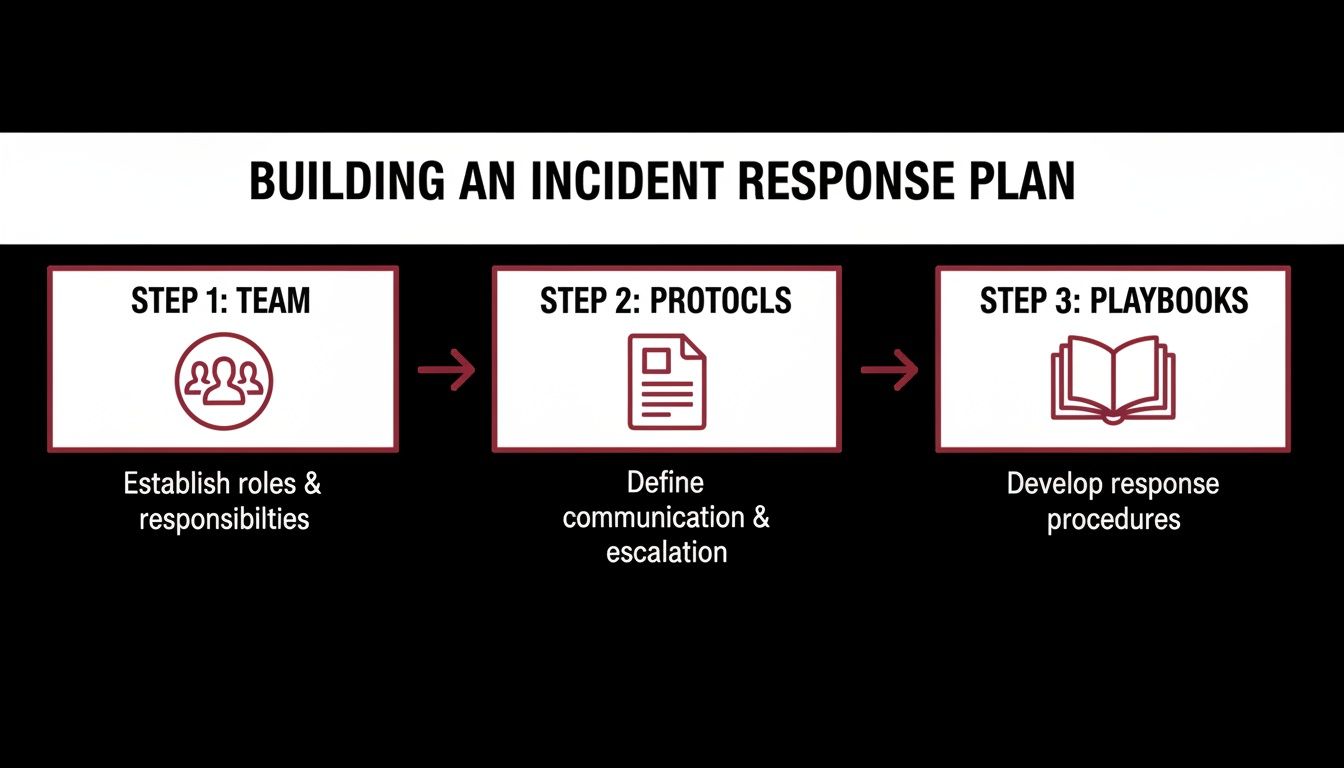
As you can see, a successful response is built long before an incident ever happens. It starts with a clear focus on your people, your processes, and your predefined actions.
Detection And Analysis: The Triage Phase
This is where the clock starts ticking. The whole point of the Detection and Analysis phase is to quickly figure out if a potential security event is real and understand just how bad it is. It's a critical triage process where your team has to separate genuine threats from the constant noise of false positives.
Your security tools—firewalls, endpoint detection, and SIEM systems—are going to be throwing alerts at you. The real skill is knowing which ones demand immediate attention.
Here’s what you need to do:
- Validate the Alert: First, confirm the suspicious activity is a real incident. Is it a genuine threat, or just a system misconfiguration or a harmless anomaly?
- Assess the Impact: Work out which systems, data, and users are affected. You need to know if you're dealing with a single compromised laptop or a widespread ransomware infection that’s tearing through your network.
- Classify Severity: Assign a severity level (like Low, Medium, High, or Critical) to prioritise the response. A critical incident that grinds your business to a halt needs an all-hands-on-deck approach, right now.
This initial analysis sets the stage for everything that comes next. If you rush it or get it wrong, your containment strategy will be flawed, giving the threat more time to spread.
Containment: Stop The Bleeding
Once you've confirmed an incident and have a handle on its initial scope, the immediate priority is to stop it from getting worse. Containment is all about isolating the affected systems to prevent the attacker from digging deeper into your network or stealing more data.
Think of it like quarantining a sick patient to prevent an outbreak. You have to act fast, but you also have to be smart about it.
Effective containment usually involves a mix of short-term fixes and longer-term strategies:
- Short-Term Containment: This is your immediate reaction. It could be unplugging an infected server from the network, disabling a compromised user account, or blocking a malicious IP address at the firewall.
- Long-Term Containment: This is about applying temporary fixes that let critical systems stay online in a limited way while you develop a full remediation plan.
The toughest call during containment is balancing security with business continuity. Taking a key sales server offline might stop the attack cold, but it also stops your revenue. Your plan must be crystal clear on who has the authority to make these difficult decisions.
Eradication And Recovery: The Clean-Up
With the immediate threat contained, the focus shifts to wiping it out completely and getting your operations back up and running safely. Eradication and Recovery go hand-in-hand, and you have to be meticulous to avoid getting reinfected.
Don't make the mistake of thinking a simple restore from a backup is enough. If the vulnerability that let the attacker in is still there, you're just setting yourself up for round two.
Eradication is the deep clean of your systems. It means:
- Scrubbing all traces of malware and any backdoors the attacker left behind.
- Patching the security vulnerability that was exploited in the first place.
- Conducting forensic analysis to truly understand the root cause.
Recovery is the careful process of bringing systems back online. This involves:
- Restoring your data from backups that you know are clean.
- Monitoring systems like a hawk for any signs of lingering malicious activity.
- Gradually reintroducing systems to the network to ensure everything is stable.
Post-Incident Activity: The Lessons Learned
This final phase is arguably the most important for building long-term resilience, and it's a core part of the continuous improvement principle in ISO 27001. An incident isn't really over until you’ve learned from it.
You need to hold a post-incident review, or a post-mortem, within a week or two of resolving the issue. This meeting isn't about pointing fingers. It's a blameless forum for honestly assessing what went right, what went wrong, and where you can improve.
This review should lead to a formal report that documents:
- A detailed timeline of events.
- The root cause of the breach.
- How effective (or ineffective) your response was.
- Clear, actionable recommendations to strengthen your security.
Turning those recommendations into concrete actions is what transforms a crisis into a powerful catalyst for getting better. For a practical playbook, this guidance on what to do after a data breach covers everything from containment to the post-incident review. This is how you make sure the same mistake doesn't burn you twice.
Keeping Your Response Plan Battle-Ready
An untested incident response plan is little more than a theory on paper. It's a collection of well-meaning assumptions about how your team will perform under immense pressure. To turn that document into a genuinely reliable tool that protects your business, you have to treat regular, rigorous testing as non-negotiable.
This isn’t about ticking a box for compliance. Think of it as forging your plan in a simulated fire. Testing is where you uncover the hidden flaws—the outdated contact lists, the unrealistic procedures, the technical glitches—before a real attacker does. It builds muscle memory, sharpens decision-making, and gives your team the confidence to act without hesitation when every second counts.

Practical Testing Methods You Can Actually Use
You don't need a Hollywood-style cyber range to test your plan effectively. For most small businesses, practical and scalable methods are far more valuable. The real trick is choosing the right kind of drill for your team's current maturity and the resources you have on hand.
I've seen companies jump into full-blown simulations before they've even nailed the basics, which just leads to frustration. It's better to start simple and build up.
Let's look at a few common methods to help you pick the best starting point for your organisation.
Choosing the Right Test for Your Incident Response Plan
This table breaks down the most common testing methods, helping you select an approach that aligns with your team's experience and available resources.
| Testing Method | Description | Resource Intensity | Best For |
|---|---|---|---|
| Walkthrough | A simple review where the team reads through the plan section by section to check for clarity and accuracy. | Low | New teams or as a first step after a plan update. |
| Tabletop Exercise | A discussion-based session where the team talks through a simulated incident scenario, like a data breach, in a meeting room. | Medium | Testing decision-making, communication flows, and roles without touching live systems. |
| Simulation | A more hands-on test where the team responds to a simulated attack in a controlled environment, often using real tools. | High | Validating technical procedures, tool effectiveness, and the team's hands-on skills. |
The key is to match the test to your goals. A walkthrough is perfect after a major plan revision, while a tabletop exercise is fantastic for getting different departments (like legal and PR) on the same page.
Designing Realistic and Relevant Scenarios
The secret to a valuable test is a scenario that feels real. Generic, textbook examples simply won't do. Your scenarios must be tailored to your specific business, your technology, and the actual threats you're most likely to face here in Australia.
So, instead of a vague "malware attack," you need to craft a scenario with specific, believable details that force your team to think on their feet.
Here are a couple of ideas to get you started:
- The Compromised Executive Account: An attacker uses a sophisticated phishing email to gain access to your CEO’s email account just before a long weekend. The goal here is to test how quickly your team can detect unusual activity, contain the compromised account, and manage the internal communications fallout.
- The Insider Data Leak: A disgruntled employee who is leaving the company is caught trying to exfiltrate a large customer database to a personal cloud storage account. This exercise tests your internal monitoring capabilities and your procedures for handling a sensitive insider threat, which must involve HR and legal from the very beginning.
The most effective scenarios are the ones that target your biggest fears. If you're worried about ransomware hitting your main operational server, then that's exactly what you need to simulate. A good test should feel slightly uncomfortable—that's how you know it's working.
Measuring Success with Key Performance Indicators
After each test, you need an honest way to measure how well your team and your plan performed. This isn't about passing or failing; it's about gathering concrete data to drive improvement. Using key performance indicators (KPIs) helps you quantify your response capabilities and track your progress over time.
Focus on these key metrics:
- Mean Time to Detect (MTTD): How long did it take for your team to realise an incident was happening from the moment the simulated attack began? A lower MTTD means you’re spotting threats faster.
- Mean Time to Respond (MTTR): Once detected, how long did it take to start the containment process? This measures the agility and decisiveness of your response team.
- Plan Adherence: Did the team actually follow the documented procedures in the IRP? Where did they deviate, and more importantly, why? Sometimes a deviation points to a flaw in the plan itself.
- Communication Effectiveness: Were the right stakeholders notified at the right times using the correct channels? Clear communication is often the first thing to break down in a real crisis.
Tracking these metrics allows you to pinpoint weaknesses and make data-driven adjustments to your plan. It’s this constant cycle of testing, measuring, and refining that ensures your IRP remains a living, evolving asset. This is particularly crucial when you consider your recovery goals. To get a better handle on this, you can learn more about the differences between Recovery Point Objective and Recovery Time Objective in our detailed guide.
Still Have Questions About Incident Response Plans?
Even with a solid guide in hand, it’s completely normal to have a few lingering questions when you’re building something as important as an incident response plan. I see the same queries pop up time and again from business owners, IT managers, and the folks in charge of compliance. Let's tackle them head-on.
Getting these details right is what turns a plan from a document that just sits on a shelf into a real, living tool that builds your business’s resilience.
How Often Should We Be Testing Our Plan?
This is easily one of the most common—and most critical—questions I get. The short answer is: there's no single magic number. For most Australian businesses, a good starting point is to run a tabletop exercise at least annually. This is your chance to get the core team in a room, walk through a scenario, and make sure everyone knows their role and how to communicate.
Beyond that, you’ll want to schedule a more hands-on technical drill every 18 to 24 months. This is where you actually test your tools and technical procedures to see if they hold up under pressure.
But the plan itself needs a bit more love. It’s a living document, not a historical artefact. I always advise my clients to review and update it:
- Quarterly: Just a quick check-in. Are the contact lists still correct? Are the tools we rely on still in place?
- After any significant change: This is non-negotiable. If you hire a new key person, overhaul your tech stack, or pivot your business model, the plan needs to reflect that new reality.
Remember, a static plan is an outdated plan. It's filled with incorrect phone numbers and faulty assumptions that will only bite you when a real crisis hits.
What’s the Single Biggest Mistake to Avoid?
Hands down, the most damaging mistake is treating the plan as a "set and forget" exercise. It’s so easy to pour effort into creating a beautiful document, get it signed off to tick a compliance box, and then shove it in a digital drawer, never to be seen again. That’s a recipe for disaster.
An untested plan isn't a plan at all; it's just a collection of unverified guesses. It’s almost guaranteed to contain:
- Outdated contact details for the very people you’ll need most.
- Procedures that sound great on paper but are completely impractical in a high-stress situation.
- Assumptions about your technology that simply aren't true anymore.
An untested plan is a mere compliance checkbox; a regularly tested plan is a genuine strategic asset. The former offers a false sense of security, while the latter builds real, measurable resilience that protects your business when it matters most.
These flaws always come out in the wash during a real incident, causing chaos, costly delays, and making a bad situation so much worse.
Will an IRP Guarantee We Won't Suffer Any Damage?
No, and any plan that promises that is selling you a fantasy. The goal of an incident response plan isn’t to make you invincible—it’s to make you resilient.
I like to use a car analogy. A seatbelt and airbags don't guarantee you'll walk away from a crash without a scratch. But what they do is dramatically boost your chances of survival and lessen the severity of your injuries.
Your IRP works the same way. It's there to:
- Drastically reduce the impact and blast radius of an attack.
- Slash your operational downtime and financial losses.
- Protect your hard-earned reputation by ensuring your response is controlled and professional.
Ultimately, a good plan is the difference between a contained, manageable event and a full-blown, business-ending catastrophe.
How Does This Plan Help with Our ISO 27001 Certification?
If you're aiming for ISO 27001 certification, a formal, documented incident response plan isn't optional—it's a must-have. It directly addresses the controls in Annex A.16 of the standard, which is all about information security incident management.
When an auditor comes in, they're going to be looking for hard evidence that you have a mature process for handling security events. You’ll need to prove your plan is:
- Documented: There's an official, approved document that exists.
- Tested: You've run your drills and have the records to show for it.
- Maintained: It's clear the plan is reviewed and updated on a regular basis.
- Understood: Your Incident Response Team actually knows what’s in it and what’s expected of them.
A robust IRP is a cornerstone of your Information Security Management System (ISMS). It's the proof an auditor needs to see that you're truly prepared, which is a massive step towards getting—and keeping—your certification.
Navigating the complexities of ISO 27001 can be challenging, but you don't have to do it alone. At Anitech, we specialise in guiding Australian businesses through every step of the certification process, ensuring your incident response plan meets the highest standards. Build true cyber resilience and gain a competitive edge. Contact us today to learn how we can help you achieve ISO 27001 certification with confidence.
Recent Comments