

At its core, an information security management system certification is more than just a piece of paper. It’s an official, third-party stamp of approval confirming your company’s system for managing sensitive data meets a rigorous, internationally recognised standard. This certification acts as a testament to your organisation's commitment to safeguarding its most critical assets. In an era where data breaches are not a matter of 'if' but 'when', having a certified ISMS demonstrates a proactive and systematic approach to security.
Think of it as concrete proof that your business isn’t just saying it protects client data, intellectual property, and other vital information—it has a robust, systematic approach to fending off cyber threats and preventing breaches. The gold standard here is, without a doubt, ISO 27001. This standard provides a comprehensive framework for establishing, implementing, maintaining, and continually improving an ISMS. It's not a prescriptive list of tools to buy, but a risk-based methodology that allows each organisation to tailor its security controls to its specific context, needs, and threat landscape. This flexibility is what makes it so powerful and universally applicable, from small startups to multinational corporations. The certification process itself is a rigorous journey that forces an organization to look deeply at its processes, identify its weaknesses, and build a culture of security from the ground up.
Why ISMS Certification Is Your Ultimate Business Shield
Picture your company’s data as a vault filled with priceless jewels. This vault contains everything from confidential client information and financial records to proprietary source code and strategic business plans. An Information Security Management System (ISMS) is the detailed blueprint for that vault—it outlines every security measure, from the thickness of the walls and the types of alarms to the access control procedures and the response plan for an attempted break-in. It's a holistic system that encompasses people, processes, and technology, all working in concert to protect your most valuable assets.
But how do your clients, partners, and stakeholders know that your blueprint is solid and the vault is truly secure? How can they be sure you've considered all the angles, from insider threats to sophisticated external attacks?
That’s exactly where information security management system certification comes in. It’s the independent inspection, the official seal of approval from a qualified, accredited third party that proves your vault isn't just designed well, but is genuinely built to be impenetrable. This external validation is what elevates your security posture from a mere internal policy to an internationally recognized mark of excellence. It moves the conversation from "we believe we are secure" to "an independent expert has confirmed we are secure," a far more powerful statement in any business negotiation or client relationship.
The Core Pillars of Information Security
An effective ISMS is built to uphold three non-negotiable principles of information security, often known as the "CIA triad". These three pillars form the bedrock of any robust security program. Getting certified turns these abstract goals into a concrete, auditable reality by forcing you to implement specific controls and processes designed to maintain each one.
- Confidentiality: This is all about making sure sensitive information is only accessible to authorised people. It's the principle of need-to-know. Certification proves you have the right controls in place—like strong access controls, encryption for data at rest and in transit, and non-disclosure agreements—to stop data leaks and shut out prying eyes. It demonstrates that you have a systematic way of classifying data and ensuring it's only seen by those with a legitimate business reason.
- Integrity: This means keeping your data accurate and complete, and ensuring it can be relied upon. It shows that your information hasn't been secretly tampered with or altered improperly, either maliciously or accidentally. Controls that support integrity include version control, data validation checks, and cryptographic hashing. Certification provides assurance that you have mechanisms to detect and prevent unauthorized modifications to your critical data.
- Availability: This guarantees that authorised users can get to the information and systems they need, when they need them. It’s proof that your systems are resilient and can handle disruptions, whether from a hardware failure, a natural disaster, or a denial-of-service attack. This is achieved through measures like system redundancy, regular backups, and a well-tested disaster recovery plan.
When you achieve certification, you're formally demonstrating that your organisation’s security strategy systematically addresses these three pillars. It’s a powerful, proactive statement about your commitment to data protection. You are not just protecting data; you are ensuring the trustworthiness and reliability of your entire operation.
An ISMS brings together all the policies, procedures, and controls needed to protect the confidentiality, integrity, and availability of your information. It’s a whole-of-business, risk-based approach that involves your people, your processes, and your technology.
From Compliance Headache to Competitive Advantage
Let’s be honest—many businesses first look at certification as just another complex compliance box to tick, a costly and time-consuming hurdle imposed by demanding clients or regulators. But that view misses the bigger, more strategic picture entirely. Framing it as a mere compliance exercise is a surefire way to undervalue one of the most powerful business-enabling initiatives you can undertake.
Achieving a certification like ISO 27001 is a game-changing business move. It builds a solid foundation for trust, opens doors for growth, and makes your business far more resilient. It forces a fundamental shift in your security posture from reactive to proactive.
Instead of scrambling to put out fires after an attack—dealing with the financial fallout, reputational damage, and regulatory fines—a certified ISMS gives you a framework for constantly finding, assessing, and dealing with risks before they can do any damage. You move from a state of crisis management to one of disciplined risk management. This systematic approach is crucial for long-term business health, with certification strengthening your overall compliance posture across the board, making it easier to meet other regulatory requirements like GDPR or the Australian Privacy Act.
For a clearer picture, here’s a quick summary of the primary advantages your organisation gains with an ISMS certification.
Key Benefits of ISMS Certification
| Benefit Category | Impact on Your Business |
|---|---|
| Client Trust & Credibility | Demonstrates a verifiable commitment to security, giving clients and partners confidence in your ability to protect their data. It answers their security questionnaires before they're even sent. |
| Competitive Edge | Sets you apart from competitors, especially for contracts that require proven security standards. It can be the deciding factor in winning tenders and securing new business. |
| Risk Management | Proactively identifies and mitigates security risks, reducing the likelihood and impact of breaches. This leads to lower insurance premiums and fewer unexpected costs. |
| Regulatory Compliance | Provides a structured framework to meet legal, statutory, and contractual security requirements, simplifying audits and reducing the risk of fines. |
| Business Resilience | Improves your ability to withstand and recover from security incidents, ensuring operational continuity and protecting your revenue streams. |
| Improved Culture & Processes | Instills a security-aware culture across the entire organisation, leading to better internal processes, reduced human error, and greater operational efficiency. |
Ultimately, these benefits work together to create a more robust, reputable, and successful business. The initial investment in certification pays dividends for years to come, not just in avoided losses but in tangible business growth.
Building Unbreakable Client Trust
In today's market, trust is your most valuable currency. A single data breach can shatter years of hard-won reputation. When a client hands over their data, they’re taking a massive leap of faith. They are entrusting you with one of their most critical assets. A certified ISMS gives them tangible, third-party validation that you take that responsibility seriously.
It answers their security questions before they even have a chance to ask them, offering a clear and universally understood benchmark of security excellence. That confidence can easily be the deciding factor for clients choosing between you and a competitor, particularly in industries where data sensitivity is everything, such as finance, healthcare, legal services, and technology. To dive deeper into this, you can explore the value of ISO 27001 certification and see how it directly impacts client relationships and retention.
This isn’t just a one-time achievement; it’s a continuous commitment that protects your reputation and ensures your business can thrive against a backdrop of ever-present digital threats. In the end, it’s not just about protecting data—it’s about protecting your entire business, your brand, and your future.
Getting to Grips with the ISO 27001 Framework

Cracking open the ISO 27001 standard for the first time can be pretty intimidating. It’s dense with clauses, controls, and official-sounding terms that can make your head spin. But honestly, once you cut through the jargon, it’s just a sensible, well-structured playbook for protecting your company’s information in a logical and repeatable way.
Think of it less like a strict rulebook filled with rigid commands and more like a recipe for rock-solid security. The framework gives you the ingredients (the controls) and a reliable method (the management system clauses), but you’re the chef. You get to decide how to put it all together to create a security system that fits your organisation’s unique culture, risk appetite, and business objectives. The real aim isn't just to tick boxes for an auditor, but to build a security process that is both tough and repeatable, one that becomes part of your organisation's DNA.
At the core of this is a concept called the Plan-Do-Check-Act (PDCA) cycle. It’s a simple yet powerful management method that stops your security from being a one-and-done project and turns it into a living, breathing part of how you do business. This cycle is what drives continuous improvement and ensures your ISMS remains effective over time.
The PDCA Cycle: Your Engine for Constant Improvement
The PDCA cycle is the beating heart of ISO 27001. It’s what ensures your Information Security Management System (ISMS) never gathers dust on a shelf. Instead of just setting up your defences, crossing your fingers, and hoping for the best, this cycle pushes you to constantly review, measure, and adapt. This iterative process makes your security nimble and ready for whatever new threats pop up, whether they're new hacking techniques, changes in technology, or shifts in your business strategy.
Here’s a simple breakdown of how this powerful loop works in the context of an ISMS:
- Plan: This is your strategy session. In this phase, you establish the ISMS. You'll identify your biggest security risks, analyze their potential impact, and set clear security objectives and processes to manage them. This involves understanding your organisational context, defining the scope of the ISMS, and creating the risk treatment plan. Think of it as drawing up the architectural blueprint for your security.
- Do: Time for action. This is where you roll up your sleeves and implement the plan. You deploy the security controls and procedures you’ve carefully laid out in the risk treatment plan. You conduct training, roll out new policies, and configure new technologies. Your policies go from paper to practice, becoming embedded in the day-to-day operations of the business.
- Check: Now you step back and measure. You need to monitor and review how your ISMS is performing to see if it’s actually doing its job and meeting your objectives. This involves activities like conducting internal audits, monitoring security metrics (like the number of incidents or patch times), and reviewing logs. Are your controls working as expected? Are you hitting your security targets? This phase is all about collecting data to make informed decisions.
- Act: Based on what you learned in the 'Check' phase, you make smart adjustments to continually improve the ISMS. This could mean tightening up a policy, upgrading a control that isn't performing well, providing additional training, or refining a process to patch up any weaknesses you found. The results of your checks are fed back into the planning phase, and the cycle begins again.
This isn't a one-time thing. It's a continuous cycle that bakes improvement right into your company culture. It makes sure your journey toward information security management system certification is built on a solid foundation of constant refinement and adaptation.
Understanding the Clauses and Annex A
The ISO 27001 standard is essentially split into two parts: the main clauses (Clauses 4 to 10) and Annex A. It's crucial to understand the relationship between them. The clauses tell you what you need to do—the mandatory, high-level requirements for building and managing your ISMS. Annex A gives you the how—a comprehensive toolkit of 114 security controls you can pick from to handle the risks you've identified.
The clauses lay down the high-level structure. They are the "shall" statements of the standard. They cover the big-picture items, like understanding your business context (Clause 4), getting leadership buy-in and defining policies (Clause 5), planning for risk and setting objectives (Clause 6), providing resources and ensuring competence (Clause 7), managing operations (Clause 8), measuring performance (Clause 9), and driving improvement (Clause 10). These are the main support beams of your security fortress.
Annex A, on the other hand, is a detailed list of 114 security controls sorted into 14 categories, covering everything from physical security and access control to cryptography and incident management. Now, here’s the most important bit: you do not have to implement every single one. That’s probably the biggest myth about ISO 27001 and a major source of anxiety for newcomers.
The real genius of ISO 27001 is its flexibility. Your risk assessment is what tells you which Annex A controls actually matter to your business. You pick and choose the ones you need to tackle your specific vulnerabilities, which makes the framework work for any organisation, big or small. You must, however, justify why any excluded controls are not applicable in a document called the Statement of Applicability (SoA).
Imagine Annex A as a catalogue of security solutions. Your risk assessment helps you diagnose your security problems, and then you just flip through the catalogue to find the right tools for the job. This risk-based approach ensures your security efforts are efficient, cost-effective, and targeted at your most significant threats.
Risk Assessment: The Heart of Your ISMS
Everything in the ISO 27001 framework orbits around one central activity: a practical, thorough risk assessment. This process is the true heart of your ISMS because it forces you to put your time, money, and effort where they’ll make the biggest difference. It's the engine that drives your entire security strategy.
Rather than just guessing where your weak spots are or implementing controls based on hype, a risk assessment gives you a structured way to identify threats to your crucial information assets, analyze the vulnerabilities they could exploit, and evaluate the potential impact if they did. This allows you to build a risk treatment plan—a clear, actionable strategy for defusing your most serious vulnerabilities first. The plan might involve mitigating the risk (by applying a control), accepting the risk (if it's within your risk appetite), avoiding the risk (by stopping the activity), or transferring the risk (e.g., through insurance).
For example, your assessment might flag a high risk of data leakage from personal mobile phones used for work (BYOD). Your risk treatment plan would then point you to specific Annex A controls, like creating a mobile device policy (A.6.2.1) and using technology like Mobile Device Management (MDM) to protect data on those devices (A.6.2.2). The link between the identified risk and the chosen control is clear and defensible.
By putting risk assessment front and centre, ISO 27001 stops being a daunting document and becomes a logical, helpful guide. It gives you the power to build a security posture that’s perfectly tailored to your real-world challenges, clearing a direct path toward achieving your information security management system certification.
The Strategic Advantage of ISMS in Australia

For any Australian business, getting an information security management system certification isn’t just about ticking a box for global standards. It's a sharp, strategic move that plugs you directly into our nation's unique cybersecurity landscape and opens up massive commercial doors. While ISO 27001 is an international standard, its application has specific and powerful implications within the Australian context.
Think of the ISO 27001 standard as a universal language for security. It's respected everywhere, from Silicon Valley to Singapore. But its real power here in Australia is how well it translates into our local security dialects—the specific frameworks and regulations that dictate how government and the private sector operate, such as the Australian Cyber Security Centre's guidelines and the Privacy Act.
This alignment stops certification from being a mere compliance chore and turns it into a genuine business asset, giving you a clear competitive advantage in a tough market. It demonstrates that you not only meet global best practices but are also attuned to national security priorities.
Building a Defence Aligned with National Priorities
The Aussie cybersecurity scene has its own set of rules and expectations, largely driven by government initiatives to bolster the nation's collective defence. Government bodies like the Australian Cyber Security Centre (ACSC) have laid out very clear guidelines to help organisations build up their defences against both everyday and sophisticated threats that target Australian businesses.
This is where ISO 27001 really shines. Its risk-based approach is the perfect launchpad for putting these national directives into action—and often, going well beyond them. The standard provides the management system "wrapper" that ensures these directives are not just implemented as one-off technical fixes, but are managed, monitored, and improved over time.
Take the ACSC’s Essential Eight mitigation strategies. It's basically a priority list of practical security controls that, when implemented correctly, can shut down the vast majority of cyber attacks by making it much harder for adversaries to compromise systems. The Essential Eight is not a replacement for a comprehensive ISMS, but a critical component of one.
An ISO 27001 certified ISMS doesn't just sit alongside the Essential Eight; it actively fuels its implementation. The risk assessment process at the heart of the standard naturally uncovers the very threats the Essential Eight is built to defeat, such as malware delivery and execution, and credential theft. The ISMS then provides the structure to ensure these eight controls are consistently applied, monitored, and maintained.
This synergy means Australian businesses can use ISO 27001 to build a truly layered, defence-in-depth security posture that’s both recognised internationally and perfectly suited to our local threat conditions.
The Essential Eight and ISO 27001: A Powerful Combination
Many businesses are surprised to find how neatly the controls in ISO 27001’s Annex A line up with the goals of the Essential Eight. This alignment creates a much smoother path to reaching a higher level of security maturity, as the work done for ISO 27001 certification directly contributes to meeting the Essential Eight requirements.
- Application Control: This Essential Eight strategy is about preventing the execution of unapproved software. ISO 27001's access control objectives (A.9) and system acquisition, development, and maintenance controls (A.14) give you the policy backbone and technical framework needed to implement and manage application whitelisting.
- Patching Applications and Operating Systems: The standard’s focus on managing technical vulnerabilities (A.12.6.1) directly supports the Essential Eight's strict patching rules. An ISMS ensures you have a formal process for identifying, assessing, and applying patches in a timely manner.
- Restricting Admin Privileges: The "principle of least privilege" is baked into ISO 27001's access policies (A.9.2.3). The standard requires you to manage privileged access rights carefully, which is the core tenet of this Essential Eight control.
- Multi-Factor Authentication (MFA): Putting strong user authentication controls in place (A.9.4.2) is a core part of any good ISMS and a non-negotiable in the Essential Eight for protecting against credential theft.
When you use the ISO 27001 framework as your guide, you can systematically tackle each of the Essential Eight strategies within a managed, risk-assessed environment. The end result? Your defences are solid, auditable, and perfectly in step with national expectations.
Unlocking Government and Enterprise Contracts
If you want to work with the Australian Government or land major enterprise clients, proving your security credentials is non-negotiable. An information security management system certification is often the very key that unlocks these high-value opportunities, acting as a prerequisite for even being considered.
Government departments, and the big players they work with, must often adhere to the strict controls in the Australian Government Information Security Manual (ISM). The ISM is a detailed, and often prescriptive, rulebook for protecting government information and systems.
While the ISM is its own beast, an ISO 27001 certified ISMS provides a fantastic foundation for meeting many of its demands. It proves you have a working, risk-managed security system in place, which instantly makes you a safer bet for any government agency and demonstrates the security maturity they expect from their suppliers.
Australia is constantly adapting to sophisticated cyber threats, weaving ISO 27001 together with national frameworks like the ACSC's Essential Eight. Many local organisations use the controls from ISO 27001 Annex A to meet or even exceed these maturity levels, proving they have a defence strategy built for Australia's specific threat environment. Given the persistent attacks we face, ISO 27001 compliance is a business imperative. What’s more, government tenders often require compliance not just with ISO 27001, but also with the Australian Government Information Security Manual (ISM) or similar schemes. This layered approach is vital for managing risk and is essential for winning government work or operating in critical sectors. For a deeper dive into how this all comes together, you can find more insights about ISO 27001 in Australia at Hightable.io.
In a tender process, that certification can be the single factor that moves you from the "maybe" pile to the shortlist before anyone even reads your proposal. It's a trusted signal that you’re mature, competent, and reliable, saving both you and the potential client countless hours in security due diligence.
Your Step-By-Step Path to ISO 27001 Certification
Getting your information security management system certification can feel a bit like planning a major expedition. You know the destination is worth it, but the path looks long and challenging. You need a clear map, the right team, and a solid plan to reach your destination without getting lost. This guide is that map, breaking the whole process down into manageable, actionable phases.
With this roadmap in hand, what seems like a monumental project becomes a structured and achievable goal. It’s all about taking a systematic approach, one step at a time, to build a truly resilient security posture for your business. The journey requires commitment, but it is a logical progression, not an insurmountable mountain.
To help you visualise the journey, here’s a simple process flow showing the three core phases you'll navigate on your path to certification.
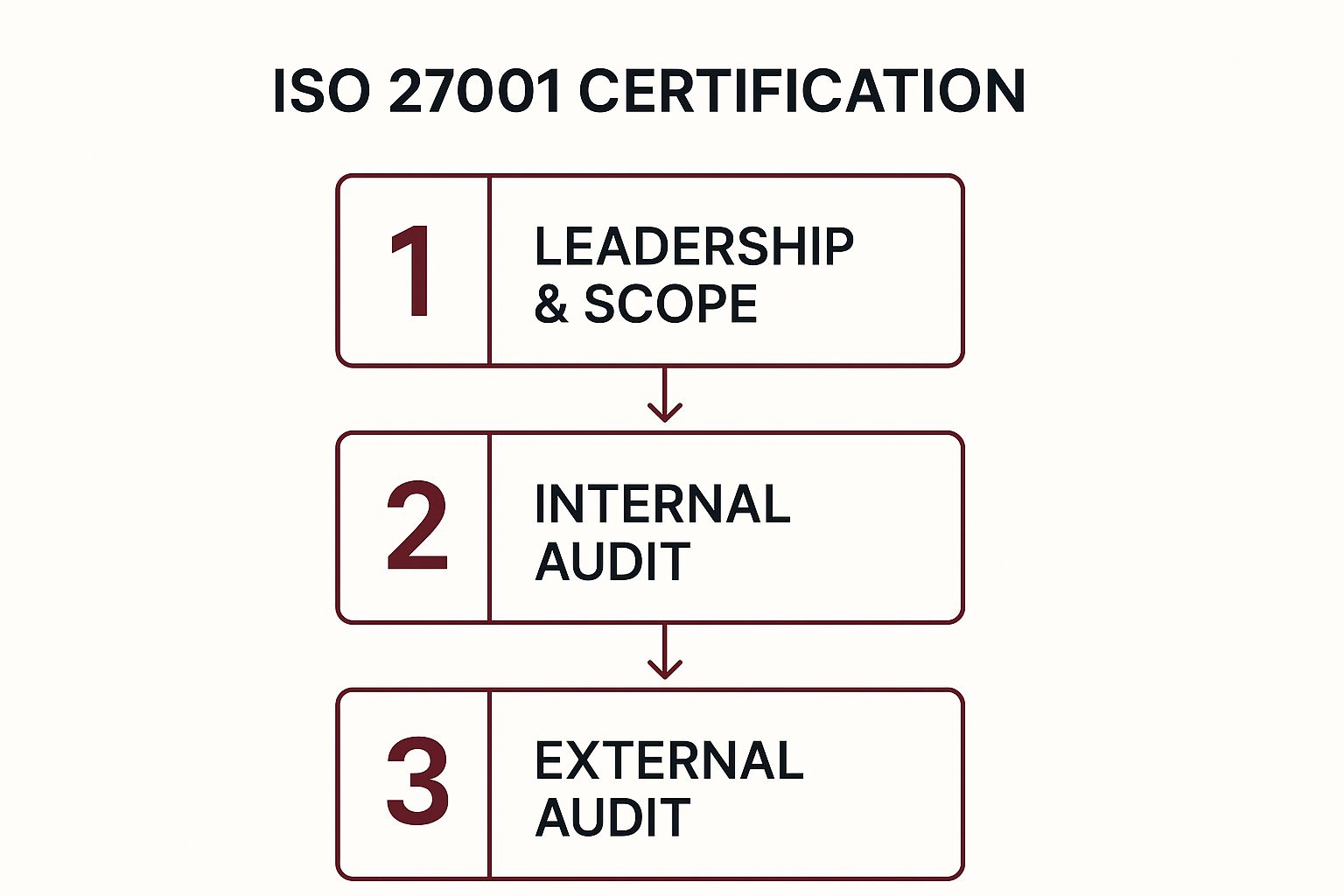
As you can see, the path to ISO 27001 certification is a structured progression. It moves logically from foundational strategy and planning (Phase 1), through internal validation and refinement (Phase 2), and finally to independent verification by an external body (Phase 3). Each phase builds upon the last, ensuring a thorough and robust outcome.
Phase 1: Laying the Foundation
Before you can build anything lasting, you need a solid foundation. In the world of ISO 27001, this means two things: getting unwavering leadership on board and clearly defining the boundaries of your ISMS. Without these two critical elements in place, your certification project is likely to stall, run out of resources, or fail at the audit stage.
Securing Leadership Buy-In
Think of your senior management team as the architects and sponsors of this project. They control the resources (both financial and human), champion the cause across the organization, and set the tone for the importance of security. You have to frame the certification not as an IT cost or a technical project, but as a strategic business investment.
Lead the conversation with the benefits we've already covered—gaining a competitive edge, building unshakable client trust, meeting tender requirements, and reducing financial risk from breaches and fines. Present a clear business case. When leadership truly understands the 'why' and the return on investment, they'll be far more likely to get behind the 'how' and provide the sustained support needed for success.
Defining Your ISMS Scope
Next, you have to define the scope of your ISMS. This is like drawing the official boundaries of your security fortress. You need to be crystal clear about which parts of your organisation the ISMS will protect and, therefore, be audited against.
Your scope statement is one of the most critical documents you'll create. It tells auditors exactly what is 'in' and what is 'out' of the system being certified. A vague or poorly defined scope can lead to confusion, scope creep, delays, and even audit failure. Auditors need to know precisely what they are assessing.
To nail down your scope, you’ll need to consider:
- Organisational Units: Which departments or teams handle your most sensitive information (e.g., Finance, HR, R&D)?
- Physical Locations: Are you just including the head office, or do multiple branches, data centres, and remote worker locations need to be covered?
- Key Business Processes: Which processes are absolutely critical to your operations and rely on secure data (e.g., customer onboarding, payment processing, product development)?
- Technologies and Assets: What specific networks, servers, databases, and applications fall within these boundaries?
Getting this right from the very beginning is absolutely crucial for a smooth certification process. It focuses your efforts and resources where they are needed most.
Phase 2: The Internal Check-Up
Once your foundation is set and you’ve implemented your ISMS controls and processes, it’s time for an internal check-up. This phase is all about self-assessment, conducted through a comprehensive internal audit and a formal management review. This is your chance to find and fix any issues before the external auditors arrive. It's far better to find problems yourself than have an external auditor find them for you.
Your internal audit is essentially a dress rehearsal for the main event. It’s a systematic, evidence-based review of your ISMS to ensure it meets all the requirements of the ISO 27001 standard and is actually working as intended. This process has to be objective, so it’s often best performed by someone who wasn't directly involved in building the ISMS, or by an external consultant, to get an unbiased view.
The goal here is to identify any nonconformities—that is, any areas where your system doesn't quite meet the standard. Finding them now is a good thing! It gives you the opportunity to implement corrective actions to fix the root cause of the problem, without putting your external certification at risk.
After the internal audit, you'll conduct a management review. This is a formal meeting where your senior leadership team reviews the overall performance of the ISMS. They’ll look at the internal audit results, metrics on security performance, the status of risk assessments, any security incidents that occurred, and the progress you’re making towards your security objectives. This is vital as it demonstrates leadership's ongoing commitment and involvement, which is a key requirement of the standard.
Phase 3: The External Certification Audit
This is the final leg of the journey, where your hard work is put to the test. An independent, accredited certification body will come in to formally assess your ISMS against the ISO 27001 standard. The external audit is almost always done in two parts: Stage 1 and Stage 2.
The Stage 1 Audit: Document Review
Think of the Stage 1 audit as the auditor checking your blueprints and plans before they inspect the actual building. They will meticulously review your documentation—your ISMS policy, procedures, scope statement, risk assessment methodology and report, and Statement of Applicability—to confirm that, on paper, your ISMS has been designed to meet all the requirements of ISO 27001.
The auditor will be looking for:
- A clearly and correctly defined scope for the ISMS.
- Complete documentation for all mandatory policies and procedures.
- Solid evidence of a thorough risk assessment and a corresponding risk treatment plan.
- A well-defined Statement of Applicability that justifies the inclusion and exclusion of Annex A controls.
At the end of Stage 1, the auditor will give you a report. It will highlight any areas of concern or potential nonconformities that you'll need to sort out before the Stage 2 audit can go ahead. It also helps them plan the Stage 2 audit effectively.
The Stage 2 Audit: Implementation Check
If Stage 1 was about checking the blueprints, Stage 2 is about inspecting the finished building to see if it was built to spec and is functioning correctly. The auditors will return, usually a few weeks or months later, to verify that your ISMS is not just a pile of documents but is fully implemented and operating effectively across the organisation.
During this stage, the auditors will use various techniques to gather evidence:
- Interview your staff from different departments to check they understand the security policies and their responsibilities.
- Observe your processes in action to see if they follow the documented procedures (e.g., watching how a new employee is granted access to systems).
- Review records, logs, and other data as evidence that your security controls are working (e.g., backup logs, incident reports, visitor logs).
They’re looking for tangible proof that your ISMS is a living, breathing part of your company culture and operations. If the auditors are satisfied that your system meets all the requirements of the standard, they will recommend your organisation for information security management system certification. For a deeper dive into what to expect during this crucial phase, you can learn more about how to get ISO certified in Australia from local experts in the field.
Successfully navigating these phases transforms a complex standard into an actionable plan, moving you confidently toward your certification goal.
Maintaining Your Certification and Driving Continuous Improvement
Getting your information security management system certification is a massive win, a moment for celebration. But it’s a mistake to see it as the finish line. In reality, it’s the starting line for a long-term commitment to security excellence. The real power and value of your ISMS is unlocked in the years that follow, as it becomes a living, breathing part of your organisation’s culture.
This isn't about just keeping a certificate on the wall to impress visitors. It’s about building a truly resilient security posture that adapts, evolves, and gets stronger over time in the face of a constantly changing threat landscape. The journey now shifts from getting it all set up to keeping it running smoothly and effectively, focusing on activities that ensure your ISMS stays sharp, relevant, and aligned with where your business is heading.
The Rhythm of Surveillance Audits
Your relationship with the certification body doesn't stop once you have the certificate in hand. To keep your certification valid, you’ll go through regular surveillance audits. Think of them as annual check-ups to make sure your ISMS is still working effectively, being maintained, and continually improving in line with the ISO 27001 standard.
Instead of dreading them as inspections, see them as a massive opportunity. These audits give you a fresh, external perspective from an expert, helping you spot weaknesses, inefficiencies, or areas for improvement you might be too close to see. They provide a regular deadline that keeps your team on their toes and ensures that good security habits don't fade away under the pressure of daily business operations.
A typical three-year certification cycle plays out like this:
- Year 1: The big one—the full, two-stage certification audit to gain the initial certificate.
- Year 2: The first surveillance audit. This is a smaller-scale review, focusing on specific parts of the ISMS, including mandatory elements like internal audits, management reviews, and corrective actions.
- Year 3: The second surveillance audit, another check-in that will likely focus on different areas of your ISMS than the first one.
At the end of year three, you'll go through a full recertification audit, which is similar to the initial Stage 2 audit, to renew your certification for another three years. This structured rhythm is designed to make sure your ISMS never gets dusty, outdated, or ineffective.
Weaving the PDCA Cycle into Your Company DNA
Remember the Plan-Do-Check-Act (PDCA) cycle from when you were first setting things up? After certification, it stops being a project tool and becomes the heartbeat of your daily security operations. It’s the engine that drives constant improvement, keeping your security posture under a microscope and ensuring it evolves.
This cycle is what makes your ISMS dynamic, not static. It’s what lets your organisation adapt to new cyber threats, shiny new technologies, and shifting business goals without missing a beat. When a security incident happens or a new vulnerability is discovered, the PDCA framework gives you a clear, structured way to respond, learn from the event, and beef up your defences to prevent it from happening again. It transforms mistakes and near-misses into valuable learning opportunities.
Continuous improvement is the lifeblood of a mature ISMS. It reinforces the idea that security isn't a one-off project but an ongoing system that weaves security into the very fabric of your company culture, delivering value every single day.
This entire process is overseen by accreditation bodies that make sure the whole certification ecosystem has integrity. In Australia, the Joint Accreditation System of Australia and New Zealand (JAS-ANZ) is the main body keeping an eye on ISO 27001. They accredit the certification bodies, ensuring they themselves meet tough standards of competence and impartiality. Between July 2020 and June 2021, JAS-ANZ processed 20 scheme scope extensions, with information security making up the largest chunk—a clear sign of the growing specialisation and demand in the Australian security market. They also manage critical updates, like the transition from the older ISO 27001:2013 to the newer ISO 27001:2022, which is vital for tackling modern cyber threats like those related to cloud services and supply chain security. You can read the full research on JAS-ANZ's role in maintaining accreditation standards in their annual report.
Adapting to an Ever-Changing Threat Environment
The security landscape never sits still. What kept you safe yesterday might be a wide-open door for an attacker tomorrow. A certified ISMS gives you the framework to manage this change proactively, so you’re always a step ahead instead of playing catch-up after an incident.
Your system for continuous improvement needs to be ready to react to key triggers for change, such as:
- New Technologies: Adopting a new cloud service, IoT device, or AI tool? That introduces new risks and attack surfaces that need to be assessed and managed within your ISMS.
- Emerging Threats: When news breaks about a new type of ransomware or a critical software vulnerability, your risk assessment and control effectiveness need to be reviewed.
- Business Changes: Merging with another company, opening a new office, or expanding into a new market will dramatically change your risk profile and the scope of your ISMS.
- Regulatory Updates: Privacy laws and industry regulations are always changing. Your policies and procedures need to keep up to ensure ongoing compliance.
By treating your ISMS as a living system, you ensure it stays relevant and effective, safeguarding your business against whatever comes next. To keep your ISMS sharp and drive this evolution, it's worth exploring proven continuous improvement strategies that can slot right into your management rhythm and culture.
The Long-Term Value of Sticking With It
Maintaining your information security management system certification takes work, but the payoff is enormous and multifaceted. It pushes your organisation beyond a simple tick-box compliance mindset and into a state of true security maturity, where security is seen as a business enabler, not a roadblock.
It builds deep, lasting trust with your clients, gives you a sustainable edge over the competition, and embeds a culture of risk awareness across your entire team, from the C-suite to the front line. For many businesses, juggling this ongoing cycle of audits, reviews, and improvements can be a lot to handle internally. An annual ISO support program can provide the expert guidance and resources needed to navigate surveillance audits smoothly, keep documentation in order, and drive real, meaningful improvement year after year.
Ultimately, the goal isn't just to keep a certificate. It's to build a resilient organisation that can confidently stare down the security challenges of the future and seize the opportunities that a secure posture creates. This sustained commitment is what transforms your ISMS from a framework on paper into a core part of your business's success story.
Got Questions About ISMS Certification? We've Got Answers
Stepping into the world of information security management system certification always kicks up a few questions. Once you’re sold on the ‘why’, the ‘how’ can seem a bit daunting, and the practical realities can be murky. It’s completely normal to wonder about the nitty-gritty details like timelines, costs, and what’s really required to get over the line.
Let's clear the air and tackle some of the most common queries we hear from businesses just like yours that are embarking on this journey.
How Long Does ISO 27001 Certification Take?
Honestly, it depends. There is no one-size-fits-all answer. Think of it like a home renovation – are you just painting a few rooms, or are you building a whole new extension from the ground up? The timeline for certification is unique to every single business and depends heavily on your starting point.
For a small or medium-sized business starting from scratch with very few formal security policies or processes, you're typically looking at a 6 to 12-month journey. That window covers everything from the initial gap analysis and planning, through risk assessments and control implementation, to conducting your own internal checks (like internal audits and management reviews), and finally, getting through the official two-stage external audit.
But if your organisation already has some solid security habits, good documentation, and a mature IT function, you could find yourself on the fast track, potentially achieving certification in as little as 3 to 6 months. The biggest things that will influence your timeline are the size of your company, the complexity of your operations and technology, the defined scope of your ISMS, and how good your security posture is right now. The availability of internal resources to dedicate to the project is also a major factor.
What Is the Difference Between Compliant and Certified?
This is a big one, and the distinction is crucial, especially when you're talking to potential clients. It all comes down to proof and independent validation.
Being ‘compliant’ means you've done the work to align your practices with the ISO 27001 standard. You’ve read the standard, implemented the controls you think are necessary, and created the required documentation. You’ve followed the recipe yourself and you’re pretty sure you’ve made a great cake. It’s essentially a self-declaration of your security posture. While this is a good internal step, it carries little weight externally.
Being ‘certified’, however, is when an accredited, independent certification body (the auditor) comes in to taste that cake. They conduct a formal, rigorous audit of your entire ISMS, examining your documentation, interviewing your staff, and testing your controls. They then officially verify that you meet every single requirement of the standard.
Certification gives you a whole other level of credibility and market value. It’s the difference between saying, "Trust us, we're secure," and having an expert stand up and announce, "We've checked their work, and they are secure." That external validation is what really matters to clients, partners, and regulators, as it provides objective, unbiased assurance.
How Much Does ISMS Certification Cost?
When you’re budgeting for an information security management system certification, it’s helpful to split the investment into two main buckets: the internal preparation costs and the external auditing fees.
- Implementation Costs: This is all the internal spending needed to get your ISMS audit-ready. This is often the largest component. It might include bringing in a consultant to provide expertise and guidance, buying new security software or hardware (like an endpoint detection solution or a new firewall), and factoring in the time your team spends on risk assessments, training, and writing documentation.
- Certification Costs: These are the fees you pay directly to the external, accredited certification body. This fee covers their time for conducting the initial Stage 1 and Stage 2 audits, plus the annual surveillance audits required to keep your certification active for the three-year cycle, and the recertification audit at the end.
For a small to medium Aussie business, the total cost can vary wildly—anywhere from tens of thousands to well over one hundred thousand dollars for the first year. It all boils down to the scope and complexity you define for your ISMS. A bigger scope that covers more people, locations, and services will naturally require a bigger investment in both implementation and auditing fees.
Is ISO 27001 Mandatory in Australia?
No, ISO 27001 isn't a blanket law that every single business in Australia must follow. There is no general legislation that mandates it. But in many industries and supply chains, it might as well be. It's not the law, but it’s often the rule of the game.
If you want to work with government departments (federal, state, or local), or land contracts with big corporations, you’ll find that certification is frequently a non-negotiable requirement listed in tenders and procurement documents. This is especially true in sensitive sectors like finance, defence, healthcare, and technology. It has become the de facto benchmark for proving you’re serious about protecting data.
More and more, lacking the certification doesn't just put you at a competitive disadvantage; it can knock you out of the running for high-value work before you even get a chance to bid. It’s a powerful signal to the market that your business is mature, trustworthy, and takes its security responsibilities seriously.
At Anitech, we specialise in guiding Australian small businesses through every step of the certification process. Our expert consultants simplify the complexities, helping you build a robust ISMS that not only achieves certification but also gives you a real competitive advantage. Start your journey towards security excellence by exploring our tailored ISO 27001 consulting services at https://iso-27001.com.au.
Recent Comments