

Getting an information security management systems certification in Australia is one of the smartest strategic moves you can make to protect your sensitive data and, just as importantly, build unbreakable client trust. This certification, with ISO 27001 being the global gold standard, gives you a proven framework to manage and secure your information assets. It’s how you show partners and customers that your security practices are truly world-class.
Why Your Business Can No Longer Ignore ISMS Certification in Australia
The whole conversation around information security in Australia has shifted. It's not some technical checklist for the IT team anymore; it’s a critical boardroom discussion about survival, reputation, and getting a leg up on the competition. The question has moved on from if we need certification to when and how fast.
This isn't about some far-off, abstract threat. The urgency is a direct response to the sheer volume and sophistication of cyber-attacks hitting Australian businesses of all shapes and sizes. Let's be honest, a firewall and some antivirus software just don't cut it anymore. Today’s threats demand a structured, systematic defence—and that’s exactly what an Information Security Management System (ISMS) delivers.
The Rising Tide of Cyber Threats Down Under
The threat isn’t just growing; it's accelerating at a frightening pace. The latest data paints a grim picture. The Australian Cyber Security Centre clocked over 94,000 cybercrime incidents last year alone. That's a massive 23% jump from the year before, highlighting a dangerous vulnerability gap that many organisations are scrambling to close.
And this isn't just a "big company" problem. In fact, small and medium-sized businesses are often seen as easy pickings by cybercriminals because they assume their defences are weaker. A single breach can be absolutely devastating, leading to huge financial losses, operational chaos, and brand damage that you may never recover from.
An ISMS forces you to move from a reactive, "firefighting" security model to a proactive, risk-based approach. It compels you to identify what your most valuable information assets are, understand the specific threats they face, and implement proportionate controls to protect them.
Moving Beyond Compliance to a Real Competitive Edge
While dodging disaster is the main driver, the benefits of chasing an information security management systems certification in Australia go way beyond just defence. It’s become a powerful way to stand out in a market where everyone is, rightly, security-conscious.
Clients, partners, and even government agencies are now asking for proof of your security credentials before they'll even consider working with you.
- Winning Government Tenders: Many Australian federal and state government contracts now explicitly list ISO 27001 certification as either mandatory or highly desirable. No certificate, no chance.
- Securing Your Place in the Supply Chain: Big companies are auditing their suppliers because they know a breach could come from anywhere. Certification is the clearest signal that you won't be the weak link that brings them down.
- Building Genuine Customer Confidence: We all hear about data breaches in the news. Seeing that certification mark tells customers you’re serious about protecting their data, which builds incredible loyalty and trust.
Essentially, ISO 27001 is fast becoming the price of admission for playing in high-value markets. It's no longer just an IT project; it's a strategic investment in your company’s resilience, reputation, and future. If you're new to this, understanding the importance of cybersecurity for growing businesses is a great starting point to grasp why this is so vital.
A Framework for True Organisational Resilience
At its core, the journey to certification is about building a tougher, more resilient organisation from the inside out. It creates a cultural shift where information security becomes everyone’s job, not just something the tech people handle.
The process makes you document procedures, define clear roles, and put smart controls in place that bring much-needed structure to your security efforts. This disciplined approach doesn't just strengthen your defences; it often makes your daily operations run smoother too. And if an incident does happen, a certified ISMS means you have a tested plan ready to go—to respond, recover, and keep the damage to a minimum.
For a complete rundown of the certification journey, our guide on ISO 27001 certification in Australia lays out a detailed roadmap. This proactive stance is what separates businesses that thrive from those that stumble when a crisis hits.
Setting the Stage for a Successful Certification Journey
Before you write a single policy or even think about a new security tool, stop. The success of your entire information security management systems certification in Australia is won or lost right here, in the preparation. A truly effective ISO 27001 project is built on a rock-solid foundation, not a rushed implementation. This is your blueprint for getting that foundation right from day one.
Jumping into this without a clear plan is like setting sail without a map. Sure, you might eventually hit land, but it won't be where you intended, and the journey will be a nightmare. Let’s break down how to start smart, making sure every step builds towards a successful, stress-free certification.
This simple flow often shows the real-world pressures pushing Australian businesses towards certification, starting from growing cyber threats and ending with the decision to get certified.
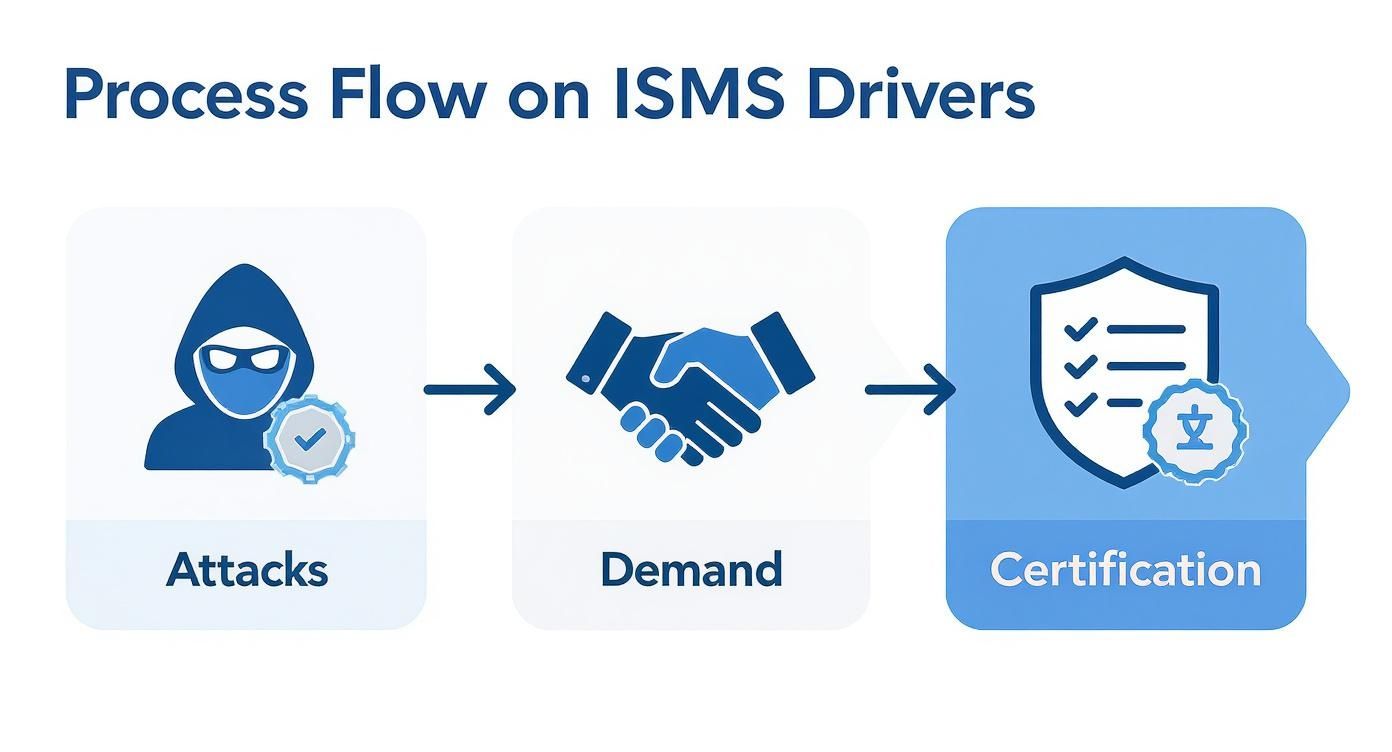
As you can see, it's often a combination of seeing the very real risk of cyber attacks and having clients directly ask for proven security that finally triggers the move towards formal certification.
Secure Genuine Leadership Buy-In
Let's be blunt: getting the leadership team on board is the single most critical factor for success. But genuine buy-in is so much more than a signature on a budget request. It's about creating a true top-down security culture where the executive team doesn't just approve the project, but actively champions it and understands its value.
To get there, you have to speak their language. Frame this whole thing not as a technical chore, but as a powerful business enabler.
- Talk Business Risk: Forget jargon. Explain how an ISMS directly slashes tangible business risks, like the financial hit from a data breach, the nightmare of reputational damage, or fines for not complying with Australian privacy laws.
- Show Them the Money: Point to the government tenders you can't bid on or the enterprise clients whose security questionnaires you keep failing. ISO 27001 isn't a cost centre; it's a key that unlocks new revenue.
- Present a Clear Plan: Give them a realistic timeline, budget, and resource plan. Vague promises make leaders nervous. A well-structured approach shows you've done your homework.
When your CEO is the one talking about information security, it sends a powerful message across the whole company. It’s no longer just an "IT problem"—it’s a core business priority.
The Art of Defining Your ISMS Scope
One of the first and most expensive mistakes I see businesses make is trying to boil the ocean. They try to apply the ISMS to every single corner of the organisation at once. This just leads to a bloated project, a burnt-out team, and a lot of wasted money. The key is to be strategic. Define a clear, manageable scope for your Information Security Management System.
Your scope is the boundary of your ISMS. What parts of the business will actually be included in the certification?
Think about what's most critical. A Sydney-based software company, for example, might scope its ISMS to cover its development teams, production cloud environment, and customer support functions—the areas handling sensitive client data. They could choose to exclude internal HR or finance systems for now to keep the project tight and achievable, with a plan to expand later.
A well-defined scope is your best defence against a never-ending project. It should be small enough to be manageable but large enough to be meaningful and cover your key information security risks.
Assembling Your Certification Team
This isn't a solo mission. You need a dedicated team, and you've really got two paths: build an internal one or bring in the experts.
Building an Internal Team
This is a fantastic option if you have people inside the business who are motivated and really get how things work. Your team will typically need an ISMS Manager or Project Lead to drive everything, plus people from key departments like IT, HR, and legal. The big win here? All that knowledge stays in-house long after the certificate is on the wall.
Hiring External Consultants
For many small businesses in Australia, this is simply the fastest and most efficient route. An experienced ISO 27001 consultant has been through this process dozens of times. They know the common pitfalls, they know what auditors are looking for, and they can provide templates and guidance that will save you literally hundreds of hours. If you go this route, find someone with direct experience in the Australian market and a proven track record with businesses your size.
Conduct an Initial Gap Analysis
Okay, you've got your team and your scope. Now it's time to figure out where you're actually starting from. A gap analysis is just a detailed comparison of your current security practices against the specific requirements of the ISO 27001 standard.
You'll go through your existing policies, procedures, and tech controls to see what's already in place, what's missing, and what needs a bit of work. It’s an honest look in the mirror that turns the vague goal of "getting certified" into a concrete, step-by-step project plan. The output is usually a detailed report or spreadsheet listing each ISO 27001 control and your current level of compliance.
For instance, you might discover you have great password policies (Clause A.5.17) but absolutely no formal process for managing supplier security (Clause A.5.19). That instantly tells you where to focus your energy. This roadmap becomes your guide for the entire implementation, ensuring you're working on the right things in the right order.
Building a Resilient Information Security Management System
This is where the rubber hits the road. All that planning needs to transform into a living, breathing Information Security Management System (ISMS). It’s about taking your blueprint and building the core components that will genuinely protect your Australian business from real-world threats—not just satisfy an auditor.
The aim isn't to create a folder of documents that gathers dust. You’re building a resilient security framework that weaves itself into the very DNA of your operations. Let's walk through how to make that happen with practical solutions, not just box-ticking exercises.
Conducting a Risk Assessment That Matters
Your entire ISMS hinges on a solid risk assessment. A common pitfall I see is businesses downloading a generic template and populating it with vague threats. This approach is lazy, ineffective, and an experienced auditor will spot it a mile away. A truly powerful risk assessment has to reflect the specific dangers your business faces here in Australia.
This means you need to get granular. Instead of just listing "malware," dig deeper. Think about the specific risk of a ransomware attack encrypting your client database, triggered by a convincing phishing email sent to your sales team. This level of detail is what allows you to accurately gauge the real-world likelihood and potential fallout.
To make your risk assessment genuinely valuable, follow these steps:
- Identify Your Information Assets: What's the crown jewel information you need to protect? This covers everything from client databases and financial records to your unique intellectual property and sensitive employee data.
- Pinpoint Specific Threats: For each asset, what could go wrong? Think about malicious insiders, accidental data deletion by well-meaning staff, hardware failure, or targeted cyber-attacks common in your industry.
- Analyse Vulnerabilities: Where are the cracks in your armour? This could be unpatched software, a lack of employee security training, or poor physical security at your office.
- Evaluate Likelihood and Impact: For each threat-vulnerability pair, figure out the odds of it happening and the business impact if it did. This is crucial for prioritising what to fix first.
This detailed process elevates your risk assessment from a theoretical exercise to a strategic weapon that directs every dollar and hour you spend on security.
Developing a Pragmatic Risk Treatment Plan
Once your risks are identified and prioritised, you need to decide what to do about them. This is your Risk Treatment Plan (RTP). ISO 27001 gives you four distinct options for tackling each risk, and a smart plan will use a blend of all four.
- Treat the Risk: This is your most common move. You implement security controls to lower the risk's likelihood or impact. To counter that phishing attack risk, for instance, you might roll out advanced email filtering and regular staff awareness training.
- Tolerate the Risk: For some minor risks where the fix costs more than the potential damage, you might formally decide to accept it. The key is to document the business justification for this decision.
- Transfer the Risk: This usually means shifting the financial fallout to someone else. A classic example is taking out a comprehensive cyber insurance policy to cover the hefty costs of a data breach.
- Terminate the Risk: Sometimes, you can eliminate a risk entirely by stopping the activity causing it. If a clunky legacy system is a massive security headache, you might decide to decommission it for good.
Your RTP should be a crystal-clear, actionable document. It needs to detail which treatment option was chosen for each risk, who is responsible for getting it done, and the timeline for completion.
Crafting Your Core ISMS Documents
Documentation is the backbone of any information security management systems certification in Australia. It’s the proof that your ISMS is well-planned, properly implemented, and actively managed. Two of the most critical documents you'll produce are the Statement of Applicability and your key security policies.
The Statement of Applicability (SoA) is a central document. It lists all 93 security controls from ISO 27001's Annex A. For every single control, you must state whether it applies to your business, justify that decision, and point to how you’ve implemented it.
The SoA is essentially the master index of your security controls. It connects your risk assessment findings to the specific actions you've taken, providing auditors with a clear and concise overview of your entire security posture.
Beyond the SoA, you’ll need a suite of core security policies. These are the high-level documents that establish the rules of the road for information security across your entire organisation.
Essential policies often include:
- Information Security Policy: The top-level document showing management's commitment and outlining your main security goals.
- Acceptable Use Policy: Defines how employees are allowed to use company systems and data.
- Access Control Policy: Spells out the rules for granting, reviewing, and revoking user access.
- Incident Response Plan: Your step-by-step playbook for handling a security incident, from detection through to recovery.
A truly resilient ISMS will also have clear policies on intellectual property and data rights policies to safeguard your organisation's most valuable assets. Every policy should be written in plain English, be easy to understand, and be communicated effectively to all staff. You can learn more about building an information security management system and what goes into it.
Implementing Proportional Security Controls
Finally, with your risks assessed and policies written, it's time to roll up your sleeves and implement the security controls from Annex A. The keyword here is proportionality. You’re not meant to apply every control with maximum force; you select and apply controls that are appropriate for the specific risks you’ve identified.
For example, a small e-commerce business in Perth might double down on tech controls like web application firewalls and encrypting customer payment data. A legal firm in Melbourne, on the other hand, might prioritise people-focused controls like strict confidentiality agreements and training on how to handle sensitive client files.
This tailored approach is gaining serious traction. The adoption of ISO 27001 in Australia has seen huge growth, mirroring a global trend with year-on-year growth rates hitting around 21%. While we're not as big as markets like Japan or the UK, Australia has shown impressive spikes in certification as businesses in IT, retail, and services realise they need real security. This growth proves that organisations are finally moving towards security frameworks that genuinely strengthen their defences, not just fulfil a compliance checklist.
Conquering the Internal and External Audits

The audit phase often feels like the final boss battle in your certification journey. I've seen plenty of teams get tense at this stage, but it helps to reframe it. Think of your audit less as a hostile inspection and more as a collaborative check-up.
It’s your chance to show off all the hard work you’ve put in and get valuable, impartial feedback on your new Information Security Management System (ISMS). Let’s break down the whole process, from the crucial "dress rehearsal" of your internal audit right through to the official two-stage certification audit.
With the right mindset and preparation, this can genuinely be a moment of confidence, not stress.
Mastering Your Internal Audit First
Before you even think about inviting an external certification body through your doors, you need to audit yourself. The internal audit isn't optional; it's a mandatory part of the ISO 27001 standard. More importantly, it’s your single best chance to find and fix problems on your own terms.
Trust me, rushing or skipping this step is a recipe for a painful and potentially failed external audit.
Think of it as a friendly but firm health check. The whole point is to confirm your ISMS is actually running as designed and meeting the standard’s requirements. You’re essentially playing the role of the external auditor to kick the tyres of your own system.
A solid internal audit will:
- Validate Your Documentation: Does your practice match your policies? If your access control policy states that reviews happen quarterly, you need to be able to produce the records to prove it.
- Test Your Controls: Are the security controls you’ve put in place actually working? This means sampling evidence, like checking server patch logs or reviewing the visitor access register.
- Identify Non-conformities: This is the main game. You are actively hunting for gaps or deviations from the standard so you can fix them before they become a problem for the certification auditor.
For many Australian small businesses, achieving the necessary impartiality for an internal audit can be tough. It's why a lot of companies choose to bring in a third-party consultant to run it for them, guaranteeing a fresh, expert perspective.
The Formal Two-Stage Certification Audit
Once your internal audit is done and you’ve dealt with any findings, it’s time to engage an accredited certification body. The formal process for an information security management systems certification in Australia is always split into two distinct stages.
The entire process is methodical, designed to ensure your ISMS isn't just a paper-pusher's dream but a living, effective system. An experienced consultant can be a huge help during this time, preparing your team and organising your evidence. For a closer look at the nuts and bolts, you might find this deep dive on the ISO 27001 audit process useful.
Stage 1: The Documentation Review
The Stage 1 audit is basically a desktop review. The auditor will either visit your site or conduct it remotely to assess the design and documentation of your ISMS. They aren't digging deep into implementation evidence just yet; they're checking if you’ve built everything on a solid foundation.
During this stage, the auditor will have their eyes on key documents like:
- Your ISMS Scope document
- The overarching Information Security Policy
- Your Risk Assessment and Risk Treatment Plan
- The all-important Statement of Applicability (SoA)
The goal of Stage 1 is simple: to determine if your ISMS is well-designed on paper and ready for the main event. The auditor gives you a report highlighting any concerns or potential non-conformities that must be sorted out before Stage 2 can kick off.
This is an incredibly valuable checkpoint. It gives you a clear heads-up on any weaknesses in your documentation before you invest time and resources in the more intense second stage.
Stage 2: The Implementation Audit
A few weeks or maybe a couple of months later, once you’ve addressed the feedback from Stage 1, the Stage 2 audit begins. This is the main event. The auditor will return for a much more detailed, hands-on assessment to verify that your ISMS is not only documented but also fully implemented and operational.
Here, the auditor is looking for tangible proof that your policies are being followed and your controls are working as intended.
What to Expect During the Stage 2 Audit
The auditor will spend their time talking to staff, observing processes, and reviewing records. For example, they might:
- Ask a developer how they approach secure coding, then ask to see evidence in your code repository.
- Chat with your HR manager about the new employee onboarding process and review the completed security awareness training records.
- Sit with an IT admin to watch them review system access logs, making sure the process matches what’s written in your procedure document.
It’s so important to prepare your team. Let them know an audit is happening and explain that it's perfectly fine to say, "I don't know, but I can find that out" or "Let me get the right person for you." Honesty and a willingness to find the correct information are far more impressive than fumbling for an answer.
Handling Non-conformities Gracefully
It's completely normal for an auditor to find issues. These are called non-conformities, and they are opportunities for improvement, not signs of failure. They generally come in two flavours.
Minor Non-conformity: An isolated slip-up or a small deviation from the standard. A classic example is a single missed access review for a non-critical system. You’ll just need to submit a corrective action plan explaining how you'll fix the issue and stop it from happening again.
Major Non-conformity: This points to a significant, systemic failure in your ISMS. This could be the complete absence of a mandatory process, like having no internal audit program at all. A major finding will block certification until you can provide solid evidence that the issue is fully resolved, which might even require a follow-up audit.
The key is your response. View any findings as free consulting. Thank the auditor for spotting the gap, then get to work on a solid corrective action plan. A professional and proactive response shows the maturity of your management system.
Keeping Your Certification and Fuelling Continuous Improvement
Getting your ISO 27001 certificate is a huge win, but it’s the starting block, not the finish line. The real, lasting value comes from treating your Information Security Management System (ISMS) as a living, breathing part of your business—one that constantly adapts and gets better. This isn't about a one-time project; it's about building genuine security resilience and turning your ISMS into the engine that drives a stronger, security-first culture.
This is your long-term playbook. It’s about more than just keeping the certificate on the wall; it’s about making your security posture stronger every single day and turning that initial achievement into a genuine competitive advantage.
Running Management Reviews That Actually Matter
The management review is one of the most powerful—and most frequently bungled—tools in the ISMS toolkit. This isn't just a tick-box exercise to keep the auditor happy. When you do it right, it’s a strategic huddle where your leadership team gets a clear, no-fluff picture of your security performance and makes smart decisions to push things forward.
Think of it as the board meeting for your information security. It’s where you take the pulse of your ISMS, checking that it’s still hitting business goals and properly managing your real-world risks.
To make these reviews count, you have to bring the right data to the table. Forget vague updates; you need actionable intelligence.
- Key Performance Indicators (KPIs): Show the story over time. How many security incidents did we have this quarter compared to last? What’s our completion rate on the annual security training?
- Internal Audit Findings: Lay out the results from your internal checks. Focus on any non-conformities, the fixes you put in place, and what you learned from them.
- Risk Assessment Updates: What’s new? Highlight any fresh risks that have popped up or shifts in the ratings of existing ones. For example, expanding into a new market might suddenly introduce new data residency risks you didn't have before.
- Feedback from Stakeholders: What are clients, staff, or even regulators saying about your security? This feedback is pure gold.
Your management review needs to end with a clear plan of attack. The output should be documented minutes with concrete decisions, names assigned to tasks, and firm deadlines. This isn't just for the auditor; it’s your roadmap for improvement until the next review.
Keeping Your Risk Assessments Alive and Kicking
The threat landscape is always shifting, so your risk assessment can't afford to sit on a shelf gathering dust. A risk assessment you did a year ago is a history lesson, not a current tool. To maintain a valuable information security management systems certification in Australia, your risk assessment has to be a dynamic process that mirrors the changing realities of your business.
This means setting a regular rhythm for reviews—at least once a year, or whenever something significant changes.
So, what counts as a "significant change"?
- New Tech: Rolling out a new CRM or shifting services to a different cloud provider fundamentally alters your risk profile.
- Business Shifts: Pushing into a new market or launching a new product line brings new information assets and new potential threats along for the ride.
- Emerging Threats: A new flavour of ransomware starting to hit businesses in Australia? That should trigger an immediate review of your defences and controls.
- Security Incidents: If you get hit by an incident, it's a massive red flag that your risk assessment might have underestimated a particular threat.
Imagine a Melbourne-based marketing agency adopting a new AI-powered analytics tool. They'd need to update their risk assessment immediately, looking at the AI provider's own security, the sensitivity of the client data being crunched, and how it all lines up with Australian privacy principles.
Nailing Your Surveillance Audits
Your ISO 27001 certificate is valid for three years, but that doesn't mean the auditors disappear. To keep your certification active, you'll face annual surveillance audits. Think of them as "mini-audits" designed to confirm you’re still maintaining and improving your ISMS.
They’re less intense than the initial big audit, but they are just as crucial. The auditor won't check everything. Instead, they'll sample different parts of your ISMS each year, making sure that over the three-year cycle, the whole system gets a once-over. This ongoing scrutiny is what keeps the certification meaningful.
The cost of obtaining and maintaining ISO 27001 certification in Australia reflects this continuous process. For a small business, the initial certification might run from AUD 20,000 to AUD 40,000, but those annual surveillance audits typically cost between AUD 2,000 and AUD 10,000. These figures highlight the necessary investment for Australian businesses to properly manage cyber risks and maintain their credibility in the market. You can dive deeper into the numbers with a full overview of the ISO 27001 accreditation cost in Australia.
Weaving Security into Your Company's DNA
At the end of the day, the goal is to get beyond just being compliant. The most secure companies are the ones where security isn't just a rulebook—it's a shared value woven right into the company culture. You get there through relentless training and awareness.
A one-off training session during onboarding just won't cut it. You need a continuous program that keeps security front-of-mind for every single person.
Practical Ways to Build a Strong Security Culture:
- Regular Phishing Drills: These are brilliant for teaching staff to spot dodgy emails in a safe space. The key is providing immediate, helpful feedback to anyone who clicks.
- A "Security Champions" Network: Find enthusiastic people in different departments, give them a bit of extra training, and empower them to be the local go-to for security questions and best practices.
- "Topic of the Month" Campaigns: Focus on a different security theme each month—like password hygiene, physical security, or safe remote working—and promote it with short videos, posters, or intranet articles.
When you make security everyone's job, you transform your ISMS from a pile of documents into a powerful, collective defence that gets stronger over time. It's what will protect your business long after the auditors have packed up and gone home.
Your Top Questions About ISO 27001 Certification in Australia, Answered
Even with a solid plan in hand, I know that diving into an information security management systems certification in Australia can feel a bit like navigating uncharted waters. It’s a serious commitment, and it's only natural to have questions about the time, money, and practicalities involved.
I've been helping Aussie businesses through this for years, and the same questions pop up time and time again. Let's tackle them head-on, so you can move forward with confidence.
How Long Does It Really Take to Get Certified?
This is always the first thing people ask, and the honest answer is: it depends. There's no one-size-fits-all timeline. How long it takes is a direct reflection of your starting point, the size of your business, and the people you can dedicate to the project.
For a typical small or medium-sized Aussie business that already has some decent security habits, you should realistically budget for 6 to 12 months.
That might sound like a long time, but it allows you to do the job properly. This gives you enough breathing room for all the essential stages: mapping out your gaps, building the actual ISMS documentation, rolling out any new controls, running your own internal checks, and then facing the formal audits.
A word of warning from experience: don't rush it. I've seen businesses try to sprint to the finish line, and they often end up with a flimsy, "tick-the-box" system that doesn't actually improve their security. Worse, it's more likely to fail the external audit, which costs more time and money in the long run.
Now, if you’re already running a tight ship with mature, well-documented systems, you might be able to get it done in 4-6 months. On the other hand, if you're a larger organisation or starting from ground zero, it could easily take more than a year to be audit-ready.
Is ISO 27001 a Legal Requirement in Australia?
The simple answer is no, there isn't a law that says every business in Australia must have ISO 27001 certification. But that answer is a bit deceptive.
In reality, it's quickly becoming what I call a "market-driven" requirement. Your clients, partners, and even the government are making it a non-negotiable.
- Winning Government Work: Look at any tender from a federal or state government department. More and more, you'll see ISO 27001 listed as a mandatory requirement. Without it, you can’t even get a seat at the table for those lucrative contracts.
- Securing Your Supply Chain Spot: Big companies are obsessed with supply chain risk, and rightly so. They will often demand that their key suppliers and partners are ISO 27001 certified. It's their way of ensuring you're not the weak link that could lead to a breach on their end.
- Demonstrating Due Diligence: This is a big one. While not a law itself, having the certification is a powerful way to prove you’ve taken 'reasonable steps' to protect data under the Australian Privacy Act 1988. If the worst happens and you have a data breach, being certified can be a massive factor in reducing regulatory fines and legal headaches.
So, while the government hasn't legislated it, the market has. It's the price of admission for playing in the big leagues.
How Does ISO 27001 Fit with the ACSC Essential Eight?
Great question. This is a common point of confusion, but the relationship is actually quite simple and powerful once you see it. Think of it as strategy versus tactics.
ISO 27001 is your strategic framework. It's the big-picture game plan. It forces you to figure out what information is important, what the threats are, and how you're going to manage those risks across the entire business—people and processes included.
The Essential Eight, from the Australian Cyber Security Centre (ACSC), is purely tactical. It's a specific, prioritised list of technical moves you can make to block the most common cyber-attacks we see in the wild.
They aren't competing; they work together beautifully. Your ISO 27001 risk assessment is where you'll identify a high risk of, say, a ransomware attack. Your solution? Implement several controls from the Essential Eight, like application control, patching, and multi-factor authentication. They become the "how" for your risk treatment plan.
| Aspect | ISO 27001 | ACSC Essential Eight |
|---|---|---|
| Focus | Holistic risk management framework | Prioritised technical controls |
| Scope | Entire organisation (people, process, tech) | Technical mitigation strategies |
| Goal | Manage and protect all information assets | Prevent malware and cyber intrusions |
| Analogy | The blueprint for building a secure house | The specific locks you put on the doors and windows |
Think of it this way: ISO 27001 is the playbook; the Essential Eight are some of your star plays.
What Are the Biggest Roadblocks for SMEs Trying to Get Certified?
Small and medium businesses face a unique set of challenges. The benefits are massive, but I won't sugarcoat it—the hurdles can look pretty high from the starting line.
From my experience, the struggles almost always come down to a lack of resources, both in terms of cash and people's time.
Common Hurdles for Australian SMEs:
- The Budget Squeeze: Let's be honest, the costs for consultants, auditors, and any new security software can be a big pill to swallow for a smaller business.
- Time, the Real Scarcity: This is often the killer. Your team is already flat out. Finding the hundreds of hours needed for writing documents, implementing changes, and sitting through audits is a huge ask when everyone is already wearing three different hats.
- The Expertise Gap: Most SMEs don't have a full-time security guru on staff. Without that specialist knowledge, the standard can seem like an impenetrable document, leaving you wondering where on earth to start.
- Keeping the Ball Rolling: Kicking off the project with enthusiasm is easy. Maintaining that momentum month after month, when daily operational fires need putting out, requires real discipline.
But here's the good news: these challenges are absolutely beatable. It all starts with genuine commitment from the top. If the leadership team makes it a priority, it will get done. From there, it's about being smart—scope the ISMS carefully so you're not trying to boil the ocean on day one.
And frankly, the most efficient path for most SMEs is to partner with an expert who gets it. A good consultant who knows the Australian SME landscape can provide the templates, the know-how, and the project management to get you over the line without the costly detours.
Recent Comments