

So, what exactly is an information security management systems certification? Think of it as an official seal of approval, a formal verification that your organisation's security framework is up to scratch against globally recognised standards. It’s tangible proof that you can be trusted to protect sensitive data. The most common standard for this is ISO 27001, and achieving it sends a powerful message of trust to your clients, partners, and regulators.
Why ISMS Certification Is Your New Competitive Edge

In a world where data is as good as gold, trust is the currency that truly matters. Seeing an Information Security Management System (ISMS) certification as just another box to tick is a huge mistake. It's not a technical hurdle; it’s a core business strategy that builds that very trust and gives you a serious leg up on the competition.
Let's use an analogy. Imagine your business is a bank. You could have the friendliest staff and the sleekest-looking branch, but if you don’t have a secure vault, who would deposit their valuables with you? Nobody. An uncertified business is just like that bank with no vault—it might look great on the surface, but it's missing the verified, rock-solid protection that clients now demand for their information.
An ISMS is that secure vault. It's a comprehensive approach that weaves together people, processes, and technology to manage and safeguard your company's most valuable information. The certification is the final piece of the puzzle: the independent audit that proves your vault isn't just there, but that it's built to the highest possible standards.
Build Immediate Client Confidence
When a new client is sizing you up, one of their biggest questions is always about risk. Can we really trust them with our customer lists, our secret formulas, or our financial data? An information security management systems certification answers that with a confident, resounding "yes."
It completely changes the conversation. You're no longer just making vague promises like "we take security seriously." Instead, you're presenting hard evidence. This third-party validation builds confidence instantly, helps to shorten sales cycles, and can be the single factor that wins you the deal over a competitor who can't provide the same assurance. Diving into the value of ISO 27001 certification really highlights how critical this proof is for growing your business.
Unlock New Market Opportunities
Want to work with government agencies or large corporations? Many of these highly desirable sectors have incredibly strict security standards for their suppliers. Without a recognised certification like ISO 27001, your business often won't even make it past the first round of consideration.
Certification is like a key that unlocks doors to new, high-value markets. It proves your organisation has a rigorous, risk-based security framework in place, making you a pre-qualified, low-risk partner for clients who can't afford to take chances.
This is especially true here in Australia. The Australian Cyber Security Centre reported a staggering 94,000 cybercrime incidents in just one year, which was a sharp 23% jump from the year before. With threats on the rise, organisations are desperately seeking partners who can prove they are resilient.
Protect Your Brand and Your Bottom Line
A single data breach can be catastrophic. The fallout isn't just about the initial financial hit; it includes regulatory fines, legal battles, and long-term damage to your reputation that can poison customer trust for years to come.
A certified ISMS is your strongest line of defence. It’s much more than a certificate for the wall; it’s a living, breathing system that forces your organisation to be smarter about security by:
- Proactively Identifying Risks: You’ll systematically hunt for vulnerabilities before attackers can find them.
- Implementing Robust Controls: It ensures you deploy specific, effective safeguards to counter the threats you've found.
- Fostering a Security Culture: It helps train your team to be the first line of defence, making security a shared responsibility.
This proactive approach dramatically cuts the odds of a damaging security incident. And while our focus here is on ISO 27001, other respected security certifications, like the one shown in Mergify's SOC 2 Type II Certification, also demonstrate a powerful security posture. By investing in a certified ISMS, you aren't just buying compliance—you're investing in the future of your business.
Getting to Grips with the ISO 27001 Framework
Before you can even think about achieving information security management systems certification, you need to properly understand its global gold standard: ISO 27001. This isn't just some dry, academic document gathering dust on a shelf. It’s a practical, real-world blueprint for building a resilient security culture from the ground up.
Think of it as the operating system for your organisation's entire security program. Just like Windows or macOS manages all the complex functions of a computer, this framework provides the structure, rules, and processes to manage everything security-related. It makes sure every piece of the puzzle, from your highest-level policies down to a single technical control on a server, works together seamlessly.
At its very core, the framework is built on a powerful, continuous loop of improvement.
The Plan-Do-Check-Act Cycle
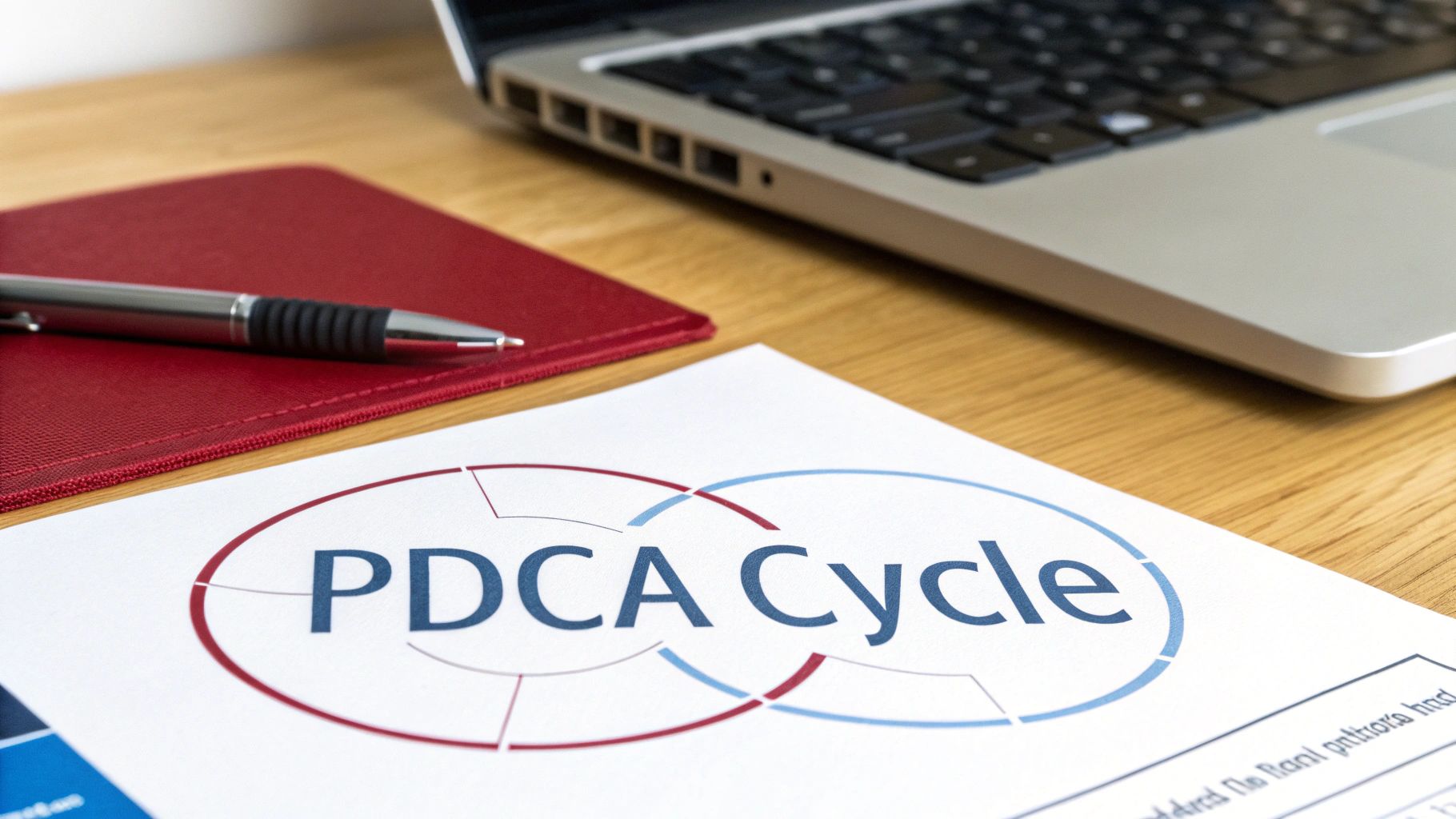
The engine that drives ISO 27001 is the Plan-Do-Check-Act (PDCA) cycle. This isn't a one-and-done project. It’s a living, breathing process of strategy, implementation, review, and refinement that keeps your security sharp and ready for whatever new threats come your way. It’s what ensures your ISMS evolves right alongside your business.
Here’s a simple breakdown of how this cycle works:
- Plan: This is where you map everything out. You define the scope of your ISMS, write your security policies, hunt down the risks, and set crystal-clear objectives.
- Do: Now you put the plan into action. This means rolling out the controls, procedures, and technologies you decided on to tackle the risks you found.
- Check: Time to step back and see how it’s all going. You’ll review the performance of your ISMS, run internal audits, and monitor key security metrics to check if your controls are actually working as intended.
- Act: Based on what you found in the 'Check' phase, you take action. This is all about making improvements, fixing weak spots, and fine-tuning your processes to make your security even stronger.
This cyclical approach is precisely what makes an ISO 27001-certified ISMS so powerful. It’s built for constant adaptation, not a "set it and forget it" mindset.
Breaking Down the Key Clauses
The ISO 27001 standard is built around a series of clauses that spell out the non-negotiable requirements for your ISMS. These clauses give you the high-level architecture—they tell you what you need to do, but cleverly leave the how up to you. This gives you the flexibility to build a system that fits your organisation perfectly.
Let's look at a few of the most important ones:
- Clause 4 Context of the Organisation: This forces you to take a hard look at your business and the world around it. Who are your stakeholders—clients, regulators, employees—and what security expectations do they have of you?
- Clause 5 Leadership: This one is absolutely critical. It demands real, demonstrable commitment from the very top. Your leaders need to set the tone, provide the resources, and make sure the ISMS is woven into the company's strategic direction.
- Clause 6 Planning: Here’s where you get into your risk assessment. You’ll identify potential threats to your information, figure out how likely they are to happen and what the damage would be, and then map out a plan to treat those risks.
- Clause 8 Operation: This is the "doing" part. It’s all about implementing your risk treatment plan and the specific controls you’ve chosen to put in place to protect your assets.
These clauses all lock together to build a complete management system. You can explore a detailed breakdown of what this involves in our comprehensive guide to information security management systems.
An ISMS aligned with ISO 27001 isn't just about firewalls and software. It's a holistic management framework that integrates people, processes, and technology to systematically protect your information's confidentiality, integrity, and availability.
Annex A: Your Security Controls Toolkit
If the clauses are the "what," then Annex A is the "how." It provides a massive list of 114 potential security controls, neatly organised into 14 categories. This isn't a mandatory checklist where you have to tick off every single box. Instead, it’s a catalogue of best practices you can pick and choose from based on your specific risks.
Think of it like a mechanic's toolkit. You wouldn't use every single tool for every job; you select the right wrench or screwdriver for the task at hand. Your risk assessment (from Clause 6) is what tells you which Annex A controls are the right ones for your organisation.
Let's see this in action.
Example: Access Control in the Real World
Imagine a marketing agency that handles highly sensitive client campaign data.
- The Risk: An unauthorised employee—let's say someone from the finance team—could accidentally access and leak a confidential pre-launch campaign strategy. This would cause massive reputational damage to their client.
- The Annex A Control: The agency would turn to A.9 Access Control. This section has specific controls like A.9.2.3 Management of privileged access rights and A.9.4.1 Information access restriction.
- The Implementation: Using these controls as a guide, the agency implements a "least privilege" policy. In simple terms, the finance employee's user account is set up to only access financial systems. They have zero access to the network folders where marketing campaign data is stored. Only verified members of the marketing team are granted access.
This practical application turns an abstract rule into a powerful, real-world safeguard. You're not just writing policies for the sake of it; you're building the digital equivalent of giving specific keys to specific employees for very specific rooms. It’s this structured approach, guided by the ISO 27001 framework, that builds a foundation of security that is both robust and auditable—paving your way to a successful certification.
The Real-World Benefits of ISMS Certification
An information security management systems certification is so much more than a fancy certificate to hang on the wall. Think of it as a powerful catalyst for growth, turning your theoretical security policies into real, bottom-line results. Let's move past the framework itself and dig into the tangible advantages that will directly impact your operations, reputation, and revenue.
These benefits aren't just abstract ideas; they're measurable improvements you'll see across every part of your business. We can break these powerful outcomes down into three key areas: building unbreakable client trust, driving operational excellence, and simplifying your compliance headaches.
Forging Unbreakable Client Trust
Trust is the absolute bedrock of any business relationship. We all know that a single data breach can shatter a company's reputation overnight, and because of this, clients are more discerning than ever. They need solid proof that their sensitive information is genuinely safe with you.
This is where certification becomes your greatest asset. It’s like a universal language for security, instantly showing your commitment to protecting data. Picture this: a potential client is weighing you up against a competitor. You can show them an internationally recognised ISO 27001 certificate, while your competitor can only offer verbal assurances. That certificate often becomes the single deciding factor that gets the deal over the line.
For Australian small and medium-sized businesses (SMBs), ISO 27001 certification is fast becoming an essential tool for locking down information security. It gives SMBs a structured way to find and fix security risks and put the right controls in place to protect sensitive data. The process usually takes a few months, depending on the business's size and complexity. While certification isn't legally mandatory in Australia, it has become a commercial necessity for anyone wanting to compete in security-conscious markets or win government contracts. You can find out more about the importance of ISO 27001 for Australian SMBs in 2025.
Ultimately, this verified trust opens doors to larger, more lucrative contracts, especially with government bodies and big corporations that often have certification as a non-negotiable requirement.
Driving Operational Excellence
One of the best things about an ISMS is how it shifts you from a reactive, chaotic security posture to a proactive, streamlined one. Before certification, a lot of organisations are in a constant state of "security firefighting"—patching holes as they pop up and reacting to incidents only after the damage is done. It’s an exhausting, inefficient, and incredibly risky way to operate.
A certified ISMS forces a complete change in mindset. It makes you systematically identify, assess, and treat risks before they can be exploited. This structured approach weaves security into the fabric of your daily operations, making it a shared responsibility instead of just "the IT department's problem."
This leads to some serious operational wins:
- Fewer Incidents: By getting ahead of risks, the number and severity of security incidents drop dramatically.
- Clearer Processes: Everyone knows their role in information security, which cuts down on confusion and human error.
- Better Resilience: When an incident does happen, you have clear plans for response and recovery, minimising downtime and financial hits.
A core outcome is the implementation of solid strategies to prevent data breaches and protect what matters most. This proactive stance doesn't just protect your assets; it frees up your team from constantly putting out fires.
Business Transformation Before and After ISMS Certification
The table below gives a clear snapshot of just how powerful the business transformation can be when an organisation moves from an uncertified state to achieving ISMS certification.
| Business Area | Before ISMS Certification (Uncertified) | After ISMS Certification (Certified) |
|---|---|---|
| Risk Management | Ad-hoc and reactive. Risks are usually dealt with only after an incident, leading to high-impact disruptions. | Systematic and proactive. Risks are continuously identified, assessed, and treated before they can cause harm. |
| Client Perception | Trust is built on promises and reputation alone. Often face long security questionnaires from potential clients. | Trust is verified by a third party. Certification acts as a "passport" to new business, speeding up sales cycles. |
| Operational Processes | Security procedures are inconsistent and undocumented. This leads to frequent human error and vulnerabilities. | Processes are standardised, documented, and followed. Security is integrated into daily operations, creating a strong culture. |
| Incident Response | Unplanned and chaotic. Incidents cause maximum disruption, extended downtime, and significant reputational damage. | Planned and rehearsed. A clear incident response plan minimises impact, ensures rapid recovery, and maintains confidence. |
| Compliance | Meeting regulatory requirements is a manual, stressful, and often duplicated effort for each different standard. | Compliance is baked into the ISMS. A single framework helps demonstrate adherence to multiple regulations efficiently. |
| Leadership Involvement | Security is seen as a technical or IT issue with minimal executive oversight. | Security is recognised as a critical business issue. Leadership is actively involved in setting policy and providing resources. |
This table really highlights the shift from a reactive, vulnerable position to one of proactive control and strategic advantage.
Simplifying Regulatory Compliance
Trying to navigate the complex web of legal, statutory, and contractual requirements can be a massive headache. From the Privacy Act here in Australia to various industry-specific standards, the compliance burden is huge and only getting bigger.
An ISMS built on ISO 27001 gives you a single, unified framework to manage all these obligations efficiently. The standard is so comprehensive that the controls you put in place to get certified will often tick the boxes for many other regulations as well.
Instead of tackling each regulation as a separate project, you can map them all back to your central ISMS. This "implement once, comply with many" approach saves a phenomenal amount of time, effort, and money.
When auditors or regulators come knocking, there's no last-minute scramble to find evidence of compliance. Your certified ISMS is a complete, well-documented system that clearly demonstrates your due diligence. This doesn't just streamline audits; it dramatically reduces the risk of non-compliance penalties, which can be crippling. Certification proves your security program isn't just an idea—it's a managed, measured, and continuously improving reality.
Your Step-by-Step Roadmap to Certification
Getting an information security management systems certification can feel like a huge mountain to climb, but it's much more approachable when you break it down into manageable steps. This roadmap will walk you through the entire journey, stage by stage. With a clear plan, you can navigate the path to certification with confidence.
Think of it like getting a ship ready for a long voyage. You wouldn't just cast off the lines and hope for the best. A successful trip needs meticulous planning, and the same goes for achieving ISO 27001 certification.
Stage 1: Defining Your Scope
The very first step is to chart your course. In this scoping phase, you'll decide exactly which parts of your organisation the ISMS will cover. Will it be the entire company? Just the product development team? Or maybe a single, critical business service?
Getting the scope right is crucial. If you make it too broad, you’ll stretch your resources thin trying to protect everything at once. But if it’s too narrow, you might leave your most valuable information completely exposed.
To nail this down, you need to think about:
- Information Assets: What are your crown jewels? Pinpoint the sensitive data, systems, and processes that your business absolutely cannot do without.
- Stakeholder Requirements: What do your clients, regulators, and business partners expect you to protect? Their needs will be a huge factor in defining your scope.
- Business Objectives: How does the ISMS support the company's big-picture goals? Aligning your scope with your strategy ensures the whole project delivers real, tangible value.
This initial stage sets the boundaries for everything that follows, making sure your efforts are focused where they count.
Stage 2: Conducting a Thorough Risk Assessment
With your course charted, it’s time to check the weather forecast for potential storms. The risk assessment is the heart of your ISMS. After all, you can't protect your information if you don't know what's threatening it.
A proper risk assessment isn't just guesswork; it's a methodical process of identifying, analysing, and evaluating potential threats to your key information assets. You'll be looking for any weak spots in your people, processes, or technology that a threat could exploit.
The process boils down to asking a few critical questions:
- What could realistically go wrong? (e.g., a server crash, a clever phishing attack, a simple employee mistake)
- What are the odds of it actually happening?
- If it did happen, how badly would it hurt the business?
By combining the likelihood of a threat with its potential impact, you can start to prioritise your risks. This means you can focus your time and money on tackling the biggest dangers first, instead of trying to fix every little thing at once. It’s the difference between preparing for a cyclone versus a bit of light rain.
A solid risk assessment is the foundation of any successful ISMS. It turns security from a blind guessing game into a strategic, data-driven discipline, making sure your controls are directly aimed at real-world threats.
Stage 3: Implementing Necessary Controls
Now you know where the storms are brewing, it's time to reinforce the ship. The implementation stage is where you bring your risk treatment plan to life. Based on your risk assessment, you'll choose and deploy the right security controls from ISO 27001’s Annex A.
This is the most hands-on part of the whole journey. It involves putting the right policies, procedures, and technical safeguards in place to bring your identified risks down to an acceptable level.
This could mean doing a range of things, such as:
- Writing a clear access control policy so employees can only see the data they need to do their jobs.
- Rolling out encryption for sensitive data, whether it's sitting on your servers or flying across the network.
- Running security awareness training to help your team spot and report social engineering attacks.
- Creating a formal incident response plan so everyone knows exactly what to do when a breach happens.
The goal isn't to eliminate every single risk—that's simply not possible. It's about making smart, informed decisions to manage risk effectively and build layers of defence that make your organisation more resilient.
The infographic below shows how all these efforts feed into the core benefits that matter most to your business: building client trust, improving operations, and staying compliant.

As you can see, the controls you implement aren't just technical busywork; they directly build the trust and stability that clients and regulators demand.
Stage 4: Running an Internal Audit
Before the official inspectors come aboard, you need to run your own drills. The internal audit is your dress rehearsal. It’s a vital self-check to answer two questions: are we doing what our policies say we do, and is it actually working?
An internal audit is done by someone in your organisation (or a consultant) who is completely independent of the area being audited. They'll go through your documentation, talk to staff, and test your controls to see if your ISMS is really meeting the ISO 27001 standard.
This is your golden opportunity to find and fix problems before the external auditors show up. It's a fantastic learning experience that helps you spot any "nonconformities"—areas where you're falling short—and find ways to improve. A thorough internal audit is one of the best signs that you're genuinely ready for certification.
Stage 5: The External Certification Audit
This is it—the final inspection before you're officially cleared to set sail. The external certification audit is carried out by an accredited, independent certification body. Their job is to perform an impartial, deep-dive assessment to confirm your ISMS meets every single requirement of ISO 27001.
The process is usually broken into two parts:
- Stage 1 Audit: Think of this as a documentation review. The auditor checks that you have all the necessary policies, procedures, and records in place. They’ll confirm your scope is sound and that your risk assessment process makes sense. This stage is all about flagging any major gaps that need fixing.
- Stage 2 Audit: This is the main event. The auditor returns to get into the details, testing your controls to see if they’re actually implemented and working effectively. They will interview your team and gather evidence to make sure your ISMS is a living, breathing part of your organisation.
If the auditor is satisfied that your ISMS meets all the standard’s requirements, they will recommend you for certification. This final step is the culmination of all your hard work. For those wanting a closer look at this final hurdle, you can learn more about what a full ISO 27001 audit involves. Passing this audit is the ultimate proof of your commitment to security, officially validating the strength of your entire program.
How to Sidestep the Common Certification Pitfalls
Getting your organisation certified is a serious undertaking. Along the way, you'll find there are a handful of common, predictable traps that can completely derail even the best-laid plans. Knowing what these are ahead of time is your best defence.
Think of it as learning from everyone else’s mistakes. By understanding where others have stumbled, you can save your team a mountain of time, money, and frustration. These aren't unique, exotic problems; they're the same few issues that trip people up time and time again. Let’s pull them apart and give you the practical advice to navigate around them.
Pitfall 1: The Goldilocks Dilemma of Scoping
One of the very first things you have to do is decide on the scope of your ISMS, and it’s arguably where most projects go wrong. I call this the "Goldilocks" problem: your scope can be too big, too small, or, with careful planning, just right. Botch this, and the consequences ripple through the entire project.
What does "too broad" look like? Imagine a company trying to certify every single department and process right out of the gate. They end up spending months documenting non-critical activities and trying to force-fit complex security controls onto low-risk data. The project quickly becomes an unwieldy monster. Resources get spread paper-thin, and the team burns out long before they’ve secured what actually matters.
On the flip side, a scope that's too narrow can be just as dangerous. I've seen a software company focus its ISMS solely on the live production environment, completely ignoring the development and testing servers. So while their product was locked down tight, an attacker could waltz into an insecure test server, steal source code, and find the exact vulnerabilities to exploit later. They bolted the front door but left the back door wide open.
Actionable Advice: Let your "crown jewels" guide your scope. Sit down and figure out what your most critical information assets are and which business processes rely on them. A well-defined scope is focused, achievable, and built to protect what's most valuable to your business.
Pitfall 2: The Illusion of Executive Buy-In
So many teams think they have leadership commitment. They get a signature on a budget or a quick mention in a company-wide meeting and tick the "buy-in" box. But this is often just passive agreement, not the active, visible sponsorship you genuinely need. Without a real champion at the top, an ISMS project is quickly dismissed as just another "IT thing."
When that happens, the project starves. Department heads drag their feet on assigning their best people to help. Simple requests for process changes are met with a wall of resistance. Before you know it, the whole initiative has stalled because security is seen as a cost centre, easily shoved aside by more immediate business demands.
To avoid this, you need more than just a signature; you need an executive who is personally invested.
- Educate Upwards: Forget the technical jargon. Talk their language. Frame the certification in terms of competitive advantage, risk reduction, and opening up new revenue streams.
- Assign Clear Responsibility: Leadership needs to formally assign security roles, making it crystal clear that protecting information is everyone's job, not just IT's.
- Demand Active Participation: The leadership team should be in the room for key decisions, reviewing progress, and reinforcing the importance of the ISMS across the whole organisation.
This level of engagement is what turns a departmental task into a core strategic objective.
Pitfall 3: Treating Certification as a Finish Line
This is probably the most common mistake of all. Teams see the information security management systems certification as a project with a start and an end date. They grind for months, pass the audit, get the certificate, and then pop the champagne. The sigh of relief is almost audible. Then, everyone quietly goes back to their old ways of working.
This "set and forget" mindset is a recipe for disaster. An ISMS isn't a project you complete; it's a living, breathing part of your organisation that needs constant attention. Threats evolve, your business changes, and new tech brings new risks. An ISMS that isn't regularly monitored, reviewed, and improved will become obsolete faster than you think.
An ISMS is a continuous cycle, not a destination. Achieving certification is really just the beginning of your security journey, not the end. It’s proof that your system is working today, but it's the ongoing commitment that keeps you secure tomorrow.
Just look at the explosion in the global ISO 27001 certification market. It’s a clear sign of how vital this ongoing commitment has become. The market, which includes Australia, was valued at USD 18.59 billion in 2025 and is forecast to hit a staggering USD 74.56 billion by 2035—that’s a compound annual growth rate of 15.2%. This rush is driven by the need to comply with tightening regulations and the growing demand for certified partners in government and enterprise contracts. You can find more insights about the growing ISO 27001 market on businessresearchinsights.com.
To steer clear of this trap, bake the Plan-Do-Check-Act cycle into your company's DNA. Schedule regular risk assessments, run your own internal audits, and hold proper management reviews. This ensures your ISMS stays effective and aligned with where the business is heading. If you can avoid these common mistakes, you’re not just setting yourself up to get certified; you're building a lasting culture of security.
Your Top Questions About ISMS Answered
Diving into an information security management systems certification can feel like a massive undertaking, and it's completely normal to have questions swirling around. Let's cut through the jargon and get straight to the practical answers you need as an Australian business owner. We’ll tackle the big questions head-on.
What’s the Real Cost of ISO 27001 Certification in Australia?
This is always the first question, and the honest answer is: it really depends. There's no single price tag. The final cost is a mix of factors unique to your business—your size, the complexity of your operations, and how solid your current security is.
Think of it like getting a custom suit made. The price depends on the fabric, the intricacy of the design, and the tailor's expertise. Getting certified is similar, and your investment will generally be split across a few key areas.
Here’s a realistic look at where the money goes:
- Consulting Fees: Bringing in an expert to guide you is often the biggest part of the budget. They’ll help with everything from risk assessments to preparing for the final audit. It might seem like a big expense, but their experience can save you a fortune by helping you avoid common, costly mistakes.
- Audit Costs: The certification body itself charges for the two-stage external audit. These fees vary between auditors, so it’s smart to shop around and get a few quotes.
- Internal Resources: Don't underestimate the value of your team's time. Your people will be deep in the trenches implementing controls, writing policies, and taking part in audits. This is a very real cost that needs to be factored in from day one.
- New Tools and Tech: Your risk assessment might reveal gaps that need plugging. This could mean investing in new security software, hardware, or specific training programs to get everyone up to speed.
For a small to medium-sized business in Australia, you should realistically budget anywhere from $25,000 to over $70,000. Of course, larger or more complex organisations will be looking at a much bigger investment.
How Long Does This Whole Certification Process Take?
Time is money, right? While every business's journey is different, a good rule of thumb is to plan for the process to take between 6 to 18 months. The biggest things influencing this timeline are your company’s size and, crucially, how much security work you’ve already done.
A small, nimble company that already has some good security habits might get it done in under a year. On the flip side, a larger organisation with tangled processes and next to no documentation is going to be on the longer end of that scale.
The biggest time sink isn’t just plugging in new technology. It’s changing how people work and building a genuine security-first culture. That human element takes time, patience, and a lot of reinforcement.
Here’s a rough breakdown of the timeline:
- Phase 1: Scoping and Planning (1-2 months): This is where you draw the map—defining the scope, getting the bosses on board, and creating a solid project plan.
- Phase 2: Risk Assessment & Control Selection (2-4 months): The deep dive. You’ll be identifying and analysing all your information security risks.
- Phase 3: Implementation (3-9 months): The heavy lifting. This is where you roll out new policies, procedures, and technical controls. It’s the longest phase for a reason.
- Phase 4: Internal Audit & Review (1-2 months): Think of this as your dress rehearsal. You'll run your own audit to find and fix any problems before the real thing.
- Phase 5: External Audits (1-2 months): The final showdown—the Stage 1 and Stage 2 audits conducted by your chosen certification body.
Trying to rush this is a classic mistake and often leads to a failed audit. A steady, methodical pace will always win the race.
Great, We're Certified. Now What?
Getting your information security management systems certification is a fantastic achievement, but it’s really the start of a new chapter, not the end of the story. Certification isn't a "set and forget" plaque for the wall; it's a living, breathing commitment to keeping your security sharp.
To keep that certificate valid, you’ll enter a three-year cycle. Your certification body will pop back in periodically to make sure your ISMS is still running effectively and that you're genuinely focused on continuous improvement.
This cycle usually looks like this:
- Year 1 Surveillance Audit: About a year after you get certified, an auditor will conduct a smaller "check-up" audit to make sure you're still on track.
- Year 2 Surveillance Audit: Another check-up at the 24-month mark, where they’ll look at different parts of your ISMS to ensure nothing has slipped.
- Year 3 Recertification Audit: At the end of the three years, you’ll go through a full recertification audit, which is pretty similar to the initial one. Pass, and your certificate is renewed for another three years.
This cycle is what keeps your ISMS from becoming a dusty binder on a shelf. It forces you to keep security top-of-mind and adapt to new threats and business goals.
Can We Get Certified Without Hiring an External Consultant?
It’s a fair question, especially when you’re watching the budget. The short answer is yes, it’s possible to do it yourself. The more important question is whether it's a good idea.
Going the DIY route means you need some serious in-house expertise, a huge time commitment, and someone who can navigate the dense language of the ISO 27001 standard. If you're lucky enough to have someone on your team who's led a certification project before, you might be in with a shot.
For most businesses, though, trying to go it alone is a big gamble:
- Misreading the Standard: The standard can be tricky and is open to interpretation. A good consultant knows exactly what auditors are looking for and how to translate the requirements into practical actions.
- Wasting Time and Money: Without an experienced guide, it’s easy to get lost in the weeds, implementing controls you don't actually need for your specific risks.
- Failing the Audit: The cost of a failed audit—both in money and in morale—can easily wipe out any savings you made by not hiring a consultant in the first place.
Think of an external consultant as your expert guide or sherpa. They know the path, they can spot the pitfalls from a mile away, and they make sure your journey is as smooth and efficient as possible. Their outside perspective is invaluable and dramatically boosts your chances of passing the first time around.
Ready to navigate the certification process with an expert in your corner? At Anitech, we specialise in guiding Australian small businesses through every step of ISO 27001 certification. With our 100% success rate, we help you build a robust ISMS that not only gets you certified but gives you a powerful competitive edge. Find out how we can simplify your journey at https://iso-27001.com.au.
Recent Comments