

An effective information security policy isn't just a document; it's the bedrock of your entire defence against cyber threats. It gives you a structured way to protect your company's most vital assets—your data, systems, and networks—from both simple human error and sophisticated external attacks. This isn't about ticking a compliance box. It's about creating a clear, actionable plan to prevent financial loss and safeguard your reputation.
Why a Security Policy Is Your First Line of Defence
Operating without a formal information security policy is a massive gamble. We’re not talking about creating more red tape; this is about building a strategic framework for survival. The threats businesses face are growing more frequent, more targeted, and more severe every single day, yet so many companies are still flying blind.
A well-crafted policy is your first and most critical line of defence. Think of it as the master blueprint for your company's security. It clearly defines the rules of the road for everyone, from the CEO down to the newest hire, on how to handle sensitive information properly.
The Soaring Cost of Unpreparedness
The consequences of inaction are brutal. A data breach is not just a technical glitch; it's a business catastrophe. It can lead to financial ruin, permanent damage to your brand, and eye-watering regulatory fines. The statistics paint a grim picture, with the average cost of a data breach now in the millions.
For small businesses, the blow is often much worse. Without the deep pockets of a large corporation, a single major security incident can be an extinction-level event.
A policy transforms security from a vague, abstract idea into a concrete set of actions. It clarifies who is responsible for what, sets firm rules for accessing critical data, and lays out a plan for when things inevitably go wrong. Without one, you're just guessing in a crisis. With one, you have a clear, actionable playbook.
A Growing Threat in Australia
This isn't some far-off problem you read about happening overseas; it's right here in our backyard. The threat level in Australia is escalating fast, which makes having a robust information security policy more critical than ever. The Office of the Australian Information Commissioner (OAIC) recently reported 1,113 data breach notifications in just one year. That's a staggering 25% increase from the previous period.
This is the highest yearly total since the Notifiable Data Breaches (NDB) scheme became law, and it sends a clear message. You can explore more data on this trend and what it means for Australian businesses.
The surge highlights a crucial reality: cybercriminals are actively and successfully targeting local businesses of all sizes. Relying on luck or a few ad-hoc security tools is no longer a viable strategy.
More Than a Document—It’s a Strategic Shield
Ultimately, your security policy is so much more than a file sitting on a server. It's a strategic shield that actively protects your most valuable assets. A strong policy helps you:
- Prevent Financial Loss: By putting controls like access management and incident response plans in place, you directly lower the risk of a costly breach.
- Protect Your Reputation: Showing you take security seriously builds immense trust with clients, partners, and customers. A public breach can destroy that trust in an instant.
- Avoid Regulatory Fines: With regulations like the NDB scheme, failing to protect data can lead to serious financial penalties.
- Create a Security-Conscious Culture: The policy is also a powerful educational tool. It turns every employee into an active participant in defending the organisation.
This guide provides an ISO 27001–aligned information security policy template designed to be a practical, no-nonsense solution. It’s your starting point for building a truly resilient and secure business.
Putting Your Information Security Policy Template to Work
Having a template is a brilliant first step, but its real value comes from how you bring it to life. This is the point where an abstract security concept becomes a practical, powerful tool for your business. It's time to shift from theory to action, transforming a standard document into a customised shield that fits your organisation like a glove.
The process can feel overwhelming, but we're here to cut through the noise. Forget the dense jargon and confusing compliance-speak. Let's break down the most important parts of a solid information security policy template so you can easily understand and adapt them for your own needs.
Ready to dive in? Grab our ISO 27001–aligned template now and you can follow along.
Customising Your Policy Core Components
First things first, you need to tailor the template to your unique business operations. A generic policy offers only generic protection; a customised one provides a targeted defence exactly where you need it most. Let's look at the key areas you'll want to focus on.
The Scope of the Policy
This section is all about setting clear boundaries—defining exactly what and who the policy covers.
- For a small consulting firm, the scope might be tightly focused on protecting client data on company laptops, in cloud apps like Microsoft 365, and during remote work. You’d want to explicitly name the types of sensitive client info, like strategic plans or financial projections, that fall under the policy.
- For a growing e-commerce store, the scope would be much broader. It needs to cover the web servers hosting the shop, the payment processing gateway, customer databases packed with personal information, and even the warehouse management system.
Access Control
This is your rulebook for ensuring the right people have access to the right information—and absolutely no one else. The principle of least privilege is your guiding star here. It’s simple: only give people the minimum access they need to do their job.
- Consulting Firm Example: In a real-world scenario, access to a specific client’s project folder in SharePoint should be locked down to only the consultants assigned to that project. The finance manager gets access to billing systems but has no business seeing the client's project files.
- E-commerce Store Example: Customer service reps definitely need access to order information to handle inquiries. But they should never be able to access or change the website's source code. That level of permission is strictly for authorised developers.
Incident Response
When a security incident happens—and let's be realistic, it probably will—this section is your playbook for minimising the damage.
- Consulting Firm Example: The plan needs to detail the immediate steps an employee must take if a laptop is lost or stolen. This should include who to contact (like the IT manager), how to trigger a remote wipe of the device, and the exact process for notifying clients whose data might have been on it.
- E-commerce Store Example: An incident response plan for an online store would map out the procedure for handling a data breach. This means isolating the affected server immediately, kicking off a forensic analysis, and following the legal steps for notifying customers under Australia's Notifiable Data Breaches (NDB) scheme.
Visualising the Protective Power of Policy
It helps to think of a strong policy as a shield. It actively safeguards your business from the most common and damaging results of a security incident. This image really drives home how it protects your finances, reputation, and legal standing.
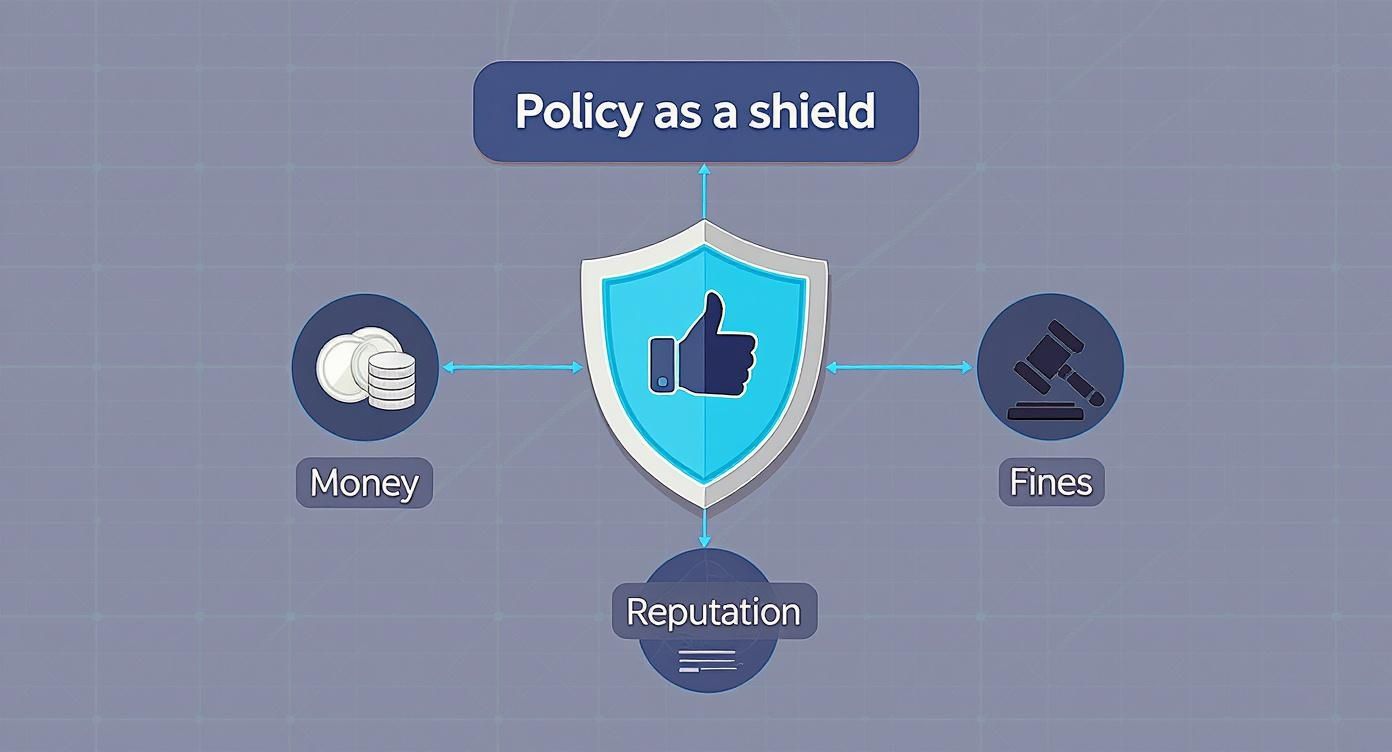
This isn't just a nice graphic; it's the truth. A well-implemented policy directly reduces financial loss, prevents reputational harm, and helps you steer clear of hefty regulatory fines.
Mapping Your Policy to ISO 27001 Standards
One of the biggest advantages of using a structured information security policy template is that it's already aligned with global best practices like ISO 27001. This isn't just for businesses chasing a formal certification; it gives you a proven, world-class framework for building robust security from the ground up.
Making the connection between your policy clauses and specific ISO 27001 controls demystifies compliance. It shows you're not just creating rules arbitrarily but are building a system that meets an internationally recognised standard of excellence.
This alignment makes a complex standard feel much more achievable and gives you a clear roadmap for strengthening your defences. It also signals a serious commitment to security, which can be a massive advantage when building trust with clients and partners. If you're looking for more inspiration, you can find a great collection of information security policy examples and templates to see how others have approached this.
To make this even clearer, the table below shows how key sections of our template map directly to the relevant ISO 27001 Annex A controls.
Mapping Policy Sections to ISO 27001 Annex A Controls
This table shows how key sections of the template align directly with specific controls from ISO 27001's Annex A, making compliance much simpler for your business.
| Policy Section | Corresponding ISO 27001 Annex A Control | Brief Explanation |
|---|---|---|
| 5. Information Security Policies | A.5.1.1 Policies for Information Security | This is the foundation. Your main policy document fulfils this by defining management's direction and commitment to information security. |
| 6. Organisation of Information Security | A.6.1.1 Information Security Roles and Responsibilities | Your policy's section on roles directly addresses this by defining who is accountable for specific security tasks. No more guessing games. |
| 8. Asset Management | A.8.1.1 Inventory of Assets | The policy should require you to create and maintain an asset inventory—a core requirement for knowing what you actually need to protect. |
| 9. Access Control | A.9.4.1 Information Access Restriction | This entire section of your policy puts the principle of least privilege into action, making sure data is only accessible to authorised people. |
| 12. Operations Security | A.12.4.1 Event Logging | By requiring that system logs are recorded and reviewed, your policy supports this control, which is crucial for spotting suspicious activity. |
| 16. Information Security Incident Management | A.16.1.7 Information Security Incident Management | The incident response plan in your policy directly corresponds to this control, ensuring you have a prepared and organised response to breaches. |
This mapping isn't just a box-licking exercise; it's a strategic tool. When a potential client or an auditor asks how you manage access control, you can point directly to your policy section and the international standard it lines up with. That builds instant credibility.
Of course, an effective policy starts with knowing what you're protecting. Before setting the rules, you must identify your vulnerabilities. To help with this critical first step, our team has also put together a comprehensive cybersecurity risk assessment template that goes hand-in-hand with your new policy. A proper risk assessment will guide how you customise each section, ensuring your policy tackles the threats that matter most to your business.
Assigning Ownership for Real Accountability
Right, you’ve done the hard work of customising your information security policy template. You’ve mapped the clauses to the ISO 27001 controls and shaped them to fit how your business actually works. But a policy without a clear owner is just a document gathering dust on a server. Its real power comes from people. It's about clear accountability that turns words on a page into daily, protective actions.
This is where we shift from the 'what' of the policy to the 'who' of responsibility.
A policy only works when everyone knows the part they play. And accountability isn't about pointing fingers when things go wrong; it’s about empowering your team to be proactive defenders of your company's information. Without someone clearly in charge, critical security tasks inevitably fall through the cracks, leaving dangerous gaps an attacker would love to find.

Let’s walk through a practical playbook for assigning these crucial security roles and responsibilities. This works even if your team is small and people need to wear multiple hats.
Defining Key Security Roles
For most small businesses, the thought of hiring a dedicated Chief Information Security Officer (CISO) is a non-starter. The good news? You don't need one. You just need to assign the necessary responsibilities to existing team members, as long as everyone knows exactly what's expected of them.
The single most critical role to assign is the Information Security Manager. Think of this person as the central hub for all things security. They champion the policy, oversee its implementation, and report on how well it's working back to the leadership team.
In a typical small business, this could be:
- The IT Manager or a senior person on your tech team.
- An Operations Manager who’s already across risk and compliance.
- Even the business owner themselves, especially in the early days.
The crucial part is that this person has the authority to actually enforce the policy and is given the time to manage their security duties properly. This isn't a side-of-desk job; their responsibilities should be formally written into their job description.
Don’t just casually ask someone to 'keep an eye on security.' You need to formalise the role of Information Security Manager. This one action creates a clear line of accountability and guarantees security has a dedicated champion inside your business.
Where the Buck Stops: The Business Owner’s Role
Even with a great Information Security Manager, some duties are so critical they have to stay with the business owner or senior leadership. These are the responsibilities you simply can't delegate, the ones that set the security tone from the very top.
- Ultimate Accountability: At the end of the day, the owner is accountable for the company's security posture. They must be the one to formally approve the information security policy and any major changes to it.
- Resource Allocation: They hold the purse strings. It's their job to provide the budget and resources needed to actually implement and maintain the security controls you've just documented.
- Driving the Security Culture: Leadership's attitude towards security is infectious. The owner has to visibly support and follow the policy, showing everyone that security is a core business value, not just an IT chore.
Clarifying Every Employee's Part to Play
Cybersecurity is a team sport, and every single employee has a position on the field. Your policy needs to state in no uncertain terms that all staff are responsible for protecting the company's information assets.
This can't be a vague, throwaway line. You need to break it down into specific, actionable duties. Make these universal responsibilities a standard part of your onboarding process for every new hire.
Core Employee Security Duties:
- Data Handling: Following the rules for how to classify, store, and share sensitive information.
- Password Management: Using strong, unique passwords and enabling multi-factor authentication (MFA) wherever possible.
- Phishing Awareness: Knowing how to spot and report suspicious emails immediately—without clicking links or opening attachments.
- Incident Reporting: Speaking up promptly about any suspected security incident, no matter how small it seems. A fast response is everything, so you’ll want a clear procedure. To help structure this, our team has created a guide to developing a robust incident response plan template.
By defining these roles from the top down, you get rid of ambiguity. Everyone understands their personal contribution to keeping the company safe.
Getting Formal Management Approval
Once you’ve defined all the roles and responsibilities, there's one final step before you can go live: getting formal management sign-off. This isn't just a rubber-stamp exercise. This is the moment your policy goes from being a well-intentioned draft to an official company directive with real authority.
To get that crucial buy-in, you have to present the policy as a business enabler, not a cost centre or a list of restrictive rules. Frame your presentation around the incredible value it brings to the entire organisation.
Focus on how the policy:
- Reduces Business Risk: Explain how specific controls directly lower the risk of a costly data breach, operational downtime, and financial loss.
- Builds Client Trust: Stress that a formal, ISO 27001-aligned policy is a massive signal to clients that you take their data security seriously. This can be a huge competitive advantage.
- Supports Business Growth: A strong security posture can unlock new opportunities, particularly with larger corporate clients or government contracts that come with strict security requirements.
When leadership sees the information security policy as a strategic asset that protects revenue and builds reputation, getting their enthusiastic approval becomes much, much easier. Their signature makes it official, giving you the mandate you need to roll it out effectively across the business.
Launching and Embedding Your Security Policy
You've crafted a brilliant policy, customised it perfectly, and even secured that all-important leadership sign-off. Now, the biggest temptation is to just attach it to an all-staff email, hit send, and tick it off your to-do list.
That would be a huge mistake. It’s a guaranteed recipe for failure. The rollout is where your policy comes to life—it's the moment it transforms from a document on a server into a living, breathing part of your company culture.
Simply hoping people will read and follow it just won't cut it. To really get security embedded into your daily operations, you need a smart, engaging plan for communication and training. This isn't about lecturing your team; it's about empowering them to become your strongest line of defence.

Beyond the All-Staff Email
A successful launch needs a proper communication strategy. Yes, an all-staff email is a necessary starting point, but think of it as just the opening act. Your real goal is to explain the ‘why’ behind the policy, not just dump the ‘what’ on everyone.
Your initial announcement should set the stage. Frame the policy as a positive move—a collective effort to protect the company, its people, and your clients. After that first email, your next move should be a company-wide meeting.
This meeting isn't for a painful, line-by-line review. It’s a high-level overview to share the policy's purpose, show that management is fully behind it, and tackle any immediate questions. Getting everyone in a room (even virtually) sends a powerful message that security is a priority for the entire business.
From General Awareness to Role-Specific Action
Once everyone gets the big picture, the real work begins: targeted, role-specific training. General security awareness is crucial, but on its own, it’s not enough. For the policy to actually stick, you have to connect the rules to the daily tasks people are already doing.
Generic training sessions are easily forgotten. Effective training uses real-world scenarios that people can relate to.
- For your Sales Team: Don't just drone on about "data protection." Run a session specifically on securing client data in your CRM. Show them the right way to share proposals, highlight the risks of using unsecured public Wi-Fi on the road, and point to the specific policy clauses that govern how they handle prospect information.
- For your Development Team: A session for developers should dive straight into the secure coding practices now required by the policy. Instead of a vague directive, walk them through practical examples of preventing common vulnerabilities like SQL injection or cross-site scripting right there in your company's codebase.
By making the training practical and relevant, you turn abstract rules into concrete actions. This is how you shift people from passive compliance to active, engaged participation.
Building a Security-First Culture
One of the biggest hurdles you'll face is resistance. It rarely comes from a bad place; it's usually because new security rules feel inconvenient or seem to slow things down. Getting past this takes more than just training—it requires a genuine cultural shift.
A strong security culture is one where people instinctively think about the security side of their actions.
Your goal is to make security a shared responsibility, not just an "IT problem." When your team understands that protecting the company is part of their job, they shift from being a potential vulnerability into your most powerful security asset.
So, how do you actually build this?
- Lead by Example: Senior leadership has to visibly follow the policy, no exceptions.
- Reward Good Behaviour: Publicly recognise employees who spot phishing attempts or suggest security improvements.
- Make it Continuous: Security isn't a one-off project. Keep it front-of-mind with ongoing awareness campaigns, regular phishing simulations, and bite-sized security tips in company newsletters.
A crucial part of embedding any security policy is providing solid, ongoing training, as detailed in this helpful Cyber Security Awareness Training Guide. It’s that consistent reinforcement that makes security feel like second nature.
Transforming Your Team into Your Strongest Defence
The threat landscape out there is more dangerous than ever, especially with sophisticated, AI-driven attacks on the rise. We're not talking about the old typo-ridden scam emails anymore; these are highly personalised and incredibly convincing. That's why turning your team into a human firewall is simply non-negotiable.
The Australian cyber threat landscape is particularly challenging, with a major surge in complex attacks. Phishing, ransomware, and supply chain attacks are becoming alarmingly common. In fact, startling data shows that, on average, 1.2% of Australian employees clicked on phishing links each month over the past year—a massive 140% increase from the previous period.
This statistic alone highlights the urgent need for training that actually works. A well-informed team is far less likely to fall for these scams. Consistent, engaging training gives them the skills and confidence to spot and report threats before they can do any real damage. Our in-depth guide offers a wealth of strategies for powerful cybersecurity training for employees that can make a genuine difference.
Ultimately, launching your information security policy template is less about the document and more about the people. By communicating effectively, providing relevant training, and fostering a culture of shared responsibility, you embed security deep within your organisation’s DNA. This proactive approach turns your team from your biggest risk into your greatest strength.
Keeping Your Policy Relevant and Audit-Ready
Your information security policy isn't a "set and forget" document. Many businesses treat it like a project they finish, file away, and then forget about. But think of it more like a garden; it needs constant attention to stay healthy and effective. A policy that was perfect a year ago can quickly become obsolete, leaving you exposed to new threats or non-compliant with new rules.
Keeping your policy alive and breathing is the secret to making it a real shield for your business, not just a piece of paper. This isn't just about ticking a box; it's about building an active management system. It’s this proactive mindset that strengthens your security and ensures you’re always prepared for the tough questions an auditor, a major client, or a regulator might ask. The goal is to move beyond simply having a policy to being able to prove your security is working.
Establishing a Practical Review Cycle
The first step is locking in a predictable review schedule. This is a common tripwire for many small businesses. Without a set rhythm for reviews, your policy is almost guaranteed to gather dust and become irrelevant as your business evolves and new threats pop up online.
Best practice is to schedule a full, comprehensive review at least once a year. Put it in the calendar like any other critical business meeting. But an annual review is just the baseline. Certain events should trigger an immediate policy check-up, no matter where you are in that yearly cycle.
Key Triggers for an Immediate Policy Update:
- A Security Incident: After you’ve contained a breach or a major scare, you need to do a post-mortem. What went wrong? Where do the controls need to be tightened? Your policy has to be updated to make sure it doesn’t happen again.
- Major Business Changes: Launching a new service? Migrating to a new cloud platform? Opening a new office? Any significant operational or IT shift means you need to revisit the policy to make sure it still covers all your bases.
- New Regulations: When new privacy laws or industry rules are introduced, your policy must be updated to reflect these new legal obligations. It's non-negotiable.
This combination of regular and event-driven reviews ensures your information security policy template grows and adapts right alongside your business and the changing threat landscape.
Managing Updates and Version Control
Once you know what needs changing, the update process itself has to be managed properly. A chaotic approach can lead to total confusion, with different versions of the policy floating around and nobody sure which one is the official one. This is where disciplined version control is your best friend.
Every single time you update the policy—no matter how small the tweak—you must update the version number (e.g., from v1.2 to v1.3). Just as importantly, keep a change log right inside the document. This log should spell out what was changed, why it was changed, who signed off on it, and the date.
A meticulous change log and strict version control aren't just good housekeeping; they are vital pieces of audit evidence. It shows an auditor you have a mature, controlled process for managing your security framework, which gives them (and your clients) immense confidence in what you're doing.
This creates a clear historical paper trail, making it easy to see how your security has evolved. It also ensures everyone is always working from the latest, greatest, and most importantly, approved version of the policy.
Communicating Changes to the Team
A policy update is useless if your team doesn't know about it. Any change needs to be clearly communicated to all relevant staff. Don't just save a new version to the shared drive and hope for the best.
Your communication plan should match the scale of the update.
- Minor Updates: For small tweaks, a clear all-staff email summarising the changes and linking to the new document might be all you need.
- Major Changes: For a big overhaul—like rolling out a new policy for remote work security—you'll need to do more. Consider running a short training session or a "lunch and learn" to walk everyone through the new rules and answer their questions on the spot.
The trick is to explain why the changes were made. When people understand the reasoning behind a new security rule, they are far more likely to buy into it and follow it correctly.
Gathering Your Evidence for Audits
The final piece of this puzzle is being perpetually ready for an audit. An auditor's job isn't just to see if you have a policy, but to verify that you actually do what it says. This means you need to be constantly collecting proof—or "artefacts" as they're often called—that your policy is being enforced in the real world.
Waiting until you get an audit notice to start scrambling for evidence is a recipe for disaster. The smart move is to collect these artefacts as part of your day-to-day work. Think of it as building your audit portfolio over time.
Here's a straightforward checklist of the essential evidence you should be gathering to prove your policy is a living, working part of your business:
- Training Completion Records: Keep a simple register showing who has completed security awareness training and when. This is gold for proving you’re meeting your training obligations.
- System Access Reviews: Hold onto the records from your periodic reviews of who has access to what. This shows you’re enforcing the principle of least privilege from your access control policy.
- Incident Response Reports: Document every security incident, even the small ones, along with how you resolved it. These reports are powerful proof that your incident response plan actually works.
- Vulnerability Scan Results: File away the reports from your regular network and system scans. Crucially, also keep a record of how you fixed any weaknesses you found.
- Internal Audit Findings: Document the results of your own internal checks on policy compliance, including any issues found and the steps taken to correct them.
- Management Review Meeting Minutes: Keep the minutes from any meeting where senior leadership discussed the security policy's performance. This proves management is engaged and committed.
By systematically collecting these artefacts, you transform an audit from a dreaded ordeal into a simple exercise of presenting your well-organised evidence. This proactive approach means you're always ready to demonstrate compliance and prove that your information security policy is a real, enforced part of your company culture.
Your Top Information Security Questions Answered
Diving into the world of formal security policies can feel a bit overwhelming. You've got the information security policy template, which is a great start, but now you're facing the real-world challenge of actually using it. Let's break down some of the most common questions from business owners, with straight-to-the-point answers.
How Often Should We Review Our Information Security Policy?
As a rule of thumb, plan a full, top-to-bottom review at least once a year. But don't just set a calendar reminder and forget about it.
Think of your policy as a living document. It needs to adapt. You should be updating it immediately after a security incident, when you make a big change to your IT setup (like moving to a new cloud service), or when new privacy laws come into play. A static policy is a weak policy.
This constant attention keeps your policy from gathering dust and ensures your defences are always ready for the latest threats.
Does Using This Template Mean We're ISO 27001 Certified?
No, but it's a massive first step in the right direction. This template gives you the foundational policy framework—the Information Security Management System (ISMS)—that ISO 27001 is built on. It’s the cornerstone of your entire certification effort.
To get certified, you need to prove you’re living by the policy. That means showing you're actively managing risks, running internal audits, and constantly improving. This template gets the core structure sorted, but certification is earned through daily action.
What’s the Biggest Mistake Businesses Make with a New Policy?
Without a doubt, it’s the ‘set it and forget it’ approach. A policy that gets drafted, signed, and then buried in a shared drive is completely useless. It offers zero real-world protection.
An active policy is a powerful shield; a forgotten one is just paper. The real value isn't in having the document, but in the daily actions it inspires across your entire team.
True security comes from making the policy part of your business's DNA. This means training your staff, building it into processes like employee onboarding, and regularly checking that its controls are actually working. Security is a continuous process, not a one-and-done project.
Is a Formal Policy Really Necessary for a Tiny Team?
Absolutely. In fact, it’s arguably more important. Cybercriminals love targeting small businesses because they assume security is an afterthought. For a small company, a single data breach can be a knockout blow, wiping you out financially and destroying your reputation.
A formal policy sets clear security rules from day one. It protects your most valuable asset—your data—and shows clients and partners that you’re a professional organisation they can trust. It's a fundamental building block for resilience and growth, no matter how small you are today.
How Can This Policy Help with Employee Burnout?
This might sound like an odd question, but it’s a surprisingly important one. Cybersecurity burnout is a real and growing problem. In fact, 78% of organisations have felt the strain from rising threat levels, limited resources, and confusing compliance rules. You can read more about this challenge in the Australian Cybersecurity Magazine.
A well-structured information security policy directly tackles this by bringing clarity and order to the chaos. When you clearly define roles, responsibilities, and step-by-step procedures (especially for handling incidents), you eliminate the guesswork. This structure helps prevent that feeling of being constantly overwhelmed, allowing your team to manage security effectively without hitting breaking point.
Ready to build a resilient security foundation for your business? At Anitech, we specialise in guiding Australian small businesses through the complexities of ISO 27001 certification. With our expert support, you can turn your information security policy into a powerful asset that protects your business and builds client trust. Learn how we can simplify your journey to certification at https://iso-27001.com.au.
Recent Comments