

Quick Summary: An information security policy is a crucial document that outlines an organization's rules for protecting its data and information systems. This guide explains why every business needs one, details its key components, and provides a step-by-step process for creating a policy that aligns with standards like ISO 27001, turning security into a competitive advantage.
An information security policy is the official rulebook for how your organisation protects its valuable data assets. For any Australian business, this isn't just about 'best practice' anymore—it's your frontline defence against ever-present cyber threats. This foundational document underpins legal compliance and, just as importantly, builds the essential trust you have with your clients by clearly defining your security posture and data protection strategies.
Think of it as the constitution for all your digital information. It’s not some dry, technical manual locked in the IT department's drawer. Instead, it's a high-level, strategic document that lays out the principles, responsibilities, and framework for keeping your entire operation secure.
Why Your Business Can't Afford to Be Without a Security Policy
Let's be blunt. Without a formal information security policy, your security efforts are just guesswork. You're left reacting to problems instead of preventing them, leading to chaos, inconsistency, and gaping holes in your defences. A policy pulls it all together, turning random acts of security into a cohesive, strategic part of how you do business.

This single document does some serious heavy lifting, directly impacting your bottom line and your hard-earned reputation.
Building a Strong Security Culture
A security policy is where a strong security culture begins. When you have clear, simple rules that everyone understands, security stops being "someone else's job." It empowers every single person—from the CEO down to the newest intern—to understand their role in protecting the company's information.
Suddenly, your team isn't your biggest vulnerability; they become your first and best line of defence. This is absolutely critical, especially when you consider that human error is still one of the biggest causes of security breaches.
Mitigating Financial and Reputational Risks
The threats facing Australian businesses are growing at an alarming rate. In 2024, the Office of the Australian Information Commissioner (OAIC) received a staggering 1,113 notifiable data breach reports. That's a huge 25% jump from the 893 breaches in 2023 and the highest number ever recorded since the scheme started in 2018. You can learn more about these rising data breach statistics and what they mean for businesses like yours.
A solid information security policy is your best defence against becoming one of those statistics.
A policy isn't just about stopping breaches—it's about proving you've done your homework. It tells clients, partners, and regulators that you are serious about data protection, which is vital for keeping their trust and avoiding crippling fines.
At the end of the day, a formal policy gives you a clear, structured way to manage cyber threats. It helps your business:
- Standardise Security Practices: Get everyone on the same page with consistent security controls across the board.
- Clarify Responsibilities: No more finger-pointing. Everyone knows who is responsible for what, from managing user access to responding to an incident.
- Support Compliance Efforts: It’s the documented evidence you need to meet legal requirements and get crucial certifications like ISO 27001.
- Enhance Client Confidence: Showing customers you have a robust policy is a powerful way to prove their data is safe with you. It can be a real competitive advantage.
By setting out these guidelines, you stop hoping for security and start actively managing it. That shift in mindset is non-negotiable for any business that wants to survive and thrive today.
Deconstructing Your Information Security Policy
Think of your information security policy as the constitution for your company's data. It’s not just some massive, dusty document nobody reads; it's the living framework that protects your most valuable assets. Let's move beyond the jargon and break down what really makes a policy work.
A strong policy isn't a single, rigid rulebook. Instead, it’s built on several key pillars, each one addressing a specific part of your security. Getting these components right means you'll have a policy your entire team can actually understand, respect, and, most importantly, follow.
The Foundation: Purpose and Scope
Every good policy starts with a clear sense of purpose. This isn't just corporate fluff; it's your 'why'. It should spell out, in simple terms, the reason this policy exists – which is usually to protect the confidentiality, integrity, and availability of your business information.
Right after that, you need to define the scope. Who and what does this policy actually cover? Be specific. Does it apply to full-time staff, contractors, and third-party vendors? What about the systems, networks, and data they use? A tightly defined scope gets rid of any grey areas and makes it crystal clear who needs to be on board.
Defining Roles and Responsibilities
One of the quickest ways for a security plan to fall apart is when nobody knows who's responsible for what. Your information security policy has to solve this by assigning clear ownership. Simply saying "the IT department handles security" is a recipe for disaster.
Instead, you need to get granular:
- Management: Spell out their role in backing the policy, allocating the right resources, and leading by example.
- Information Security Manager/Officer: Clearly define their duties in creating, updating, and checking that the policy is actually working.
- All Employees: Make it plain that everyone has a duty to follow the policy, report any security incidents they spot, and complete their training.
This clarity turns security from some abstract idea into a practical, shared mission. Suddenly, everyone in your business has a part to play in protecting company data, which is how you build a genuinely strong security culture.
A policy without clear roles is like a team without positions—everyone's running around, but nobody's scoring. By assigning specific duties, you ensure every part of your security plan has an accountable owner.
Key Policy Components Explained
Once you’ve laid the groundwork, it’s time to get into the nuts and bolts. The following components are the specific rules of the game that guide day-to-day work and decisions across your business.
A truly comprehensive information security policy brings together a few crucial, interconnected parts. Here’s a quick rundown of the essentials.
Essential Components of an Information Security Policy
| Policy Component | Purpose and Key Content |
|---|---|
| Acceptable Use | This sets out what people can and can’t do with company gear like laptops, networks, and internet access. It’s your first line of defence against misuse that could open you up to attack. |
| Data Classification | Here, you create categories for your data (e.g., Public, Internal, Confidential, Restricted) based on how sensitive it is. This helps you figure out how much protection different types of information actually need. |
| Access Control | This is all about the "who, what, when, and where" of data access. It’s based on the principle of least privilege, ensuring people only have access to what they absolutely need to do their jobs. |
| Incident Response | This is your game plan for when things go wrong. It provides a clear, step-by-step process for spotting, dealing with, and recovering from a security incident like a data breach or ransomware attack. |
| Compliance | This section details the legal, regulatory, and contractual rules you have to follow. Think of things like the Australian Privacy Act or specific industry standards you’re bound by. |
By addressing each of these areas, your policy becomes a practical blueprint for security. It goes from being a high-level statement to a useful guide that helps your team make smart, secure decisions every day. This is the foundation for a robust Information Security Management System (ISMS) that can align with world-class frameworks from organisations like the International Organization for Standardization.
Aligning Your Policy With ISO 27001
Having a documented information security policy is a solid start. But tying it to a globally respected standard like ISO 27001? That’s a total game-changer.
This alignment elevates your policy from a simple internal document to the absolute cornerstone of a powerful Information Security Management System (ISMS). For Australian businesses, especially those chasing government contracts or trying to win over large enterprise clients, this isn't just about ticking a compliance box. It’s about proving you operate at an international standard of excellence.
ISO 27001 gives you a structured way to manage sensitive company information so it stays safe. It’s a holistic approach that covers people, processes, and IT systems, all guided by a risk management process. Your policy is the document that kicks everything off, declaring management's commitment and direction for this entire system.
The Policy as the Heart of Your ISMS
Think of your ISMS as a living, breathing system designed to protect your data. In that analogy, your information security policy is its heart. It pumps purpose and direction into every other part of the system. Without it, all your other security controls—like access management or incident response plans—are just a collection of disconnected activities with no unified goal or top-level mandate.
When an ISO 27001 auditor walks in, one of the very first things they'll ask for is your policy. They see it as tangible proof of management's buy-in. A weak, generic, or vague policy is an immediate red flag, suggesting that the organisation’s security efforts might be all for show. A strong policy, on the other hand, shows that security is genuinely woven into your company culture, right from the top.
This is why a clear policy hierarchy is so important. It creates a logical structure, connecting your high-level security goals to the specific controls that manage roles and protect data.
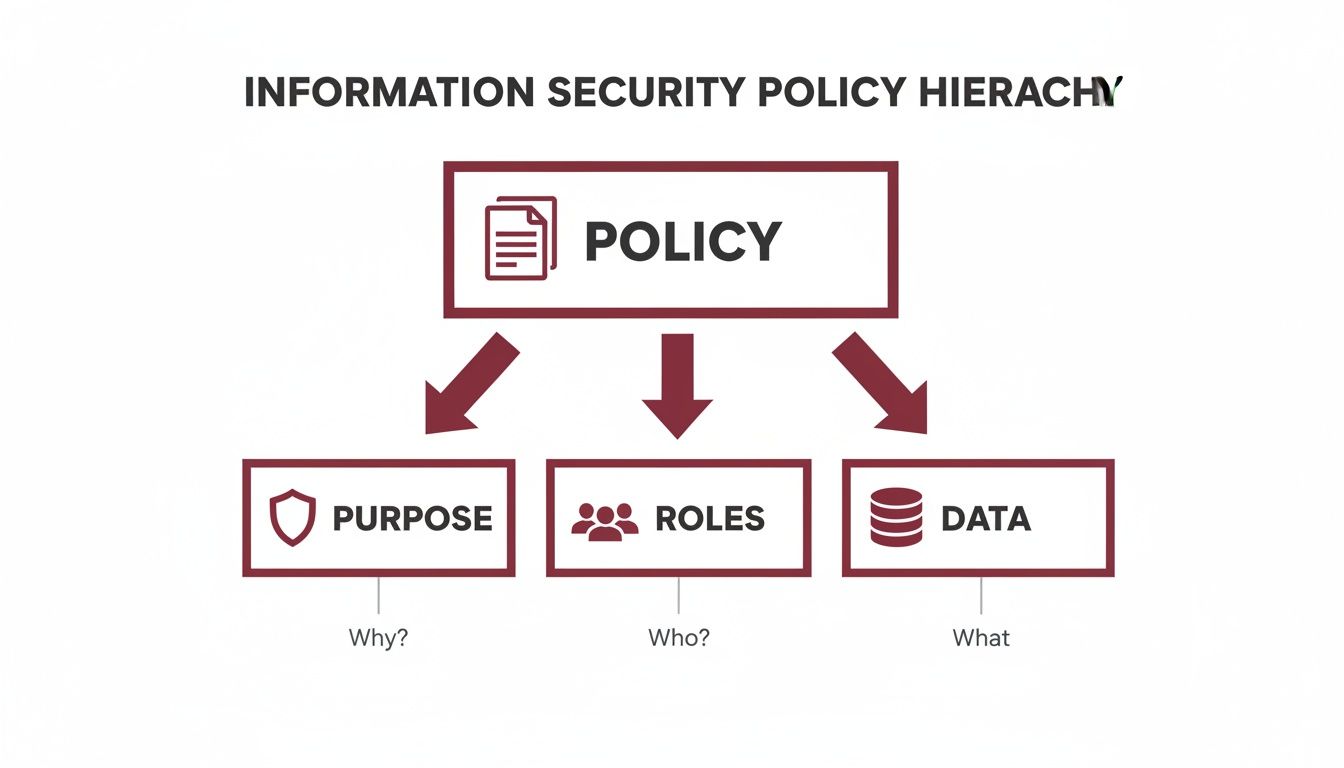
As the diagram shows, without that foundational policy at the top, critical security functions like role-based access and data protection simply float around without any guiding authority.
Given the escalating threat level here in Australia, this kind of structured approach is non-negotiable. During the 2022-2023 financial year, the Australian Signals Directorate reported over 127,000 hacks on local servers. That’s a staggering 300% jump from the year before. This explosion in cyber threats is often linked back to businesses that lack structured defences—exactly the kind of framework ISO 27001 provides, with a robust policy at its core.
Mapping Policy Elements to Key ISO 27001 Controls
To get certified, your policy can't just exist in a vacuum. It needs to directly support the requirements laid out in the ISO 27001 standard. This isn't about simply listing clauses; it's about demonstrating how your policy's objectives are brought to life through specific controls.
Here’s a practical breakdown of how your policy components map to the standard’s requirements:
- Policy Statement of Purpose: This directly satisfies Clause 5.2 (Policy), which mandates that top management establishes an information security policy that fits the organisation and clearly states its security objectives.
- Roles and Responsibilities: This lines up perfectly with Clause 5.3 (Organizational roles, responsibilities and authorities), proving you've officially assigned ownership for critical information security tasks.
- Commitment to Improvement: Your policy must explicitly state a commitment to getting better over time, which ticks the box for Clause 10.2 (Continual improvement).
The policy also acts as the foundation for the controls detailed in Annex A. For instance:
- A.5 Information Security Policies: Your main policy is the top-level control here, setting the scene for all the more specific, topic-based policies that sit beneath it.
- A.8 Asset Management: The data classification rules you define in your policy will directly guide how your company’s assets are handled, labelled, and protected.
An auditor doesn't just want to see a policy document; they want to see it in action. They will look for evidence that the policy is communicated, understood by employees, and regularly reviewed by management. Your policy is the promise; your implementation is the proof.
By thoughtfully crafting your information security policy to mirror the principles and structure of ISO 27001, you create much more than just a document. You build a resilient, defensible, and certifiable security framework. This process isn't just about passing an audit—it's about fundamentally strengthening your business against the very real and ever-present threats out there.
You can dive deeper into the specifics by exploring our comprehensive guide on the complete list of ISO 27001 controls.
A Practical Guide to Creating Your Policy
Let's be honest, turning security theory into a practical information security policy can feel like a massive headache. But it doesn't have to be. For small and medium-sized Australian businesses, the trick is to skip the jargon and focus on what your business actually needs. A solid, effective policy is well within reach for any organisation, no matter its size.
To make this real, let’s imagine a small consulting firm based in Melbourne. They're great at what they do, but they handle sensitive client data every day with no formal security rules. This makes them an easy target. We'll follow their journey as a simple, step-by-step blueprint for creating a policy from the ground up.

This guide is all about getting it done right, turning a box-ticking exercise into a genuine asset that protects your business.
Step 1: Secure Leadership Buy-In
Our Melbourne firm’s journey didn’t start with firewalls or software. It started with a chat in the boardroom. The IT manager laid out a clear business case for the directors, focusing on risk, not tech specs. They painted a picture of what a data breach would mean: financial pain, a trashed reputation, and kissing goodbye to that government tender they wanted to win.
By framing the information security policy as a way to win more business and protect what they'd already built, they got the green light and the resources they needed. This step is absolutely critical. Without genuine support from the top, any policy is just a document gathering dust.
Step 2: Assemble Your Policy Team
With the directors on board, the firm pulled together a small, smart team. This wasn't just a job for the IT folks. The team included the IT manager, someone from HR who understands people, and a senior consultant who lives and breathes client data every day.
Having this mix of perspectives was key. It meant the final policy would be grounded in reality, reflecting how people actually worked. They weren't just writing abstract rules; they were building a framework their colleagues could understand and, more importantly, follow.
Step 3: Conduct a Practical Risk Assessment
Before anyone wrote a single word, the team had to figure out what they were protecting. They ran a simple, practical risk assessment focused on the biggest threats to their business. This isn't as scary as it sounds, but it's a non-negotiable step for building strong security foundations. If you want to dive deeper, you can learn more about how to conduct a risk assessment for cyber security in our detailed guide.
Their assessment flagged a few clear and present dangers:
- Someone getting unauthorised access to client strategy documents on the shared drive.
- An employee losing a laptop packed with sensitive data.
- A ransomware attack bringing the entire business to a grinding halt.
A risk assessment isn't about finding every single boogeyman under the bed. It's about identifying the most likely and most damaging risks to your business so you can focus your policy where it counts.
Step 4: Draft the Policy Using a Template
Why reinvent the wheel? The team grabbed a reputable information security policy template and customised it to tackle the specific risks they'd just uncovered. This saved them a huge amount of time and made sure they didn't miss any of the essentials.
They put their own spin on key sections, including:
- Acceptable Use: Laying down clear, simple rules for using company laptops and the internet.
- Access Control: Bringing in a "least privilege" model. This meant consultants could only see the files for the clients they were actually working on—nothing more.
- Data Handling: Creating easy-to-follow guidelines for how to classify, store, and handle sensitive client info.
Step 5: Communicate and Train Your Staff
A policy is completely worthless if your team doesn't know it exists. Our Melbourne firm launched their new policy at a mandatory all-hands meeting. They didn't just read out the rules; they explained the why behind them, using real-world stuff-ups to show what was at stake.
After the launch, they rolled out short, sharp training sessions during their regular team meetings. The focus was on practical skills—like how to spot a dodgy phishing email or why using a password manager is a game-changer. It helped make security everyone's job.
Step 6: Establish a Simple Review Cycle
Finally, they locked in an annual review of the information security policy. This wasn't a "set and forget" project. This commitment ensures the policy stays relevant as the business evolves, technology shifts, and new threats pop up. It turns a one-off task into a living document that keeps protecting the firm year after year.
Here’s a checklist to help guide you through the same process.
Information Security Policy Implementation Checklist
This table breaks down the entire process into manageable phases, helping you track your progress from initial idea to a fully embedded policy.
| Phase | Key Action | Success Indicator |
|---|---|---|
| 1. Preparation | Secure management commitment. | Leadership has formally approved the project and allocated resources. |
| Assemble a cross-functional policy team. | Team members from IT, HR, and core operations are appointed. | |
| Define the scope and objectives. | A clear statement outlining what the policy will cover is documented. | |
| 2. Development | Conduct a practical risk assessment. | Top 5-10 business-critical risks are identified and documented. |
| Select and customise a policy template. | The draft policy directly addresses the risks identified. | |
| Draft the core policy document and supporting procedures. | The policy is written in clear, simple language, free of jargon. | |
| 3. Implementation | Obtain formal approval from management. | The final policy is signed off by the CEO or board. |
| Communicate the policy to all staff. | An all-hands meeting or official company-wide announcement is made. | |
| Conduct initial staff training sessions. | At least 90% of staff have completed mandatory security awareness training. | |
| 4. Maintenance | Schedule a regular review cycle (e.g., annually). | A recurring calendar event is set for the policy review team. |
| Monitor compliance and handle incidents. | A simple process for reporting and responding to security incidents is in place. | |
| Update the policy based on reviews and incidents. | The policy has a version number and a documented change log. |
Following these steps transforms the task from a daunting challenge into a structured project with a clear finish line. A well-implemented policy isn't just about compliance; it's about building a more resilient and trustworthy business.
Common Policy Mistakes and How to Avoid Them
Getting your information security policy written and signed off feels like a huge win, but that’s just the starting line. A policy is only as good as its implementation; otherwise, it’s just a document gathering dust on a server, waiting for an audit.
Too many businesses fall into the same traps, ending up with policies that are practically useless. This doesn't just leave you unprotected—it creates a false sense of security, which is far more dangerous.
Let's walk through the most common blunders I’ve seen and, more importantly, how you can sidestep them.
The "Set and Forget" Mentality
By far the biggest mistake is treating the policy like a one-off project. You create it, get it approved, and file it away, thinking the job is done. This is a critical error.
Your business is always changing. So are the threats you face. New software, different ways of working, and an ever-evolving stream of cyber threats mean a policy from last year could already be dangerously out of date.
A policy should be a compass, not a museum piece. It’s there to guide daily decisions, not to be admired from afar. Regular reviews keep it pointing true north.
The fix is simple: schedule a formal review of your information security policy at least once a year. You should also trigger a review whenever something significant changes—like moving to a new cloud provider or embracing a permanent remote work model. Make it an active, engaged process, not just a box-ticking exercise.
Using Overly Technical Jargon
Another classic mistake is writing a policy that reads like an IT textbook. If your team can't understand what you’re asking them to do, they won’t do it. A document loaded with acronyms and technical jargon just alienates your first line of defence: your people.
Think of it as a user manual for staying safe, not an academic paper.
- Actionable Solution: Write in plain English. Before you finalise anything, ask someone from a non-technical team, like sales or HR, to read it. If they look confused, you need to simplify it.
- Focus on 'Why': Don't just list rules. Briefly explain the reason behind them. Telling someone why multi-factor authentication is critical (because passwords get stolen all the time) makes them far more likely to actually use it.
To really nail this part, take a look at our guide on the human factor in information security and employee training.
Lacking Leadership Commitment
A policy without genuine buy-in from the top is dead on arrival. If your team sees managers bending the rules or paying lip service to security, they’ll assume it doesn't really matter. This completely undermines the security culture you’re trying to build.
Leadership can't just sign off on the policy; they have to live and breathe it. Their actions speak louder than any document.
And this has never been more critical. The latest OAIC report showed 532 notifiable data breaches in Australia between January and June 2025 alone, with a staggering 59% stemming from malicious attacks. Attackers love to target businesses where they sense weak oversight. Strong leadership and consistent enforcement are your best defence. You can discover more insights on these data breach statistics from the OAIC.
Turn Your Policy Into a Competitive Advantage
We’ve spent this guide pulling apart what an information security policy is, moving it from the ‘too-hard basket’ into a practical, must-have tool for your business. It's pretty clear that a solid policy is your first line of defence against cyber threats and the absolute bedrock for standards like ISO 27001. But the real magic happens when you see it not just as a way to stop bad things from happening, but as a way to make great things happen.
Think of it this way: a strong policy shifts your security from being a necessary expense to a powerful asset. It’s a loud and clear signal to everyone—clients, partners, and competitors—that you are serious about protecting data. This commitment, written down and acted upon, can be the very thing that makes you stand out from the crowd.
Win More Business and Build Trust
These days, customers and business partners are rightly cautious. Before they hand over their sensitive information, they want to see that you’ve got your house in order. Your information security policy is the proof they're looking for. It’s a tangible demonstration of your professionalism, giving you a serious leg-up when you're in the running for those bigger, more valuable contracts.
For small and medium Aussie businesses, this is huge. It means you can confidently explain your security practices in crucial documents like a tender response or a capability statement. This is especially true if you’re chasing government work, where demonstrating a robust security posture is often a deal-breaker. A well-defined policy provides the validated evidence you need to get in the game and win.
An information security policy isn't just for your internal files; it's a public declaration of your commitment to excellence. It tells the world you are a secure, reliable, and trustworthy partner, opening doors that might otherwise stay shut.
Create a Resilient and Aware Culture
Beyond just landing new clients, a good policy helps build a security-first culture that strengthens your entire organisation from the inside. When your whole team understands their part in protecting data, they naturally become more alert and proactive.
This cultural shift is your best weapon against human error, which is still behind so many data breaches. It builds a stronger, more secure foundation that lets you grow with confidence.
So, it's time to put what you've learned into action. Use the steps we’ve covered to either create your first information security policy or give your existing one a proper tune-up. Turn it from a piece of paper into a strategic tool that builds trust, wins contracts, and secures your company's future here in Australia.
Your Questions, Answered
Let's be honest, diving into information security can feel overwhelming, especially when you're running a small business in Australia. You've got questions, and we've got straight-talking answers based on years of experience helping businesses just like yours.
How Often Should We Update Our Policy?
Think of your security policy as a living, breathing part of your business, not something you write once and file away. Best practice is to give it a thorough review at least once a year.
But don't wait for the annual calendar reminder if something big changes. You’ll want to revisit it immediately after:
- Bringing on a new major software or cloud service.
- Making a big operational shift, like moving to a fully remote team.
- Recovering from a security incident (this is a crucial time to learn and adapt).
- The government updates regulations like the Australian Privacy Act.
Keeping it current means it stays useful and actually protects you from real-world, modern threats.
We’re a Small Business. Do We Really Need a Policy?
Yes, absolutely. In fact, you might need it more than you think. Cybercriminals love targeting small businesses because they often assume security is an afterthought. It's a dangerous assumption to prove right.
Without a formal policy, your security efforts are just a collection of ad-hoc, inconsistent actions. This leaves dangerous gaps for data breaches, financial loss, and the kind of reputational damage that can sink a small company. A simple, clear policy isn't about creating bureaucracy; it’s about building a solid foundation to protect your hard work and your customers' trust.
What's the Difference Between a Security Policy and a Privacy Policy?
This is a really common question, and it's easy to get them mixed up. They’re related, but they play for different teams.
- An Information Security Policy is your internal game plan. It’s for your eyes only (and your team's). It sets out the rules for how you protect all your data and systems from threats. The goal here is to lock things down and ensure confidentiality, integrity, and availability.
- A Privacy Policy is your external promise. This is the document you show your customers and the public. It explains how you handle their personal information—what you collect, why you collect it, and what you do with it. It’s all about transparency and complying with laws like the Australian Privacy Act.
A simple way to remember it: your security policy is how you protect data inside the business, while your privacy policy is what you promise your customers on the outside.
Who Is Ultimately Responsible for This Thing?
While your IT person or a dedicated manager might write and maintain the policy, the buck stops at the top. The CEO, the director, the business owner—whoever is in charge holds the ultimate responsibility.
Top management needs to actively champion the policy, make sure there are enough resources to actually follow it, and lead by example. When leadership is visibly committed, it sends a powerful message and builds a culture where everyone understands they have a part to play in keeping the business secure.
A strong information security policy is more than just a document; it's the foundation of your business's defence and a non-negotiable step on the path to ISO 27001 certification. We specialise in making this process clear and manageable for Australian small businesses. Let us help you transform a security requirement into a genuine competitive advantage.
Recent Comments