

Quick Summary: An information technology security policy is a foundational document outlining the rules and procedures for protecting an organization's digital assets. It defines acceptable use, data handling protocols, and incident response plans. A well-crafted policy is crucial for mitigating cyber risks, ensuring regulatory compliance like ISO 27001, and fostering a strong security culture.
At its core, an information technology security policy is the rulebook that governs how your company protects its digital world. It lays out the ground rules for things like acceptable use of company tech, how to handle sensitive data, and what to do when something goes wrong. This isn't just about ticking a box; it's about creating a clear, enforceable standard that everyone, from the CEO down, can follow.
Why Your Business Cannot Afford to Ignore Its IT Security Policy
Think of your IT security policy as the constitution for your company's digital life. It's the foundational document that gives purpose and structure to every other security measure you put in place. Without one, you're just left with a bunch of disconnected tools and tactics, hoping for the best. A robust information technology security policy is a strategic asset for risk management and operational resilience.
A well-crafted policy is like a ship's navigation chart. It gives you a clear course to follow, makes sure every crew member knows their job in protecting the ship, and helps you steer clear of the rocks—those modern cyber threats that can sink a business overnight.

This document turns security from a vague, technical idea into a tangible business asset. It cuts through the jargon and sets a clear standard of behaviour for every single person in your organisation.
A First Line of Defence Against Tangible Risks
In a world where digital threats change by the day, simply reacting to problems as they happen is a guaranteed recipe for disaster. An information technology security policy is your first, and arguably most important, proactive line of defence.
The risks of flying blind without one are very real, and they can hit every part of your business. This isn't an abstract threat; it's a growing problem for Australian businesses right now.
Recent data paints a pretty grim picture. The Office of the Australian Information Commissioner (OAIC) reported a staggering 1,113 data breaches in 2024, which is a 25% jump from 2023. Even more worrying is that malicious attacks were behind 59% of these incidents, highlighting just how critical formalised defences have become.
A solid policy confronts these threats head-on by establishing clear, enforceable rules. This drastically reduces the chance of human error and insider threats, which are so often the weakest links in any company's security chain.
A policy is more than just a document; it's a declaration of your organisation's commitment to security. It tells your employees, customers, and partners that you take the protection of their data seriously, building a foundation of trust that is critical for long-term success.
More Than Just Rules—It's a Strategic Framework
If you only see your security policy as a long list of "dos and don'ts," you're missing the bigger picture. It's actually a strategic framework that gets your entire organisation pointing in the same direction, all working towards the shared goal of protecting your most critical assets.
This framework delivers some serious business advantages:
- Consistent Security Posture: It ensures security is applied the same way across the board—from HR to finance—so there are no weak spots.
- Simplified Compliance: For standards like ISO 27001, a clear policy is exactly the kind of evidence auditors want to see, making certification and compliance a much smoother ride.
- Empowered Employees: By clearly defining responsibilities, you give staff the confidence to make secure decisions, building a powerful culture of security awareness.
- Efficient Incident Response: When the worst happens, the policy acts as a pre-approved roadmap, allowing for a fast, organised response that minimises the damage.
Neglecting data handling protocols at any point, even when a device reaches the end of its life, can open the door to a devastating breach. For example, a comprehensive policy should cover processes like secure HDD disposal to ensure sensitive information stays protected long after the hardware is out of service. It’s a crucial detail that closes a commonly overlooked security gap.
Building the Blueprint for Your IT Security Policy
An effective IT security policy isn’t some monolithic tome that sits on a shelf gathering dust. Think of it more as a blueprint—a carefully structured plan made of distinct, interconnected parts. Each piece has a specific job, and they all work together to build a strong defensive framework for your entire business. The real trick is moving from the abstract idea of "being secure" to a concrete, actionable plan, and that means breaking it all down into these essential building blocks.
This approach stops the policy from becoming a scary technical manual and turns it into a practical guide. Instead of just a dry list of rules, you get a clear picture of what needs protecting and how everyone in the organisation plays their part. The goal is to create something that’s not only complete but actually usable for every single employee.
As you start putting pen to paper, it's worth looking at how an essential governance policy framework is structured. Understanding these foundational elements is the first and most critical step toward creating a policy that is both robust and easy to follow.
The Anatomy of a Strong Policy
So, what are these non-negotiable sections? Think of them as the chapters in your security rulebook, each telling an important part of the story.
A great policy always kicks off with a clear purpose and objectives statement. This is your "why." It's a high-level section that connects the dots between security and your core business goals, like protecting customer data, keeping the lights on, and meeting legal obligations. It sets the tone for everything that follows.
Next, you have to define the scope. This part answers one simple but critical question: who and what does this policy apply to? It needs to be crystal clear, specifying all employees, contractors, third-party vendors, systems, networks, data, and even physical facilities covered by the rules. A well-defined scope leaves zero room for ambiguity.
Defining Roles and Acceptable Use
One of the most common points of failure in security is a lack of ownership. If nobody knows who's responsible, security quickly becomes "someone else's problem." This is where your policy establishes clear lines of authority and accountability.
Key roles you'll need to define include:
- Data Owners: These are typically senior managers responsible for the data their department creates and uses.
- System Custodians: This is often your IT team, the people responsible for the technical infrastructure that stores and processes the data.
- Users: This is everyone. Every employee with access to company systems and data has a responsibility to follow the policy in their daily work.
From there, you get into the Acceptable Use Policy (AUP), which provides the practical, day-to-day guidelines for staff. This is where you translate those big-picture security goals into simple ground rules for using company technology, covering things like email etiquette, internet usage, and installing software.
By clearly outlining what is and isn't allowed, an AUP empowers your team to make smart security decisions on the fly. It removes the guesswork and creates a consistent standard of behaviour—the very cornerstone of a strong security culture.
Essential Components of an IT Security Policy
To make sure you've covered all your bases, it helps to see the core components laid out. Every strong policy will address these areas, ensuring a comprehensive approach to protecting information.
| Policy Component | Primary Objective | Example Focus Area |
|---|---|---|
| Purpose & Objectives | Explain why the policy exists and link it to business goals. | Protecting customer privacy, ensuring business continuity. |
| Scope | Define who and what the policy applies to, leaving no ambiguity. | All employees, contractors, systems, and company data. |
| Roles & Responsibilities | Assign clear ownership for security tasks and accountability. | Defining Data Owners, System Custodians, and Users. |
| Acceptable Use | Set clear, day-to-day rules for using company technology. | Internet browsing, email use, software installation. |
| Data Classification | Categorise data based on sensitivity to apply proper controls. | Public, Internal, Confidential, Restricted. |
| Access Control | Ensure users only access information needed for their job. | Principle of 'least privilege', user access reviews. |
| Password Policy | Enforce strong authentication practices. | Complexity rules, length requirements, MFA. |
| Remote Work & Mobile | Securely manage access from outside the corporate network. | VPN usage, securing company laptops and phones. |
This table acts as a checklist, helping you build a policy that is not only compliant but genuinely effective at managing risk across your organisation.
From Data Classification to Remote Work Protocols
With those foundational elements locked in, your policy needs to get more specific, addressing particular risk areas with granular controls. This is where your blueprint turns into a detailed schematic for day-to-day security operations.
A data classification scheme is absolutely vital. It’s all about categorising your data into different levels—think Public, Internal, Confidential, and Restricted. This isn't just for show; it directly dictates how much protection each piece of information needs. After all, the content on your public website requires far less protection than your confidential employee payroll data.
This logically flows into access control, a set of rules ensuring people can only access the data and systems they absolutely need to do their jobs. This is known as the 'principle of least privilege'. Backing this up is a strong password policy, which must mandate complexity, length, and the use of multi-factor authentication.
Finally, in today’s world of flexible work, a dedicated remote work and mobile device policy is non-negotiable. This section must spell out the security requirements for connecting to the company network from outside the office, including rules for secure Wi-Fi use and protecting company-issued laptops and phones. For a more detailed look at how to structure these sections, our information security policy template offers a great starting point.
Aligning Your Policy with ISO 27001 Requirements
Getting your ISO 27001 certification isn't just about ticking a box that says you have an information technology security policy. It’s about proving that your policy is the active, beating heart of your entire Information Security Management System (ISMS).
From an auditor’s perspective, a policy that just sits on a server collecting digital dust is a major red flag. They want to see a living document—one that’s officially backed by management, understood by your team, and directly wired into the real-world security controls you use every day.
This is what turns your policy from a static rulebook into a dynamic tool for managing risk. It shows everyone—auditors, clients, and partners—that your commitment to security is a core part of your culture, not just something you wrote down once.
The diagram below breaks down the fundamental structure of a security policy that’s built to withstand auditor scrutiny.
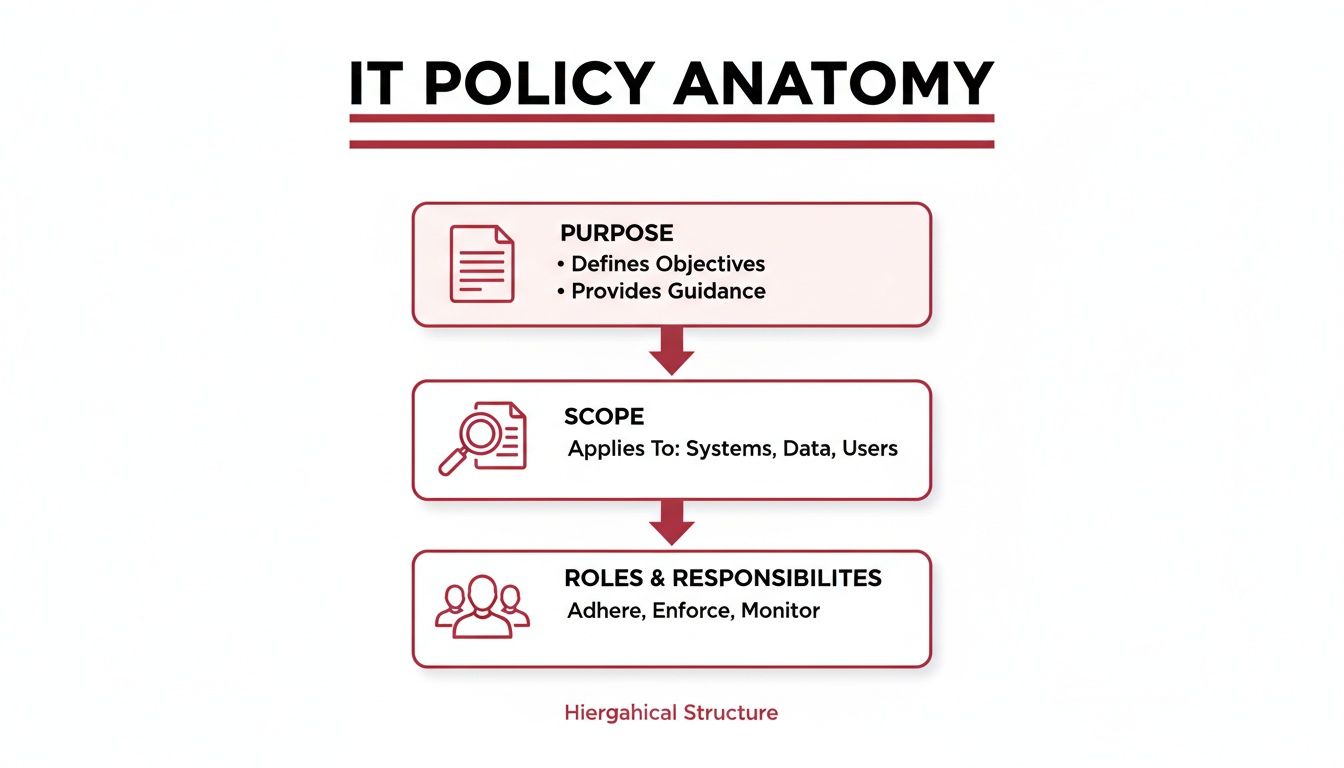
This simple hierarchy—starting with a clear 'why' (Purpose), defining its boundaries (Scope), and assigning ownership (Roles)—gives you a rock-solid foundation that auditors can easily understand and verify.
Mapping Your Policy to Annex A Controls
The real secret to satisfying ISO 27001 lies in creating a clear, logical link between what your policy says and the security controls listed in Annex A. Think of it this way: your policy states the "what" and "why," while the Annex A controls provide the "how." Auditors need to be able to draw a straight line from a high-level goal in your policy directly to the control that makes it happen.
For example, a policy statement like, "All employees must protect company information from unauthorised access," is a decent starting point. But for an auditor, it's an empty promise until you connect it to tangible actions.
Here’s how you build that bridge:
- Access Control Policy: The section in your policy about who gets access to what maps directly to Annex A controls A.5.15 (Access control), A.5.16 (Identity management), and A.5.17 (Authentication information).
- Data Classification Rules: When your policy outlines how you categorise data, it directly supports control A.5.12 (Classification of information), which is all about sorting information based on its sensitivity.
- Incident Response Plan: Your documented steps for handling a breach are the real-world application of control A.5.24 (Information security incident management planning and preparation).
When you structure your policy this way, you're essentially handing the auditor a roadmap. It makes their job easier and instantly demonstrates your organisation's mature approach to security. You can dive deeper into these requirements with our detailed guide on ISO 27001 controls.
An ISO 27001-aligned policy isn’t just a list of rules. It’s an interconnected system where every statement of intent is backed by a specific, measurable, and auditable security control. This shows you’re being proactive and methodical, not just reactive.
Demonstrating Leadership Approval and Communication
Let's be blunt: a policy without backing from the top is worthless. ISO 27001 puts a huge emphasis on leadership commitment. Your policy must be formally reviewed and signed off by senior management, which proves accountability for security starts at the highest level. This isn't just a bureaucratic step; it's a critical requirement that auditors will check.
Beyond the sign-off, you have to prove the policy has been communicated effectively and is actually understood by your people. Just firing off an all-staff email with a PDF attached won't cut it.
Auditors will be looking for concrete evidence, such as:
- Formal Communication Channels: Records showing how the policy was shared, like intranet announcements, team meeting minutes, or systems where staff must acknowledge they’ve read it.
- Training and Awareness Programs: Proof that your team has been trained on what the policy means for them and their specific roles.
- Accessibility: Confirmation that the policy is easy for anyone to find, not buried five folders deep on a forgotten network drive.
Tying your policy to broader national goals can also add weight. For instance, the Australian government's 2023-2030 Cyber Security Strategy has made cybersecurity a top national priority. By pursuing ISO 27001, your organisation is showing it’s in step with Horizon 1 of this strategy, which is all about building stronger security foundations across the nation. Achieving certification positions you as a leader in this critical area.
From Draft to Deployment: A Step-by-Step Implementation Plan
Getting an information technology security policy off the page and into practice is where the real work begins. A brilliant policy on paper is useless if it’s not implemented properly. So many policies fail right here, not because the rules are wrong, but because the rollout is fumbled. This is the moment your security blueprint becomes a living, breathing part of your company culture.
A successful deployment isn't a one-off event. It's a carefully managed process that involves the right people, crystal-clear communication, and consistent follow-through. Without a solid plan, even the best-written policy will just gather dust in a folder, failing to protect your business or impress auditors.

Assembling Your Policy Team and Defining Scope
First things first: you need to get the right people in the room. Security isn't just an IT problem, it’s everyone’s responsibility. Your policy team should reflect this reality, bringing together voices from IT, HR, Legal, and other key business units to make sure the final document is both robust and genuinely workable for everyone.
This team’s first job is to get a handle on the real risks. You can't protect what you don't understand. This means digging in to identify your most critical digital assets, figuring out what threats are pointed your way, and being honest about your current vulnerabilities. This groundwork ensures your policy tackles your organisation’s specific risk profile head-on.
Drafting with Clarity and Securing Sponsorship
With a clear picture of the risks, you can start drafting. The golden rule? Keep it simple. Avoid burying the message in dense, technical jargon that will send anyone outside the IT department to sleep. The aim is to write something a sales manager can understand just as easily as a network engineer.
Use plain language, short sentences, and a logical flow. A policy that’s easy to read is a policy that’s easy to follow.
Before you go any further, you absolutely must get executive sponsorship. This part is non-negotiable. Your policy needs a champion in the C-suite who can officially sign it off, find the budget for its rollout, and communicate its importance from the top down.
Without visible and vocal support from leadership, your information technology security policy lacks the authority it needs to be effective. It becomes a suggestion rather than a mandate, making enforcement nearly impossible.
Communicating and Training for Maximum Impact
Once leadership is on board, it's time to roll it out with a smart communication and education strategy. Just sending a mass email with the policy attached is a guaranteed way to fail. You need a compelling plan that doesn't just list the rules but explains the why behind them.
Your communication and training plan should include:
- Initial Announcement: A formal message from the top, signalling the policy's launch and why it matters to the business.
- Targeted Training Sessions: Don't do one-size-fits-all training. The security duties of an HR manager handling sensitive PII are vastly different from a developer's. Tailor the content.
- Accessible Resources: Make the policy, FAQs, and any quick-reference guides dead simple to find on your company intranet or a central hub.
- Acknowledgement Tracking: You need a system where staff formally acknowledge they’ve read and understood the policy. This is critical for accountability and gives you a clean audit trail.
Great training turns your policy from just another document into a shared understanding. It empowers every single employee to be an active part of your company's defences. For any business heading towards certification, a properly documented rollout is a cornerstone of the ISO 27001 implementation process.
Establishing a Continuous Review Cycle
Finally, remember that deployment is not the finish line. Your business changes, technology evolves, and new threats pop up all the time. Your security policy has to keep up.
Set up a formal review cycle to keep the document sharp and relevant. Best practice is to conduct a full review at least once a year, but you should also trigger a review whenever something significant happens, like:
- A major security incident
- Big changes to your IT systems or infrastructure
- Launching new products or business operations
- Updates to laws or industry regulations
By treating your policy as a living document, not a static one, you ensure it remains a powerful tool for protecting your organisation year after year. This proactive mindset is the hallmark of a mature and resilient security program.
Avoiding the Common Pitfalls of Policy Development
Even with the best of intentions, creating an information technology security policy can feel like navigating a minefield. Plenty of organisations stumble into the same predictable traps, turning what should be a powerful security tool into just another document gathering dust.
By knowing what these mistakes are ahead of time, you can steer clear and build a policy that genuinely protects your business.
One of the most common blunders is writing a policy so crammed with technical jargon that it completely alienates the very people it’s meant to guide. Let's be honest, if your sales or marketing teams can't understand the rules, they have zero chance of following them. The goal here is clarity, not a display of technical wizardry.
Another classic misstep is failing to get real, tangible support from the top. If the leadership team isn't visibly championing the policy, it has no authority. It becomes a set of nice-sounding suggestions with no teeth, leaving your organisation wide open to risk.
The Dangers of a One-Size-Fits-All Approach
In the rush to tick a box, it’s all too tempting to grab a generic template from the internet, slap your logo on it, and call it a day. This is a seriously dangerous shortcut. An effective security policy is never a one-size-fits-all solution; it has to be a direct reflection of your organisation’s unique culture, day-to-day operations, and specific risk profile.
Relying on a generic template almost always results in a policy that:
- Misses your actual threats: A retail business in Melbourne faces completely different risks to a fintech startup in Sydney. Your policy has to be about your reality.
- Creates irrelevant rules: It might have clauses about technologies you don't even use, which just causes confusion and makes the whole document seem out of touch.
- Overlooks critical compliance needs: Your policy must align with the specific legal and regulatory obligations for your industry and location here in Australia.
A policy built from a generic template is like building a house with someone else's blueprint. Sure, it might look like a house, but it won’t fit your family and it's probably got major structural flaws you won't see until it's too late.
Neglecting the Human Element
Perhaps the biggest pitfall of all is forgetting that policies are for people. You can draft the most technically brilliant document in the world, but it’s completely worthless if your team isn't trained on it, doesn't understand it, and doesn't buy into it.
This is a massive oversight, especially when you consider the explosion of social engineering attacks. Phishing in Australia is now one of our most widespread cybersecurity threats, with a shocking 140% increase in employee vulnerability recorded in just one year. People remain the front line, and basic awareness training often isn't enough to stop today's sophisticated, AI-driven attacks. This worrying trend is exactly why a comprehensive information technology security policy must be backed by engaging, continuous training. You can get more insights on Australia's threat environment from Security Quotient's 2025 analysis.
The "Set It and Forget It" Mindset
Finally, so many organisations treat policy creation like a one-and-done project. They draft it, announce it, and then it gets buried in a folder somewhere on the server, never to be seen again. This "set it and forget it" approach is a surefire recipe for irrelevance.
The security world doesn’t stand still. Threats evolve, technology changes, and your business grows. Your policy has to be a living document, reviewed and updated regularly to make sure it still makes sense in your current environment. An outdated policy doesn't just fail to protect you—it gives you a false sense of security, which is often far more dangerous than having no policy at all.
Your Questions, Answered
As you dive into creating security documentation, you're bound to run into some common questions. Getting straight answers is the first step to building an information technology security policy that actually works in the real world, not just on paper. Let's tackle a few of the most frequent queries.
How Long Should an Information Technology Security Policy Be?
This is a classic "how long is a piece of string?" question. There's no magic page count. The right length is determined entirely by the size and complexity of your organisation. A small business with a simple IT setup might have a perfectly good policy that’s only 10–15 pages long.
On the other hand, a large enterprise with different departments, global offices, and complex systems will likely have a much larger core policy. This is often supported by a whole suite of more detailed sub-policies for specific areas.
The real aim here is twofold: clarity and complete coverage. It needs enough detail to properly address your key risks—things like access control, incident response, and how you classify data—while giving people unambiguous instructions. But it also has to be written clearly enough that someone without a technical background can read it and understand what’s expected of them.
Forget the page count. Auditors are far more interested in whether your policy is fit-for-purpose and truly reflects how your business operates. A shorter policy that's well-implemented is always better than a hundred-page monster that just gathers dust.
What’s the Difference Between a Policy, a Standard, and a Procedure?
It’s easiest to think of these as a pyramid. They flow from the big picture down to the tiny details, and each document answers a different kind of question.
Together, they create a solid structure for security governance:
- A Policy: This is the view from the top. It’s the high-level document from leadership that answers the 'what' and 'why'. For example: "We will protect all sensitive customer data from unauthorised access." It sets the direction.
- A Standard: This document lays down the mandatory rules you have to follow to make the policy a reality. It gets more specific on the 'how' by setting requirements. For instance: "All passwords must use 12+ characters and multifactor authentication."
- A Procedure: This is the step-by-step instruction manual. It’s a nuts-and-bolts, 'how-to' guide for meeting a specific standard. For example: "Step 1: Open your authenticator app on your mobile device. Step 2: Enter the six-digit code into the login prompt…"
Your information technology security policy sits right at the peak of this pyramid. It's the foundation stone from which all your standards and procedures grow, giving strategic purpose to your entire security program.
How Often Should We Review Our IT Security Policy?
At the very least, you need to review your policy once a year. This is a non-negotiable best practice and a firm requirement for frameworks like ISO 27001. An annual check-in ensures the policy hasn’t drifted away from your current business reality.
But don’t just mark your calendar and forget about it. Your policy is a living document. If something significant happens, you can't wait a full year to update it.
A review should be triggered immediately after events like:
- A major security incident or data breach.
- A big shift in your IT infrastructure, like moving to a new cloud provider.
- Bringing in new, game-changing technologies, such as generative AI.
- Changes in the laws or regulations that govern your industry.
A policy that isn't regularly updated becomes irrelevant—and fast. Consistent, event-driven reviews are what keep it aligned with your business and the constantly shifting threat landscape.
Who Is Ultimately Responsible for the Security Policy?
This is a crucial point, and one that trips up a lot of businesses. While your IT Manager, CISO, or a Compliance Officer is usually tasked with the hands-on work of writing and maintaining the policy, ultimate ownership and accountability rest with senior management. We’re talking about the CEO and the Board of Directors.
Within a framework like ISO 27001, this is not optional. It’s a core principle and a clear sign of a healthy security culture. Leadership simply cannot delegate this final responsibility.
Senior management's job is to:
- Formally sign off on and approve the policy before it goes live.
- Provide the resources—the budget, people, and tools—to actually implement it.
- Actively champion a security-first culture from the very top.
Without that clear, visible backing from the executive team, an information technology security policy has no teeth. It’s just another document, not a central part of your business strategy, and enforcing it across the company becomes nearly impossible.
Navigating ISO 27001 can be complex, but you don't have to do it alone. At Anitech, our team of experts simplifies the certification process, helping you build a robust and compliant Information Security Management System from the ground up. With our 100% success rate, we ensure your business not only achieves certification but also builds a stronger, more resilient security posture. Contact us today to learn how we can help you achieve your compliance goals.
Recent Comments