

Ever tried to conduct an orchestra where every musician is playing from a different sheet of music? It’s chaos. That’s often what it feels like trying to run a business with separate, disconnected management systems. An integrated management system (IMS) is the solution—it’s the single, unified score that gets your entire organisation playing in harmony.
Unifying Your Business Operations

At its heart, an integrated management system is about tearing down the walls between departments. You know the ones—the silos that create friction, confusion, and wasted effort. Instead of juggling quality, environmental impact, and workplace safety as completely separate worlds, an IMS brings them all together under one strategic roof. It gives you a clear, top-down view of how your entire business is performing.
This isn’t about creating more red tape. It’s the exact opposite. The goal is to slash redundant paperwork, get rid of conflicting procedures, and stop your teams from duplicating their work. By harmonising different management standards, you create a single source of truth for how your business runs.
What Standards Can Be Integrated?
The beauty of an IMS is its flexibility. It lets you combine various international standards based on your company’s unique needs and risks, making sure the system actually fits your operational reality. To do this well, it helps to understand what system integration is and how it connects different parts of your business into a powerful, cohesive whole.
Some of the most common standards businesses integrate are:
- ISO 9001 (Quality Management): The backbone for ensuring your products and services consistently hit the mark with customers and meet all regulatory requirements.
- ISO 14001 (Environmental Management): A framework for managing your environmental footprint and making your operations more sustainable.
- ISO 45001 (Occupational Health & Safety): All about creating a safer, healthier workplace by proactively preventing injuries and illness.
- ISO 27001 (Information Security): Crucial for protecting your most valuable information assets, from client data to your own intellectual property.
Luckily, these standards are built on a similar high-level structure, which makes them perfect candidates for integration. This unified approach transforms compliance from a chore into a powerful engine for continuous improvement.
From Silos to Synergy
Picture a small manufacturing business. They have one person managing quality (ISO 9001) and another handling safety (ISO 45001). The quality manager runs an audit one week, pulling people off the floor. The next week, the safety manager does the same thing. Staff get interrupted twice, answer similar questions, and end up with two separate reports that might even contradict each other.
Now, let's look at it with an integrated management system in place.
An IMS merges these functions into a single, efficient process. One internal audit covers both quality and safety. One management review meeting looks at performance across all integrated standards. This gives you a clear, holistic view of your operations.
This synergy isn't just a time-saver; it cultivates a much deeper understanding of how different parts of the business affect each other. You start to see how a new safety process improves production quality or how an environmental initiative actually cuts operational costs. It pushes everyone to think more strategically, which is one of the core principles of systems thinking as per ISO27001.
By breaking down the walls between departments, an IMS builds a culture where everyone is working from the same playbook towards shared business goals. This is where real operational excellence is born.
The Real-World Payoff of a Unified System
Bringing your management systems together under one roof isn't just a box-ticking exercise or a way to tidy up your paperwork. It's a genuine strategic shift that fuels better business performance, delivering tangible results you'll see everywhere from your daily operations to your bottom line. Moving away from siloed thinking is how you build a powerful, lasting competitive advantage.
Research highlights a significant performance gap between businesses that fully integrate their systems and those that don't. While a large majority of companies have initiated integration efforts, a much smaller percentage have achieved full integration. This smaller, fully-integrated group often reports outperforming their competitors by a significant margin. These are also the companies more likely to see a rapid return on their technology investments.
Slash Costs and Unleash Efficiency
One of the first things you'll notice after implementing an IMS is a significant drop in your operational costs. When you have separate systems for quality, safety, and environment, you're creating a mountain of administrative waste. Just think of all the duplicated effort: separate audits, multiple training sessions, and clashing documents. It's a recipe for inefficiency.
An IMS brings all of this together, unlocking some serious efficiencies:
- One Audit to Rule Them All: Instead of juggling separate audits for ISO 9001, ISO 45001, and ISO 27001, you conduct one, unified audit. This immediately slashes consultant fees, causes less disruption for your teams, and saves countless staff hours.
- A Single Source of Truth: One streamlined set of policies and procedures replaces three or more overlapping, and often conflicting, manuals. This simplifies document control and dramatically cuts the time and money spent on updates and reviews.
- Cut Out the Bureaucracy: By getting rid of redundant meetings, reports, and compliance tasks, you give your team their time back. They can finally focus on the work that actually adds value, rather than getting bogged down in red tape.
Make Sharper, Smarter Decisions
A disconnected approach to management leaves you with dangerous blind spots. When your data on quality, risk, and compliance is scattered across different departments and systems, it's almost impossible for leaders to get a clear, complete picture of the organisation's health.
An integrated management system smashes these data silos and creates a single source of truth. Suddenly, your leadership team has a clear dashboard view of the entire organisation's performance and risk profile.
By bringing your data together, an IMS gives you the clarity to make truly informed, strategic calls. You can finally connect the dots and spot trends you would have otherwise missed—like how a new safety initiative is also improving product quality, or how a change in your environmental processes is cutting material costs.
This bigger-picture view helps you manage risk far more effectively. Instead of looking at information security risks in isolation from operational risks, you see them as part of a whole. This gives you a complete picture of your vulnerabilities and lets you put your resources where they’ll have the most impact. This kind of strategic clarity is a major reason why smart leaders explore the value of ISO 27001 certification as a cornerstone of their wider business strategy.
The Ripple Effect on Your People and Customers
The benefits of an integrated system go well beyond the numbers on a spreadsheet. The clarity and consistency it brings create a powerful ripple effect that touches your two most important assets: your team and your customers.
For your employees, an IMS cuts through the confusion. When roles, responsibilities, and procedures are clearly laid out in one accessible system, it removes the friction and frustration that comes from conflicting directions. This naturally boosts morale, increases engagement, and builds a culture of accountability where everyone knows how their work contributes to the company's success.
This internal harmony flows directly to your customer experience. A business running on smooth, unified processes delivers a more reliable, high-quality product or service, every single time. Customers notice that consistency. It builds trust, boosts satisfaction, and ultimately proves that your commitment to quality and security isn't just a policy hanging on a wall—it's a promise they can count on.
The Architectural Blueprint of a Modern IMS
Think of building a powerful integrated management system like designing a high-performance engine. You wouldn't just bolt parts together and hope for the best. It demands a clear architectural blueprint, one where every component is engineered to work in perfect harmony. This blueprint is designed to dismantle those old, clunky operational silos and replace them with a single, efficient structure that powers your entire organisation.
At its heart, an IMS is built on a foundation of unified elements. Instead of juggling separate policies, objectives, and procedures for different standards, you create one cohesive framework. This strategic alignment is what turns compliance from a scattered, reactive chore into a proactive engine for operational excellence.
The Foundation A Master Policy Statement
The very first brick you lay is a master policy statement. This isn't just some generic mission statement to hang on the wall; it’s a high-level declaration of your organisation's commitment to quality, safety, environmental responsibility, and any other standard you’re bringing into the fold. It acts as the "north star" for your entire system, guiding every decision and action.
For example, a business with separate systems might have a quality policy focused on customer satisfaction and a completely separate safety policy aimed at zero accidents. A master policy statement merges these, declaring a commitment to "delivering exceptional value to our customers while ensuring the health and safety of our people." This single, powerful commitment gets everyone pulling in the same direction.
The Framework Shared Objectives and KPIs
With the foundation in place, you can build out the framework using shared objectives and Key Performance Indicators (KPIs). In a siloed world, the quality team tracks defect rates while the safety team monitors incident frequency, and there's often little to no connection between them. An integrated management system forces you to think more holistically.
You start setting objectives that naturally bridge these functions. A great example would be an objective to "reduce operational disruptions by 15% within the next year." This single goal connects multiple areas:
- Quality: Fewer product defects mean less downtime and rework.
- Safety: A safer workplace has fewer incidents that halt production.
- Environmental: Better resource management reduces waste and prevents compliance headaches.
This approach creates a potent synergy. Suddenly, improving performance in one area directly contributes to success in another, leading to smarter, more impactful business improvements.
The Nuts and Bolts Unified Procedures and Documentation
This is where you'll see some of the most dramatic efficiency gains. Picture a typical business trying to manage ISO 9001 (Quality), ISO 14001 (Environmental), and ISO 45001 (Health & Safety) separately. They're stuck with three different document control procedures, three separate internal audit schedules, and three distinct management review processes. The administrative drag is immense.
An integrated management system collapses all this into a single, streamlined set of operational procedures.
Instead of maintaining three overlapping document libraries, you create one unified system for document control. One procedure governs how all policies, work instructions, and records are created, approved, and updated—regardless of whether they relate to quality, safety, or environmental management. This single change can save hundreds of administrative hours every year.
The infographic below shows just how an IMS brings these core functions together to drive better outcomes.
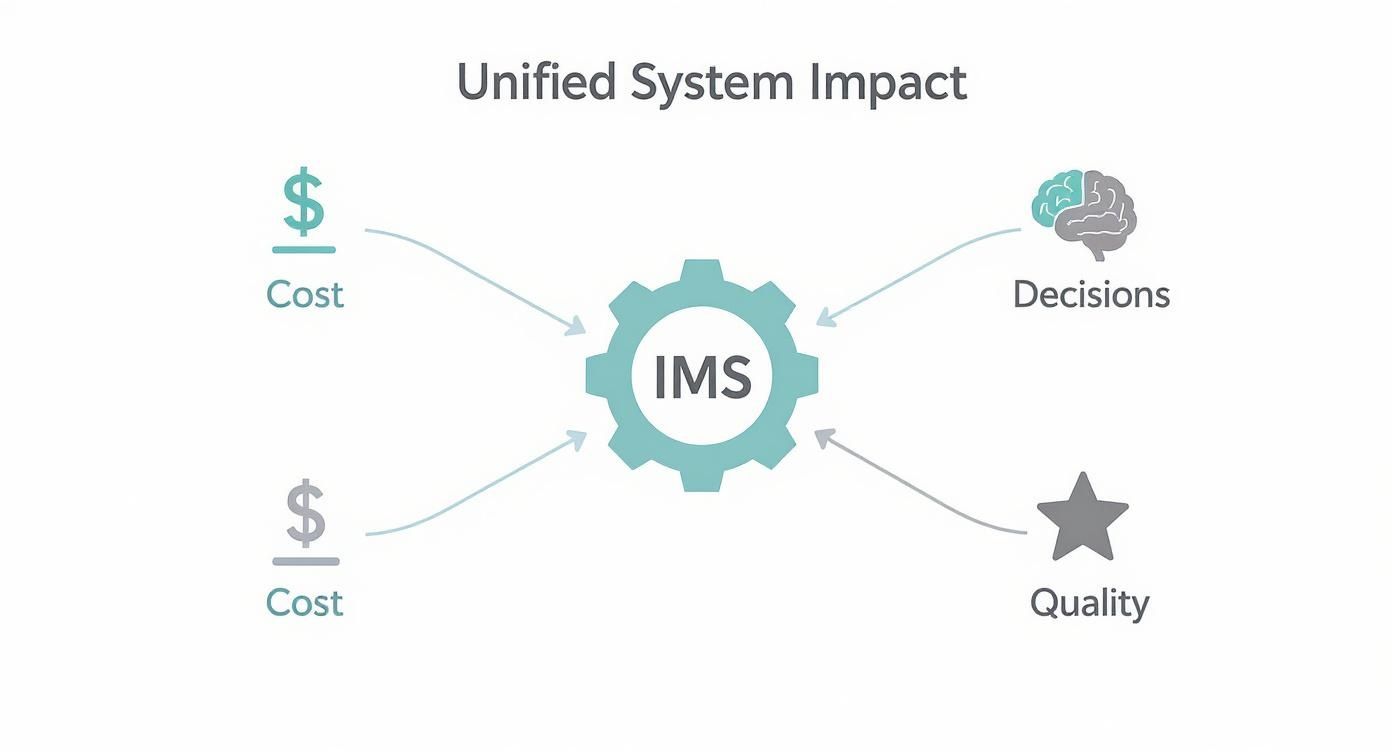
As you can see, a central IMS has a direct, positive impact on reducing costs, sharpening decision-making, and elevating quality right across the board.
The Engine The PDCA Cycle
The dynamic engine that drives this whole structure is the Plan-Do-Check-Act (PDCA) cycle. This continuous improvement loop is the heartbeat of any modern management standard, but its power is seriously amplified within an IMS. Instead of running separate PDCA cycles for each standard, you apply one unified cycle to the entire system.
- Plan: You set your shared objectives and plan the processes needed to hit them across all integrated standards.
- Do: You implement the unified procedures and train your team on the single, cohesive system.
- Check: You monitor and measure performance against your master policy and shared objectives through integrated internal audits and data analysis.
- Act: You take action to improve performance based on what you’ve found, refining the entire system—not just one isolated part of it.
This continuous, holistic cycle ensures your organisation is always learning, adapting, and improving in a coordinated way, making your business far more resilient and agile.
Comparing the Old and New Models
To truly appreciate the architectural superiority of an IMS, it helps to see a direct comparison. The shift from a fragmented, siloed approach to a unified framework creates dramatic efficiency gains in almost every core business function. The table below highlights just how different the two worlds are.
Siloed Systems vs Integrated Framework A Comparison
| Business Function | Siloed Approach (Multiple Systems) | Integrated Approach (Single IMS) |
|---|---|---|
| Policy & Objectives | Separate policies and conflicting objectives for each standard. | A single master policy and aligned objectives drive unified goals. |
| Documentation | Multiple, often overlapping, sets of documents and procedures. | One streamlined set of documents, reducing administrative burden. |
| Internal Audits | Separate, disruptive audits for each standard, causing audit fatigue. | A single, combined audit process that saves time and resources. |
| Management Review | Multiple review meetings, discussing performance in isolation. | One holistic management review for a complete view of business health. |
| Employee Training | Redundant training sessions on different systems and procedures. | A unified training program covering all integrated standards efficiently. |
| Risk Management | Fragmented risk registers that create dangerous blind spots. | A comprehensive risk assessment covering all operational areas. |
Ultimately, the architectural blueprint of an integrated management system is all about intelligent design. It’s a deliberate strategy to build a stronger, more efficient, and more responsive organisation by ensuring all its core management functions aren't just co-existing, but are truly working as one.
Weaving ISO 27001 Into Your Business for Total Information Security

Let’s be honest: in a world where data is your most valuable currency, treating information security as a separate IT problem is a recipe for disaster. Cybersecurity isn't some niche, technical concern anymore; it’s a core business function, period.
This is exactly why slotting the ISO 27001 standard into your integrated management system (IMS) is more than just a smart move. For many businesses, it's about survival and growth. By doing this, you're taking security out of the server room and embedding it into the very fabric of your operations. It becomes just as natural as delivering a quality product or keeping your workplace safe.
Annex SL: The Universal Adapter for ISO Standards
You might be wondering how a seemingly technical standard like ISO 27001 can possibly sit neatly alongside standards for quality (ISO 9001) or the environment (ISO 14001). The secret ingredient is a shared blueprint called Annex SL.
Think of Annex SL as a universal adapter for all modern ISO standards. It provides a common high-level structure, identical core text, and the same definitions for key terms. This means that major clauses like 'Context of the Organisation', 'Leadership', 'Planning', and 'Performance Evaluation' look and feel the same, no matter which standard you're working with.
This shared architecture makes plugging ISO 27001 into your existing IMS surprisingly straightforward. You aren't reinventing the wheel. You're simply extending the solid framework you already have to cover a new, absolutely critical area of business risk.
Conducting Unified Risk Assessments
The real magic of integrating ISO 27001 happens when you start looking at risk. Instead of running separate, disconnected risk assessments—one for operational hazards, another for environmental impacts, and a third for cyber threats—you can run a single, unified assessment.
This holistic approach gives you a bird's-eye view, helping you see how different types of risks are tangled together.
A unified risk assessment breaks down departmental silos. It lets you see how a data breach (an ISO 27001 concern) could cripple your service delivery (an ISO 9001 issue) or throw your entire supply chain into chaos. This complete picture ensures that critical threats don't fall through the cracks between different systems.
For example, solid data protection is crucial for any IMS. A solution like GDPR Compliant HR Software Integration with Microsoft Purview can help meet both security and compliance needs, showing how these areas are linked. This integrated view leads to far more effective and efficient strategies for managing risk.
Aligning Security With Business Goals
When information security operates in a vacuum, its policies can feel completely detached from what the business is actually trying to achieve. Integrating ISO 27001 forces a crucial conversation, ensuring every security control you put in place serves a clear, strategic purpose.
It pushes you to ask the hard questions:
- How do our security goals support our quality policy? Protecting customer data integrity, for instance, is fundamental to delivering a high-quality service.
- Where does our business continuity plan (ISO 22301) overlap with information security incidents? A cyberattack is a major business disruption, so your response plans must be intertwined.
- How does protecting our intellectual property (ISO 27001) fuel our long-term growth?
Answering these questions ensures your security measures aren't just technical busywork but are active enablers of your business strategy. This strategic alignment is a cornerstone of a successful security posture, and you can learn more by exploring our detailed guide on ISO 27001 implementation.
The Power of an Integrated Audit
Just as you combine risk assessments, you can also consolidate your internal audits. An integrated audit is an incredibly efficient way to test multiple standards at once. Why disrupt your teams with separate audits for quality, safety, and security when you can conduct one comprehensive review?
During an integrated audit, an auditor might:
- Check document control procedures to make sure they meet the requirements of both ISO 9001 and ISO 27001 at the same time.
- Interview a department head about how they handle operational risks and information security risks within their team.
- Assess a training program to see if it covers both workplace safety and cybersecurity awareness.
This approach saves a staggering amount of time and money, with some organisations reporting significant reductions in their internal audit man-days. More importantly, it reinforces the message that security, quality, and safety aren’t separate battles—they’re all part of a single commitment to operational excellence. An integrated audit proves that a secure business is an efficient, well-run business.
Your Roadmap for Implementing a Scalable IMS
Bringing an integrated management system (IMS) to life can feel like a massive undertaking, especially if you’re a small or medium-sized business trying to do more with less. But it doesn't have to be a headache. The trick is to stop thinking of it as a huge, one-off project and start seeing it as a journey you take in manageable phases. This roadmap will walk you through it, step by step, so you can build a system that actually works for you and scales as you grow.
The adoption of integration services among SMEs continues to grow as modern tools make implementation more accessible. You no longer need a massive IT department or a bottomless budget. Low-code platforms and integration services have levelled the playing field, putting powerful systems within reach for smaller businesses. You can get a deeper look at these trends in this IoT integration market report.
Phase 1: Laying the Groundwork
Before you even think about writing a policy, you need to get the lay of the land and bring your leadership team along for the ride. This first phase is all about discovery and getting everyone on the same page. Trust me, rushing this part is the number one reason these projects go off the rails.
Start with a solid gap analysis. This just means taking a hard look at your current processes and systems and comparing them against the standards you want to integrate (like ISO 9001, ISO 45001, or ISO 27001). The goal is simple: figure out what you’re already doing right and where the holes are.
Next, get real leadership buy-in. This is absolutely non-negotiable. Your leaders can't see this as just another compliance checkbox. You need to show them how the IMS is a strategic move that will make the business more efficient and better at managing risk. Build a clear business case that speaks their language—talk about lower costs, smarter decisions, and a real competitive advantage.
Phase 2: Design and Documentation
Once you know where your gaps are and you’ve got the full support of your leadership, it’s time to start designing your IMS. The golden rule here? Keep it simple and practical. It’s incredibly easy to fall into the trap of creating a mountain of documents that will do nothing but gather dust.
Focus on creating one cohesive set of documents that covers all your chosen standards.
- Develop a Master Policy: Write a single, high-level policy that outlines your company’s commitment to quality, safety, security, and whatever else you're integrating.
- Define Shared Objectives: Come up with a few clear, measurable goals that connect back to your master policy and overall business strategy.
- Create Unified Procedures: Instead of having separate procedures for document control, internal audits, and corrective actions, build one streamlined process for each.
The goal is simplicity. If a procedure doesn't add real value or help you meet a specific requirement, question whether you need it. An effective IMS simplifies work, it doesn't complicate it.
Phase 3: Engagement and Training
An IMS is just a theory until your people actually use it. This phase is all about bringing your team on board, making sure they understand why you’re doing this and how it makes their jobs easier, not harder. Poor communication can kill a project, so make it a top priority.
Start with clear, consistent messaging. Explain the benefits in plain English that your team will connect with—less paperwork, clearer roles, and fewer headaches. Be ready to answer their questions and address their concerns honestly. Make them feel like they're part of the solution.
From there, roll out focused training sessions. Don’t just email everyone a manual and hope for the best. The training needs to be tailored. Senior managers need to understand their role in overseeing the system, while your frontline staff needs hands-on guidance for the new, unified procedures they’ll be using every day.
Phase 4: Implementation and Auditing
Alright, it's time to go live. The smartest way to do this is with a gradual rollout. Pick a single department or location to run a pilot program. This lets you test everything in a controlled setting, get real feedback from the team, and fix any issues before you launch it across the entire company.
Once the system is up and running, the real work begins. You have to keep an eye on it to make sure it's actually delivering on its promises. This is where your first internal audit is crucial.
Think of it less as an exam and more as a health check for your new system. The audit will help you:
- Verify Compliance: Double-check that your new processes tick all the boxes for your chosen standards.
- Identify Weaknesses: Find any areas where the system isn't working as smoothly as you'd hoped.
- Find Improvement Opportunities: Uncover insights that will help you make the IMS even better over time.
The findings from this first audit give you everything you need to transition into the final phase: continuous improvement.
Avoiding Common Implementation Traps
Even with the best plan, things can go wrong. Knowing the common pitfalls ahead of time is the best way to steer clear of them and keep your implementation on track.
| Common Trap | How to Avoid It |
|---|---|
| Analysis Paralysis | Don't chase perfection right out of the gate. Build a "minimum viable system" that works, then refine it over time based on feedback and real-world results. |
| Poor Communication | Create a communication plan from day one. Use regular updates, team huddles, and open forums to keep everyone in the loop and feeling involved. |
| Employee Resistance | Get your team involved early and often. When people feel a sense of ownership over the system, they're far more likely to get on board. |
| Lack of Resources | Be realistic about what this will take in terms of time and money. Make sure you have the budget and leadership commitment locked in before you start. |
By following this practical roadmap, you can build a scalable integrated management system that delivers real, tangible value. It’s a journey that takes your business from a bunch of separate parts and turns it into a single, cohesive unit ready for whatever comes next.
Sustaining and Improving Your IMS for Long-Term Success
Right, you’ve done the hard yards and launched your integrated management system. It’s a huge milestone, but I have to be honest with you – this is where the real work begins. Getting certified is one thing; making the system a living, breathing part of your business is another entirely.
Think of it less like a project you can tick off and more like a high-performance engine. It needs regular tuning, the right fuel, and a commitment to keeping it running smoothly. This ongoing effort is what turns a good system into a genuine competitive advantage.
And the numbers back this up. Some analyses suggest that businesses could unlock billions in savings each year just by getting better at integrating their systems. It’s clear that an integrated management system isn't just a 'nice-to-have' anymore; it's essential for any business serious about efficiency and growth. For a deeper dive, check out this report on the Australian system integration market.
Who’s Driving? Establishing a Clear Governance Framework
For your IMS to actually deliver results long-term, someone needs to own it. This isn't about creating more red tape. It's about clear accountability. Without someone in the driver's seat, even the most brilliantly designed system will eventually stall.
The best approach is to either form a small, cross-functional IMS committee or nominate a dedicated IMS manager. This person (or group) becomes the champion for the system. They’re responsible for keeping an eye on its health, coordinating reviews, and making sure the momentum from the launch doesn't fade away.
Their job boils down to a few key things:
- Keeping Score: Tracking the shared KPIs you set up during implementation to see what’s working and what’s not.
- Organising Audits: Managing the schedule for both your internal check-ups and external certification audits.
- Keeping Docs Fresh: Making sure your single set of policies and procedures actually reflects how your team works today, not six months ago.
- Sparking Change: Taking what you learn from audits and reviews and turning it into real, practical improvements.
Making Your Management Reviews Actually Matter
Let’s be real: for many businesses, the management review is a box-ticking exercise done purely to keep the auditor happy. This is a massive missed opportunity. A great management review is the strategic heartbeat of your IMS. It’s where your leadership team connects the dots between the system’s performance and the company’s big-picture goals.
To make these meetings worthwhile, stop just reporting data and start analysing it. Don't just show the numbers; tell the story behind them. What trends are you seeing? What risks are on the horizon? Where are the hidden opportunities?
A great management review doesn't just look backward at what happened; it looks forward to what's next. It's a strategic conversation that connects the performance of your IMS directly to the overarching goals of the business.
Create a consistent agenda that touches on every part of your integrated system—from quality and safety to info-security. This ensures nothing falls through the cracks and leads to a more holistic conversation. And most importantly, every review should end with a clear list of actions, each with a name and a deadline next to it.
Building a Culture Where Everyone Wants to Improve
The most powerful management systems I’ve seen are fuelled by a culture where every single person feels they can speak up and suggest a better way of doing things. This doesn’t happen by magic. You have to build it, brick by brick.
It starts by making it ridiculously easy for people to share their ideas. Encourage your team to question the status quo. Ask them simple things like, "What's the most frustrating part of your day?" or "If you could wave a magic wand, what one thing would you change about this process?"
Here are a few simple ways to get this going:
- Create an "Idea Box": This could be a simple online form, a dedicated email, or even a whiteboard in the lunchroom. The tool doesn't matter; the ease of access does.
- Celebrate the Wins: When someone suggests an idea you implement, make a fuss about it. Publicly thank them. This shows their input is genuinely valued.
- Always Close the Loop: Nothing kills motivation faster than feeling like your ideas vanish into a black hole. Always respond. Even if you can’t use an idea, explain why. It shows you’re listening.
Staying Sharp with Impactful Audits
Your internal audit program is your secret weapon for keeping the IMS sharp. It's your chance to check if the system is not only compliant but actually effective. To get real value, your audits have to be more than a glorified checklist.
A truly great audit focuses on performance. Your auditor should be digging for proof that the system is helping you hit your business goals. They need to get into the weeds of your processes, looking for strengths to build on and weaknesses to fix.
When it’s time for your external certification audit, a strong history of internal audits is your best friend. It shows the external auditor that you’re on top of your own game and proactively improving. It builds a massive amount of confidence and turns the external audit from an interrogation into a collaborative conversation.
Ultimately, an effective integrated management system isn’t about passing an audit. It’s about building a smarter, more resilient business that’s always getting better.
Common Questions About Integrated Management Systems
Even with a clear plan in front of you, the idea of creating an integrated management system (IMS) can feel a bit daunting. You’re bound to have questions, and getting straight answers is crucial before you commit time and resources.
Let's tackle some of the most common queries we hear from businesses that are standing exactly where you are now. This is your practical FAQ, designed to give you the clarity needed to move forward with confidence.
Which ISO Standards Are Best Suited for Integration?
Most businesses find the sweet spot by starting with the "big three." This combination creates a powerful, well-rounded foundation that covers the fundamentals of quality, environmental responsibility, and looking after your people.
The foundational trio usually includes:
- ISO 9001 (Quality): The bedrock for delivering consistent work and keeping clients happy.
- ISO 14001 (Environmental): For managing your environmental footprint and meeting sustainability targets.
- ISO 45001 (Health & Safety): All about creating a safe and healthy workplace for your team.
But in today’s world, ISO 27001 (Information Security) is quickly becoming the fourth essential pillar. It’s designed to slot in neatly alongside the others, adding a critical layer of data protection to create a truly comprehensive approach to managing business risk.
Can a Small Business Realistically Implement an IMS?
Yes, absolutely. The beauty of an IMS is that it's not a rigid, one-size-fits-all system only for corporate giants. It’s built to scale. The trick for a smaller business is to keep it simple and avoid the temptation to over-engineer everything. The goal is to make life easier, not to create a bureaucratic nightmare.
Start with what matters most. Pick the one or two standards that tackle your biggest risks or are most important for winning key contracts. A phased approach, especially when paired with modern cloud-based software, makes an IMS more achievable and affordable than ever for small to medium businesses.
What Is the Biggest Mistake Companies Make During Implementation?
Without a doubt, the biggest pitfall we see is when a company treats an IMS implementation as a box-ticking exercise that gets dumped on one person or department. When it becomes "the compliance person's problem," it’s dead on arrival.
A successful IMS isn't just a set of documents; it's a cultural shift. It needs visible, genuine buy-in from the leadership team and active participation from everyone. It has to be part of how you operate every day, not just a file saved on the server. When people see it as a tool to make the business better, it works. When they see it as a burden, it fails.
How Does an IMS Improve Day-to-Day Operations?
On a practical, everyday level, a good IMS just makes work smoother for everyone. Instead of having different, sometimes conflicting, rules from various departments, you have one clear, consistent way of doing things. This alone cuts down on a huge amount of confusion and helps people get their jobs done right.
It also gets rid of the frustrating, redundant tasks that waste time and drain morale—like having separate audits for quality and safety, or filling out three different forms for the same incident. For an employee, it means less hassle and clearer expectations. For a manager, it provides a single, unified view of what's going on, making it far easier to spot problems and make smart decisions.
Ready to build a more secure, efficient, and resilient business? At Anitech, we specialise in helping Australian businesses navigate the complexities of ISO 27001 and integrate it seamlessly into their operations. Let our experts simplify the certification process for you.
Recent Comments