

An integrated management system, or IMS, is a single, unified framework an organisation uses to manage all its policies, processes, and procedures. Think of it as a way to meet the demands of multiple management standards—like ISO 9001 for quality or ISO 27001 for information security—all at once. Instead of juggling separate, parallel systems for each compliance need, an IMS brings them all together into one cohesive structure. This approach is brilliant because it eliminates redundant tasks and makes business operations so much simpler.
What Are Integrated Management Systems and Why Do They Matter

Imagine trying to drive a car with a separate steering wheel for quality, another for environmental safety, and a third just for data security. It would be an absolute mess—inefficient, chaotic, and downright dangerous. Yet, this is exactly how many businesses operate, managing their compliance obligations with isolated, disconnected systems for every standard they follow. This setup creates internal friction, conflicting priorities, and a mountain of duplicate paperwork.
An integrated management system (IMS) is the solution. It acts like a unified dashboard for your entire organisation. It pulls all those siloed processes into a single, streamlined framework, giving you the power to manage multiple business functions—from quality and safety to environmental and information security—through one set of well-defined procedures.
Moving Beyond Siloed Compliance
The old way of doing things involves building a separate management system for each standard. You might have one for ISO 9001 (Quality), another for ISO 14001 (Environmental), and a third for ISO 27001 (Information Security). Each system comes with its own documentation, its own audit schedule, its own management reviews, and its own dedicated teams. This separation is a recipe for trouble.
It leads to some pretty significant problems:
- Redundant Efforts: You’ll find teams in different departments doing almost identical tasks, like risk assessments or document control, without ever talking to each other.
- Conflicting Procedures: What one department does might directly clash with another’s processes, creating confusion and operational bottlenecks that slow everyone down.
- Increased Costs: Maintaining separate systems means paying for multiple internal and external audits, running separate training programs, and dealing with duplicated administrative overhead.
- Lack of a Holistic View: Senior leadership ends up with a fragmented picture, struggling to see how the organisation is truly performing and where the real risks lie.
An integrated system tackles these issues head-on by creating a common structure that underpins all compliance activities. This isn't just a theory; it’s a smart business strategy for achieving genuine operational excellence. This unified approach requires a real understanding of how different parts of your business connect, aligning perfectly with the core principles of systems thinking that are so central to standards like ISO 27001.
The Power of a Unified Framework
By harmonising common elements like policies, objectives, and processes, an IMS cuts through the complexity. Instead of juggling multiple audit schedules, you can run a single, combined audit that covers all the standards you need to meet. Instead of writing separate policy manuals for everything, you create one integrated manual that addresses all your compliance needs in one place.
This consolidation does more than just save time and money. It fosters a culture of collaboration, breaking down those frustrating departmental silos and encouraging teams to pull together towards shared organisational goals.
An effective Integrated Management System (IMS) acts as your strategic GPS, guiding you in building a modern compliance risk management framework to proactively mitigate risks. It provides the structure needed to navigate complex regulatory environments with clarity and confidence.
This table really drives home the advantages of shifting from a fragmented to a unified approach.
Siloed vs Integrated Systems A Quick Comparison
| Aspect | Siloed Systems (Traditional) | Integrated Management System (IMS) |
|---|---|---|
| Efficiency | High duplication of tasks (e.g., multiple audits, separate risk registers). | Streamlined processes with a single set of policies and procedures. |
| Cost | Higher costs due to multiple certification audits, separate training, and administration. | Reduced costs through combined audits, shared resources, and less paperwork. |
| Risk Management | Fragmented view of risks, with potential gaps between different systems. | Holistic view of organisational risks, leading to more robust and comprehensive mitigation. |
| Consistency | Inconsistent processes and documentation across different departments. | Standardised approach, ensuring consistency and clarity across the organisation. |
| Decision Making | Slow and disjointed, based on incomplete data from separate systems. | Faster and more informed, based on a unified view of business performance. |
At the end of the day, an integrated management system isn't just for huge corporations with complex compliance needs. It's a powerful strategic tool for any business, regardless of size, that wants to operate more efficiently, manage risks effectively, and build a resilient foundation for long-term, sustainable growth.
The Real-World Payoffs of an Integrated Approach
Let's move past the theory. Adopting an integrated management system (IMS) isn't just about tidying up your paperwork; it's a strategic move that delivers clear, measurable benefits to your business. We're talking about a stronger bottom line, sharper decision-making, and a genuine competitive edge. These aren't abstract concepts—they show up in your audit reports, your operational budget, and your team's day-to-day effectiveness.
When you bring your quality, security, and environmental management under one roof, you create a ripple effect of positive change. So, let’s get into the concrete advantages that make an integrated system one of the smartest decisions a growing business can make.
Streamline Your Operations and Boost Efficiency
The most immediate win you'll notice from an integrated management system is the end of duplicated effort. In a typical business, different teams often perform almost identical tasks—like risk assessments, document control, and internal audits—for each separate standard. It’s a huge drain on time and resources.
An IMS cuts through that by creating a single, consistent set of processes. Instead of juggling multiple policy manuals, you have one. Instead of separate management meetings for quality and security, you hold a single, holistic review. This consolidation frees up your team's time to focus on what actually grows the business, not on navigating bureaucracy.
Picture this: a mid-sized manufacturing firm we worked with had its quality and safety teams conducting separate risk assessments on the very same production line. By integrating ISO 9001 and ISO 45001, they combined these into a single, more robust process. The result? A 25% cut in administrative time and a much clearer, more complete picture of their operational risks.
Unlock Serious Cost Reductions
One of the most compelling reasons to adopt an IMS is the money it saves. These savings aren't just wishful thinking; they come from several key areas and build a powerful business case for making the switch.
- Combined Audits: Paying for multiple external audits every year to maintain separate certifications gets expensive, fast. An integrated audit that covers all your standards at once is far more cost-effective. Many organisations see their annual external audit costs drop by 20% to 40%.
- Reduced Admin Overhead: Less duplication means fewer hours spent maintaining documents, scheduling meetings, and prepping for audits. This directly lowers your day-to-day operational costs.
- Consolidated Training: Instead of running separate training sessions for quality, environmental, and security policies, you can build a single, unified training program that covers all the essential elements of your integrated system.
By bringing multiple management systems under one umbrella, businesses can conduct a single internal audit, saving considerable time and money. Some of our clients have successfully reduced their internal audit man-days by more than 40% and achieved significant cost savings on external audits.
This isn't just about trimming the budget. It’s about freeing up that cash and reinvesting it into areas that actually drive growth and innovation.
Strengthen Your Risk Management and Build Resilience
When your systems are siloed, you create blind spots. Managing risk in isolation makes it dangerously easy to miss how different threats are connected—and how they could impact your entire organisation. An integrated approach gives you a complete, 360-degree view of risk, making your business far more resilient.
By combining your risk registers for quality (ISO 9001), information security (ISO 27001), and environmental impact (ISO 14001), you can spot and prioritise threats far more effectively. A quality failure could expose a data vulnerability. An environmental incident could trigger a supply chain meltdown. An IMS helps you connect these dots before they become a crisis.
Think about a tech company that integrated its ISO 9001 (Quality) and ISO 27001 (Information Security) systems. Before, their quality team was focused on software bugs, while the security team worried about cyberattacks. After integrating, they saw how poor code quality (a quality issue) was creating security vulnerabilities. This holistic view pushed them to adopt a "secure by design" development process, which ultimately fortified their products and better protected their customers.
Drive Smarter, Faster Decision-Making
Good business decisions are built on good data. An IMS gives your leadership team a single, unified dashboard of how the organisation is performing. No more trying to piece together fragmented reports from different departments; you get one coherent picture.
This consolidated view makes strategic planning faster and more informed. When you track performance indicators for quality, security, and environmental compliance together, it’s much easier to spot trends, allocate resources effectively, and make sure every department is pulling in the same direction.
For example, a logistics company integrated its systems to track fuel efficiency (environmental), on-time delivery rates (quality), and vehicle safety incidents (health and safety) on a single dashboard. This unified data quickly revealed that their most fuel-efficient routes were also their safest. That insight—a connection they’d completely missed before—allowed them to optimise scheduling for both cost savings and better driver safety. It’s a perfect example of how an IMS can turn compliance from a chore into a powerful tool for strategic improvement.
Weaving Key ISO Standards Into Your IMS
So, how do you actually blend different ISO standards into a single, cohesive system? It can feel a bit like putting together a complex puzzle, but there's a secret weapon that makes it all click into place: a shared blueprint that most modern standards now follow. Once you grasp this common structure, you can build a powerful, unified integrated management system (IMS) that juggles multiple compliance needs without the usual headaches of running separate, often conflicting, frameworks.
The magic behind this simplicity is a framework called Annex SL. Think of it as the universal adapter for ISO standards. It lays out a high-level structure—a common table of contents, if you will—that standards like ISO 9001, ISO 14001, and ISO 27001 all share. This identical foundation is what makes integration not just doable, but incredibly smart.
Because they’re all built on the same skeleton, key areas like leadership, planning, support, operations, performance reviews, and improvement line up almost perfectly. This means you’re not reinventing the wheel for each standard. Instead, you can craft one set of policies and procedures that satisfies the core demands of many standards at once.
The Power Trio: Quality, Environment, and Safety
For a lot of businesses, particularly in sectors like manufacturing, construction, and logistics, the natural starting point for an IMS is bringing together quality, environmental, and safety management. It just makes sense—these three areas are tangled up in the day-to-day grind of getting work done.
- ISO 9001 (Quality Management): This is all about consistently delivering what customers expect and making them happy. It's the foundation for reliable products and services.
- ISO 14001 (Environmental Management): This standard helps you get a handle on your environmental footprint, managing your responsibilities in a way that supports sustainability.
- ISO 45001 (Occupational Health & Safety): The focus here is simple but critical: preventing work-related injuries and illness by providing a safe and healthy workplace.
When you merge these three, you create a real operational synergy. A single risk assessment, for example, can flag quality defects, environmental hazards, and safety risks in one go. This holistic view stops you from making a decision to improve product quality that accidentally creates a new safety hazard for your team. This is a big trend across Australia, as organisations increasingly combine these core standards to work smarter and tick all the regulatory boxes.
Folding Information Security into the Mix
In a world where everything is connected, protecting information isn't just an IT problem anymore—it’s a fundamental business priority. That's why weaving ISO 27001 (Information Security Management) into your IMS is a strategic masterstroke for any modern business. Your data is one of your most valuable assets, and keeping it safe is just as vital as ensuring product quality or employee well-being.
An integrated approach helps you connect the dots.
Imagine a quality management process (ISO 9001) for handling customer complaints that involves collecting personal information. Without an integrated security lens (ISO 27001), you could easily create a major data breach risk without even realising it.
By combining these standards, you bake security into the DNA of your operations. Your document control procedures will cover both quality records and sensitive data. Your employee training will tackle both safety protocols and cybersecurity best practices. This ensures your approach to security is solid, consistent, and part of the very fabric of your business. Understanding the journey to ISO compliance is your first step in building this fortified system.
The Annex SL Blueprint in Action
So, how does this common structure help in the real world? Let’s look at how a few key clauses from Annex SL align across different standards, allowing for a single, unified process.
| Annex SL Clause | How It Unifies Different Standards in an IMS |
|---|---|
| Clause 4: Context of the Organisation | This asks you to map out the internal and external issues affecting your business. A single analysis can cover market demands (ISO 9001), environmental laws (ISO 14001), and cyber threats (ISO 27001). |
| Clause 5: Leadership | This requires commitment from the top down. One leadership review meeting can tackle quality goals, environmental performance, and security policies, ensuring everyone hears the same message. |
| Clause 6: Planning (Risks & Opportunities) | The focus here is on identifying and managing risks. You can use one master risk register to track everything from supply chain failures (ISO 9001) to workplace hazards (ISO 45001) and data vulnerabilities (ISO 27001). |
| Clause 9: Performance Evaluation | This clause is all about monitoring and measuring. A single internal audit program can check for compliance and effectiveness across all your chosen standards, saving a huge amount of time and effort. |
This alignment is where the real efficiency kicks in. Instead of running four separate internal audits, you run one. Instead of holding four different management reviews, you hold one. This consolidation doesn’t just save time; it gives leadership a much clearer, more complete picture of the organisation's overall health and resilience. As you merge these standards, it's also worth getting to grips with the principles of ISO 31000 risk management, as it provides a fantastic framework for the "Planning" clause.
By taking advantage of this shared structure, you can create an integrated management system that’s so much more than the sum of its parts. It becomes a streamlined, logical, and powerful engine for driving real improvement across every part of your business.
Your Roadmap to an Integrated Management System
Bringing your separate compliance processes together under one roof is a big step, but it’s far from impossible. When you break it down into clear, manageable phases, you can build an integrated management system (IMS) that genuinely makes your business better. Think of this as your practical roadmap for getting it done right, from the first conversation to long-term success.
The secret isn't in the paperwork; it's in the planning and communication. Don't look at this as just another compliance hurdle. See it for what it is: a strategic move to make your business stronger, smarter, and more resilient.
Phase 1: Get Leadership on Board and Define Your Scope
Before you touch a single document, the first and most critical job is to get your leadership team completely behind the project. An IMS isn’t just an IT thing or a quality thing—it's a business-wide evolution. You need to build a solid business case that speaks their language, focusing on real-world benefits like saving money on combined audits, getting a clearer view of risks, and making day-to-day operations run smoother.
Once you have their backing, it’s time to draw some lines in the sand.
- Which standards are you combining? Be practical. Start with a natural pairing, like ISO 9001 (Quality) and ISO 45001 (Health & Safety). If data security is a major concern, weaving in ISO 27001 might be your top priority.
- How much of the business will this cover? Are you going all-in from day one, or will you pilot the IMS in a specific department or location? Be realistic about what you can manage initially.
Getting the scope right from the start saves you from the dreaded "scope creep" down the line and makes sure everyone is pulling in the same direction.
Phase 2: Run a Proper Gap Analysis
With your scope locked in, it's time for a reality check. A gap analysis is your diagnostic tool, showing you exactly where you stand today versus where you need to be to meet the standards. This is more than a simple box-ticking exercise; it’s a brilliant opportunity to find both your weaknesses and your hidden strengths.
As you dig in, keep an eye out for these common red flags:
- Process Chaos: Are different teams handling the same tasks (like document control or risk assessments) in totally different ways?
- Missing Paperwork: Are critical procedures living only in someone's head, ready to walk out the door when they do?
- Obvious Compliance Gaps: Are there parts of the standards that your current systems don't even touch?
The results of this analysis will become the foundation of your implementation plan. It tells you precisely what needs to be created, tweaked, or formalised to bring your IMS to life.
The point of a gap analysis isn't to find fault; it's to get an honest starting point. It gives you the hard data needed to prioritise your efforts and put your resources where they'll make the biggest impact.
Phase 3: Build Your Integrated Documents and Controls
This is where the real construction begins. Forget about creating separate manuals and procedures for each standard. The goal here is to develop a single, unified set of documentation that works for everything. Thanks to the shared Annex SL structure in modern ISO standards, you’ll find that requirements for things like policies, objectives, and risk management overlap massively.
For example, you can create:
- One Integrated Management Manual: A single high-level document that explains the scope of your IMS and how it covers all the standards you’ve chosen.
- A Set of Unified Policies: A single policy for managing documents, one for running internal audits, and one for management reviews that works across quality, safety, and security.
- A Consolidated Risk Register: One central place to track all organisational risks, from product defects and safety hazards to cybersecurity threats.
This integrated approach doesn't just save a mountain of time; it drives consistency across the entire business.
As you can see below, core standards for quality, environment, and security can all flow into a single, unified system.
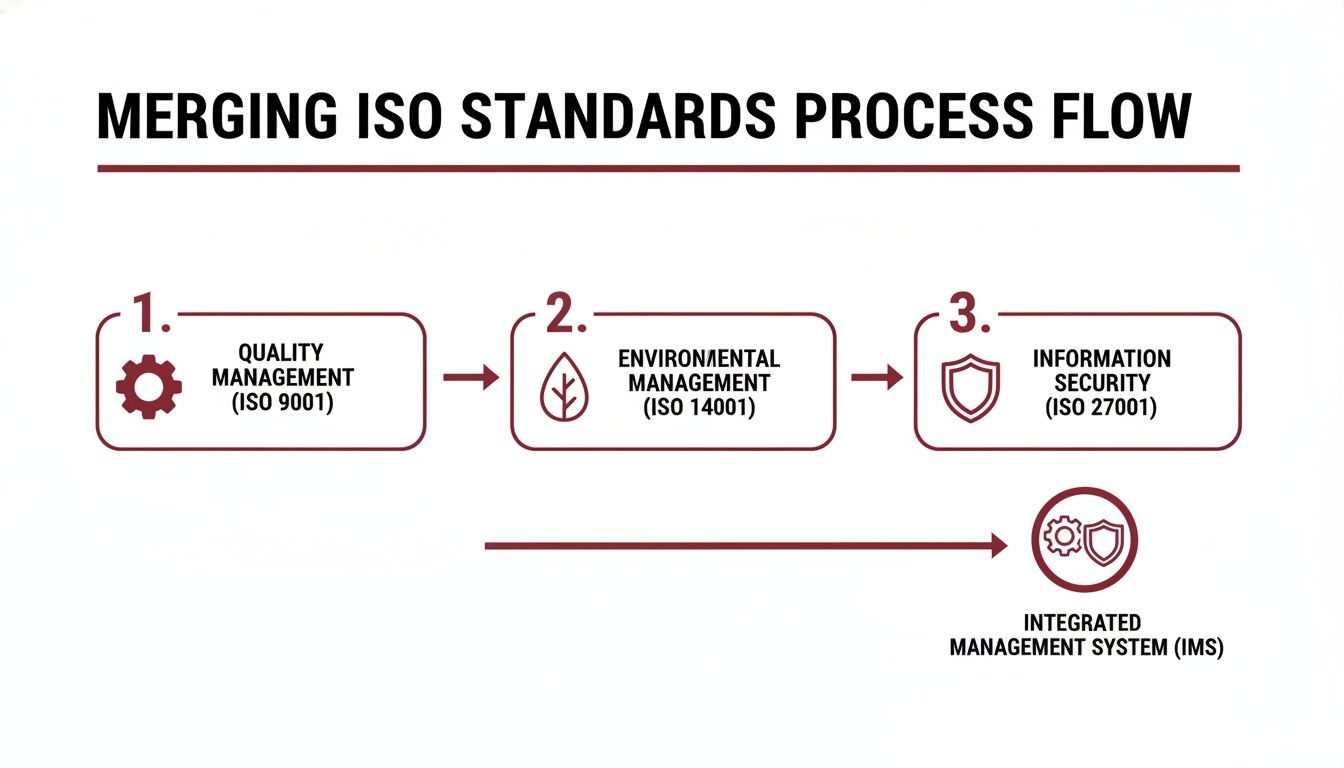
The real insight here is that common management principles let you handle these different areas through a shared set of processes, which cuts down on complexity and admin headaches.
Phase 4: Roll Out Training and Communication
An IMS is only as good as the people using it every day. A classic mistake is designing a perfect system on paper but forgetting to bring your team along for the ride. Your rollout needs a solid training and communication plan to build awareness and make sure everyone knows what their role is.
Your training shouldn't be a one-size-fits-all affair. Tailor it:
- For the Leadership Team: Focus on their strategic role in overseeing the IMS, reviewing performance, and championing continuous improvement.
- For Managers and Team Leaders: Train them on the new integrated processes, what they’re responsible for, and how to track performance in their own teams.
- For All Employees: Give them general awareness training on why the IMS exists, key policies (like information security), and how their daily work helps the whole system succeed.
Clear and consistent communication is non-negotiable. Use your regular team meetings, newsletters, and intranet to share progress, celebrate small wins, and constantly remind everyone why you’re making this change. For anyone tackling the security side of things, a well-defined plan is essential. You can find out more about that in our guide to ISO 27001 implementation.
Phase 5: Lock in Your Audits and Management Reviews
Once your IMS is live, you need a way to check that it’s actually working and find ways to make it even better. This happens through two key activities: internal audits and management reviews.
- Internal Audits: Instead of running separate audits, you can conduct a single, integrated audit that checks compliance against all your standards at once. It’s far more efficient and gives you a much better big-picture view of your business’s health.
- Management Reviews: Hold regular meetings where your leadership team looks at the performance of the entire IMS. This one strategic session should cover everything from quality KPIs and safety incidents to security risks and environmental targets.
These activities aren't just about finding problems. They are the engine that drives continuous improvement, making sure your IMS grows with your business and keeps delivering value long after you get the certificate. Follow these phases, and you'll build an integrated system that’s robust, efficient, and perfectly in tune with your business goals.
Getting the Right People and Tools in Place for Your IMS

A world-class integrated management system (IMS) is built on more than just well-written procedures. To really make it sing, you need the right people championing its cause and the right technology to make it all work smoothly. Think of it like a high-performance racing team: you need skilled drivers (your people) and a state-of-the-art car (your tools) to even have a shot at winning.
This section gets into the nitty-gritty of the governance structure and digital tools that turn an IMS from a dusty compliance folder into a dynamic engine for business improvement. By defining clear roles and picking smart technology, you can build a system that’s effective, accountable, and built for the long haul.
Establishing a Clear Governance Structure
Without clear ownership, even the best-laid plans can fall apart. A strong governance framework makes sure everyone knows their role in keeping the IMS humming and getting better over time. This isn't about creating pointless bureaucracy; it’s about building a culture of accountability where compliance becomes everyone’s business.
Certain roles are absolutely essential for driving this culture and ensuring your integrated management system functions as it should.
An IMS without clear roles is like a ship without a captain or a crew. You might have a great destination in mind, but no one is steering the vessel or managing the sails, leaving you adrift in a sea of compliance requirements.
By defining these roles, you create clear lines of responsibility that stop tasks from falling through the cracks. It empowers people to take real ownership of the system's success.
Defining Key Roles and Responsibilities
A successful IMS team is a mix of high-level strategic oversight and practical, on-the-ground execution. While job titles might differ from one company to the next, the functions these people perform are critical.
Here are the core players you need on your team:
- IMS Manager or Coordinator: This person is the central pilot for your entire system. They look after the day-to-day operations, coordinate audits, report on performance to leadership, and are the go-to contact for everything IMS-related.
- Departmental Champions: These are your advocates on the front lines. A champion from each key department (like IT, HR, or Operations) helps roll out IMS procedures within their team, provides priceless feedback, and gets their colleagues on board.
- Internal Auditors: This specially trained group is responsible for giving the IMS regular health checks. They objectively assess whether processes are actually being followed and pinpoint opportunities for improvement, making sure the system stays sharp.
- Executive Sponsor: This is a senior leader who champions the IMS from the top. They secure the necessary resources, clear organisational roadblocks, and visibly support the system’s goals, sending a powerful message that this stuff is a top priority.
This structure ensures your IMS has rock-solid support from the boardroom right down to the shop floor, creating a strong foundation for lasting success.
Equipping Your Team with the Right Digital Tools
In the past, managing compliance meant drowning in spreadsheets, binders, and paper forms. Thankfully, technology has completely changed the game. Today’s tools can automate workflows, deliver deep insights, and ensure consistency across your integrated management systems. The right tech stack turns your IMS from a clunky machine into a smart, responsive system.
The Australian IT services sector is a huge part of this shift, helping businesses with system integration and modernisation. With IT spending in Australia forecast to hit around AU$147 billion in 2025, a big chunk of that investment is going into automation, cloud migration, and better cybersecurity. More and more, organisations are looking for managed service providers who can offer operational oversight for complex system rollouts—which is exactly what a robust IMS needs. You can discover more insights about Australian IT market trends and how they support business system integration.
Must-Have Technologies for a Modern IMS
Picking the right software can dramatically cut down on administrative headaches and make your whole system far more effective.
Here are some of the essential tools to consider:
- Document Control Software: This becomes your single source of truth for every policy, procedure, and record. It handles version control, manages review and approval workflows, and guarantees employees always have the latest documents at their fingertips.
- Audit Management Platforms: These tools take the pain out of the entire audit cycle. They help you schedule audits, create checklists, track non-conformances and corrective actions, and generate professional reports, all from one central dashboard.
- Risk Assessment and Management Tools: Forget static risk registers in spreadsheets. These platforms allow for dynamic risk management. They help you identify, assess, and treat risks across all your standards, giving you a complete picture of your organisation’s risk profile.
- Compliance and Training Management Software: This tech helps you keep track of employee training, manage certifications, and automate reminders for refresher courses. It ensures your team stays competent and fully aware of their responsibilities.
By investing in these tools, you empower your team to manage the IMS more efficiently. They can then focus on making strategic improvements instead of getting bogged down in manual, administrative tasks. The right technology doesn't just support your IMS—it supercharges it.
Common Pitfalls and How to Avoid Them
Bringing an integrated management system (IMS) to life is a brilliant strategic move, but like any major business initiative, the path isn't always smooth. Even the best-laid plans can encounter a bit of turbulence. The trick is knowing where the common challenges lie so you can steer around them, turning potential roadblocks into genuine opportunities to strengthen your system.
A successful IMS isn't about a flawless launch day. It’s about anticipating the real-world hurdles and navigating them with a steady hand. From leadership support that's all talk and no action, to employees who just see more red tape, these issues can quickly undermine all your hard work. Let’s look at how to tackle them head-on.
Lacking Genuine Leadership Commitment
This is the classic project-killer. An IMS project is doomed to fail if senior leaders pay it lip service but don't truly champion it. When the people at the top aren't visibly committed, the initiative gets branded as a low-priority 'nice-to-have'—the first thing to be ignored when deadlines get tight. Without that executive buy-in, you'll be starved of the resources and authority needed to see it through.
The key is to make the business case impossible to ignore.
- Talk ROI: Don't just talk about compliance; talk about money. Highlight the potential cost savings from combined audits, which can often be between 20-40%, and show how streamlined processes boost efficiency across the board.
- Frame it as a Shield: Explain how a unified view of risk isn't just a tick-box exercise—it's what protects the business from real financial and reputational harm.
- Find Your Champion: Appoint a senior leader to be the official sponsor. Their job is to knock down organisational barriers and consistently remind everyone why this matters.
Creating a Bureaucratic Paperwork Monster
This is a very real and dangerous trap. It’s easy to end up with an IMS that’s just a mountain of complicated documents, forms, and procedures that nobody actually uses or understands. When the system feels like a bureaucratic weight instead of a useful tool, your team will find workarounds. Your IMS becomes a "paper reality"—a system that only exists in a folder on the server, completely detached from how work actually gets done.
The solution? Always design with the end-user in mind. Keep it simple and practical.
Your IMS should serve the business; the business should not serve the IMS. The goal is to create lean, intuitive processes that make people's jobs easier, not harder. This is the secret to getting people to actually use and value the system.
Instead of inventing complex new rules, start by looking at how your teams already operate. Figure out what’s working well and build on that. You can then weave the compliance requirements into their existing routines in a way that feels natural and adds obvious value.
Neglecting Employee Training and Communication
You could design the most elegant integrated system imaginable, but if your people don't get it, it will fail. If they don't understand why it’s there or how it helps them, it’s just another confusing change to resist. Firing off a couple of all-staff emails and hoping for the best is a sure-fire recipe for failure.
A solid training and communication plan is absolutely essential.
- Start with "Why": People need to understand the reason for the change. Constantly communicate how the IMS will make their jobs better—less duplicated effort, clearer responsibilities, and smoother workflows.
- Make Training Relevant: A one-size-fits-all training session won't cut it. A software developer and a warehouse manager need to know different things. Tailor the training to the specific processes and tools that matter to each role.
- Open Up a Feedback Loop: Give your team clear channels to ask questions, voice concerns, or suggest improvements. When you act on their feedback, it proves you're listening and are committed to making the system work for everyone, not just for management.
By getting ahead of these common pitfalls, you can guide your IMS implementation toward real success. The aim is to build a living, breathing system that your team embraces—one that delivers real, lasting value to your entire organisation.
Your IMS Questions, Answered by the Experts
Thinking about bringing an integrated management system into your business is a big step. It’s not just a minor process change; it’s a strategic decision that builds a stronger, more resilient company. Naturally, you've got questions. We've got answers, based on years of helping businesses just like yours make this move with confidence.
How Long Will an IMS Implementation Actually Take?
This is usually the first thing everyone asks, and for good reason. While there's no one-size-fits-all answer, a typical IMS implementation takes somewhere between six and twelve months. What pushes you to one end of that scale or the other really depends on your business.
The size and complexity of your organisation are the biggest factors. A small business with clear, well-defined processes might get things done in six months. A larger company with multiple locations and complex operations could easily take a year or more. The number of standards you’re blending together also plays a huge part in the timeline.
Ultimately, the best way to stay on schedule is with a crystal-clear scope and solid project management from day one.
Can We Start Small and Just Integrate Two Standards?
Absolutely! In fact, we often recommend it. Kicking off with just two standards is a smart, pragmatic approach. It lets your team get a feel for how an integrated management system works without overwhelming them. Think of it as a way to build momentum and show some quick wins to management.
The trick is to start with a pairing that has a natural synergy in your day-to-day operations.
- ISO 9001 (Quality) & ISO 45001 (Health & Safety): This is a go-to for manufacturing, construction, and other hands-on industries. Your quality control processes are almost always intertwined with keeping your people safe.
- ISO 9001 (Quality) & ISO 27001 (Information Security): For any tech company or service provider, this is a powerhouse combination. Protecting client data is a non-negotiable part of delivering a quality service, so linking these two just makes sense.
Starting small and building out is the secret to a successful implementation. You get to fine-tune your integrated processes on a manageable scale before rolling in other standards later.
This approach lets your IMS grow and adapt with your business, turning it into a flexible, long-term asset.
Isn't an IMS Just for Big Corporations?
This is one of the biggest misconceptions out there. While it's true that large companies rely on them, an IMS can be a game-changer for small and medium-sized businesses (SMEs). In many ways, the benefits—like efficiency and cost savings—are even more critical when you're a smaller outfit trying to grow.
For an SME, an integrated system is a serious competitive advantage. It helps you punch well above your weight.
- You Make Every Resource Count: SMEs can't afford to waste time or money. An IMS gets rid of duplicated effort and streamlines your operations, so your team can achieve more.
- You Cut Down on Costs: Think about it: one combined audit instead of several separate ones. Less administrative busywork. Those savings go straight to your bottom line.
- You Build Instant Credibility: Having certifications for multiple standards shows you’re a mature, reliable business. It's the kind of thing that helps you win bigger contracts and break into new markets.
An IMS doesn't just level the playing field; it gives your business the solid foundation it needs to compete and scale with confidence.
Embarking on an integrated management system journey can seem daunting, but you don't have to go it alone. Anitech has over 20 years of experience helping Australian small businesses achieve ISO certification with a 100% success rate. We take the complexity out of the process, guiding you from the first planning session to your final certification audit, so you can stay focused on what you do best—running your business. Learn more about how Anitech can support your IMS journey.
Recent Comments