

Let's get straight to it. For a small to medium-sized Australian business, the total first-year ISO 27001 accreditation cost typically lands somewhere between $20,000 and $70,000. It's a significant figure, but thinking of it as just a cost is missing the point. This is a strategic investment in your company's resilience, reputation, and future growth.
Your Guide To ISO 27001 Accreditation Costs
Getting started with ISO 27001 can feel a lot like mapping out a major building project. You know the final structure—a secure, robust fortress for your data—is non-negotiable, but the initial blueprints and costings can seem intimidating. The final price isn’t one single line item; it's a mix of costs for your expert architects (consultants), quality building materials (security tools), and the final council inspection (audits).
This guide is your financial blueprint. We’re here to pull back the curtain on the numbers, helping you see the ISO 27001 accreditation cost not as a burden, but as a genuine business advantage. Achieving this standard doesn't just protect your most valuable asset—your data. It opens doors to bigger clients who won't even talk to you without proof of your security credentials. In a world of constant cyber threats, this certification is your shield.
Understanding The Core Investment
The path to ISO 27001 certification is a structured one, with several key stages that each have costs attached. You’re essentially building your Information Security Management System (ISMS) from the ground up. This involves figuring out where you stand now, writing policies, putting security controls in place, and finally, getting the official tick of approval from an accredited auditor.
To give you a clear, big-picture view of what this looks like financially, here’s a breakdown of the main expenses involved.
Estimated First-Year ISO 27001 Cost Breakdown For Australian SMEs
This table lays out the estimated first-year costs for an Australian SME, showing you exactly where your investment goes at each step of the process.
| Cost Component | Typical Price Range (AUD) | Description & Key Activities |
|---|---|---|
| External Consulting & Advisory | $5,000 – $30,000+ | Expert help with the tricky stuff: gap analysis, risk assessments, policy writing, and implementation. A good consultant gets you there faster and helps you avoid expensive mistakes. |
| Certification Body Audit Fees | $10,000 – $20,000 | This is the fee for the official, mandatory two-stage external audit (Stage 1 and Stage 2). An accredited certification body conducts this to verify you meet the standard. |
| Security Tools & Technology | $2,000 – $15,000+ | The cost of software and hardware needed to meet the standard's controls. Think vulnerability scanners, password managers, endpoint protection, and maybe even compliance platforms. |
| Internal Resource Time | (Varies – Opportunity Cost) | Often the biggest hidden cost. This is the time your own team spends on documentation, training, meetings, and putting new processes into action. It's real, even if it's not a direct invoice. |
| Employee Training | $1,000 – $5,000 | Everyone on your team needs security awareness training. This makes sure they understand their role in protecting company data and upholding the ISMS. |
Seeing the numbers laid out like this helps you plan, but it’s crucial to remember that this is more than just an expense sheet.
Why This Investment Is Worth Every Cent
Just looking at these figures as costs is short-sighted. Each one is a building block for a stronger, more trustworthy organisation. The fallout from a single data breach—in fines, lost business, and reputational ruin—can easily dwarf the entire investment in ISO 27001. If you'd like a closer look at the steps involved, this practical guide to the ISO 27001 certification process is an excellent resource.
ISO 27001 isn't just a certificate to hang on the wall. It’s a fundamental shift in how your business thinks about and handles security. It weaves a culture of risk management and continuous improvement into the very fabric of your company, delivering value long after the first audit is done.
Ultimately, the money you spend on ISO 27001 is a proactive investment in your business’s future. It equips you to handle threats, win the confidence of high-value clients, and operate with the peace of mind that your information is protected by a world-class standard. In the following sections, we’ll walk through each of these costs in more detail, helping you budget effectively and get the best possible return on this critical investment.
The Real Breakdown: What Goes Into The Cost of ISO 27001?
Figuring out the total ISO 27001 accreditation cost is a lot like budgeting for a major home renovation. It’s never just one single price. Instead, it’s a sum of several distinct parts: the architect (your consultant), the building inspector (the auditor), your own crew doing the work (your internal team), and the materials and security systems (your tools and software).
Let's pull back the curtain on where your money actually goes. Moving past the initial sticker shock, you’ll get a much clearer, more strategic picture of each cost. This is how you build a smart budget, making sure every dollar spent genuinely strengthens your security defences.
This chart gives you a quick visual on how the costs are typically split.
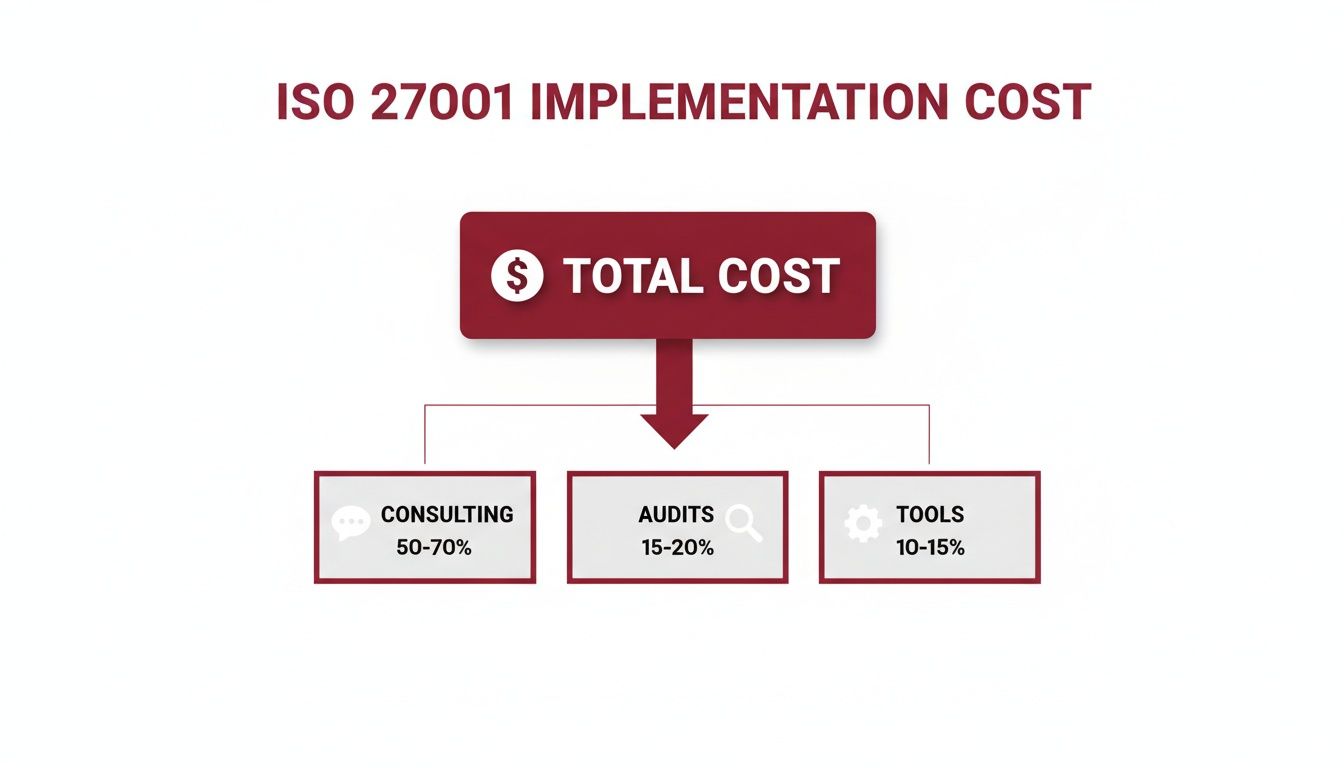
As you can see, the main investments usually fall into three buckets: getting expert guidance, paying for the formal audit, and acquiring the right tech to get the job done.
The Architect: Your External Consultant
Let’s be honest, for most small businesses, trying to navigate the maze of ISO 27001 alone is a recipe for frustration and wasted effort. This is where a good consultant comes in. Think of them as the expert architect and project manager for your security renovation. They draw up the blueprints, guide the build, and make sure everything is up to code so you don't face a costly tear-down later.
A seasoned consultant does more than just tick boxes; they fast-track your entire project. Their experience helps you sidestep the common traps and rookie mistakes that can lead to a failed audit and months of rework.
Here's what they typically handle:
- Gap Analysis: A top-to-bottom review of your current security, showing you exactly where you stand against the ISO 27001 standard and what needs fixing.
- Risk Assessment: They help you pinpoint and evaluate the specific security risks your business actually faces, not just theoretical ones.
- Policy & Documentation: They guide you in creating the practical, comprehensive documentation your Information Security Management System (ISMS) requires.
- Implementation Support: They’re there to offer hands-on help as your team puts new security controls and procedures in place.
For a small business in Australia, engaging a consultant can run anywhere from $5,000 to over $30,000. It’s a significant investment, no doubt. But their expertise nearly always saves you more in the long run by cutting down on wasted internal hours and preventing expensive blunders. You can see how experts map out this journey in our guide to the ISO 27001 implementation process.
The Inspector: Certification Body Audit Fees
Once your security framework is built, you need an independent, accredited inspector to come in and officially sign off on it. This is the job of the certification body, and their audit is the final, non-negotiable step to getting that official ISO 27001 certificate.
You can't mark your own homework here. This external validation is precisely what makes the certification so valuable and credible to your clients. The cost covers a strict two-stage audit.
- Stage 1 Audit: This is essentially a "desk audit." The auditor reviews all your documentation to make sure your ISMS policies and procedures are well-defined and, on paper, meet the standard’s requirements.
- Stage 2 Audit: Now they come to see it in action. In this deep-dive review (either on-site or remote), the auditor verifies that your security controls are actually working as intended and as described in your paperwork.
For an Aussie SME, these audit fees typically land somewhere between $10,000 and $20,000. The exact figure will depend on things like the size of your company and how complex your security scope is.
The Building Crew: Your Internal Resource Costs
This is the cost everyone forgets. It's the "opportunity cost" of your own team’s time—the hours they spend building your security system instead of doing their normal jobs.
This cost won't show up on an invoice, but its impact on your budget and productivity is very, very real. Your people will be pulled away from their day-to-day work to focus on documentation, meetings, training, and implementation.
This hidden cost is substantial. Internal teams can spend hundreds of hours on documentation, attending meetings, undergoing training, and implementing new procedures. Failing to account for this can lead to project delays and resource burnout.
Time gets sunk into a lot of different areas:
- Participating in risk assessment workshops.
- Writing and reviewing new security policies.
- Implementing new technical controls.
- Gathering evidence for the auditors.
- Attending security awareness training sessions.
Putting a number on this is key to a realistic budget. A simple way is to multiply the hours spent by the average hourly rate of the staff involved. This "soft cost" can easily add thousands of dollars to the total ISO 27001 accreditation cost.
The Security Systems: Technology and Tooling
Finally, you can't have a modern fortress without the right tech—the digital equivalent of surveillance cameras and reinforced gates. For ISO 27001, this means the software and hardware you need to effectively implement and manage your security controls.
Your gap analysis and risk assessment will tell you exactly what tools you need. The good news is you might already have some in place. Others will be a new investment.
Common tech costs might include:
- Vulnerability Scanners: To actively find weak spots in your systems.
- Endpoint Protection: Next-gen antivirus and malware defence for every laptop and server.
- Password Managers: To enforce strong, unique passwords across the whole company.
- Compliance Management Software: Platforms designed to automate evidence collection and give you a dashboard view of your compliance status.
- Incident Management Systems: Tools to help you track and respond to security incidents in a structured way.
The spend here can swing wildly, from a few thousand dollars for the basics to $15,000 or more for more advanced solutions.
When you add it all up, the average cost for ISO 27001 certification in Australia generally falls between AUD $10,000 and AUD $50,000. That covers everything from the initial setup to the external audits and ongoing maintenance. The implementation piece alone—which includes many of these tech costs—often ranges from AUD $5,000 to AUD $25,000.
By understanding these four core components, you can move from a vague, intimidating number to a clear, actionable budget for a successful and strategic investment in your business's security.
How Your Business DNA Shapes The Final Price Tag
Let's get one thing straight: there's no fixed menu price for ISO 27001 accreditation. Think of it more like building a custom home. The final cost is a direct reflection of your company’s unique blueprint—its size, complexity, and how much ground you need to cover. No two businesses are the same, so no two certification journeys will ever carry the exact same price tag.
Getting a handle on these factors is the key to budgeting properly. It helps you move past vague estimates and see exactly where your business fits on the cost spectrum. This clarity means no nasty financial surprises down the road, allowing you to plan your security investment with confidence.
Company Size and Employee Count
The most obvious cost driver is your headcount. More people equals more complexity. It means more laptops and phones to secure, and a much bigger job when it comes to security training. Every single employee is a potential risk point, and your Information Security Management System (ISMS) needs to be built to manage that.
An auditor's time is money—your money. Auditing a 200-person company is a fundamentally bigger task than a 20-person startup. They need to interview more staff, dig through more procedures, and check that security controls are being applied consistently across the board. All this extra time translates directly into higher audit fees.
The table below gives you a ballpark idea of how the ISO 27001 accreditation cost scales in Australia.
ISO 27001 Cost By Company Size (Australian Estimates)
| Company Size (Employees) | Initial Certification Cost (AUD) | Annual Surveillance Audit Cost (AUD) |
|---|---|---|
| 1-50 (Small) | $20,000 – $40,000 | $10,000 – $18,000 |
| 51-200 (Medium) | $40,000 – $70,000 | $18,000 – $30,000 |
| 200+ (Large) | $70,000+ | $30,000+ |
As you can see, costs rise sharply with headcount, reflecting the increased scope and effort required. If you're looking for more detail, you can find a deeper dive into Australian ISO 27001 certification costs.
The number of employees is a primary multiplier for ISO 27001 costs. More people mean more devices, more access points, more training, and more potential for human error. Your ISMS has to account for all of it, which naturally expands the scope and effort for both implementation and auditing.
The Complexity of Your IT Environment
Beyond just people, the tangle of your technology stack plays a huge part. Imagine two companies, both with 50 employees.
- Company A (Simple): A marketing agency running everything on standard SaaS tools like Google Workspace, Salesforce, and Xero. Their data lives in the cloud with big, trusted providers, and their IT setup is dead simple.
- Company B (Complex): A software dev house with its own on-site servers, a mix of cloud environments (like AWS and Azure), proprietary apps in development, and a whole lot of sensitive client code to protect.
Company B is facing a much more expensive journey to certification. Their audit has to cover physical server security, the setup of multiple cloud platforms, and the security of their entire software development process. This demands more specialised auditors and a lot more time, which all drives up the cost.
The Scope of Your Information Security Management System
One of the most critical decisions you'll make is defining the "scope" of your ISMS. This simply means deciding which parts of your business will be covered by the ISO 27001 certificate. The good news? You don't always have to certify the whole company.
A tight, well-defined scope can be a brilliant way to manage costs. For example, a fintech company might decide to only include the systems, people, and processes tied to its main financial app, leaving internal functions like HR and marketing out of the picture for now.
Of course, a broader scope covering the entire business offers more comprehensive security and looks much better to enterprise clients. It’s a classic trade-off:
- Narrow Scope: Lower upfront costs and a faster path to certification.
- Broad Scope: Higher costs and a longer timeline, but delivers rock-solid assurance to everyone you work with.
The trick is to match the scope to your business goals. If you need the certificate to land a specific government contract, then your scope absolutely must cover every service related to that contract.
Physical Locations and Geographic Spread
The number of offices you have also adds to the bill. If your ISMS scope includes multiple sites, the auditor will probably need to visit each one to check that physical security controls are up to scratch everywhere.
This adds a few layers to your budget:
- Travel and Accommodation: You’ll be footing the bill for the auditor’s flights and hotels.
- More Audit Time: More locations mean more time on the clock, which means higher fees.
- Implementation Headaches: Making sure security policies (like access control and clean desks) are enforced the same way across different offices adds to the workload.
For a business with one office in Sydney, the audit is a straightforward event. But for a manufacturer with an office in Melbourne, a warehouse in Brisbane, and a sales team in Perth, the logistics and costs of that Stage 2 audit just got a whole lot bigger. Each of these variables—size, complexity, scope, and location—weaves together to create a cost profile that is uniquely yours.
Budgeting For The Long Haul With Ongoing Maintenance Costs
Getting your ISO 27001 certificate is a massive win, but it’s really just the beginning. Think of it as the start of a marathon, not the finish line of a sprint. Your Information Security Management System (ISMS) isn't something you can just "set and forget." It’s a living part of your business that needs constant attention to fend off new threats.
This is where the ongoing maintenance costs come into play. These are the recurring expenses that keep your certification active and, more importantly, keep your security defences sharp. Factoring these into your budget from day one is the secret to a sustainable security program that protects your business without any nasty financial surprises down the track.
It’s a bit like owning a high-performance car. The initial price is just the first hurdle. To keep it running smoothly and safely, you have to budget for regular services, oil changes, and tune-ups. Skipping maintenance doesn't just put you at risk—it's a surefire way to run into bigger, more expensive problems later on.
Annual Surveillance Audits: The Yearly Health Check
After you’re certified, your certification body will pop in every year for a surveillance audit. It’s not as full-on as the initial two-stage audit, but it’s absolutely critical. This is your annual health check to prove your ISMS is still working as it should and that you’re sticking to the standard.
During this audit, the assessor will:
- Dip into a sample of your security controls to see that they’re being maintained.
- Check that you're running your regular internal audits and management reviews.
- Make sure you’ve sorted out any minor issues (or non-conformities) from previous audits.
- Confirm your ISMS is still hitting the goals you set for it.
These audits are mandatory to keep your certificate on the wall. The cost for these yearly check-ups is a fundamental part of the total ISO 27001 accreditation cost over time.
The Triennial Recertification Audit: Renewing Your Commitment
Your ISO 27001 certificate is valid for three years. When that cycle is up, it's time for a full recertification audit to renew it for another three. This one is much more thorough than the annual audits—it feels a lot more like your initial Stage 2 audit in terms of scope and intensity.
The triennial audit is a deep-dive reassessment of your entire ISMS. It’s the ultimate proof that your commitment to security isn’t a one-off project but is genuinely woven into the fabric of your business. The cost is higher than a surveillance audit, so it’s vital to plan for this bigger expense in your third year.
Ongoing maintenance, particularly the cycle of annual surveillance and triennial recertification audits, is the mechanism that ensures ISO 27001 remains a credible and robust standard. It forces organisations to continuously improve, adapt, and demonstrate their security commitment year after year.
Ongoing maintenance is a critical long-term component of the ISO 27001 accreditation cost in Australia. You can typically expect annual surveillance audits to cost between AUD $2,000 and $10,000. The more intensive triennial recertification can range from AUD $5,000 to $15,000. These recurring audits ensure your ISMS stays relevant against new threats, and for smart small businesses, this upkeep is simply a planned operational expense. To get a better handle on these figures, you can discover more insights about Australian ISO 27001 costs and see how they fit into the bigger picture.
Other Hidden Ongoing Expenses To Budget For
Beyond the predictable rhythm of audits, a few other recurring costs are essential for keeping your security posture—and your ISO 27001 certificate—in good standing. Forgetting these can lead to security gaps and budget blowouts.
Here are the other key ongoing costs to factor in:
- Continuous Staff Training: Threats evolve, and so does your team. You’ll need an ongoing security awareness program for new starters and annual refreshers for all staff to keep them sharp.
- Security Software Renewals: That endpoint protection, vulnerability scanner, or password manager? They all have annual subscription or licensing fees. These are non-negotiable costs if you want to maintain your technical controls.
- Consultant Retainers (Optional but Recommended): Many businesses keep their consultant on a retainer. It gives you on-demand access to expert advice for internal audits, management reviews, or navigating any changes to the standard. It's a great source of peace of mind.
- Penetration Testing: While not always mandatory every single year, regular "pen tests" are a best practice for sniffing out new vulnerabilities. Many businesses run them annually to stay one step ahead of attackers.
- Internal Resource Time: Just like during the setup phase, your team will need to put in the hours each year for internal audits, updating risk assessments, and gathering evidence for surveillance audits. This internal time is still a significant, if hidden, cost.
By mapping out all these expenses over a three-year cycle, you can build a realistic, sustainable budget. This foresight stops you from being caught off guard and makes sure your investment in ISO 27001 continues to pay dividends, protecting your business and reassuring your clients year after year.
Smart Ways to Manage Your ISO 27001 Spend
Investing in ISO 27001 is a big step, but it doesn't mean you have to write a blank cheque. With a bit of smart planning, you can get certified without blowing your budget. The goal here isn’t to be cheap; it’s to be efficient. You want every dollar to pull its weight in building a stronger, more secure business.
Thinking ahead is the key. A proactive approach stops costs from spiralling and turns what looks like a big expense into a well-managed investment. It’s all about making clever choices that fit your business, using what you’ve already got, and knowing when to bring in an expert to dodge costly mistakes.
Tightly Define Your ISMS Scope
One of the best ways to control costs right from the start is to be surgical with the scope of your Information Security Management System (ISMS). You probably don't need to certify every single part of your organisation on day one. Starting with a smaller, more focused area can dramatically cut down the initial workload and, therefore, the price tag.
Think about a software company, for example. They might decide to only include the people, processes, and tech directly involved in building and shipping their main product. This means departments like HR or marketing are left out of the initial audit, making the whole project far more manageable.
This focused approach helps you:
- Get certified faster and start seeing the benefits sooner.
- Cut down the auditor's time on-site, which directly lowers their fees.
- Minimise disruption to parts of the business that aren’t critical for this first step.
The trick is to make sure the scope still covers what your clients or contracts require. A well-defined scope is a strategic move, not a shortcut.
Leverage Your Existing Security Controls
Chances are, you’re not starting from absolute zero. Most businesses already have decent security measures in place, even if they aren't formally written down as part of an ISMS. The key is to find them, document them, and build on them.
Before you go splashing cash on new tools, take stock of what you're already doing. You might find you have:
- Strong password policies that your IT system already enforces.
- Solid backup and recovery plans that you test regularly.
- Effective antivirus software running on all company devices.
Recognising and formalising the security measures you already use is a huge cost-saver. Every existing control that aligns with an ISO 27001 requirement is one less thing you have to build, buy, or implement from the ground up, saving both time and money.
By mapping your current setup against the ISO 27001 standard, you can laser-focus your budget on filling the real gaps instead of reinventing the wheel.
The Consultant Question: DIY vs. Expert Guidance
Deciding whether to go it alone or hire a consultant is a major fork in the road. The DIY path might look cheaper at first glance because you're saving on consulting fees, but this can be a classic false economy.
Trying to get certified without an expert can lead to serious misinterpretations of the standard, months of wasted effort on the wrong documents, and a very real risk of failing your Stage 1 audit. A failed audit means paying for another one, plus all the time spent on rework. Suddenly, your costs are climbing.
Bringing in a skilled consultant like Anitech early on nearly always brings down the total cost. A good guide stops you from making expensive mistakes, gets you to the finish line faster, and saves your internal team from being stretched too thin. They make sure you get it right the first time, delivering a much better return on your investment.
Bundle Services for Greater Efficiency
Another really practical way to manage your spend is to look for efficiencies in how you get things done. If your business also needs other standards—like ISO 9001 for quality or ISO 45001 for safety—bundling them into an Integrated Management System (IMS) can be a game-changer. An IMS streamlines everything, cuts down on admin, and can seriously reduce your audit fees. You can learn more about how Integrated Management Systems create these efficiencies.
Likewise, bundling different services with one provider can create savings. Getting your consulting, internal audit support, and ongoing maintenance from the same place often results in a more cohesive and budget-friendly program. Exploring proven cost reduction strategies for businesses can also spark ideas for your overall approach, including your security investments. These broader business principles are perfect for applying to your ISO 27001 project, helping you find savings without weakening your security framework.
Calculating The True Return On Your Security Investment
So far, we've been crunching the numbers—looking at the invoices and internal hours that make up the ISO 27001 accreditation cost. But to really get the full picture, we need to stop thinking of this as an expense and start seeing it as a strategic investment. This isn't just about ticking a compliance box; it's about making your business more resilient, more trustworthy, and ready for serious growth.
Treating ISO 27001 as just another bill is like complaining about the cost of a fortress wall without considering the value of the city it protects. The real question isn't "How much will this set me back?" but "What's the payoff for this protection?"
Let's break down the returns you can genuinely expect. They're often game-changers.
Unlocking Tangible Financial Wins
The most obvious returns are the ones you can see on your profit and loss statement. ISO 27001 isn't just a defensive move; it's a powerful commercial tool that can pay for itself many times over.
Here’s where you’ll see the hard cash benefits:
- Winning High-Value Contracts: More and more, especially in Australia, big corporate and government tenders have ISO 27001 as a non-negotiable requirement. If you don't have it, you can't even get in the door. The certification is your ticket to play in the big leagues, turning a compliance project into a direct revenue pipeline.
- Drastically Reducing Breach Costs: For a small business, a data breach can be a knockout blow. The costs aren't just about the fines; they include eye-watering bills for forensic investigators, lawyers, customer compensation, and the kind of reputational damage that's hard to come back from. A solid ISMS, proven by ISO 27001, is one of your best defences, potentially saving you from a financial disaster that would make the certification cost look tiny.
- Lowering Cyber Insurance Premiums: Insurers are getting tough on cyber risk. When you can show them you've got a proactive, internationally recognised security framework in place, you’re in a much better position to negotiate lower premiums. Certification proves you're a lower-risk client, and that can mean immediate, ongoing savings year after year.
Building Priceless Intangible Value
These next benefits are a bit harder to stick on a spreadsheet, but they are just as powerful. They build a rock-solid foundation of trust and resilience that becomes a core part of who you are as a business.
The real magic of ISO 27001 isn't just stopping bad things from happening; it's creating the right conditions for good things to happen. It swaps customer doubt for hard proof of your commitment to security, turning trust from a vague promise into a certified fact.
This trust shows up in a few critical ways:
- Elevating Your Brand Reputation: In a noisy marketplace, that ISO 27001 certification mark makes you stand out. It’s a clear signal to everyone that you take security seriously, positioning your brand as more mature, reliable, and trustworthy than your competitors who haven't made the same commitment.
- Fostering an Unbreakable Security Culture: The certification journey gets your whole team thinking about security. It stops being an "IT problem" and becomes everyone's responsibility. This cultural shift creates a vigilant, proactive team where everyone knows their role in protecting the company’s—and your clients'—information. It's one of the most lasting benefits you'll get.
- Strengthening Customer and Partner Confidence: When clients and partners give you their data, they're taking a leap of faith. ISO 27001 gives them third-party, verifiable proof that you have the right systems to protect it. This confidence leads to better relationships, happier customers, and a much smoother sales process.
At the end of the day, the ISO 27001 accreditation cost is an investment in your company’s future. The long-term rewards—winning bigger contracts, dodging catastrophic breaches, and building a brand people trust—deliver a return that makes the initial outlay look like a bargain. For a deeper analysis, exploring the ROI of cyber security investments can provide further clarity on how these benefits directly impact your bottom line.
Got Questions About ISO 27001 Costs? We’ve Got Answers.
Even after breaking down the numbers, you've probably still got a few things on your mind about the real cost of getting ISO 27001 certified. That's completely normal. This section tackles the most common questions we hear from Australian businesses, giving you straight, clear answers to help you finalise your budget and move forward.
So, How Long Does This Whole Certification Process Take?
For most small to medium-sized Australian businesses, you're looking at a timeline of six to twelve months from the day you start to the day you have that certificate in your hands. Of course, that's just a ballpark figure.
What can speed it up or slow it down? If you're a small company with a well-defined scope and have already put some decent security measures in place, you could be on the faster end of that scale. On the flip side, a larger business with a messy IT setup and virtually no documentation could easily stretch past the one-year mark. Bringing in an experienced consultant is probably the single best way to fast-track the process, as they know exactly how to dodge the common roadblocks.
Are There Any Government Grants to Help With the Cost?
Yes, sometimes there are! It's definitely worth looking into. Australian businesses, especially those in critical industries or aiming to work with the government, should keep an eye out for federal and state grants. You'll often find programs designed to bolster cybersecurity or support the defence supply chain that can help lighten the load of the ISO 27001 accreditation cost.
The catch is that these grants come and go, so you need to check what’s available right now. A few good places to start your search are:
- AusIndustry: This is the federal government’s go-to for grants that support business innovation and improvement.
- State-based business grants: Every state has its own pot of money and programs to help local businesses grow.
- Industry-specific funding: Keep an ear to the ground for grants aimed at your sector, whether that's fintech, healthcare, or something else.
Is ISO 27001 Just a One-Time Cost?
This is one of the biggest misconceptions out there—absolutely not. Getting certified is the first major investment, but maintaining ISO 27001 is an ongoing commitment. You need to factor recurring costs into your budget to keep your certificate valid and your security sharp.
Think of ISO 27001 less like a one-off purchase and more like a subscription to business resilience. The ongoing investment in surveillance audits and maintenance is what guarantees the standard keeps delivering real value and protection, year after year.
This means budgeting for the annual surveillance audits required to keep your certificate active, plus a bigger recertification audit every three years. On top of that, you’ll have ongoing expenses like software renewals, regular employee training, and perhaps occasional support from your consultant.
How Do I Pick the Right Certification Body?
Choosing your certification body is a big deal. The most important thing is to make sure they are accredited by a body like JAS-ANZ (the Joint Accreditation System of Australia and New Zealand). This accreditation is your proof that their audits are legitimate and your certificate will be recognised globally.
Once you have a shortlist of accredited bodies, here’s what to look for:
- Industry Know-How: Have they audited businesses like yours before? An auditor who gets your industry can provide a much more relevant and useful assessment.
- Costs and What’s Included: Get quotes from at least three different bodies. Don’t just compare the final price—look at their audit process and exactly what you get for your money.
- Availability: How soon can they get an auditor out to you? Check their lead times to make sure their schedule lines up with your goals for the Stage 1 and Stage 2 audits.
Picking a reputable, accredited body means you'll never have to worry about a client or partner questioning the value of your certificate. It’s the final stamp of approval, confirming your security investment meets the highest global standards.
Figuring out the ISO 27001 accreditation cost can feel like a maze, but you don’t have to navigate it on your own. At Anitech, we specialise in walking Australian small businesses through every single step. We focus on making the journey smooth, cost-effective, and successful—our 100% success rate speaks for itself.
Ready to turn your security investment into a serious competitive advantage? Contact Anitech today for a clear, no-obligation chat.
Recent Comments