

Getting your ISO 27001 accreditation is the single best way to prove you’re serious about information security. It’s not just a certificate; it's a globally recognised standard that gives you a solid framework for building, running, and constantly improving how you protect your data.
Think of it as a blueprint for safeguarding everything that matters – from your company’s secrets to your customers’ private information.
Why ISO 27001 Accreditation Is No Longer Optional
In a world where one bad data breach can destroy years of trust and land you with massive fines, just saying you're secure doesn't cut it anymore. Your clients, your partners, and even the regulators want to see proof.
This is where ISO 27001 stops being a "nice-to-have" and becomes a must-have for any ambitious Australian business looking to grow. It’s a powerful signal that you've got a smart, risk-based system in place to manage information security properly.
Honestly, this isn't about ticking boxes for compliance. It’s a strategic move that directly helps your bottom line. Getting accredited shows you have a verifiable system to protect your most valuable asset: your information. That covers everything from your intellectual property and financial records to employee details.
Building a Competitive Edge with Trust
Picture this: you’re bidding on a huge contract with a government department or a major corporation. Having that ISO 27001 certification can be the one thing that gets you over the line. These big players are incredibly risk-averse and demand high security standards from everyone they work with. Without the cert, your proposal might not even get a second look.
I've seen it time and again – the push for ISO 27001 often starts when a key client asks for it. That's the market telling you that top-tier security is now the price of admission for playing in the big leagues.
The standard isn't just about your IT department, either. It forces you to look at the whole picture – your people, your processes, and your technology. This holistic approach is what makes it so respected around the world.
What’s at the Core of ISO 27001?
At its heart, the standard is all about creating and maintaining an Information Security Management System (ISMS). An ISMS isn't a piece of software you install; it’s the complete set of policies, procedures, and controls you use to manage information risk. It’s a living, breathing system that you’re always working to improve.
So, what do you actually get out of it?
- Clients will trust you more. You can show them tangible proof that their data is safe, which builds stronger, more loyal relationships.
- You'll win more business. Accreditation unlocks doors to new contracts and markets, especially in highly regulated industries like finance and healthcare.
- You’ll get better at managing risk. The process gives you a structured way to spot threats and put the right protections in place, drastically cutting your chances of a security incident. A key driver here is avoiding disaster, and that starts with understanding what a data breach is.
The demand for this certification is skyrocketing. The global market, valued at USD 18.59 billion in 2025, is set to explode to USD 74.56 billion by 2035—that's a growth rate of 15.2% every year.
Here in Australia, there’s a real sense of urgency. Businesses with the older 2013 version of the standard must transition to the 2022 version by 31 October 2025, or they'll lose their accreditation.
This guide is your roadmap. We’ll cut through the jargon and give you clear, practical steps tailored for Australian businesses. We won't just tell you what to do; we'll show you how to do it, setting you up for a smooth journey to ISO 27001 accreditation. If you want to dive deeper into the business case, check out our article on why your business should get ISO 27001 certified.
Building Your Foundation for Certification Success
Let's be clear: you don't just "decide" to get ISO 27001 certified one Monday and have the certificate by Friday. A successful audit is the final step in a journey that starts with a solid foundation. Getting this early stage right is everything. It's where you map out your strategy, get the right people on board, and turn a massive, intimidating project into a series of manageable steps.
Nail this groundwork, and you'll save yourself a world of pain, time, and money later on. It shifts the entire project from a box-ticking compliance chore into a strategic move that actually makes your business stronger.
Think of it as creating a positive feedback loop for your business.
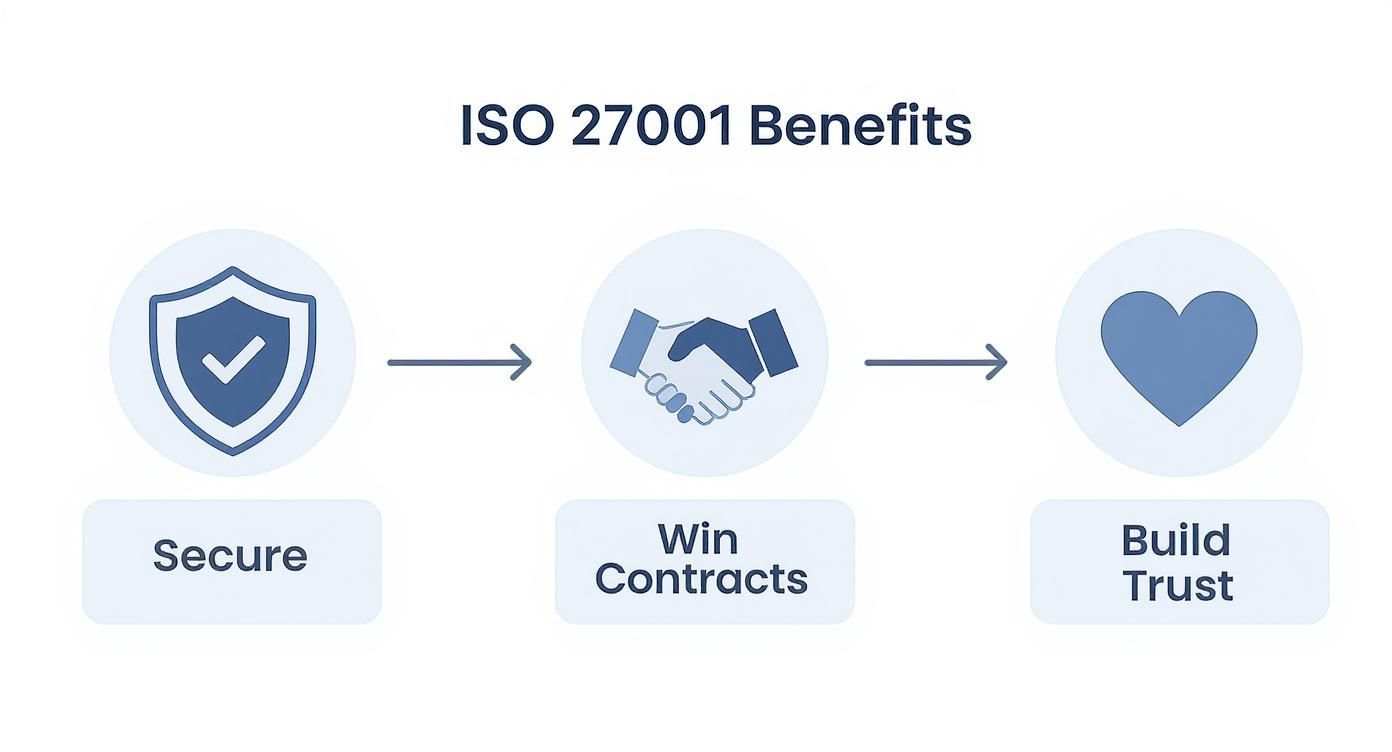
When you lock down your information security, you build trust. That trust helps you win bigger contracts and grow your business, which in turn gives you more resources to invest back into your security. It’s a powerful cycle.
Securing Leadership Buy-in as a Strategic Imperative
Before you write a single policy or check a single server setting, your first job is to get your leadership team on side. This is non-negotiable. If the people at the top see this as just another IT cost or a bureaucratic hoop to jump through, you're set up to fail. You'll be constantly fighting for budget and begging for people's time.
The trick is to frame it as a strategic investment.
Don't start the conversation with technical jargon about Annex A controls—you'll see their eyes glaze over. Speak their language: risk, revenue, and reputation. Explain how ISO 27001 accreditation isn't just a shield; it's a sword that helps you win new business.
Pull up some real examples. Show them the tender you couldn't bid on because you lacked a security certification. Point out how your main competitor is splashing their ISO 27001 badge all over their marketing materials. Suddenly, the conversation isn't about cost anymore—it's about opportunity.
Leadership buy-in isn't just about getting the budget signed off. It's about getting the authority you need to make things happen. When the directive to cooperate comes from the C-suite, doors open and other department heads suddenly find the time to help.
Performing a Thorough Gap Analysis
With the leadership team behind you, it's time for a dose of reality. You need to figure out exactly where you stand right now. This is what a gap analysis is for: a brutally honest look at your current security practices versus what the ISO 27001 standard actually demands.
The entire point is to find the gaps between what you're doing and what you should be doing. This isn’t a blame game; it’s an exercise in discovery. You need to dig into everything from your password policies to whether the server room door is kept locked.
A few key areas you'll want to scrutinise include:
- Documentation: Do you have written, official policies for things like responding to a data breach or granting new employees system access? Or does it all just live in someone's head?
- Risk Management: Do you have a formal way of finding, analysing, and dealing with information security risks? Or do you just react when something breaks?
- Employee Awareness: Do your people actually understand their security duties? Have they been trained, or are you just hoping they'll do the right thing?
- Technical Controls: Are your firewalls, antivirus, and encryption tools configured correctly and up to the job?
The final report from your gap analysis becomes your project plan. It’s a clear, prioritised to-do list that will guide your entire implementation.
Defining Your ISMS Scope Strategically
One of the most crucial early decisions is defining the scope of your Information Security Management System (ISMS). In simple terms, the scope sets the boundaries. It defines exactly which parts of your business the ISO 27001 certificate will cover. The good news? It doesn't have to be your entire organisation.
A smart, well-defined scope keeps the project focused and achievable. Get it wrong, and you're in for a world of trouble. A scope that's too broad becomes a monstrous, expensive project. A scope that's too narrow might not cover what your clients actually care about, making the certificate worthless.
Think about what influences your business. Who are your "interested parties"—your customers, regulators, business partners? What do they expect from you when it comes to security? Your scope has to meet their needs.
Let's imagine a couple of scenarios:
- Scenario A: The SaaS Startup: A small SaaS company in Sydney might focus its ISMS scope purely on its production cloud environment, its customer support platform, and the dev team. This laser-focuses the effort on the exact systems and data that its customers pay for, delivering maximum value from the certification.
- Scenario B: The Financial Services Firm: A Melbourne-based financial advisory firm has a different reality. Its scope would need to be much wider, covering every department that touches client financial data, its physical offices, HR records, and its relationships with any third-party data processors. The sensitive nature of their work and regulatory demands leave no other choice.
Ultimately, your scope must serve your business goals. Ask yourself: "Why are we doing this?" The answer will tell you where to draw the lines for your ISMS.
For many Australian businesses, this journey requires careful planning. In Australia, the process of achieving ISO 27001 certification can take a small to mid-sized SaaS company three to six months, assuming dedicated resources and readiness for external audits. You can find more detail on what this process entails by reading about ISO 27001 certification for SaaS companies. This timeframe reflects the complexity of aligning information security controls with modern business operations—especially as Australian organisations increasingly rely on cloud infrastructure and handle multi-tenant environments.
Putting Your Information Security Management System into Action
Alright, you’ve done the groundwork and got your leadership on board. Now comes the exciting part: bringing your Information Security Management System (ISMS) to life. This is where the planning stops and the real work begins. We're talking about building the actual policies, processes, and controls that will stand guard over your precious information assets every single day.
This isn’t just a box-ticking exercise for the IT department. It’s about weaving security into the very DNA of your business operations, making it a natural part of how everyone works. And it all kicks off with the cornerstone of any solid ISMS: the risk assessment.
Getting a Handle on Risk Assessment and Treatment
Think of your risk assessment as a structured conversation with yourself about what could go wrong. It’s a methodical process that pushes you to ask: "What are our biggest threats, how much damage could they do, and what are we going to do about them?" This is the intelligent engine driving your ISO 27001 accreditation.
Getting this right means you’re not just throwing money at generic security solutions. Instead, you're strategically investing your resources to neutralise the threats that pose a genuine danger to your specific business.
First things first, you need to know what you’re protecting. Identify your critical information assets, and think broader than just servers and software. This includes:
- Your Data: Customer lists, financial projections, source code, employee PII.
- Your Hardware: Laptops, phones, servers, and even the paper files in your cabinets.
- Your Reputation: The trust you've built with customers, which can evaporate after a single breach.
With your assets listed, you can start identifying the threats and vulnerabilities tied to each one. A threat is what could happen (like a phishing attack), and a vulnerability is the weakness that lets it happen (like an employee who hasn't been trained to spot phishing emails).
A classic mistake I see is businesses focusing only on shadowy hackers from overseas. Don't forget the risks inside your own walls—an employee accidentally deleting a critical file or a trusted supplier having a security lapse that exposes your data.
Next, you’ll need to figure out the likelihood and potential impact of each risk. A simple high-medium-low matrix works wonders here. A ransomware attack locking up your entire customer database? That’s a high-impact, high-likelihood risk that needs immediate attention. An old marketing laptop being stolen? Maybe a lower priority.
Once your risks are prioritised, ISO 27001 gives you four ways to handle them:
- Treat it: Implement a control to lower the risk. This is what you'll do most of the time.
- Tolerate it: Formally accept the risk. This is for when the fix would cost more than the potential damage, but it has to be a conscious, documented decision.
- Terminate it: Get rid of the activity causing the risk, like shutting down an old, vulnerable server you no longer need.
- Transfer it: Share the burden. A common example is taking out a comprehensive cyber insurance policy.
Writing Policies That People Will Actually Read and Use
The decisions you make in your risk treatment plan will directly inform the security policies you need. And here’s a pro tip: write them for your team, not just for the auditor. A 50-page document choked with technical jargon is destined to collect dust on a digital shelf.
Keep your policies clear, concise, and focused on what your people need to do in their day-to-day roles. For instance, instead of a dense "Access Control Policy," create a simple, practical guide called "How We Manage and Protect System Access."
You'll almost certainly need a few core policies, including:
- A top-level Information Security Policy that shows leadership is behind this.
- An Acceptable Use Policy outlining the do's and don'ts for employees.
- A clear Password Policy on creating and managing strong passwords.
- A Data Backup and Recovery Policy so you know you can bounce back from disaster.
The goal is to provide clear guardrails that help people work securely, not to tie them up in red tape. For a deeper dive into the overall framework, you can learn more about building out a complete Information Security Management System.
Rolling Out the Annex A Controls Systematically
With your policies drafted, it’s time to implement the specific security controls from Annex A of the ISO 27001 standard. Don't be intimidated by the list; Annex A offers a menu of 93 potential controls grouped into four themes: Organisational, People, Physical, and Technological.
The key word here is potential. You don't have to implement all of them. Your choices must be directly linked back to your risk assessment. You'll record these decisions in a critical document called the Statement of Applicability (SoA). This is your master list, showing every control, whether you've implemented it, and a short justification for your choice.
To give you a clearer picture, here’s a breakdown of the control themes and what they mean in the real world.
Key Annex A Control Domains and Their Business Impact
This table summarises some of the most important Annex A domains from the ISO 27001:2022 update, showing how they translate into practical business actions.
| Control Domain | Objective | Example for an Australian SaaS Company |
|---|---|---|
| Organisational Controls | Establish the foundational security framework. | Implementing a clear policy for managing third-party supplier security, ensuring all vendors meet your security standards before gaining access to your data. |
| People Controls | Address the human element of security. | Creating a mandatory security awareness training program for all new hires and conducting annual refreshers to keep staff aware of threats like phishing. |
| Physical Controls | Secure the physical environment. | Implementing access card systems for the office and server room, ensuring only authorised personnel can enter sensitive areas. |
| Technological Controls | Implement technical security measures. | Enforcing multi-factor authentication (MFA) across all critical systems and using robust encryption for all customer data, both in transit and at rest. |
The best approach is to be methodical. Tackle the controls based on the priorities you identified in your risk assessment. As you move forward, it's also worth keeping an eye on how new tech can bolster your ISMS. For those interested, there's a lot of great information out there on how global standards like ISO 27001 integrate with AI-powered risk detection.
By following this structured path, you're not just preparing for an audit; you're building a genuinely resilient security posture for your business.
Weaving Security into Your Company's DNA
Let's get one thing straight: ISO 27001 isn't an IT project. Thinking it is is one of the most common mistakes I see businesses make. In reality, it’s a full-blown cultural shift. Your policies and controls, no matter how perfectly written, are only as strong as the people who live and breathe them every day.
Without genuine buy-in from your entire team, your carefully crafted Information Security Management System (ISMS) is just a fancy binder collecting dust. The real mission is to transform security from a box-ticking exercise into a shared responsibility. It's about creating an environment where everyone, from the CEO down to the new intern, instinctively understands their part in protecting the company’s most valuable information. That’s what takes an ISMS from good to truly great.
Designing Security Training People Won’t Hate
Be honest—most security awareness training is painfully boring. A generic slideshow crammed with technical jargon is the quickest way to make your team's eyes glaze over. If you want security practices to actually stick, your training has to be engaging, relevant, and ongoing.
Ditch the one-size-fits-all approach immediately. Your sales team faces entirely different threats than your developers do. A salesperson is far more likely to get a clever phishing email disguised as a client request, while a developer might be targeted with a malicious code library. Great training speaks directly to these role-specific scenarios.
Here are a few ideas to get you started, moving beyond tired old presentations:
- Run Realistic Drills: Don't just talk about phishing—simulate it. Send out a controlled phishing campaign and then discuss the results as a team. What made that email so convincing? Which red flags did people spot? This kind of hands-on experience is far more memorable than any lecture.
- Make It a Game: A little friendly competition goes a long way. Use quizzes, leaderboards, and even small prizes for people who consistently demonstrate sharp security instincts, like being the first to report a suspicious email.
- Bite-Sized Learning: Forget the huge annual training dump. Instead, send out short, punchy security tips on Slack or your internal chat platform each week. A two-minute video on creating better passphrases will be absorbed far more readily than a one-hour seminar.
The secret is to make security training a conversation, not a monologue. When you get people actively involved, the lessons land and start to shape their daily habits.
Building a 'No-Blame' Culture for Reporting
One of the biggest blockers to solid security is fear. If your team is worried they'll be punished for making a mistake, they simply won't report incidents promptly. That small delay can be the difference between a minor hiccup and a full-blown disaster. A "no-blame" culture isn't just a nice idea; it's essential.
This means you have to actively encourage people to put their hand up the moment they see something odd or realise they’ve slipped up, like clicking on a dodgy link. Your response has to be one of support, not blame. Thank the person for their honesty, and then use the incident as a teachable moment for the whole organisation.
Creating psychological safety here is everything. When an employee reports a potential security slip-up, they need to be treated as part of the solution, not the source of the problem. This builds incredible trust and effectively turns your entire team into a human firewall.
Of course, this only works if the reporting channels are crystal clear. Everyone needs to know exactly who to call and how to raise an alarm. Don’t bury this information in a 50-page policy document. Plaster it on posters in the break room, bring it up in team meetings, and create a dedicated, easy-to-find channel in your company’s chat tool.
Using Internal Audits as a Tool for Improvement, Not Fear
Just hearing the words "internal audit" can send a shiver down anyone's spine, but it shouldn't. An internal audit of your ISMS isn’t about pointing fingers; it’s a health check for your security posture. It’s your chance to find the weak spots before an external auditor—or worse, a cybercriminal—does.
These audits are simply a systematic, independent look at whether your security activities are actually matching up with what you planned and with the ISO 27001 standard itself. They give you a structured way to ask the tough questions:
- Are our security controls really working the way we think they are?
- Are people actually following the policies we wrote?
- Is our documentation still accurate, or is it out of date?
Think of it as getting a fresh pair of eyes on your work. You could even have the head of one department audit another to get a different perspective. The findings from these audits are pure gold—they give you a clear, evidence-based roadmap for what to improve next.
This whole process is a cornerstone of the Plan-Do-Check-Act (PDCA) cycle that ISO 27001 is built on. The audit is the "Check" part of the cycle, giving you the hard data you need to "Act" and make your ISMS even stronger.
The Power of the Management Review
Just as crucial as those internal audits are your regular management reviews. This is where your leadership team gets in a room and formally assesses how the ISMS is performing. It’s the meeting that keeps security on the leadership’s radar and ensures the system remains fit for purpose.
And to be clear, this isn't a quick chat for a status update. A proper management review is a structured meeting that digs into specific inputs, like:
- The results from your latest internal and external audits.
- Feedback from customers or partners about your security.
- The current state of your risk assessments and treatment plans.
- Any security incidents that have cropped up and what you learned from them.
The output is a set of documented decisions and actions for improvement. This might mean funnelling more budget into security training, green-lighting a new security tool, or making a critical update to a policy. These reviews are the proof that your leadership is genuinely invested in the ISMS, which is exactly what external auditors want to see.
For Australian businesses, the road to ISO 27001 accreditation can feel daunting. We often see hurdles like the high cost of implementation, a shortage of skilled people, and the sheer complexity of the process. In fact, studies show 40% of businesses point to high costs, 35% to skill gaps, and 30% to procedural complexity as major barriers. But the payoff—like stronger compliance and a serious competitive advantage—is pushing more Australian SMEs to go for it. You can read more about these trends in these insights on ISO 27001 in Australia. By truly embedding security into your culture from day one, you directly tackle those complexity and skill gap issues, making the whole journey a lot smoother and more successful in the long run.
Navigating the Audit and Maintaining Your Hard-Earned Accreditation
You’ve done the hard yards. You’ve built your Information Security Management System (ISMS) from the ground up and woven security into the very fabric of your business culture. Now, you’re standing at the final hurdle before certification: the audit.
This is the moment of truth, where an independent, accredited auditor comes in to verify that your system meets the stringent requirements of the ISO 27001 standard. It can feel a bit daunting, I know. But if you've done the work, this is just a formal confirmation that you’ve built something truly robust.
This isn’t about just ticking boxes to pass a test. It’s about proving—to yourself, your clients, and your partners—that your security practices are effective, consistent, and genuinely part of how you operate. A successful audit is the ultimate testament to your commitment to protecting sensitive data.
Unpacking the Two-Stage Audit Process
The good news is that the certification audit isn't a single, high-stakes event. It’s cleverly divided into two distinct stages, which gives you a chance to iron out any kinks before the final deep-dive. Getting your head around what each stage involves is the key to sailing through the process without any nasty surprises.
Think of the auditor less as an examiner and more as a critical friend. Their goal is to validate your efforts, not to catch you out. They genuinely want you to pass, but they need to see clear, objective proof that you’re meeting every clause of the standard.
Stage 1: The Readiness Review
The first phase, known as the Stage 1 audit, is basically a high-level documentation review. At this point, the auditor is focused on one main question: is your ISMS designed properly on paper and ready for the main event? They won’t be combing through server logs or interviewing your entire staff just yet. It’s all about the theoretical soundness of your system.
During this review, the auditor will pore over your key documents, such as:
- Your ISMS Scope: Is it clearly defined? Does the justification make sense?
- The Statement of Applicability (SoA): Have you clearly documented which controls you've chosen and, just as importantly, explained your reasoning for any exclusions?
- Risk Assessment and Treatment Plans: Is your methodology logical? Is the report thorough?
- Core Policies: Have you established the foundational policies, especially your overarching Information Security Policy?
The Stage 1 audit is a golden opportunity to get direct feedback from an expert. Treat any observations or minor non-conformities they point out as free consulting—it's invaluable advice on how to strengthen your ISMS before the far more intense Stage 2 audit kicks off.
If all goes well, the auditor will give you the green light for Stage 2. They’ll usually schedule it a few weeks or even a month or two down the track, giving you plenty of time to act on their feedback and get everything shipshape.
Stage 2: The Main Certification Audit
This is where the rubber really hits the road. The Stage 2 audit is a much deeper, more detailed assessment. The auditor’s mission is to verify that your ISMS isn't just a collection of nice documents but is fully implemented and operating effectively in your day-to-day business. They are hunting for concrete evidence that you do what your policies say you do.
This stage is much more hands-on and typically involves a mix of activities:
- Reviewing Records: The auditor will want to see tangible proof that your controls are working. This could be anything from access control logs and new starter training records to the outputs from your latest internal audit.
- Interviewing Staff: They’ll chat with a cross-section of your team, from the C-suite to the front line. They're trying to gauge how well security policies and individual responsibilities are understood throughout the organisation.
- Observing Processes: Don't be surprised if they ask you to walk them through a process. For example, they might want to see how a new employee is granted system access or how a security incident is reported and managed in real-time.
Preparation is absolutely critical for Stage 2. Your goal is to make the auditor's job as easy as possible. Have all your evidence organised, ensure key people are available for interviews, and be ready to explain your processes with confidence. Honesty and transparency are your best friends here. If you’ve found a weakness and have a plan to address it, be upfront. For a full rundown of what to expect, you can get more details on the ISO 27001 audit process and how to best prepare your team.
Life After Certification: Keeping the Momentum Going
Earning your ISO 27001 accreditation is a massive milestone, and you should definitely celebrate it! But it’s vital to see it as the starting line of an ongoing race, not the finish line. The standard is built around the principle of continual improvement. Your ISMS is a living thing that needs regular care and attention to stay effective against a constantly shifting threat landscape.
Your certification runs on a three-year cycle. This involves annual surveillance audits in years one and two, followed by a full recertification audit in year three to renew your certificate. These surveillance audits are less intensive than the initial Stage 2, but they are designed to ensure you're maintaining and improving your ISMS.
To stay on track, you need a solid maintenance rhythm.
- Continuous Monitoring: Keep a finger on the pulse of your security controls. Are they still working as intended? Are new threats emerging that you need to account for?
- Regular Risk Assessments: Your risk assessment isn't a "set and forget" document. Revisit it at least once a year, or any time your business goes through a significant change, like adopting a new technology or launching a new service.
- Ongoing Internal Audits: Stick to your internal audit schedule like glue. This is your best tool for finding and fixing problems before the external auditor does.
- Consistent Management Reviews: Keep holding those regular management reviews. This ensures leadership stays engaged and that your ISMS continues to align with the company's strategic goals.
Ultimately, maintaining your ISO 27001 accreditation is about embedding a culture of perpetual improvement. It guarantees that your initial investment pays dividends for years to come, keeping your organisation secure, compliant, and ready for whatever comes next.
Got Questions About ISO 27001? You're Not Alone.
As businesses start to seriously consider ISO 27001, a whole lot of practical questions naturally pop up. Moving from the "why" to the "how" means thinking about the real-world stuff: How much will this actually cost? Is it something we legally have to do? And what's the deal with all the industry jargon?
Getting straight answers to these common queries is crucial. It cuts through the confusion, helps you plan your budget and resources properly, and makes sure you’re chasing certification for all the right reasons. Here are the direct answers to the questions we hear most often from Australian businesses just like yours.
What’s the Real Cost for ISO 27001 Accreditation in Australia?
Let's get the big question out of the way. Trying to put an exact dollar figure on ISO 27001 accreditation is tough because it’s not an off-the-shelf product. The final cost really hinges on your company’s size, how complex your operations are, and where your security measures stand right now.
That said, for a typical small to medium-sized business in Australia, you should budget somewhere in the range of AUD $20,000 to AUD $80,000. It's a wide gap, I know, so let’s unpack what pushes the cost to one end of the scale or the other.
A few key things will make up your final bill:
- Expert Help: Do you have a security guru on your team, or will you need to bring in a consultant? Getting expert guidance can save you from costly mistakes and dramatically speed up the process, but it’s a significant part of the budget.
- New Tech and Tools: Your initial gap analysis might highlight the need for some new software or hardware. This could be anything from a better endpoint protection system to a dedicated platform for managing risk.
- Team Training: A huge part of ISO 27001 is making sure your people are security-aware. You’ll need to invest time and maybe some money in creating and running training that actually sticks.
- The Audit Itself: The external audit comes with its own price tag. These fees cover the auditors' time for both Stage 1 and Stage 2 audits, plus the ongoing surveillance audits to keep your certificate valid.
The biggest factor, by far, is your starting point. If you’re building an Information Security Management System (ISMS) from the ground up, it’s naturally going to cost more than if you already have a decent security foundation to build on.
Think of it less as a cost and more as an investment in your business's resilience. The upfront expense might seem like a lot, but it's a drop in the ocean compared to the financial and reputational fallout from a major data breach, which can easily cost an SME hundreds of thousands, if not millions.
The good news is that a well-scoped ISMS helps you manage these costs. By focusing only on the parts of your business that truly need it, you avoid overspending and put your resources where they’ll make the biggest difference.
Is ISO 27001 Legally Required in Australia?
This is a fantastic and very common question. The short answer is no. For the vast majority of Australian businesses, ISO 27001 accreditation isn't legally mandated by the government. You won’t get a fine from a regulator just for not having it.
But hold on, because that simple "no" can be a bit misleading. In the real world, the standard has become a de facto requirement in a huge number of commercial situations. It's often the market, not the law, that makes certification a necessity.
Just think about these common scenarios:
- Government Tenders: If you want to work with federal, state, or even local government, you’ll see ISO 27001 pop up as a prerequisite in tender documents all the time. They need to know their supply chain is secure, and certification is the clearest proof you can offer.
- Big Corporate Contracts: Large companies, especially in sensitive fields like finance, healthcare, and tech, are now making ISO 27001 a non-negotiable for their key suppliers. It’s a core part of how they manage their own risk.
- Client Vetting: Potential clients are getting smarter. They’ll often send detailed security questionnaires, and you can bet they’ll ask about ISO 27001. Not having it can be a major red flag that sends them straight to one of your certified competitors.
So, while the law might not force your hand, your best clients and biggest growth opportunities probably will. It’s fast becoming the price of admission for doing business in high-value sectors.
What’s the Difference Between Certification and Accreditation Anyway?
People often use the terms "certification" and "accreditation" as if they mean the same thing, but in the world of ISO standards, they are very different. Getting this right is key to making sure you're working with a legitimate, competent auditor.
Here’s the simple breakdown:
Certification is what your business gets. It’s the process where an independent auditing company (a "certification body") checks your ISMS. If they agree that your system meets all the requirements of the ISO 27001 standard, they issue you a certificate.
Accreditation is what the auditing company gets. This is the official thumbs-up from a national authority, confirming that the certification body is competent, unbiased, and operates to a high standard. For us here in Australia and New Zealand, that authority is JAS-ANZ (Joint Accreditation System of Australia and New Zealand).
Think of it like a two-step quality check:
- Your business is certified by a certification body.
- That certification body is accredited by an authority like JAS-ANZ.
This system is what gives the whole process its integrity. Accreditation means the auditors are themselves being audited, which is a vital layer of oversight.
Why should you care? Because when you’re choosing an auditor, you should only ever work with a certification body that is accredited by JAS-ANZ. A certificate from a non-accredited provider holds very little weight and will likely be rejected by any client or government agency that knows what they’re looking for. It's your guarantee that the ISO 27001 accreditation process is rigorous, consistent, and respected globally.
Getting through the ISO 27001 process can feel overwhelming, but you don't have to tackle it alone. At Anitech, our specialty is making certification a clear and achievable goal for Australian small businesses. With our 100% success rate and over 20 years of experience, we provide the expert guidance you need to not only get the certificate but to build truly lasting security resilience. Let us handle the complexity so you can focus on growing your business with confidence. Start your ISO 27001 journey with Anitech today.
Recent Comments