

Quick Summary: This guide to ISO 27001 audits outlines the process from planning and conducting internal audits to mastering external certification. Learn to define audit scopes, build an effective audit program, prepare your team, handle nonconformities, and ensure your information security management system meets ISO/IEC 27001:2022 requirements for continuous compliance.
If you’re preparing for ISO 27001 audits, staring down your first assessment can feel like a massive headache. But it’s one of the most important things you can do to prove your business takes information security seriously. This isn't just about ticking boxes for compliance; it's about building a robust security foundation that earns genuine customer trust. This guide will give you a clear, no-nonsense path from planning right through to certification.
Turning Audits from a Burden into a Business Advantage
Many small business owners I talk to see ISO 27001 audits as a complex, expensive hurdle they just have to get over. It's an easy trap to fall into, but that view misses the real opportunity. When done right, the audit process is one of the best ways to sharpen your security, get a leg up on the competition, and build solid trust with clients. This is especially true here in Australia, where data security is a huge deal for customers.
Instead of seeing it as a chore, think of it as a clear signal to the market. A successful audit shows you're truly committed to protecting sensitive information. For potential partners and clients, that kind of proof can be the deciding factor that sets you apart.
The Real Value of an ISO 27001 Audit
The benefits go way beyond a certificate you can hang on the wall. A structured audit forces you to take a hard look at your own operations, find weaknesses you didn't even know you had, and put strong controls in place that actually protect your business from real-world threats.
For small businesses, the payoff is huge:
- Enhanced Client Trust: Certification is a powerful way to back up your security claims. It helps you win those bigger contracts where ISO 27001 is a non-negotiable requirement.
- Improved Security Posture: The audit process will almost certainly uncover vulnerabilities in your systems and daily processes, giving you the chance to fix them before they turn into a costly breach.
- Operational Efficiency: Implementing the ISO 27001 framework naturally leads to more organised and streamlined business processes, which cuts down on the risk of human error.
- Compliance with Regulations: It helps you get your house in order for legal and regulatory requirements, like the Australian Privacy Act.
By shifting your mindset and treating the audit as a strategic tool rather than a daunting task, you can strengthen your defences and prove your commitment to excellence.
This flowchart breaks down the core stages of an ISO 27001 audit, from kicking off the planning to achieving final certification.
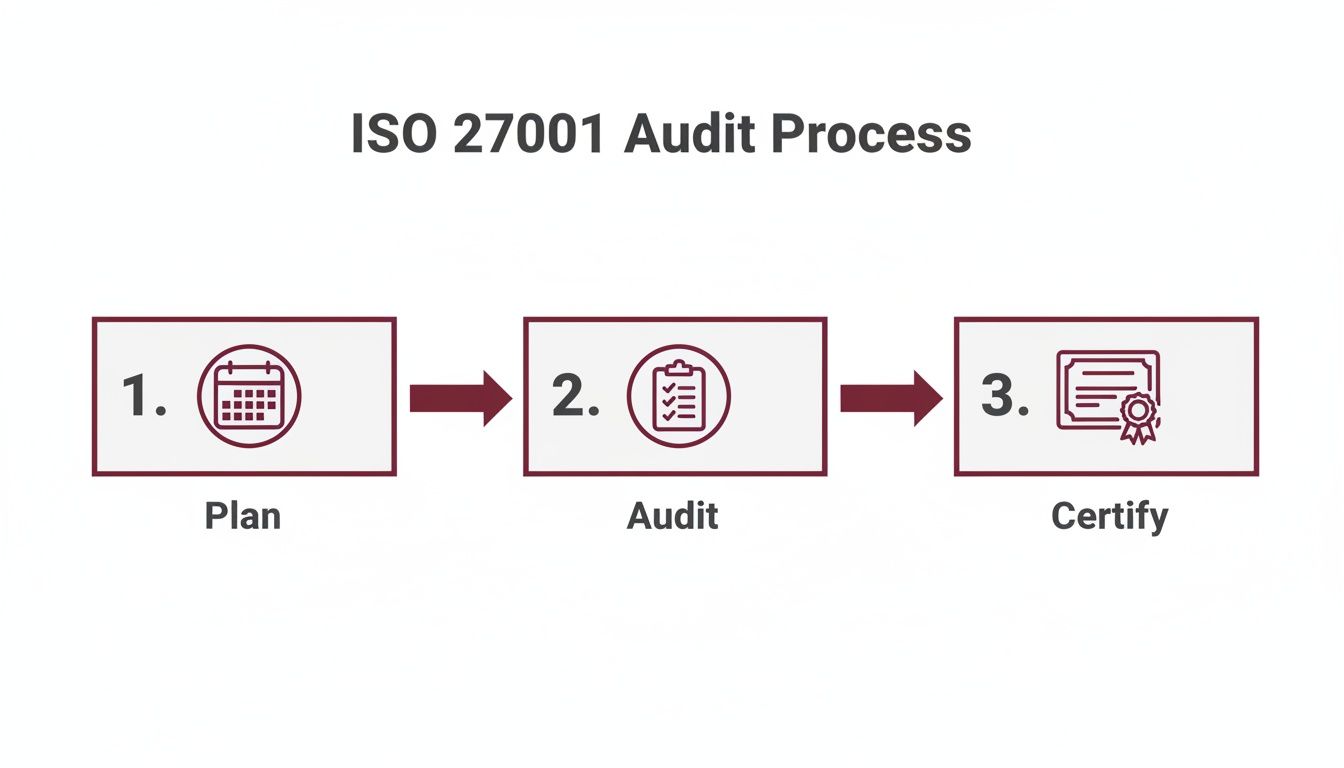
This process shows that getting certified is a journey, not a one-off event. It all comes down to careful preparation at every stage. To help you navigate it, we've put together a detailed guide on the ISO 27001 audit process specifically for Australian businesses.
Getting to Grips with Internal and External Audits
Before you dive headfirst into the audit process, it’s really important to get a clear picture of the two main types of ISO 27001 audits. They each have a different job to do, but you absolutely need both to get certified and stay that way.
Think of it like this: the internal audit is your dress rehearsal, and the external audit is opening night. One prepares you for the other, making sure you’re ready when it really counts.
First up is the internal audit. This is essentially your own organisation's health check—a chance to look at your Information Security Management System (ISMS) from the inside. It’s your opportunity to find and fix things on your own time, without the pressure of an external assessor looking over your shoulder. For a small business, this is an incredibly valuable exercise.
Running your own thorough internal audits means you can spot weaknesses, nonconformities, and areas to improve long before they become a bigger headache during the official certification audit. It’s a powerful way to keep getting better and is the bedrock of a strong security culture.
So, What's the Point of Internal Audits?
Internal audits aren't just a practice run. They're a core part of the ISO 27001 standard itself, spelled out as a requirement in Clause 9.2. A solid, well-run internal audit program shows external auditors you're genuinely committed to keeping your ISMS in good shape.
Here’s what a good internal audit really helps you nail down:
- Spotting the Gaps: They shine a light on any differences between your documented procedures and what’s actually happening on the ground.
- Checking Your Defences: You get to test if your security controls are truly working as they should be to handle the risks you've identified.
- Getting Your Team Ready: It gets your staff used to the audit process, so they feel more confident and prepared when they have to chat with external auditors.
- Driving Real Improvement: The findings give you a clear to-do list for corrective actions and smart ways to strengthen your overall security.
If you want to get a better handle on this first critical step, our guide on what an ISO internal audit involves is packed with practical tips for small businesses.
And Then Comes the External Audit
The external audit is the main event. This is the formal assessment carried out by an independent, accredited third-party, which we call a certification body. Their one and only job is to objectively confirm that your ISMS ticks all the boxes required by the ISO 27001 standard. If you get through this successfully, your business earns its certification.
Unlike your internal audits, which you manage yourself, the external audit follows a very strict, two-stage process.
An external audit isn't just about passing an exam. It’s about proving to your clients, partners, and the world that your promise of security is backed by a system that meets a global standard of excellence.
To help you see the differences at a glance, here’s a quick comparison of the two audit types.
Internal vs External ISO 27001 Audits: A Comparison
| Aspect | Internal Audit | External Audit |
|---|---|---|
| Auditor | An employee of your company or a hired consultant. | An accredited auditor from a third-party Certification Body. |
| Purpose | To find and fix issues, check compliance, and drive internal improvement. | To formally verify compliance with the ISO 27001 standard for certification. |
| Frequency | Conducted regularly throughout the year as part of your audit program. | Typically occurs annually for surveillance, with a recertification every three years. |
| Audience | The findings are for your management team and key stakeholders. | The audit report goes to the Certification Body to make a certification decision. |
| Outcome | An internal report with findings, nonconformities, and recommendations for improvement. | A formal audit report and, if successful, the issuance or maintenance of your ISO 27001 certificate. |
While they have different goals, you can see how the internal audit directly prepares you for the rigour of the external one.
Stage 1: The Documentation Deep-Dive
The first stage of the external audit is mostly a 'desktop' review. The auditor will sit down and go through all of your ISMS documentation with a fine-tooth comb. They're looking to see if you have all the right policies, procedures, and foundational documents in place and that, on paper at least, it all lines up with the standard.
You can expect them to scrutinise key documents like:
- Your ISMS scope statement
- The main information security policy
- Your risk assessment methodology and risk treatment plan
- The Statement of Applicability (SoA)
- Records from your internal audits and management reviews
The whole point of Stage 1 is for the auditor to confirm you’ve built a solid framework. If they spot any major gaps here, they’ll tell you what needs fixing before you can move on to the next phase.
Stage 2: The "Show Me" Audit
Once you’ve passed Stage 1, the auditor schedules the on-site (or sometimes remote) implementation audit. This is where they check that the ISMS you’ve documented is actually alive and kicking throughout your business. This is where you need to provide real-world evidence.
They’ll do this by interviewing your staff, watching processes in action, and reviewing records to see that your security controls are working as planned. They need proof that your ISMS isn't just a folder of documents, but a living, breathing part of how you operate day-to-day. Passing Stage 2 is the final hurdle to achieving your ISO 27001 certification.
Building an Internal Audit Program That Works
Let's be honest, a solid internal audit program is your secret weapon for a smooth certification process. This isn't about creating more paperwork just for the sake of it. It's about building a system that genuinely improves your security posture and, frankly, makes you look great when the external auditors show up for your ISO 27001 audits.
Think of your audit program as the engine for continuous improvement. It’s the framework that provides the structure to regularly check if your Information Security Management System (ISMS) is actually doing what you designed it to do and meeting the standard's requirements. A well-oiled program shows you’re serious about security, not just ticking boxes.

Defining Your Audit Scope and Objectives
Before you dive in, you need to know exactly what you're looking at. The audit scope is where you draw the line in the sand. Are you going to audit the entire ISMS at once? Or will you focus on specific departments, locations, or maybe just the processes you know are high-risk? For a small business, starting with a tighter, more focused scope is almost always the smarter move.
Then you have your audit objectives – what are you actually trying to achieve here? These need to be clear and measurable, directly linking back to your security goals. Maybe you want to verify that those new access controls are working as intended. Or perhaps you need to confirm that your risk assessment process is being followed correctly by the team.
Here are a few real-world examples of what clear objectives look like:
- Verify Compliance: To confirm that the marketing department's handling of customer data aligns with our data classification policy and the Privacy Act.
- Assess Control Effectiveness: To evaluate how well the new incident response plan works by reviewing records from last quarter's security incidents.
- Identify Improvement Opportunities: To find any potential weak spots in our employee onboarding and offboarding process when it comes to system access.
Creating a Realistic Audit Schedule
Your audit schedule is your roadmap for the year. A good plan prevents that last-minute scramble and ensures you methodically review all the critical parts of your ISMS over time. One of the biggest mistakes I see is businesses creating a ridiculously ambitious schedule that their team can never stick to.
So, be realistic. Look at your business's natural rhythm and avoid scheduling audits during your busiest seasons. The best approach is to prioritise your audits based on risk.
A well-structured audit schedule is more than a calendar; it's a strategic tool. It signals to everyone in the organisation that security is an ongoing priority, not a one-off event.
A practical schedule for a small business might look something like this:
- Quarter 1: Risk Assessment & Treatment Processes (High Risk)
- Quarter 2: Access Control & HR Security (High Risk)
- Quarter 3: Physical Security & Asset Management (Medium Risk)
- Quarter 4: Supplier Relationships & Business Continuity (Medium Risk)
This staggered approach makes the whole process feel manageable and doesn't throw a spanner in the works of your day-to-day operations – a huge plus for any small business.
Selecting and Empowering Your Internal Auditors
You don't need a massive team of dedicated security gurus to run effective internal audits. In my experience, the best internal auditors are often just curious, detail-oriented people from different parts of the business. The one non-negotiable from ISO 27001 is that your auditors must be objective and impartial.
This simply means the IT manager shouldn't be auditing their own department’s controls. It’s a conflict of interest. Instead, you could train someone from finance to audit the IT processes, and have someone from IT audit the HR security procedures. This cross-departmental approach is fantastic because it guarantees impartiality and also spreads security awareness across the company.
Empowering them comes down to a few key things:
- Provide Training: Make sure they understand the basics of ISO 27001 and have some fundamental auditing techniques under their belt.
- Grant Authority: They need the backing of management and the right access to conduct interviews and review evidence without hitting roadblocks.
- Supply Resources: Give them practical tools to work with, like a well-thought-out audit checklist.
Developing Practical Audit Checklists
An audit checklist is an auditor's best friend. It provides structure and makes sure no critical controls get missed. You can find generic checklists online, and they’re an okay starting point, but the real value comes from tailoring them to your specific ISMS.
For instance, when you're auditing Access Control (Annex A.5), your checklist shouldn't just have a line item that says "Check user access." That’s far too vague. You need to get specific.
Sample Checklist Items for Access Control
| Control Area | Evidence to Review | Question for Staff |
|---|---|---|
| User Registration | Review HR records for the last three new starters. | "Can you walk me through the process for granting a new employee system access?" |
| Access Rights Review | Examine logs of the last quarterly access review for the finance system. | "How do you ensure a user's access is still appropriate for their role?" |
| User De-registration | Check termination records against system access logs to confirm timely removal. | "What is the procedure for revoking access when someone leaves the company?" |
This level of detail is what separates a tick-box exercise from a truly thorough review. Of course, building an effective internal audit program also means taking a hard look at your company's IT asset management best practices to ensure all your bases are covered.
By putting together a program with a clear scope, a realistic schedule, empowered auditors, and practical tools, your internal ISO 27001 audits will shift from a dreaded compliance task into a powerful engine for security improvement. This proactive stance doesn't just get you ready for the external audit; it makes your business fundamentally stronger and more resilient.
How to Prepare for Your External Certification Audit
This is it. The external certification audit is where all your hard work gets put to the test. Think of it less as an exam and more as your chance to showcase the strength of your Information Security Management System (ISMS). Nailing this stage really comes down to one thing: meticulous preparation. You want to walk in feeling completely confident, not just "ready."
Your preparation really boils down to two key areas: getting your paperwork in order and getting your people ready. Auditors need to see clear, easily accessible proof that your ISMS isn't just a document on a shelf but is a living, breathing part of your business. Let's create a game plan to close any last-minute gaps and make sure your ISO 27001 audits go off without a hitch.
Gathering Your Must-Have Documents
I've seen it time and time again: documentation is the bedrock of a successful audit. If an auditor can't verify compliance because the records are a mess, you're starting on the back foot. Make sure you have a central spot for all your key documents—a secure shared drive or a dedicated compliance platform both work well.
Before the auditor even arrives, pull together and double-check these essentials:
- ISMS Policy & Scope: This is your high-level commitment, clearly defining what your ISMS covers and what it doesn't.
- Statement of Applicability (SoA): A truly critical document. It lists all the Annex A controls and justifies why you've included or excluded each one.
- Risk Assessment and Treatment Plan: This is the proof of your systematic approach to identifying, analysing, and dealing with information security risks.
- Internal Audit Records: All your reports, findings, and corrective action plans from internal audits are non-negotiable. They show you're actively monitoring your own system.
- Management Review Minutes: These records prove that top management is genuinely involved, reviewing the ISMS's performance and steering the ship.
Being able to pull up a requested document in seconds sends an incredibly powerful message to an auditor. It shows maturity, good management, and builds instant confidence in your entire operation.
To really iron out any kinks before the big day, using an IT security audit checklist can be a game-changer for spotting gaps you might have missed.
Preparing Your Team for Auditor Interviews
Paperwork is only half the story. The auditor will absolutely want to talk to your team to confirm that your policies and procedures are actually being followed in the real world. Staff interviews can make people nervous, so a bit of preparation goes a long way in helping them answer accurately and confidently.
The goal isn't to feed them scripted answers—auditors see right through that. Instead, make sure they genuinely understand their specific roles and responsibilities within the ISMS. I always recommend running a few informal mock interviews. Ask a developer how they handle sensitive data in a test environment, or ask someone from HR to walk you through the security steps for onboarding a new employee.
Give your team a few simple ground rules:
- Be honest. If they don't know the answer, "I'm not sure, but I can find out" is far better than guessing.
- Keep it concise. Just answer the question asked. Don't volunteer extra information that could open up a new line of questioning.
- Show, don't just tell. If they can, they should be ready to actually demonstrate a process or pull up a specific record for the auditor.
Navigating the ISO 27001:2022 Transition
One of the most critical things to focus on right now is your alignment with the latest version of the standard, ISO/IEC 27001:2022. The update brought in some pretty significant changes to the Annex A controls to better reflect the modern threats we all face.
For Australian businesses already certified under the old standard, there's a hard deadline looming. You absolutely must transition to ISO/IEC 27001:2022 by 31 October 2025, or you risk losing your certification. With that clock ticking, you can bet that auditors are laser-focused on your transition plan. They'll want to see evidence that you're implementing the updated controls, which have been consolidated from 114 down to 93 to better tackle current risks like cloud security.
This final prep phase is your last, best chance to find and fix any remaining issues. It’s what turns audit anxiety into a successful outcome. Our consultants can provide the expert guidance you need on how to get ISO certified, making sure your small business is ready for every step of the external audit.
Turning Audit Findings into Strategic Improvements
Discovering a 'nonconformity' during an ISO 27001 audit isn't a failure—it's your roadmap for improvement. I always tell my clients that the audit report is one of the most valuable resources they'll ever get. It’s an expert, third-party perspective on exactly where to focus to make your security stronger.
If you can shift your mindset from stress to strategy, you’ll turn these findings into a genuine asset for your business. Embracing the feedback shows auditors, partners, and customers that you're serious about continuous improvement. This is your chance to move beyond just ticking a compliance box and build a truly resilient Information Security Management System (ISMS).
Understanding Audit Findings
When the auditor hands over their report, their findings will almost always fall into one of three buckets. Knowing the difference is critical, as it dictates how urgently and thoroughly you need to respond.
- Major Nonconformity: Significant failure in your ISMS, like missing internal audits entirely.
- Minor Nonconformity: An isolated deviation, such as one late access review.
- Opportunity for Improvement (OFI): Auditor's advice on making a compliant process even better.
A major nonconformity halts certification until fixed. Minor nonconformities can often be resolved within an agreed timeframe without delaying certification.
From Finding to Fix: The Corrective Action Process
Getting a nonconformity triggers a formal process aimed at preventing recurrence, not just fixing symptoms.
Root Cause Analysis
Dig deep by asking "why" until you identify the systemic issue. For example, a delayed user deprovisioning might reveal no link between HR offboarding and IT access removal.
Developing a Corrective Action Plan
Your plan should include:
- Description: State the nonconformity and root cause.
- Planned Correction: Immediate steps to fix the instance.
- Corrective Action: Systemic changes to eliminate the root cause.
- Responsibilities & Timelines: Assign ownership and set due dates.
- Verification: Evidence that the fix is effective.
This structured approach demonstrates maturity and drives continuous improvement. For insights on auditors who champion ongoing assurance, see CyberPulse.com.au.
Got Questions About ISO 27001 Audits? We've Got Answers
How Much Does an ISO 27001 Audit Cost for a Small Business?
Costs vary based on size, system complexity, and certification body. For a small business, expect an investment between a few thousand and over ten thousand dollars. Always request detailed quotes and breakdowns to avoid hidden fees.
How Long Does the Entire Certification Process Take?
From scratch, a small business typically spends 6 to 12 months building its ISMS, conducting internal audits, and addressing findings. Post-certification, you’ll undergo annual surveillance audits and a full recertification every three years to maintain compliance.
Ready to streamline your ISO 27001 audits? Visit https://iso-27001.com.au for expert guidance on certification and ongoing compliance.
Recent Comments