

ISO27001 Australia Certification Essentials
ISO27001 Australia is the gold standard for building an Information Security Management System that truly fits local organisations. Securing certification not only proves your compliance with global best practices but also opens doors to lucrative government contracts and high-value clients.
Consider a Sydney-based fintech that needed formal security proof in just ten days. They mapped their core controls, assembled the ISMS framework and booked an audit slot—all before their tender deadline. Fast, precise action wins bids.
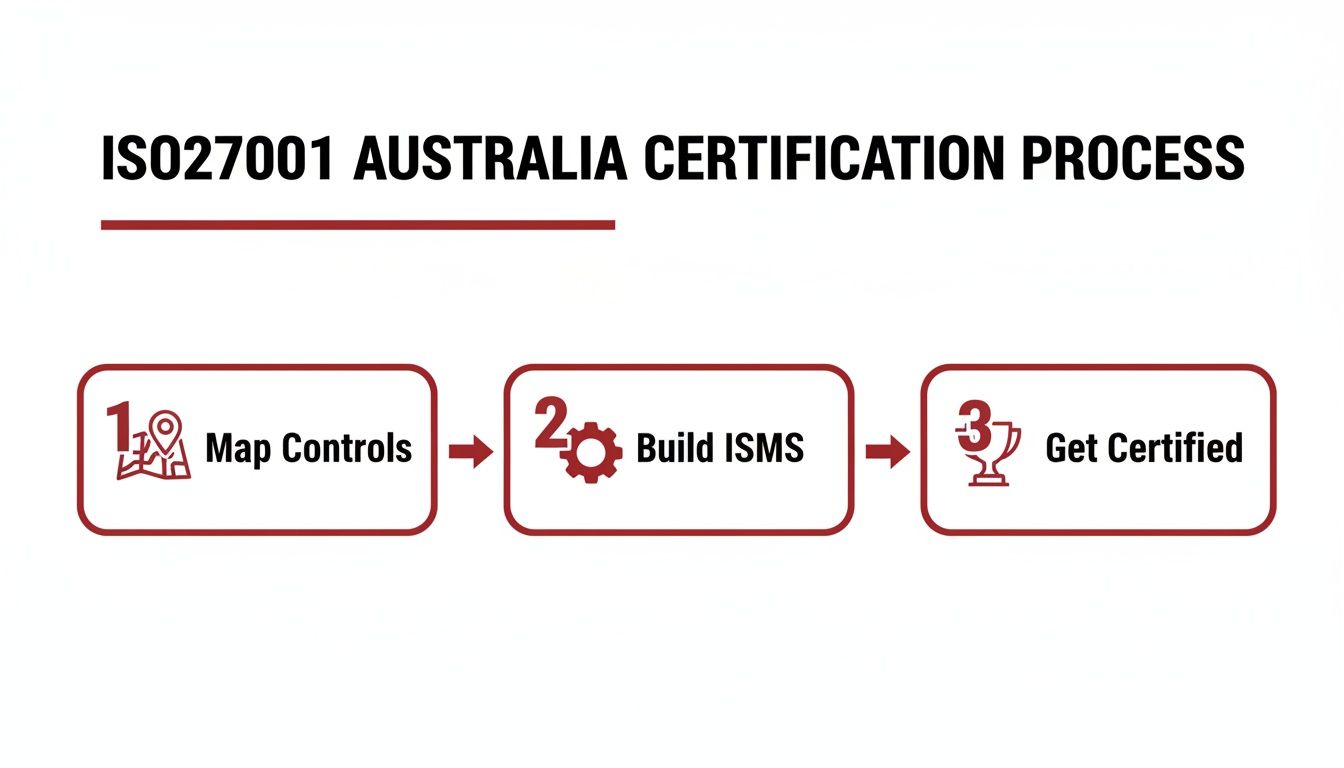
- Map Core Controls such as access management, encryption and incident response
- Build Your ISMS by drafting policies, procedures and evidence aligned to Annex A
- Prepare For Audits with registrar-led Stage 1 and Stage 2 assessments
Core Control Domains
Before you dive into implementation, here’s a quick reference of the major control areas and their rollout schedules under the 2022 update:
Summary Of ISO27001 Key Control Areas And Timelines
This table gives you an at-a-glance view of core domains, essential elements and when each should be fully embedded.
| Control Domain | Key Elements | Timeline Requirement |
|---|---|---|
| Organisational | Governance framework, risk methodology, leadership buy-in | 2 weeks |
| Technical | Access control, encryption tools, continuous monitoring | 1 month |
| Physical | Asset protection, site access logs, equipment security | 2 weeks |
Keep this chart close when you plan your milestones. It will help to balance workload and hit deadlines without scrambling.
Recent market intelligence shows that by 2025, ISO 27001 certification in Australia has become almost non-negotiable for government tenders. The global market, valued at $16.14 billion in 2024, is forecast to climb to $66.25 billion by 2034. Locally, up to 40% of ISO 27001 controls overlap with SOC 2, creating a potential 3–9 month dual compliance shortcut via managed services. For more detailed figures and trends, see ISO 27001 Compliance Trends in Australia.
Benefits At A Glance
- Tender Advantage: Bid with confidence by showing a formally certified ISMS
- Control Visibility: Quickly spot gaps and prioritise fixes
- Dual Compliance: Align ISO 27001 and SOC 2 to streamline audits
Key Takeaway: A focused control map plus a clear ISMS blueprint can cut your certification journey in half while satisfying auditor requirements.
With core domains, timelines and market drivers now crystal clear, you’re ready to tackle each implementation phase head-on.
Build Your Foundation For ISO27001 Australia
Before you put pen to paper on any policy, it’s vital to establish a rock-solid base. That means getting your team aligned, defining scope and mapping out how information actually moves through your business.
Bringing leaders on board early sets a clear direction and keeps everyone rowing the same way. In numerous Australian SMBs, naming an executive sponsor can speed up decision-making by 30%, cutting through red tape and securing resources more quickly.
That senior-level support not only fast-tracks your certification journey but also signals to the wider team that this is a priority.
Key Foundation Checklist
- Leadership Alignment: Appoint an executive sponsor to champion your ISMS.
- Scope Definition: Pinpoint which departments or services fall under ISO27001.
- Process Mapping: Sketch out core workflows to spot gaps, overlaps and hand-off points.
- Asset Inventory: Catalogue digital and physical assets, noting owners and locations.
Buying in from the top often gets overlooked, yet it sets the pace for everything that follows.
For instance, a Melbourne consultancy hosts weekly briefings with directors to keep momentum strong.
This simple routine ensures leadership stays engaged and challenges surface before they become crises.
Assemble Your ISMS Team
Breaking down silos pays dividends. Bring together IT, HR, legal and operations—each adds a unique perspective.
A handy trick is to name “planner” roles that balance workload and timelines. At an Adelaide startup, department champions met fortnightly to share progress and tackle roadblocks head-on.
Inviting stakeholders in early also unearths hidden processes and bespoke tools you might otherwise miss.
Insight Clear role definitions eliminate confusion and accelerate policy drafting.
Stick to your defined scope to avoid drift. Politely decline any add-ons falling outside your agreed boundaries.
Map Existing Processes
Start by drawing workflows on a whiteboard or using tools like Lucidchart and Draw.io.
For example, when mapping vendor onboarding, one Sydney firm spotted a missing approval step—a gap that could’ve led to unmanaged risk.
Process maps do more than visualise flow; they highlight control points and ownership, feeding directly into your risk assessment.
| Process Step | Responsible Party | Documentation Needed |
|---|---|---|
| Vendor Onboarding | Procurement Manager | Approval emails, signed contracts |
| Employee Offboarding | HR | Exit checklists, access logs |
| Data Backups | IT | Backup schedules, test reports |
Running parallel with these maps, build an asset register that captures location, owner and risk rating. A Sydney healthcare SME wrapped this up in just two days by tagging assets and using a simple spreadsheet with filters.
Practical Tips
- Label assets both physically and in your register for quick audits.
- Use spreadsheets with built-in filters instead of clunky manual lists.
- Where possible, automate updates to keep records fresh.
It might feel tedious now, but a thorough foundation means fewer surprises during Stage 1 and Stage 2 audits.
Read also our guide on Information Security Management Systems for practical implementation advice.
With these pieces in place, your ISO27001 journey gains clarity and momentum. Next up, we’ll look at tailoring risk assessments to these well-defined processes.
Align Objectives With Business Goals
Tie every ISO objective back to a revenue or retention metric. When a Brisbane tech firm linked control metrics to customer churn, budget approvals became almost automatic.
Tip Position ISO compliance as a driver for growth, not just another cost centre.
That shift turned routine reviews into strategic discussions, keeping the project front of mind for senior managers.
Now, let’s gear up for the risk assessment phase and keep this momentum rolling.
Conduct Context Analysis And Risk Assessment
Laying out a clear context analysis and risk assessment is your launchpad for a targeted ISO27001 project in Australia. You’re essentially charting the internal and external factors that define your ISMS scope. A Sydney-based consultancy, for instance, mapped out vendor dependencies and uncovered cloud security gaps as part of their early planning.
As you assemble your context map, keep a close eye on regulatory obligations, stakeholder demands and local market pressures.
- Internal and External Issues: Note drivers and constraints that shape your security landscape.
- Business Objectives: Tie your risk appetite back to revenue goals and expansion plans.
- Cloud Dependencies: Identify third-party providers and flag potential weak points.
Turning these insights into a risk matrix sharpens your focus. Teams in Melbourne have adopted a 5×5 grid to spot cloud misconfigurations that carry the highest likelihood and impact.
Quantifying risk like this means you direct effort where it truly matters. It guides you toward treatment options that strike a balance between cost and control effectiveness.
Notably, ISO27001 certification timelines have tightened with expert services now shrinking duration to 3–9 months for Australian SMBs in 2025, directly boosting contract wins in a market growing at 15.2% CAGR to $74.56 billion by 2035. Discover more insights about ISO27001 certification market growth in this report Read the full research on ISO27001 certification market growth
Documenting Risk Scenarios
Once your scenarios are mapped, lay them out in a simple template. Include a concise description, root cause, potential impact and trigger events. This documentation becomes the backbone of your treatment plan.
Treatment paths vary from acceptance through to mitigation or transfer. A Perth MSP, for example, shifted software-related risks via cyber insurance, freeing their team to tackle internal control gaps.
- Accept: Acknowledge low-impact risks and monitor them.
- Mitigate: Introduce controls like encryption or MFA to reduce exposure.
- Transfer: Offload the risk with insurance or contractual clauses.
You might be interested in exploring our guide on risk assessment for cyber security in Australia for detailed methodologies.
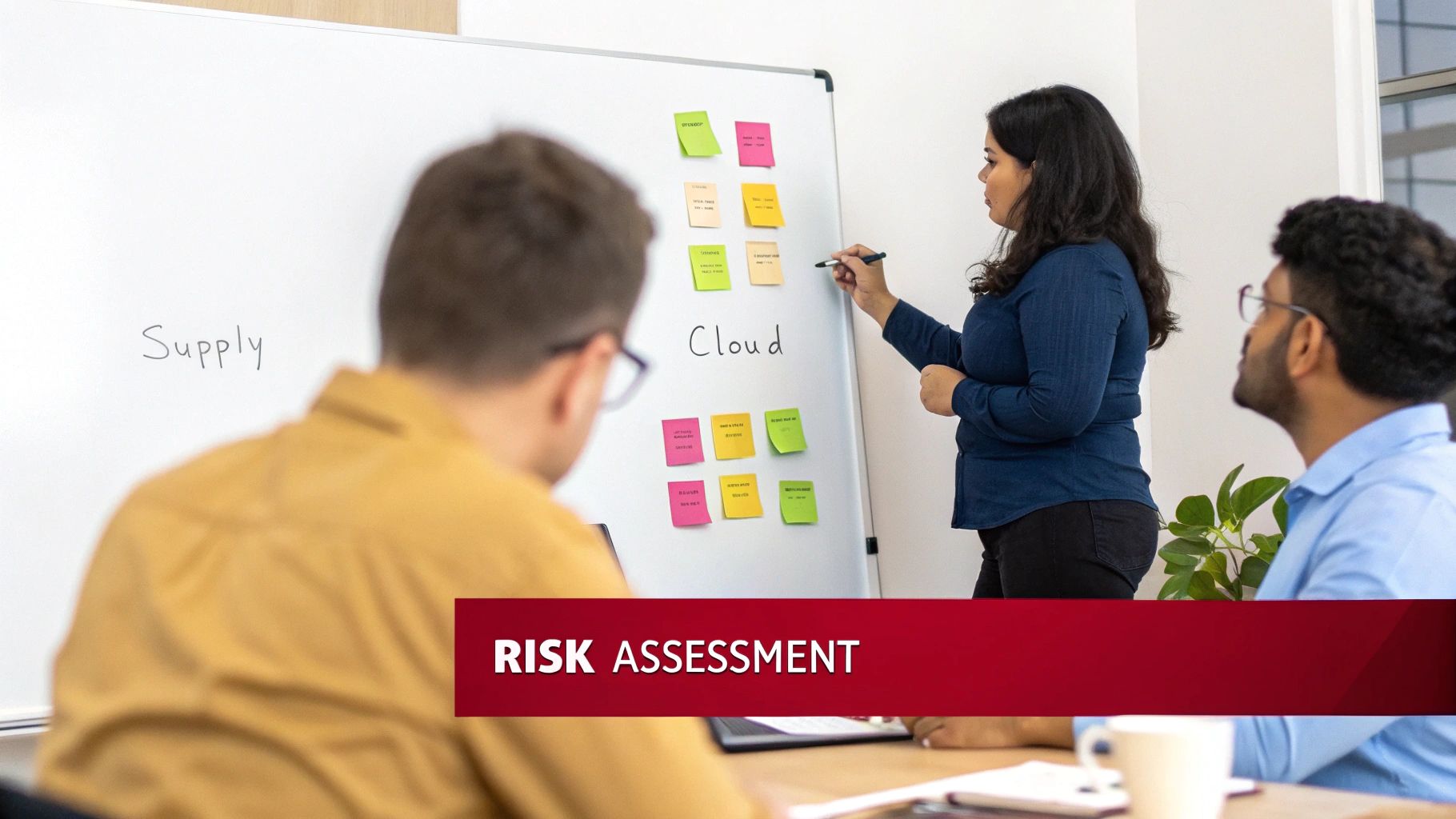
The data highlights that supplier security and cloud configuration gaps are among the top risk drivers, emphasising the need for tailored controls.
Prioritising Annex A Controls
Now it’s time to match each high-risk scenario with the relevant Annex A clause. For cloud misconfiguration issues, Control A.12 on operations security often ticks the right boxes. A simple scoring matrix—rating controls by effectiveness versus effort—keeps your team focused.
- Involve key stakeholders early to confirm control relevance and costs.
- Revisit risk scores quarterly as your business context shifts.
- Document any control exceptions, complete with management sign-off, to stay audit-ready.
Certification Path Comparison
Below is a quick glance at how the self-managed route stacks up against managed services for ISO27001 in Australia. Use this to decide whether you want to lean on external expertise or keep things in-house.
| Path | Duration | Overlap With SOC2 | Cost Efficiency |
|---|---|---|---|
| Self-managed | 6–12 months | ~40% | Lower direct cost, higher internal resource use |
| Managed services | 3–9 months | ~40% | Higher fees, faster delivery, fewer staff hours |
Choosing the right path depends on your time frame and budgetary limits.
By fine-tuning your context analysis and risk assessment, you ensure every control you later pick aligns with real threats. This upfront clarity paves the way for a well-scoped ISMS.
Key Insight A thorough context and risk phase can reduce audit findings by up to 30% by eliminating surprises.
Keep all risk documentation in a central, version-controlled repository. Update your risk register anytime you spot new cloud exploits or supplier changes. Tie risk-treatment owners to clear KPIs and review progress in your management forums.
Watch out for these common pitfalls:
- Overlooking shifts in your business environment that render assessments obsolete.
- Failing to engage critical stakeholders when outlining scenarios.
- Underestimating the resources needed to deploy chosen controls swiftly.
Address these early to harden your ISMS resilience.
Next, align these findings with your ISMS scope document. Use the risk treatment plan to update your Statement of Applicability and bolster your evidence registers. Then, convene a top-management review to allocate resources against your most pressing risks. Finally, schedule internal audits to confirm context and risk work translates into implemented controls, before kicking off the full control rollout.
Apply ISO27001 Controls And Document Your ISMS
Turning your risk assessment and scope into living policies takes more than dumping templates into a folder. You need documents that staff can actually follow and tools that support real-time collaboration.
In practice, an Australian software house ran short “documentation sprints” to draft, refine and finalise policies in days rather than months. They set up a version-controlled repository to track every change automatically—no more “policy paralysis.”
Craft Policies For Key Controls
Most local teams begin with the Annex A control families, mapping each group to specific business risks. For example, a Sydney firm customised templates for access control, incident response and supplier management to fit their workflows.
When auditors later asked for segregation-of-duties proof, the team quickly produced:
- Role Definitions showing who approves user provisioning
- Incident Playbooks outlining step-by-step breach responses
- Supplier Onboarding Procedures with mandatory security checks
These concise guides replaced dusty manuals. Short, focused writing bursts also kept stakeholders engaged throughout.
Run Documentation Sprints And Version Tracking
Short sprints maintain momentum—and they work. A Melbourne startup used three-day cycles to draft two core policies each time. Their routine looked like:
- Sprint Planning: Align policy outlines with scope and risk data
- Collaborative Writing: Co-edit shared docs with live comment threads
- Rapid Approval: Control owners sign off within hours, not weeks
This approach slashed review loops by 40%. Every document lived in a version-controlled repo so you can filter edits by date, author or comment.
“We never lost track of edits or approvals, which was a lifesaver during Stage 2.”
Combining sprints with automation keeps your ISMS agile and audit-ready.
Train Stakeholders And Embed Practices
Policies only matter if people follow them. To embed new controls, Australian organisations run brief, practical sessions. An Adelaide team, for instance, held 30-minute demos on updated access-control workflows.
They mix formats like:
- Lunch-and-Learn Sessions to walk through policy changes in real time
- Interactive Quizzes on the intranet to reinforce roles and responsibilities
- Role-Specific Cheat Sheets summarising steps and key contacts
These activities keep staff engaged and clarify expectations. Automated badges track attendance, providing robust audit evidence.
Maintain Momentum And Avoid Pitfalls
Policy fatigue is real. Keep energy high with clear ownership and quick wins. Steer clear of these common traps:
| Pitfall | Remedy |
|---|---|
| Policies that read like code | Use plain language and visuals |
| Waiting for “perfect” templates | Ship a lean version, then iterate |
| Ignoring cloud-specific needs | Align cloud settings with existing procedures |
Assign risk owners to quarterly reviews. That simple rhythm prevents outdated procedures slipping through the cracks.
Produce An Auditable Documentation Suite
Your final deliverable should tick every Annex A box. Key documents include:
- Statement of Applicability detailing chosen controls
- Control Implementation Plans with tasks, owners and dates
- Evidence Registers linking to logs, screenshots and reports
A minimal code snippet shows how logs are archived for audit purposes:
git commit -m "Add incident response playbook v1.2"
  docs/IncidentResponse_Playbook_v1.2.pdf
For cloud security, embed references to your CSP’s configuration reports and link to vulnerability scan outputs.
Key Takeaway
An auditable ISMS weaves together version history, training records and evidence—so registrar reviews become a breeze.
When policies, people and proof come together naturally, ISO27001 controls in Australia evolve into a daily habit, not a one-off project. You’ll be ready to impress auditors and safeguard your organisation’s critical assets.
Prepare For Audit And Achieve Certification

Facing an ISO 27001 audit can feel overwhelming. Yet a few well-planned actions make everything smoother.
In practice, running trial audits and setting up reliable evidence systems strips away surprises. It also boosts your team’s confidence.
- Draft a pre-audit checklist aligned with Annex A controls
- Book mock audits with in-house or external reviewers
- Automate evidence capture for logs, access records and policies
Pre Audit Documentation
Waiting until the last minute to gather records invites chaos. Instead, collect and link every document back to its control requirement.
Keep a central evidence register and track version histories closely. That way, nothing slips through the cracks.
- Merge all risk assessments and context analysis outputs
- Ensure each policy and procedure is signed off by the responsible control owner
- Use automated tools to timestamp and archive logs in real time
Conduct Mock Audit Drills
Treat these rehearsals as a safe space to uncover weak spots. You’ll spot missing artefacts and fine-tune processes before the official audit.
Try rotating roles so everyone understands different perspectives. Afterwards, update your evidence register without delay.
- Assign and rotate audit roles across your team
- Walk through incident response and access-control scenarios
- Log findings immediately and refresh your evidence register
Check out our guide on ISO 27001 audit preparation for deeper insights into each stage.
Case Study Of Australian Bank
An Australian bank cut its audit prep from weeks to days by automating evidence collection. They kicked off with an early pre-stage chat with their registrar to refine the scope.
Key outcomes included:
- 80% reduction in evidence retrieval time
- Zero major nonconformities in Stage 1
- Rapid closure of minor findings within two days
They mapped every control to system logs and dashboards, ensuring clarity at each audit checkpoint.
Common Findings And Rapid Remediation
Auditors often flag an incomplete Statement of Applicability or missing evidence links.
Common audits catch gaps in incident response timelines and access review logs.
- Update SoA entries with control rationales and current status
- Create focused corrective-action plans for high-priority gaps
- Assign clear owners and realistic target dates for fixes
| Audit Phase | Focus Area | Expected Action |
|---|---|---|
| Stage 1 Audit | Documentation Review | Ensure policies match the SoA |
| Stage 2 Audit | Control Effectiveness Testing | Demo incident simulation logs |
| Surveillance Y1 | Ongoing Compliance | Share updated risk treatment logs |
| Surveillance Y2 | Continual Improvement | Review KPI trends |
Maintaining a clear audit timeline means you’ll never miss your annual checks. In fact, regular internal reviews can cut nonconformities by up to 30%.
Embed these practices and ISO 27001 certification becomes part of your routine. Share regular updates in management meetings and capture decisions as audit evidence.
Next Steps
Once your registrar confirms the audit dates, lock in your internal schedule.
- Reserve slots for Year 1 and Year 2 surveillance audits
- Refresh evidence monthly with control-check sessions
Keeping this cadence makes your ISMS robust and perpetually audit-ready. Stay ahead of the curve.
Maintain Your ISO27001 Australia Certification
Securing ISO 27001 is no finish line—it’s the foundation for an evolving security culture. Regularly refreshing your information security management system (ISMS) keeps it in step with fresh threats and audit criteria. Over time, this mindset shifts compliance from a checkbox to a genuine advantage.
AI Powered Monitoring
Turning to machine-driven oversight transforms your stance from reactive to proactive. Real-time dashboards flag unusual patterns, letting you tackle incidents before they escalate. For instance, a Sydney healthcare provider sliced its response window by 30% after using machine learning alerts to spot odd access spikes.
- Instant alerts trigger corrective measures without delay
- Trend analyses reveal vendor performance gaps
- Automated anomaly detection closes blind spots
“Real-time monitoring built confidence in our risk management,” says an IT manager at an Adelaide firm.
By tying together CMDB and SIEM feeds, your dashboard delivers a unified view of system health and control effectiveness. That constant visibility makes it straightforward to spot and resolve emerging issues.
Align Essential Eight Maturity
Mapping your defences against the Essential Eight maturity framework shows exactly where to focus next. A Brisbane fintech began by highlighting weaknesses in memory protection and application whitelisting. From there, they set clear, quarterly goals for each control domain.
- Review where each control sits on the maturity scale
- Agree improvement targets and assign ownership
- Monitor progress in monthly management reviews
| Control Family | Current Maturity | Target Maturity | Responsible Owner |
|---|---|---|---|
| Application Whitelisting | Level 1 | Level 3 | Security Lead |
| Patch Management | Level 2 | Level 4 | IT Operations Manager |
| Data Backup | Level 3 | Level 4 | Infrastructure Team |
Revisit this table before surveillance audits to showcase steady progress. Transparency in these metrics builds trust with both stakeholders and auditors.
Internal Audit Programmes
Routine internal audits shine a light on gaps before they become problems. Rotating audit teams brings fresh eyes—an Australian e-commerce startup discovered two undocumented workflows during a third-party review, sidestepping a serious nonconformity.
Each audit cycle typically covers:
- Defining the scope with precise control references
- Updating evidence-collection checklists from live dashboards
- Holding review sessions that assign corrective actions
Post-audit, a quick policy refresh keeps everyone on track. Short, interactive sessions embed new steps into daily work:
- 30-minute workshops on updated processes
- Interactive quizzes to gauge comprehension
- Concise policy summaries shared on the intranet
“Visible leadership support and clear expectations are the heart of a security-first culture.”
By weaving AI monitoring, maturity assessments and regular audits into everyday routines, ISO 27001 certification becomes an ongoing asset rather than a one-off project. Consistent leadership reviews and open reporting anchor genuine commitment to information security.
Engaging specialists like Anitech can help you optimise monitoring with tailored dashboards. Their solutions generate audit-ready reports that save you time and effort.
ISO27001 Australia FAQ
Navigating certification questions early can save you weeks. The answers here build on our previous discussion and draw on real Australian case studies.
What Sets ISO27001 Apart From SOC2 In Australia
ISO27001 revolves around a complete information security management system (ISMS) guided by Annex A. SOC2, on the other hand, zeroes in on operational controls via the Trust Services Criteria.
| Feature | ISO27001 Australia | SOC2 Australia |
|---|---|---|
| Scope | Organisation-Wide ISMS | Service Provider Services |
| Framework | Annex A Controls | Trust Criteria Categories |
| Certification | Certified by Registrar | Attested by CPA Firm |
How ISO27001 Australia Timelines Work
A small to medium business often completes both audit stages in 6–9 months, covering context analysis, control rollout and mock drills. Your timeline will shift depending on team size and risk complexity.
- Engaging a consultant can accelerate progress for tighter-knit teams.
- Running documentation tasks in parallel can shave off as much as 40% of the effort.
Insider Tips To Pass Stage 2 Audit First Time
- Collect authentic evidence: system logs, signed training sheets and change records.
- Hold at least two mock audits with reviewers from finance, IT and operations.
- Map each control directly to risk treatment outcomes you’ve documented.
“Getting the registrar on board early slashed our nonconformities by 50%,” recalls an ISMS lead at a Perth technology outfit.
Maintaining Your ISO27001 Australia Certification
Routine surveillance audits keep you on track. Update your risk register every quarter and discuss control effectiveness at management meetings. Even simple reminders—like a monthly policy roundup—stop your ISMS from slipping.
Key maintenance actions:
- AI-powered monitoring dashboards for real-time alerts
- Scheduling internal audits well ahead of registrar visits
- Integrating Essential Eight improvements with your ISMS goals
For a deeper dive, revisit the audit preparation section or explore our ISO27001 Australia resources.
Ready to simplify your ISO27001 journey? Partner with Anitech for expert guidance and a 100% success rate. Get started at https://iso-27001.com.au
Integrating ISO27001 with Other Standards and Frameworks
ISO27001 Australia rarely exists in isolation. Many organisations in sectors like finance, healthcare and government need to align with multiple compliance regimes. This section explores how to integrate ISO27001 with other leading frameworks for maximum efficiency.
ISO27001 and SOC2 Convergence
As noted, around 40% of ISO27001 Annex A controls overlap with SOC2 Trust Services Criteria. To capitalise on this:
- Map Controls Side-by-Side: Create a crosswalk document matching Annex A clauses to SOC2 criteria.
- Harmonise Evidence: Consolidate logs, policies and test reports in a shared repository.
- Joint Audit Scheduling: Plan registrar and CPA firm audits in the same quarter to minimise disruption.
This approach can cut dual compliance costs by up to 25% and reduce total audit time by 20%.
NIST Cybersecurity Framework (CSF)
Many Australian federal agencies reference NIST CSF. To integrate:
- Use CSF’s Core Functions (Identify, Protect, Detect, Respond, Recover) to align your ISO27001 processes.
- Map ISO27001 Annex A to NIST CSF subcategories for a unified risk management strategy.
- Leverage Common Controls like vulnerability management and incident response for both frameworks.
GDPR and Privacy Legislation
Australian businesses handling EU citizen data must align ISO27001 with GDPR requirements:
- Embed GDPR data processing principles into your ISMS risk assessments.
- Update policies to include data subject rights, breach notification timelines and consent management.
- Maintain a Data Processing Inventory linked to your asset register for transparency.
ISO22301 Business Continuity
ISO22301 and ISO27001 share resilience goals. Integration steps:
- Extend your ISMS risk treatment plan to include business continuity scenarios.
- Align BCMS (Business Continuity Management System) documentation with your ISMS policy structure.
- Conduct joint exercises covering security incidents and continuity activation.
This combined strategy ensures your organisation not only prevents incidents but also recovers swiftly.
Sector-Specific Implementation Considerations in Australia
Different industries face unique challenges in implementing and auditing ISO27001 Australia. Understanding these nuances ensures targeted controls and smoother certification.
Healthcare and Aged Care
- Privacy and PHI: Implement stricter access controls, encryption at rest and in transit for patient records.
- Legacy Systems: Many providers run older platforms that require compensating controls like network segmentation.
- Incident Response: Build clear playbooks for breaches involving health data, including regulatory notification timelines.
Financial Services
- Regulatory Overlay: APRA CPS 234 complements ISO27001. Map CPS 234 requirements to Annex A controls on change management and vulnerability testing.
- Third-Party Dependencies: Financial institutions rely on fintech partners. Enhance supplier security assessments with contractual clauses and SOC2 reports.
- Continuous Monitoring: Real-time SIEM integration is often mandatory, feeding into daily risk reviews.
Government Agencies
- Protective Security Policy Framework (PSPF): Australian government bodies must align PSPF PSP 12–14 with ISO27001 controls on personnel security and incident management.
- Classified Data Handling: Implement compartmentalisation controls and strict need-to-know access models.
- Auditor Engagement: Early dialogue with the Office of the Australian Information Commissioner (OAIC) can clarify scope and avoid scope creep.
Education and Research
- Open Networks: Universities operate open Wi-Fi and guest networks. Layered controls like captive portals and NAC (Network Access Control) are essential.
- Intellectual Property: Protect research data with strong encryption and granular access policies.
- Student Privacy: Align policies with the Privacy Act and embed data protection training for staff and students.
Small and Medium Enterprises (SMEs)
SMEs often face resource constraints:
- Lean ISMS Models: Focus on high-impact Annex A controls first, such as access management, backup and patching.
- Managed Services: Outsource GRC (Governance, Risk, Compliance) platforms to reduce internal overhead.
- Shared Templates: Adapt industry-specific policy libraries to accelerate documentation.
Sector-tailored strategies ensure your ISO27001 Australia implementation adds genuine business value rather than becoming a compliance burden.
Leveraging Technology for ISO27001 Compliance
Modern technology accelerates your ISO27001 Australia journey by automating evidence collection, workflows and reporting.
Governance, Risk & Compliance (GRC) Platforms
GRC platforms centralise policy distribution, risk registers and audit trails. Leading features include:
- Automated Risk Scoring based on control effectiveness and threat intelligence feeds.
- Policy Acknowledgment Workflows to capture user sign-off electronically.
- Audit Dashboards summarising control status, nonconformities and remediation progress.
Cloud-Native Security Tools
If your stack runs on AWS, Azure or Google Cloud:
- CSP Configuration Reports: Integrate AWS Config or Azure Security Center findings into your evidence register.
- IaC Scanning: Tools like Terraform Validator can prevent misconfigurations before deployment.
- Automated Backups: Use native snapshot and encryption features to satisfy Annex A backup and encryption requirements.
SIEM and XDR Integration
Extended Detection and Response (XDR) and SIEM tools provide:
- Real-Time Alerting tied to ISO27001 incident response processes.
- Log Retention Policies aligned with SoA evidence requirements.
- Threat Intelligence Correlation for proactive risk treatments.
Robotic Process Automation (RPA)
RPA bots can handle repetitive audit tasks:
- Pull system logs at scheduled intervals.
- Compile evidence bundles for each Annex A control.
- Notify control owners of upcoming review dates automatically.
Collaboration and Knowledge Management
Platforms like Confluence or SharePoint support:
- Versioned Policy Libraries ensuring staff access the latest documents.
- Commenting and Approval Chains reducing email back-and-forth.
- Searchable Repositories for rapid evidence retrieval during audits.
By harnessing these technologies, your ISO27001 Australia compliance efforts become leaner, more transparent and easier to sustain.
Measuring the ROI of ISO27001 Certification
Investing in ISO27001 Australia certification yields both tangible and intangible returns. Understanding your ROI helps justify budgets and drive continuous improvement.
Cost Savings and Risk Reduction
- Reduced Incident Costs: Organisations with certified ISMS report 40% lower breach response costs.
- Insurance Premium Discounts: Cyber insurers often offer reduced rates for certified entities—savings of 10–20%.
- Vendor Negotiation Leverage: Certification can lower the cost of third-party assurances and service contracts.
Revenue Uplift
- Tender Success Rates: Certified companies win up to 25% more government and large enterprise contracts.
- Market Differentiation: Security accreditation enhances brand reputation, leading to quicker sales cycles.
- Cross-Selling Opportunities: Clients are more open to purchasing additional services from a trusted, certified provider.
Efficiency Gains
- Process Standardisation: Clear policies and automated workflows reduce rework by 30%.
- Audit Preparation Time: Automation and central repositories cut prep time by up to 50%.
- Management Oversight: Dashboards and KPIs free up leadership bandwidth for strategic initiatives.
Calculating Your ROI
- Identify Costs: Certification fees, consultant rates, internal hours and tool subscriptions.
- Quantify Benefits: Estimate contract wins, insurance savings and incident cost reduction.
- Build Timeline: Spread costs and benefits over a 3–5 year horizon.
- Compute Payback Period: Determine when benefits exceed costs and model Net Present Value (NPV).
Present your ROI analysis to senior management to secure resources and demonstrate the strategic impact of ISO27001 Australia.
Emerging Trends and Future Outlook for ISO27001 in Australia
As technology and threats evolve, so too will the expectations for ISO27001 compliance in Australia.
Artificial Intelligence and Machine Learning
- Behavioural Analytics: Predictive models detect anomalies beyond static rules.
- Automated Control Testing: AI-driven scripts can continuously test access controls and configurations.
- Chatbot Assistants: Guided remediation bots help staff follow ISMS procedures in real time.
Supply Chain and Third-Party Risk
Increasing scrutiny on supplier ecosystems means:
- Dynamic Risk Profiling: Continuous assessment of vendor security posture via APIs.
- Blockchain for Audit Trails: Immutable logs of transactions and certificates.
- Contractual SLAs Linked to ISO Controls: Penalties triggered by security deviations.
Quantum-Resistant Cryptography
While still emerging, organisations should:
- Assess Crypto-Agility: Plan for future migration to quantum-resistant algorithms.
- Document Transition Strategies: Include roadmaps in Annex A controls for encryption.
- Monitor Industry Standards: Stay aligned with ANZ cryptographic advisories.
Remote Work and Zero Trust Architecture
The rise of hybrid workplaces drives:
- Zero Trust Policies: Shift from perimeter security to continuous verification.
- Micro-Segmentation: Limit lateral movement within cloud environments.
- Secure Access Service Edge (SASE): Converge networking and security controls in the cloud.
Regulatory Evolution
- Privacy Act Amendments: Upcoming enhancements may tighten breach notification windows and fines.
- Critical Infrastructure Laws: Entities in energy, water and transport sectors face new obligations.
- Global Convergence: Expect closer alignment between ISO27001 and international data sovereignty requirements.
Staying ahead of these trends ensures your ISO27001 Australia certification remains relevant and valuable.
Additional Resources and Support for ISO27001 in Australia
Leveraging external expertise and community resources accelerates your ISO27001 journey.
- Standards Australia: Official publications and guidance on ISO27001 implementation.
- Australian Information Security Association (AISA): Networking events, working groups and workshops.
- Online Training Providers: Certified lead auditor and implementer courses from PECB, BSI and IRCA.
- Local Consultancies: Firms like Anitech, KordaMentha and Deloitte deliver tailored compliance services.
- Open-Source Templates: GitHub repositories with policy and procedure examples licensed for reuse.
Joining user groups and sharing lessons learned can surface practical tips and reduce trial-and-error. Engage in industry forums to stay updated on changing expectations in the ISO27001 Australia landscape.
Deep Dive Case Studies
Real-world examples illustrate how diverse organisations achieve ISO27001 Australia certification.
Case Study: Regional Healthcare Network
- Challenge: Multiple sites, diverse legacy EMR systems, limited budget.
- Approach: Phased ISMS roll-out, starting with critical patient data flows. Used managed GRC platform for workflow automation.
- Outcome: Certification in 7 months, 50% reduction in third-party audit fees, improved patient trust scores.
Case Study: National Retail Chain
- Challenge: Omnichannel environment, high transaction volumes, PCI DSS overlap.
- Approach: Mapped PCI DSS controls to Annex A, leveraged SIEM integration for joint monitoring. Ran cross-functional sprints combining ISMS and PCI teams.
- Outcome: Dual compliance achieved in 10 months, 30% drop in security incidents, faster new-store onboarding.
Case Study: Government Agency
- Challenge: Strict PSPF requirements, sensitive citizen data, extensive legacy infrastructure.
- Approach: Early engagement with OAIC, scoped ISMS to high-impact systems, introduced micro-segmentation and zero trust pilot.
- Outcome: Completed certification in 9 months, zero major nonconformities, enhanced stakeholder confidence and budget approvals.
Each of these case studies demonstrates the adaptability of the ISO27001 Australia approach to varied operational contexts.
End of Guide
For ongoing support and expert guidance, visit ISO27001 Australia resources or get in touch with a certified consultant to tailor your ISMS implementation and achieve certification with confidence.
Recent Comments