

Trying to run a modern business without a solid data protection plan is like leaving the keys in your front door overnight. For Australian organisations, ISO 27001 certification isn't just a "nice-to-have"; it’s the framework that shifts your entire approach from putting out fires to preventing them in the first place. This isn't just an internal choice anymore—it's a critical demand from clients, partners, and regulators who need absolute proof that you take security seriously.
Why ISO 27001 Is a Game Changer for Australian Businesses
Think of your company's data as its crown jewels—everything from customer lists and trade secrets to financial records. Without a proper security system, those jewels are just sitting there, exposed. ISO 27001 gives you the architectural blueprint for building a fortress around them. That fortress is called an Information Security Management System (ISMS).
But this is far more than a simple compliance exercise. It's a genuine business strategy that gets your whole team thinking about security in a new way. An ISMS gives you a structured, repeatable method for finding, analysing, and neutralising information security risks. It bakes a culture of constant vigilance and improvement right into your operations.
Understanding Your ISMS
At its heart, an ISMS is a living system. It's not a static document you file away. It's the collection of policies, procedures, and controls that work together to protect your information. Here’s a simple look at its core pillars.
| Pillar | Its Role in Your Security Framework |
|---|---|
| Risk Assessment | Systematically identifying potential threats and vulnerabilities to your information. |
| Policy & Governance | Defining the rules and responsibilities for everyone in the organisation. |
| Security Controls | The practical measures (like encryption or access controls) you implement to reduce risks. |
| Continual Improvement | Regularly reviewing and updating the system to adapt to new threats and business changes. |
This structured approach ensures you’re not just guessing about what to protect or how. It brings method to the madness.
The Escalating Threat Landscape in Australia
Let's be blunt: the need for this kind of structured defence has never been greater. The Australian cyber threat environment is getting more dangerous by the day. In 2024 alone, a staggering 1,113 data breaches were reported to the Office of the Australian Information Commissioner.
AI-driven phishing attacks have doubled in the last nine months, and persistent ransomware campaigns continue to hit roughly one-third of all Aussie firms. We all remember the headlines from high-profile breaches like the one at Optus in 2022, which showed millions of us that no one is safe. ISO 27001 forces you to build layered defences—mandating regular audits and integrating controls for everything from data leakage and cloud risks to threat intelligence.
Adopting this standard is a direct, powerful response to these threats. It's how you prove to clients and partners that their data is safe in your hands, building the kind of trust that underpins any successful business relationship.
By implementing an ISMS, you are not just preventing breaches; you are building business resilience. It's about ensuring your operations can withstand, respond to, and recover from any information security incident with minimal disruption.
Building Trust and Unlocking Opportunities
For countless Australian businesses, particularly in tech, finance, and health, ISO 27001 certification has become the price of admission for winning major contracts. Government departments and large corporations simply won't engage with partners who can't provide certified proof of their commitment to information security.
This certification becomes a powerful engine for growth in a few key ways:
- Competitive Advantage: It immediately sets you apart from competitors, showing a higher level of maturity and reliability.
- Market Access: It unlocks doors to lucrative government tenders and enterprise supply chains that have made certification a prerequisite.
- Client Confidence: It gives customers tangible proof that you're protecting their sensitive information, which builds incredible loyalty.
- Regulatory Alignment: It naturally helps you meet the requirements of data protection laws, shielding you from the risk of eye-watering fines.
Ultimately, ISO 27001 is a cornerstone of your company's overall GRC (Governance, Risk, and Compliance) strategy. To see how these pieces fit together, it’s helpful to understand What is GRC (Governance, Risk, and Compliance) and its role in shaping modern business. It’s vital to see the full picture, and you can dig deeper into the value of ISO 27001 certification to appreciate the real returns. It transforms security from a cost centre into a strategic asset that protects your reputation and drives real growth.
The Business Case for ISO 27001: Fuelling Your Growth
Let’s be honest, getting ISO 27001 certified is about more than just ticking a security box. While locking down your information is the core goal, the real magic lies in the business advantages that follow. This isn’t just a piece of paper for the boardroom wall; it’s a strategic move that can directly boost your revenue, build rock-solid trust with clients, and unlock doors that would otherwise be bolted shut.
When you achieve certification, you're sending a powerful signal to the entire market. You’re showing everyone that your business operates at an internationally recognised level of security excellence. For any Australian company looking to get ahead, that’s a massive advantage.
The Golden Ticket to High-Value Contracts
Ever noticed how the most valuable contracts, especially with government departments or big-name corporations, seem to have an impossibly high bar for entry? More often than not, ISO 27001 certification is that bar. These organisations are swimming in sensitive data—citizen records, customer financial details, you name it—and they simply can’t risk partnering with a supplier who might have a security hole.
Think of your certification as a golden ticket. It gets you into the room for these exclusive opportunities. When your proposal lands on the desk, it immediately stands out from uncertified competitors because you’ve already proven you take risk management seriously. This is especially true if you’re bidding for work in sectors like defence, healthcare, finance, or IT services.
Here’s a classic scenario we see all the time:
An ambitious Aussie tech startup is going head-to-head with a much larger, established rival for a game-changing contract with a national bank. The big guy has the legacy, but they don't have ISO 27001. The startup, however, made the smart investment. They can prove their security isn't just a promise—it's independently verified and robust. That single piece of assurance often becomes the tipping point, helping the smaller, nimbler company land a foundational client and set themselves up for incredible growth.
A Direct Boost to Your Bottom Line
The financial upside of ISO 27001 is very real. It works in two ways: it saves you money and it protects the money you’re already making. A certified Information Security Management System (ISMS) shows you're proactive, not reactive, about risk—something cyber insurance providers love to see.
- Cheaper Insurance Premiums: Insurers are getting smarter. They want to see hard evidence of strong security controls before they offer a policy. Being certified often means you’re seen as a lower risk, which can lead to better terms and lower premiums for your cyber insurance.
- Dodging Million-Dollar Fines: A major data breach can be utterly devastating. Under Australia's Notifiable Data Breaches (NDB) scheme, a serious privacy breach can lead to fines that run into the millions of dollars. A well-oiled ISMS is your best defence against that ever happening.
You can look at ISO 27001 as a strategic financial decision. It’s about spending thousands on prevention now to avoid spending millions on a cure later—a "cure" that involves massive fines, legal battles, and a brand reputation that’s next to impossible to repair.
Turning Security into Your Best Marketing Tool
In a world where every customer is wary of how their data is being handled, trust is the new currency. ISO 27001 is one of the clearest, most powerful ways to earn it. It lets you flip security from a behind-the-scenes operational cost into a marketing powerhouse that wins you new business.
You can slap that certification badge on your website, your pitch decks, and all your marketing materials. It sends a simple, direct message that cuts through the noise: "We take the security of your data incredibly seriously, and we have the international stamp of approval to prove it."
This isn't just fluff; it has a real impact:
- It builds fierce customer loyalty. When clients feel safe with you, they stick around.
- It speeds up the sales process. You’ve already answered the big security questions before they’re even asked, removing a major roadblock for potential customers.
- It makes your brand look better. You’re positioned as a responsible, trustworthy leader in your field—a huge advantage over the competition.
Pursuing ISO 27001 Australia certification is a public declaration of your commitment to being the best. That commitment doesn’t just protect your business; it fuels its growth, strengthens your position in the market, and helps you build the kind of lasting client relationships every successful company is built on.
Your Step-by-Step Roadmap to ISO 27001 Certification
Getting started with ISO 27001 can feel a bit like planning a major construction project. At first glance, it seems huge and complicated, but once you have a clear blueprint, it breaks down into a series of logical, manageable steps. Let’s walk through that process, turning a complex standard into a practical roadmap from day one to final certification.
Think of it this way: first, you survey the land and draw up the plans (that’s your scoping). Next, you pour the foundation (your risk assessment and ISMS implementation). Then, you get an independent builder to do an inspection (the internal audit) before the final council sign-off (the external audit). This structured approach takes the guesswork out of the equation and gives you the confidence to see it through.
As you can see, getting certified is more than just a compliance tick-box; it's a strategic move that opens doors to bigger tenders, builds rock-solid client trust, and fuels business growth.
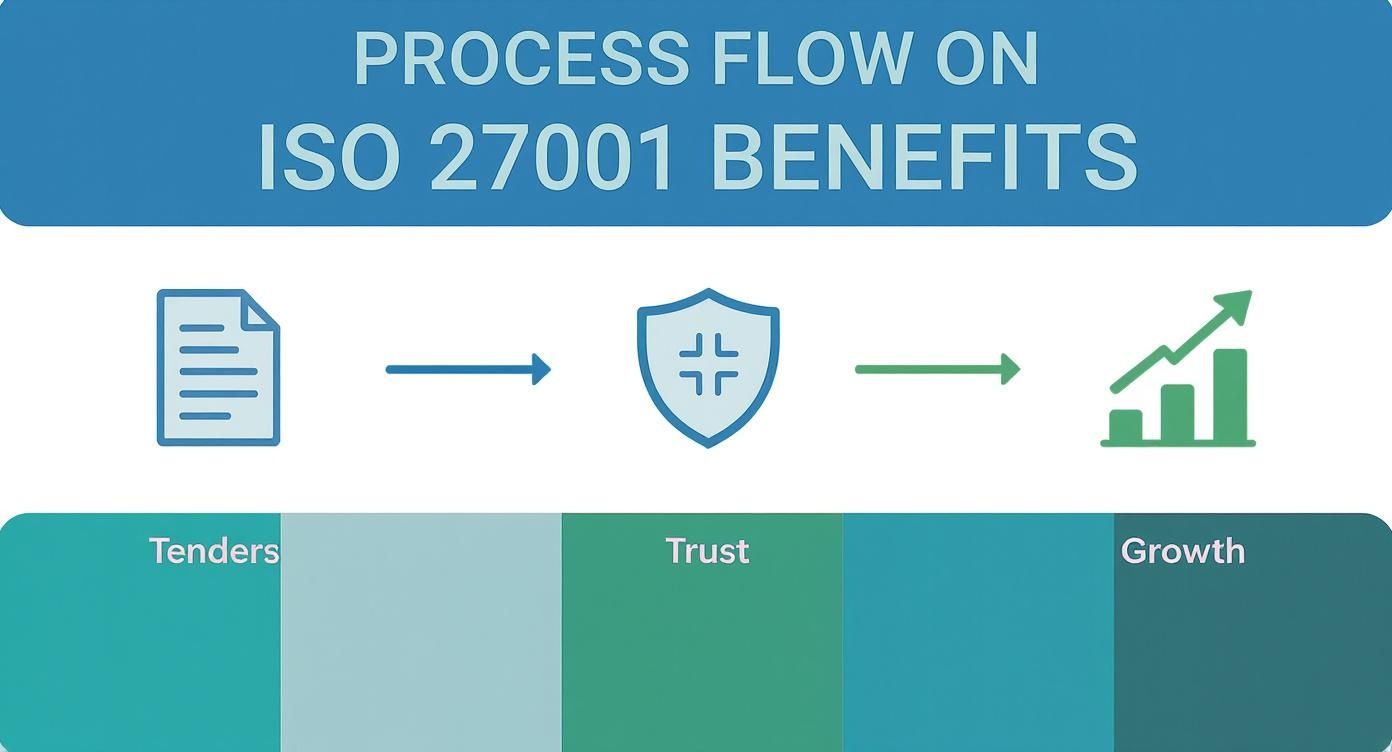
This process shows that ISO 27001 isn't just a cost—it's an investment that unlocks real commercial opportunities.
Phase 1: Laying the Groundwork
This first phase is all about preparation and planning. Don't rush it. Cutting corners here is like building a house on a dodgy foundation; it’s guaranteed to cause problems down the track. Getting this right from the start sets the entire project up for success.
- Secure Executive Buy-In: First things first, your leadership team needs to be fully on board. They must understand the commercial benefits, commit the right resources (people's time, budget), and genuinely champion the project across the entire organisation.
- Define Your ISMS Scope: Next, you need to draw a clear line in the sand defining the boundaries of your Information Security Management System (ISMS). What parts of the business will it cover? Which office locations, teams, and critical data assets are in or out? A tight, well-defined scope keeps the project focused and stops it from spiralling out of control.
Phase 2: Building Your Security Framework
With the plans locked in, it’s time to start building the core of your ISMS. This part of the process involves some deep analysis and the hands-on work of putting your security controls into place.
Your first move is a comprehensive risk assessment. This is where you get forensic, identifying potential threats to your information, figuring out how likely they are to happen, what the damage would be, and deciding how to handle each one. You might choose to accept a risk, reduce it with a new control, transfer it (like with insurance), or avoid it altogether.
From there, you’ll develop a Risk Treatment Plan (RTP). This is your practical action plan, documenting exactly which security controls you’re going to implement to tackle the risks you've just identified.
At this point, you'll also create your Statement of Applicability (SoA). It's a critical document that lists all 114 Annex A controls. For each control, you must justify whether it applies to your organisation and, if it does, explain how you've implemented it. It’s a non-negotiable part of the audit.
Phase 3: Implementation and Documentation
This is where the theory hits the road. You’ll start rolling out all the security controls you detailed in your Risk Treatment Plan. This could be anything from writing new data handling policies and training your team, to setting up new security software or upgrading the locks on the server room door.
Documentation is a massive part of this phase. You need to keep meticulous records of everything: policies, procedures, risk assessments, staff training logs—you name it. This paper trail is the evidence your auditor will be looking for.
For Australian businesses, this phase has never been more important. With cybercrime on the rise and regulators watching closely, ISO 27001 is fast becoming the benchmark. The updated ISO 27001:2022 standard means any organisation certified under the old 2013 version must transition by 31 October 2025, or they risk losing their accreditation. That's a deal-breaker for winning major contracts in today's market.
Phase 4: Inspection and Verification
Before you call in the external auditors for the final exam, you need to check your own work. This phase is all about making sure your ISMS isn’t just built, but is actually working as intended day-to-day.
- Conduct an Internal Audit: You need to run an objective internal audit to check if your ISMS meets the ISO 27001 standard and your own internal policies. It’s your chance to find and fix any gaps before the external auditors do.
- Hold a Management Review: Your senior leadership team must formally sit down and review the ISMS. They’ll look at its performance, go over the audit results, and make decisions on any improvements needed.
This internal check-up is a mandatory step and shows your commitment to keeping your security sharp. To get a better grasp of this crucial step, our detailed guide on the ISO 27001 audit process can help clarify what to expect.
Phase 5: The Certification Audit
This is it—the final step. An accredited, independent certification body comes in to assess your ISMS. It happens in two stages:
- Stage 1 Audit: Think of this as a "readiness check." The auditor reviews all your documentation to make sure you have everything required by the standard. It’s a desktop review to confirm you’re prepared for the main event.
- Stage 2 Audit: Now the auditor conducts a much deeper, on-site review. They’ll talk to your staff, inspect your systems, and gather evidence to verify that your ISMS is fully implemented and running effectively in the real world.
If the auditor finds no major issues (or "non-conformities"), they’ll recommend your organisation for certification. Once it's all approved, you’ll receive your official ISO 27001 certificate, which is valid for three years, provided you pass your annual surveillance audits.
Decoding the Core Requirements and Annex A Controls
Let's cut through the jargon. When you peel back the layers, ISO 27001 is built on two fundamental parts: the mandatory management clauses (Clauses 4-10) and the practical security controls listed in Annex A.
Think of it like building a house. The clauses are your architectural blueprints—they lay out the essential structure, foundations, and framework you must follow. Annex A is your catalogue of building materials and fittings, from locks and alarms to firewalls. You don't need every single item, but you must choose the right ones to make your house secure against the specific threats in your neighbourhood.
Many businesses get overwhelmed by the long list of controls. But it becomes a whole lot clearer when you group them into common-sense themes. Instead of a dry checklist, we’ll look at this from a practical standpoint: protecting your people, your digital assets, and your physical spaces. This approach turns a complex standard into a set of real-world actions.
Understanding the Mandatory Clauses
Before we even get to the specific security measures, you need to understand the high-level rules that form the backbone of your Information Security Management System (ISMS). These clauses, from 4 to 10, are non-negotiable. They provide the 'why' and 'how' for everything else you'll do.
- Clause 4 Context of the Organisation: This is about taking a good, hard look at your business. What internal and external issues could impact your information security? Who are your stakeholders, and what do they expect from you?
- Clause 5 Leadership: Security starts at the top. This clause demands that your senior management is bought in, actively involved, and visibly championing the cause.
- Clause 6 Planning: This is where the strategy happens. You’ll figure out how to assess risks and set clear, measurable security goals.
- Clause 7 Support: You can't achieve security without the right resources. This covers everything from competent staff and ongoing training to proper documentation.
- Clause 8 Operation: This is the 'doing' part—putting your risk treatment plan into action and implementing the security controls you’ve chosen.
- Clause 9 Performance Evaluation: How do you know if any of this is actually working? Here, you’ll monitor, measure, and audit your ISMS to find out.
- Clause 10 Improvement: Based on what you find, you take action to fix what's broken and continuously fine-tune your ISMS. Security isn't a one-and-done project.
These clauses create a continuous cycle—often called the Plan-Do-Check-Act loop—that ensures your security efforts evolve and improve over time.
Securing Your People
Your team is your greatest asset and, let's be honest, often your biggest security vulnerability. Annex A provides a whole suite of controls focused on managing this human element, from the day someone joins your team to the day they leave. For Australian businesses, this means carefully aligning these security practices with local employment laws.
A perfect example is background verification checks. When you're hiring for a role with access to sensitive information, you need to be sure the candidate is who they say they are. In Australia, this has to be done in strict compliance with the Privacy Act 1988 and fair work regulations. It’s a balancing act—ensuring you trust the person handling your data without overstepping legal boundaries.
Another crucial area is information security awareness and training. It’s not enough to just have a policy document gathering dust on a server somewhere. Your team needs to understand the 'why' behind the rules. This means regular, engaging training on spotting phishing emails, creating strong passwords, and knowing their responsibilities. Done right, this turns your staff from potential weak links into your first and best line of defence.
Fortifying Your Digital Gates
This theme is all about the technical controls designed to protect your networks, systems, and data from attack or unauthorised access. For any business in Australia—especially those in SaaS, fintech, or e-commerce—these controls are the absolute bedrock of their security.
Imagine a Sydney-based SaaS company that handles client data from across the country. For them, access control is everything. A non-negotiable Annex A control they would implement is multi-factor authentication (MFA). This means logging into their platform requires more than just a password; it needs a second check, like a code sent to a mobile phone. This one simple step makes it exponentially harder for an attacker to get in, even if they somehow steal a password.
Other vital controls in this digital realm include:
- Network security management: Using firewalls and segmenting networks to contain a potential breach and stop it from spreading.
- Malware protection: Keeping up-to-date antivirus and anti-malware software running on every company device.
- Data encryption: Making sure that sensitive data is scrambled and unreadable to prying eyes, both when it's stored on your servers (at rest) and when it's being sent over the internet (in transit).
These digital defences are what maintain the confidentiality, integrity, and availability of the information you’re responsible for.
By translating Annex A controls into practical security themes, you move away from abstract requirements and start building a tangible defence system tailored to your specific business risks. This is the essence of achieving meaningful ISO 27001 Australia compliance.
Protecting Your Physical Spaces
While cyber threats steal the headlines, the physical security of your offices and equipment is still a critical piece of the ISO 27001 puzzle. This group of controls is all about stopping unauthorised physical access, damage, or interference with your company's information and facilities.
This could be as simple as a clear desk and clear screen policy at an accounting firm in Melbourne. This policy ensures sensitive client financial records are locked away at the end of the day and that employees lock their computers whenever they step away from their desks. It’s a low-tech but incredibly effective habit that prevents opportunistic theft or snooping.
Other physical security measures might involve:
- Secure areas: Using access controls like key cards or biometrics to protect server rooms or archives where sensitive documents are stored.
- Equipment security: Securing laptops with cable locks and having a formal process for tracking all company-owned mobile devices.
- Cabling security: Protecting network and power cables from being accidentally damaged or deliberately tapped into.
By weaving together strong controls for your people, your digital gateways, and your physical environments, you create a robust, layered security framework that addresses the full spectrum of threats your business actually faces.
How Small Businesses and SaaS Companies Win with ISO 27001

Let's clear up a common myth. Many people think ISO 27001 is a heavyweight championship reserved for massive corporations and big banks. For a small Aussie business or a nimble SaaS company, the standard can look intimidating, expensive, and frankly, out of reach.
But that couldn't be further from the truth.
In reality, ISO 27001 is one of the most powerful strategic assets a smaller organisation can have. It’s the key to punching well above your weight class, building immediate trust, and unlocking doors to bigger, better opportunities. Getting it done early isn't just a cost; it's a calculated investment in your future growth and resilience.
Gaining a Massive Competitive Edge
In a crowded market, trust is your most valuable currency. Picture this: an enterprise client is choosing between two SaaS providers. The one with verifiable, internationally recognised security credentials has an immediate and powerful advantage.
That's what ISO 27001 does. It acts as a trust signal that cuts through the noise.
It tells potential customers that you've moved beyond empty promises and have a robust, audited system for protecting their data. For a small business, this levels the playing field, allowing you to compete confidently against larger, more established players who might not have made the same commitment to security.
Scaling Your ISMS for a Smaller Team
Implementing an Information Security Management System (ISMS) doesn't require an army of security analysts. The trick for a small business is to be smart and pragmatic, scaling the system to fit your specific size and risk profile.
- Focus on High-Impact Risks: A small team can't boil the ocean. Start by pinpointing the most significant risks to your most critical data and concentrate your initial efforts there.
- Use Smart Tools: Modern GRC (Governance, Risk, and Compliance) platforms can be a lifesaver. They automate documentation, track controls, and manage audits, saving countless hours of manual work.
- Embrace a Security Culture: With a smaller team, it’s far easier to embed a security-first mindset. Your ISMS becomes incredibly effective when everyone, from the CEO to the newest hire, understands their role in protecting information.
Achieving certification with a lean team is entirely possible. For more insights, check out our guide on cybersecurity for small businesses to see how practical steps can make a huge difference. This isn’t just about compliance; it's about showing a genuine dedication to security excellence.
Tackling Unique SaaS and Cloud Challenges
For Australian SaaS companies, security isn't just a feature—it's the very foundation of your business. Your clients trust you with their data, and they need absolute assurance it's protected, especially in complex cloud environments.
One of the biggest hurdles is managing security in a multi-tenant architecture, where different customers' data lives on shared infrastructure. ISO 27001 provides the framework you need to implement crucial controls like data segregation and logical access controls, making sure one customer can never access another's information.
For a SaaS startup seeking investor funding, ISO 27001 certification can be a game-changer. It demonstrates maturity, responsible risk management, and a clear understanding of enterprise-level requirements, making you a far more attractive and less risky investment.
Your reliance on cloud providers like AWS or Azure adds another layer of complexity. Adopting ISO 27001 forces you to take a structured approach to managing these third-party risks. The standard helps you establish clear security requirements in your contracts and implement monitoring to ensure they're being met. With 69% of organisations reporting challenges in maintaining consistent security across multi-cloud setups, this structured approach is absolutely vital.
Using Certification as a Powerful Sales Asset
Once you achieve certification, don't keep it a secret! It’s one of your most persuasive marketing and sales tools. It instantly answers the biggest security questions potential enterprise clients have, which can shorten sales cycles and remove major roadblocks.
Here’s how to put your certification to work:
- Display the Badge Prominently: Add the certification logo to your website footer, email signatures, and marketing materials.
- Create Security-Focused Content: Write blog posts or white papers that explain your commitment to security and what your certification means for your customers.
- Equip Your Sales Team: Give your sales team a one-page summary of your ISMS. They can share it with prospects to proactively address any security concerns right from the start.
For any ambitious Australian small business or SaaS company, pursuing ISO 27001 certification is a clear path to building credibility, winning bigger deals, and creating a secure foundation for long-term success.
Your Top Questions About ISO 27001 in Australia, Answered
If you’re an Australian business leader, the world of ISO 27001 can seem complicated. You’re likely weighing up the cost, the effort, and the real-world payoff. To cut through the noise, we’ve tackled the most common questions we hear on the ground.
Think of this as your practical, no-nonsense guide to making a smart decision for your business.
How Much Does ISO 27001 Certification Cost in Australia?
This is always the first question, and the honest answer is: it really depends. The total investment hinges on your company’s size, complexity, and how solid your current security habits are. There’s no single price tag.
But we can break down the costs into three main buckets:
- Certification Body Audit Fees: This is what you pay an accredited auditor for the formal Stage 1 and Stage 2 audits, plus the yearly check-ins. For a small Aussie business (say, 10-50 staff), you’re typically looking at AUD $10,000 to $20,000 for the initial three-year certification cycle.
- Consultancy Fees (Optional): Many businesses bring in an expert to guide them. It can be a massive time-saver and dramatically increase your chances of a smooth process. Depending on how much help you need, this can add anywhere from $15,000 to $50,000+ to your budget.
- Internal Resources: Don't overlook the value of your team's time. Your people will need to carve out hours for risk assessments, writing policies, and putting new controls in place. This is a real cost.
The key is to see this as an investment in protecting your business and unlocking new opportunities, not just another line item on the budget.
Is ISO 27001 a Legal Requirement in Australia?
While ISO 27001 isn't a blanket law for every business in Australia, it’s quickly becoming the ticket to play in many high-value sectors. The real pressure isn't from legislation; it's coming from the market itself.
In practice, certification is often a non-negotiable requirement for:
- Government Tenders: Federal and state government departments almost always demand ISO 27001 certification from suppliers who handle sensitive data. No certificate, no contract.
- Enterprise Contracts: Big players in finance, tech, and healthcare won't risk their reputation on a partner without certified security. It’s a standard due diligence check.
Market forces are turning certification into a must-have for any business that manages valuable information and wants to be a trusted player in the supply chain. It's the new benchmark for reliability.
ISO 27001 bridges the gap between your security practices and your customers' expectations. It’s the clearest way to demonstrate that you are a responsible custodian of their data, which is a powerful commercial advantage.
For software-as-a-service companies, in particular, adopting effective SaaS risk management strategies is the bedrock. ISO 27001 builds on that foundation, giving you a framework that proves your resilience and gives you a serious competitive edge.
How Long Does It Take to Get ISO 27001 Certified?
Again, this comes down to your starting point. Every organisation's journey is unique, but we can give you a rough idea to help set expectations.
A small, nimble company that already has some good security fundamentals in place might get certified in as little as 3 to 6 months.
On the other hand, a larger, more complex organisation starting from square one might be looking at a timeline of 9 to 18 months. The heaviest lifts are usually the initial deep-dive risk assessment and then rolling out the new security controls across the business.
The two biggest factors for keeping things moving? Strong project management and rock-solid commitment from your leadership team. Without those, timelines can easily blow out.
How Does ISO 27001 Relate to the ACSC Essential Eight?
This is a fantastic question and a common point of confusion. The best way to think about it is that they are powerful allies, not rivals. They work together to build a formidable defence.
- ISO 27001 is your comprehensive management system (an ISMS). It’s the strategic blueprint for your entire security program, defining the 'what' and the 'why' of managing risk across the business.
- The ACSC Essential Eight is a focused list of specific, hands-on technical controls. It gives you the practical 'how' for blocking the most common cyber attacks we see today.
Here’s an analogy: ISO 27001 is the complete architectural plan for your security fortress. The Essential Eight are the detailed instructions for building the strongest gates, the highest walls, and the most vigilant watchtowers.
Smart Australian businesses embed the Essential Eight controls within their ISO 27001 framework. This dual approach is incredibly effective. It proves you have a strategic management system and that your technical defences are aligned with government-endorsed best practices for cyber resilience.
So, Where Do You Begin Your ISO 27001 Journey?
You’ve seen the why, the what, and the how of ISO 27001 in Australia. Now it’s time to take that first, crucial step. This is where all the theory gets put into practice. The path to certification doesn’t start under a mountain of paperwork; it begins with a few clear decisions and a focused effort.
This final section is your launchpad. We’ll boil down the entire process into a straightforward checklist you can start using today. This isn't about trying to fix everything at once. It's about getting started with confidence, armed with the knowledge to build a more secure and resilient business.
Your Immediate Action Checklist
Kicking off an ISO 27001 certification can feel huge, but it really just comes down to a few critical first moves. Get these foundational steps right, and everything that follows becomes a whole lot smoother.
Think of this as your practical, step-by-step launch plan:
-
Get Your Leadership On Board: Before you write a single line of a policy, you need the full backing of your leadership team. And I don’t just mean getting the budget signed off. They need to genuinely understand that ISO 27001 is a strategic move for the business, not just another IT project. Their commitment is the fuel that will drive this forward and unlock the resources you need.
-
Assemble a Small, Dedicated Crew: You don’t need a massive committee. Find a project champion—someone with the passion and authority to lead the charge—and bring in a couple of key people from different corners of the business, like IT, HR, and operations. This core team will be the engine room for the entire process.
-
Define a Clear and Realistic Scope: This is probably the most important decision you'll make early on. You need to decide exactly what parts of your organisation the Information Security Management System (ISMS) will cover. Is it the entire company? A specific business unit? Just the Sydney office, or a particular software platform? Nailing down the scope stops it from spiralling out of control later and keeps the project manageable.
The trick is to start with a scope you know you can achieve. You can always expand it down the track. A classic mistake is being too ambitious from the get-go, which just leads to burnout and a stalled project. Start small, get the win, and then build on that success.
Time for Your First Gap Analysis
Once you've got your team and your scope locked in, the next logical step is figuring out exactly where you stand right now. A gap analysis is like getting a map and sticking a big "You Are Here" pin in it. It's an honest look at your current security practices measured against what the ISO 27001 standard actually requires.
The process involves sitting down and reviewing your existing policies, procedures, and technical controls to see what’s already in place and, more importantly, what’s missing. You don’t need to be perfect here; the whole point is to create a clear to-do list.
This analysis will quickly shine a light on areas that need work, such as:
- Missing Paperwork: Highlighting policies or procedures you need to create from scratch.
- Control Weaknesses: Finding gaps in your defences, like inconsistent password rules or the lack of a formal process for when an employee leaves.
- Resource Shortfalls: Realising you might need specific tools or expertise to tick certain boxes.
The results of your gap analysis become the blueprint for your entire project plan. It lets you prioritise tasks, estimate timelines, and assign resources where they're needed most. It turns the vague goal of "getting certified" into a concrete plan with specific, actionable steps.
Plan for Success and Build Momentum
The journey to achieving ISO 27001 Australia certification is a marathon, not a sprint. The secret to finishing strong is to start smart. Don't get bogged down in the nitty-gritty of Annex A controls on day one. Instead, focus on building a solid foundation with leadership buy-in, a clear scope, and a realistic picture of where you are today.
By taking these first steps, you create the structure and momentum you need to see the whole process through. You turn an intimidating standard into a manageable project, setting your business on a clear path towards stronger security, deeper client trust, and a real competitive edge.
Ready to take that first step with confidence? The journey to ISO 27001 certification can be complex, but you don't have to navigate it alone. Anitech offers expert ISO 27001 consulting services tailored for Australian businesses. With our 100% success rate, we simplify the process so you can focus on what you do best. Visit us at https://iso-27001.com.au to learn how we can guide you to certification success.
Recent Comments