

An ISO 27001 certificate is more than just a piece of paper. It’s your organisation’s official proof that you’ve built an Information Security Management System (ISMS) tough enough to meet a demanding international standard. It’s a clear, verifiable signal to your clients, partners, and regulators that you don't just talk about data security—you live it. This certificate shifts you from simply claiming to be secure to proving it with an independent stamp of approval.
Your Guide to the ISO 27001 Certificate
In a world full of digital risks, trust is the most valuable currency you have. So, how do you actually show people your organisation is a safe pair of hands for their valuable information? This is where an ISO 27001 certificate comes in, acting as a powerful, globally recognised symbol of trust.
Think about it like this: if you were hiring a company to install a security system in your home, you wouldn't just take their word that it works. You’d look for official credentials and proof that they meet industry standards. The ISO 27001 certificate does exactly that for your business's data security. It shows the world you’ve put a comprehensive system in place to manage and protect your information assets.
What Does the Certificate Actually Mean?
At its heart, getting certified means your organisation has a working Information Security Management System (ISMS). An ISMS isn't a piece of software you install; it's the entire framework of policies, procedures, and technical controls that shape how you handle information security day-to-day.
Think of it as your company's security command centre. It's not a static checklist you tick off once and forget about. It's a living, breathing system that needs constant attention and improvement.
This is what really sets ISO 27001 apart. It’s built on a continuous cycle of planning, doing, checking, and acting. This ensures your security measures don't get stale and actually keep up with new threats as they appear.
This is a huge differentiator. While other frameworks offer guidance, ISO/IEC 27001 is a certifiable standard. That means an accredited, independent auditor has gone through your systems with a fine-tooth comb and confirmed they meet the high bar required. That third-party validation is what gives the certificate its credibility and authority.
Why This Is So Much More Than a Compliance Document
It’s tempting to see ISO 27001 as just another compliance box to tick, but that misses the point entirely. Its real power is the strategic edge it gives your business. For Australian businesses especially, it's fast becoming a non-negotiable for playing in the big leagues, whether in the public or private sector.
Holding this certificate shows the market that you operate with a high level of security maturity. It gives you a real competitive advantage, particularly when you're bidding for contracts where data security is a deal-breaker. In fact, many large corporations and government agencies won't even look at a supplier who doesn't have it.
But the benefits go way beyond just winning new work. A well-run ISMS helps you:
- Systematically Find Your Risks: The standard makes you conduct a proper risk assessment, which often uncovers weaknesses you never knew you had.
- Protect Your Crown Jewels: It ensures you have the right controls to protect everything from client data and intellectual property to your financial records.
- Build a Security-First Culture: Getting certified needs buy-in from the top down and awareness from all staff, embedding good security habits across the whole organisation.
- Show You've Done Your Homework: If a breach does happen, having a certified ISMS demonstrates that you took recognised, reasonable steps to protect data, which can seriously reduce legal and financial fallout.
The Path to Certification Explained
The journey to an ISO 27001 certificate is a structured, methodical process. It definitely requires commitment, but it’s a perfectly achievable goal for any business, small or large. The process usually kicks off by defining the scope of your ISMS—in other words, deciding which parts of your business will be covered.
From there, you’ll conduct a risk assessment, put the necessary security controls in place, and document all your policies and procedures. This is followed by internal audits to make sure everything is running smoothly. The final step is the external audit by an accredited certification body. If you pass, they issue your certificate. For a more detailed look at the process, you can find some great information on achieving information security management system certification.
Ultimately, the certificate isn't the finish line. It’s the start of an ongoing commitment to getting better at security, making your business more resilient, trustworthy, and competitive.
The Business Case for ISO 27001 Certification
Getting an ISO 27001 certificate isn't just about ticking a compliance box; it's a powerful business move with real, measurable returns that hit your bottom line. If you only see it as an expense, you're missing the bigger picture. This certification is a tool for generating revenue, building rock-solid client trust, and shielding your business from the ever-present threat of cyber attacks.

The real value clicks into place when you stop thinking "cost" and start thinking "opportunity." Think of the certificate as a master key, opening doors to bigger, more profitable contracts that were completely out of reach before. It's about turning your security posture into your most convincing sales pitch.
Unlock New Revenue and Gain a Competitive Edge
Put yourself in this position: you're bidding for a major government tender or a contract with a huge, publicly-listed company. These organisations don't just politely ask about your security. They demand proof. An ISO 27001 certificate is often the price of admission—a non-negotiable requirement just to get your foot in the door.
Without it, you're out of the running before you even start, no matter how great your service is. With it, you jump to the front of the queue, setting your business apart from competitors who can’t offer the same verified level of security. This certification is your ticket to a more profitable game.
In Australia, the line between certification and revenue is crystal clear. A case study of a regional bank brings this home: they missed their annual ISO 27001 audit by only six weeks, and their certification was suspended. Within days, a major client pulled a $2 million data-hosting contract. It's a brutal reminder of just how much is riding on that piece of paper.
Build Unshakeable Customer Trust and Loyalty
Trust is the currency of any business relationship. When clients give you their sensitive data—personal details, financial records, or precious intellectual property—they are placing enormous faith in you to protect it. An ISO 27001 certificate offers that concrete, third-party validation that their trust is well-founded.
It’s the difference between saying "we take security seriously" and proving it with a globally respected standard. This kind of verifiable commitment speaks volumes to clients, building loyalty and making them far more likely to stick with you and grow the relationship over time.
A certified Information Security Management System (ISMS) shows you have a proactive, systematic way of managing risk. It tells your clients that you don't just react to threats—you get ahead of them, protecting their interests as if they were your own.
This level of assurance is a huge advantage that helps you not just win new clients, but keep them for the long haul.
Drastically Reduce Financial and Reputational Risk
A single data breach can be devastating, especially for a small or medium-sized business. The financial fallout can include massive fines, legal battles, and customer payouts, not to mention the cost of cleaning up the mess. The damage to your reputation, however, can be even worse, wiping out years of hard-won goodwill overnight.
A properly implemented ISMS, the backbone of an ISO 27001 certificate, is your best defence. It forces you to find your weak spots and put strong controls in place, dramatically lowering the chances of a cyber-attack succeeding.
On top of that, this proactive approach to risk doesn't go unnoticed by cyber insurance providers. Many insurers will offer lower premiums to certified businesses because they see you as a much safer bet. This is a direct cost saving, and just one more way investing in security pays off. You can dig deeper into this in our article on the ROI of cyber security.
Ultimately, managing risk makes your business tougher and more sustainable. It’s an investment in your company's future, giving you the confidence to operate securely and grow. By translating technical security measures into clear business value, the ISO 27001 certificate proves that information security isn’t a burden—it’s a critical engine for growth, reputation, and long-term success.
Getting to Grips with the Core ISO 27001 Requirements
Diving into the ISO 27001 standard can feel a bit like trying to assemble complex furniture without the instructions. But once you see how it’s put together, you’ll find it’s a logical, powerful framework designed to make your business genuinely more secure. At its heart, the standard is all about one central concept: the Information Security Management System (ISMS).
Think of your ISMS as the central command centre for your company's security. It's not just a piece of software or a dusty policy document; it’s the entire ecosystem of processes, technology, and people working in concert to protect your information. It’s what turns your security efforts from a scattered reaction into a coordinated, effective, and always-improving strategy.
Ultimately, earning an ISO 27001 certificate is about proving that your ISMS is not only up and running but is also effective and aligned with global best practices. It gives you a structured, repeatable way to manage security, moving you away from simply putting out fires as they appear.
The Foundation: Your Information Security Management System
Everything in ISO 27001 begins and ends with the ISMS. It’s the engine that drives your whole security program. The standard asks you to establish, implement, maintain, and continually improve this system. That cycle is absolutely critical—because threats never stand still, and neither can your defences.
A well-designed ISMS forces you to ask the right questions: What information is most critical to our business? What are the real threats we face? From there, you can implement the right controls to protect what matters most. It’s a risk-based approach, which means you focus your time and money where they’ll have the biggest impact, making it incredibly efficient for businesses of any size.
The backbone of any good ISMS is its documentation. While this might sound tedious, it’s essential for keeping everyone on the same page and, of course, proving compliance. To get a better handle on this, you can learn more about the minimum documented information needed for achieving ISO 27001 certification.
Demystifying the Key ISO 27001 Clauses
The main body of the standard is organised into sections called "clauses." These are the high-level requirements your ISMS needs to meet, providing the blueprint for your entire security framework.
Here’s a quick rundown of the big ones:
- Clause 4: Context of the Organisation: This is all about knowing your business and its environment. You need to look at internal and external issues (like new regulations or competitive pressures) and understand what interested parties (customers, regulators, employees) expect from you when it comes to security.
- Clause 5: Leadership: This one is non-negotiable. Your top management has to be fully on board, driving the security policy, assigning resources, and showing everyone that security is a priority. If leadership isn't committed, an ISMS is dead in the water.
- Clause 6: Planning: This is where you get to the heart of risk. You must identify, analyse, and evaluate your information security risks. Think of it like a homeowner checking for unlocked doors and windows before installing a security system—you find the weak spots before an intruder does.
The risk assessment process is the true cornerstone of a successful ISMS. It ensures your security controls are directly tied to the actual threats your business faces, preventing wasted effort on irrelevant measures.
A thorough risk assessment is the first real hurdle. To get this foundational step right, it's often wise to look for local experts in cybersecurity risk assessment services.
From Planning to Continual Improvement
Once you’ve mapped out your risks, the next set of clauses walks you through putting your plans into practice and making sure your ISMS is a living, breathing system—not a "set and forget" project.
- Clause 7: Support: You can't build a strong ISMS without the right resources. This clause covers everything from making sure your staff are competent and aware of their roles, to establishing clear communication channels and keeping documentation in order.
- Clause 8: Operation: This is where the rubber meets the road. You roll out the controls and processes you planned during your risk assessment to manage security threats day-to-day.
- Clause 9: Performance Evaluation: How do you know if any of this is actually working? This clause demands that you monitor, measure, and evaluate your security performance. This means running internal audits and holding regular management reviews to check your progress.
- Clause 10: Improvement: Finally, you close the loop. Based on what you learned from your evaluations, you fix what’s broken and continually fine-tune your ISMS. This commitment to always getting better is what builds true, long-term resilience.
This structured approach ensures every security decision is deliberate, backed by evidence, and directly supports your business goals.
Understanding the Annex A Controls
While the clauses tell you what to do (e.g., "manage risks"), Annex A gives you a menu of specific controls to help you figure out how to do it. The latest version, ISO 27001:2022, organises 93 controls into four main themes. But here's the key: you don't have to implement all of them.
Your risk assessment is what dictates which controls are relevant to your business. You’ll record these decisions in a critical document called the Statement of Applicability (SoA), which lists the controls you’ve chosen and explains why you’ve included or excluded others. It’s this flexibility that makes the standard so powerful and adaptable for any organisation.
To help make sense of the controls, they’re grouped into four logical themes.
Overview of ISO 27001 Annex A Control Categories
The table below provides a snapshot of the four themes introduced in ISO 27001:2022, breaking down what each area covers and why it’s important for your business.
| Control Theme | Category Examples | Business Purpose |
|---|---|---|
| Organisational Controls | Information security policies, use of assets, information classification. | To establish a strong governance framework and define the rules for information security across the business. |
| People Controls | Security awareness training, remote working policies, screening. | To ensure that employees and contractors understand their security responsibilities and handle information securely. |
| Physical Controls | Secure areas, entry controls, equipment maintenance, clear desk and clear screen policy. | To protect physical assets like servers, laptops, and sensitive documents from unauthorised access, theft, or damage. |
| Technological Controls | Access control, cryptography, network security, data backup, malware protection. | To use technology to protect information systems and data against cyber threats and ensure system integrity. |
By breaking the standard down into these manageable pieces—the ISMS framework, the core clauses, and the Annex A controls—the path to an ISO 27001 certificate becomes much clearer. It’s a systematic journey that builds a resilient security culture, protects your organisation, and proves your commitment to security excellence.
Why Australian Businesses Can No Longer Ignore ISO 27001
The ground has well and truly shifted for Australian businesses. Not too long ago, you could be forgiven for thinking that serious information security was a problem for the big banks and tech giants. For everyone else, it was on the back burner. That time is over.
Today, having a rock-solid approach to security is a basic requirement for survival and growth, no matter your size or what industry you're in. The old "it won't happen to us" mindset isn't just outdated—it's a dangerous liability.
Getting an ISO 27001 certificate has gone from a 'nice-to-have' badge of honour to a non-negotiable part of modern business strategy. Your digital systems aren't just a part of your business anymore; they are your business. Ignoring that reality is like leaving the front door of your office wide open overnight and just hoping for the best.
The New Reality of Cyber Threats in Australia
The threat is no longer some abstract idea. It's here, it's persistent, and it's growing at a terrifying pace. For businesses in Australia, the numbers paint a pretty stark picture.
We've seen a massive surge in companies going for ISO 27001 certification, and it’s no surprise why. The Australian Cyber Security Centre fielded over 94,000 cybercrime reports in the last year alone. That's a staggering 23% jump from the year before. You can explore more data on this trend and see just how real this is for Australian businesses.
That figure isn't just a statistic; it represents thousands of real businesses facing real attacks. Every single report is a story of potential disruption, financial loss, or a damaged reputation that's hard to rebuild. This constant barrage of threats means that a few informal security policies scribbled down somewhere just won't cut it anymore. You need a systematic, internationally-recognised framework to build a genuine defence.
Aligning with National Security Priorities
The Australian Government has drawn a clear line in the sand. With the launch of the 2023–2030 Australian Cyber Security Strategy, there’s been a major shift in national policy. The government is placing far greater responsibility on businesses to toughen up their digital defences. This isn't just a list of suggestions; it's the blueprint for a more secure national economy, and every business is expected to do its part.
Getting an ISO 27001 certificate is one of the most direct and respected ways to show you're taking this seriously and aligning with these national priorities. It proves you're not only protecting your own data but also helping to secure the entire supply chain.
By proactively embracing this standard, you position your business not as a potential weak link, but as a trusted and responsible leader in your industry. This alignment is becoming increasingly important for securing government contracts and partnerships with major enterprises.
This new strategic focus from Canberra is fast-tracking the demand for security standards that can be verified. Businesses that can prove they meet a framework like ISO 27001 will find themselves in a much stronger position than those who can't.
The Competitive Disadvantage of Inaction
In this new environment, the biggest risk isn’t the cost of getting certified—it's the cost of doing nothing. Your competitors are not standing still. The smart ones are already using their ISO 27001 certification as a powerful tool to win bigger contracts, attract better talent, and build bulletproof trust with their clients.
Think about it from a competitive standpoint:
- Winning Tenders: More and more, certification is a non-negotiable requirement for government and corporate tenders. Without it, you're not even in the running for some of the best opportunities.
- Building Client Trust: In a market where everyone is worried about data breaches, clients are actively looking for partners they can trust. An ISO 27001 certificate is instant, verifiable proof that you’re committed to protecting their information.
- Attracting and Retaining Partners: Your security affects everyone you work with. Good partners and suppliers will always choose to work with organisations that don't expose them to unnecessary risk.
Every day you wait, you risk falling further behind. Your competitors are out there building their reputations on security and reliability, making them the easy choice for savvy customers.
The message couldn't be clearer: the game has changed for good. Verifiable information security is now a core pillar of business resilience and a critical driver of growth. For any Australian business serious about thriving in the years ahead, ignoring the call for ISO 27001 is no longer an option. The time for waiting is over.
Your Step-by-Step Path to an ISO 27001 Certificate
Getting started with ISO 27001 certification can feel like a massive undertaking, but it's really a well-defined process. The key is to see it not as a chaotic scramble, but as a planned expedition with clear stages and milestones. When you break it down, the journey becomes a series of manageable, achievable tasks that build confidence every step of the way.
The whole point of the process is to be methodical. It's not about slapping a generic security template onto your business. It's about building a robust Information Security Management System (ISMS) from the ground up—one that truly understands and addresses your unique risks.
Let's walk through what that journey actually looks like.
Phase One: Laying the Groundwork
You don’t start by buying new software or writing policies. You start with understanding. The very first move is a thorough gap analysis. Think of it like getting a detailed map of your current location before planning your route. We take a hard look at your existing security practices, policies, and controls and measure them against what the ISO 27001 standard requires.
This initial review tells us exactly where you stand—what you’re doing well and where the gaps are. It gives us the clarity we need to build a realistic project plan, figure out what resources are needed, and set an achievable timeline. Honestly, skipping this step is a recipe for wasting time and money on security measures you don’t need while leaving critical vulnerabilities wide open.
Once the gap analysis is done, the next crucial milestone is defining the scope of your ISMS.
- What needs protection? You need to decide exactly which parts of your business the ISMS will cover. Is it for the whole organisation? Just the product development team? Or a specific client-facing service?
- Why does the scope matter? A clearly defined scope keeps the project focused and manageable. It means your efforts are concentrated on protecting your most sensitive information and critical processes, giving you the best security bang for your buck.
Getting this foundational phase right sets you up for a smooth and efficient path to your ISO 27001 certificate.
Phase Two: Building Your Custom ISMS
With your gaps identified and your scope defined, it's time to start building. This is where you design and implement the core components of your ISMS, creating the policies, procedures, and controls that will form the backbone of your security program. The goal here is a custom fit; your ISMS has to reflect the real-world risks your business actually faces.
A huge part of this phase is the risk assessment and treatment plan. This is your strategic playbook for defence. You'll systematically identify potential threats to your information, figure out the likelihood and potential impact of each one, and then decide how to handle them. For a low-impact risk, you might just accept it. For a high-impact one, you’ll implement controls to mitigate it, or maybe transfer the risk through cyber insurance.
This risk-based approach is the absolute heart of ISO 27001. It ensures your security investments are proportional to your actual threats, so you're not overspending on minor issues while leaving gaping holes elsewhere.
Once you have your risk treatment plan, you’ll develop the necessary documentation. This means creating key documents like your main information security policy, procedures for things like access control, and your Statement of Applicability (SoA)—which is just a formal document explaining why you've chosen or excluded certain security controls. This paperwork isn't just for the auditor; it’s a vital tool for making sure everyone in the organisation applies security practices consistently.
Phase Three: Validation and the Final Audit
After your ISMS is built and running, you need to prove it works as intended. This phase is all about testing, tweaking, and getting ready for the final certification audit. It kicks off with a full internal audit. This is basically a dress rehearsal for the real thing, carried out by an impartial party to simulate the external audit.
The internal audit is critical for a few reasons:
- Find Non-Conformities: It flags any areas where your ISMS falls short of the ISO 27001 standard before the external auditor finds them.
- Opportunity for Improvement: It gives you practical feedback, so you can make corrections and strengthen your system.
- Builds Confidence: A successful internal audit is a great sign that your team and processes are ready for the official assessment.
This infographic shows how the rising tide of cybercrime has spurred a strategic government response, pushing standards like ISO 27001 to the forefront as a proven defence.
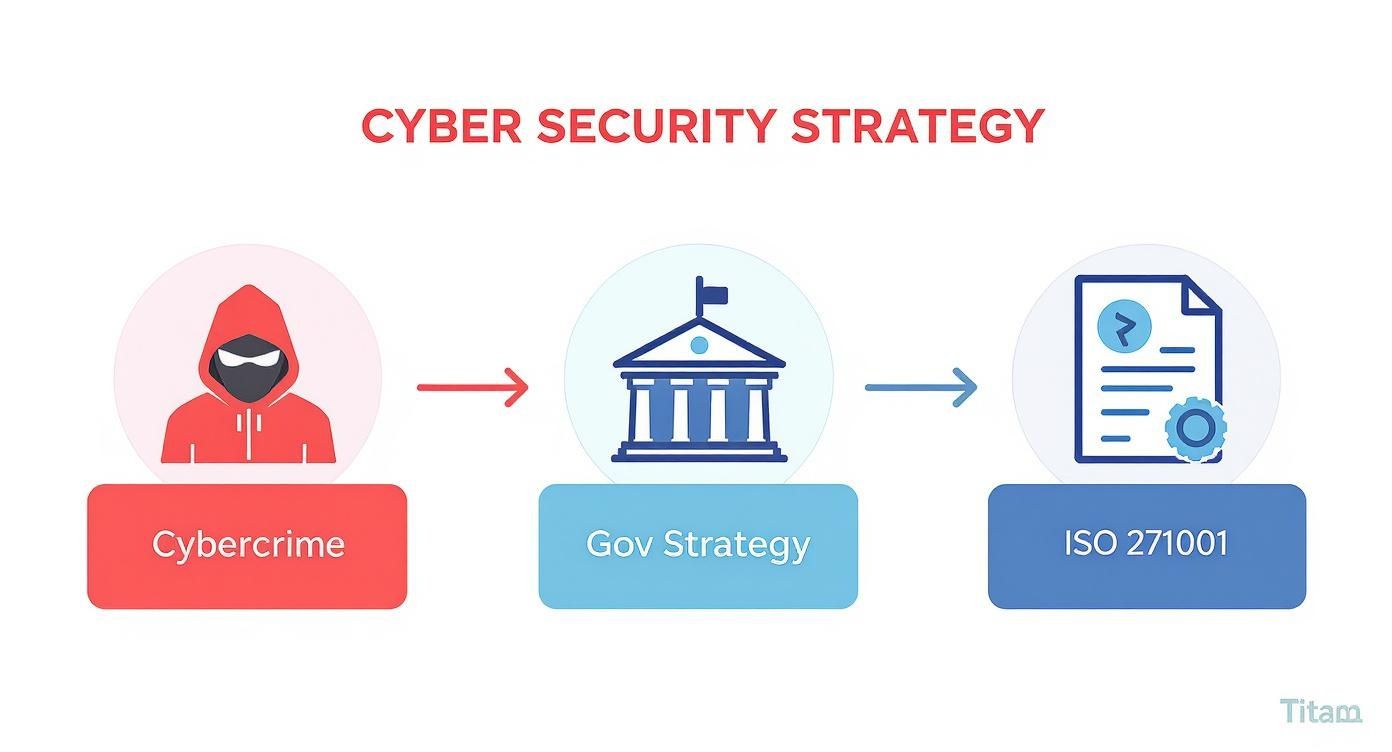
As you can see, getting an ISO 27001 certificate isn't just a compliance exercise; it's a direct and powerful way for businesses to align with national security priorities and build genuine resilience.
The final step is the external certification audit, which is handled by an accredited certification body. This is usually done in two stages. Stage 1 is a documentation review, where the auditor checks that all your policies and procedures are in place. Stage 2 is a deeper dive where they observe your ISMS in action, talk to your staff, and verify that your security controls are actually working effectively.
With a structured approach, this final audit isn't something to dread. It’s simply the last checkpoint on a journey you’ve carefully planned. By following a proven framework, what once seemed overwhelming becomes a manageable, even stress-free, process. With the right partner guiding you, a powerful ISO 27001 certificate is well within your reach.
Maintaining Your Certification for Long-Term Success
Getting your ISO 27001 certificate is a huge win. It’s a powerful statement to your clients, partners, and competitors that you are serious about information security. But here’s the thing: the real work—and the real payoff—starts the day after that certificate arrives.
Certification isn't a finish line. It's the starting block for an ongoing commitment to building a resilient and trustworthy business.
Think about it. The world of cyber threats doesn't stand still. New vulnerabilities pop up, and attackers get more creative by the day. Your Information Security Management System (ISMS) has to keep pace. If it doesn't, that certificate hanging on the wall starts to lose its meaning pretty quickly.
This is where the idea of "continual improvement" comes in. It’s not just corporate jargon; it's the engine that keeps your security practices sharp, relevant, and ready to tackle whatever comes next.
The Rhythm of Staying Secure
Keeping your certification isn’t about just ticking boxes once a year. It's about getting into a steady rhythm of activities that keep your ISMS in top shape. These aren't just hoops to jump through for an auditor; they're vital processes that ensure your security posture is genuinely strong and supports your business goals.
This cycle of checking, refining, and improving is what separates a truly secure organisation from one that just has a piece of paper. You're building a living, breathing security culture, not just a static defence.
Some key activities in this rhythm include:
- Regular Internal Audits: Treat these like a routine health check-up for your ISMS. They’re an honest, internal look at how well your security controls are working and whether everyone is following the right procedures. They help you spot small cracks before they become major problems during an official audit.
- Periodic Management Reviews: This is where the leadership team gets involved. They'll look at the performance of the ISMS, review what the internal audits found, and make smart decisions about where to invest time and resources. It keeps security on the boardroom agenda and ensures it’s always aligned with the bigger picture.
Navigating the Mandatory ISO 27001:2022 Transition
If you need a perfect example of why this matters, look no further than the mandatory switch to the new ISO 27001:2022 standard. This isn't an optional "nice-to-have" update; it's a required evolution to keep the standard relevant against modern cyber threats.
For Australian businesses, this transition is a major milestone. There’s a hard deadline of October 31, 2025, for any organisation certified under the old 2013 version. Every business in Australia with an ISO 27001 certification must get re-accredited to the new standard to keep it valid. Dropping the ball here could have serious consequences for your contracts and reputation. You can find out more about what Australian businesses need to know about ISO 27001 in 2025.
That deadline isn't going to budge. If you miss it, your ISO 27001 certificate becomes invalid. That could mean losing clients, damaging your brand, and watching your competitive advantage disappear overnight.
The time to start planning for this is now. The changes are more than just cosmetic; they require you to update risk assessments, revise your Statement of Applicability, and implement a host of new or updated security controls. It's a process that needs careful planning and time to get right.
Your Long-Term Partner in Security
Successfully keeping your ISO 27001 certificate—and navigating big shifts like the 2022 transition—really shows the value of having an expert in your corner. It’s about more than just getting certified; it's about having a guide who knows your business and can help you stay ahead of the game.
A long-term partnership ensures you’re not just maintaining compliance, but actively strengthening your security every day. It turns your ISMS from a simple shield into a dynamic system that protects your business, keeps your clients’ trust, and secures your place in the market for years to come.
Got Questions About ISO 27001? We've Got Answers.
Stepping into the world of an ISO 27001 certificate can feel like learning a new language. It’s completely normal to have a lot of questions, especially when you’re figuring out what it means for your business.
We’ve put together some straight-to-the-point answers to the questions we hear most often. Let's clear up the confusion so you can move forward with confidence.
How Long Does It Actually Take to Get Certified?
This is probably the number one question we get asked. While there's no single magic number, a realistic timeframe for a small to medium-sized business in Australia is somewhere between 6 to 12 months.
It’s not a race, and the final timeline really comes down to a few key things:
- Your Business Complexity: A small startup with one office is going to have a much quicker journey than a company with multiple locations and intricate data systems.
- Your Starting Point: If you already have some solid security practices in place, you’re ahead of the game. If you're starting from square one, it will naturally take a bit longer to build that foundation.
- Available Resources: This is a big one. The more time your team can dedicate—and whether you bring in experts to help—will massively impact how quickly you can get certified.
What's the Real Cost of an ISO 27001 Certificate?
Think of certification as an investment in your business’s resilience, not just a line-item expense. There isn't a fixed price tag, as the cost is shaped by the same factors that influence the timeline. Your main costs will be the consulting fees to get your systems ready and the certification body's fee for the audit itself.
The biggest driver of cost is the scope of your Information Security Management System (ISMS). A wider scope covering more people, places, and processes requires a bigger investment to implement and audit properly.
The trick is to define your scope smartly. That way, you’re putting your resources where they’ll have the greatest impact and deliver real security value.
Is This Genuinely Doable for a Small Business?
Yes, absolutely. ISO 27001 might sound like something reserved for huge corporations, but it’s designed to be incredibly flexible and scalable. It's a perfect fit for small businesses.
The secret is its risk-based approach. You're not forced to implement every single security control under the sun. Instead, you identify the specific risks your business faces and implement the controls that make sense to counter them.
This stops you from wasting money on security measures you simply don't need. With the right guidance, achieving an ISO 27001 certificate isn't just possible for a small business; it's one of the smartest strategic moves you can make.
Ready to turn your information security into a competitive advantage? The expert team at Anitech has a 100% success rate in guiding Australian businesses through to certification. Get a clear path to your ISO 27001 certificate with our proven consulting services.
Recent Comments