

Getting an ISO 27001 certification is much more than a piece of paper. It’s the result of a rigorous, independent audit that confirms you've built and are maintaining a comprehensive Information Security Management System (ISMS) that meets the global benchmark. Essentially, it’s verifiable proof that you’re systematically protecting your most valuable information assets.
Why ISO 27001 Is Your Competitive Edge in Australia

In Australia's tough business climate, treating ISO 27001 as just another compliance headache is a huge missed opportunity. The reality is, it’s become a powerful strategic tool that gives you a genuine competitive advantage. For a growing number of businesses, it's the key that unlocks new revenue and builds rock-solid confidence with stakeholders.
This isn't about ticking boxes. It's about showing the world you have a mature, proactive stance on information security. When you commit to the ISO 27001 framework, you’re sending a clear signal to clients, partners, and regulators that you take their data’s safety seriously. That commitment instantly elevates your security posture from a reactive cost centre to a proactive business enabler.
Building Verifiable Trust with Clients
Trust is the currency of modern business. With data breaches making headlines almost daily, clients are more cautious than ever about who they trust with their sensitive information. An ISO 27001 certification cuts through the noise and acts as an independent stamp of approval on your security promises.
Instead of just telling prospects you’ll protect their data, you can show them. That assurance can be the one thing that tips the scales in your favour when a potential client is weighing you up against a competitor. It makes due diligence simpler and often shortens sales cycles because that foundation of trust is already there.
An Information Security Management System (ISMS) isn't just a folder of documents; it's the living, breathing framework that proves your commitment to security. It systematically manages risks, ensures you can keep operating through disruptions, and builds a culture of security awareness from the ground up.
This trust doesn’t just help you win new business; it helps you keep it. Clients stick with partners they know can reliably protect their information, which means less churn and a stronger foothold in your market.
Meeting Stringent Regulatory and Contractual Demands
Let's face it, the regulatory landscape in Australia is only getting stricter. Frameworks like the Notifiable Data Breaches (NDB) scheme impose serious obligations on how you handle personal information and respond to incidents. Adopting ISO 27001 gives you a robust system that helps you meet—and often exceed—these legal requirements.
Beyond compliance, it's about opportunity. More and more lucrative contracts, especially from government agencies and large corporations, now list ISO 27001 certification as a non-negotiable prerequisite. Without it, you might not even get a look-in at the tender process. Being certified opens doors that would otherwise remain firmly shut.
Proactive Defence in a Heightened Threat Environment
The need for iron-clad security has never been clearer. Cyber threats are on the rise in Australia, and the numbers are startling. According to 2023 data, there were over 94,000 reported cybercrime incidents in the last year alone—a shocking 23% increase from the previous year. This constant barrage is exactly why so many Australian businesses are turning to ISO 27001 to build a solid defence. For a deeper dive into how this applies locally, you can find more insights about ISO 27001 certification in Australia on pm-docs.com.au.
By implementing a certified ISMS, you’re fundamentally changing your approach. You move away from a reactive, "break-fix" mentality to a proactive, risk-based strategy. The framework forces you to get methodical:
- Identify your information assets: Figure out what data you have, where it is, and why it's important.
- Assess potential threats: Understand the real-world risks facing that data, both internal and external.
- Implement smart controls: Put targeted security measures in place to neutralise those specific risks.
This isn't just about defending against today's threats. It’s about building the resilience to adapt to whatever comes next, making sure your business stays secure and operational no matter what.
Building a Solid Foundation for Your ISMS
Before you write a single policy or implement a new control, the success of your ISO 27001 certification is decided by the groundwork you put in place. This initial phase is all about strategy and clarity. It’s the critical step that takes you from the idea of better security to a tangible, well-defined project with a clear path to the finish line.
Get this part right, and you'll avoid the classic pitfalls: costly missteps, scope creep that derails your budget, and a loss of momentum just when you need it most. It's the difference between a reactive scramble and a controlled, methodical process.
First, You Need Genuine Executive Buy-In
Let's be clear: getting executive buy-in is more than just a signature on a project charter. You need an active, visible sponsor in the C-suite.
Your leadership team has to see ISO 27001 for what it is—a business-critical initiative, not just another IT project. Without their genuine support, you’ll constantly battle for resources, face pushback from other departments, and struggle to make security a part of your company’s DNA.
How do you get them on board? You have to speak their language. Frame the project around tangible business outcomes:
- Slash Your Risk: Show them how a structured ISMS directly cuts down the financial and reputational fallout from a data breach. Use real-world examples.
- Unlock New Business: Point out how certification opens doors to bigger contracts, especially with government and enterprise clients who won't even talk to you without it.
- Boost Efficiency: Explain how clear processes and defined responsibilities actually streamline operations and reduce the chaos caused by security incidents.
This isn’t about scare tactics. It’s about building a rock-solid business case. Your goal is to find a champion in the leadership team who will go to bat for the project, clear roadblocks, and continually reinforce its importance across the whole organisation.
Next, Define Your ISMS Scope with Precision
One of the most crucial decisions you'll make early on is defining the scope of your Information Security Management System (ISMS). A vague or poorly defined scope is a recipe for disaster.
If it’s too broad, you’ll be staring down the barrel of a project that’s become overwhelmingly complex and expensive. If it’s too narrow, you might leave critical information assets unprotected, defeating the entire purpose.
Your scope document needs to draw a clear line in the sand. It must specify:
- Which parts of the business are in? (e.g., The Engineering department, the Sydney office, the Client Services unit).
- What information are we protecting? (e.g., All client PII, our source code, Q3 financial reports).
- Which systems and technologies are included? (e.g., The production AWS environment, the customer support platform, the internal file servers).
For instance, a software company might decide its ISMS will cover the entire development lifecycle, its production servers, and the customer support platform that handles sensitive data. To keep the initial project manageable, they might deliberately exclude their internal marketing and sales systems, planning to bring them into scope in year two.
Think of your scope document as your project’s North Star. It provides absolute clarity on what you're protecting, why you're protecting it, and what's officially 'out of bounds' for the first audit.
This clarity ensures everyone—from your internal team to the external auditor—is on the exact same page.
Then, Conduct a No-Nonsense Gap Analysis
With your scope locked in, it’s time for a gap analysis. This isn't about finding fault; it's an honest, structured comparison of where your security practices are today versus where the ISO 27001 standard says they need to be.
The gap analysis will shine a light on both your weaknesses and your strengths. You might find you already have a great incident response process but lack any formal documentation for user access reviews. Knowing this helps you focus your time and money where it will have the biggest impact.
A good gap analysis systematically works through each clause of the standard and the Annex A controls, asking simple but powerful questions:
- Do we currently do this?
- If we do, where’s the proof (e.g., policies, system logs, meeting records)?
- If we don’t, what’s the fix?
The output from this assessment becomes the backbone of your entire project plan. It moves you from guesswork to data-driven planning, allowing you to build a realistic timeline, set an accurate budget, and assign the right people to the right tasks.
The findings from your analysis will directly inform your overarching security strategy. Building a comprehensive plan to tackle information security risks is a huge piece of this puzzle. For a deeper dive into structuring this, our guide on developing a robust risk management strategy offers essential insights that fit perfectly with the gap analysis process, ensuring your efforts are targeted and effective right from the start.
Now, let's look at how these foundational steps fit into the bigger picture. The entire journey can be broken down into a few core phases, each with its own set of activities and goals.
Core Phases of the ISO 27001 Certification Journey
| Phase | Key Activities | Primary Goal |
|---|---|---|
| 1. Scoping & Planning | Executive buy-in, scope definition, gap analysis, project planning. | To establish a clear project charter, scope, and realistic roadmap. |
| 2. Documentation & Design | Writing policies (SoA), procedures, and risk treatment plans. | To create the formal documentation required by the standard. |
| 3. Implementation | Rolling out new controls, training staff, and deploying security tools. | To close the gaps identified and embed security into daily operations. |
| 4. Internal Audit & Review | Conducting internal audits, management reviews, and corrective actions. | To verify the ISMS is working as intended before the external audit. |
| 5. Certification Audit | Stage 1 (documentation review) and Stage 2 (implementation audit). | To achieve formal ISO 27001 certification from an accredited body. |
| 6. Continual Improvement | Ongoing monitoring, regular audits, and updating the ISMS. | To maintain certification and ensure the ISMS evolves with the business. |
Understanding this lifecycle helps you appreciate that ISO 27001 isn't a one-off project. It's an ongoing commitment to a new way of managing information security.
Right, you’ve done the prep work and got the leadership team on board. Now comes the real work: building your Information Security Management System (ISMS).
This is the point where theory meets reality. It’s easy to get stuck here, especially if you’re trying to force-fit a generic template onto your business. An ISMS shouldn't just be a folder full of documents to impress an auditor; it needs to be a living, breathing part of your organisation that genuinely makes you more secure. It’s about creating policies and processes your team actually understands and uses.
Let's break down how to build a solid foundation, focusing on three core pillars: aligning your policies, scoping your assets, and analysing your risks.
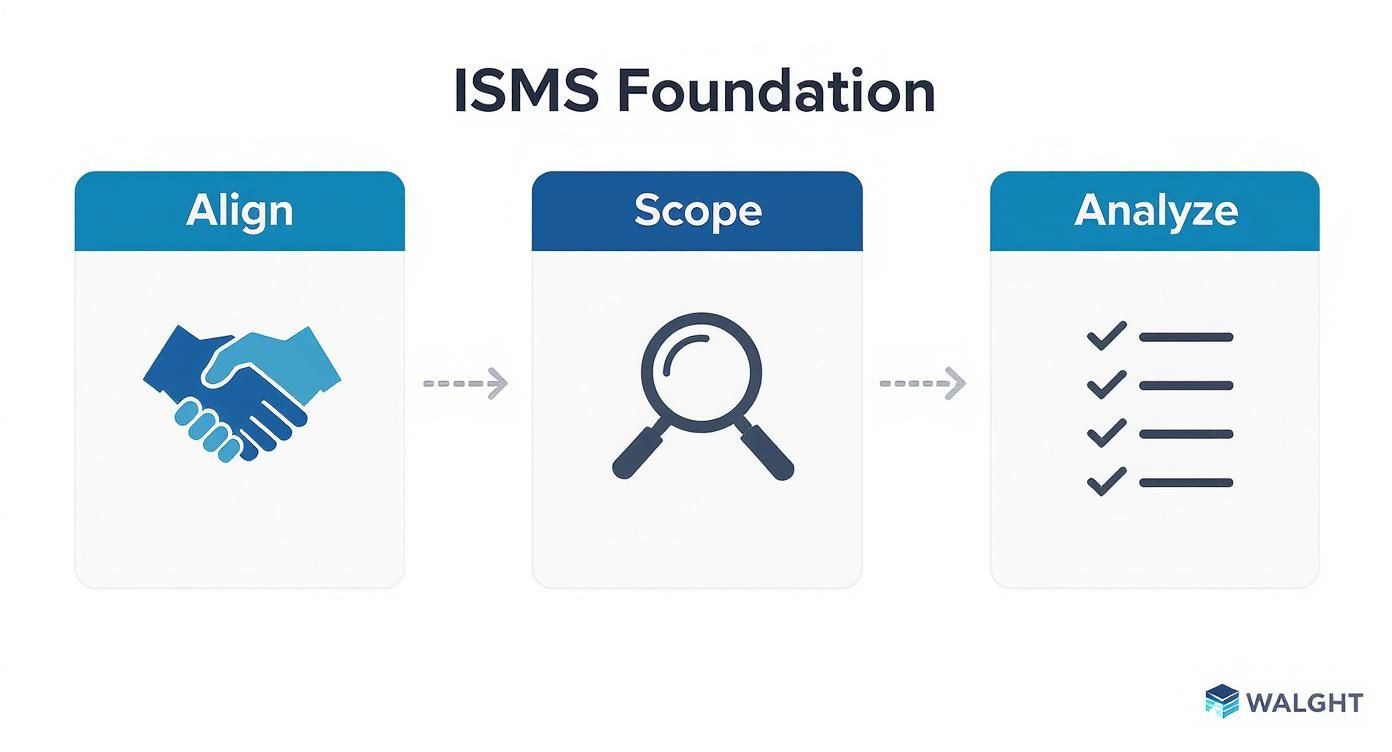
Think of this as a sequence. Each step feeds into the next, creating a logical path to a robust and effective security framework.
Crafting Your Core Security Policies
First up, you need an Information Security Policy. Consider this the constitution for your entire ISMS. It's the high-level document, signed off by senior management, that declares your company's commitment to protecting its information. It’s what sets the tone for everything else.
This isn’t the place for a 50-page technical manual. Keep it clear and concise. The goal is to state your intentions plainly, outlining key objectives like protecting customer data, ensuring your services stay online, and maintaining the integrity of business records.
From this main policy, you'll branch out into more specific, detailed documents. These are the ones that guide day-to-day activities.
- Acceptable Use Policy: This tells your team what they can and can’t do with company tech and data.
- Access Control Policy: Here you’ll define who gets access to what, and how that access is managed and reviewed.
- Incident Response Plan: This lays out the exact steps to follow when—not if—a security incident happens.
These supporting documents are where your high-level commitment becomes practical, giving your people clear rules to follow.
Executing a Meaningful Risk Assessment
The risk assessment is the real engine of your ISMS. This is where you stop guessing and start methodically identifying the genuine threats and weaknesses that affect the assets you’ve scoped. A huge mistake I see people make is keeping this process too abstract.
For the assessment to be worthwhile, it has to be grounded in your specific business reality. A fintech in Sydney might be most worried about a sophisticated phishing attack leading to the theft of client financial data. A logistics firm in Melbourne, on the other hand, might see a ransomware attack on its warehouse management system as the biggest threat, as it would grind their entire operation to a halt.
Follow a structured process:
- Identify Information Assets: List what matters within your scope—your customer database, payment gateways, source code, etc.
- Identify Threats: What could actually happen? Think malware, unauthorised access, hardware failure, or even just simple human error.
- Identify Vulnerabilities: What weaknesses could a threat exploit? This could be anything from unpatched servers to a lack of security awareness training.
- Analyse and Evaluate Risk: Look at each threat-vulnerability pairing and estimate the likelihood of it happening and the potential business impact. This is how you figure out what to tackle first.
This exercise leaves you with a prioritised list of risks, which you can then decide how to address.
The point of a risk assessment isn't to get to zero risk—that’s a fantasy. It's about making informed decisions. You’re choosing which risks to accept, which to reduce, and which to avoid, all based on your company’s unique appetite for risk.
This approach ensures you’re spending your time, money, and energy protecting what truly matters, instead of trying to secure everything equally.
The Crucial Statement of Applicability
After your risk assessment, you’ll have a clear picture of your biggest risks. The next step is deciding what to do about them. This brings us to one of the most vital documents in your ISO 27001 certification journey: the Statement of Applicability (SoA).
The SoA is your security action plan. It takes the 93 controls from ISO 27001’s Annex A and, for each one, makes you document three things:
- Is this control applicable to us?
- Have we implemented it?
- Why did we make that decision?
For instance, if you’re a fully remote business with no physical office, you’d mark controls about physical building security as 'not applicable'. The justification is simple: "The organisation has no physical premises in scope."
On the flip side, for a control like A.5.15 (Access control), you’d mark it as applicable, confirm you’ve implemented it via your Access Control Policy and MFA, and point to that documentation as evidence.
The SoA becomes the go-to document for your team and your external auditor. It’s a clean, transparent snapshot of your security controls, showing that you’ve thoughtfully considered every requirement in relation to your specific risks. As you build out your ISMS, you’ll naturally start looking at specific safeguards. For example, implementing robust technical controls like preventing DNS leaks is a perfect technical measure you’d detail in your SoA to address certain network security risks.
Nailing these core components—your policies, risk assessment, and SoA—gives you the strong, auditable foundation your ISMS needs. This isn’t just about passing an audit; it’s about creating a resilient security program that can grow and adapt right alongside your business.
Embedding Security Into Your Company Culture
You’ve built a brilliant Information Security Management System (ISMS). The documentation is pristine, your risk assessment is watertight, and the Statement of Applicability is a thing of beauty. But let’s be real for a moment—none of it means a thing if it just sits on a server gathering digital dust.
The true test of your ISO 27001 certification journey is making security a living, breathing part of your company. This is where policies and controls jump off the page and into the daily habits of your team. It's about shifting from a theoretical framework to an operational reality where everyone, from the CEO down, knows their part in protecting the organisation’s information.
Without this cultural shift, even the most perfectly designed ISMS is destined to fail. It’s the human element that makes or breaks your security posture. This phase is all about winning hearts and minds to build a resilient, security-first organisation from the ground up.
Bringing Your Annex A Controls to Life
Putting your chosen Annex A controls into practice is a serious undertaking that will touch every corner of your business. This isn't just an IT project; it’s a company-wide effort that requires collaboration across all departments to ensure the controls are both effective and practical.
Take a new access control policy (A.5.15), for example. It's not just about flicking a switch in some software. It means sitting down with HR to clearly define roles and permissions, training managers on the right way to request and approve access, and having a rock-solid process for revoking access the moment an employee leaves.
The same goes for your incident response plan (A.5.26). A document alone won't save you. You need to run tabletop exercises with your legal, comms, and tech teams to make sure everyone knows exactly what to do when a breach hits. The real goal is to weave these security practices so seamlessly into the daily workflow that they become second nature.
Your controls should feel like guardrails, not roadblocks. When implemented thoughtfully, they make the secure way of working the easiest and most intuitive way of working for your employees.
This practical application is where you see the real return on your investment. It’s where you start to slash human error and build a genuinely more resilient operation, one control at a time.
Designing Security Awareness Training That Actually Sticks
Let’s be honest: most security training is a snooze-fest. It’s often seen as a compliance chore that employees click through as fast as they can. To truly bake a security mindset into your culture, you have to do better than the standard, tick-a-box approach.
Effective training isn’t a one-off event; it’s an ongoing program. Forget the annual slideshow presentation. Think more like a multi-faceted campaign that reinforces key messages in different ways all year round.
Here are a few techniques I’ve seen work wonders:
- Make it a game: Use leaderboards, quizzes, and even small prizes to make learning about security fun and competitive. A simple monthly phishing quiz with a gift card for the sharpest department can do more for engagement than a two-hour lecture.
- Use real-world scenarios: Ditch the generic examples. Create training that reflects what your team actually does. For the sales team, that might be a phishing simulation disguised as a hot new lead. For finance, an urgent but fraudulent invoice request.
- Deliver bite-sized lessons: People are busy. Deliver your training in small, digestible chunks. Short, two-minute videos, quick-read emails, or an infographic are far more likely to be absorbed.
The aim is to make security personal. When people understand why a policy exists and see how it helps them in their specific role, you start to see real, lasting behaviour change.
Cultivating a Security-First Mindset
Changing your company’s culture is easily the toughest part of the ISO 27001 process. It's also the most rewarding. A genuine security-first mindset means protecting information becomes a shared responsibility, not just "the IT guy's job."
This has to be driven from the top. When your leadership team actively joins in on training, talks about security in company-wide meetings, and leads by example, it sends a powerful message that this stuff matters.
To really get this going, try these strategies:
- Appoint Security Champions: Find those enthusiastic people in different departments who 'get it' and empower them to be security advocates. They can help answer questions, promote good habits, and give you priceless feedback from the trenches.
- Bake it into Onboarding: Make security awareness a core part of your new-hire process from day one. This sets the expectation immediately that security is fundamental to their job, no matter the role.
- Celebrate the Wins: When someone spots a clever phishing email and reports it, shout it from the rooftops! Publicly acknowledging their contribution encourages everyone to be more proactive and shows that vigilance is valued.
Ultimately, building this culture is everything. In 2025, ISO 27001 certification is a key commercial advantage in the Australian market, crucial for winning government tenders and major corporate contracts. All certified organisations must transition to the updated ISO 27001:2022 standard by 31 October 2025, or they risk losing their certification—and the business that comes with it.
The Human Factor Is Your Strongest Defence
While technology gives you essential tools, your people are the real frontline of your information security. A well-trained, security-aware team can spot threats that automated systems will always miss. They are your human firewall.
Investing in your team's security education isn’t just an ISO 27001 requirement; it’s one of the highest-impact security investments you can possibly make. It turns your workforce from a potential weakness into your greatest strength.
By empowering every single employee with the knowledge and motivation to act securely, you build a truly resilient organisation ready to face a world of ever-evolving threats. For more detailed approaches, check out our guide on the human factor in information security and employee training strategies.
Getting Through Your Internal and External Audits

Let's be honest, the word "audit" can make anyone a bit nervous. But it's time to shift that mindset. The audits for your ISO 27001 certification aren't about finding fault or catching you out. Think of them as a final validation—a collaborative check-in to confirm all the hard work you've poured into building a rock-solid Information Security Management System (ISMS).
This is your chance to get an expert, third-party seal of approval on your systems, documentation, and team alignment. A well-prepared audit is a smooth audit, so let’s walk through how to tackle both the internal and external audits with confidence.
The Internal Audit: Your Crucial Dress Rehearsal
Before an external certification body even sets foot in your door, you need to run a comprehensive internal audit. Seriously, don't skip this or rush it. It's the final dress rehearsal before opening night. The goal is to examine your ISMS with the same critical eye an external auditor would, letting you find and fix any gaps in a low-stakes environment.
A thorough internal audit gives you a massive advantage and dramatically increases your chances of passing the real thing. It’s your opportunity to kick the tyres, test your procedures, and make sure your documentation actually matches what your team does day-to-day.
You've got a couple of options for getting it done:
- Your own people: You can train up members of your team to be internal auditors. The only catch is they must be completely independent of the department they're auditing to keep things objective.
- An outside expert: Bringing in a consultant can provide a fresh pair of eyes. They have no prior history with your ISMS, so their perspective is entirely unbiased.
No matter which way you go, the objective is the same: find any non-conformities or areas for improvement before the main event.
What Does the Internal Auditor Look For?
The internal audit is basically a mirror of the external one. The auditor will dig into your documentation, talk to your key people, and look for hard evidence that your security controls are working as intended. They're really just checking that you're "doing what you say you're doing."
For example, if your Access Control Policy says all user permissions are reviewed quarterly, the auditor will ask to see the records. They'll want proof of who did the review, when it happened, and what was done about it. If you can't produce that evidence, it gets flagged as a non-conformity.
The internal audit is your best confidence-building tool. Every issue you uncover and resolve now is one less surprise during the certification audit. It’s all about proactive improvement, not last-minute panic.
After the audit, you'll get a detailed report of the findings. This becomes your to-do list. You’ll need to put corrective actions in place to fix any non-conformities, making sure to document every single step you take. This paper trail is vital evidence for the external auditor.
Demystifying the External Certification Audit
Once you’ve aced your internal audit and closed out all the corrective actions, you're ready for the big one. The external certification audit is the formal process run by an accredited body that, if all goes well, results in your ISO 27001 certification. It’s usually split into two parts.
Stage 1 Audit: The Documentation Review
The first stage is mostly a "desktop audit." The external auditor pores over your ISMS documentation to make sure it ticks all the boxes required by the ISO 27001 standard. They're just confirming you have all the necessary policies, procedures, and records on paper.
They'll pay close attention to key documents like:
- Your ISMS Scope document
- The overarching Information Security Policy
- Your Risk Assessment and Risk Treatment Plan
- The Statement of Applicability (SoA)
- Evidence of your internal audit and management review meetings
At this point, the auditor is checking for completeness and compliance. They want to be sure your ISMS is well-designed on paper before they come on-site. You'll get a report from this stage highlighting any issues you need to fix before moving on.
Stage 2 Audit: The Implementation Audit
Stage 2 is the main event. This is when the auditor comes to your premises (or dials in remotely) to see your ISMS in action. They need to verify it's not just a nice set of documents but a fully functioning system embedded in your business. This is a far more hands-on process.
The auditor will interview a range of your staff—from the C-suite to the front line—to see if they understand and follow the security policies. They'll ask for practical evidence that controls are working. For instance, they might ask a developer how they secure test data or have an HR team member walk them through the security steps for onboarding a new employee.
They're looking for proof that security is part of your company culture. For a deeper dive into what to expect from start to finish, you can learn more about the complete ISO 27001 audit process and auditor expectations.
Passing this stage shows your ISMS is a living, breathing part of your organisation. Once you get through it, the auditor will officially recommend you for certification.
Keeping Your ISMS Alive: Maintenance and Continuous Improvement
Popping the champagne for your ISO 27001 certification is a fantastic feeling, but it’s important to see it for what it truly is: the starting line, not the finish. The real power of ISO 27001 isn't in the piece of paper; it’s in creating a living, breathing framework for security resilience. Your certificate proves you met the standard on a specific day, but maintaining it shows that security is baked into your company culture for the long haul.
The threat landscape certainly doesn't stand still. New tech pops up, business goals pivot, and cyber attackers are always dreaming up new ways to cause trouble. This is where the real work begins—maintaining and constantly improving your system to ensure your security posture evolves just as fast.
The Rhythm of Surveillance Audits
Your certification is valid for three years, but that doesn't mean you can just set it and forget it. To make sure you’re staying compliant, your certification body will pop in for periodic surveillance audits, usually once a year. Think of them as mini-audits or scheduled health checks for your ISMS.
During these visits, the auditor won't go through everything again. Instead, they’ll sample a selection of your controls, check that your documentation is up-to-date, and confirm you’ve sorted out any minor non-conformities from previous audits. These regular check-ins are designed to keep you on the straight and narrow, stopping those great security habits from slowly fading away over time.
Living by the Plan-Do-Check-Act Cycle
The whole ISO 27001 standard is built around a simple but incredibly powerful concept: the Plan-Do-Check-Act (PDCA) cycle. This is the engine that drives continuous improvement, turning your ISMS from a static pile of documents into a dynamic system that learns and adapts.
Here’s what that looks like in the real world:
- Plan: You spot an area for improvement. Maybe an internal audit flagged something, you’ve identified a new risk, or you’ve received some feedback from the team. You then map out a plan for the changes needed.
- Do: Time to put the plan into action. This could be anything from updating a policy and rolling out new security software to running some targeted training for a specific department.
- Check: Now, did it work? You need to measure the results. You’ll monitor performance metrics and gather data to see if your actions genuinely improved your security.
- Act: Based on what you learned in the "Check" phase, you make a decision. If the change was a success, you standardise it and bake it into your ISMS. If it didn't hit the mark, it's back to the "Plan" phase to try a different approach.
This isn’t a one-and-done deal. It’s a continuous loop that ensures your ISMS is constantly being refined, optimised, and made stronger.
Making Management Reviews Count
A huge part of the "Check" phase is the management review. This isn’t just another meeting to cram into the calendar; it's a formal, structured process where your senior leadership team gets together to properly assess how the ISMS is performing. The standard is quite clear that these reviews have to happen at planned intervals.
The agenda for this meeting is everything. To be effective, it needs to cover some specific ground:
- Findings from internal and external audits.
- Feedback from clients, regulators, and other key stakeholders.
- Hard data from your security monitoring tools.
- The status of fixes for previous issues.
- Any shifts in the risk landscape or the wider business context.
The management review is your number one tool for accountability. It forces information security to remain a top-level priority and ensures the ISMS stays aligned with the organisation's strategic direction.
What comes out of this meeting is just as critical. It should result in documented decisions about any necessary changes to the ISMS and solid commitments for the resources needed to make them happen. This formal process closes the loop, turning valuable insights into concrete, actionable improvements.
Tracking Metrics That Actually Matter
You can't improve what you don't measure. But tracking vanity metrics that just look good on a chart is a complete waste of time. Your key performance indicators (KPIs) need to be directly linked to your information security objectives.
Let's say one of your objectives is to reduce security incidents caused by human error. Your KPIs might then include things like:
- The number of staff who correctly report phishing emails.
- The average score on security awareness training quizzes.
- A measurable drop in incidents traced back to user mistakes.
By focusing on meaningful metrics, you get out of the guessing game. You have solid data telling you what's working and what isn’t, allowing you to make evidence-based decisions on where to invest your time and budget for the biggest impact. This sustained effort is what turns security from a cost centre into a real competitive advantage.
This focus on continuous improvement isn’t just an Australian trend; it’s a global movement. The worldwide market for ISO 27001 certification is projected to explode from USD 18.59 billion in 2025 to an incredible USD 74.56 billion by 2035. While North America and Europe lead the pack for now, the Asia-Pacific region, including Australia, is a major growth engine, making up around 25% of the market. This surge is being driven by rising cyber threats and proactive government policies. You can dig deeper into these market trends and their business implications on businessresearchinsights.com.
Your Top ISO 27001 Certification Questions, Answered
If you're looking at ISO 27001, you've probably got a few questions. It’s a big undertaking, and it’s smart to get clarity before you dive in. We hear the same questions from business leaders across Australia, so let’s tackle the most common ones head-on.
How Long Does Certification Take for a Small to Medium Business?
For a typical Australian SME, you’re generally looking at a six to twelve-month journey from start to finish. I know that’s a wide range, but the final timeline really depends on a few things.
How complex is your business? What’s the scope of your Information Security Management System (ISMS)? And critically, how much time can your internal team realistically commit to the project?
If you have solid buy-in from management and a dedicated team driving it, you can definitely hit the six-month mark. This covers everything—the initial gap analysis, risk assessments, putting controls in place, running your internal audits, and getting through the final two-stage external audit.
What Are the Main Costs Involved?
Budgeting for ISO 27001 means looking beyond just the final certificate fee. The total investment breaks down into a few different buckets. If you want a full rundown on what the certification itself entails, this is a great resource on What is ISO 27001 certification.
Here’s where your money will likely go:
- External Fees: These are the non-negotiables paid to your chosen certification body. It covers their time for the Stage 1 and Stage 2 audits, plus the annual surveillance audits required to keep your certification active.
- Implementation Costs: This is what you spend to close any security gaps. It could be new software, hardware upgrades to meet specific controls, or specialised training for your staff.
- Internal Resource Costs: Don’t forget the value of your team’s time! The hours your people spend building, documenting, and managing the ISMS are a real cost to the business.
Many businesses also choose to bring in a consultant. While it's an extra line item, an experienced hand can save you a lot of time and help you sidestep common, expensive mistakes.
Can We Actually Fail the ISO 27001 Audit?
This is a big fear for many, but the audit process isn't really a pass/fail exam in the way you might think. It’s more collaborative. An auditor's job is to find any 'non-conformities'—areas where you don't quite meet the standard.
A non-conformity isn't a failure; it's an opportunity for improvement. Auditors aim to help you strengthen your ISMS, not to catch you out.
They'll classify findings as either 'Major' or 'Minor'. A Major Non-conformity is a serious gap, like completely missing a mandatory part of the standard. You'll need to fix this before they can issue a certificate. For Minor Non-conformities, you’ll usually just need to show them a solid plan for how you're going to fix it.
Honestly, because any well-prepared company will have already done a thorough internal audit, a complete "failure" at the final stage is incredibly rare.
At Anitech, we guide Australian businesses through this entire process every day. Our expert consultants take the guesswork out of it, helping you achieve certification efficiently while building a security framework that actually works for you. To see how we can give your business a competitive edge, visit us at https://iso-27001.com.au.
Recent Comments